
Market Overview:
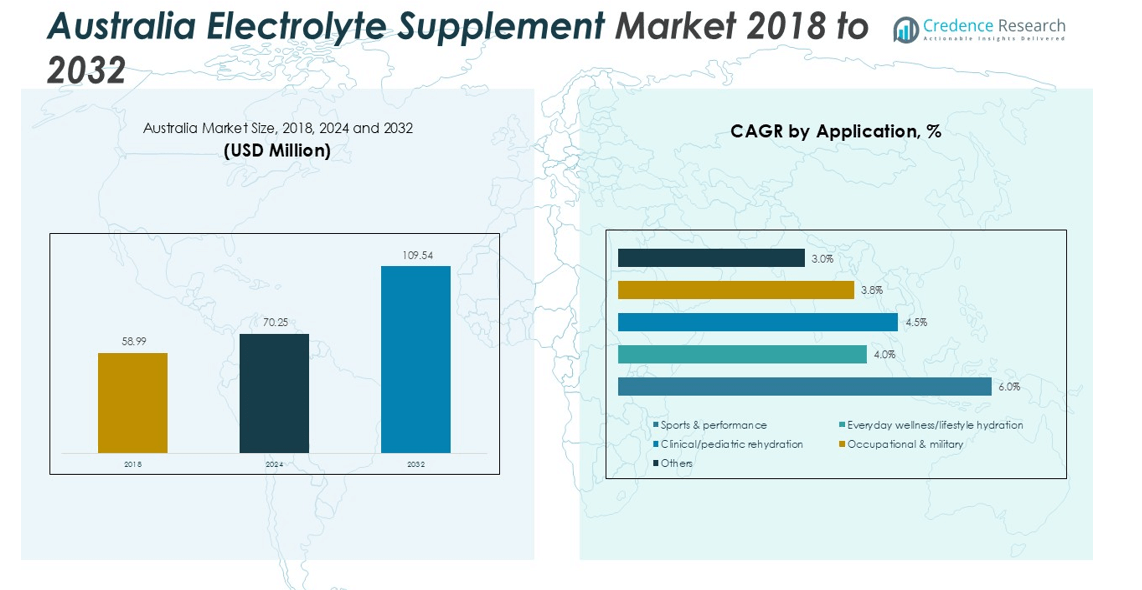
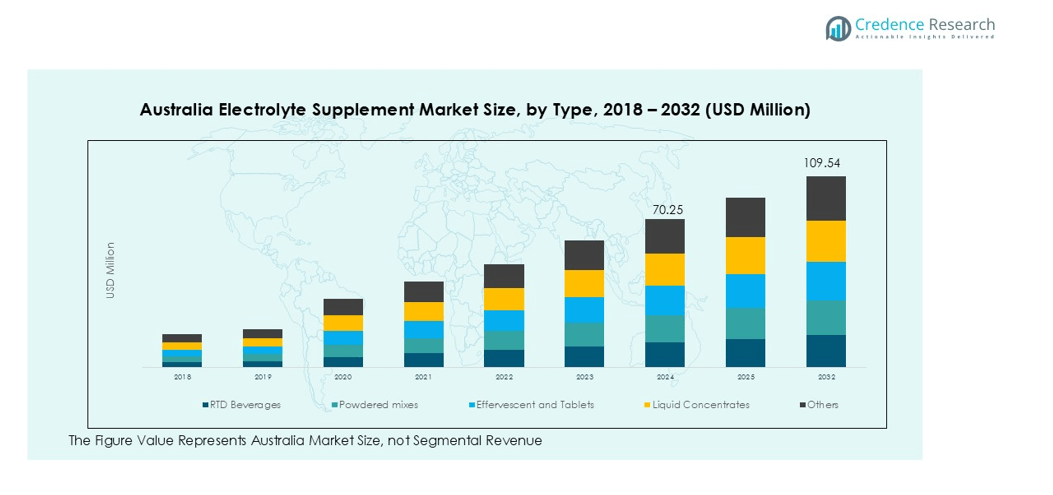
The Australia Electrolyte Supplement size was valued at USD 58.99 million in 2018 to USD 70.25 million in 2024 and is anticipated to reach USD 109.54 million by 2032, at a CAGR of 5.71% during the forecast period.
| REPORT ATTRIBUTE | DETAILS |
|---|---|
| Historical Period | 2020-2023 |
| Base Year | 2024 |
| Forecast Period | 2025-2032 |
| Australia Electrolyte Supplement Market Size 2024 | USD 70.25 million |
| Australia Electrolyte Supplement Market, CAGR | 5.71% |
| Australia Electrolyte Supplement Market Size 2032 | USD 109.54 million |
The key drivers of this market include the growing prevalence of dehydration-related issues, especially in warmer climates, and the increasing popularity of sports and fitness supplements. The rising consumer demand for products that aid in hydration, energy replenishment, and muscle recovery during physical exertion is a significant factor. Moreover, the availability of a wide variety of electrolyte supplements, including powders, drinks, and tablets, has fueled their adoption.
In terms of regional analysis, New South Wales and Victoria are the leading regions in terms of market share, driven by their large urban populations and high levels of sports and fitness participation. Additionally, the growing presence of major supplement manufacturers in these regions has enhanced the availability and accessibility of electrolyte supplements. As the market expands, other regions such as Queensland are expected to experience a surge in demand for these products.
Market Insights:
- The Australia Electrolyte Supplement Market was valued at USD 58.99 million in 2018, expected to grow to USD 70.25 million by 2024, and reach USD 109.54 million by 2032, at a CAGR of 5.71%.
- New South Wales and Victoria dominate the market, accounting for 50% of the total share, driven by urban populations and sports participation.
- Queensland holds a 25% market share, fueled by its warm climate and high levels of outdoor sports participation.
- The increasing awareness of hydration's importance is driving demand for electrolyte supplements, especially in warmer regions like Queensland.
- The rising participation in fitness and sports activities, including gym memberships and outdoor events, is contributing to the growing demand for electrolyte supplements.
- Queensland’s health-conscious trends and active population further fuel the surge in demand, aligning with climate-related needs for hydration products.
- Technological advancements, such as sugar-free and organic options, are enhancing the accessibility and effectiveness of electrolyte supplements in meeting diverse consumer needs.
Market Drivers:
Growing Awareness of Hydration and Wellness
The increasing focus on hydration and overall wellness is a major driver for the Australia Electrolyte Supplement Market. More consumers are recognizing the importance of maintaining proper hydration for optimal health and performance. This growing awareness is not only seen in athletes but also in the general population. The market sees higher demand for products that promote effective hydration, particularly in warmer regions where dehydration risks are higher. This trend reflects the broader shift towards health-conscious living in Australia.
Rising Participation in Sports and Fitness Activities
The growing interest in sports and fitness activities is a significant factor contributing to the demand for electrolyte supplements in Australia. Both professional athletes and fitness enthusiasts require supplements to maintain energy levels, enhance performance, and aid in recovery. The surge in gym memberships, outdoor sports, and marathon events increases the need for products that replenish electrolytes lost through sweat. This active lifestyle trend drives growth in the Australia Electrolyte Supplement Market, with an expanding consumer base looking for hydration solutions.
- For instance, in April 2024, Vitaco Health launched ATHENA Sports Nutrition, a range designed for the specific biological needs of female athletes and fortified with 4 key supplements including iron, collagen, calcium, and electrolytes.
Impact of Extreme Weather Conditions on Health
Australia’s hot climate exacerbates dehydration concerns, particularly during the summer months. High temperatures lead to increased sweating, which in turn depletes electrolytes necessary for bodily functions. Electrolyte supplements provide a convenient solution to restore these essential minerals, ensuring proper muscle function and reducing the risk of heat-related illnesses. The growing prevalence of heatwaves across the country drives higher demand for these products, particularly in areas like New South Wales and Queensland.
- For instance, Fixx Nutrition formulated its Fuel X Pro endurance drink mix to combat dehydration in warm climates by including 4 key electrolytes, with a single serving containing 468mg of sodium to replenish minerals lost through sweat.
Technological Advancements in Product Offerings
Ongoing innovation in electrolyte supplement formulations and delivery methods is another key driver of the market. Manufacturers are introducing new, more effective products that cater to various consumer needs, including sugar-free, organic, and vegan options. These advancements offer improved absorption and faster hydration, meeting the demands of health-conscious individuals. The expansion of retail and online channels also increases accessibility, further fueling growth in the Australia Electrolyte Supplement Market.
Market Trends:
Shift Towards Natural and Clean Label Products
A notable trend in the Australia Electrolyte Supplement Market is the growing consumer preference for natural and clean label products. Consumers are becoming more conscious about the ingredients in their supplements, demanding options that are free from artificial additives, preservatives, and excessive sugars. This shift is driven by the desire for healthier alternatives that align with the clean eating movement. Manufacturers are responding by developing products with organic, non-GMO, and plant-based ingredients. The market now features electrolyte supplements that cater to dietary restrictions, such as gluten-free, dairy-free, and vegan formulations. This trend not only meets consumer preferences but also boosts brand loyalty among health-conscious buyers.
- For instance, Australian brand Sodii has successfully developed a clean-label electrolyte powder that features salt sourced from an ancient 5-million-year-old lake in Western Australia, Each serving provides a precise dose of 1000mg of sodium, catering to health-conscious consumers seeking natural hydration.
Rise in Functional Beverages and On-the-Go Solutions
Functional beverages are increasingly popular in the Australia Electrolyte Supplement Market, particularly in the form of ready-to-drink (RTD) products and single-serving sachets. The convenience of portable, ready-to-consume electrolyte drinks aligns with the fast-paced lifestyle of Australian consumers. These products are marketed as quick hydration solutions that can be consumed during exercise or throughout the day. RTD beverages, such as electrolyte-infused waters and sports drinks, continue to grow in demand as they provide convenience without compromising on health benefits. The rise of these on-the-go solutions reflects the broader trend toward easy, functional products that support active and health-focused lifestyles in Australia.
- For instance, Dr. Hydrate has capitalized on this trend by offering single-serving sachets that are HASTA-certified, meaning each batch is tested for over 250 banned substances.
Market Challenges Analysis:
Competition from Alternative Hydration Solutions
The Australia Electrolyte Supplement Market faces significant competition from alternative hydration solutions, such as coconut water, fruit juices, and other natural beverages. These alternatives are often perceived as healthier or more natural, which appeals to a large segment of the population. Many consumers prefer these options due to their perceived nutritional benefits and minimal processing. This competition challenges the growth of electrolyte supplements, especially as these alternative solutions are marketed as providing similar hydration benefits without the added sugars or synthetic ingredients often found in commercial electrolyte products.
Price Sensitivity and Consumer Perception
Price sensitivity remains a challenge in the Australia Electrolyte Supplement Market. While many consumers seek premium hydration products, some may hesitate due to higher price points associated with high-quality or specialized formulations. The perception that electrolyte supplements are unnecessary for the average person further hinders market growth. For price-conscious consumers, the added cost of these supplements can be a barrier, especially when lower-cost alternatives are readily available. This dynamic complicates efforts to expand the market beyond fitness enthusiasts and athletes to a broader consumer base.
Market Opportunities:
Expansion of Product Variants for Diverse Consumer Needs
The Australia Electrolyte Supplement Market presents significant opportunities for manufacturers to expand their product range to cater to diverse consumer preferences. With an increasing demand for products free from artificial additives, there is a growing opportunity for clean-label, organic, and vegan electrolyte supplements. Introducing options tailored to specific health needs, such as low-sodium or sugar-free variants, can help manufacturers appeal to a broader audience. Customizing products for various lifestyles, including supplements aimed at seniors, athletes, or health-conscious individuals, can further drive market growth. Such diversification can position brands as leaders in addressing unique consumer demands for healthier, functional hydration.
Growth in E-commerce and Digital Platforms
The rise of e-commerce offers significant growth potential for the Australia Electrolyte Supplement Market. Online shopping provides convenient access to a wide variety of products, allowing consumers to easily compare and purchase electrolyte supplements. As more Australian consumers turn to digital platforms for their purchasing decisions, the market for online retail of health supplements is expanding. E-commerce platforms enable targeted marketing strategies and personalized offers, allowing brands to reach niche segments more effectively. This shift in consumer behavior towards online shopping presents a valuable opportunity for companies to enhance their digital presence and increase market share.
Market Segmentation Analysis:
By Type
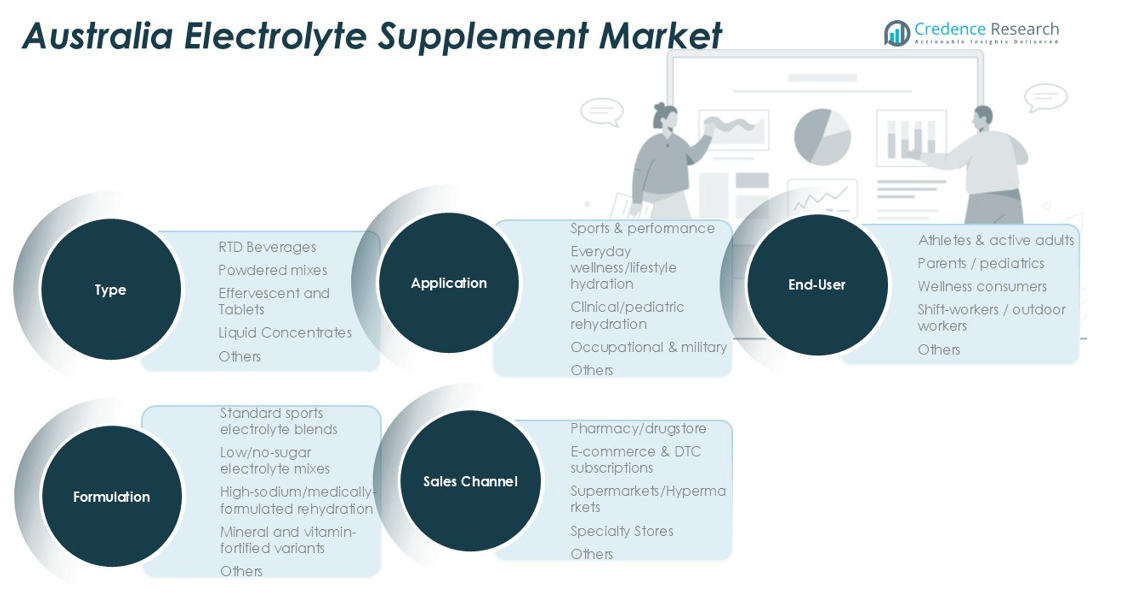
The Australia Electrolyte Supplement Market is segmented into RTD beverages, powdered mixes, effervescent tablets, liquid concentrates, and others. RTD beverages dominate the market due to their convenience and ease of use, particularly among athletes and active consumers. Powdered mixes and effervescent tablets are also gaining traction for their flexibility and portability. Liquid concentrates, while less popular, cater to niche markets that require concentrated hydration solutions. Each type of supplement is tailored to different consumer needs, from on-the-go hydration to more specialized formulations.
- For instance, the Emergen-C brand offers an effervescent powder drink mix that delivers key nutrients to the body. Each serving provides 1,000 mg of Vitamin C to support the immune system.
By Application
In the application segment, the Australia Electrolyte Supplement Market is divided into sports & performance, everyday wellness/lifestyle hydration, clinical/pediatric rehydration, and occupational & military. Sports & performance accounts for the largest share, driven by the increasing number of fitness enthusiasts and athletes. Everyday wellness and lifestyle hydration is also growing as more people prioritize hydration for general well-being. Clinical and pediatric rehydration supplements address specific health needs, while occupational & military applications cater to individuals in high-risk dehydration environments, such as outdoor workers and armed forces.
By End-User
The end-user segment includes athletes & active adults, parents/pediatrics, wellness consumers, and shift-workers/outdoor workers. Athletes & active adults are the primary consumers, driven by their need for enhanced performance and recovery. Wellness consumers focus on hydration for daily health maintenance. Parents/pediatrics require hydration solutions for children, particularly in hot climates. Shift-workers and outdoor workers benefit from electrolyte supplements to combat dehydration during long hours in physically demanding jobs. Each group has unique needs, fostering demand for targeted products.
- For instance, the Australian brand Hydralyte offers products specifically for pediatric use that are formulated to replace lost electrolytes and fluids. Their electrolyte powder contains 160mg of potassium per 200mL serving to aid in rehydration.
Segmentations:
By Type:- RTD Beverages
- Powdered Mixes
- Effervescent and Tablets
- Liquid Concentrates
- Others
- Sports & Performance
- Everyday Wellness/Lifestyle Hydration
- Clinical/Pediatric Rehydration
- Occupational & Military
- Others
- Athletes & Active Adults
- Parents/Pediatrics
- Wellness Consumers
- Shift-Workers/Outdoor Workers
- Others
- Standard Sports Electrolyte Blends
- Low/No-Sugar Electrolyte Mixes
- High-Sodium/Medically-Formulated Rehydration
- Mineral and Vitamin-Fortified Variants
- Others
- Pharmacy/Drugstore
- E-commerce & DTC Subscriptions
- Supermarkets/Hypermarkets
- Specialty Stores
- Others
Regional Analysis:
New South Wales and Victoria: Dominating the Electrolyte Supplement Market
New South Wales and Victoria account for 50% of the Australia Electrolyte Supplement Market, driven by large urban populations and high sports participation. Cities like Sydney and Melbourne contribute significantly to the demand for electrolyte supplements, with health-conscious individuals and fitness enthusiasts fueling market growth. These regions also host major sports events, boosting the need for hydration products. The prevalence of fitness culture and outdoor activities further strengthens the demand for electrolyte supplements, solidifying these areas as the primary markets for such products.
Queensland: Growing Demand Driven by Climate and Sports Engagement
Queensland holds a 25% share of the Australia Electrolyte Supplement Market, with its warm climate and high levels of sports engagement contributing to increased demand for hydration solutions. The state's outdoor sports, such as surfing and rugby, significantly influence the need for electrolyte supplements to support performance and recovery. Queensland’s active population, coupled with the health-conscious trends, positions the state as a strong growth region. The climate-related demand for hydration products is expected to continue driving market expansion across the state.
Western Australia and South Australia: Emerging Markets with Potential
Western Australia and South Australia collectively account for 25% of the Australia Electrolyte Supplement Market. These regions, while smaller in population compared to the eastern states, are seeing a rise in health and fitness trends, which is driving the demand for electrolyte supplements. Western Australia’s active outdoor lifestyle, with hiking and cycling, supports the growth of the market, while South Australia’s increasing wellness focus offers additional opportunities for product growth. Both regions represent key areas for future expansion.
Key Player Analysis:
- PepsiCo
- The Coca-Cola Company
- Abbott Laboratories
- Nestlé S.A.
- Unilever PLC
- GlaxoSmithKline plc
- Otsuka Pharmaceutical Co., Ltd.
- GU Energy Labs
- Skratch Labs
- Ultima Health Products
- Hammer Nutrition
- SOS Hydration Inc.
Competitive Analysis:
The Australia Electrolyte Supplement Market is highly competitive, with both global giants and local players fighting for market share. Major multinational brands like PepsiCo's Gatorade and Coca-Cola's Powerade lead the market, benefiting from strong brand recognition and wide distribution networks. Local brands, such as Hydralyte and VOOST, are carving out niches by offering products tailored to Australian preferences, focusing on convenience and effectiveness. Emerging players like Unilever’s Liquid I.V. are gaining ground by targeting health-conscious consumers with clean-label and sugar-free options. Competition is driven by product innovation, digital marketing strategies, and a growing consumer demand for functional hydration solutions, with brands increasingly focusing on natural and low-sugar formulations to attract health-focused buyers. This dynamic market environment encourages continuous product development and strategic partnerships to enhance market positioning.
Recent Developments:
- In July 2025, PepsiCo launched its first-ever prebiotic cola, Pepsi Prebiotic Cola, which contains prebiotic fiber and comes in "Original Cola" and "Cherry Vanilla" flavors.
- In January 2025, The Coca-Cola Company announced its agreement to acquire Billson’s, an Australian brand of premium alcohol ready-to-drink products, with the acquisition expected to close by the end of the month.
Report Coverage:
The research report offers an in-depth analysis based on Type, Application, End-User, Formulation, Sales Channel. It details leading market players, providing an overview of their business, product offerings, investments, revenue streams, and key applications. Additionally, the report includes insights into the competitive environment, SWOT analysis, current market trends, as well as the primary drivers and constraints. Furthermore, it discusses various factors that have driven market expansion in recent years. The report also explores market dynamics, regulatory scenarios, and technological advancements that are shaping the industry. It assesses the impact of external factors and global economic changes on market growth. Lastly, it provides strategic recommendations for new entrants and established companies to navigate the complexities of the market.
Future Outlook:
- The demand for electrolyte supplements in Australia will continue to grow as health-conscious consumers prioritize hydration for overall wellness.
- Sports and fitness activities will remain a key driver, with an increasing number of Australians engaging in outdoor and indoor sports.
- There will be a shift towards natural, organic, and sugar-free electrolyte products as consumers become more mindful of ingredient labels.
- The rise of e-commerce and direct-to-consumer (DTC) subscriptions will enhance product accessibility, especially in remote areas.
- The growing popularity of fitness influencers and online health communities will further fuel the demand for electrolyte supplements.
- Clinical and pediatric rehydration solutions will see growth due to heightened awareness of hydration in health management for children and vulnerable groups.
- Outdoor workers and shift workers will drive the need for targeted electrolyte products tailored to high-risk dehydration environments.
- Technological advancements in supplement formulations will offer more effective and quicker hydration, meeting diverse consumer preferences.
- Major brands will continue to expand their presence in Australia, with a focus on personalized hydration solutions for various consumer needs.
- Increased awareness of extreme weather conditions and their impact on hydration will continue to propel the market, especially in regions like Queensland.

Request a Free Sample
Fill in your details and we'll send you a free sample report.
- Sample data tables & charts
- Research methodology
Market Dynamics
Growing Awareness of Hydration and Wellness
Australian consumers are increasingly prioritizing hydration as part of a healthy lifestyle, leading to higher demand for electrolyte supplements not only among athletes but also the general population, especially in warmer regions where dehydration risks are elevated.
Rising Participation in Sports and Fitness Activities
The surge in gym memberships, outdoor sports, and fitness events across Australia is driving demand for electrolyte supplements to support energy, performance, and recovery, particularly among athletes and active adults.
Impact of Extreme Weather Conditions
Australia's hot climate and frequent heatwaves increase the risk of dehydration, making electrolyte supplements essential for maintaining proper hydration and reducing heat-related health risks, especially in states like Queensland and New South Wales.
Technological Advancements and Product Innovation
Manufacturers are introducing sugar-free, organic, and vegan electrolyte supplements, as well as convenient formats like RTD beverages and single-serve sachets, broadening the appeal and accessibility of these products to diverse consumer segments.
Expansion of E-commerce and Digital Platforms
The growth of online retail and direct-to-consumer subscription models is making electrolyte supplements more accessible, allowing brands to reach a wider audience, including those in remote or regional areas, and enabling targeted marketing strategies.
Need a Custom Version of This Report?
Tailor the scope, geography, or segments to your exact requirements.
- Custom geography or segment scope
- Direct access to our analyst team
Frequently Asked Questions
What is the current market size for Australia Electrolyte Supplement, and what is its projected size in 2032?
At what Compound Annual Growth Rate is the Australia Electrolyte Supplement market projected to grow between 2024 and 2032?
Which Australia Electrolyte Supplement market segment held the largest share in 2024?
What are the primary factors fueling the growth of the Australia Electrolyte Supplement market?
Table of Content
Chapter 1 Market Segmentation
- 1.1 Segmentation Framework
- 1.1.1 Product and Service Classification
- 1.1.2 Application and End-Use Classification
- 1.1.3 Technology and Solution Classification
- 1.1.4 Customer and Distribution Channel Classification
- 1.1.5 Geographic Segmentation
- 1.1.6 Market Segment Definitions and Boundaries
- 1.2 By Type
- 1.2.1 RTD Beverages
- 1.2.2 Powdered Mixes
- 1.2.3 Effervescent and Tablets
- 1.2.4 Liquid Concentrates
- 1.2.5 Others
- 1.3 By End-User
- 1.3.1 Athletes & Active Adults
- 1.3.2 Parents/Pediatrics
- 1.3.3 Wellness Consumers
- 1.3.4 Shift-Workers/Outdoor Workers
- 1.3.5 Others
- 1.4 By Application
- 1.4.1 Sports & Performance
- 1.4.2 Everyday Wellness/Lifestyle Hydration
- 1.4.3 Clinical/Pediatric Rehydration
- 1.4.4 Occupational & Military
- 1.4.5 Others
- 1.5 By Sales Channel
- 1.5.1 Pharmacy/Drugstore
- 1.5.2 E-commerce & DTC Subscriptions
- 1.5.3 Supermarkets/Hypermarkets
- 1.5.4 Specialty Stores
- 1.5.5 Others
Chapter 2 Introduction
- 2.1 Report Objectives and Scope
- 2.2 Product Definition and Industry Terminology
- 2.3 Market Inclusions and Exclusions
- 2.4 Research Process
- 2.4.1 Primary Research and Expert Interviews
- 2.4.2 Secondary Research and Source Review
- 2.4.3 Top-Down and Bottom-Up Estimation
- 2.4.4 Data Triangulation and Verification
- 2.5 Market Size Measurement Basis
- 2.5.1 2018: USD 58.99 million → 2032: USD 109.54 million
- 2.6 Historical and Forecast Reference Periods
- 2.6.1 Base Year: 2018
- 2.6.2 Forecast Period: 2018-2032
- 2.7 Research Assumptions and Limitations
Chapter 3 Executive Summary
- 3.1 Market Snapshot and Key Findings
- 3.2 Base-Year Market Size, 2018
- 3.3 Forecast Market Size, 2032
- 3.4 Revenue and Volume Growth Outlook
- 3.5 Key Demand and Supply Indicators
- 3.6 Leading Market Segments
- 3.7 Fastest-Growing Market Opportunities
- 3.8 Regional Performance Highlights
- 3.9 Technology and Industry Transformation
- 3.10 Competitive Landscape Summary
- 3.11 Analyst View and Strategic Implications
Chapter 4 Australia Electrolyte Supplement Market Trends and Developments
- 4.1 Historical Industry Development
- 4.2 Recent Market Trends and Developments
- 4.3 Demand and Customer Behavior Trends
- 4.4 Technology and Product Innovation
- 4.5 Artificial Intelligence, Automation and Digitalization
- 4.6 Local Manufacturing and Supply Chain Realignment
- 4.7 Industry Partnerships, Mergers and Acquisitions
- 4.8 Sustainability and Circular Economy Developments
- 4.9 Government and Private Sector Investment Trends
- 4.10 Emerging Business Models and Commercialization
- 4.11 Industry Developments and Announcements
Chapter 5 Australia Electrolyte Supplement Market Production, Supply and Demand Analysis
- 5.1 Demand Trend and Consumption Analysis
- 5.2 Demand Forecast, 2018-2032
- 5.3 Production and Output Trend
- 5.4 Production and Output Forecast, 2018-2032
- 5.5 Installed Capacity and Capacity Utilization
- 5.6 Company-Wise Production Plants and Statistics
- 5.6.1 Installed Production Capacity
- 5.6.2 Actual Production
- 5.6.3 Planned Capacity and Expansion Targets
- 5.7 Supply Chain Structure and Procurement Trends
- 5.8 Supply-Demand Gap and Bottlenecks
- 5.9 Import Dependence and Sourcing Structure
- 5.10 Contract Manufacturing and Outsourcing
- 5.11 Regional Supply and Demand Concentration
Chapter 6 Australia Electrolyte Supplement Market Pricing Analysis
- 6.1 Pricing Structure and Measurement
- 6.2 Historical Pricing Trends
- 6.3 Pricing Outlook, 2018-2032
- 6.4 Average Selling Price and Unit Economics
- 6.5 Pricing by Product and Market Segment
- 6.6 Geographic Pricing Differences
- 6.7 Key Input, Energy, Labor and Logistics Costs
- 6.8 Contract Pricing and Purchasing Models
- 6.9 Pricing Sensitivity and Competitive Positioning
- 6.10 Price, Margin and Profitability Implications
Chapter 7 Australia Electrolyte Supplement Market Dynamics
- 7.1 Market Growth Drivers
- 7.1.1 Demand-Side Drivers
- 7.1.2 Technology and Innovation Drivers
- 7.1.3 Infrastructure and Investment Drivers
- 7.1.4 Regulatory and Policy Drivers
- 7.2 Market Restraints
- 7.2.1 Cost and Affordability Constraints
- 7.2.2 Technology and Adoption Barriers
- 7.2.3 Supply Chain and Operational Constraints
- 7.3 Market Challenges
- 7.3.1 Competitive Pressure and Margin Erosion
- 7.3.2 Skills, Infrastructure and Implementation Gaps
- 7.4 Emerging Market Opportunities
- 7.5 Market Dynamics Impact and Time-Horizon Assessment
Chapter 8 Australia Electrolyte Supplement Value Chain Analysis
- 8.1 Industry Value Chain Overview
- 8.2 Upstream Suppliers and Critical Inputs
- 8.3 Technology and Component Providers
- 8.4 Manufacturing or Service Delivery
- 8.5 Distribution, Channel Partners and Integrators
- 8.6 Downstream Applications and End Users
- 8.7 Value Addition and Profit Pools
- 8.8 Vertical Integration and Outsourcing
- 8.9 Supplier Concentration and Risk
- 8.10 Supply Chain Localization and Resilience
Chapter 9 Australia Electrolyte Supplement Market Regulations and Policies
- 9.1 Relevant Laws, Standards and Compliance Frameworks
- 9.2 Product, Service, Safety and Quality Requirements
- 9.3 Government Policies, Incentives and Subsidies
- 9.4 Imports, Exports and Trade Barriers
- 9.5 Public Procurement and Local Content Requirements
- 9.6 Environmental and Sustainability Compliance
- 9.7 Upcoming Policy Changes and Market Implications
Chapter 10 Australia Electrolyte Supplement Market Hotspots and Opportunities
- 10.1 Market Opportunity Mapping and Growth Hotspots
- 10.2 High-Growth Applications and Customer Groups
- 10.3 Underserved Markets and White-Space Opportunities
- 10.4 Emerging Technology and Product Opportunities
- 10.5 New Capacity and Investment Hotspots
- 10.6 Market Entry and Expansion Opportunities
- 10.7 Distribution and Partnership Opportunities
- 10.8 Near-Term and Long-Term Commercial Potential
- 10.9 Opportunity Attractiveness and Execution Risks
Chapter 11 Australia Electrolyte Supplement Market Outlook, 2018-2032
- 11.1 Market Size and Analysis
- 11.1.1 Revenue (Market Measurement: 2018: USD 58.99 million → 2032: USD 109.54 million)
- 11.1.2 Market Volume and Quantity Sold
- 11.1.3 Historical Market Size
- 11.1.4 Base-Year Market Size, 2018
- 11.2 Market Forecast, 2018-2032
- 11.2.1 Revenue Forecast to 2032
- 11.2.2 Volume Forecast to 2032
- 11.2.3 CAGR and Year-on-Year Growth
- 11.2.4 Incremental Revenue Opportunity
- 11.3 Forecast Assumptions and Scenario Analysis
- 11.3.1 Base-Case Forecast
- 11.3.2 Optimistic and Conservative Scenarios
- 11.3.3 Technology, Pricing and Policy Sensitivities
- 11.4 Market Attractiveness and Growth Outlook
Chapter 12 Australia Electrolyte Supplement Market Segmentation and Outlook
- 12.1 Segmentation Summary and Market Shares, 2018
- 12.2 Largest and Fastest-Growing Segments
- 12.3 By Type - Market Size and Forecast, 2018-2032
- 12.3.1 Segment Definition and Scope
- 12.3.2 Historical Market Size
- 12.3.3 Revenue Forecast, 2018-2032
- 12.3.4 Volume Forecast, 2018-2032
- 12.3.5 Base-Year Market Share, 2018
- 12.3.6 Segment CAGR and Growth Drivers
- 12.3.7 Subsegment Market Size and Forecast
- 12.3.7.1 RTD Beverages
- 12.3.7.2 Powdered Mixes
- 12.3.7.3 Effervescent and Tablets
- 12.3.7.4 Liquid Concentrates
- 12.3.7.5 Others
- 12.3.8 Subsegment Pricing and Adoption Trends
- 12.3.9 Leading Suppliers and Competition
- 12.3.10 Regional Demand and Opportunities
- 12.4 By End-User - Market Size and Forecast, 2018-2032
- 12.4.1 Segment Definition and Scope
- 12.4.2 Historical Market Size
- 12.4.3 Revenue Forecast, 2018-2032
- 12.4.4 Volume Forecast, 2018-2032
- 12.4.5 Base-Year Market Share, 2018
- 12.4.6 Segment CAGR and Growth Drivers
- 12.4.7 Subsegment Market Size and Forecast
- 12.4.7.1 Athletes & Active Adults
- 12.4.7.2 Parents/Pediatrics
- 12.4.7.3 Wellness Consumers
- 12.4.7.4 Shift-Workers/Outdoor Workers
- 12.4.7.5 Others
- 12.4.8 Subsegment Pricing and Adoption Trends
- 12.4.9 Leading Suppliers and Competition
- 12.4.10 Regional Demand and Opportunities
- 12.5 By Application - Market Size and Forecast, 2018-2032
- 12.5.1 Segment Definition and Scope
- 12.5.2 Historical Market Size
- 12.5.3 Revenue Forecast, 2018-2032
- 12.5.4 Volume Forecast, 2018-2032
- 12.5.5 Base-Year Market Share, 2018
- 12.5.6 Segment CAGR and Growth Drivers
- 12.5.7 Subsegment Market Size and Forecast
- 12.5.7.1 Sports & Performance
- 12.5.7.2 Everyday Wellness/Lifestyle Hydration
- 12.5.7.3 Clinical/Pediatric Rehydration
- 12.5.7.4 Occupational & Military
- 12.5.7.5 Others
- 12.5.8 Subsegment Pricing and Adoption Trends
- 12.5.9 Leading Suppliers and Competition
- 12.5.10 Regional Demand and Opportunities
- 12.6 By Sales Channel - Market Size and Forecast, 2018-2032
- 12.6.1 Segment Definition and Scope
- 12.6.2 Historical Market Size
- 12.6.3 Revenue Forecast, 2018-2032
- 12.6.4 Volume Forecast, 2018-2032
- 12.6.5 Base-Year Market Share, 2018
- 12.6.6 Segment CAGR and Growth Drivers
- 12.6.7 Subsegment Market Size and Forecast
- 12.6.7.1 Pharmacy/Drugstore
- 12.6.7.2 E-commerce & DTC Subscriptions
- 12.6.7.3 Supermarkets/Hypermarkets
- 12.6.7.4 Specialty Stores
- 12.6.7.5 Others
- 12.6.8 Subsegment Pricing and Adoption Trends
- 12.6.9 Leading Suppliers and Competition
- 12.6.10 Regional Demand and Opportunities
- 12.7 Segment Growth Comparison
- 12.8 Segment Attractiveness and Priority Matrix
Chapter 13 Australia Electrolyte Supplement End-Use and Application Market Outlook
- 13.1 End-Use Industry and Customer Demand Structure
- 13.2 Leading Applications and Customer Groups
- 13.3 End-Use Market Size, Share and Forecast
- 13.4 Major End-Use Industry Deep Dives
- 13.4.1 Customer Requirements and Use Cases
- 13.4.2 Demand and Replacement Cycles
- 13.4.3 Technical and Regulatory Considerations
- 13.4.4 Purchasing and Procurement Models
- 13.4.5 Leading Vendors and Distribution Channels
- 13.4.6 Forecast and Commercial Opportunities
- 13.5 Emerging Applications and Cross-Segment Demand
- 13.6 End-Use Industry Investment Priorities
Chapter 14 Australia Electrolyte Supplement Geographic Market Outlook, 2018-2032
- 14.1 Domestic Market Distribution and Demand Clusters
- 14.2 State- or Province-Wise Market Size and Forecast, 2018-2032
- 14.3 City and Metropolitan Market Outlook
- 14.4 Industrial, Manufacturing and Commercial Clusters
- 14.5 Geographic Concentration of Key End Users
- 14.6 Local Pricing and Purchasing Differences
- 14.7 Domestic Production Facilities and Capacity Map
- 14.8 Local Infrastructure and Project Pipeline
- 14.9 State-Level Policy and Incentive Differences
- 14.10 Subnational Investment Hotspots and Opportunities
- 14.11 Distribution and Logistics Networks
- 14.12 Domestic Competitive Footprint
Chapter 15 Australia Electrolyte Supplement Technology, Innovation and Sustainability Outlook
- 15.1 Technology Landscape and Maturity
- 15.2 Product, Process and Service Innovation
- 15.3 AI, Automation and Digital Tools in the Industry
- 15.4 Technology Adoption and Performance Benchmarking
- 15.5 Innovation Pipeline and R&D Investment
- 15.6 Patent and Intellectual Property Trends
- 15.7 Energy Efficiency and Resource Management
- 15.8 Sustainability, Recycling and Circularity
- 15.9 Technology Roadmap, 2018-2032
- 15.10 Risks of Obsolescence and Technology Substitution
Chapter 16 Australia Electrolyte Supplement Market Key Strategic Imperatives
- 16.1 Growth and Market Entry Priorities
- 16.2 High-Return Products and Segments
- 16.3 Pricing, Profitability and Cost Optimization
- 16.4 Technology Investment and Product Differentiation
- 16.5 Supply Chain Localization and Resilience
- 16.6 Distribution and Customer Acquisition
- 16.7 Partnership, Acquisition and Capacity Strategy
- 16.8 Regional Expansion Priorities
- 16.9 Short-, Medium- and Long-Term Actions
Chapter 17 Competition Outlook
- 17.1 Industry Competition Characteristics
- 17.2 Market Structure and Concentration
- 17.3 Market Share and Competitive Positioning, 2018
- 17.4 Company-Wise Revenue and Product Benchmarking
- 17.5 Production and Service Capacity Benchmarking
- 17.6 Technology, Pricing and Differentiation
- 17.7 Regional Footprint and Distribution Strength
- 17.8 Mergers, Acquisitions and Strategic Alliances
- 17.9 New Entrants and Competitive Threats
- 17.10 Porter's Five Forces and Industry Attractiveness
- 17.11 Competitive Outlook, 2018-2032
Chapter 18 Company Profiles
- 18.1 Company Coverage and Selection Criteria
- 18.2 PepsiCo
- 18.2.1 Business Description
- 18.2.2 Company Ownership and Geographic Presence
- 18.2.3 Product and Service Portfolio
- 18.2.4 Manufacturing and Operating Footprint
- 18.2.5 Production Capacity and Expansion Plans
- 18.2.6 Financial Performance and Investment
- 18.2.7 Market Share and Competitive Position
- 18.2.8 Technology and Innovation Capabilities
- 18.2.9 Strategic Alliances or Partnerships
- 18.2.10 Recent Developments
- 18.2.11 Growth Strategy and Outlook
- 18.3 The Coca-Cola Company
- 18.4 Abbott Laboratories
- 18.5 Nestlé S.A.
- 18.6 Unilever PLC
- 18.7 GlaxoSmithKline plc
- 18.8 Otsuka Pharmaceutical Co., Ltd.
- 18.9 GU Energy Labs
- 18.10 Skratch Labs
- 18.11 Hydralyte
- 18.12 Other Relevant Market Participants
Note: Every listed company is profiled on the structure shown under the first company. The company list is preliminary and may change based on research findings, market developments, data availability and client requirements.
Chapter 19 Disclaimer
- 19.1 Research and Forecast Disclaimer
- 19.2 Data Source and Estimation Limitations
Note: The depth of individual sections depends on data availability for this market. Volume, capacity, trade and other unit-based metrics are included where applicable.

