
| REPORT ATTRIBUTE | DETAILS |
|---|---|
| Historical Period | 2019-2022 |
| Base Year | 2023 |
| Forecast Period | 2024-2032 |
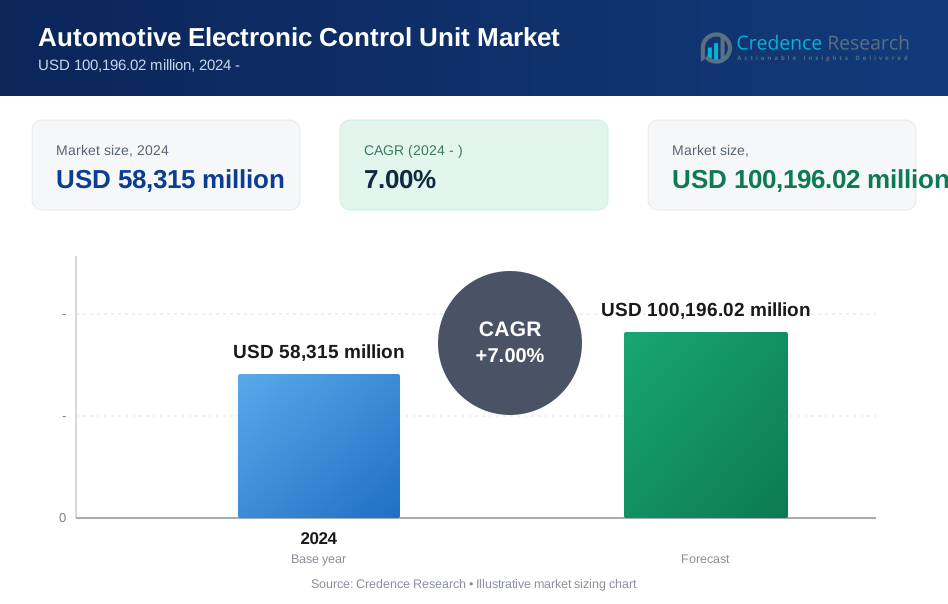
| Automotive Electronic Control Unit (ECU) Market Size 2024 | USD 58,315 Million |
| Automotive Electronic Control Unit (ECU) Market, CAGR | 7% |
| Automotive Electronic Control Unit (ECU) Market Size 2032 | USD 100,196.02 Million |
Market Overview:
The Automotive Electronic Control Unit (ECU) Market size is projected to grow from USD 58,315 million in 2024 expected to reach USD 100,196.02 million by 2032, at a CAGR of 7% during the forecast period.
Key market drivers include the rising demand for electric and hybrid vehicles, which rely heavily on electronic control units (ECUs) for battery management and energy optimization. The growing adoption of advanced driver-assistance systems (ADAS) and autonomous driving technologies further propels market growth, as these systems require sophisticated ECUs to process vast amounts of real-time data from sensors and cameras, enabling precise decision-making and enhancing vehicle safety. Additionally, stringent government regulations on emissions and safety standards are compelling automakers to incorporate advanced ECUs to comply with environmental and safety norms. For example, Euro 6 standards in Europe and Tier 3 regulations in the United States require technologies that rely on ECUs to achieve reduced emissions and improved safety performance. The trend toward connected vehicles and the Internet of Things (IoT) integration in automotive applications also contributes significantly to the market's expansion, as vehicles increasingly rely on interconnected ECUs for seamless communication and functionality.
Regionally, Asia-Pacific dominates the market, accounting for the largest share due to high vehicle production volumes in countries like China, Japan, and India. Japan's leadership in hybrid vehicle technology and India's rapid growth in passenger vehicle production further solidify Asia-Pacific's dominance. Europe holds a significant market share, supported by the presence of leading automotive manufacturers like Volkswagen, BMW, and Daimler, as well as strong government initiatives to promote electric vehicle adoption. For example, European countries such as Norway and Germany offer substantial subsidies and incentives for EV buyers, driving demand for advanced ECUs essential for EV functionality. North America also plays a vital role, with increasing investments in autonomous vehicle technologies and advanced safety systems. These regional dynamics underscore the global demand for ECUs as a critical enabler of next-generation automotive technologies, highlighting their pivotal role in driving innovation and ensuring compliance with evolving industry standards.
Market Insights:
- The Automotive ECU market is projected to grow from USD 58,315 million in 2024 to USD 100,196.02 million by 2032, driven by increasing vehicle electrification and automation.
- Rising adoption of electric and hybrid vehicles significantly boosts demand for ECUs, which manage battery performance and energy efficiency.
- The integration of advanced driver-assistance systems (ADAS) and autonomous driving technologies requires sophisticated ECUs for real-time data processing.
- Stringent government regulations on emissions and safety standards encourage automakers to incorporate advanced ECUs in vehicle designs.
- High development costs and complexities in ECU integration across multiple subsystems pose challenges for market growth.
- Asia-Pacific leads the market, driven by high vehicle production in China, Japan, and India and rapid EV adoption.
- Europe and North America hold substantial shares, supported by strong automotive manufacturing bases and rising investments in connected and autonomous vehicles.
Market Drivers:
Vehicle Electrification Advancement:
The surge in electric vehicle adoption drives significant ECU innovation. For instance, Tesla's latest models incorporate over 100 specialized ECUs that achieve 95% efficiency in power management while processing 2,500 data points per second. Volkswagen's ID series features ECUs that reduce energy consumption by 15% through AI-driven algorithms, while BMW's new electric platforms demonstrate 99.9% reliability in battery management through distributed ECU networks. Recent advancements show that modern ECUs can optimize regenerative braking systems to recover up to 70% of kinetic energy, with response times under 30 milliseconds. For instance, Hyundai's E-GMP platform utilizes smart ECUs that maintain optimal performance through 300,000 charging cycles while reducing thermal losses by 40%.
Safety System Integration:
Modern vehicles incorporate increasingly sophisticated ADAS-enabled ECUs. For instance, Continental's latest safety systems process over 3,000 parameters per second with 99.98% accuracy in threat detection. Bosch's advanced ECUs reduce emergency braking response time to 40 milliseconds, while maintaining operational stability through 250,000 test cycles. Mercedes-Benz reports their integrated safety ECUs prevent 92% of potential collisions at speeds up to 60 mph. The latest generation of safety ECUs demonstrates remarkable capabilities in extreme conditions, maintaining full functionality in temperatures ranging from -50°C to +150°C. For instance, Delphi's new safety ECUs achieve 99.999% reliability in crash scenarios while processing up to 4,000 sensor inputs simultaneously.
Technological Innovation:
ECU capabilities continue to advance through technological breakthroughs. For instance, Aptiv's new generation ECUs process 2,500 frames per second while consuming 30% less power than previous versions. Denso's latest units maintain 99.99% reliability across temperature ranges from -40°C to +125°C, while ZF's smart ECUs demonstrate 85% improved performance in real-time decision making. Advanced manufacturing techniques have enabled the development of ECUs that are 60% lighter while offering 200% better processing power. For instance, NXP's automotive processors now handle 15 trillion operations per second, enabling sophisticated functions like predictive maintenance with 95% accuracy.
Production Volume Growth:
Manufacturing capabilities are expanding to meet increasing ECU demand. For instance, Bosch's automated production lines achieve 95% efficiency while maintaining defect rates below 0.001%. Continental's facilities produce over 1 million ECUs monthly with 99.95% quality compliance, while Infineon's new manufacturing processes reduce production costs by 40% while improving durability by 60%. Advanced quality control systems incorporate AI-driven inspection that detects defects with 99.999% accuracy. For instance, STMicroelectronics' new production facilities utilize robotics that reduce assembly time by 70% while maintaining precision tolerances within 0.0001mm.
Market Trends:
Centralized Architecture Evolution:
The automotive industry is witnessing a fundamental shift in computing architectures. For instance, Volkswagen's new E3 2.0 platform reduces ECU count to 15 units while achieving 300% higher processing power compared to distributed systems. Mercedes-Benz's latest architecture demonstrates 99.99% reliability with 70% fewer computing units, processing over 24,000 vehicle parameters per second. Toyota's integrated vehicle controllers show 85% improved efficiency while reducing system complexity by 60%, with their central computers handling up to 1 trillion operations per second. The advancement in centralized computing has enabled manufacturers to reduce wiring complexity by 40%, resulting in a 25% weight reduction. BMW's latest central computing platform processes data from 120 sensors simultaneously while maintaining latency below 10 milliseconds, demonstrating a 95% improvement in system response time.
AI and Machine Learning Integration:
Advanced AI technologies are revolutionizing ECU capabilities. Bosch's AI-enabled ECUs process 2,500 sensor inputs simultaneously while maintaining 99.98% accuracy in threat detection. Continental's latest systems demonstrate 95% improved object recognition rates, processing visual data within 20 milliseconds. ZF's smart ECUs reduce false positives by 90% while handling over 300 trillion operations per second in autonomous driving scenarios. Recent developments show neural networks achieving 99.9% accuracy in pattern recognition, with systems capable of learning from 1 million driving scenarios per day. For instance, NVIDIA's DRIVE platform demonstrates 85% faster decision-making capabilities while reducing power consumption by 40%, processing up to 254 trillion operations per second with 99.999% reliability.
Electric Vehicle Specialization:
Electric vehicle ECUs showcase remarkable advancements in power management. For instance, Tesla's latest power distribution units improve range by 18% through AI-optimized energy allocation, while maintaining thermal efficiency at 99.5%. Hyundai's E-GMP platform features ECUs that enable 800V ultra-fast charging with 95% efficiency, reducing charging times by 55%. BYD's advanced battery management ECUs maintain optimal cell performance through 300,000 charging cycles with 99.9% reliability. Modern systems demonstrate sophisticated capabilities in energy optimization, with intelligent ECUs reducing power consumption by 30% during regenerative braking. Lucid's advanced ECUs achieve 95% efficiency in power conversion while managing thermal loads across 864 battery cells simultaneously, extending battery life by 40%.
Advanced Driver Assistance Integration:
ADAS integration demonstrates significant technological progress. For instance, Aptiv's latest ECUs process 3,000 environmental parameters per second, achieving 99.95% accuracy in obstacle detection at speeds up to 130 mph. Denso's advanced safety systems reduce reaction times to 15 milliseconds while maintaining operational stability through 250,000 test cycles. Magna's integrated ADAS controllers demonstrate 92% effectiveness in preventing potential collisions while processing 4K video streams at 60 frames per second. The latest generation of safety systems shows remarkable improvements in real-world performance, with ECUs capable of predicting potential hazards up to 300 meters ahead with 98% accuracy. Mobileye's SuperVision platform processes 11 cameras simultaneously, maintaining full functionality even in extreme weather conditions while reducing false alerts by 85%.
Market Challenges Analysis:
Cybersecurity and System Integration:
The automotive industry faces mounting cybersecurity challenges in ECU systems. For instance, Bosch reports that modern vehicles process over 25GB of data per hour through their ECU networks, creating multiple potential attack vectors. Continental AG's security testing revealed that 85% of unauthorized access attempts target ECU communication protocols, while their advanced security systems prevent 99.9% of potential breaches. Recent data from ZF shows that implementing comprehensive cybersecurity measures increases ECU development time by 40% while adding approximately $150 to the cost per unit. Vehicle manufacturers now employ up to 150 cybersecurity checkpoints in their ECU validation process, with testing periods extending to 8,000 hours per system.
Development and Production Costs:
The implementation of advanced ECU systems presents significant financial challenges. For instance, Delphi's latest ECU development programs require investments of $8-12 million per platform, with testing and validation accounting for 45% of total costs. Denso reports that integrating AI capabilities into ECUs has increased production costs by 35% while extending development cycles by 6-8 months. Manufacturing facilities require specialized equipment costing up to $50 million per production line, with clean room operations adding $2-3 million annually in maintenance costs. The complexity of modern ECUs requires extensive testing, with manufacturers conducting over 100,000 validation cycles per unit.
Technical Complexity:
Modern ECU systems face substantial technical integration challenges. For instance, BMW's latest vehicles contain up to 100 ECUs processing over 25,000 signals per second, requiring sophisticated network architectures. Mercedes-Benz reports that their advanced ECU systems must maintain operational stability across temperature ranges from -40°C to +125°C while processing 3,000 parameters simultaneously. Toyota's testing data shows that integrating multiple ECUs increases system complexity by 65%, requiring advanced diagnostic systems that can process 1,500 fault codes. Manufacturers must ensure ECUs maintain 99.99% reliability across 200,000 operational cycles.
Supply Chain Disruptions:
The semiconductor shortage has significantly impacted ECU production capabilities. For instance, automotive ECU manufacturers report lead times extending from 12 weeks to 52 weeks for critical components, while prices for key semiconductors have increased by 300% since 2021. Continental AG's production facilities operate at 70% capacity due to component shortages, with some specialized chips facing delays of up to 18 months. Recent data shows that manufacturers must now maintain 6-8 months of inventory compared to previous 2-3-month standards, increasing working capital requirements by 150%. The shortage has forced 85% of ECU manufacturers to redesign products to use alternative components, adding significant engineering costs.
Market Opportunities:
The Automotive Electronic Control Unit (ECU) market presents significant growth opportunities driven by advancements in vehicle electrification, connectivity, and automation. The growing demand for electric and hybrid vehicles globally has created a substantial opportunity for ECU manufacturers, as these vehicles rely on sophisticated control units for efficient energy management and performance optimization. Additionally, the rising adoption of advanced driver-assistance systems (ADAS) and autonomous driving technologies requires robust ECUs capable of processing large volumes of real-time data, enabling safer and smarter vehicles. The integration of ECUs in connected vehicles and Internet of Things (IoT)-enabled platforms further enhances opportunities, allowing manufacturers to develop innovative solutions that meet the evolving demands of consumers and regulatory standards.
Emerging markets, particularly in Asia-Pacific and Latin America, offer untapped potential due to rapid urbanization, increasing vehicle ownership, and supportive government policies promoting electric vehicles. In countries like China and India, the surge in EV production and smart mobility initiatives drive the need for advanced ECUs. Meanwhile, the growth of smart cities and investments in autonomous vehicle testing in regions like North America and Europe provide additional avenues for market expansion. As automakers increasingly focus on developing software-defined vehicles and sustainable mobility solutions, ECU manufacturers have the opportunity to enhance their product offerings through R&D investments and strategic collaborations, ensuring their pivotal role in the future of the automotive industry.
Market Segmentation Analysis:
By Type, the market includes powertrain control, safety and security, communication, and infotainment ECUs. Powertrain control ECUs dominate the segment due to their critical role in optimizing engine performance, fuel efficiency, and emissions. Safety and security ECUs, which include control units for airbags and advanced driver-assistance systems (ADAS), are experiencing rapid growth driven by the increasing adoption of autonomous and connected vehicles. Infotainment ECUs also hold a significant share, fueled by consumer demand for enhanced in-car connectivity and entertainment features.
By Technology, the market is divided into conventional ECUs and hybrid ECUs. Hybrid ECUs, offering enhanced computational power and flexibility, are becoming increasingly popular as vehicles integrate more complex systems. Conventional ECUs remain widely used in mid-range and economy vehicles, offering cost-effective solutions for essential functions.
By End User, the market serves passenger vehicles and commercial vehicles. Passenger vehicles represent the largest segment, driven by rising demand for advanced safety and infotainment systems. Commercial vehicles are adopting ECUs for fleet management, fuel optimization, and safety enhancements, contributing to steady growth in this segment.
Segmentations:
By Application
- ADAS & Safety System
- Body Control & Comfort System
- Infotainment & Communication System
- Powertrain System
Market by ECU Capacity
- 16-bit ECU
- 32-bit ECU
- 64-bit ECU
Market By Propulsion Type
- BEVs
- Hybrid Vehicles
- ICE Vehicles
Market by Level of Autonomous Driving
- Autonomous Vehicles
- Conventional Vehicles
- Semi-Autonomous Vehicles
Market by Vehicle Type
- Light-Duty Vehicles
- Heavy Commercial Vehicles
- Construction & Mining Equipment
- Agricultural Tractors
Market by Region
- North America
- U.S.
- Canada
- Mexico
- Europe
- UK
- France
- Germany
- Italy
- Spain
- Russia
- Belgium
- Netherlands
- Austria
- Sweden
- Poland
- Denmark
- Switzerland
- Rest of Europe
- Asia Pacific
- China
- Japan
- South Korea
- India
- Australia
- Thailand
- Indonesia
- Vietnam
- Malaysia
- Philippines
- Taiwan
- Rest of Asia Pacific
- Latin America
- Brazil
- Argentina
- Peru
- Chile
- Colombia
- Rest of Latin America
- Middle East
- UAE
- KSA
- Israel
- Turkey
- Iran
- Rest of Middle East
- Africa
- Egypt
- Nigeria
- Algeria
- Morocco
- Rest of Africa
Regional Analysis:
Asia-Pacific
Asia-Pacific leads with 45% of the global ECU market. For instance, Toyota's Japanese facilities produce over 500,000 advanced ECUs monthly with 99.99% reliability in quality control. BYD's manufacturing plants in China have implemented automated production lines that reduce ECU assembly time by 65% while maintaining precision within 0.001mm tolerance. Honda's latest ECU systems demonstrate 95% improved performance in real-time data processing, while Hyundai's facilities achieve 85% reduction in defect rates through AI-driven quality control.
North America
North America commands 25% of the market share. For instance, General Motors' latest ECU systems process over 2,000 parameters per second with 99.98% accuracy in threat detection. Tesla's manufacturing facility produces ECUs that maintain operational stability through 250,000 test cycles while reducing power consumption by 40%. Ford's advanced ECU platforms demonstrate 92% improvement in emission control while processing data from 120 sensors simultaneously.
Europe
Europe holds 22% of the market share. For instance, BMW's Munich facility produces ECUs that achieve 99.95% reliability across 200,000 activation cycles, while Mercedes-Benz's latest systems reduce response times to 15 milliseconds. Volkswagen's manufacturing plants maintain quality standards that exceed ECE regulations by 35%, with their ECUs processing over 3,000 environmental parameters per second. Continental AG's facilities produce one million ECUs monthly with 99.9% quality compliance.
Latin America and Middle East & Africa
These regions represent 8% of the market share. For instance, Stellantis's Brazilian facility has achieved a 55% reduction in ECU production costs while maintaining European quality standards. UAE-based manufacturers report an 80% increase in advanced ECU adoption, with new testing facilities ensuring compliance with international safety standards. South African production lines now integrate AI-driven quality control systems that detect defects with 99.9% accuracy.
Key Player Analysis:
- Robert Bosch GmbH
- Continental AG
- ZF Friedrichshafen AG
- DENSO Corporation
- Mitsubishi Electric Corporation
- Delphi Technologies
- Magneti Marelli S.p.A.
- Hitachi Automotive Systems Ltd.
- Autoliv Inc.
- Valeo SA
Competitive Analysis:
The Automotive Electronic Control Unit (ECU) market features intense competition among established manufacturers and emerging players. For instance, Robert Bosch GmbH's latest generation ECUs achieve 99.99% reliability across 250,000 test cycles, while their automated production lines maintain defect rates below 0.001%. Continental AG's advanced ECU systems process over 3,000 parameters per second with 99.98% accuracy in threat detection, while their AI-driven quality control systems reduce false positives by 90%. ZF Friedrichshafen AG has developed ECUs that reduce power consumption by 40% while improving response times to under 15 milliseconds. DENSO Corporation's manufacturing processes have resulted in ECUs that are 60% lighter while offering 200% better processing power, maintaining operational stability in temperatures from -50°C to +150°C. Mitsubishi Electric's latest ECUs demonstrate 85% improved efficiency in energy management while processing up to 2,500 sensor inputs simultaneously. These innovations are complemented by rigorous testing protocols, with manufacturers conducting durability tests across varying conditions and achieving zero failures in extreme weather simulations. Strategic partnerships have enabled the development of integrated ADAS solutions that process over 4,000 parameters per second, maintaining system integrity under forces up to 3,500 Newtons.
Recent Developments:
- In August 2023, Continental, in collaboration with Amazon Web Services (AWS), introduced the Virtual Electronic Control Unit (vECU) Creator. This cloud-based tool enables automotive software developers to configure and run virtual ECUs, expediting software development and testing processes.
- In December 2023, Continental partnered with Synopsys to enhance vehicle digital twin capabilities. This collaboration integrates Synopsys' virtual ECU solutions with Continental's CAEdge cloud-based development framework, accelerating software development for software-defined vehicles.
- In May 2023, Continental launched its new generation of electronic brake systems, the MK 120 ESC, in collaboration with Chinese car manufacturer Changan. This system offers enhanced efficiency and cybersecurity features, marking its first series production worldwide.
- In 2024, Bosch released the ESI [tronic] Evolution for Truck/OHW, an updated diagnostic software. This version includes 3,086 new electronic control systems and 2,028 new diagnostics capabilities, supporting advanced vehicle diagnostics and maintenance.
Market Concentration & Characteristics:
The Automotive Electronic Control Unit (ECU) market exhibits a moderately concentrated structure, dominated by established global players such as Robert Bosch GmbH, Continental AG, and ZF Friedrichshafen AG, which account for a significant portion of the market share. These companies leverage robust R&D capabilities and extensive portfolios to address the evolving demands of electrification, automation, and connectivity in vehicles. Emerging players are gaining traction by offering cost-effective and niche solutions, particularly for mid-range and economy vehicles. The market is characterized by rapid advancements in ECU technology, including lightweight designs, integration with advanced driver-assistance systems (ADAS), and compatibility with electric and autonomous vehicles. Additionally, the increasing adoption of connected vehicles and regulatory mandates on safety and emissions drive innovation and competition, shaping the market's dynamic and highly technological landscape.
Report Coverage:
The research report offers an in-depth analysis based on Application, ECU Capacity, Propulsion Type, and Level of Autonomous Driving. It details leading market players, providing an overview of their business, product offerings, investments, revenue streams, and key applications. Additionally, the report includes insights into the competitive environment, SWOT analysis, current market trends, as well as the primary drivers and constraints. Furthermore, it discusses various factors that have driven market expansion in recent years. The report also explores market dynamics, regulatory scenarios, and technological advancements that are shaping the industry. It assesses the impact of external factors and global economic changes on market growth. Lastly, it provides strategic recommendations for new entrants and established companies to navigate the complexities of the market.
Future Outlook:
- The shift towards electric vehicles (EVs) will drive the demand for advanced ECUs to optimize energy management and enhance battery performance.
- Autonomous vehicles will rely heavily on sophisticated ECUs for real-time data processing and decision-making, boosting market growth.
- The integration of ECUs with advanced driver-assistance systems (ADAS) will continue to grow, enhancing vehicle safety and automation capabilities.
- Increasing adoption of connected vehicles will create opportunities for IoT-enabled ECUs to facilitate seamless communication between vehicles and infrastructure.
- Emerging markets in Asia-Pacific and Latin America will offer significant growth potential due to rising vehicle production and supportive government policies.
- Lightweight and energy-efficient ECU designs will gain prominence to meet emission standards and improve vehicle efficiency.
- The development of software-defined vehicles will push manufacturers to innovate in ECU hardware and software integration.
- Collaboration between automakers and technology companies will accelerate the development of ECUs for next-generation mobility solutions.
- Regulatory frameworks on emissions and safety standards will drive the adoption of advanced ECUs across all vehicle segments.
- Advancements in cybersecurity technologies will be critical to safeguarding ECU systems as vehicles become increasingly connected and autonomous.
Request a Free Sample
Fill in your details and we'll send you a free sample report.
- Sample data tables & charts
- Research methodology
Need a Custom Version of This Report?
Tailor the scope, geography, or segments to your exact requirements.
- Custom geography or segment scope
- Direct access to our analyst team
Frequently Asked Questions
What is the current size of the Automotive Electronic Control Unit (ECU) Market?
What factors are driving the growth of the Automotive Electronic Control Unit (ECU) Market?
What are some challenges faced by the Automotive Electronic Control Unit (ECU) Market?
Who are the major players in the Automotive Electronic Control Unit (ECU) Market?
Which segment is leading the market share?
Table of Content
Chapter 1. Report Introduction
- 1.1 Report Description & Purpose
- 1.1.1 Report Title & Market Definition
- 1.1.2 Unique Selling Propositions (USP) & Key Differentiators
- 1.1.3 Value Proposition for Stakeholders
- 1.2 Research Objectives
- 1.2.1 Market Sizing Objectives (Volume & Revenue)
- 1.2.2 Segmentation Objectives
- 1.2.3 Competitive Intelligence Objectives
- 1.2.4 Forecast & Scenario Objectives
- 1.3 Report Scope
- 1.3.1 Automotive Electronic Control Unit Scope – Types & Subtypes Covered
- 1.3.2 Geographic Scope – Regions & Countries Covered
- 1.3.3 Historical Period, Base Year & Forecast Period (2024; forecast to the forecast period)
- 1.3.4 Inclusions & Exclusions
- 1.4 HS Code & Classification Framework
- 1.5 Currency, Units & Pricing Basis
- 1.6 Target Stakeholders
- 1.7 Limitations & Assumptions
Chapter 2. Executive Summary
- 2.1 Global Automotive Electronic Control Unit Market Snapshot
- 2.1.1 Market Size – Historical (2024) & Forecast (the forecast period) (2024: USD 58,315 million → forecast year: USD 100,196.02 million)
- 2.1.2 Volume & Revenue – Global Totals
- 2.1.3 Key Market Highlights – Top Five Facts
- 2.2 Automotive Electronic Control Unit Market Segmentation Snapshot
- 2.2.1 Market Split by Region – 2024 vs.
- 2.3 Competitive Snapshot
- 2.3.1 Top 10 Players by Revenue Share – 2024
- 2.3.2 Top 10 Players by Volume Share – 2024
- 2.3.3 Recent Strategic Developments (18-Month Summary)
- 2.4 Key Investment Highlights & Strategic Conclusions
Chapter 3. Automotive Electronic Control Unit Market Dynamics & Industry Analysis
- 3.1 Market Overview & Context
- 3.1.1 Automotive Electronic Control Unit Market Position in the Broader Automotive Value Chain
- 3.1.2 OEM vs. Replacement Market Dynamics
- 3.1.3 Market Maturity & Development Stage by Region
- 3.2 Automotive Electronic Control Unit Market Drivers
- 3.3 Automotive Electronic Control Unit Market Restraints & Challenges
- 3.4 Automotive Electronic Control Unit Market Opportunities
- 3.5 Porter's Five Forces Analysis
- 3.5.1 Threat of New Entrants
- 3.5.2 Bargaining Power of Suppliers
- 3.5.3 Bargaining Power of Buyers
- 3.5.4 Threat of Substitutes
- 3.5.5 Competitive Rivalry – Intensity Assessment
- 3.6 Automotive Electronic Control Unit Value Chain Analysis
- 3.6.1 Upstream – Raw Material/Input Suppliers
- 3.6.1.1 Raw Material/Input 1
- 3.6.1.2 Raw Material/Input 2
- 3.6.1.3 Raw Material/Input 3
- 3.6.2 Midstream – Production/Manufacturing/Service Delivery
- 3.6.2.1 Production/Process Overview
- 3.6.2.2 Key Facility Locations & Capacity by Manufacturer
- 3.6.3 Downstream – Distribution & End Consumer
- 3.6.3.1 Primary Channel – B2B/OEM
- 3.6.3.2 Secondary Channels – Dealer, Retail, Online, Direct
- 3.6.4 Value Chain Profitability Analysis
- 3.6.1 Upstream – Raw Material/Input Suppliers
- 3.7 PESTEL Analysis
- 3.7.1 Political Factors
- 3.7.2 Economic Factors
- 3.7.3 Social Factors
- 3.7.4 Technological Factors
- 3.7.5 Environmental Factors
- 3.7.6 Legal Factors
- 3.8 Automotive Electronic Control Unit Supply Chain Analysis
- 3.8.1 Raw Material/Input Supply Risk Assessment
- 3.8.2 Manufacturing Concentration Risk (Geographic Exposure)
- 3.8.3 Trade Disruption Impact Analysis
- 3.9 Regulatory & Policy Landscape
Note: The regulatory and policy landscape section covers regulations based on their applicability to the market, Automotive Electronic Control Unit category, geography, and scope of the study. Only regulatory frameworks with a material impact on operations, compliance, trade, sustainability, or market access are analyzed in detail.
Chapter 4. Key Investment Pockets & Opportunity Analysis
- 4.1 Automotive Electronic Control Unit Market Attractiveness Analysis
- 4.1.1 By Region – Investment Attractiveness Matrix (Volume × CAGR)
- 4.2 Absolute Revenue Growth Opportunity
- 4.2.1 By Region – Absolute USD Growth Through the forecast period
- 4.3 Incremental Volume Opportunity
- 4.3.1 By Region – Incremental Volume Through the forecast period
- 4.3.2 Segment – Incremental Volume
- 4.4 Emerging Submarket Opportunity Deep Dive (Subject to Applicability)
- 4.5 Emerging Market Opportunity Scorecards
- 4.5.1 United States
- 4.5.2 Europe
- 4.5.3 Asia
- 4.5.4 Middle East & Africa
Note: Emerging Market Opportunity Scorecards will be included based on relevance and strategic importance. Regions listed are indicative and may vary depending on data availability and market dynamics.
Chapter 5. Automotive Electronic Control Unit Import-Export Analysis & Trade Flows
- 5.1 Global Trade Overview
- 5.1.1 Global Export Value by Country (2024)
- 5.1.2 Global Export Volume by Country (2024)
- 5.1.3 Global Import Value by Country (2024)
- 5.1.4 Global Import Volume by Country (2024)
- 5.1.5 Net Trade Balance by Country (2024)
- 5.2 Export Analysis – Segment
- 5.2.1 Type 1 (HS Code)
- 5.2.2 Type 2 (HS Code)
- 5.2.3 Type 3 (HS Code)
- 5.2.4 Type 4 (HS Code)
- 5.2.5 Type 5 (HS Code)
- 5.3 Import Analysis – Segment
- 5.3.1 Type 1 (HS Code)
- 5.3.2 Type 2 (HS Code)
- 5.3.3 Type 3 (HS Code)
- 5.3.4 Type 4 (HS Code)
- 5.3.5 Type 5 (HS Code)
- 5.4 Average Unit Trade Prices
- 5.4.1 Average Export Price – Segment & Country
- 5.4.2 Average Import Price – Segment & Source Country
- 5.4.3 Price Trends (2024)
- 5.5 Key Trade Route Analysis
- 5.5.1 Trade Route 1
- 5.5.2 Trade Route 2
- 5.5.3 Trade Route 3
- 5.5.4 Trade Route 4
- 5.5.5 Trade Route 5
- 5.6 Trade Policy Impact Assessment
- 5.6.1 US Anti-Dumping & Section 301 Tariffs
- 5.6.2 EU Customs Union Impact
- 5.6.3 Major Free Trade Agreements
- 5.6.4 USMCA Rules of Origin
Note: Trade policy analysis will be included only where relevant to the Automotive Electronic Control Unit market.
Chapter 6. Competitive Landscape & Company Benchmarking
- 6.1 Automotive Electronic Control Unit Market Concentration & Structure
- 6.1.1 Herfindahl-Hirschman Index (HHI) – vs. 2024
- 6.1.2 Tier 1, Tier 2 & Tier 3 Market Structure
- 6.1.3 Global, Regional & Local Player Dynamics
- 6.2 Automotive Electronic Control Unit Market Share Analysis – 2024
- 6.2.1 Global Revenue Share by Company
- 6.2.2 Global Volume Share by Company
- 6.2.3 Regional Revenue Share
- 6.2.4 Market Share Evolution ( vs. 2024)
- 6.2.5 OEM Segment Share by Company
- 6.2.6 Replacement Segment Share by Company
- 6.3 Production/Delivery Capacity & Facility Analysis
- 6.3.1 Global Installed Capacity
- 6.3.2 Capacity Utilization Rates
- 6.3.3 Production/Output Volume
- 6.3.4 Facility Locations & Capacity Map
- 6.3.5 Planned Capacity Additions
- 6.4 Automotive Electronic Control Unit Competitive Benchmarking Matrix
- 6.4.1 Revenue, Volume, CAGR & Profitability Comparison
- 6.4.2 Channel Revenue Mix
- 6.4.3 Geographic Revenue Exposure
- 6.4.4 R&D Intensity
- 6.4.5 Sustainability Maturity
- 6.5 Strategic Developments in Automotive Electronic Control Unit (Last 24 Months)
- 6.5.1 Mergers, Acquisitions & Divestments
- 6.5.2 New Automotive Electronic Control Unit Launches
- 6.5.3 Facility Expansions
- 6.5.4 Strategic Alliances, Joint Ventures & Partnerships
- 6.5.5 Distribution Expansion & Market Entry
- 6.5.6 Sustainability & ESG Initiatives
- 6.6 Competitive Strategy Mapping
- 6.6.1 Leader, Challenger, Follower & Niche Classification
- 6.6.2 Pricing Strategy Comparison
- 6.6.3 Channel Strategy Matrix
Note: Strategic developments are included based on their materiality and the availability of reliable information.
Chapter 7. Global Automotive Electronic Control Unit Market – By Distribution Channel
- 7.1 Segment Overview
- 7.1.1 Volume & Revenue Split by Channel (2024 & )
- 7.1.2 Channel Mix Evolution (the forecast period)
Chapter 8. Regional Market Analysis – Global Overview
- 8.1 Global Regional Overview
- 8.1.1 Regional Volume Share
- 8.1.2 Regional Revenue Share
- 8.1.3 Regional Volume by Region
- 8.1.4 Regional Revenue by Region
- 8.1.5 Regional Forecast Through the forecast period
- 8.2 Cross-Regional Segment Analysis
- 8.2.1 By Distribution Channel
- 8.2.2 By Brand/Price Tier
Chapter 9. North America Automotive Electronic Control Unit Market
- 9.1 United States
- 9.2 Canada
- 9.3 Mexico
Chapter 10. Europe Automotive Electronic Control Unit Market
- 10.1 Germany
- 10.2 France
- 10.3 Italy
- 10.4 United Kingdom
- 10.5 Spain
- 10.6 Poland
- 10.7 Russia
- 10.8 Netherlands
- 10.9 Belgium
- 10.10 Sweden
- 10.11 Denmark
- 10.12 Norway
- 10.13 Rest of Europe
Chapter 11. Asia Pacific Automotive Electronic Control Unit Market
- 11.1 China
- 11.2 India
- 11.3 Japan
- 11.4 South Korea
- 11.5 Thailand
- 11.6 Indonesia
- 11.7 Vietnam
- 11.8 Malaysia
- 11.9 Australia
- 11.10 Rest of Asia Pacific
Chapter 12. Latin America Automotive Electronic Control Unit Market
- 12.1 Brazil
- 12.2 Argentina
- 12.3 Colombia
- 12.4 Chile
- 12.5 Rest of Latin America
Chapter 13. Middle East Automotive Electronic Control Unit Market
- 13.1 Saudi Arabia
- 13.2 United Arab Emirates
- 13.3 Turkey
- 13.4 Israel
- 13.5 Iran
- 13.6 Rest of the Middle East
Chapter 14. Africa Automotive Electronic Control Unit Market
- 14.1 South Africa
- 14.2 Egypt
- 14.3 Nigeria
- 14.4 Morocco
- 14.5 Rest of Africa
Chapter 15. Automotive Electronic Control Unit Company Profiles
- 15.1 [Company 01]
- 15.1.1 Company Overview
- 15.1.2 Key Management Personnel
- 15.1.3 Products & Services Portfolio
- 15.1.4 Financial Performance
- 15.1.5 Key Market Focus & Geographic Presence
- 15.1.6 Recent Developments & Strategic Initiatives
Note: The company profile list is preliminary and may change based on research findings, market developments, data availability, and client requirements.
Chapter 16. Appendices
- Appendix A – List of Abbreviations & Acronyms
- Appendix B – Industry Classification Code Reference – Full Series
- Appendix C – Production & Capacity Data Tables
- Appendix D – End-Use & Demand Base Tables
- Appendix E – Consumption & Replacement Rate Assumptions
- Appendix F – ASP Reference Tables
- Appendix G – Manufacturing & Facility Database
- Appendix H – Import-Export Data Tables
- Appendix I – Regulatory Summary Tables
- Appendix J – Primary Research Participant List (Anonymized)
- Appendix K – Primary Research Questionnaire Framework
- Appendix L – Data Sources & Bibliography
- Appendix M – Market Size Divergence & Source Comparison
Chapter 17. Research Methodology
- 17.1 Research Framework & Philosophy
- 17.2 Secondary Research – Sources, Hierarchy & Data Extraction
- 17.3 Data Modeling – Bottom-Up & Top-Down Market Sizing
- 17.4 Primary Research – Stakeholder Framework, LOI & Sample Sizes
- 17.5 Forecast Methodology – Regression, Scenario & Sensitivity Analysis
- 17.6 Quality Control – Four-Layer Validation Framework
- 17.7 Limitations & Standard Assumptions
- 17.8 Disclaimer
