
Market Overview:
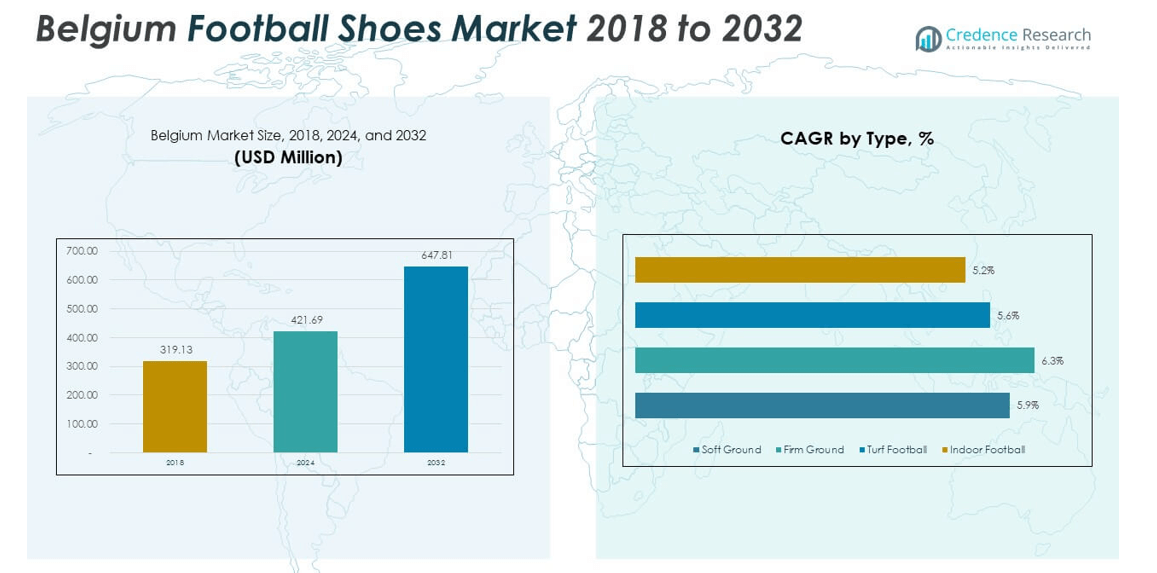
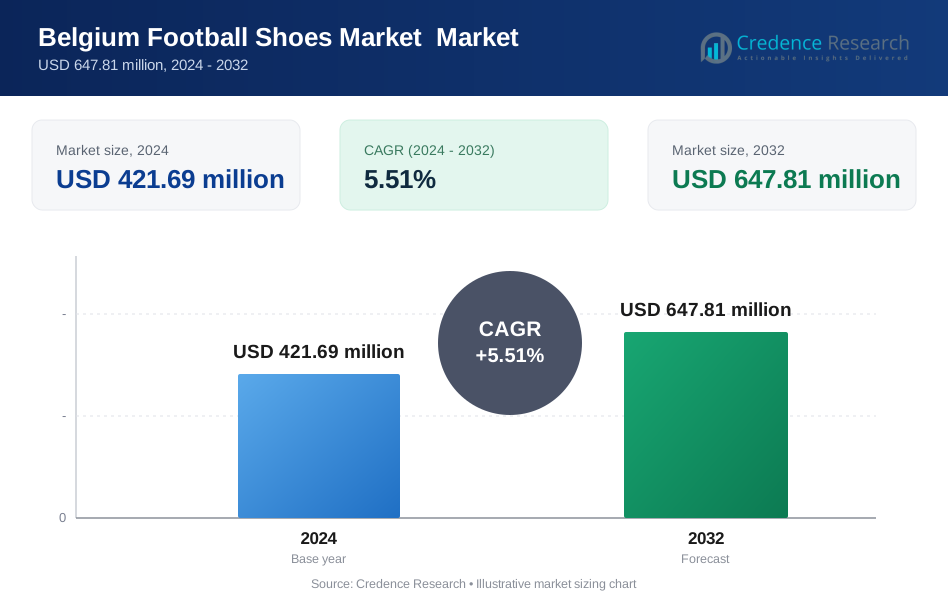
The Belgium Football Shoes Market size was valued at USD 319.13 million in 2018 to USD 421.69 million in 2024 and is anticipated to reach USD 647.81 million by 2032, at a CAGR of 5.51% during the forecast period.
| REPORT ATTRIBUTE | DETAILS |
|---|---|
| Historical Period | 2020-2023 |
| Base Year | 2024 |
| Forecast Period | 2025-2032 |
| Belgium Football Shoes Market Size 2024 | USD 421.69 million |
| Belgium Football Shoes Market , CAGR | 5.51% |
| Belgium Football Shoes Market Size 2032 | USD 647.81 million |
Growth in the Belgium Football Shoes Market is driven by the country’s strong football culture, rising participation at grassroots levels, and the influence of professional leagues. Consumers increasingly seek high-performance, lightweight, and durable shoes that offer comfort and injury prevention. The popularity of futsal and indoor football also supports demand for specialized footwear. International brands launching innovative designs, sustainability-driven products, and customization options continue to expand market appeal. Sponsorships and endorsements by professional clubs further strengthen consumer interest and adoption.
Regionally, Flanders leads the Belgium Football Shoes Market due to its dense club networks, strong community involvement, and professional league presence. Wallonia shows steady growth, fueled by expanding grassroots participation and demand for affordable footwear options. Brussels-Capital, though smaller in size, has a significant role with its multicultural population and premium-focused consumer base. It attracts flagship stores and exclusive product launches from global brands, strengthening its strategic importance. Together, these subregions reflect diverse consumer preferences and ensure broad-based growth across the country.
Market Insights
- The Belgium Football Shoes Market was valued at USD 319.13 million in 2018, reached USD 421.69 million in 2024, and is projected to hit USD 647.81 million by 2032, expanding at a CAGR of 5.51%.
- Flanders led the market with a 52% share in 2024, supported by strong professional club presence, while Wallonia held 32% due to expanding grassroots football, and Brussels-Capital accounted for 16%, driven by premium-focused demand.
- Brussels-Capital, though smaller, is the fastest-growing region with 16% share, benefiting from multicultural demographics, flagship store launches, and lifestyle-driven adoption of football footwear.
- Firm ground shoes dominated the type segment with nearly 40% share, driven by natural grass pitch usage across Belgium.
- Indoor football shoes accounted for around 25% share, fueled by the rising popularity of futsal and urban community leagues.
Market Drivers
Rising Football Participation and Community Engagement as Key Growth Accelerators
Football maintains the position of Belgium’s most popular sport, fueling consistent footwear demand. Clubs across amateur and professional levels encourage purchases of specialized shoes. It benefits from rising interest in grassroots tournaments, school-level competitions, and community leagues. Consumers recognize the performance advantages of advanced boots, leading to higher adoption. Professional leagues also inspire young players to invest in premium shoes. The Belgium Football Shoes Market grows in parallel with strong community involvement. Sponsorships by leading clubs further influence consumer preferences. Expanding local tournaments increase brand exposure and stimulate consistent retail demand.
- For instance, in November 2020, Adidas’ Football Collective initiative supplied 150,000 free kits to over 10,000 grassroots and amateur teams across Europe including Belgium demonstrating direct, large-scale support for youth and community football participation.
Demand for Performance-Oriented Footwear with Advanced Material Innovation
Athletes prioritize football shoes designed with lightweight structures, breathable fabrics, and durability. Sports brands deliver improved grip and injury prevention features to meet these needs. It reflects a growing consumer focus on both comfort and safety. Belgium’s professional players reinforce this trend by showcasing branded performance shoes in competitive matches. Retailers highlight technical features like adaptive compression and stud optimization to drive appeal. The Belgium Football Shoes Market demonstrates higher spending patterns for performance lines. Consumers also value durability as a key factor in purchase decisions. Enhanced shoe designs create recurring demand cycles among frequent players.
Growing Influence of Indoor Football and Futsal on Product Demand
The increasing popularity of futsal and indoor football drives demand for specialized shoes. Indoor leagues offer strong participation among youth and urban communities. It creates a clear requirement for rubber-soled, court-optimized designs. Global sports brands actively supply this segment through localized marketing campaigns. The Belgium Football Shoes Market strengthens as futsal expands its reach. Retailers adapt their product mix to include indoor-specific variants. Consumers prioritize traction and flexibility when selecting futsal footwear. Increased adoption across urban centers reflects the expanding appeal of indoor football formats.
- For instance, Puma’s Future Z 3.4 integrates second-generation FUZIONFIT+ technology, which adapts to the player’s foot shape for dynamic support and flexibility, combined with Advanced Creator Zones designed to enhance grip and ball control.
Role of Brand Innovation and Sustainability in Consumer Purchase Decisions
Leading companies invest in recyclable materials and eco-friendly designs. It supports environmentally conscious buying behavior among Belgian consumers. Shoe models built with recycled fibers and water-reducing production methods gain traction. The Belgium Football Shoes Market benefits from sustainability-focused product strategies. Younger consumers align purchases with values linked to eco-responsibility. Retailers promote sustainable launches as part of long-term loyalty campaigns. Innovation through limited editions and customized features attracts premium buyers. Brand-led initiatives combine performance excellence with environmental responsibility to sustain growth momentum.
Market Trends
Technological Advancements in Customization Platforms for Football Footwear
Consumers prefer shoes reflecting personal style and comfort requirements. Brands respond by offering online customization tools with design flexibility. It allows buyers to select materials, colors, and performance attributes. The Belgium Football Shoes Market expands through these interactive digital platforms. Customization enhances consumer loyalty by aligning products with personal identity. Younger demographics engage actively with personalized experiences. Limited edition and exclusive designs create higher brand recognition. Technology-driven customization reinforces brand competitiveness and market penetration.
- For instance, in January 2025 Nike extended its Nike By You platform to the latest Mercurial football boots, allowing consumers to customize base colors, sole plates, Swoosh finishes, and add personal inscriptions across both Elite and Academy models.
Integration of Digital Retail Experiences to Improve Consumer Accessibility
E-commerce channels are crucial in shaping buyer choices across footwear. Brands strengthen their presence through online marketplaces and direct-to-consumer models. It delivers convenience and wide product availability across Belgium. The Belgium Football Shoes Market gains momentum through these digital strategies. Augmented reality tools enable virtual try-ons, increasing confidence before purchase. Online channels provide targeted promotions to football enthusiasts. Retailers track consumer behavior to refine offerings. Expanding e-commerce strengthens sales across both urban and semi-urban locations.
- For instance, Adidas introduced an AR try-on feature in its mobile app in 2019, enabling users to overlay digital models such as the AlphaEdge 4D onto their feet in real time for virtual fitting.
Expansion of Premium Lifestyle Segment with Football-Influenced Footwear Styles
Athleisure continues to blend sports design with lifestyle preferences. Football shoes gain acceptance beyond the pitch as fashion statements. It drives demand for premium collections combining performance with streetwear appeal. The Belgium Football Shoes Market captures value from this crossover trend. Global brands launch collaborations with designers and cultural influencers. Youth customers adopt football-inspired styles for casual use. Retail stores display performance shoes alongside lifestyle collections. This dual appeal increases sales in both sports and fashion categories.
Adoption of Smart Technologies and Data-Driven Product Features
Sports technology integration emerges as a defining trend in footwear. Shoes equipped with smart sensors track movement, speed, and energy output. It appeals to performance-driven players aiming to measure progress. The Belgium Football Shoes Market incorporates innovation into premium offerings. Players adopt these solutions for training optimization. Data-driven feedback enhances coaching programs and individual skill development. Leading brands invest in connected footwear ecosystems. Smart product integration shapes future competition in football shoe categories.
Market Challenges Analysis
High Market Competition and Price Sensitivity Among Consumers
The market faces pressure from intense rivalry between global brands and local suppliers. It creates challenges in differentiating products solely on performance or design. The Belgium Football Shoes Market must navigate consumer preference for affordable yet quality footwear. Price sensitivity remains high in amateur and semi-professional segments. Retailers often engage in discount campaigns, reducing profit margins. Sustaining premium pricing strategies becomes difficult in a cost-conscious environment. Competitive advertising intensifies market noise, challenging consumer attention. Balancing affordability and innovation requires careful brand positioning.
Supply Chain Volatility and Pressure on Sustainable Production Models
Brands struggle to balance demand growth with reliable supply chains. It exposes vulnerabilities in raw material sourcing and manufacturing cycles. The Belgium Football Shoes Market must address rising expectations for eco-friendly production. Transitioning to recycled inputs increases costs and complicates supply logistics. Regulatory pressures across Europe mandate higher sustainability compliance. Disruptions in distribution networks add delays during peak seasons. Consumer expectations for rapid product delivery elevate operational risks. Aligning sustainability with efficiency emerges as a major challenge.
Market Opportunities
Growing Potential in Women’s Football and Youth Development Programs
The surge in women’s football tournaments generates higher footwear demand. Youth academies expand rapidly with structured training programs across Belgium. It builds new customer segments requiring performance shoes. The Belgium Football Shoes Market captures growth through these inclusivity-driven developments. Brands tailor launches to women-specific designs with enhanced comfort features. Youth-focused products highlight durability and affordability. Sponsorships of female athletes increase visibility for targeted collections. Long-term opportunities exist in expanding participation across gender and age groups.
Increasing Role of Sustainability and Eco-Friendly Consumer Preferences
Sustainability initiatives create attractive growth prospects across footwear segments. Belgian consumers actively choose products aligned with environmental values. It influences long-term brand loyalty and purchasing decisions. The Belgium Football Shoes Market gains strength from eco-focused product launches. Retailers expand portfolios with recyclable and bio-based materials. Marketing campaigns emphasize both performance and ecological benefits. Partnerships with local organizations support sustainable positioning. Opportunities expand through combining innovation with responsible production practices.
Market Segmentation Analysis
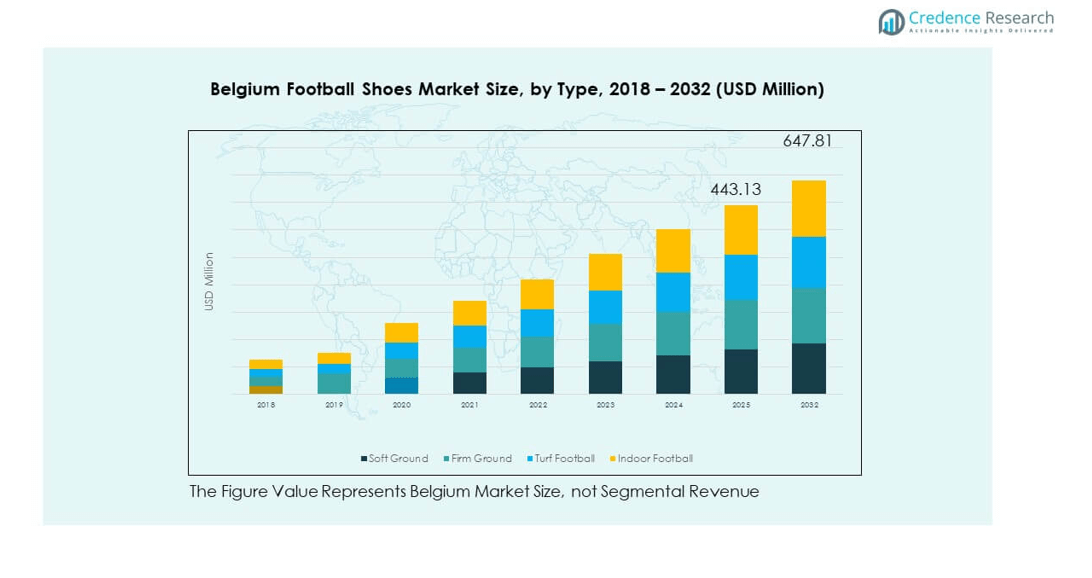
By type, the Belgium Football Shoes Market is divided into soft ground, firm ground, turf football, and indoor football. Firm ground shoes hold the leading share, supported by widespread use on natural grass pitches across Belgium. Soft ground variants cater to professional and semi-professional players seeking stability on wet surfaces. Turf football and indoor football shoes gain momentum from the growth of futsal and community-level participation, particularly in urban regions where artificial pitches are common. It benefits from consumer preference for performance features tailored to surface-specific conditions.
- For instance, Adidas reported an 11% year-on-year increase in net sales in 2024, supported by strong demand across its global football footwear portfolio, including established franchises like Predator that feature Primeknit collars for enhanced ankle support.
By stud, the market is segmented into metal studs, rubber studs, and flat sole categories. Metal studs retain importance among elite players requiring enhanced traction on soft or moist pitches. Rubber studs dominate amateur and youth categories where safety, affordability, and versatility matter. Flat sole designs are increasingly tied to indoor football shoes, reflecting expanding adoption of futsal and recreational play. It reflects a balanced demand pattern shaped by varying surface requirements across the country.
- For instance, Adidas indoor football shoes feature flat sole constructions with non-marking grippy rubber outsoles, designed to optimize traction and performance on indoor courts for futsal players.
By sales channel, the market is classified into retail channels, e-commerce, and direct-to-consumer models. Retail outlets remain dominant, supported by established sports chains and specialty stores providing in-person product experiences. E-commerce is growing quickly due to convenience, digital promotions, and virtual try-on technologies. Direct-to-consumer strategies are gaining traction as brands focus on strengthening loyalty and reducing distribution dependency. It highlights the strategic importance of multi-channel approaches to sustain reach and capture evolving consumer buying behavior.
Segmentation
By Type
- Soft Ground
- Firm Ground
- Turf Football
- Indoor Football
By Stud
- Metal Studs
- Rubber Studs
- Flat Sole
By Sales Channel
- Retail Channels
- E-commerce
- Direct to Consumer
Regional Analysis
Flanders
Flanders dominates the Belgium Football Shoes Market with a 52% share, supported by its strong football culture and established club networks. The region benefits from hosting several professional league teams that influence consumer behavior. Retail chains and specialty outlets maintain wide availability of performance shoes across urban and suburban areas. It strengthens its position through high grassroots participation rates and active community leagues. Flanders also sees strong adoption of premium and customized shoe models. Investment in sports infrastructure and sponsorship programs drives steady growth momentum.
Wallonia
Wallonia holds a 32% share, driven by growing participation in football among younger demographics. Local clubs and training academies expand access to football shoes in both urban and rural communities. It experiences rising demand for mid-range and affordable footwear due to income sensitivity. International brands leverage partnerships with regional retailers to strengthen their reach. Wallonia’s market also reflects a preference for futsal and indoor football shoes, aligning with increasing urban activities. Retail expansion supports broader consumer adoption and sustains long-term growth in the region.
Brussels-Capital Region
Brussels-Capital accounts for 16% of the Belgium Football Shoes Market, shaped by its urban lifestyle and multicultural demographics. The region attracts global brands that introduce flagship stores and exclusive launches. It sees high demand for premium and lifestyle-oriented football footwear linked to fashion trends. Brussels benefits from active youth academies and corporate-backed sports initiatives. Football shoes here often serve both performance and casual purposes, reflecting diverse consumer profiles. Strategic retail positioning ensures consistent growth in this smaller but influential market segment.
Key Player Analysis
- Nike Inc.
- Adidas AG
- Puma SE
- Umbro
- Quick
- Lotto Sport Italia
- New Balance
- DYNAMIC GEAR BV (Patrick)
- Skechers
- Sokito
- Other Key Players
Competitive Analysis
The Belgium Football Shoes Market is highly competitive, with global and regional players focusing on innovation, distribution, and brand visibility. Nike, Adidas, and Puma dominate through advanced performance technologies, aggressive marketing, and strong athlete endorsements. It also sees contributions from players such as Lotto Sport Italia, New Balance, Umbro, and DYNAMIC GEAR BV (Patrick), who target niche categories with differentiated products. Local entrants like Sokito strengthen competition by offering sustainable designs that appeal to environmentally conscious consumers. Companies actively invest in new product launches, digital retail platforms, and sponsorship deals to secure loyalty. Partnerships with professional clubs and youth academies reinforce brand recognition and drive sales. The market remains dynamic, shaped by continuous upgrades in product design, smart technology integration, and sustainability-driven strategies.
Recent Developments
- In January 2025, PUMA introduced the "Unlimited" football boots pack, which includes the FUTURE 8, ULTRA 5, and KING ULTIMATE models, showcasing their latest innovations for the year and marking a significant launch for football enthusiasts in Belgium and across Europe.
- In September 2025, Adidas AG announced a high-profile partnership with Kith, resulting in the Fall 2025 Kith x adidas Football collection, which merges sport and streetwear influences. The launch featuring both modernized classics like the Supernova Indoor and the Predator Sala football boot goes live on September 19, 2025, targeting Belgium alongside other European markets through Kith retail locations and the Adidas brand webstore
Report Coverage
The research report offers an in-depth analysis based on Type, Stud and Sales Channel. It details leading market players, providing an overview of their business, product offerings, investments, revenue streams, and key applications. Additionally, the report includes insights into the competitive environment, SWOT analysis, current market trends, as well as the primary drivers and constraints. Furthermore, it discusses various factors that have driven market expansion in recent years. The report also explores market dynamics, regulatory scenarios, and technological advancements that are shaping the industry. It assesses the impact of external factors and global economic changes on market growth. Lastly, it provides strategic recommendations for new entrants and established companies to navigate the complexities of the market.
Future Outlook
- Rising grassroots participation will expand demand for performance-focused football shoes in Belgium.
- Growth in futsal and indoor football adoption will create steady traction for specialized footwear.
- Increasing sustainability focus will drive launches of eco-friendly and recyclable product lines.
- Digital retail platforms will expand accessibility, shaping consumer purchasing behavior across regions.
- Customization technology will strengthen loyalty by enabling consumers to design personalized footwear.
- Integration of smart features will position football shoes as tools for performance analytics.
- Collaborations between brands and football clubs will reinforce brand recognition and influence sales.
- Lifestyle-driven adoption will blur the line between performance footwear and casual fashion choices.
- Regional retailers will expand product availability through targeted marketing and localized campaigns.
- Competitive innovation will sustain momentum, ensuring the Belgium Football Shoes Market evolves dynamically.
Request a Free Sample
Fill in your details and we'll send you a free sample report.
- Sample data tables & charts
- Research methodology
Need a Custom Version of This Report?
Tailor the scope, geography, or segments to your exact requirements.
- Custom geography or segment scope
- Direct access to our analyst team
Frequently Asked Questions
What is the current market size for Belgium Football Shoes Market, and what is its projected size in 2032?
At what Compound Annual Growth Rate is the Belgium Football Shoes Market projected to grow between 2024 and 2032?
Which Belgium Football Shoes Market segment held the largest share in 2024?
What are the primary factors fueling the growth of the Belgium Football Shoes Market?
Who are the leading companies in the Belgium Football Shoes Market?
Table of Content
Chapter 1. Report Introduction
- 1.1 Report Description & Purpose
- 1.1.1 Report Title & Market Definition
- 1.1.2 Unique Selling Propositions (USP) & Key Differentiators
- 1.1.3 Value Proposition for Stakeholders
- 1.2 Research Objectives
- 1.2.1 Market Sizing Objectives (Volume & Revenue)
- 1.2.2 Segmentation Objectives
- 1.2.3 Competitive Intelligence Objectives
- 1.2.4 Forecast & Scenario Objectives
- 1.3 Report Scope
- 1.3.1 Belgium Football Shoes Market Scope – Types & Subtypes Covered
- 1.3.2 Geographic Scope – Regions & Countries Covered
- 1.3.3 Historical Period, Base Year & Forecast Period (2024; forecast to 2032)
- 1.3.4 Inclusions & Exclusions
- 1.4 HS Code & Classification Framework
- 1.5 Currency, Units & Pricing Basis
- 1.6 Target Stakeholders
- 1.7 Limitations & Assumptions
Chapter 2. Executive Summary
- 2.1 Global Belgium Football Shoes Market Market Snapshot
- 2.1.1 Market Size – Historical (2024) & Forecast (2024-2032) (2024: USD 421.69 million → 2032: USD 647.81 million)
- 2.1.2 Volume & Revenue – Global Totals
- 2.1.3 Key Market Highlights – Top Five Facts
- 2.2 Belgium Football Shoes Market Market Segmentation Snapshot
- 2.2.1 Market Split by Region – 2024 vs. 2032
- 2.3 Competitive Snapshot
- 2.3.1 Top 10 Players by Revenue Share – 2024
- 2.3.2 Top 10 Players by Volume Share – 2024
- 2.3.3 Recent Strategic Developments (18-Month Summary)
- 2.4 Key Investment Highlights & Strategic Conclusions
Chapter 3. Belgium Football Shoes Market Market Dynamics & Industry Analysis
- 3.1 Market Overview & Context
- 3.1.1 Belgium Football Shoes Market Market Position in the Broader Automotive Value Chain
- 3.1.2 OEM vs. Replacement Market Dynamics
- 3.1.3 Market Maturity & Development Stage by Region
- 3.2 Belgium Football Shoes Market Market Drivers
- 3.3 Belgium Football Shoes Market Market Restraints & Challenges
- 3.4 Belgium Football Shoes Market Market Opportunities
- 3.5 Porter's Five Forces Analysis
- 3.5.1 Threat of New Entrants
- 3.5.2 Bargaining Power of Suppliers
- 3.5.3 Bargaining Power of Buyers
- 3.5.4 Threat of Substitutes
- 3.5.5 Competitive Rivalry – Intensity Assessment
- 3.6 Belgium Football Shoes Market Value Chain Analysis
- 3.6.1 Upstream – Raw Material/Input Suppliers
- 3.6.1.1 Raw Material/Input 1
- 3.6.1.2 Raw Material/Input 2
- 3.6.1.3 Raw Material/Input 3
- 3.6.2 Midstream – Production/Manufacturing/Service Delivery
- 3.6.2.1 Production/Process Overview
- 3.6.2.2 Key Facility Locations & Capacity by Manufacturer
- 3.6.3 Downstream – Distribution & End Consumer
- 3.6.3.1 Primary Channel – B2B/OEM
- 3.6.3.2 Secondary Channels – Dealer, Retail, Online, Direct
- 3.6.4 Value Chain Profitability Analysis
- 3.6.1 Upstream – Raw Material/Input Suppliers
- 3.7 PESTEL Analysis
- 3.7.1 Political Factors
- 3.7.2 Economic Factors
- 3.7.3 Social Factors
- 3.7.4 Technological Factors
- 3.7.5 Environmental Factors
- 3.7.6 Legal Factors
- 3.8 Belgium Football Shoes Market Supply Chain Analysis
- 3.8.1 Raw Material/Input Supply Risk Assessment
- 3.8.2 Manufacturing Concentration Risk (Geographic Exposure)
- 3.8.3 Trade Disruption Impact Analysis
- 3.9 Regulatory & Policy Landscape
Note: The regulatory and policy landscape section covers regulations based on their applicability to the market, Belgium Football Shoes Market category, geography, and scope of the study. Only regulatory frameworks with a material impact on operations, compliance, trade, sustainability, or market access are analyzed in detail.
Chapter 4. Key Investment Pockets & Opportunity Analysis
- 4.1 Belgium Football Shoes Market Market Attractiveness Analysis
- 4.1.1 By Region – Investment Attractiveness Matrix (Volume × CAGR)
- 4.2 Absolute Revenue Growth Opportunity
- 4.2.1 By Region – Absolute USD Growth Through 2032
- 4.3 Incremental Volume Opportunity
- 4.3.1 By Region – Incremental Volume Through 2032
- 4.3.2 Segment – Incremental Volume
- 4.4 Emerging Submarket Opportunity Deep Dive (Subject to Applicability)
- 4.5 Emerging Market Opportunity Scorecards
- 4.5.1 United States
- 4.5.2 Europe
- 4.5.3 Asia
- 4.5.4 Middle East & Africa
Note: Emerging Market Opportunity Scorecards will be included based on relevance and strategic importance. Regions listed are indicative and may vary depending on data availability and market dynamics.
Chapter 5. Belgium Football Shoes Market Import-Export Analysis & Trade Flows
- 5.1 Global Trade Overview
- 5.1.1 Global Export Value by Country (2024)
- 5.1.2 Global Export Volume by Country (2024)
- 5.1.3 Global Import Value by Country (2024)
- 5.1.4 Global Import Volume by Country (2024)
- 5.1.5 Net Trade Balance by Country (2024)
- 5.2 Export Analysis – Segment
- 5.2.1 Type 1 (HS Code)
- 5.2.2 Type 2 (HS Code)
- 5.2.3 Type 3 (HS Code)
- 5.2.4 Type 4 (HS Code)
- 5.2.5 Type 5 (HS Code)
- 5.3 Import Analysis – Segment
- 5.3.1 Type 1 (HS Code)
- 5.3.2 Type 2 (HS Code)
- 5.3.3 Type 3 (HS Code)
- 5.3.4 Type 4 (HS Code)
- 5.3.5 Type 5 (HS Code)
- 5.4 Average Unit Trade Prices
- 5.4.1 Average Export Price – Segment & Country
- 5.4.2 Average Import Price – Segment & Source Country
- 5.4.3 Price Trends (2024)
- 5.5 Key Trade Route Analysis
- 5.5.1 Trade Route 1
- 5.5.2 Trade Route 2
- 5.5.3 Trade Route 3
- 5.5.4 Trade Route 4
- 5.5.5 Trade Route 5
- 5.6 Trade Policy Impact Assessment
- 5.6.1 US Anti-Dumping & Section 301 Tariffs
- 5.6.2 EU Customs Union Impact
- 5.6.3 Major Free Trade Agreements
- 5.6.4 USMCA Rules of Origin
Note: Trade policy analysis will be included only where relevant to the Belgium Football Shoes Market market.
Chapter 6. Competitive Landscape & Company Benchmarking
- 6.1 Belgium Football Shoes Market Market Concentration & Structure
- 6.1.1 Herfindahl-Hirschman Index (HHI) – vs. 2024
- 6.1.2 Tier 1, Tier 2 & Tier 3 Market Structure
- 6.1.3 Global, Regional & Local Player Dynamics
- 6.2 Belgium Football Shoes Market Market Share Analysis – 2024
- 6.2.1 Global Revenue Share by Company
- 6.2.2 Global Volume Share by Company
- 6.2.3 Regional Revenue Share
- 6.2.4 Market Share Evolution ( vs. 2024)
- 6.2.5 OEM Segment Share by Company
- 6.2.6 Replacement Segment Share by Company
- 6.3 Production/Delivery Capacity & Facility Analysis
- 6.3.1 Global Installed Capacity
- 6.3.2 Capacity Utilization Rates
- 6.3.3 Production/Output Volume
- 6.3.4 Facility Locations & Capacity Map
- 6.3.5 Planned Capacity Additions
- 6.4 Belgium Football Shoes Market Competitive Benchmarking Matrix
- 6.4.1 Revenue, Volume, CAGR & Profitability Comparison
- 6.4.2 Channel Revenue Mix
- 6.4.3 Geographic Revenue Exposure
- 6.4.4 R&D Intensity
- 6.4.5 Sustainability Maturity
- 6.5 Strategic Developments in Belgium Football Shoes Market (Last 24 Months)
- 6.5.1 Mergers, Acquisitions & Divestments
- 6.5.2 New Belgium Football Shoes Market Launches
- 6.5.3 Facility Expansions
- 6.5.4 Strategic Alliances, Joint Ventures & Partnerships
- 6.5.5 Distribution Expansion & Market Entry
- 6.5.6 Sustainability & ESG Initiatives
- 6.6 Competitive Strategy Mapping
- 6.6.1 Leader, Challenger, Follower & Niche Classification
- 6.6.2 Pricing Strategy Comparison
- 6.6.3 Channel Strategy Matrix
Note: Strategic developments are included based on their materiality and the availability of reliable information.
Chapter 7. Global Belgium Football Shoes Market Market – By Distribution Channel
- 7.1 Segment Overview
- 7.1.1 Volume & Revenue Split by Channel (2024 & 2032)
- 7.1.2 Channel Mix Evolution (2024-2032)
Chapter 8. Regional Market Analysis – Global Overview
- 8.1 Global Regional Overview
- 8.1.1 Regional Volume Share
- 8.1.2 Regional Revenue Share
- 8.1.3 Regional Volume by Region
- 8.1.4 Regional Revenue by Region
- 8.1.5 Regional Forecast Through 2032
- 8.2 Cross-Regional Segment Analysis
- 8.2.1 By Distribution Channel
- 8.2.2 By Brand/Price Tier
Chapter 9. North America Belgium Football Shoes Market Market
- 9.1 United States
- 9.2 Canada
- 9.3 Mexico
Chapter 10. Europe Belgium Football Shoes Market Market
- 10.1 Germany
- 10.2 France
- 10.3 Italy
- 10.4 United Kingdom
- 10.5 Spain
- 10.6 Poland
- 10.7 Russia
- 10.8 Netherlands
- 10.9 Belgium
- 10.10 Sweden
- 10.11 Denmark
- 10.12 Norway
- 10.13 Rest of Europe
Chapter 11. Asia Pacific Belgium Football Shoes Market Market
- 11.1 China
- 11.2 India
- 11.3 Japan
- 11.4 South Korea
- 11.5 Thailand
- 11.6 Indonesia
- 11.7 Vietnam
- 11.8 Malaysia
- 11.9 Australia
- 11.10 Rest of Asia Pacific
Chapter 12. Latin America Belgium Football Shoes Market Market
- 12.1 Brazil
- 12.2 Argentina
- 12.3 Colombia
- 12.4 Chile
- 12.5 Rest of Latin America
Chapter 13. Middle East Belgium Football Shoes Market Market
- 13.1 Saudi Arabia
- 13.2 United Arab Emirates
- 13.3 Turkey
- 13.4 Israel
- 13.5 Iran
- 13.6 Rest of the Middle East
Chapter 14. Africa Belgium Football Shoes Market Market
- 14.1 South Africa
- 14.2 Egypt
- 14.3 Nigeria
- 14.4 Morocco
- 14.5 Rest of Africa
Chapter 15. Belgium Football Shoes Market Company Profiles
- 15.1 [Company 01]
- 15.1.1 Company Overview
- 15.1.2 Key Management Personnel
- 15.1.3 Products & Services Portfolio
- 15.1.4 Financial Performance
- 15.1.5 Key Market Focus & Geographic Presence
- 15.1.6 Recent Developments & Strategic Initiatives
Note: The company profile list is preliminary and may change based on research findings, market developments, data availability, and client requirements.
Chapter 16. Appendices
- Appendix A – List of Abbreviations & Acronyms
- Appendix B – Industry Classification Code Reference – Full Series
- Appendix C – Production & Capacity Data Tables
- Appendix D – End-Use & Demand Base Tables
- Appendix E – Consumption & Replacement Rate Assumptions
- Appendix F – ASP Reference Tables
- Appendix G – Manufacturing & Facility Database
- Appendix H – Import-Export Data Tables
- Appendix I – Regulatory Summary Tables
- Appendix J – Primary Research Participant List (Anonymized)
- Appendix K – Primary Research Questionnaire Framework
- Appendix L – Data Sources & Bibliography
- Appendix M – Market Size Divergence & Source Comparison
Chapter 17. Research Methodology
- 17.1 Research Framework & Philosophy
- 17.2 Secondary Research – Sources, Hierarchy & Data Extraction
- 17.3 Data Modeling – Bottom-Up & Top-Down Market Sizing
- 17.4 Primary Research – Stakeholder Framework, LOI & Sample Sizes
- 17.5 Forecast Methodology – Regression, Scenario & Sensitivity Analysis
- 17.6 Quality Control – Four-Layer Validation Framework
- 17.7 Limitations & Standard Assumptions
- 17.8 Disclaimer
