Beverage Warmers Market Overview:
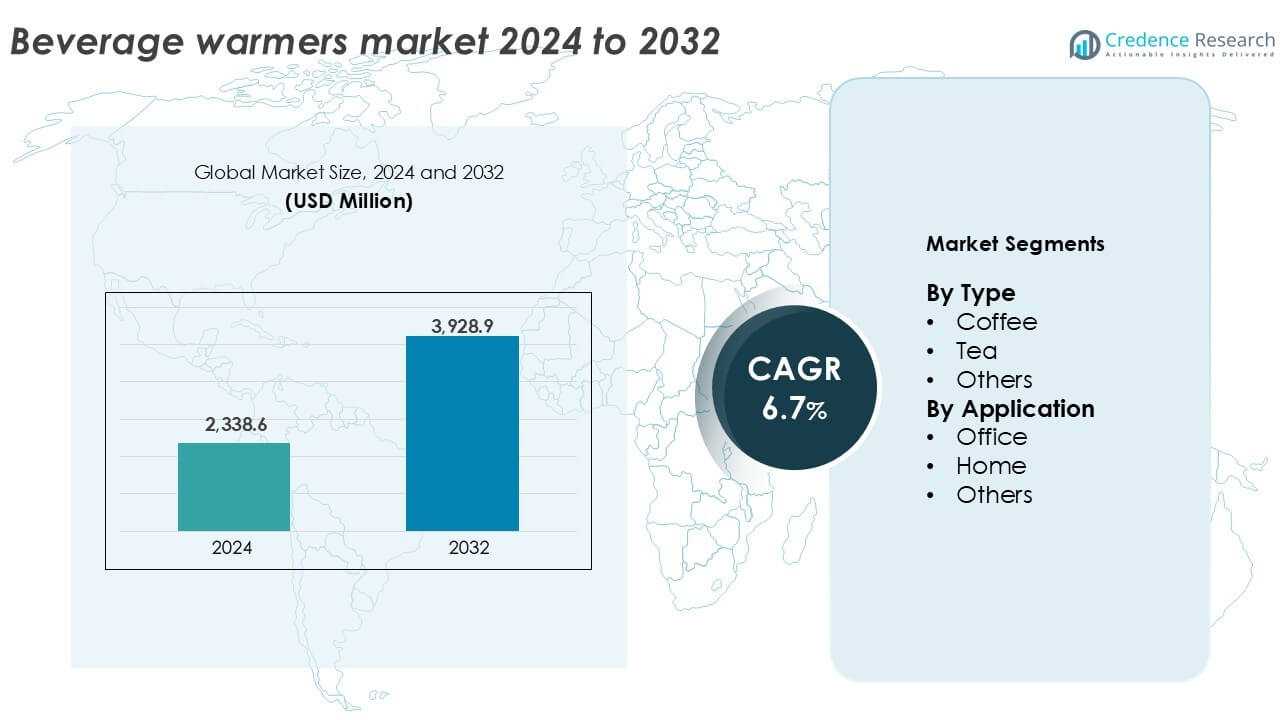
The Beverage Warmers Market size was valued at USD 2,338.6 million in 2024 and is anticipated to reach USD 3,928.9 million by 2032, at a CAGR of 6.7% during the forecast period.
| REPORT ATTRIBUTE |
DETAILS |
| Historical Period |
2020-2023 |
| Base Year |
2024 |
| Forecast Period |
2025-2032 |
| Beverage Warmers Market Size 2024 |
USD 2,338.6 million |
| Beverage Warmers Market, CAGR |
6.7% |
| Beverage Warmers Market Size 2032 |
USD 3,928.9 million |
Beverage Warmers Market Insights
- Rising coffee and tea consumption, along with work-from-home trends, drives consistent demand for personal-use beverage warmers across home and office applications.
- Smart warmers with temperature control, USB power, and compact designs are gaining traction, especially among tech-savvy and urban consumers.
- The market features strong competition from brands like Mr. Coffee, Salton, Cosori, and VonShef, each offering varied price points and features across e-commerce and retail.
- North America leads with a 35% market share, followed by Europe at 28% and Asia-Pacific at 22%; the coffee segment dominates by type with over 65% share, while the home application segment leads with 55% due to remote work adoption and lifestyle changes.
Beverage Warmers Market Segmentation Analysis:
By Type
The coffee segment dominates the beverage warmers market, accounting for over 65% of the total share in 2024. Rising global coffee consumption, especially among working professionals and millennials, drives the demand for coffee-specific warmers. These devices maintain optimal drinking temperature, improving consumer experience. Compact electric mug warmers and smart temperature-controlled coasters gain popularity in urban areas. The tea segment holds a moderate share, supported by increasing herbal and green tea intake. However, the “others” category, which includes hot chocolate and specialty drinks, remains niche but shows steady growth in regions with diverse beverage cultures.
- For instance, Ember Technologies has sold over 3 million temperature-controlled smart mugs globally, primarily targeting coffee drinkers with adjustable warmth settings via mobile app.
Access crucial information at unmatched prices!
Request your sample report today & start making informed decisions powered by Credence Research Inc.!
Download Sample
By Application
The home segment leads the market with a share exceeding 55% in 2024. Growing remote work culture, rising demand for convenience appliances, and gifting trends fuel adoption. Consumers prefer compact, affordable beverage warmers for home offices and personal use. The office segment also records significant uptake, driven by workplace comfort trends and shared amenities. Employers invest in beverage warmers to enhance employee satisfaction and reduce coffee run frequency. The “others” category, including hospitality and commercial lounges, registers gradual growth as businesses upgrade customer amenities in waiting areas and premium service settings.
- For instance, Cosori’s coffee mug warmer set appears frequently in online home appliance best‑seller lists for desk use.
Key Growth Drivers
Rising Coffee and Tea Consumption Worldwide
Global coffee and tea consumption continues to climb, significantly driving demand for beverage warmers. Urban consumers increasingly seek hot drinks at consistent temperatures throughout the day. The shift toward premium and specialty beverages such as espresso, matcha, and herbal infusions enhances the appeal of temperature-controlled drinkware. Rising awareness about taste preservation and aroma enhancement when beverages are kept at optimal warmth supports market growth. With the growing café culture and increased time spent working or relaxing at home, consumers adopt personal-use beverage warmers for convenience. Furthermore, gift-giving trends during holidays and corporate events fuel the adoption of high-end smart beverage warmers. The growing tea-drinking population in countries like China, India, and the UK adds to the product’s relevance. As consumer habits shift towards frequent, smaller servings of hot beverages throughout the day, the utility of beverage warmers is reinforced across both home and office settings.
- For instance, a 2024 National Coffee Association survey showed 67% of U.S. adults reported drinking coffee in the past day, the highest in 20 years.
Work-from-Home and Remote Work Culture Expansion
The widespread adoption of hybrid and remote work models significantly boosts the demand for small, personal-use appliances, including beverage warmers. Home offices have become standard, with professionals seeking to recreate office-like convenience at home. Beverage warmers cater to this need by keeping coffee and tea at ideal temperatures during long video calls or focus sessions. As workers reduce frequent kitchen visits, these devices save time and enhance productivity. Compact and energy-efficient designs make them suitable for desktop use. The growing preference for tech-integrated models with auto shut-off, temperature control, and USB connectivity aligns with the remote worker’s need for smarter tools. E-commerce platforms have widened product accessibility, while influencer reviews and tech gadget showcases increase consumer awareness. The rising demand for wellness-oriented and functional products further propels this category. As remote work becomes a permanent fixture in many sectors, the beverage warmers market gains long-term tailwinds.
- For instance, Gallup data shows that 78% of remote-capable employees work remotely at least part of the week with 52% in hybrid arrangements reinforcing continued demand for home office amenities.
Technological Advancements and Smart Home Integration
The beverage warmers market benefits from rapid innovation in consumer electronics and smart home ecosystems. Modern beverage warmers now feature precision temperature control, wireless charging capabilities, and smartphone connectivity. Brands develop models with customizable settings, automatic shut-off timers, and LED displays, enhancing safety and user experience. Integration with home assistants like Alexa and Google Home supports voice-controlled operation, increasing consumer appeal. These enhancements attract tech-savvy users seeking convenience and personalization. Materials innovation has also led to heat-resistant surfaces and spill-proof designs, making the devices more durable and desk-friendly. Manufacturers use these technological upgrades to differentiate products in a highly competitive market. Partnerships between appliance makers and software developers also create opportunities for cross-functional products, such as self-heating smart mugs. As consumers increasingly prioritize multi-functional and connected devices, advanced beverage warmers align well with modern lifestyle preferences, making technology a central growth pillar.
Key Trends & Opportunities
Premiumization and Giftable Appliance Demand
Premium beverage warmers are gaining traction due to rising consumer interest in lifestyle appliances that combine functionality with aesthetic appeal. Products with sleek designs, stainless steel finishes, and luxury packaging are preferred for personal use and corporate gifting. The gifting market, particularly during holidays, festivals, and corporate events, presents a lucrative opportunity for manufacturers. Limited-edition launches, color variants, and bundled gift sets with mugs or specialty coffee/tea items increase product desirability. This trend is especially strong in North America, Europe, and parts of Asia, where consumer spending on home gadgets and wellness products is growing. Brands targeting this segment often position their products as lifestyle enhancers rather than just kitchen tools. E-commerce platforms amplify this opportunity by enabling product personalization, review-based discovery, and influencer-led campaigns. As gift-oriented consumption continues to grow, companies have the chance to boost average selling prices and brand loyalty through premium positioning.
- For instance, Amazon lists Elysian Aura electric coffee mug warmers marketed specifically as gifting items during holidays and festivals.
Surging E-Commerce and D2C Channel Penetration
Digital commerce plays a pivotal role in expanding the reach of beverage warmer brands, particularly among younger consumers and remote workers. Online platforms offer broad product visibility, price comparison, and review-based decision-making, which influence buying behavior. Direct-to-consumer (D2C) channels help brands maintain tighter control over pricing, promotions, and customer engagement. Small brands leverage social media to launch niche or customized beverage warmers, targeting wellness-conscious and design-oriented audiences. Subscription models and loyalty programs integrated into brand websites encourage repeat purchases. Flash sales, influencer collaborations, and bundled deals on marketplaces such as Amazon, Flipkart, and Alibaba further stimulate growth. Moreover, global fulfillment options open access to untapped international markets. This shift to digital retail enables both startups and established players to test new designs, run targeted campaigns, and gather customer feedback in real time. With rising smartphone usage and digital payment adoption, e-commerce will remain a vital growth opportunity.
Key Challenges
Limited Product Differentiation and Brand Loyalty
One of the major challenges in the beverage warmers market is low product differentiation across brands. Many manufacturers offer similar design features, heating technology, and functionality, leading to commoditization. This limits consumers’ motivation to choose one brand over another, resulting in high price sensitivity. As a result, smaller players face difficulty in building long-term brand loyalty. Without strong branding, product innovation, or after-sales service differentiation, maintaining market share becomes difficult. While tech integration provides some edge, competing firms often replicate features quickly. Bulk imports of inexpensive, unbranded warmers also crowd the market, particularly in emerging economies. Retailers and online platforms tend to push low-margin, fast-moving models, making premium positioning harder to sustain. To counter this, companies must invest in brand storytelling, user experience enhancements, and ecosystem development. However, these strategies demand high marketing spend and continuous product upgrades, raising operational costs.
Safety Compliance and Energy Efficiency Regulations
The beverage warmers market faces growing scrutiny regarding energy consumption, electrical safety, and material standards. Regulatory bodies in the U.S., EU, and parts of Asia require certifications for home and office appliance safety. Products must comply with guidelines related to heat control, fire hazards, and electromagnetic interference. Non-compliance leads to product recalls, reputational damage, and restricted market entry. This poses a barrier for new entrants and small manufacturers lacking the resources to undergo rigorous testing and certification. Furthermore, increasing pressure to improve energy efficiency adds to production complexity and cost. Smart beverage warmers that stay plugged in or offer continuous heating face criticism for unnecessary power use, prompting demand for eco-mode settings and automatic shut-off features. Balancing innovation with compliance becomes crucial, especially in developed markets. As governments push stricter product standards under sustainability mandates, ensuring compliance without pricing out customers remains a core operational challenge.
Regional Analysis
North America
North America held the largest share in the beverage warmers market in 2024, accounting for approximately 35% of global revenue. The region benefits from strong coffee consumption, widespread work-from-home adoption, and high acceptance of small home appliances. The U.S. leads demand, driven by lifestyle-focused consumers and high disposable income. E-commerce growth, especially on platforms like Amazon and Best Buy, supports product accessibility. Smart warmers and premium designs gain popularity among tech-savvy users. Office spaces and co-working environments also contribute to segmental growth. Manufacturers prioritize North America for early product launches and marketing campaigns targeting holiday gifting seasons.
Europe
Europe captured around 28% of the global beverage warmers market in 2024, supported by rising tea and specialty coffee culture. Countries such as the UK, Germany, and France lead consumption, influenced by traditional hot beverage habits. Energy-efficient and aesthetically designed products perform well in this region due to eco-conscious consumer behavior. Growth is also driven by gift-focused purchasing and increasing office appliance demand. Regulatory standards for electrical safety and energy use are strict, prompting demand for certified and high-quality products. Both home and workplace use cases remain strong across urban centers, supporting steady product penetration across Western and Northern Europe.
Asia-Pacific
Asia-Pacific accounted for nearly 22% of the beverage warmers market in 2024 and is the fastest-growing region. Rapid urbanization, rising disposable income, and the surge in tea and instant coffee consumption drive growth. China, Japan, and South Korea dominate due to high-tech adoption and expanding e-commerce access. India and Southeast Asia are emerging markets, supported by growing middle-class households and gifting trends. Compact and affordable models perform well in space-constrained urban homes. The demand for USB and smart warmers is increasing among young professionals. Local brands and global entrants compete aggressively, offering a wide variety of designs and pricing tiers.
Latin America
Latin America held approximately 7% of the global beverage warmers market in 2024. Brazil, Mexico, and Argentina lead regional consumption, fueled by strong coffee-drinking cultures and rising middle-class appliance ownership. Growth remains moderate due to limited product availability and price sensitivity. E-commerce platforms are expanding, but offline retail remains dominant in rural areas. Increasing demand for personal-use electronics and desk gadgets in urban centers supports volume growth. Seasonal sales and gifting occasions during local holidays present opportunities for market penetration. However, lower awareness of premium features limits the smart warmer segment’s growth compared to other regions.
Middle East & Africa
The Middle East & Africa (MEA) region contributed around 5% to the global beverage warmers market in 2024. Demand is rising in urban centers such as the UAE, Saudi Arabia, and South Africa, where coffee chains and home appliance sales are growing. Cultural tea-drinking habits and hospitality trends support product relevance. However, market penetration is still at a nascent stage due to limited distribution and low consumer awareness in rural areas. Price-sensitive buyers prefer entry-level models, while expat communities and tech-oriented consumers show interest in smart versions. Growth potential remains strong with rising lifestyle modernization and retail development.
Beverage Warmers Market Segmentations:
By Type
By Application
By Geography
- North America
- Europe
- Germany
- France
- U.K.
- Italy
- Spain
- Rest of Europe
- Asia Pacific
- China
- Japan
- India
- South Korea
- South-east Asia
- Rest of Asia Pacific
- Latin America
- Brazil
- Argentina
- Rest of Latin America
- Middle East & Africa
- GCC Countries
- South Africa
- Rest of the Middle East and Africa
Competitive Landscape
The beverage warmers market features a mix of established appliance brands and emerging players focused on affordable, compact solutions. Companies like Mr. Coffee, Norpro, and Salton lead in North America with strong retail presence and brand recall. Cosori and VonShef offer premium, tech-integrated models that appeal to style-conscious consumers. Value brands such as Nicelucky, YEVIOR, and YEAILIFE gain traction via online platforms through budget-friendly and functional designs. Innovation centers around smart features, USB compatibility, and energy efficiency. Players compete on pricing, product design, warranty, and seasonal promotions. E-commerce channels intensify competition, enabling smaller brands like Evelots and WALFRONT to reach broader audiences through direct-to-consumer models. Market participants continuously expand their product lines to capture gifting and office-use segments. Branding, customer reviews, and influencer marketing heavily impact buying decisions, especially for first-time buyers. As consumer expectations shift toward design and tech integration, competitive intensity is expected to rise further.
Shape Your Report to Specific Countries or Regions & Enjoy 30% Off!
Key Player Analysis
- Cosori
- Evelots
- Coffee
- Nicelucky
- Norpro
- Salton
- VonShef
- WALFRONT
- YEAILIFE
- YEVIOR
Recent Developments
- In May 2024, Dr. Markus Mann, the Technology and Innovation Manager at Kanthal Division, was awarded the innovation prize at Alleima’s second Annual General Meeting (AGM) in Sandviken. He received this recognition for his remarkable work producing the innovative product Kanthal® Flow Heater.
- In December 2022, Xiaomi unveiled its first titanium thermos cup variant. According to XIAOMI, the MIJIA thermos cup Ti is the first thermos cup made of titanium metal. Due to its high purity, titanium doesn’t precipitate heavy metals. According to Xiaomi, it is a recognized biophilic metal and increases the thermos’ reliability. Xiaomi employs titanium to make the MIJIA cup. The cup weighs 21.5g and has a 450ml capacity. The thermos can keep liquids cold for six hours at ten degrees Celsius and heat for up to six hours at 58 degrees Celsius.
- In September 2022, the smart, effective, and fashionable Heat Coaster Pro coffee heating pad was released by an established product design company specializing in heat coasters, Ikago. Heat Coaster Pro operates without a hitch and maintains coffee warmth because of an infrared sensor and a unique heating film. With so many functions, the Ikago Heat Coaster Pro stands out compared to other beverage warmers available today. It uses an infrared sensor with integrated algorithms to learn the current temperature of a beverage. It’s user-friendly. Customers may adjust the temperature with a 1°F/°C increase using the touch screen on the digital display, which provides a clear view.
Report Coverage
The research report offers an in-depth analysis based on Type, Application and Geography. It details leading market players, providing an overview of their business, product offerings, investments, revenue streams, and key applications. Additionally, the report includes insights into the competitive environment, SWOT analysis, current market trends, as well as the primary drivers and constraints. Furthermore, it discusses various factors that have driven market expansion in recent years. The report also explores market dynamics, regulatory scenarios, and technological advancements that are shaping the industry. It assesses the impact of external factors and global economic changes on market growth. Lastly, it provides strategic recommendations for new entrants and established companies to navigate the complexities of the market.
Future Outlook
- Demand for smart beverage warmers with app connectivity will rise among tech-focused consumers.
- Remote work culture will continue to drive purchases of personal-use warmers for home offices.
- Compact and USB-powered designs will gain popularity in urban and space-limited environments.
- Manufacturers will expand premium product lines targeting gifting and lifestyle segments.
- E-commerce platforms will remain the primary sales channel for both global and niche brands.
- Asia-Pacific will emerge as the fastest-growing market due to rising middle-class adoption.
- Energy-efficient models with auto shut-off features will meet growing regulatory demands.
- Product bundling with mugs and beverage accessories will support market expansion.
- Competition will intensify as low-cost brands enter through online marketplaces.
- Customizable temperature settings and durable materials will become key buying factors.



