
Market Overview:
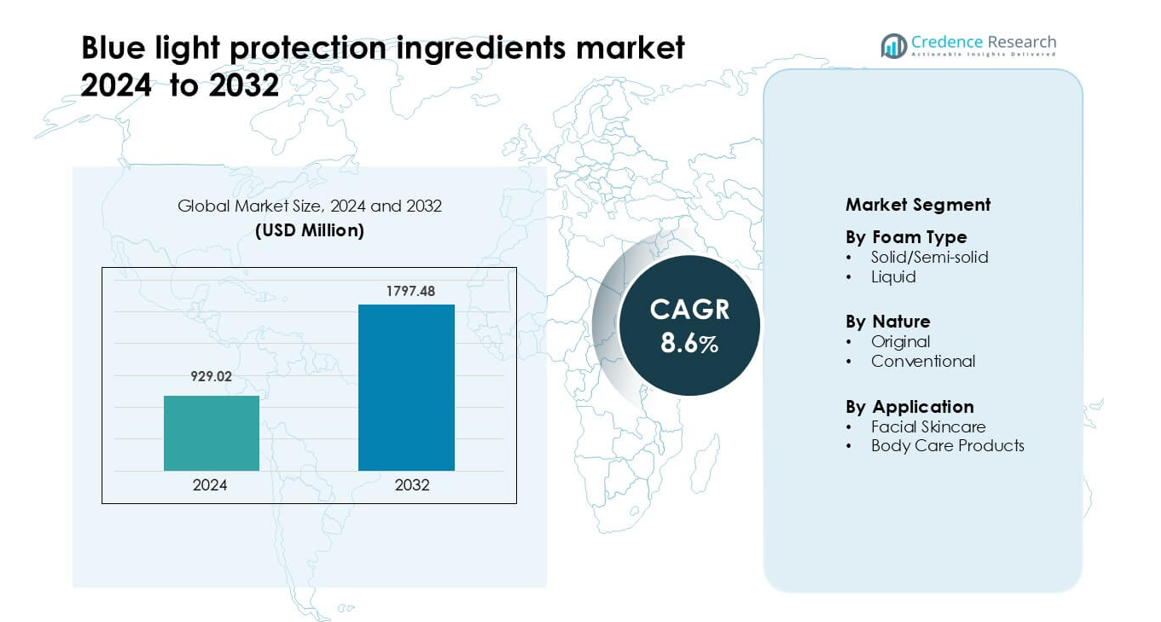
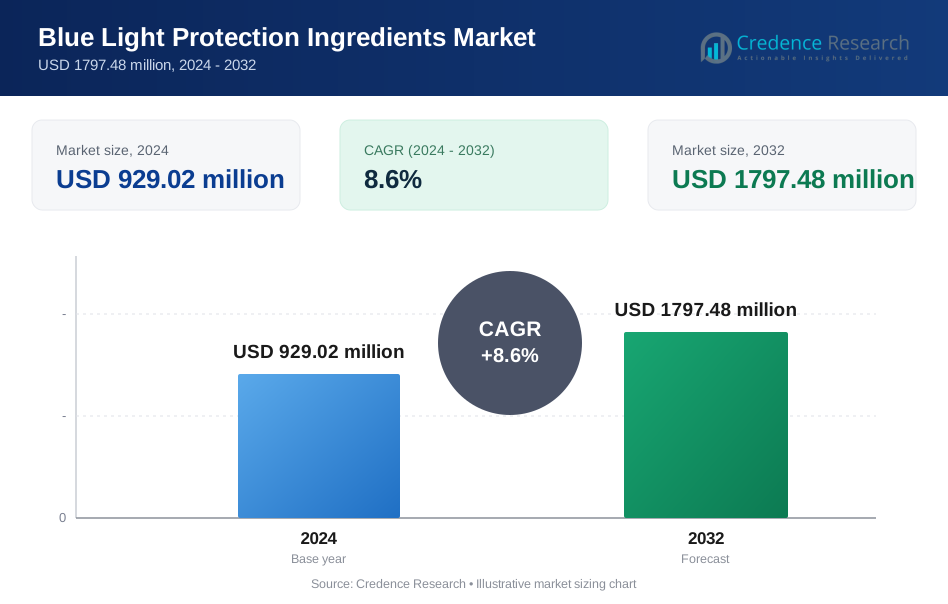
Blue light protection ingredients market was valued at USD 929.02 million in 2024 and is anticipated to reach USD 1797.48 million by 2032, growing at a CAGR of 8.6 % during the forecast period.
| REPORT ATTRIBUTE | DETAILS |
|---|---|
| Historical Period | 2020-2023 |
| Base Year | 2024 |
| Forecast Period | 2025-2032 |
| Blue Light Protection Ingredients Market Size 2024 | USD 929.02 million |
| Blue Light Protection Ingredients Market, CAGR | 8.6% |
| Blue Light Protection Ingredients Market Size 2032 | USD 1797.48 million |
The Blue Light Protection Ingredients Market features strong competition among RAHN AG, SkinCeuticals International, Kobo Products, Inc., Croda International Plc, Lonza Group, Evonik Industries, Clariant International Ltd, BASF Group, Ashland Global Specialty Chemicals Inc., and DSM Nutritional Products, LLC. These companies lead innovation in antioxidant complexes, microalgae extracts, and carotenoid-based actives targeting digital aging concerns. They invest in clinical testing, formulation stability, and clean-label development to strengthen brand partnerships and expand global reach. North America remains the leading region with about 34% share in 2024, supported by high awareness of blue light damage and strong adoption of advanced skincare formulations.
Market Insights
- Blue light protection ingredients market was valued at USD 929.02 million in 2024 and is anticipated to reach USD 1797.48 million by 2032, growing at a CAGR of 8.6 % during the forecast period.
- Demand grows due to rising digital screen exposure, strong focus on anti-aging solutions, and higher adoption of clean beauty formulations using microalgae, lutein, and botanical antioxidants.
- Trends include expansion of multi-functional skincare, increased use of clinically validated actives, and growing opportunities in body care and professional-grade formulations.
- The market remains competitive with companies such as RAHN AG, SkinCeuticals International, Kobo Products, Croda, Lonza, Evonik, Clariant, BASF, Ashland, and DSM advancing stabilized ingredient systems; restraints include low consumer awareness and stability challenges in natural actives.
- North America leads with 34% share, followed by Europe at 29% and Asia-Pacific at 27%; facial skincare holds the largest segment share at 68% due to stronger demand for blue-light-protective creams and serums.
Market Segmentation Analysis:
By Form Type
The solid/semi-solid category leads the Blue Light Protection Ingredients Market with about 57% share in 2024 due to strong use in creams, balms, and hybrid skincare formats. Brands prefer this form because solid and semi-solid bases hold blue-light-filtering actives such as lutein, zinc oxide, and microalgae extracts with higher stability. Demand grows as consumers look for thicker textures that offer longer surface retention and improved barrier repair. The liquid segment expands at a steady pace, driven by serums and essence-based products targeting fast absorption and layered skincare routines.
- For instance, a cosmetic company reported formulating a serum with 0.05% Tisochrysis lutea microalgae extract in nanostructured lipid carriers; when stored at 40 °C and 75% relative humidity, the carrier size remained stable (average diameter ~ 150 nm) over 30 days, indicating strong colloidal stability under stress.
By Nature
The original (naturally derived) category dominates this segment with nearly 61% share in 2024 due to rising preference for plant-based antioxidants and clean-label formulations. Consumers trust natural ingredients like marigold-derived lutein, carotenoids, and botanical flavonoids for safer and long-term digital light protection. Brands promote original variants to align with sustainability goals and regulatory pressure for greener formulations. Conventional options continue to serve mass-market needs, supported by stable synthetic filters and cost-effective production, but they grow slower as natural-positioned products gain visibility.
- For instance, Katra Phytochem Pvt Ltd does engage in the cultivation of marigold (Tagetes erecta) through contract farming with local farmers for the production of lutein and zeaxanthin products (such as XanMaX).
By Application
Facial skincare holds the largest share with about 68% in 2024, driven by high usage of blue-light-shielding creams, serums, and moisturizers aimed at protecting digital-exposed skin. Increased screen time, early aging concerns, and strong marketing of anti-photoaging benefits fuel this dominance. Body care products gain traction as brands expand blue-light claims into lotions and targeted treatments, though adoption remains lower due to limited consumer awareness. Growth in body care is supported by wider retail penetration and the rise of multifunctional products offering hydration plus digital-radiation protection.
Key Growth Drivers
Rising Digital Screen Exposure
Growing screen time pushes strong demand for blue light protection ingredients. Many consumers spend long hours on phones, laptops, and TVs, raising concerns about digital aging. Brands respond by investing in stronger actives that block high-energy visible light and support skin repair. The shift toward remote work boosts this demand further and shapes new skincare routines. Manufacturers develop advanced antioxidant blends that slow oxidative stress. The growing awareness of premature aging encourages faster adoption across premium and mass skincare lines. Continuous digital dependence makes this driver one of the strongest forces in the market.
- For instance, a survey found that remote workers spend roughly 13 hours per day looking at screens about two hours more than their on-site counterparts.
Accelerating Clean Beauty Movement
Natural blue light protection ingredients gain strong acceptance across global markets. Consumers choose plant-based lutein, carotenoids, and microalgae due to safety and sustainability needs. Clean beauty regulations also encourage brands to replace synthetic filters with eco-friendly actives. This shift pushes companies to expand natural ingredient sourcing and develop stable botanical extracts. Certifications and green labels further increase consumer trust. As awareness grows, more brands introduce vegan and cruelty-free formulations. The clean beauty trend continues to elevate the demand for original, less processed blue light protection compounds.
- For instance, Sunpure Extracts produces its LUTIsight™ lutein and bright™ zeaxanthin from Tagetes erecta petals.
Expansion of Multi-Functional Skincare
Blue light protection becomes a core feature in modern hybrid skincare. Consumers prefer products that combine hydration, anti-aging, SPF, and digital defense. This preference drives strong innovation in serums, creams, and daily moisturizers. Brands integrate blue-light-shielding antioxidants with peptides and barrier-support actives. Retailers promote multi-functional products due to higher value perception. This expansion encourages ingredient suppliers to create blends that work across textures and formats. The rise of multi-step routines strengthens this driver and boosts product penetration in premium and mass channels.
Key Trend & Opportunity
Growth of Tech-Aware Beauty Consumers
Tech-aware consumers reshape market demand for digital protection. Younger users seek products that protect skin from screen exposure due to lifestyle habits. Brands respond with ingredient stories that highlight visible light defense. This shift creates an opportunity to expand into gaming communities and digital workers. Companies also use digital campaigns that educate buyers about long-term skin damage. The trend supports premiumization and encourages advanced ingredient research. As awareness grows, brands gain more scope to launch targeted blue-light-protection lines across global markets.
- For instance, Pilgrim, a D2C beauty brand in India, found through its survey that 80% of women believe skincare products can protect their skin from blue-light damage, driving the company to create blue-light defense formulations specifically for screen-intensive users.
Rising Demand for Professional-Grade Formulations
Professional skincare brands add strong blue light filters to meet clinic and spa needs. Dermatologists highlight visible light risks, increasing consumer confidence. Ingredient suppliers create medical-grade antioxidant complexes to suit clinical treatments. This trend supports higher-priced formulations and encourages scientific claims. The professional sector offers opportunities for data-backed product launches. More brands partner with skin clinics for testing and validation. The growing preference for evidence-based skincare strengthens this trend and drives market expansion.
- For instance, Dermaenergy s Black Label Revive Rich moisturizer, sold exclusively through skin clinics, includes their digital antioxidant system to counteract blue-light damage this advanced formula is formulated for mature skin with pre- and probiotics, reflecting a clinical-grade effort.
Product Expansion Beyond Facial Skincare
Blue light protection ingredients shift from facial products to wider categories. Companies now target body care, lip care, and haircare with specialized actives. This expansion helps brands enter untouched segments with strong market potential. Developers create lighter textures that fit body lotions and daily-use items. Retailers promote broader protection benefits for full-body exposure. This trend encourages suppliers to design flexible ingredient systems. Expanding into non-facial formats offers strong growth opportunities for new brands.
Key Challenge
Limited Consumer Knowledge of Blue Light Damage
Many buyers still lack clear understanding of blue light’s long-term skin effects. This gap slows adoption in several regions. Brands must invest heavily in awareness campaigns to explain visible light damage. Scientific claims need stronger communication to gain trust. Retailers struggle to showcase benefits without complex explanations. This limits growth in price-sensitive markets where education remains low. Manufacturers face challenges in differentiating products without overwhelming consumers. Overcoming this knowledge gap remains a major barrier for market expansion.
Stability Issues with Natural Active Ingredients
Natural blue light protection ingredients face formulation challenges. Botanical extracts often degrade under heat, light, or oxidation. This instability increases production costs and limits long shelf life. Manufacturers need advanced encapsulation and stabilization technologies to maintain performance. Smaller brands struggle with these costs, affecting product consistency. Regulatory pressure for clean formulas adds more complexity. The challenge slows expansion of natural variants in mass-market products. Ensuring stability remains critical for wider adoption across global categories.
Regional Analysis
North America
North America holds about 34% share of the Blue Light Protection Ingredients Market in 2024, driven by strong adoption of digital-focused skincare and high consumer awareness of screen-induced aging. Brands in the US and Canada invest in advanced antioxidant blends and natural actives to meet demand for clean and multi-functional products. Retailers highlight blue light defense as a key claim across premium and mass skincare. Growth accelerates due to high device penetration, strong influence of dermatologists, and rapid product innovation. The region benefits from mature regulatory systems and strong R&D capabilities.
Europe
Europe accounts for nearly 29% share in 2024, supported by strict cosmetic regulations, high safety standards, and rapid acceptance of natural blue-light-protection ingredients. Consumers favor botanical lutein, microalgae extracts, and carotenoid-rich blends due to rising eco-conscious preferences. Germany, France, and the UK lead innovation with strong demand for anti-aging and digital pollution protection. Brands benefit from established distribution networks and growing interest in dermocosmetics. The region’s focus on sustainability and clean beauty enhances product visibility and encourages the launch of certified formulations across major EU markets.
Asia-Pacific
Asia-Pacific leads growth momentum and captures about 27% share in 2024, driven by massive digital device usage and strong beauty culture across China, Japan, and South Korea. Consumers actively seek products addressing digital aging, pigmentation, and skin barrier issues. K-beauty and J-beauty brands promote blue light protection as part of daily skincare routines. Ingredient suppliers introduce high-performance microalgae, niacinamide blends, and antioxidant complexes. Expanding e-commerce and increasing awareness among younger consumers strengthen market penetration. The region’s fast-paced innovation cycle accelerates new product development and amplifies adoption across facial and body skincare.
Latin America
Latin America holds around 6% share in 2024, supported by rising awareness of digital skin damage and growing interest in multi-functional skincare. Brazil and Mexico lead demand with stronger influence from beauty influencers and dermatology clinics. Consumers seek cost-effective blue light protection in daily moisturizers and sunscreens. Local brands integrate antioxidant-rich botanical ingredients to align with natural beauty trends. Market expansion is supported by improving retail infrastructure and increasing smartphone usage. However, limited awareness outside major cities restricts higher penetration, yet long-term growth remains promising as education and affordability improve.
Middle East & Africa
The Middle East & Africa region captures about 4% share in 2024, driven by rising screen time and interest in anti-aging skincare among urban consumers. The UAE and Saudi Arabia lead demand due to higher purchasing power and fast adoption of global beauty trends. Brands offer blue light protection in lightweight formats suited to warm climates. Ingredient suppliers focus on heat-stable antioxidants to maintain formulation performance. Awareness campaigns from dermatology clinics support growth. Limited market maturity and price sensitivity in several African nations slow wider penetration, but increasing digital exposure encourages steady future adoption.
Market Segmentations
By Foam Type
- Solid/Semi-solid
- Liquid
By Nature
- Original
- Conventional
By Application
- Facial Skincare
- Body Care Products
By Geography
- North America
- U.S.
- Canada
- Mexico
- Europe
- Germany
- France
- U.K.
- Italy
- Spain
- Rest of Europe
- Asia Pacific
- China
- Japan
- India
- South Korea
- South-east Asia
- Rest of Asia Pacific
- Latin America
- Brazil
- Argentina
- Rest of Latin America
- Middle East & Africa
- GCC Countries
- South Africa
- Rest of the Middle East and Africa
Competitive Landscape
The competitive landscape of the Blue Light Protection Ingredients Market features strong participation from leading players such as RAHN AG, SkinCeuticals International, Kobo Products, Inc., Croda International Plc, Lonza Group, Evonik Industries, Clariant International Ltd, BASF Group, Ashland Global Specialty Chemicals Inc., and DSM Nutritional Products, LLC. These companies focus on advanced antioxidant systems, microalgae-derived actives, carotenoid complexes, and stabilized botanical extracts to strengthen product performance. Many players invest in clinical validation and in-vitro testing to support efficacy claims and differentiate ingredients in a crowded market. Partnerships with skincare brands and dermatology-led product development remain key growth strategies. Companies also expand global distribution, enhance clean-label portfolios, and develop multifunctional actives compatible with serums, creams, and hybrid skincare formats. Growing demand for digital-aging protection drives continuous innovation, encouraging firms to improve ingredient stability, sensory compatibility, and sustainability profiles.
Key Player Analysis
- RAHN AG
- SkinCeuticals International
- Kobo Products, Inc.
- Croda International Plc
- Lonza Group
- Evonik Industries
- Clariant International Ltd
- BASF Group
- Ashland Global Specialty Chemicals Inc.
- DSM Nutritional Products, LLC
Recent Developments
- In June 2025, Vaseline collaborated with Ogilvy Singapore and Ogilvy Canada to address the rising but often overlooked concern of blue light exposure through its new Asian campaign titled ‘Screen Block’, launched in Thailand. Targeting gamers who can spend up to 12 hours daily in front of screens, the campaign highlights the urgent need for protective skincare solutions in digitally intensive lifestyles. This initiative is expected to significantly enhance awareness and consumer engagement in Southeast Asia, reinforcing the demand for blue light protection ingredients in daily-use skincare products.
- In May 2025, Emcutix Biopharmaceuticals Limited, a subsidiary of Emcure Pharmaceuticals Ltd., expanded its presence in the sun and digital protection market with the launch of SOLGLO Hybrid Sunscreen SPF 70 PA++++ and SOLGLO Invisible Sunscreen Gel SPF 50+ PA++++. These advanced broad-spectrum sunscreens defend against UVA and UVB rays and also nourish the skin, reflecting a growing market shift toward multifunctional products. Their launch is expected to fuel demand for hybrid formulations that incorporate blue light defense, particularly in dermatology-backed skincare lines.
- In April 2025, Evonik Industries showcased new daily-sun-care ingredient concepts at in-cosmetics Global 2025, highlighting formulations with demonstrated anti-blue-light benefits. The company positioned these innovations to meet fast-growing demand for digital-exposure protection
Report Coverage
The research report offers an in-depth analysis based on Foam Type, Nature, Application and Geography. It details leading market players, providing an overview of their business, product offerings, investments, revenue streams, and key applications. Additionally, the report includes insights into the competitive environment, SWOT analysis, current market trends, as well as the primary drivers and constraints. Furthermore, it discusses various factors that have driven market expansion in recent years. The report also explores market dynamics, regulatory scenarios, and technological advancements that are shaping the industry. It assesses the impact of external factors and global economic changes on market growth. Lastly, it provides strategic recommendations for new entrants and established companies to navigate the complexities of the market.
Future Outlook
- Demand will rise as global screen time continues to increase across all age groups.
- Brands will expand blue light protection into body care, lip care, haircare, and hybrid formulations.
- Natural ingredients such as lutein, carotenoids, and microalgae extracts will gain stronger preference.
- Clinical validation and dermatology-backed studies will play a bigger role in product positioning.
- Multi-functional skincare with combined antioxidant, anti-aging, and digital defense features will dominate launches.
- More companies will invest in encapsulation and stabilization technologies to improve ingredient performance.
- Regulatory bodies will encourage safer and cleaner formulations, boosting plant-based actives.
- Growth will accelerate in Asia-Pacific as K-beauty and J-beauty influence global product innovation.
- Professional skincare brands and clinics will adopt high-potency blue-light-defense ingredients for targeted treatments.
- Increased collaboration between ingredient suppliers and skincare brands will drive faster innovation cycles.
Request a Free Sample
Fill in your details and we'll send you a free sample report.
- Sample data tables & charts
- Research methodology
Need a Custom Version of This Report?
Tailor the scope, geography, or segments to your exact requirements.
- Custom geography or segment scope
- Direct access to our analyst team
Frequently Asked Questions
What is the current market size for Blue light protection ingredients market, and what is its projected size in 2032?
At what Compound Annual Growth Rate is Blue light protection ingredients market projected to grow between 2025 and 2032?
Which application segment is estimated to post the highest CAGR during the forecast period?
Who are the major global blue light protection ingredients market players?
What are the major market drivers of the blue light protection ingredients industry?
What are the major market restraints of the blue light protection ingredients industry?
What are the major market opportunities of the blue light protection ingredients industry?
Who are the leading companies in Blue light protection ingredients market?
Table of Content
Chapter 1. Report Introduction
- 1.1 Report Description & Purpose
- 1.1.1 Report Title & Market Definition
- 1.1.2 Unique Selling Propositions (USP) & Key Differentiators
- 1.1.3 Value Proposition for Stakeholders
- 1.2 Research Objectives
- 1.2.1 Market Sizing Objectives (Volume & Revenue)
- 1.2.2 Segmentation Objectives
- 1.2.3 Competitive Intelligence Objectives
- 1.2.4 Forecast & Scenario Objectives
- 1.3 Report Scope
- 1.3.1 Blue Light Protection Ingredients Scope – Types & Subtypes Covered
- 1.3.2 Geographic Scope – Regions & Countries Covered
- 1.3.3 Historical Period, Base Year & Forecast Period (2024; forecast to 2032)
- 1.3.4 Inclusions & Exclusions
- 1.4 HS Code & Classification Framework
- 1.5 Currency, Units & Pricing Basis
- 1.6 Target Stakeholders
- 1.7 Limitations & Assumptions
Chapter 2. Executive Summary
- 2.1 Global Blue Light Protection Ingredients Market Snapshot
- 2.1.1 Market Size – Historical (2024) & Forecast (2024-2032) (2024: USD 929.02 million → 2032: USD 1797.48 million)
- 2.1.2 Volume & Revenue – Global Totals
- 2.1.3 Key Market Highlights – Top Five Facts
- 2.2 Blue Light Protection Ingredients Market Segmentation Snapshot
- 2.2.1 Market Split by Region – 2024 vs. 2032
- 2.3 Competitive Snapshot
- 2.3.1 Top 10 Players by Revenue Share – 2024
- 2.3.2 Top 10 Players by Volume Share – 2024
- 2.3.3 Recent Strategic Developments (18-Month Summary)
- 2.4 Key Investment Highlights & Strategic Conclusions
Chapter 3. Blue Light Protection Ingredients Market Dynamics & Industry Analysis
- 3.1 Market Overview & Context
- 3.1.1 Blue Light Protection Ingredients Market Position in the Broader Automotive Value Chain
- 3.1.2 OEM vs. Replacement Market Dynamics
- 3.1.3 Market Maturity & Development Stage by Region
- 3.2 Blue Light Protection Ingredients Market Drivers
- 3.3 Blue Light Protection Ingredients Market Restraints & Challenges
- 3.4 Blue Light Protection Ingredients Market Opportunities
- 3.5 Porter's Five Forces Analysis
- 3.5.1 Threat of New Entrants
- 3.5.2 Bargaining Power of Suppliers
- 3.5.3 Bargaining Power of Buyers
- 3.5.4 Threat of Substitutes
- 3.5.5 Competitive Rivalry – Intensity Assessment
- 3.6 Blue Light Protection Ingredients Value Chain Analysis
- 3.6.1 Upstream – Raw Material/Input Suppliers
- 3.6.1.1 Raw Material/Input 1
- 3.6.1.2 Raw Material/Input 2
- 3.6.1.3 Raw Material/Input 3
- 3.6.2 Midstream – Production/Manufacturing/Service Delivery
- 3.6.2.1 Production/Process Overview
- 3.6.2.2 Key Facility Locations & Capacity by Manufacturer
- 3.6.3 Downstream – Distribution & End Consumer
- 3.6.3.1 Primary Channel – B2B/OEM
- 3.6.3.2 Secondary Channels – Dealer, Retail, Online, Direct
- 3.6.4 Value Chain Profitability Analysis
- 3.6.1 Upstream – Raw Material/Input Suppliers
- 3.7 PESTEL Analysis
- 3.7.1 Political Factors
- 3.7.2 Economic Factors
- 3.7.3 Social Factors
- 3.7.4 Technological Factors
- 3.7.5 Environmental Factors
- 3.7.6 Legal Factors
- 3.8 Blue Light Protection Ingredients Supply Chain Analysis
- 3.8.1 Raw Material/Input Supply Risk Assessment
- 3.8.2 Manufacturing Concentration Risk (Geographic Exposure)
- 3.8.3 Trade Disruption Impact Analysis
- 3.9 Regulatory & Policy Landscape
Note: The regulatory and policy landscape section covers regulations based on their applicability to the market, Blue Light Protection Ingredients category, geography, and scope of the study. Only regulatory frameworks with a material impact on operations, compliance, trade, sustainability, or market access are analyzed in detail.
Chapter 4. Key Investment Pockets & Opportunity Analysis
- 4.1 Blue Light Protection Ingredients Market Attractiveness Analysis
- 4.1.1 By Region – Investment Attractiveness Matrix (Volume × CAGR)
- 4.2 Absolute Revenue Growth Opportunity
- 4.2.1 By Region – Absolute USD Growth Through 2032
- 4.3 Incremental Volume Opportunity
- 4.3.1 By Region – Incremental Volume Through 2032
- 4.3.2 Segment – Incremental Volume
- 4.4 Emerging Submarket Opportunity Deep Dive (Subject to Applicability)
- 4.5 Emerging Market Opportunity Scorecards
- 4.5.1 United States
- 4.5.2 Europe
- 4.5.3 Asia
- 4.5.4 Middle East & Africa
Note: Emerging Market Opportunity Scorecards will be included based on relevance and strategic importance. Regions listed are indicative and may vary depending on data availability and market dynamics.
Chapter 5. Blue Light Protection Ingredients Import-Export Analysis & Trade Flows
- 5.1 Global Trade Overview
- 5.1.1 Global Export Value by Country (2024)
- 5.1.2 Global Export Volume by Country (2024)
- 5.1.3 Global Import Value by Country (2024)
- 5.1.4 Global Import Volume by Country (2024)
- 5.1.5 Net Trade Balance by Country (2024)
- 5.2 Export Analysis – Segment
- 5.2.1 Type 1 (HS Code)
- 5.2.2 Type 2 (HS Code)
- 5.2.3 Type 3 (HS Code)
- 5.2.4 Type 4 (HS Code)
- 5.2.5 Type 5 (HS Code)
- 5.3 Import Analysis – Segment
- 5.3.1 Type 1 (HS Code)
- 5.3.2 Type 2 (HS Code)
- 5.3.3 Type 3 (HS Code)
- 5.3.4 Type 4 (HS Code)
- 5.3.5 Type 5 (HS Code)
- 5.4 Average Unit Trade Prices
- 5.4.1 Average Export Price – Segment & Country
- 5.4.2 Average Import Price – Segment & Source Country
- 5.4.3 Price Trends (2024)
- 5.5 Key Trade Route Analysis
- 5.5.1 Trade Route 1
- 5.5.2 Trade Route 2
- 5.5.3 Trade Route 3
- 5.5.4 Trade Route 4
- 5.5.5 Trade Route 5
- 5.6 Trade Policy Impact Assessment
- 5.6.1 US Anti-Dumping & Section 301 Tariffs
- 5.6.2 EU Customs Union Impact
- 5.6.3 Major Free Trade Agreements
- 5.6.4 USMCA Rules of Origin
Note: Trade policy analysis will be included only where relevant to the Blue Light Protection Ingredients market.
Chapter 6. Competitive Landscape & Company Benchmarking
- 6.1 Blue Light Protection Ingredients Market Concentration & Structure
- 6.1.1 Herfindahl-Hirschman Index (HHI) – vs. 2024
- 6.1.2 Tier 1, Tier 2 & Tier 3 Market Structure
- 6.1.3 Global, Regional & Local Player Dynamics
- 6.2 Blue Light Protection Ingredients Market Share Analysis – 2024
- 6.2.1 Global Revenue Share by Company
- 6.2.2 Global Volume Share by Company
- 6.2.3 Regional Revenue Share
- 6.2.4 Market Share Evolution ( vs. 2024)
- 6.2.5 OEM Segment Share by Company
- 6.2.6 Replacement Segment Share by Company
- 6.3 Production/Delivery Capacity & Facility Analysis
- 6.3.1 Global Installed Capacity
- 6.3.2 Capacity Utilization Rates
- 6.3.3 Production/Output Volume
- 6.3.4 Facility Locations & Capacity Map
- 6.3.5 Planned Capacity Additions
- 6.4 Blue Light Protection Ingredients Competitive Benchmarking Matrix
- 6.4.1 Revenue, Volume, CAGR & Profitability Comparison
- 6.4.2 Channel Revenue Mix
- 6.4.3 Geographic Revenue Exposure
- 6.4.4 R&D Intensity
- 6.4.5 Sustainability Maturity
- 6.5 Strategic Developments in Blue Light Protection Ingredients (Last 24 Months)
- 6.5.1 Mergers, Acquisitions & Divestments
- 6.5.2 New Blue Light Protection Ingredients Launches
- 6.5.3 Facility Expansions
- 6.5.4 Strategic Alliances, Joint Ventures & Partnerships
- 6.5.5 Distribution Expansion & Market Entry
- 6.5.6 Sustainability & ESG Initiatives
- 6.6 Competitive Strategy Mapping
- 6.6.1 Leader, Challenger, Follower & Niche Classification
- 6.6.2 Pricing Strategy Comparison
- 6.6.3 Channel Strategy Matrix
Note: Strategic developments are included based on their materiality and the availability of reliable information.
Chapter 7. Global Blue Light Protection Ingredients Market – By Distribution Channel
- 7.1 Segment Overview
- 7.1.1 Volume & Revenue Split by Channel (2024 & 2032)
- 7.1.2 Channel Mix Evolution (2024-2032)
Chapter 8. Regional Market Analysis – Global Overview
- 8.1 Global Regional Overview
- 8.1.1 Regional Volume Share
- 8.1.2 Regional Revenue Share
- 8.1.3 Regional Volume by Region
- 8.1.4 Regional Revenue by Region
- 8.1.5 Regional Forecast Through 2032
- 8.2 Cross-Regional Segment Analysis
- 8.2.1 By Distribution Channel
- 8.2.2 By Brand/Price Tier
Chapter 9. North America Blue Light Protection Ingredients Market
- 9.1 United States
- 9.2 Canada
- 9.3 Mexico
Chapter 10. Europe Blue Light Protection Ingredients Market
- 10.1 Germany
- 10.2 France
- 10.3 Italy
- 10.4 United Kingdom
- 10.5 Spain
- 10.6 Poland
- 10.7 Russia
- 10.8 Netherlands
- 10.9 Belgium
- 10.10 Sweden
- 10.11 Denmark
- 10.12 Norway
- 10.13 Rest of Europe
Chapter 11. Asia Pacific Blue Light Protection Ingredients Market
- 11.1 China
- 11.2 India
- 11.3 Japan
- 11.4 South Korea
- 11.5 Thailand
- 11.6 Indonesia
- 11.7 Vietnam
- 11.8 Malaysia
- 11.9 Australia
- 11.10 Rest of Asia Pacific
Chapter 12. Latin America Blue Light Protection Ingredients Market
- 12.1 Brazil
- 12.2 Argentina
- 12.3 Colombia
- 12.4 Chile
- 12.5 Rest of Latin America
Chapter 13. Middle East Blue Light Protection Ingredients Market
- 13.1 Saudi Arabia
- 13.2 United Arab Emirates
- 13.3 Turkey
- 13.4 Israel
- 13.5 Iran
- 13.6 Rest of the Middle East
Chapter 14. Africa Blue Light Protection Ingredients Market
- 14.1 South Africa
- 14.2 Egypt
- 14.3 Nigeria
- 14.4 Morocco
- 14.5 Rest of Africa
Chapter 15. Blue Light Protection Ingredients Company Profiles
- 15.1 [Company 01]
- 15.1.1 Company Overview
- 15.1.2 Key Management Personnel
- 15.1.3 Products & Services Portfolio
- 15.1.4 Financial Performance
- 15.1.5 Key Market Focus & Geographic Presence
- 15.1.6 Recent Developments & Strategic Initiatives
Note: The company profile list is preliminary and may change based on research findings, market developments, data availability, and client requirements.
Chapter 16. Appendices
- Appendix A – List of Abbreviations & Acronyms
- Appendix B – Industry Classification Code Reference – Full Series
- Appendix C – Production & Capacity Data Tables
- Appendix D – End-Use & Demand Base Tables
- Appendix E – Consumption & Replacement Rate Assumptions
- Appendix F – ASP Reference Tables
- Appendix G – Manufacturing & Facility Database
- Appendix H – Import-Export Data Tables
- Appendix I – Regulatory Summary Tables
- Appendix J – Primary Research Participant List (Anonymized)
- Appendix K – Primary Research Questionnaire Framework
- Appendix L – Data Sources & Bibliography
- Appendix M – Market Size Divergence & Source Comparison
Chapter 17. Research Methodology
- 17.1 Research Framework & Philosophy
- 17.2 Secondary Research – Sources, Hierarchy & Data Extraction
- 17.3 Data Modeling – Bottom-Up & Top-Down Market Sizing
- 17.4 Primary Research – Stakeholder Framework, LOI & Sample Sizes
- 17.5 Forecast Methodology – Regression, Scenario & Sensitivity Analysis
- 17.6 Quality Control – Four-Layer Validation Framework
- 17.7 Limitations & Standard Assumptions
- 17.8 Disclaimer
