
Market Overview:
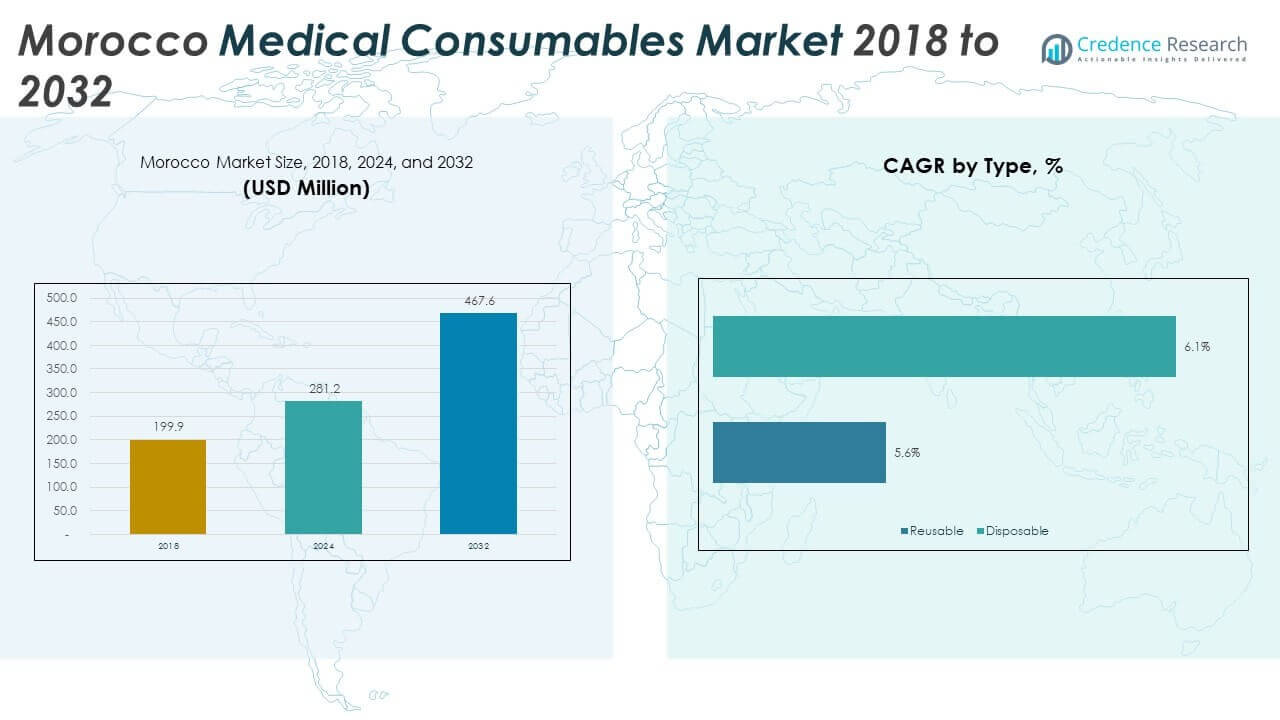
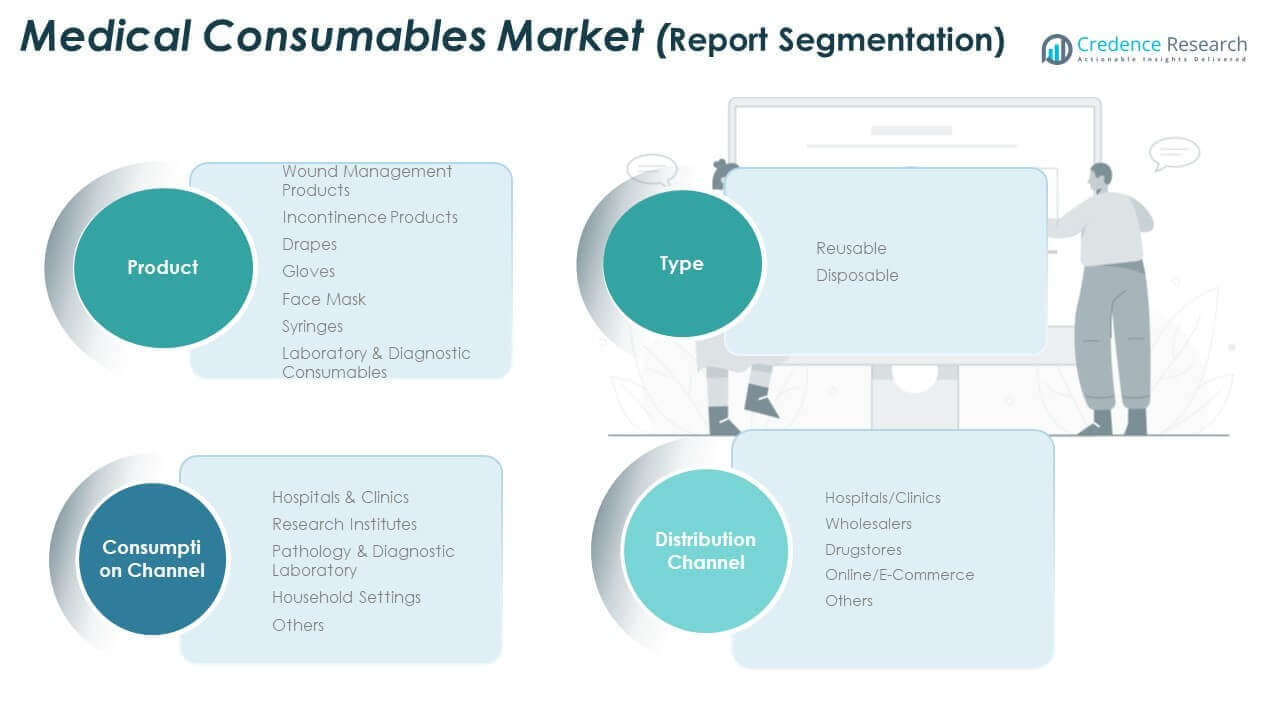
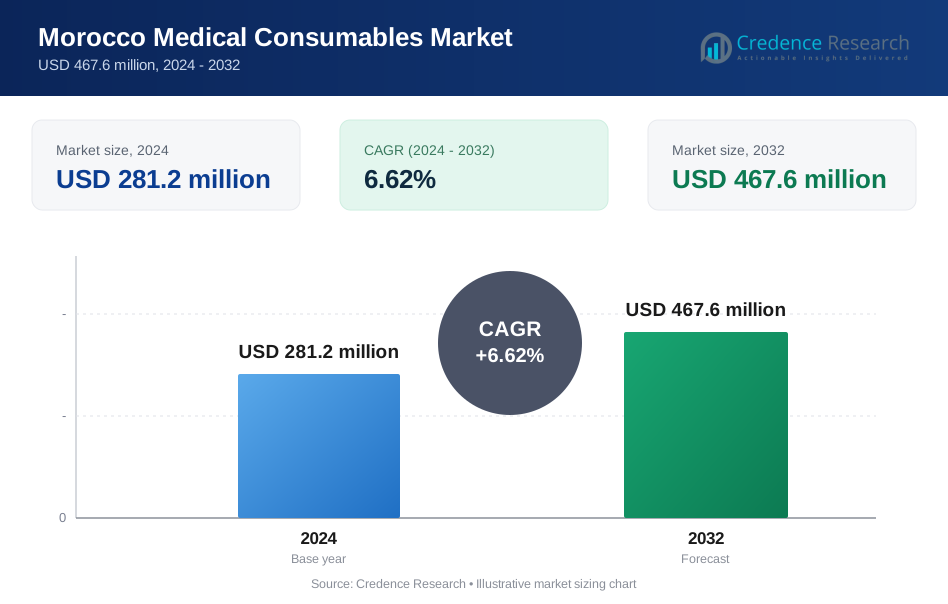
The Morocco Medical Consumables Market size was valued at USD 199.9 million in 2018 to USD 281.2 million in 2024 and is anticipated to reach USD 467.6 million by 2032, at a CAGR of 6.62% during the forecast period.
| REPORT ATTRIBUTE | DETAILS |
|---|---|
| Historical Period | 2020-2023 |
| Base Year | 2024 |
| Forecast Period | 2025-2032 |
| Morocco Medical Consumables Market Size 2024 | USD 281.2 million |
| Morocco Medical Consumables Market, CAGR | 6.62% |
| Morocco Medical Consumables Market Size 2032 | USD 467.6 million |
The market is gaining momentum due to increased healthcare infrastructure investment, public health program expansion, and rising demand for infection prevention products. Higher surgical volumes, chronic disease prevalence, and diagnostic testing contribute to consistent product consumption. Hospitals, clinics, and diagnostic labs continue to prioritize single-use items for safety and efficiency. Government initiatives supporting universal health access and procurement reforms encourage faster adoption of certified consumables. Private sector growth and the rise of outpatient services also drive consistent demand for a wide range of disposable medical products across the country.
Regionally, Casablanca–Settat leads the market with its concentration of hospitals, clinics, and distribution centers. Rabat–Salé–Kénitra follows closely, backed by government health institutions and teaching hospitals. Marrakech–Safi shows strong growth through medical tourism and infrastructure investments. Fès–Meknès and other emerging regions benefit from ongoing upgrades in healthcare access and supply networks. Rural areas show potential as supply chains expand and local assembly improves product reach and affordability.
Market Insights
- The Morocco Medical Consumables Market was valued at USD 199.9 million in 2018, reached USD 281.2 million in 2024, and is projected to attain USD 467.6 million by 2032, growing at a CAGR of 6.62% during the forecast period.
- Casablanca–Settat leads with about 38% share due to hospital density, Rabat–Salé–Kénitra follows with nearly 24% driven by public institutions, and Marrakech–Safi holds around 21% supported by private care growth and medical tourism.
- Marrakech–Safi is the fastest-growing region with about 21% share, supported by infrastructure upgrades, rising private hospitals, and increased elective procedures.
- By type, disposable consumables dominate with an estimated 65% share, supported by infection control standards and high patient turnover.
- Reusable consumables account for nearly 35% share, supported by cost efficiency and structured sterilization practices in public healthcare facilities.
Market Drivers
Expanding National Healthcare Coverage and Public Infrastructure Investments
The Morocco Medical Consumables Market benefits from rising healthcare spending and expanding public facilities. Morocco’s government is actively increasing access to primary and tertiary care through hospital upgrades. New clinics and health centers drive demand for disposable gloves, syringes, and wound care supplies. Urban health programs and rural outreach initiatives support volume growth across regions. Public procurement frameworks now prioritize essential consumables. The Health Emergency Plan allocates resources to boost supply readiness. The insurance expansion under RAMED improves patient access to diagnostics and treatments. The demand for standard and advanced medical disposables has grown with increased hospital admissions. Patient-centric reforms continue to support stable growth for medical consumables in public sector settings.
Increased Burden of Chronic Diseases and Surgical Procedures
The Morocco Medical Consumables Market sees strong demand due to rising chronic illness cases and higher surgical volumes. Lifestyle-linked conditions such as diabetes, cardiovascular disease, and respiratory disorders are increasing steadily. These require long-term management and routine monitoring, boosting usage of diagnostic strips, catheters, and infusion sets. Surgical volumes in private and public hospitals have also risen post-COVID, elevating demand for sterile drapes, gauze, and anesthesia kits. Oncology and dialysis patients represent a recurring consumer base for daily-use products. The growing adoption of minimally invasive procedures leads to higher procedural efficiency and faster turnover. This shift elevates the need for single-use consumables across operating units. The medical tourism sector supports procedural volumes in tier-one hospitals. The combination of disease prevalence and treatment frequency sustains demand.
- For instance, Morocco unified its health coverage schemes under CNSS in 2023, extending AMO Tadamon to low-income populations and improving access to over 12 million previously uninsured citizens.
Private Sector Growth and Investment in Diagnostic and Surgical Care
The Morocco Medical Consumables Market gains momentum from the expansion of the private medical ecosystem. Diagnostic labs, specialty hospitals, and ambulatory surgery centers are scaling across urban zones. These centers consume high volumes of consumables across imaging, pathology, and surgery. Investments in high-end surgical suites and outpatient diagnostics raise throughput and procedural efficiency. Private players prefer imported, quality-certified disposables to ensure patient safety. Competitive pricing and fast distribution models boost access to high-demand products. Growing partnerships between global medtech brands and local distributors help fill gaps in product availability. Physician-owned clinics and wellness chains now account for a significant share of procurement. The market continues to attract new suppliers targeting niche diagnostic and surgical categories.
- For instance, Akdital operates 22 private hospitals across Morocco and plans to expand to 50+ facilities by 2026, increasing demand for surgical and diagnostic consumables in the private sector.
Improving Infection Prevention Protocols and Regulatory Oversight
The Morocco Medical Consumables Market strengthens with stricter infection control mandates and compliance audits. Healthcare-acquired infections have led to national hygiene protocol updates in hospitals and clinics. Single-use consumables such as gloves, masks, surgical gowns, and barrier kits are now standard across inpatient and outpatient units. Post-pandemic awareness has heightened compliance with sterilization and protective gear usage. Regulators now impose quality checks across importers and local suppliers. Accreditation frameworks push providers to adopt CE- and FDA-certified products. Training programs for clinical staff encourage safe handling and disposal. Standard operating procedures in surgical and diagnostic settings reinforce high turnover of sterile items. These evolving practices secure consistent demand for high-grade disposable products.
Market Trends
Shift Toward Self-Care Consumables and Home-Based Health Monitoring
The Morocco Medical Consumables Market reflects growing interest in home-use diagnostic and wellness products. Consumers actively monitor blood glucose, blood pressure, and oxygen levels using easy-to-use kits. Pharmacies now stock self-administered test kits and reusable devices with disposable components. The rise of elderly care and chronic disease management supports home-based medical routines. Health-conscious urban populations prefer convenience-driven medical solutions. Local suppliers are introducing economical, single-use packs for daily tracking. Digital health platforms promote remote diagnostics through integrated consumables. Product bundling models in chronic care segments continue to gain attention. The self-care trend improves access while driving repeat purchases of consumables.
- For instance, Roche Diabetes Care supports remote patient monitoring through its Accu-Chek platform, which integrates glucose meters, cloud dashboards, and Bluetooth-enabled consumables used in over 100 countries.
Digitization of Supply Chain and Adoption of Smart Inventory Models
The Morocco Medical Consumables Market shows strong progress in digital supply integration and logistics automation. Hospitals and clinics implement automated inventory systems to avoid stockouts of critical items. Distributors adopt cloud-based dashboards for order tracking and replenishment. E-commerce platforms expand access to niche consumables in secondary cities. Demand forecasting tools enable bulk procurement and waste reduction. RFID tagging and barcode scanning support expiry tracking and audit compliance. Cold-chain logistics for temperature-sensitive products are improving in urban hubs. Government and private buyers use digital tenders for transparent procurement. The digital transformation enhances product availability and supports vendor accountability.
- For instance, BD (Becton Dickinson) uses RFID-enabled smart cabinets to manage on-site stock levels of surgical and diagnostic consumables across hundreds of hospitals globally.
Preference for Eco-Friendly and Biodegradable Medical Disposables
The Morocco Medical Consumables Market witnesses a gradual transition toward environmentally sustainable options. Hospitals and clinics increasingly seek biodegradable or recyclable alternatives for gloves, packaging, and gowns. Suppliers now offer plant-based or non-toxic polymers for disposables used in general practice. Environmental concerns from plastic waste drive policy revisions around medical trash management. Product innovation is focused on minimizing synthetic content and improving post-use recyclability. Public tenders now include sustainability criteria in evaluations. NGOs and rural health programs support eco-friendly sourcing for outreach missions. Medical waste segregation training promotes conscious usage and disposal. This trend aligns with Morocco’s broader national green transition efforts.
Expansion of Local Manufacturing Capabilities and OEM Partnerships
The Morocco Medical Consumables Market experiences capacity growth through domestic production and OEM linkages. The government encourages import substitution through tax benefits and land grants. Local firms partner with international manufacturers for assembling or white-labeling disposable items. Casablanca and Rabat serve as hubs for consumables packaging and labeling operations. Quality certifications improve with better process controls and trained manpower. Industrial parks near ports offer cost-efficient logistics support. Startups invest in automation lines for gloves, syringes, and dressings. Regional medical fairs promote cross-border sourcing partnerships with West African markets. The trend supports faster lead times and enhanced supply resilience.
Market Challenges Analysis
High Import Dependence and Exposure to Global Supply Disruptions
The Morocco Medical Consumables Market faces volatility from over-reliance on imported products. A large share of critical items including catheters, surgical gowns, and sterile dressings come from Europe and Asia. Price fluctuations, shipping delays, and geopolitical tensions impact supply stability. Currency volatility raises landed costs for importers, affecting margins and retail pricing. Local manufacturers remain limited in scale and lack certifications needed for institutional procurement. Regulatory delays in product registration further slow market entry for new suppliers. Limited warehousing and last-mile cold chain facilities restrict bulk stocking. Rural health centers suffer the most from sporadic availability. The market must develop backup sourcing models to reduce risk exposure.
Limited Standardization and Low Awareness in Semi-Urban and Rural Areas
The Morocco Medical Consumables Market faces challenges in maintaining product quality across all healthcare tiers. In semi-urban and rural settings, awareness of product specifications and safety standards is limited. Clinics may opt for low-cost, non-certified alternatives without adequate sterility controls. Inadequate training in storage and disposal practices can lead to contamination. Procurement often lacks transparency and depends on informal networks. Absence of structured audits weakens enforcement of hygiene norms. Logistics bottlenecks delay replenishment cycles in remote areas. Patient education on disposable product use is still evolving. Without consistent outreach and regulatory pressure, quality gaps in underserved zones may persist.
Market Opportunities
Strategic Focus on Medical Tourism and High-End Surgical Facilities
The Morocco Medical Consumables Market can leverage the country’s rising profile in elective surgery and wellness tourism. International patients visiting Casablanca and Marrakesh drive procedural demand in orthopedic, cosmetic, and dental care. These procedures depend on high-quality, single-use surgical kits, gowns, and protective gear. Investments in JCI-accredited centers and international collaborations support volume growth. Suppliers targeting premium segments can scale through specialty hospital networks. Custom packaging and product traceability attract global partnerships.
Expansion of Preventive Healthcare and Chronic Disease Management Programs
The Morocco Medical Consumables Market can grow by aligning with national non-communicable disease strategies. Government-led screening campaigns for diabetes, hypertension, and cancer require large quantities of diagnostic consumables. Mobile clinics and telemedicine initiatives extend care to underdiagnosed regions. Affordable, easy-to-use products for daily monitoring can meet emerging demand. Health-tech startups can integrate consumables with app-based health plans. Volume-based contracts in preventive care will support sustained procurement.
Market Segmentation Analysis
By Type
The Morocco Medical Consumables Market shows clear preference across reusable and disposable categories. Reusable products serve cost-sensitive public facilities with structured sterilization systems. These items support long-term use in controlled clinical environments. Disposable consumables dominate due to infection control standards. Hospitals prefer single-use items to reduce cross-contamination risk. Post-pandemic protocols reinforced this shift. High patient turnover supports disposable volume growth. Product reliability drives purchasing decisions.
- For instance, Mölnlycke Health Care supplies single‑use surgical solutions used in millions of procedures annually across more than 100 countries, reinforcing global disposable adoption standards.
By Product
The Morocco Medical Consumables Market covers a broad product mix with strong demand diversity. Wound management products lead due to trauma and surgical care needs. Gloves and face masks maintain high usage across all care settings. Syringes remain essential in treatment and vaccination programs. Drapes support surgical volume growth in hospitals. Laboratory and diagnostic consumables gain traction with testing expansion. Incontinence products serve aging and chronic care segments. Product demand aligns closely with care intensity.
By Consumption Channel
The Morocco Medical Consumables Market depends heavily on hospitals and clinics. These facilities account for the largest consumption share. Diagnostic laboratories drive steady demand for testing-related consumables. Research institutes use specialized and low-volume products. Household settings show gradual uptake through self-care trends. Pharmacies support this shift with retail-ready items. Other channels include mobile clinics and outreach programs. Channel growth reflects healthcare access expansion.
- For instance, Promamec supplies medical equipment and consumables to hundreds of healthcare facilities across Morocco through long‑term institutional contracts.
By Distribution Channel
The Morocco Medical Consumables Market relies on hospitals and clinics for direct procurement. Wholesalers play a critical role in nationwide distribution. Drugstores support retail and home-use product access. Online and e-commerce channels remain emerging but promising. Urban buyers favor digital ordering for convenience. Smaller channels serve rural and semi-urban demand. Distribution efficiency influences brand selection. Supply reliability remains a key differentiator.
Segmentation
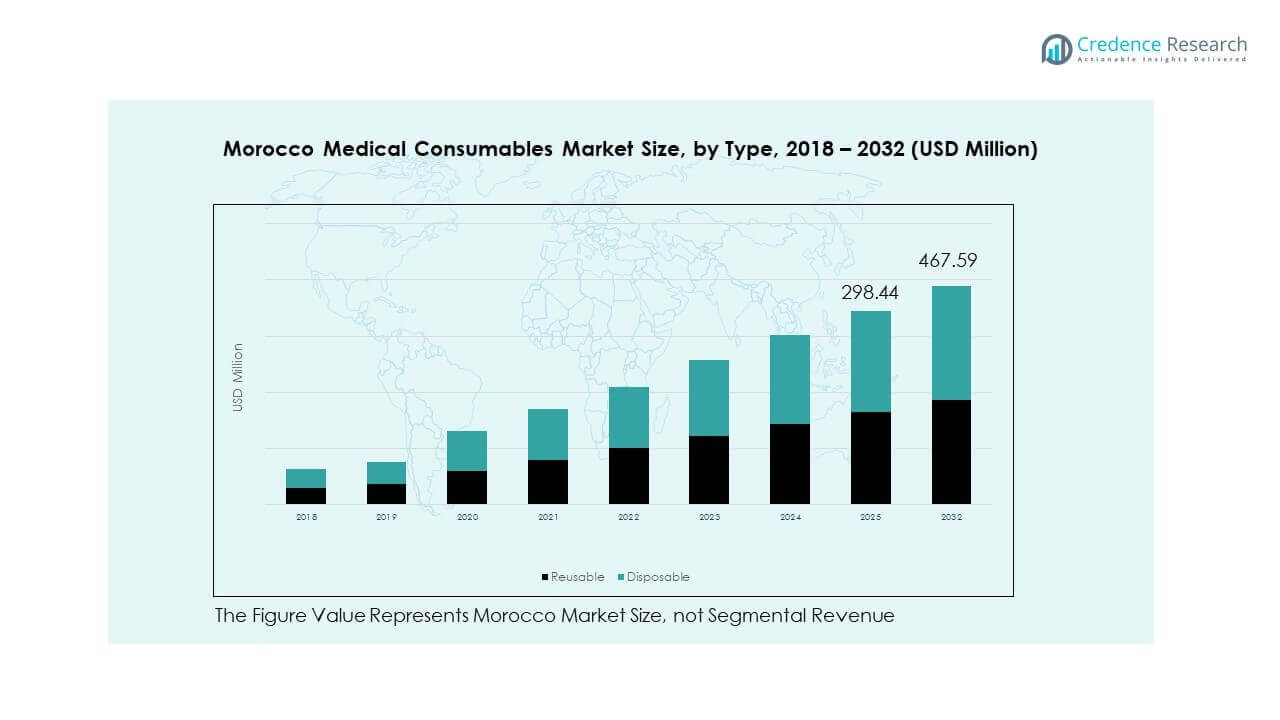
By Type
- Reusable
- Disposable
By Product
- Wound Management Products
- Incontinence Products
- Drapes
- Gloves
- Face Mask
- Syringes
- Laboratory & Diagnostic Consumables
By Consumption Channel
- Hospitals & Clinics
- Research Institutes
- Pathology & Diagnostic Laboratory
- Household Settings
- Others
By Distribution Channel
- Hospitals / Clinics
- Wholesalers
- Drugstores
- Online / E-Commerce
- Others
Regional Analysis
The Morocco Medical Consumables Market shows strong concentration in the Casablanca–Settat subregion. This area accounts for nearly 38% market share due to hospital density. Large public hospitals and private clinics drive steady consumables demand. Casablanca hosts major distributors and logistics hubs. Procurement cycles remain shorter in this subregion. Advanced diagnostics increase consumables turnover. Urban insurance coverage supports sustained purchasing volumes.
The Rabat–Salé–Kénitra subregion holds around 24% market share nationwide. Government hospitals and teaching institutions anchor regional demand. Policy-led healthcare expansion supports stable procurement volumes. Rabat benefits from central purchasing and regulatory presence. Diagnostic laboratories record consistent consumables usage. Public health programs increase preventive care adoption. The subregion maintains balanced public and private demand.
The remaining regions, including Marrakech–Safi and Fès–Meknès, contribute nearly 38% combined share. Marrakech–Safi holds about 21% due to medical tourism growth. Fès–Meknès accounts for nearly 11% through regional hospitals. Southern and eastern provinces represent smaller but rising shares. Infrastructure upgrades support gradual volume expansion. Distribution reach remains a key regional differentiator.
Key Player Analysis
Competitive Analysis
The Morocco Medical Consumables Market features a mix of domestic producers and global brands. Local firms focus on basic disposables such as gloves and syringes. Promamec and Sterifil benefit from established hospital relationships. These players compete on pricing and delivery speed. International companies target premium wound care and surgical products. Mölnlycke Health Care holds strength in infection prevention solutions. Brand trust influences procurement decisions in tertiary hospitals. Distribution partnerships shape competitive reach across regions. Competition also depends on regulatory compliance and product certifications. Import-oriented players leverage global quality standards to secure tenders. Meditech Gloves Morocco gains traction through partial local sourcing. Private hospitals favor consistent supply and product reliability. IM MEDICARE focuses on tailored portfolios for clinics and labs. Smaller suppliers compete in semi-urban markets through aggressive pricing. Product breadth and after-sales support affect long-term contracts. Competitive pressure encourages gradual portfolio diversification.
Recent Developments
- In January 2026, Cicor Group acquired the Moroccan subsidiary of Valtronic, an electronic medical device manufacturer, doubling its production capacity in Morocco and strengthening its global platform for medical consumables and devices.
- In December 2025, Promamec received an $8.5 million investment from AfricInvest to strengthen the country's healthcare supply chain through local assembly, reduced lead times, and improved stock availability in rural areas.
Report Coverage
The research report offers an in-depth analysis based on Type, Product, Consumption Channel, and Distribution Channel. It details leading market players, providing an overview of their business, product offerings, investments, revenue streams, and key applications. Additionally, the report includes insights into the competitive environment, SWOT analysis, current market trends, as well as the primary drivers and constraints. Furthermore, it discusses various factors that have driven market expansion in recent years. The report also explores market dynamics, regulatory scenarios, and technological advancements that are shaping the industry. It assesses the impact of external factors and global economic changes on market growth. Lastly, it provides strategic recommendations for new entrants and established companies to navigate the complexities of the market.
Future Outlook
- Demand for disposable consumables will continue to rise, driven by strict infection control protocols.
- Urbanization and private healthcare expansion will increase consumption in Casablanca and Marrakesh.
- Domestic manufacturing of gloves and syringes is expected to scale under government incentives.
- Online and e-commerce distribution will gain traction, especially for home-care and chronic-use products.
- Surgical consumables will see growth from increased outpatient procedures and elective surgeries.
- Diagnostic consumables will expand with investments in lab automation and mobile testing units.
- Retail pharmacies will carry more self-care items, supporting chronic disease monitoring at home.
- Eco-friendly and biodegradable products may attract volume in public tenders with sustainability goals.
- Medical tourism will boost demand for premium-grade consumables in specialty clinics and hospitals.
- Supplier partnerships and localized warehousing will improve regional access and reduce stock delays.
Request a Free Sample
Fill in your details and we'll send you a free sample report.
- Sample data tables & charts
- Research methodology
Need a Custom Version of This Report?
Tailor the scope, geography, or segments to your exact requirements.
- Custom geography or segment scope
- Direct access to our analyst team
Frequently Asked Questions
What is the current market size for Morocco Medical Consumables Market, and what is its projected size in 2032?
At what Compound Annual Growth Rate is the Morocco Medical Consumables Market projected to grow between 2024 and 2032?
Which Morocco Medical Consumables Market segment held the largest share in 2024?
What are the primary factors fueling the growth of the Morocco Medical Consumables Market?
Who are the leading companies in the Morocco Medical Consumables Market?
Which region commanded the largest share of the Morocco Medical Consumables Market in 2024?
Table of Content
Chapter 1. Report Introduction
- 1.1 Report Description & Purpose
- 1.1.1 Report Title & Market Definition
- 1.1.2 Unique Selling Propositions (USP) & Key Differentiators
- 1.1.3 Value Proposition for Stakeholders
- 1.2 Research Objectives
- 1.2.1 Market Sizing Objectives (Volume & Revenue)
- 1.2.2 Segmentation Objectives
- 1.2.3 Competitive Intelligence Objectives
- 1.2.4 Forecast & Scenario Objectives
- 1.3 Report Scope
- 1.3.1 Morocco Medical Consumables Scope – Types & Subtypes Covered
- 1.3.2 Geographic Scope – Regions & Countries Covered
- 1.3.3 Historical Period, Base Year & Forecast Period (2024; forecast to 2032)
- 1.3.4 Inclusions & Exclusions
- 1.4 HS Code & Classification Framework
- 1.5 Currency, Units & Pricing Basis
- 1.6 Target Stakeholders
- 1.7 Limitations & Assumptions
Chapter 2. Executive Summary
- 2.1 Global Morocco Medical Consumables Market Snapshot
- 2.1.1 Market Size – Historical (2024) & Forecast (2024-2032) (2024: USD 281.2 million → 2032: USD 467.6 million)
- 2.1.2 Volume & Revenue – Global Totals
- 2.1.3 Key Market Highlights – Top Five Facts
- 2.2 Morocco Medical Consumables Market Segmentation Snapshot
- 2.2.1 Market Split by Region – 2024 vs. 2032
- 2.3 Competitive Snapshot
- 2.3.1 Top 10 Players by Revenue Share – 2024
- 2.3.2 Top 10 Players by Volume Share – 2024
- 2.3.3 Recent Strategic Developments (18-Month Summary)
- 2.4 Key Investment Highlights & Strategic Conclusions
Chapter 3. Morocco Medical Consumables Market Dynamics & Industry Analysis
- 3.1 Market Overview & Context
- 3.1.1 Morocco Medical Consumables Market Position in the Broader Automotive Value Chain
- 3.1.2 OEM vs. Replacement Market Dynamics
- 3.1.3 Market Maturity & Development Stage by Region
- 3.2 Morocco Medical Consumables Market Drivers
- 3.3 Morocco Medical Consumables Market Restraints & Challenges
- 3.4 Morocco Medical Consumables Market Opportunities
- 3.5 Porter's Five Forces Analysis
- 3.5.1 Threat of New Entrants
- 3.5.2 Bargaining Power of Suppliers
- 3.5.3 Bargaining Power of Buyers
- 3.5.4 Threat of Substitutes
- 3.5.5 Competitive Rivalry – Intensity Assessment
- 3.6 Morocco Medical Consumables Value Chain Analysis
- 3.6.1 Upstream – Raw Material/Input Suppliers
- 3.6.1.1 Raw Material/Input 1
- 3.6.1.2 Raw Material/Input 2
- 3.6.1.3 Raw Material/Input 3
- 3.6.2 Midstream – Production/Manufacturing/Service Delivery
- 3.6.2.1 Production/Process Overview
- 3.6.2.2 Key Facility Locations & Capacity by Manufacturer
- 3.6.3 Downstream – Distribution & End Consumer
- 3.6.3.1 Primary Channel – B2B/OEM
- 3.6.3.2 Secondary Channels – Dealer, Retail, Online, Direct
- 3.6.4 Value Chain Profitability Analysis
- 3.6.1 Upstream – Raw Material/Input Suppliers
- 3.7 PESTEL Analysis
- 3.7.1 Political Factors
- 3.7.2 Economic Factors
- 3.7.3 Social Factors
- 3.7.4 Technological Factors
- 3.7.5 Environmental Factors
- 3.7.6 Legal Factors
- 3.8 Morocco Medical Consumables Supply Chain Analysis
- 3.8.1 Raw Material/Input Supply Risk Assessment
- 3.8.2 Manufacturing Concentration Risk (Geographic Exposure)
- 3.8.3 Trade Disruption Impact Analysis
- 3.9 Regulatory & Policy Landscape
Note: The regulatory and policy landscape section covers regulations based on their applicability to the market, Morocco Medical Consumables category, geography, and scope of the study. Only regulatory frameworks with a material impact on operations, compliance, trade, sustainability, or market access are analyzed in detail.
Chapter 4. Key Investment Pockets & Opportunity Analysis
- 4.1 Morocco Medical Consumables Market Attractiveness Analysis
- 4.1.1 By Region – Investment Attractiveness Matrix (Volume × CAGR)
- 4.2 Absolute Revenue Growth Opportunity
- 4.2.1 By Region – Absolute USD Growth Through 2032
- 4.3 Incremental Volume Opportunity
- 4.3.1 By Region – Incremental Volume Through 2032
- 4.3.2 Segment – Incremental Volume
- 4.4 Emerging Submarket Opportunity Deep Dive (Subject to Applicability)
- 4.5 Emerging Market Opportunity Scorecards
- 4.5.1 United States
- 4.5.2 Europe
- 4.5.3 Asia
- 4.5.4 Middle East & Africa
Note: Emerging Market Opportunity Scorecards will be included based on relevance and strategic importance. Regions listed are indicative and may vary depending on data availability and market dynamics.
Chapter 5. Morocco Medical Consumables Import-Export Analysis & Trade Flows
- 5.1 Global Trade Overview
- 5.1.1 Global Export Value by Country (2024)
- 5.1.2 Global Export Volume by Country (2024)
- 5.1.3 Global Import Value by Country (2024)
- 5.1.4 Global Import Volume by Country (2024)
- 5.1.5 Net Trade Balance by Country (2024)
- 5.2 Export Analysis – Segment
- 5.2.1 Type 1 (HS Code)
- 5.2.2 Type 2 (HS Code)
- 5.2.3 Type 3 (HS Code)
- 5.2.4 Type 4 (HS Code)
- 5.2.5 Type 5 (HS Code)
- 5.3 Import Analysis – Segment
- 5.3.1 Type 1 (HS Code)
- 5.3.2 Type 2 (HS Code)
- 5.3.3 Type 3 (HS Code)
- 5.3.4 Type 4 (HS Code)
- 5.3.5 Type 5 (HS Code)
- 5.4 Average Unit Trade Prices
- 5.4.1 Average Export Price – Segment & Country
- 5.4.2 Average Import Price – Segment & Source Country
- 5.4.3 Price Trends (2024)
- 5.5 Key Trade Route Analysis
- 5.5.1 Trade Route 1
- 5.5.2 Trade Route 2
- 5.5.3 Trade Route 3
- 5.5.4 Trade Route 4
- 5.5.5 Trade Route 5
- 5.6 Trade Policy Impact Assessment
- 5.6.1 US Anti-Dumping & Section 301 Tariffs
- 5.6.2 EU Customs Union Impact
- 5.6.3 Major Free Trade Agreements
- 5.6.4 USMCA Rules of Origin
Note: Trade policy analysis will be included only where relevant to the Morocco Medical Consumables market.
Chapter 6. Competitive Landscape & Company Benchmarking
- 6.1 Morocco Medical Consumables Market Concentration & Structure
- 6.1.1 Herfindahl-Hirschman Index (HHI) – vs. 2024
- 6.1.2 Tier 1, Tier 2 & Tier 3 Market Structure
- 6.1.3 Global, Regional & Local Player Dynamics
- 6.2 Morocco Medical Consumables Market Share Analysis – 2024
- 6.2.1 Global Revenue Share by Company
- 6.2.2 Global Volume Share by Company
- 6.2.3 Regional Revenue Share
- 6.2.4 Market Share Evolution ( vs. 2024)
- 6.2.5 OEM Segment Share by Company
- 6.2.6 Replacement Segment Share by Company
- 6.3 Production/Delivery Capacity & Facility Analysis
- 6.3.1 Global Installed Capacity
- 6.3.2 Capacity Utilization Rates
- 6.3.3 Production/Output Volume
- 6.3.4 Facility Locations & Capacity Map
- 6.3.5 Planned Capacity Additions
- 6.4 Morocco Medical Consumables Competitive Benchmarking Matrix
- 6.4.1 Revenue, Volume, CAGR & Profitability Comparison
- 6.4.2 Channel Revenue Mix
- 6.4.3 Geographic Revenue Exposure
- 6.4.4 R&D Intensity
- 6.4.5 Sustainability Maturity
- 6.5 Strategic Developments in Morocco Medical Consumables (Last 24 Months)
- 6.5.1 Mergers, Acquisitions & Divestments
- 6.5.2 New Morocco Medical Consumables Launches
- 6.5.3 Facility Expansions
- 6.5.4 Strategic Alliances, Joint Ventures & Partnerships
- 6.5.5 Distribution Expansion & Market Entry
- 6.5.6 Sustainability & ESG Initiatives
- 6.6 Competitive Strategy Mapping
- 6.6.1 Leader, Challenger, Follower & Niche Classification
- 6.6.2 Pricing Strategy Comparison
- 6.6.3 Channel Strategy Matrix
Note: Strategic developments are included based on their materiality and the availability of reliable information.
Chapter 7. Global Morocco Medical Consumables Market – By Distribution Channel
- 7.1 Segment Overview
- 7.1.1 Volume & Revenue Split by Channel (2024 & 2032)
- 7.1.2 Channel Mix Evolution (2024-2032)
Chapter 8. Regional Market Analysis – Global Overview
- 8.1 Global Regional Overview
- 8.1.1 Regional Volume Share
- 8.1.2 Regional Revenue Share
- 8.1.3 Regional Volume by Region
- 8.1.4 Regional Revenue by Region
- 8.1.5 Regional Forecast Through 2032
- 8.2 Cross-Regional Segment Analysis
- 8.2.1 By Distribution Channel
- 8.2.2 By Brand/Price Tier
Chapter 9. North America Morocco Medical Consumables Market
- 9.1 United States
- 9.2 Canada
- 9.3 Mexico
Chapter 10. Europe Morocco Medical Consumables Market
- 10.1 Germany
- 10.2 France
- 10.3 Italy
- 10.4 United Kingdom
- 10.5 Spain
- 10.6 Poland
- 10.7 Russia
- 10.8 Netherlands
- 10.9 Belgium
- 10.10 Sweden
- 10.11 Denmark
- 10.12 Norway
- 10.13 Rest of Europe
Chapter 11. Asia Pacific Morocco Medical Consumables Market
- 11.1 China
- 11.2 India
- 11.3 Japan
- 11.4 South Korea
- 11.5 Thailand
- 11.6 Indonesia
- 11.7 Vietnam
- 11.8 Malaysia
- 11.9 Australia
- 11.10 Rest of Asia Pacific
Chapter 12. Latin America Morocco Medical Consumables Market
- 12.1 Brazil
- 12.2 Argentina
- 12.3 Colombia
- 12.4 Chile
- 12.5 Rest of Latin America
Chapter 13. Middle East Morocco Medical Consumables Market
- 13.1 Saudi Arabia
- 13.2 United Arab Emirates
- 13.3 Turkey
- 13.4 Israel
- 13.5 Iran
- 13.6 Rest of the Middle East
Chapter 14. Africa Morocco Medical Consumables Market
- 14.1 South Africa
- 14.2 Egypt
- 14.3 Nigeria
- 14.4 Morocco
- 14.5 Rest of Africa
Chapter 15. Morocco Medical Consumables Company Profiles
- 15.1 [Company 01]
- 15.1.1 Company Overview
- 15.1.2 Key Management Personnel
- 15.1.3 Products & Services Portfolio
- 15.1.4 Financial Performance
- 15.1.5 Key Market Focus & Geographic Presence
- 15.1.6 Recent Developments & Strategic Initiatives
Note: The company profile list is preliminary and may change based on research findings, market developments, data availability, and client requirements.
Chapter 16. Appendices
- Appendix A – List of Abbreviations & Acronyms
- Appendix B – Industry Classification Code Reference – Full Series
- Appendix C – Production & Capacity Data Tables
- Appendix D – End-Use & Demand Base Tables
- Appendix E – Consumption & Replacement Rate Assumptions
- Appendix F – ASP Reference Tables
- Appendix G – Manufacturing & Facility Database
- Appendix H – Import-Export Data Tables
- Appendix I – Regulatory Summary Tables
- Appendix J – Primary Research Participant List (Anonymized)
- Appendix K – Primary Research Questionnaire Framework
- Appendix L – Data Sources & Bibliography
- Appendix M – Market Size Divergence & Source Comparison
Chapter 17. Research Methodology
- 17.1 Research Framework & Philosophy
- 17.2 Secondary Research – Sources, Hierarchy & Data Extraction
- 17.3 Data Modeling – Bottom-Up & Top-Down Market Sizing
- 17.4 Primary Research – Stakeholder Framework, LOI & Sample Sizes
- 17.5 Forecast Methodology – Regression, Scenario & Sensitivity Analysis
- 17.6 Quality Control – Four-Layer Validation Framework
- 17.7 Limitations & Standard Assumptions
- 17.8 Disclaimer
