
Caspofungin Market Overview:
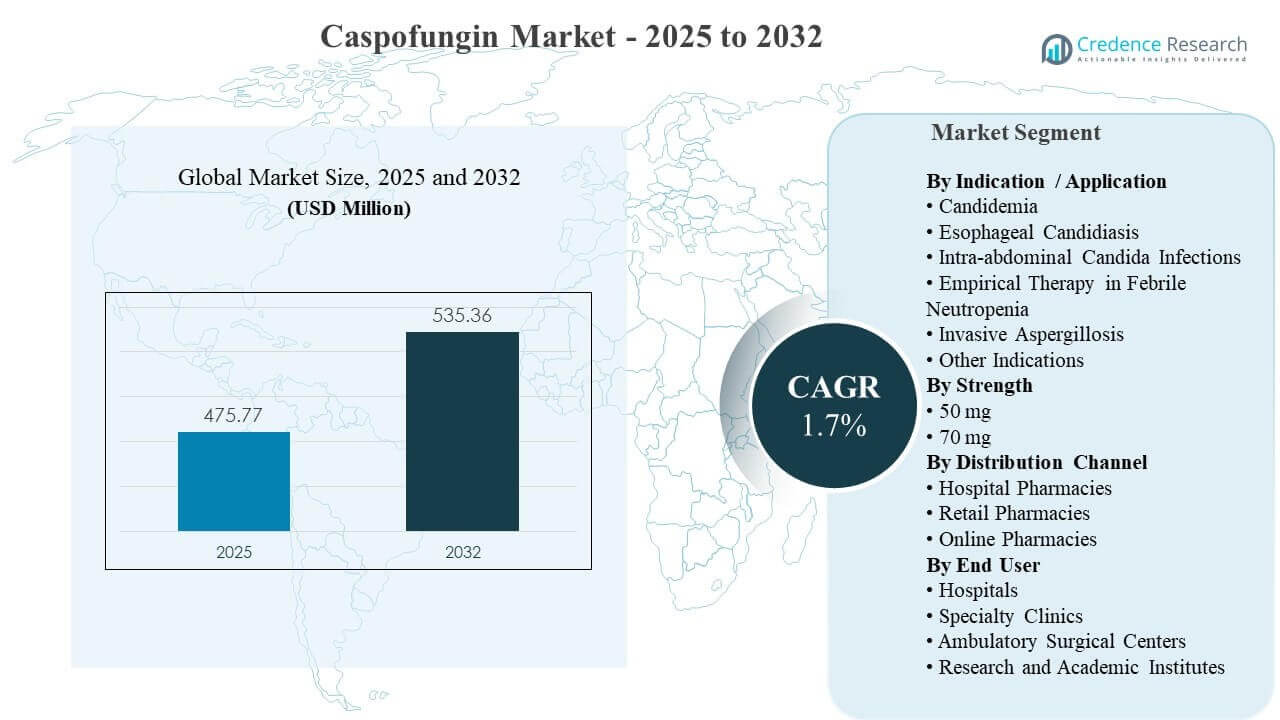
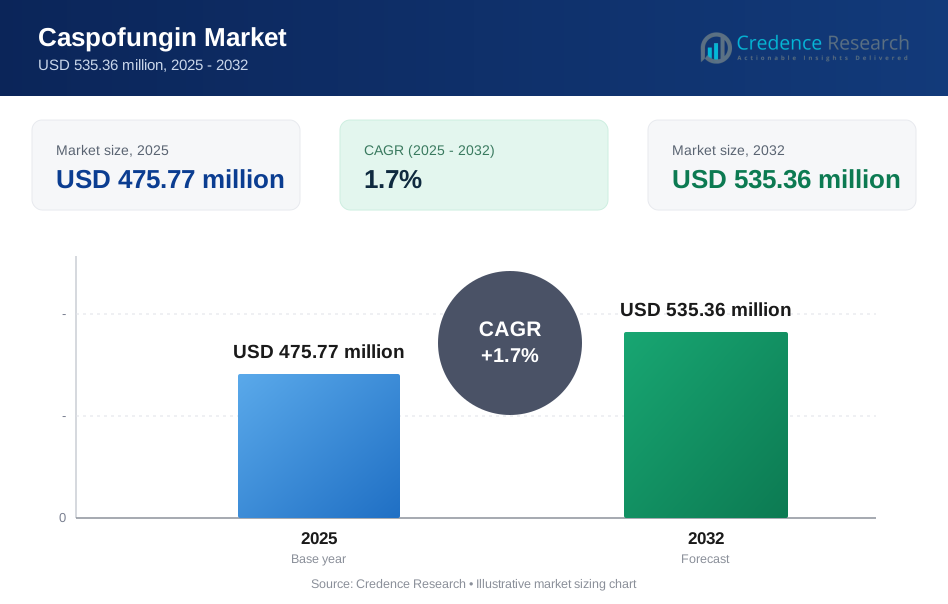
The global Caspofungin market size was estimated at USD 475.77 million in 2025 and is expected to reach USD 535.36 million by 2032, growing at a CAGR of 1.7% from 2025 to 2032. Demand is primarily sustained by the persistent clinical burden of invasive fungal infections in immunocompromised and critically ill patients, where echinocandins remain a preferred IV therapy due to efficacy and tolerability in hospital protocols. Regional performance continues to be shaped by acute-care capacity, antifungal stewardship adoption, and the pace of generic uptake across hospital tenders, which collectively influence utilization and pricing dynamics over the forecast period.
| REPORT ATTRIBUTE | DETAILS |
|---|---|
| Historical Period | 2020-2024 |
| Base Year | 2025 |
| Forecast Period | 2026-2032 |
| Caspofungin Market Size 2025 | USD 475.77 million |
| Caspofungin Market, CAGR | 1.7% |
| Caspofungin Market Size 2032 | USD 535.36 million |
Key Market Trends & Insights
- The Caspofungin market is projected to expand from USD 475.77 million (2025) to USD 535.36 million (2032) at a 1.7% CAGR (2025–2032).
- Hospital pharmacies led distribution with 56.9% share in 2025, reflecting the inpatient, protocol-driven nature of IV antifungal use.
- Candidemia and broader candidiasis-related indications represented the largest indication cluster at 41.2% in 2025, supported by ICU and immunocompromised patient demand.
- Lyophilized powder formulations accounted for 58.7% in 2025, driven by stability, cold-chain practicality, and hospital inventory preferences for sterile injectables.
- North America captured 38.10% of global revenue in 2025, underpinned by higher antifungal utilization intensity and established hospital stewardship pathways.
Segment Analysis
The Caspofungin market remains largely hospital-centric because the drug is administered intravenously and is most commonly initiated for severe, life-threatening fungal infections that require close monitoring. Purchasing decisions are strongly influenced by formulary positioning, stewardship restrictions, and tender-driven procurement, which stabilizes volumes but limits rapid pricing expansion. Generic availability supports access and continuity, but competitive pressure also compresses value growth, contributing to a steady, low-growth trajectory over the forecast period.
Clinical demand is concentrated in candidemia and other invasive Candida infections, with additional pull from empiric therapy settings such as febrile neutropenia and select aspergillosis cases where echinocandin use is clinically appropriate. Strength-level demand is shaped by protocol dosing and the balance between loading and maintenance regimens, which can vary by patient weight and severity. Channel dynamics favor hospital pharmacies, while retail and online channels remain smaller due to infusion requirements and care setting constraints.
By Indication / Application Insights
Candidemia and broader candidiasis-related infections accounted for the largest share of 41.2% in 2025. The leading position is supported by high incidence of invasive Candida infections among ICU, oncology, and transplant patients where rapid initiation of IV therapy is common. Hospital stewardship programs also reinforce echinocandin use in severe disease and in patients with contraindications to alternatives. Broader coverage across multiple invasive Candida presentations sustains consistent utilization across acute-care settings.
By Strength Insights
50 mg accounted for the largest share of 29.6% in 2025. Hospital purchasing often favors standardized vial strengths aligned with common maintenance dosing and inventory simplification. Protocol dosing across a wide patient pool supports recurring demand for widely used vial sizes in inpatient therapy. Tender outcomes and supply continuity can further reinforce the leading strength mix over time.
By Distribution Channel Insights
Hospital Pharmacies accounted for the largest share of 56.9% in 2025. Caspofungin treatment is typically initiated in inpatient settings for severe infections, keeping dispensing centralized within hospital pharmacy systems. Clinical monitoring requirements and infusion administration workflows further strengthen hospital dominance. Restricted-use policies and stewardship oversight also channel utilization through hospital formularies rather than outpatient channels.
By End User Insights
Hospitals represented the primary end-user base for caspofungin therapies due to the high-acuity nature of invasive fungal infections and the need for inpatient IV administration. Specialty clinics participate where outpatient infusion models are used for stabilized patients, but overall contribution remains lower than hospitals. Ambulatory surgical centers contribute minimally because caspofungin use is not closely tied to procedural prophylaxis. Research and academic institutes influence demand mainly through clinical research and stewardship studies rather than high-volume purchasing.
Market Drivers
Rising Burden Of Invasive Fungal Infections In High-Risk Patients
Invasive fungal infections remain a persistent threat in immunocompromised populations, including oncology patients, transplant recipients, and critically ill ICU cohorts. Caspofungin benefits from established use in severe Candida infections where timely IV therapy improves outcomes. Hospital protocols often prioritize predictable safety and efficacy profiles in unstable patients, supporting consistent utilization. Clinical emphasis on early empiric treatment pathways in high-risk febrile neutropenia further sustains demand across acute-care settings.
- For instance, in a randomized trial of invasive candidiasis in ICU patients, caspofungin achieved a favorable clinical response at end of IV therapy in 68% (27/40) of patients versus 56% (32/57) with amphotericin B, while 6–8 week all‑cause mortality was 45% (18/40) with caspofungin compared with 40% (23/57) for amphotericin B, supporting its continued use in severe Candida infections where timely IV therapy is crucial.
Hospital Stewardship And Protocolized Antifungal Pathways
Antimicrobial stewardship programs increasingly standardize antifungal selection, dosing, and escalation pathways in hospitals. Caspofungin maintains relevance in guideline-aligned protocols for invasive candidiasis management and for patients with intolerance or resistance concerns. Structured order sets and pharmacy oversight drive repeatable purchasing behavior through hospital channels. This protocolization reduces volatility in demand and supports steady baseline consumption.
Expansion Of Critical Care And Complex Care Infrastructure
Growth in ICU capacity, advanced surgical care, and specialty oncology services increases the addressable patient pool at risk for invasive fungal infections. Complex care pathways frequently involve broad-spectrum antibiotics, central lines, and immunosuppression that elevate fungal risk. Caspofungin remains an important therapeutic option in these environments where IV antifungal coverage is required. As tertiary care expands, utilization patterns remain anchored in inpatient settings.
- For instance, global analyses of invasive candidiasis highlight that ICU patients can account for nearly half of candidemia episodes in some series, with ICU cohorts in one caspofungin trial including 97 of 224 total patients (about 43%), underscoring the concentration of fungal burden in critical care environments.
Generic Availability Supporting Access And Continuity
Wider availability of generic caspofungin improves affordability and procurement flexibility for hospitals, supporting broader access across public and private healthcare systems. Competitive sourcing can reduce supply disruption risk by enabling multi-supplier contracting. Increased access reinforces use in empiric therapy and severe candidiasis settings where rapid initiation is clinically important. At the same time, price competition moderates overall value growth, contributing to stable market expansion.
Market Challenges
Supply reliability and sterile injectable manufacturing constraints remain a practical challenge for hospital procurement teams. Quality requirements, capacity limitations, and distribution disruptions can create short-term availability gaps that force substitution or protocol adjustments. Tender dependence and multi-vendor sourcing strategies mitigate risk, but disruptions can still affect treatment continuity in high-acuity settings. These factors keep procurement planning and inventory buffers central to hospital purchasing behavior.
- For instance, a 2025 study on sterile injectable products in Saudi Arabia found that pharmaceutical supply chain disturbances increased the odds of reported shortages by an odds ratio of 1.32 and were consistently cited by supply chain managers as the primary determinant of hospital-level stockouts.
Pricing pressure from generic competition is another key constraint on market value expansion. Hospital tenders often prioritize cost efficiency, compressing margins and limiting revenue uplift even when clinical demand is stable. Competitive bids can lead to rapid price normalization, especially in mature markets with multiple suppliers. This dynamic helps explain the market’s steady but comparatively modest growth profile.
Market Trends and Opportunities
Hospitals are increasingly optimizing antifungal stewardship using decision-support tools and standardized pathways that can improve appropriate echinocandin utilization. This creates opportunities for suppliers to differentiate through reliability, contracting flexibility, and service support for hospital systems. Broader adoption of protocol-driven care can improve forecast visibility and stabilize purchasing volumes. Demand remains supported by the ongoing expansion of complex-care populations.
- For instance, a pan-Indian multicenter invasive fungal infection registry coordinated by the Indian Council of Medical Research is enrolling high-risk patients across 8 advanced mycology centers and has achieved 95–100% detection rates for fungal infections, underscoring the growing pool of immunocompromised and ICU patients requiring systemic antifungals.
Shifts toward diversified sourcing and risk-managed procurement are creating opportunities for manufacturers with strong supply chains and compliant sterile injectable capacity. In emerging markets, expanding tertiary care networks and improving diagnostic capabilities can lift identification and treatment of invasive fungal infections. As access improves, adoption of IV antifungals can rise in targeted settings such as oncology and critical care centers. These trends support incremental growth and deeper penetration beyond the most mature hospital markets.
Regional Insights
North America
North America accounted for 38.10% of the Caspofungin market in 2025, equivalent to approximately USD 181.27 million. The region benefits from high ICU and transplant procedure volumes, strong antifungal stewardship programs, and established hospital procurement systems. Utilization intensity is supported by rapid initiation protocols for invasive Candida infections in high-risk patients. Competitive dynamics are strongly tender-driven, with emphasis on supply reliability and formulary compliance.
Europe
Europe represented 30.90% of global revenue in 2025, or about USD 147.01 million. Demand is sustained by large public hospital networks, mature infectious disease management practices, and structured stewardship adoption across key countries. Procurement is influenced by centralized purchasing and strict cost controls, which increase price competition and reinforce multi-supplier sourcing. Clinical need remains anchored in critical care and immunocompromised patient pathways.
Asia Pacific
Asia Pacific captured 24.60% share in 2025, translating to roughly USD 117.04 million. Expansion of tertiary hospitals, rising oncology and critical care capacity, and improving access to sterile injectables support uptake in major markets. Increasing adoption of standardized antifungal protocols and broader availability of generics strengthen utilization in high-volume hospital settings. The region’s growth outlook is supported by infrastructure investment and expanding treatment access in complex care.
Latin America
Latin America held 4.70% of the market in 2025, or approximately USD 22.36 million. Demand is concentrated in larger urban hospitals and private networks where critical care infrastructure and diagnostic capacity are more developed. Budget constraints and procurement variability can affect access consistency, reinforcing the importance of cost-effective sourcing. Utilization remains highest in referral centers treating severe candidiasis cases.
Middle East & Africa
Middle East and Africa accounted for 1.70% share in 2025, equivalent to about USD 8.09 million. Market activity is concentrated in higher-capability tertiary hospitals, particularly in countries with expanding critical care services. Limited access, variable diagnostics, and constrained hospital budgets can restrict broader utilization. Where available, procurement is closely tied to hospital formularies and government purchasing structures.
Competitive Landscape
Competition in the Caspofungin market is shaped by originator-to-generic transition, hospital tendering, and the ability to maintain consistent sterile injectable supply. Suppliers differentiate through pricing, contract coverage, delivery reliability, and support for hospital formulary requirements. Portfolio breadth in anti-infectives and established relationships with hospital procurement bodies also influence share stability. Regulatory compliance and manufacturing quality remain critical barriers that limit the number of credible suppliers in some markets.
Merck & Co., Inc. remains a central reference point as the originator, with brand legacy shaping clinical familiarity and historical formulary placement. The company’s positioning emphasizes established clinical evidence, pharmacovigilance continuity, and alignment with hospital protocol expectations. In competitive settings, differentiation is influenced by contracting strategy and supply dependability rather than product novelty. Brand credibility can remain relevant in institutions that prioritize continuity and validated clinical performance.
The industry research and growth report includes detailed analyses of the competitive landscape of the market and information about key companies, including:
- Merck & Co., Inc.
- Fresenius Kabi
- Cipla Limited
- Gland Pharma Limited
- Sun Pharmaceutical Industries Ltd.
- Teva Pharmaceutical Industries Ltd.
- Sandoz International GmbH
- Viatris Inc.
- Dr. Reddy’s Laboratories Ltd.
- Natco Pharma Limited
- Biocon Limited
- Apotex Inc.
- Xellia Pharmaceuticals
- Sanofi S.A.
Qualitative and quantitative analysis of companies has been conducted to help clients understand the wider business environment as well as the strengths and weaknesses of key industry players. Data is qualitatively analyzed to categorize companies as pure play, category-focused, industry-focused, and diversified; it is quantitatively analyzed to categorize companies as dominant, leading, strong, tentative, and weak.
Recent Developments
- In November 2025, Merck & Co. announced a definitive agreement to acquire Cidara Therapeutics for approximately $9.2 billion. While Cidara's lead candidate, CD388, is an antiviral, the acquisition is strategically significant for the antifungal market because Cidara developed Rezafungin a next-generation echinocandin that was clinically compared against Caspofungin as the "gold standard" active comparator in its pivotal trials.
Report Scope
| Report Attribute | Details |
| Market size value in 2025 | USD 475.77 million |
| Revenue forecast in 2032 | USD 535.36 million |
| Growth rate (CAGR) | 1.7% (2025–2032) |
| Base year | 2025 |
| Forecast period | 2026–2032 |
| Quantitative units | USD million |
| Segments covered | By Indication / Application Outlook: Candidemia, Esophageal Candidiasis, Intra-abdominal Candida Infections, Empirical Therapy in Febrile Neutropenia, Invasive Aspergillosis, Other Indications; By Strength Outlook: 50 mg, 70 mg; By Distribution Channel Outlook: Hospital Pharmacies, Retail Pharmacies, Online Pharmacies; By End User Outlook: Hospitals, Specialty Clinics, Ambulatory Surgical Centers, Research and Academic Institutes |
| Regional scope | North America, Europe, Asia Pacific, Latin America, Middle East & Africa |
| Key companies profiled | Merck & Co., Inc.; Fresenius Kabi; Cipla Limited; Gland Pharma Limited; Sun Pharmaceutical Industries Ltd.; Teva Pharmaceutical Industries Ltd.; Sandoz International GmbH; Viatris Inc.; Dr. Reddy’s Laboratories Ltd.; Natco Pharma Limited; Biocon Limited; Apotex Inc.; Xellia Pharmaceuticals; Sanofi S.A. |
| No. of Pages | 332 |
Segmentation
By Indication / Application
- Candidemia
- Esophageal Candidiasis
- Intra-abdominal Candida Infections
- Empirical Therapy in Febrile Neutropenia
- Invasive Aspergillosis
- Other Indications
By Strength
- 50 mg
- 70 mg
By Distribution Channel
- Hospital Pharmacies
- Retail Pharmacies
- Online Pharmacies
By End User
- Hospitals
- Specialty Clinics
- Ambulatory Surgical Centers
- Research and Academic Institutes
By Region
- North America
- U.S.
- Canada
- Mexico
- Europe
- Germany
- France
- U.K.
- Italy
- Spain
- Rest of Europe
- Asia Pacific
- China
- Japan
- India
- South Korea
- South-east Asia
- Rest of Asia Pacific
- Latin America
- Brazil
- Argentina
- Rest of Latin America
- Middle East & Africa
- GCC Countries
- South Africa
- Rest of the Middle East and Africa
Request a Free Sample
Fill in your details and we'll send you a free sample report.
- Sample data tables & charts
- Research methodology
Need a Custom Version of This Report?
Tailor the scope, geography, or segments to your exact requirements.
- Custom geography or segment scope
- Direct access to our analyst team
Frequently Asked Questions
What is the current size of the Caspofungin market and its forecast value?
What is the growth rate of the Caspofungin market?
Which segment is the largest in the Caspofungin market?
What are the key factors supporting growth in this market?
Who are the leading companies in the Caspofungin market?
Which region leads the Caspofungin market?
Table of Content
Chapter 1. Report Introduction
- 1.1 Report Description & Purpose
- 1.1.1 Report Title & Market Definition
- 1.1.2 Unique Selling Propositions (USP) & Key Differentiators
- 1.1.3 Value Proposition for Stakeholders
- 1.2 Research Objectives
- 1.2.1 Market Sizing Objectives (Volume & Revenue)
- 1.2.2 Segmentation Objectives
- 1.2.3 Competitive Intelligence Objectives
- 1.2.4 Forecast & Scenario Objectives
- 1.3 Report Scope
- 1.3.1 Caspofungin Scope – Types & Subtypes Covered
- 1.3.2 Geographic Scope – Regions & Countries Covered
- 1.3.3 Historical Period, Base Year & Forecast Period (2025; forecast to 2032)
- 1.3.4 Inclusions & Exclusions
- 1.4 HS Code & Classification Framework
- 1.5 Currency, Units & Pricing Basis
- 1.6 Target Stakeholders
- 1.7 Limitations & Assumptions
Chapter 2. Executive Summary
- 2.1 Global Caspofungin Market Snapshot
- 2.1.1 Market Size – Historical (2025) & Forecast (2025-2032) (2025: USD 475.77 million → 2032: USD 535.36 million)
- 2.1.2 Volume & Revenue – Global Totals
- 2.1.3 Key Market Highlights – Top Five Facts
- 2.2 Caspofungin Market Segmentation Snapshot
- 2.2.1 Market Split by Region – 2025 vs. 2032
- 2.3 Competitive Snapshot
- 2.3.1 Top 10 Players by Revenue Share – 2025
- 2.3.2 Top 10 Players by Volume Share – 2025
- 2.3.3 Recent Strategic Developments (18-Month Summary)
- 2.4 Key Investment Highlights & Strategic Conclusions
Chapter 3. Caspofungin Market Dynamics & Industry Analysis
- 3.1 Market Overview & Context
- 3.1.1 Caspofungin Market Position in the Broader Automotive Value Chain
- 3.1.2 OEM vs. Replacement Market Dynamics
- 3.1.3 Market Maturity & Development Stage by Region
- 3.2 Caspofungin Market Drivers
- 3.3 Caspofungin Market Restraints & Challenges
- 3.4 Caspofungin Market Opportunities
- 3.5 Porter's Five Forces Analysis
- 3.5.1 Threat of New Entrants
- 3.5.2 Bargaining Power of Suppliers
- 3.5.3 Bargaining Power of Buyers
- 3.5.4 Threat of Substitutes
- 3.5.5 Competitive Rivalry – Intensity Assessment
- 3.6 Caspofungin Value Chain Analysis
- 3.6.1 Upstream – Raw Material/Input Suppliers
- 3.6.1.1 Raw Material/Input 1
- 3.6.1.2 Raw Material/Input 2
- 3.6.1.3 Raw Material/Input 3
- 3.6.2 Midstream – Production/Manufacturing/Service Delivery
- 3.6.2.1 Production/Process Overview
- 3.6.2.2 Key Facility Locations & Capacity by Manufacturer
- 3.6.3 Downstream – Distribution & End Consumer
- 3.6.3.1 Primary Channel – B2B/OEM
- 3.6.3.2 Secondary Channels – Dealer, Retail, Online, Direct
- 3.6.4 Value Chain Profitability Analysis
- 3.6.1 Upstream – Raw Material/Input Suppliers
- 3.7 PESTEL Analysis
- 3.7.1 Political Factors
- 3.7.2 Economic Factors
- 3.7.3 Social Factors
- 3.7.4 Technological Factors
- 3.7.5 Environmental Factors
- 3.7.6 Legal Factors
- 3.8 Caspofungin Supply Chain Analysis
- 3.8.1 Raw Material/Input Supply Risk Assessment
- 3.8.2 Manufacturing Concentration Risk (Geographic Exposure)
- 3.8.3 Trade Disruption Impact Analysis
- 3.9 Regulatory & Policy Landscape
Note: The regulatory and policy landscape section covers regulations based on their applicability to the market, Caspofungin category, geography, and scope of the study. Only regulatory frameworks with a material impact on operations, compliance, trade, sustainability, or market access are analyzed in detail.
Chapter 4. Key Investment Pockets & Opportunity Analysis
- 4.1 Caspofungin Market Attractiveness Analysis
- 4.1.1 By Region – Investment Attractiveness Matrix (Volume × CAGR)
- 4.2 Absolute Revenue Growth Opportunity
- 4.2.1 By Region – Absolute USD Growth Through 2032
- 4.3 Incremental Volume Opportunity
- 4.3.1 By Region – Incremental Volume Through 2032
- 4.3.2 Segment – Incremental Volume
- 4.4 Emerging Submarket Opportunity Deep Dive (Subject to Applicability)
- 4.5 Emerging Market Opportunity Scorecards
- 4.5.1 United States
- 4.5.2 Europe
- 4.5.3 Asia
- 4.5.4 Middle East & Africa
Note: Emerging Market Opportunity Scorecards will be included based on relevance and strategic importance. Regions listed are indicative and may vary depending on data availability and market dynamics.
Chapter 5. Caspofungin Import-Export Analysis & Trade Flows
- 5.1 Global Trade Overview
- 5.1.1 Global Export Value by Country (2025)
- 5.1.2 Global Export Volume by Country (2025)
- 5.1.3 Global Import Value by Country (2025)
- 5.1.4 Global Import Volume by Country (2025)
- 5.1.5 Net Trade Balance by Country (2025)
- 5.2 Export Analysis – Segment
- 5.2.1 Type 1 (HS Code)
- 5.2.2 Type 2 (HS Code)
- 5.2.3 Type 3 (HS Code)
- 5.2.4 Type 4 (HS Code)
- 5.2.5 Type 5 (HS Code)
- 5.3 Import Analysis – Segment
- 5.3.1 Type 1 (HS Code)
- 5.3.2 Type 2 (HS Code)
- 5.3.3 Type 3 (HS Code)
- 5.3.4 Type 4 (HS Code)
- 5.3.5 Type 5 (HS Code)
- 5.4 Average Unit Trade Prices
- 5.4.1 Average Export Price – Segment & Country
- 5.4.2 Average Import Price – Segment & Source Country
- 5.4.3 Price Trends (2025)
- 5.5 Key Trade Route Analysis
- 5.5.1 Trade Route 1
- 5.5.2 Trade Route 2
- 5.5.3 Trade Route 3
- 5.5.4 Trade Route 4
- 5.5.5 Trade Route 5
- 5.6 Trade Policy Impact Assessment
- 5.6.1 US Anti-Dumping & Section 301 Tariffs
- 5.6.2 EU Customs Union Impact
- 5.6.3 Major Free Trade Agreements
- 5.6.4 USMCA Rules of Origin
Note: Trade policy analysis will be included only where relevant to the Caspofungin market.
Chapter 6. Competitive Landscape & Company Benchmarking
- 6.1 Caspofungin Market Concentration & Structure
- 6.1.1 Herfindahl-Hirschman Index (HHI) – vs. 2025
- 6.1.2 Tier 1, Tier 2 & Tier 3 Market Structure
- 6.1.3 Global, Regional & Local Player Dynamics
- 6.2 Caspofungin Market Share Analysis – 2025
- 6.2.1 Global Revenue Share by Company
- 6.2.2 Global Volume Share by Company
- 6.2.3 Regional Revenue Share
- 6.2.4 Market Share Evolution ( vs. 2025)
- 6.2.5 OEM Segment Share by Company
- 6.2.6 Replacement Segment Share by Company
- 6.3 Production/Delivery Capacity & Facility Analysis
- 6.3.1 Global Installed Capacity
- 6.3.2 Capacity Utilization Rates
- 6.3.3 Production/Output Volume
- 6.3.4 Facility Locations & Capacity Map
- 6.3.5 Planned Capacity Additions
- 6.4 Caspofungin Competitive Benchmarking Matrix
- 6.4.1 Revenue, Volume, CAGR & Profitability Comparison
- 6.4.2 Channel Revenue Mix
- 6.4.3 Geographic Revenue Exposure
- 6.4.4 R&D Intensity
- 6.4.5 Sustainability Maturity
- 6.5 Strategic Developments in Caspofungin (Last 24 Months)
- 6.5.1 Mergers, Acquisitions & Divestments
- 6.5.2 New Caspofungin Launches
- 6.5.3 Facility Expansions
- 6.5.4 Strategic Alliances, Joint Ventures & Partnerships
- 6.5.5 Distribution Expansion & Market Entry
- 6.5.6 Sustainability & ESG Initiatives
- 6.6 Competitive Strategy Mapping
- 6.6.1 Leader, Challenger, Follower & Niche Classification
- 6.6.2 Pricing Strategy Comparison
- 6.6.3 Channel Strategy Matrix
Note: Strategic developments are included based on their materiality and the availability of reliable information.
Chapter 7. Global Caspofungin Market – By Distribution Channel
- 7.1 Segment Overview
- 7.1.1 Volume & Revenue Split by Channel (2025 & 2032)
- 7.1.2 Channel Mix Evolution (2025-2032)
Chapter 8. Regional Market Analysis – Global Overview
- 8.1 Global Regional Overview
- 8.1.1 Regional Volume Share
- 8.1.2 Regional Revenue Share
- 8.1.3 Regional Volume by Region
- 8.1.4 Regional Revenue by Region
- 8.1.5 Regional Forecast Through 2032
- 8.2 Cross-Regional Segment Analysis
- 8.2.1 By Distribution Channel
- 8.2.2 By Brand/Price Tier
Chapter 9. North America Caspofungin Market
- 9.1 United States
- 9.2 Canada
- 9.3 Mexico
Chapter 10. Europe Caspofungin Market
- 10.1 Germany
- 10.2 France
- 10.3 Italy
- 10.4 United Kingdom
- 10.5 Spain
- 10.6 Poland
- 10.7 Russia
- 10.8 Netherlands
- 10.9 Belgium
- 10.10 Sweden
- 10.11 Denmark
- 10.12 Norway
- 10.13 Rest of Europe
Chapter 11. Asia Pacific Caspofungin Market
- 11.1 China
- 11.2 India
- 11.3 Japan
- 11.4 South Korea
- 11.5 Thailand
- 11.6 Indonesia
- 11.7 Vietnam
- 11.8 Malaysia
- 11.9 Australia
- 11.10 Rest of Asia Pacific
Chapter 12. Latin America Caspofungin Market
- 12.1 Brazil
- 12.2 Argentina
- 12.3 Colombia
- 12.4 Chile
- 12.5 Rest of Latin America
Chapter 13. Middle East Caspofungin Market
- 13.1 Saudi Arabia
- 13.2 United Arab Emirates
- 13.3 Turkey
- 13.4 Israel
- 13.5 Iran
- 13.6 Rest of the Middle East
Chapter 14. Africa Caspofungin Market
- 14.1 South Africa
- 14.2 Egypt
- 14.3 Nigeria
- 14.4 Morocco
- 14.5 Rest of Africa
Chapter 15. Caspofungin Company Profiles
- 15.1 [Company 01]
- 15.1.1 Company Overview
- 15.1.2 Key Management Personnel
- 15.1.3 Products & Services Portfolio
- 15.1.4 Financial Performance
- 15.1.5 Key Market Focus & Geographic Presence
- 15.1.6 Recent Developments & Strategic Initiatives
Note: The company profile list is preliminary and may change based on research findings, market developments, data availability, and client requirements.
Chapter 16. Appendices
- Appendix A – List of Abbreviations & Acronyms
- Appendix B – Industry Classification Code Reference – Full Series
- Appendix C – Production & Capacity Data Tables
- Appendix D – End-Use & Demand Base Tables
- Appendix E – Consumption & Replacement Rate Assumptions
- Appendix F – ASP Reference Tables
- Appendix G – Manufacturing & Facility Database
- Appendix H – Import-Export Data Tables
- Appendix I – Regulatory Summary Tables
- Appendix J – Primary Research Participant List (Anonymized)
- Appendix K – Primary Research Questionnaire Framework
- Appendix L – Data Sources & Bibliography
- Appendix M – Market Size Divergence & Source Comparison
Chapter 17. Research Methodology
- 17.1 Research Framework & Philosophy
- 17.2 Secondary Research – Sources, Hierarchy & Data Extraction
- 17.3 Data Modeling – Bottom-Up & Top-Down Market Sizing
- 17.4 Primary Research – Stakeholder Framework, LOI & Sample Sizes
- 17.5 Forecast Methodology – Regression, Scenario & Sensitivity Analysis
- 17.6 Quality Control – Four-Layer Validation Framework
- 17.7 Limitations & Standard Assumptions
- 17.8 Disclaimer
