
Market Overview:
The Cat Furniture and Scratchers Market is projected to grow from USD 1,279.8 million in 2024 to an estimated USD 2,009.22 million by 2032, with a compound annual growth rate (CAGR) of 5.8% from 2024 to 2032.
| REPORT ATTRIBUTE | DETAILS |
|---|---|
| Historical Period | 2020-2023 |
| Base Year | 2024 |
| Forecast Period | 2025-2032 |
| Cat Furniture and Scratchers Market Size 2024 | USD 1,279.8 million |
| Cat Furniture and Scratchers Market, CAGR | 5.8% |
| Cat Furniture and Scratchers Market Size 2032 | USD 2,009.22 million |
Demand rises due to stronger concern for cat mental and physical stimulation. Makers design multi-level towers, climbing posts, and durable scratch boards to support instinctive behavior. Buyers prefer eco-friendly woods, sisal, and recycled materials for home-safe use. Many owners choose premium models that blend with home décor. Retailers expand e-commerce reach to offer more customized options. Compact homes push interest in space-saving vertical designs. Manufacturers respond with modular units that boost flexibility in multi-cat homes.
North America leads due to wide pet adoption and strong spending on premium pet furnishings. Europe follows with steady interest in sustainable materials and ergonomic structures suited for indoor cats. Asia Pacific grows at a faster pace driven by rising urban living and higher pet humanization in China, Japan, and South Korea. Latin America shows growing traction supported by expanding specialty pet stores. The Middle East and Africa emerge as developing markets with gradual rise in indoor pet care awareness.
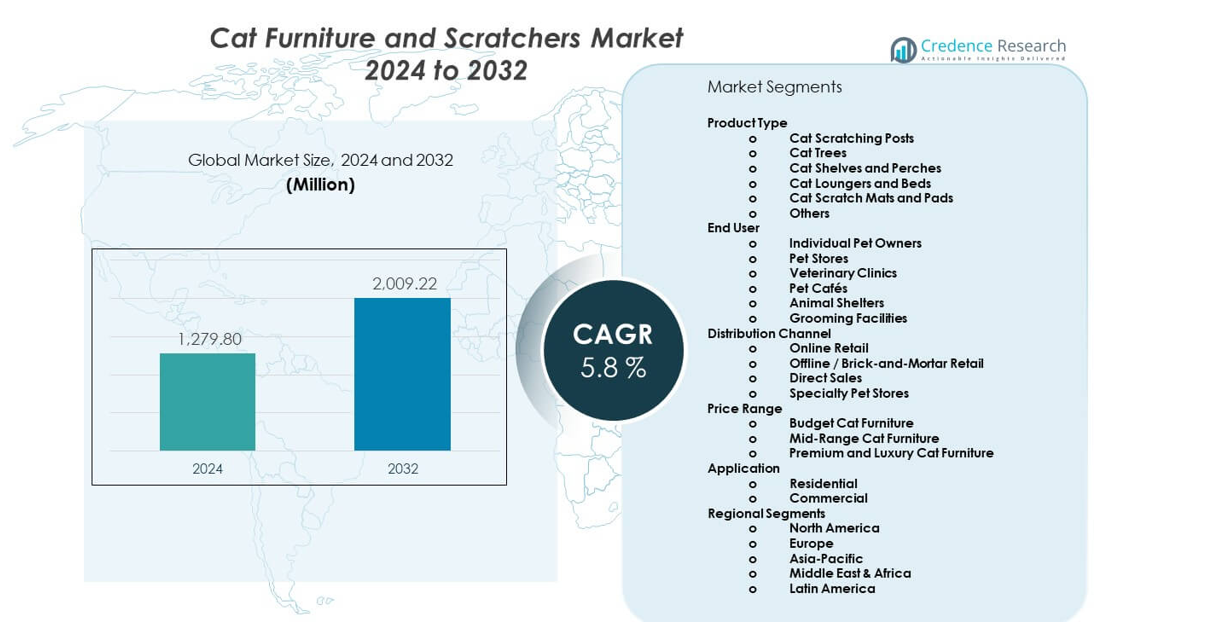
Market Insights:
- The Cat Furniture and Scratchers Market is valued at USD 1,279.8 million in 2024 and is projected to reach USD 2,009.22 million by 2032, growing at a 8% CAGR driven by rising pet humanization and premium furniture adoption.
- North America (40%), Europe (30%), and Asia-Pacific (25%) dominate due to high pet ownership, strong décor-focused buying, and growing indoor living trends across urban homes.
- Asia-Pacific is the fastest-growing region with 25% share, supported by rapid urbanization, rising disposable income, and strong online retail penetration.
- Cat scratching posts hold the largest product share at 5%, driven by widespread need for durable claw-care solutions in indoor spaces.
- Residential applications represent the dominant segment with the highest share, supported by growing adoption of cats across single and multi-pet households.
Market Drivers:
Rising Focus On Pet Wellness And Enriched Indoor Environments
Growing interest in pet well-being lifts structured demand for advanced designs. Buyers want safe spaces that support climbing, scratching, and resting needs. Makers create tall posts and cushioned areas that reduce stress in indoor cats. The Cat Furniture and Scratchers Market benefits from stronger emphasis on animal enrichment. Households prefer designs that help reduce destructive behavior in tight living spaces. Many owners choose units that support instinctive movement without crowding rooms. New layouts mix durability with soft textures to improve daily comfort. Brands expand assortments that match diverse activity habits across multiple breeds.
- FOR INSTANCE, Tuft + Paw positions itself in the premium segment with prices for its furniture ranging from around US\(69toUS\) 699, demonstrating a demand among consumers for well-designed, aesthetic, and functional cat furniture.
Shift Toward Premium, Customized, And Home-Décor-Friendly Products
Premium designs gain strong traction due to rising interest in stylish interiors. Buyers want furniture-grade woods and modern silhouettes that blend with home décor. Makers use high-end fabrics that improve comfort and reduce dust retention. It pushes brands to offer modular towers that adapt to smaller homes. Growing customization lifts interest in color-matched posts and personalized scratching zones. Multi-cat homes prefer adjustable levels that reduce conflict. Durable sisal and reinforced frames support long-term use. Premium choices strengthen value perception across lifestyle-driven shoppers.
- For instance, Tuft + Paw offers modular cat trees and beds that combine design and durability, reinforcing its premium positioning in the market.
Growing Impact Of E-Commerce Expansion And Digital Engagement
Online channels raise access to diverse furniture and scratcher designs. Video demos help buyers compare stability, height, and surface quality. The Cat Furniture and Scratchers Market grows due to stronger digital visibility. Brands use user reviews to highlight durability and comfort performance. Fast delivery improves adoption for first-time cat owners. Custom recommendation tools guide buyers toward suitable sizes and materials. Social media boosts awareness of enrichment needs and modern home setups. Rising online promotions lift repeat purchases across urban clusters.
Broader Adoption Of Eco-Friendly, Recycled, And Sustainable Materials
Sustainable materials attract owners who value safe and green home products. Makers use recycled woods and natural sisal to reduce chemical exposure. It improves buyer trust in long-term indoor use. Eco-friendly dyes and washable cushions support cleaner home conditions. Demand rises for toxin-free finishes that protect sensitive cats. Brands promote sustainable packaging to meet rising consumer expectations. Durable recycled bases lower waste and extend product life. New innovations support responsible production without lowering comfort quality.
Market Trends:
Growing Integration Of Space-Saving Vertical And Multifunctional Structures
Vertical towers gain traction due to shrinking home spaces. Buyers want tall, slim models that support climbing without limiting movement. Makers add shelves, ramps, and hideouts in compact forms. The Cat Furniture and Scratchers Market sees rising demand for multifunction layouts. Foldable units appeal to renters with limited floor space. Built-in scratch zones reduce the need for multiple items. Many households choose wall-mounted posts that free up lower areas. Brands develop modular pieces that adjust to room layouts.
- For instance, brands like Vesper (Catit) deliver affordable, multifunctional cat trees and modular furniture that fit urban apartments while providing scratching surfaces and resting zones.
Expansion Of Smart Features And Tech-Enabled Pet Interaction Designs
Smart add-ons gain interest due to rising focus on interactive pet care. Motion-trigger sensors help track activity and rest cycles. Makers add detachable sensors that monitor scratching frequency. It improves understanding of behavior patterns in multi-cat homes. LED cues guide cats toward safe climbing paths. Smart cushions track temperature to support health checks. App links help owners adjust play features from a distance. Tech-driven features build stronger engagement across young pet owners.
- For instance, several modern smart pet devices now include sensors that monitor pet behavior, and industry articles note growth in sensor-enabled toys and furniture that support health and activity tracking.
Stronger Influence Of Minimalist, Scandinavian, And Luxury Interior Themes
Design trends shape preferences across modern households. Buyers want furniture that blends clean lines with soft tones. The Cat Furniture and Scratchers Market accepts designs that mirror human furniture themes. Oak finishes and neutral fabrics match minimalist living rooms. Luxury lines add soft woven textures and curved wooden frames. Many owners avoid bulky units that interrupt décor flow. Light-toned sisal improves neutral interior appeal. Aesthetic alignment becomes a key purchasing factor in premium homes.
Rising Popularity Of Multi-Pet Compatible Designs And Shared Activity Units
Growing multi-pet homes lift need for shared climbing and scratching options. Makers build stronger bases that hold higher weight loads. It supports balanced use among different breeds. Side-by-side scratching panels reduce conflict over shared zones. Elevated resting shelves help create private layers for each cat. Adjustable height settings improve comfort across age groups. Multi-entry cubbies support hiding behavior in busy homes. New households choose durable structures that support long-term multi-pet habits.
Market Challenges Analysis:
High Material Costs, Durability Issues, And Rising Pressure On Quality Assurance
Material cost inflation limits affordability across several regions. The Cat Furniture and Scratchers Market faces quality expectations that demand stronger testing. Many low-cost units suffer from stability concerns. Buyers avoid products that wobble during climbing. Makers struggle to balance lightweight frames with long-term durability. Scratching surfaces wear down quickly when quality is poor. Warranty claims rise when fabrics tear or posts loosen. Brands must maintain strict quality checks to retain buyer trust.
Strong Competition, Design Saturation, And Difficulty In Differentiation
Rising competition creates pressure on pricing and product uniqueness. Many brands release similar towers, trees, and posts. It reduces the ability to stand out in crowded online catalogs. New brands rely on aggressive discounts to win early traction. Overlapping features limit long-term differentiation across categories. Buyers compare dozens of models before finalizing a purchase. Busy marketplaces increase review volatility and rating drops. Companies must innovate with materials and layouts to retain market presence.
Market Opportunities:
Expansion Into Premium Lifestyle Collections And High-Value Custom Designs
Premium lifestyle lines open new growth paths for brands. Buyers show strong interest in custom colors, custom fabrics, and modular layouts. The Cat Furniture and Scratchers Market benefits from wider premium adoption. It allows brands to introduce hardwood finishes and tailored sisal textures. High-value units attract décor-focused households. Makers can expand customizable height levels and private cubbies. Stronger personalization enhances loyalty among returning buyers. Premium upgrades create higher margins for manufacturers.
Growth Potential Across Emerging Markets And Rapid Urban Pet Adoption
Emerging markets offer strong room for expansion in urban centers. Rising pet humanization lifts demand for modern designs. Many first-time owners prefer compact towers that suit small apartments. It encourages brands to introduce low-cost modular starter units. Growth in online retail improves product reach in underserved areas. Makers can target young pet owners with space-saving sets. New awareness programs help promote proper scratching options. Expanding retail networks open new distribution advantages.
Market Segmentation Analysis:
Product Type
The Cat Furniture and Scratchers Market expands across cat scratching posts, cat trees, shelves and perches, loungers and beds, scratch mats and pads, and other activity units. Cat scratching posts lead due to strong demand for durable surfaces that support natural claw use. Cat trees hold steady traction with multi-level layouts suited for active indoor pets. Shelves and perches gain attention in compact homes where vertical movement helps reduce stress. Loungers and beds appeal to owners who want softer resting zones. Scratch mats stay popular for low-cost enrichment needs. It supports broad product diversity across varied household setups.
- For instance, Trixie expanded its sustainable offering in late 2023 with the Finca Felice cardboard cat furniture set, a modular "fortress" made entirely from recycled cardboard, consisting of cubes, a ramp and a tunnel that can be reconfigured or expanded into a larger "cat castle," providing scratching, hiding and lounging opportunities for heavier or multi-cat households.
End User
Individual pet owners dominate due to widespread home adoption of cats. Pet stores maintain steady demand for robust display-ready units. Veterinary clinics use stable furniture to ease handling in exam rooms. Pet cafés and grooming facilities prefer durable structures that support frequent use. Animal shelters adopt cost-effective designs to manage high activity loads across shared spaces.
- For instance, PetPals Group Inc. introduced its Wagon 5-level minimalist wood cat tower in October 2024, featuring a hexagon-shaped laminated-wood condo, removable plush cushions, three natural sisal rope scratching posts and pom-pom toys, positioned as a modern multi-activity cat tree for climbing, scratching and lounging up to 20 lb cats in high-traffic settings.
Distribution Channel
Online retail grows quickly due to strong preference for wide catalogs and user reviews. Offline stores retain buyers who want direct product inspection. Direct sales help brands push premium collections. Specialty pet stores attract décor-focused buyers who prefer curated layouts.
Price Range
Budget products serve new pet households. Mid-range options offer balanced durability and design. Premium and luxury ranges target style-driven buyers seeking hardwood builds and modern aesthetics.
Application
Residential use dominates due to rising indoor pet care. Commercial spaces adopt sturdy units that support frequent activity in cafés, clinics, and shelters.
Segmentation:
Product Type
- Cat Scratching Posts
- Cat Trees
- Cat Shelves and Perches
- Cat Loungers and Beds
- Cat Scratch Mats and Pads
- Others
End User
- Individual Pet Owners
- Pet Stores
- Veterinary Clinics
- Pet Cafés
- Animal Shelters
- Grooming Facilities
Distribution Channel
- Online Retail
- Offline / Brick-and-Mortar Retail
- Direct Sales
- Specialty Pet Stores
Price Range
- Budget Cat Furniture
- Mid-Range Cat Furniture
- Premium and Luxury Cat Furniture
Application
- Residential
- Commercial
Regional Segments
- North America
- U.S.
- Canada
- Mexico
- Europe
- Germany
- France
- U.K.
- Italy
- Spain
- Rest of Europe
- Asia Pacific
- China
- Japan
- India
- South Korea
- South-east Asia
- Rest of Asia Pacific
- Latin America
- Brazil
- Argentina
- Rest of Latin America
- Middle East & Africa
- GCC Countries
- South Africa
- Rest of the Middle East and Africa
Regional Analysis:
North America
North America leads the Cat Furniture and Scratchers Market with a 40% share driven by high pet ownership and premium spending patterns. Buyers prefer modern, furniture-grade designs that blend with home décor. Brands expand assortments that match small apartments and larger suburban homes. Demand rises for durable scratch posts and multi-level trees that support indoor lifestyles. E-commerce platforms boost product reach across major cities. It strengthens regional leadership through strong brand presence and wide retail networks.
Europe
Europe holds a 30% share supported by strong interest in sustainable and minimalist home products. Buyers show preference for eco-friendly woods and natural sisal. The Cat Furniture and Scratchers Market gains traction due to rising emphasis on enrichment for indoor cats. Many households prefer compact shelves and perches that match modern interiors. Specialty pet stores showcase premium designs with high aesthetic value. Regional buyers show strong loyalty to trusted European brands.
Asia-Pacific
Asia-Pacific accounts for 25% and shows the fastest rise due to urban living patterns and growing pet humanization. Rising adoption in China, Japan, and South Korea shifts demand toward compact, vertical structures. Many owners choose wall-mounted perches to manage limited living areas. It benefits from strong e-commerce penetration and competitive pricing. Young consumers drive interest in decorative and multi-functional designs. Expanding pet-care awareness supports steady regional growth across emerging cities.
Key Player Analysis:
- Americat Company
- North American Pet Products
- Go Pet Club
- MidWest Homes for Pets
- PetPals Group Inc.
- Inter IKEA Systems B.V.
- Tuft + Paw
- Ware Pet Products
- Prevue Pet Products
- Catastrophic Creations
- PetFusion
- Vesper
- Catit
- Trixie
- PawHut
Competitive Analysis:
The Cat Furniture and Scratchers Market shows steady competition driven by design variety, pricing tiers, and rising focus on décor-aligned products. Leading brands invest in durable materials, modular structures, and eco-friendly options to attract premium buyers. Smaller companies target niche appeal through handmade pieces and recycled materials. It benefits from strong online visibility where customer reviews influence purchase patterns. Global players maintain scale advantages through wide distribution networks and consistent manufacturing standards. Regional brands focus on aesthetic customization suited to local home layouts. Competition intensifies as more firms launch compact and multi-functional units that fit modern living spaces.
Recent Developments:
- In March 2025, PetPals Group Inc. further broadened its large cat tree portfolio with models such as Wagon 2.0, Grayson, Pharaoh V2 and Tundra, targeting big cats and multi‑cat households by emphasizing tall, sturdy structures with multiple scratching posts and elevated lounging zones within its “Large Cat Trees” range.
- In March 2024, Inter IKEA Systems B.V. launched UTSÅDD, its first global pet collection, comprising 29 products for cats and dogs that cover eating, sleeping, playing and hiding, including cat houses and dedicated scratching accessories developed with veterinarians and pet‑product experts to blend pet needs, safety and home‑friendly design.
Report Coverage:
The research report offers an in-depth analysis based on Product Type, End User, Distribution Channel, Price Range, and Application. It details leading market players, providing an overview of their business, product offerings, investments, revenue streams, and key applications. Additionally, the report includes insights into the competitive environment, SWOT analysis, current market trends, as well as the primary drivers and constraints. Furthermore, it discusses various factors that have driven market expansion in recent years. The report also explores market dynamics, regulatory scenarios, and technological advancements that are shaping the industry. It assesses the impact of external factors and global economic changes on market growth. Lastly, it provides strategic recommendations for new entrants and established companies to navigate the complexities of the market
Future Outlook:
- Demand for décor-aligned furniture will rise with stronger interest in modern home themes.
- Eco-friendly materials will gain more adoption among health-conscious pet owners.
- Multi-functional and space-saving towers will support dense urban living.
- Brands will expand modular systems to increase product life cycles.
- Online retail growth will drive broader access to customizable designs.
- Smart interaction add-ons may appear in premium segments.
- Commercial spaces like cafés and clinics will adopt sturdier, high-use structures.
- Regional brands will rise with culturally aligned design patterns.
- Sustainable packaging and recycled materials will gain priority for manufacturers.
- Broader pet humanization trends will strengthen demand for premium comfort units.

Request a Free Sample
Fill in your details and we'll send you a free sample report.
- Sample data tables & charts
- Research methodology
Market Dynamics
Rising Focus on Pet Wellness and Enriched Indoor Environments
Consumers are increasingly prioritizing their cats' mental and physical stimulation, driving demand for advanced furniture and scratchers that support climbing, scratching, and resting needs. This trend is especially strong in urban areas where indoor living is prevalent and enrichment is essential for pet well-being.
Shift Toward Premium, Customized, and Home-Décor-Friendly Products
There is growing consumer interest in stylish, premium cat furniture that blends with modern home décor, leading manufacturers to offer modular, customizable, and aesthetically pleasing designs. This shift supports higher price points and attracts style-conscious pet owners.
Broader Adoption of Eco-Friendly, Recycled, and Sustainable Materials
Health- and environment-conscious buyers are seeking cat furniture made from natural, recycled, and toxin-free materials, prompting brands to innovate with sustainable woods, sisal, and eco-friendly finishes. This driver is particularly strong in Europe and among premium buyers globally.
Growing Impact of E-Commerce Expansion and Digital Engagement
The rise of online retail and digital marketing has made a wide variety of cat furniture and scratchers accessible to more consumers, with user reviews, video demos, and customization tools enhancing the buying experience. E-commerce growth is especially significant in Asia Pacific and North America.
Increasing Urbanization and Compact Living Spaces
As more people live in smaller urban homes, there is heightened demand for space-saving, vertical, and multifunctional cat furniture. Manufacturers are responding with modular and wall-mounted designs that maximize utility without occupying excessive floor space.
Need a Custom Version of This Report?
Tailor the scope, geography, or segments to your exact requirements.
- Custom geography or segment scope
- Direct access to our analyst team
Frequently Asked Questions
What is the current market size for the Cat Furniture and Scratchers Market, and what is its projected size in 2032?
At what Compound Annual Growth Rate is the Cat Furniture and Scratchers Market projected to grow between 2025 and 2032?
Who are the major players in the global cat furniture and scratchers market?
What are the major market drivers of the cat furniture and scratchers industry?
What are the major market restraints of the cat furniture and scratchers industry?
What are the major market opportunities of the cat furniture and scratchers industry?
Who are the leading companies in the Cat Furniture and Scratchers Market?
Table of Content
Chapter 1 Market Segmentation
- 1.1 Segmentation Framework
- 1.1.1 Product and Service Classification
- 1.1.2 Application and End-Use Classification
- 1.1.3 Technology and Solution Classification
- 1.1.4 Customer and Distribution Channel Classification
- 1.1.5 Geographic Segmentation
- 1.1.6 Market Segment Definitions and Boundaries
- 1.2 By End User
- 1.2.1 Individual Pet Owners
- 1.2.2 Pet Stores
- 1.2.3 Veterinary Clinics
- 1.2.4 Pet Cafés
- 1.2.5 Animal Shelters
- 1.2.6 Grooming Facilities
- 1.3 By Price Range
- 1.3.1 Budget Cat Furniture
- 1.3.2 Mid-Range Cat Furniture
- 1.3.3 Premium and Luxury Cat Furniture
- 1.4 By Product Type
- 1.4.1 Cat Scratching Posts
- 1.4.2 Cat Trees
- 1.4.3 Cat Shelves and Perches
- 1.4.4 Cat Loungers and Beds
- 1.4.5 Cat Scratch Mats and Pads
- 1.4.6 Others
Chapter 2 Introduction
- 2.1 Report Objectives and Scope
- 2.2 Product Definition and Industry Terminology
- 2.3 Market Inclusions and Exclusions
- 2.4 Research Process
- 2.4.1 Primary Research and Expert Interviews
- 2.4.2 Secondary Research and Source Review
- 2.4.3 Top-Down and Bottom-Up Estimation
- 2.4.4 Data Triangulation and Verification
- 2.5 Market Size Measurement Basis
- 2.5.1 2024: USD 1,279.8 million → 2032: USD 2,009.22 million
- 2.6 Historical and Forecast Reference Periods
- 2.6.1 Base Year: 2024
- 2.6.2 Forecast Period: 2024-2032
- 2.7 Research Assumptions and Limitations
Chapter 3 Executive Summary
- 3.1 Market Snapshot and Key Findings
- 3.2 Base-Year Market Size, 2024
- 3.3 Forecast Market Size, 2032
- 3.4 Revenue and Volume Growth Outlook
- 3.5 Key Demand and Supply Indicators
- 3.6 Leading Market Segments
- 3.7 Fastest-Growing Market Opportunities
- 3.8 Regional Performance Highlights
- 3.9 Technology and Industry Transformation
- 3.10 Competitive Landscape Summary
- 3.11 Analyst View and Strategic Implications
Chapter 4 Global Cat Furniture and Scratchers Market Trends and Developments
- 4.1 Historical Industry Development
- 4.2 Recent Market Trends and Developments
- 4.3 Demand and Customer Behavior Trends
- 4.4 Technology and Product Innovation
- 4.5 Artificial Intelligence, Automation and Digitalization
- 4.6 Local Manufacturing and Supply Chain Realignment
- 4.7 Industry Partnerships, Mergers and Acquisitions
- 4.8 Sustainability and Circular Economy Developments
- 4.9 Government and Private Sector Investment Trends
- 4.10 Emerging Business Models and Commercialization
- 4.11 Industry Developments and Announcements
Chapter 5 Global Cat Furniture and Scratchers Market Production, Supply and Demand Analysis
- 5.1 Demand Trend and Consumption Analysis
- 5.2 Demand Forecast, 2024-2032
- 5.3 Production and Output Trend
- 5.4 Production and Output Forecast, 2024-2032
- 5.5 Installed Capacity and Capacity Utilization
- 5.6 Company-Wise Production Plants and Statistics
- 5.6.1 Installed Production Capacity
- 5.6.2 Actual Production
- 5.6.3 Planned Capacity and Expansion Targets
- 5.7 Supply Chain Structure and Procurement Trends
- 5.8 Supply-Demand Gap and Bottlenecks
- 5.9 Import Dependence and Sourcing Structure
- 5.10 Contract Manufacturing and Outsourcing
- 5.11 Regional Supply and Demand Concentration
Chapter 6 Global Cat Furniture and Scratchers Market Pricing Analysis
- 6.1 Pricing Structure and Measurement
- 6.2 Historical Pricing Trends
- 6.3 Pricing Outlook, 2024-2032
- 6.4 Average Selling Price and Unit Economics
- 6.5 Pricing by Product and Market Segment
- 6.6 Geographic Pricing Differences
- 6.7 Key Input, Energy, Labor and Logistics Costs
- 6.8 Contract Pricing and Purchasing Models
- 6.9 Pricing Sensitivity and Competitive Positioning
- 6.10 Price, Margin and Profitability Implications
Chapter 7 Global Cat Furniture and Scratchers Market Dynamics
- 7.1 Market Growth Drivers
- 7.1.1 Demand-Side Drivers
- 7.1.2 Technology and Innovation Drivers
- 7.1.3 Infrastructure and Investment Drivers
- 7.1.4 Regulatory and Policy Drivers
- 7.2 Market Restraints
- 7.2.1 Cost and Affordability Constraints
- 7.2.2 Technology and Adoption Barriers
- 7.2.3 Supply Chain and Operational Constraints
- 7.3 Market Challenges
- 7.3.1 Competitive Pressure and Margin Erosion
- 7.3.2 Skills, Infrastructure and Implementation Gaps
- 7.4 Emerging Market Opportunities
- 7.5 Market Dynamics Impact and Time-Horizon Assessment
Chapter 8 Global Cat Furniture and Scratchers Value Chain Analysis
- 8.1 Industry Value Chain Overview
- 8.2 Upstream Suppliers and Critical Inputs
- 8.3 Technology and Component Providers
- 8.4 Manufacturing or Service Delivery
- 8.5 Distribution, Channel Partners and Integrators
- 8.6 Downstream Applications and End Users
- 8.7 Value Addition and Profit Pools
- 8.8 Vertical Integration and Outsourcing
- 8.9 Supplier Concentration and Risk
- 8.10 Supply Chain Localization and Resilience
Chapter 9 Global Cat Furniture and Scratchers Market Regulations and Policies
- 9.1 Relevant Laws, Standards and Compliance Frameworks
- 9.2 Product, Service, Safety and Quality Requirements
- 9.3 Government Policies, Incentives and Subsidies
- 9.4 Imports, Exports and Trade Barriers
- 9.5 Public Procurement and Local Content Requirements
- 9.6 Environmental and Sustainability Compliance
- 9.7 Upcoming Policy Changes and Market Implications
Chapter 10 Global Cat Furniture and Scratchers Market Hotspots and Opportunities
- 10.1 Market Opportunity Mapping and Growth Hotspots
- 10.2 High-Growth Applications and Customer Groups
- 10.3 Underserved Markets and White-Space Opportunities
- 10.4 Emerging Technology and Product Opportunities
- 10.5 New Capacity and Investment Hotspots
- 10.6 Market Entry and Expansion Opportunities
- 10.7 Distribution and Partnership Opportunities
- 10.8 Near-Term and Long-Term Commercial Potential
- 10.9 Opportunity Attractiveness and Execution Risks
Chapter 11 Global Cat Furniture and Scratchers Market Outlook, 2024-2032
- 11.1 Market Size and Analysis
- 11.1.1 Revenue (Market Measurement: 2024: USD 1,279.8 million → 2032: USD 2,009.22 million)
- 11.1.2 Market Volume and Quantity Sold
- 11.1.3 Historical Market Size
- 11.1.4 Base-Year Market Size, 2024
- 11.2 Market Forecast, 2024-2032
- 11.2.1 Revenue Forecast to 2032
- 11.2.2 Volume Forecast to 2032
- 11.2.3 CAGR and Year-on-Year Growth
- 11.2.4 Incremental Revenue Opportunity
- 11.3 Forecast Assumptions and Scenario Analysis
- 11.3.1 Base-Case Forecast
- 11.3.2 Optimistic and Conservative Scenarios
- 11.3.3 Technology, Pricing and Policy Sensitivities
- 11.4 Market Attractiveness and Growth Outlook
Chapter 12 Global Cat Furniture and Scratchers Market Segmentation and Outlook
- 12.1 Segmentation Summary and Market Shares, 2024
- 12.2 Largest and Fastest-Growing Segments
- 12.3 By End User - Market Size and Forecast, 2024-2032
- 12.3.1 Segment Definition and Scope
- 12.3.2 Historical Market Size
- 12.3.3 Revenue Forecast, 2024-2032
- 12.3.4 Volume Forecast, 2024-2032
- 12.3.5 Base-Year Market Share, 2024
- 12.3.6 Segment CAGR and Growth Drivers
- 12.3.7 Subsegment Market Size and Forecast
- 12.3.7.1 Individual Pet Owners
- 12.3.7.2 Pet Stores
- 12.3.7.3 Veterinary Clinics
- 12.3.7.4 Pet Cafés
- 12.3.7.5 Animal Shelters
- 12.3.7.6 Grooming Facilities
- 12.3.8 Subsegment Pricing and Adoption Trends
- 12.3.9 Leading Suppliers and Competition
- 12.3.10 Regional Demand and Opportunities
- 12.4 By Price Range - Market Size and Forecast, 2024-2032
- 12.4.1 Segment Definition and Scope
- 12.4.2 Historical Market Size
- 12.4.3 Revenue Forecast, 2024-2032
- 12.4.4 Volume Forecast, 2024-2032
- 12.4.5 Base-Year Market Share, 2024
- 12.4.6 Segment CAGR and Growth Drivers
- 12.4.7 Subsegment Market Size and Forecast
- 12.4.7.1 Budget Cat Furniture
- 12.4.7.2 Mid-Range Cat Furniture
- 12.4.7.3 Premium and Luxury Cat Furniture
- 12.4.8 Subsegment Pricing and Adoption Trends
- 12.4.9 Leading Suppliers and Competition
- 12.4.10 Regional Demand and Opportunities
- 12.5 By Product Type - Market Size and Forecast, 2024-2032
- 12.5.1 Segment Definition and Scope
- 12.5.2 Historical Market Size
- 12.5.3 Revenue Forecast, 2024-2032
- 12.5.4 Volume Forecast, 2024-2032
- 12.5.5 Base-Year Market Share, 2024
- 12.5.6 Segment CAGR and Growth Drivers
- 12.5.7 Subsegment Market Size and Forecast
- 12.5.7.1 Cat Scratching Posts
- 12.5.7.2 Cat Trees
- 12.5.7.3 Cat Shelves and Perches
- 12.5.7.4 Cat Loungers and Beds
- 12.5.7.5 Cat Scratch Mats and Pads
- 12.5.7.6 Others
- 12.5.8 Subsegment Pricing and Adoption Trends
- 12.5.9 Leading Suppliers and Competition
- 12.5.10 Regional Demand and Opportunities
- 12.6 Segment Growth Comparison
- 12.7 Segment Attractiveness and Priority Matrix
Chapter 13 Global Cat Furniture and Scratchers End-Use and Application Market Outlook
- 13.1 End-Use Industry and Customer Demand Structure
- 13.2 Leading Applications and Customer Groups
- 13.3 End-Use Market Size, Share and Forecast
- 13.4 Major End-Use Industry Deep Dives
- 13.4.1 Customer Requirements and Use Cases
- 13.4.2 Demand and Replacement Cycles
- 13.4.3 Technical and Regulatory Considerations
- 13.4.4 Purchasing and Procurement Models
- 13.4.5 Leading Vendors and Distribution Channels
- 13.4.6 Forecast and Commercial Opportunities
- 13.5 Emerging Applications and Cross-Segment Demand
- 13.6 End-Use Industry Investment Priorities
Chapter 14 Global Cat Furniture and Scratchers Geographic Market Outlook, 2024-2032
- 14.1 Regional Market Size and Share, 2024
- 14.2 Regional Market Forecast, 2024-2032
- 14.3 Regional Pricing, Production and Demand Differences
- 14.4 North America
- 14.4.1 United States
- 14.4.2 Canada
- 14.4.3 Mexico
- 14.5 Europe
- 14.5.1 Germany
- 14.5.2 France
- 14.5.3 Italy
- 14.5.4 United Kingdom
- 14.5.5 Spain
- 14.5.6 Poland
- 14.5.7 Russia
- 14.5.8 Netherlands
- 14.5.9 Belgium
- 14.5.10 Sweden
- 14.5.11 Denmark
- 14.5.12 Norway
- 14.5.13 Rest of Europe
- 14.6 Asia Pacific
- 14.6.1 China
- 14.6.2 India
- 14.6.3 Japan
- 14.6.4 South Korea
- 14.6.5 Thailand
- 14.6.6 Indonesia
- 14.6.7 Vietnam
- 14.6.8 Malaysia
- 14.6.9 Australia
- 14.6.10 Rest of Asia Pacific
- 14.7 Latin America
- 14.7.1 Brazil
- 14.7.2 Argentina
- 14.7.3 Colombia
- 14.7.4 Chile
- 14.7.5 Rest of Latin America
- 14.8 Middle East
- 14.8.1 Saudi Arabia
- 14.8.2 United Arab Emirates
- 14.8.3 Turkey
- 14.8.4 Israel
- 14.8.5 Iran
- 14.8.6 Rest of the Middle East
- 14.9 Africa
- 14.9.1 South Africa
- 14.9.2 Egypt
- 14.9.3 Nigeria
- 14.9.4 Morocco
- 14.9.5 Rest of Africa
- 14.10 Regional Investment, Policy and Supply Chain Differences
- 14.11 Regional Competitive Landscape
- 14.12 Geographic Growth Hotspots
Chapter 15 Global Cat Furniture and Scratchers Technology, Innovation and Sustainability Outlook
- 15.1 Technology Landscape and Maturity
- 15.2 Product, Process and Service Innovation
- 15.3 AI, Automation and Digital Tools in the Industry
- 15.4 Technology Adoption and Performance Benchmarking
- 15.5 Innovation Pipeline and R&D Investment
- 15.6 Patent and Intellectual Property Trends
- 15.7 Energy Efficiency and Resource Management
- 15.8 Sustainability, Recycling and Circularity
- 15.9 Technology Roadmap, 2024-2032
- 15.10 Risks of Obsolescence and Technology Substitution
Chapter 16 Global Cat Furniture and Scratchers Market Key Strategic Imperatives
- 16.1 Growth and Market Entry Priorities
- 16.2 High-Return Products and Segments
- 16.3 Pricing, Profitability and Cost Optimization
- 16.4 Technology Investment and Product Differentiation
- 16.5 Supply Chain Localization and Resilience
- 16.6 Distribution and Customer Acquisition
- 16.7 Partnership, Acquisition and Capacity Strategy
- 16.8 Regional Expansion Priorities
- 16.9 Short-, Medium- and Long-Term Actions
Chapter 17 Competition Outlook
- 17.1 Industry Competition Characteristics
- 17.2 Market Structure and Concentration
- 17.3 Market Share and Competitive Positioning, 2024
- 17.4 Company-Wise Revenue and Product Benchmarking
- 17.5 Production and Service Capacity Benchmarking
- 17.6 Technology, Pricing and Differentiation
- 17.7 Regional Footprint and Distribution Strength
- 17.8 Mergers, Acquisitions and Strategic Alliances
- 17.9 New Entrants and Competitive Threats
- 17.10 Porter's Five Forces and Industry Attractiveness
- 17.11 Competitive Outlook, 2024-2032
Chapter 18 Company Profiles
- 18.1 Company Coverage and Selection Criteria
- 18.2 Americat Company
- 18.2.1 Business Description
- 18.2.2 Company Ownership and Geographic Presence
- 18.2.3 Product and Service Portfolio
- 18.2.4 Manufacturing and Operating Footprint
- 18.2.5 Production Capacity and Expansion Plans
- 18.2.6 Financial Performance and Investment
- 18.2.7 Market Share and Competitive Position
- 18.2.8 Technology and Innovation Capabilities
- 18.2.9 Strategic Alliances or Partnerships
- 18.2.10 Recent Developments
- 18.2.11 Growth Strategy and Outlook
- 18.3 North American Pet Products
- 18.4 Go Pet Club
- 18.5 MidWest Homes for Pets
- 18.6 PetPals Group Inc.
- 18.7 Inter IKEA Systems B.V.
- 18.8 Tuft + Paw
- 18.9 Ware Pet Products
- 18.10 Prevue Pet Products
- 18.11 Catit
- 18.12 Other Relevant Market Participants
Note: Every listed company is profiled on the structure shown under the first company. The company list is preliminary and may change based on research findings, market developments, data availability and client requirements.
Chapter 19 Disclaimer
- 19.1 Research and Forecast Disclaimer
- 19.2 Data Source and Estimation Limitations
Note: The depth of individual sections depends on data availability for this market. Volume, capacity, trade and other unit-based metrics are included where applicable.

