
Cath Lab Services Market Overview:
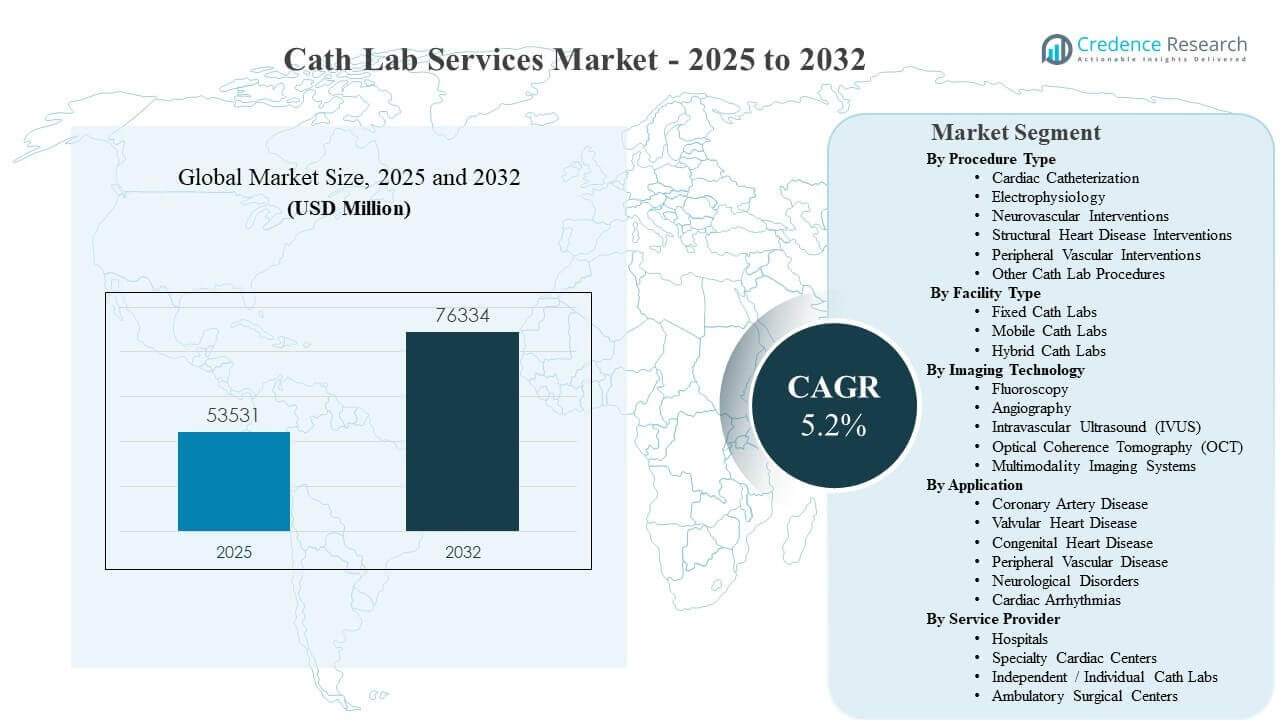
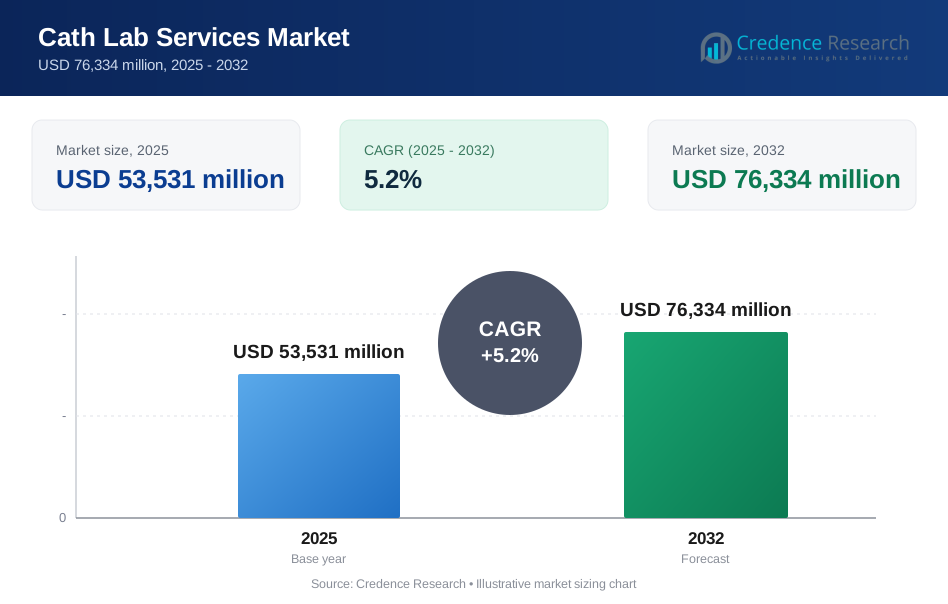
The global Cath Lab Services Market size was estimated at USD 53,531 million in 2025 and is expected to reach USD 76,334 million by 2032, growing at a CAGR of 5.2% from 2025 to 2032. Growth is primarily driven by rising procedural volumes across coronary, peripheral, and electrophysiology pathways, which pushes hospitals and specialty cardiac centers to expand cath lab capacity, optimize scheduling, and invest in higher-throughput workflows. The Cath Lab Services Market also benefits from expanding access to minimally invasive interventions and steady replacement cycles for imaging suites in high-volume cardiovascular networks.
| REPORT ATTRIBUTE | DETAILS |
|---|---|
| Historical Period | 2020-2024 |
| Base Year | 2025 |
| Forecast Period | 2026-2032 |
| Cath Lab Services Market Size 2025 | USD 53,531 million |
| Cath Lab Services Market, CAGR | 5.2% |
| Cath Lab Services Market Size 2032 | USD 76,334 million |
Key Market Trends & Insights
- The Cath Lab Services Market expanded from USD 53,531 million (2025) toward USD 76,334 million (2032), reflecting sustained multi-specialty interventional demand.
- North America held 38.7% share in 2025, supported by dense cath lab infrastructure and high procedural throughput.
- Asia Pacific accounted for 27.1% share in 2025, reflecting capacity build-out and rising demand for interventional cardiology and neurovascular services.
- Europe represented 24.6% share in 2025, underpinned by mature referral pathways and broad reimbursement coverage for cardiac procedures.
- Fixed Cath Labs led Facility Type with 83.2% share in 2025, reflecting dominance of permanent suites in hospital-based service lines.
Segment Analysis
The Cath Lab Services Market is shaped by provider focus on procedural throughput, clinical complexity, and service-line integration across cardiology, electrophysiology, vascular, and neurovascular pathways. Hospitals and specialty cardiac centers prioritize reliable room utilization, predictable staffing, and efficient case turnover to reduce waiting lists and improve referral retention. Demand is also influenced by the increasing share of minimally invasive procedures that require specialized imaging, sterile workflows, and coordinated peri-procedural care.
Technology intensity remains a major differentiator in the Cath Lab Services Market as providers balance capital upgrades with operating efficiency. Imaging platforms and intravascular guidance tools support improved procedural planning and optimization, especially in complex coronary, structural heart, and peripheral interventions. Facility decisions are often tied to patient acuity, the need for surgical backup, and the ability to run multi-disciplinary programs without disrupting elective schedules.
By Procedure Type Insights
Cardiac Catheterization and related coronary workflows remain the utilization backbone for many cath lab schedules, supporting steady baseline demand for diagnostic and interventional services. Electrophysiology programs expand procedure time requirements as arrhythmia care pathways scale in tertiary hospitals and specialty cardiac centers. Structural heart disease interventions drive incremental demand for higher-acuity suite readiness and tighter coordination between imaging, anesthesia, and clinical teams. Neurovascular interventions increase service needs in centers building comprehensive stroke capabilities and specialized endovascular teams.
By Facility Type Insights
Fixed Cath Labs accounted for the largest share of 83.2% in 2025. Fixed Cath Labs lead because fixed suites anchor high-volume hospital cardiac service lines and provide stable imaging performance for routine and complex interventions. Fixed Cath Labs also support predictable scheduling across multi-physician teams, enabling consistent throughput management. Fixed Cath Labs typically integrate with adjacent ICU and surgical services, improving readiness for higher-acuity cases and strengthening referral confidence.
By Imaging Technology Insights
Fluoroscopy and angiography remain foundational modalities because broad procedural coverage is required across coronary, peripheral, and structural heart pathways. Intravascular Ultrasound (IVUS) and Optical Coherence Tomography (OCT) support optimization of complex coronary interventions, reinforcing demand in advanced centers. Multimodality imaging systems gain traction where providers run multiple high-acuity programs and require flexible room configuration. Imaging decisions in the Cath Lab Services Market often align with clinical complexity mix, accreditation standards, and protocol standardization goals.
By Application Insights
Coronary Artery Disease drives a large share of overall demand due to recurring diagnostic and interventional needs and large eligible patient volumes. Valvular Heart Disease supports growth where structural heart pathways expand and multidisciplinary heart teams broaden referral capture. Peripheral Vascular Disease sustains demand for endovascular services in centers addressing limb ischemia and complex vascular disease management. Cardiac Arrhythmias strengthen electrophysiology service utilization as ablation programs and monitoring pathways expand in specialty cardiac centers.
By Service Provider Insights
Hospitals remain the dominant service setting because hospitals combine cath lab capacity with critical care backup, anesthesia coverage, and integrated cardiothoracic services for higher-acuity patient pathways. Specialty cardiac centers compete through focused cardiovascular workflows, shorter scheduling windows, and differentiated patient experience for elective cases. Independent cath labs expand selectively in geographies with supportive referral patterns and stable payer dynamics. Ambulatory surgical centers increase participation in lower-acuity pathways where patient selection criteria and safety protocols support short-stay care models.
Cath Lab Services Market Drivers
Rising cardiovascular disease burden and procedural volumes
The Cath Lab Services Market is driven by growing volumes of coronary and peripheral interventions as cardiovascular disease prevalence increases across aging populations. Higher diagnostic catheterization activity supports steady baseline utilization across hospital networks. Greater use of minimally invasive approaches expands addressable cases for cath lab scheduling. Providers respond by increasing suite availability, standardizing protocols, and improving case turnover to manage demand.
- For instance, Philips reported that St. Antonius Hospital’s use of the Azurion platform reduced interventional procedure time by 17%, cut patient preparation time by 12%, and enabled the department to treat 1 additional patient per day after implementation.
Expansion of minimally invasive structural heart and endovascular pathways
The Cath Lab Services Market benefits from structural heart and complex endovascular programs that require specialized cath lab readiness. Tertiary centers expand multidisciplinary pathways to manage valvular disease and high-risk coronary populations. Program growth increases demand for advanced imaging, specialized staffing, and coordinated peri-procedural services. These requirements strengthen service intensity and support capacity expansion decisions.
- For instance, Edwards Lifesciences reported real-world TVT Registry data covering more than 10,000 patients across more than 800 U.S. sites, where its SAPIEN 3 Ultra RESILIA valve showed a statistically significant reduction in paravalvular leak for the 29 mm valve, with 88.3% of patients showing no PVL and 10.7% showing only mild PVL at 30 days.
Technology upgrades that improve procedural precision and workflow efficiency
The Cath Lab Services Market grows as imaging and intravascular guidance technologies support improved procedural planning and treatment optimization. Facilities adopt upgrades to improve image quality, reduce repeat imaging, and support complex lesion assessment. Workflow enhancements also improve room utilization and reduce downtime associated with calibration and changeover. Providers link technology investment to throughput gains and service-line differentiation.
Hospital capacity optimization and service-line competitiveness
The Cath Lab Services Market is supported by health system focus on cath lab productivity, referral retention, and reduced elective procedure backlogs. Hospitals prioritize scheduling systems, staffing models, and standardized pathway management to stabilize utilization. Competitive dynamics also push specialty centers to expand capacity and improve patient experience. These actions translate into sustained demand for cath lab services across provider settings.
Cath Lab Services Market Challenges
Operational constraints are a persistent challenge in the Cath Lab Services Market as staffing shortages affect procedure scheduling, room utilization, and on-call coverage. Interventional cardiology and electrophysiology require specialized teams, and recruitment delays can limit capacity even when suite infrastructure is available. Refurbishment downtime and equipment maintenance can disrupt elective schedules and create bottlenecks. Cost pressures also increase scrutiny on capital upgrades and service expansion ROI.
Clinical and regulatory complexity adds friction in the Cath Lab Services Market, especially for higher-acuity structural heart and neurovascular procedures. Credentialing, pathway standardization, and safety protocols require continuous training and documentation effort. Payer policy variability can also influence case mix and site-of-care decisions across hospital versus outpatient settings. These factors can slow expansion in smaller facilities and concentrate growth in well-resourced centers.
- For instance, the FDA’s approval summary for Abbott’s TriClip G4 System states that in a clinical study of 175 patients treated with the device plus medicine versus 175 treated with medicine alone, 88 in 100 device-treated patients achieved tricuspid regurgitation reduced to moderate or less at one year, while 2 in 100 experienced a major safety complication within 30 days.
Cath Lab Services Market Trends and Opportunities
The Cath Lab Services Market is seeing increased emphasis on hybrid readiness and multidisciplinary program design to support structural heart and complex endovascular care. Providers align cath lab scheduling with imaging, anesthesia, and surgical backup requirements to expand eligible case volumes. Technology-driven protocol standardization improves clinical consistency and supports training efficiency across distributed networks. These approaches create opportunities for differentiated service offerings in high-volume systems.
Outpatient and short-stay optimization creates another opportunity in the Cath Lab Services Market as hospitals and specialty centers redesign pathways to reduce inpatient burden. Streamlined pre-assessment and recovery workflows improve throughput and patient satisfaction for selected procedures. Mobile cath labs support continuity-of-service during refurbishments and enable interim capacity expansion. These trends support flexible capacity strategies and improved utilization management.
- For instance, Modular Devices reports that its mobile cath labs can be delivered and installed in days rather than months, use a standard 8' x 48' footprint expandable to 15' x 48' with pop-outs, and include integrated radiation shielding with OEM-installed imaging systems, supporting renovation coverage, temporary service continuity, and short-term capacity expansion.
Regional Insights
North America
North America represented 38.7% share in 2025 in the Cath Lab Services Market, supported by high cath lab density, strong procedure volumes, and broad availability of advanced cardiovascular care pathways. Health systems in the United States and Canada emphasize throughput optimization, service-line integration, and technology refresh cycles to maintain capacity for elective and urgent cases. Specialty cardiac centers and large hospital networks reinforce demand through structured referral models and complex intervention programs.
Europe
Europe accounted for 24.6% share in 2025 in the Cath Lab Services Market, supported by mature cardiac care networks and established reimbursement coverage across major markets. European providers focus on protocol standardization, procedural safety, and efficient utilization of fixed cath labs for routine and advanced interventions. Structural heart programs and vascular pathways continue to expand in specialized centers, increasing service intensity in tertiary hubs.
Asia Pacific
Asia Pacific held 27.1% share in 2025 in the Cath Lab Services Market, reflecting capacity expansion across large populations and increasing access to interventional cardiology and neurovascular care. Private hospital investment and public-sector modernization strengthen suite additions in major urban centers. Rising demand for minimally invasive procedures also pushes facilities to improve imaging capability and staffing models to manage higher volumes and growing case complexity.
Latin America
Latin America captured 6.2% share in 2025 in the Cath Lab Services Market, with demand concentrated in major metropolitan hospital systems and private providers. Growth is supported by selective capacity expansion, rising cardiovascular procedure volumes, and modernization of imaging suites in leading centers. Constraints include uneven infrastructure distribution and variability in access outside top-tier urban networks.
Middle East & Africa
Middle East & Africa represented 3.4% share in 2025 in the Cath Lab Services Market, supported by concentrated investment in GCC healthcare hubs and select tertiary centers. Growth is typically driven by modernization programs, private hospital expansion, and specialized cardiac service-line development. Infrastructure variability across countries keeps share smaller, although leading urban centers continue to expand interventional capability.
Competitive Landscape
Competition in the Cath Lab Services Market centers on capacity expansion, technology upgrades, service-line integration, and differentiation through clinical quality and scheduling access. Hospital systems pursue protocol standardization and throughput improvement to manage growing volumes across cardiology, electrophysiology, and vascular pathways. Private hospital groups and specialty centers compete through faster scheduling, patient experience design, and targeted investment in advanced imaging and hybrid readiness. Mobile and interim capacity solutions also influence competition by reducing refurbishment disruption and enabling flexible service continuity.
InHealth Group differentiates within the Cath Lab Services Market through interim and mobile cath lab capacity models that support continuity during refurbishment cycles and capacity constraints. InHealth Group’s approach aligns with hospital needs for rapid deployment, predictable scheduling continuity, and reduced disruption to elective pathways. InHealth Group’s positioning supports health systems that require flexible room availability without delaying modernization projects. This operating model complements fixed-suite strategies by helping providers protect throughput and referral confidence.
The industry research and growth report includes detailed analyses of the competitive landscape of the market and information about key companies, including:
- InHealth Group
- Alberta Health Services
- Alliance Medical Group / Alliance Medical GmbH
- Ramsay Health Care
- PeaceHealth
- Campbell County Health
- Canyon Vista Medical Center
- Henry Ford Health
- Ochsner Rush Health
- Adventist Health Bakersfield
- Netcare Hospitals
- El Camino Health
Qualitative and quantitative analysis of companies has been conducted to help clients understand the wider business environment as well as the strengths and weaknesses of key industry players. Data is qualitatively analyzed to categorize companies as pure play, category-focused, industry-focused, and diversified; it is quantitatively analyzed to categorize companies as dominant, leading, strong, tentative, and weak.
Recent Developments
- In June 2025, Teleflex completed the acquisition of BIOTRONIK’s Vascular Intervention business, stating that the deal would significantly enhance its global presence in the cath lab and broaden its portfolio of interventional technologies. This update is relevant to the cath lab services market because it strengthens Teleflex’s position across procedures performed in catheterization labs.
- In October 2025, Royal Philips introduced an industry-first cath lab integration that automatically synchronizes pre-operative CT data with C-arm movement, helping pave the way for CT-guided PCI in the cath lab. Philips said the launch brings pre-operative imaging directly into cath lab workflow, which can improve procedural efficiency and support interventional cardiology care.
- In February 2026, Medtronic announced its intent to acquire CathWorks for up to $585 million as part of its strategy to expand its interventional cardiology portfolio and transform the cath lab with real-time physiologic data. The company said the acquisition would support more individualized treatment decisions in coronary artery disease and increase Medtronic’s presence in cath lab-based diagnostics and treatment.
- In March 2026, Columbia Asia Hospital Bukit Jalil launched a new Cardiac Catheterization Laboratory to expand access to advanced heart and vascular care through minimally invasive procedures. The hospital described the new cath lab as a major step in strengthening its specialized cardiac services and improving access to life-saving interventions.
Report Scope
| Report Attribute | Details |
| Market size value in 2025 | USD 53,531 million |
| Revenue forecast in 2032 | USD 76,334 million |
| Growth rate (CAGR) | 5.2% (2025–2032) |
| Base year | 2025 |
| Forecast period | 2026–2032 |
| Quantitative units | USD million |
| Segments covered | By Procedure Type Outlook: Cardiac Catheterization, Electrophysiology, Neurovascular Interventions, Structural Heart Disease Interventions, Peripheral Vascular Interventions, Other Cath Lab Procedures; By Facility Type Outlook: Fixed Cath Labs, Mobile Cath Labs, Hybrid Cath Labs; By Imaging Technology Outlook: Fluoroscopy, Angiography, Intravascular Ultrasound (IVUS), Optical Coherence Tomography (OCT), Multimodality Imaging Systems; By Application Outlook: Coronary Artery Disease, Valvular Heart Disease, Congenital Heart Disease, Peripheral Vascular Disease, Neurological Disorders, Cardiac Arrhythmias; By Service Provider Outlook: Hospitals, Specialty Cardiac Centers, Independent / Individual Cath Labs, Ambulatory Surgical Centers |
| Regional scope | North America, Europe, Asia Pacific, Latin America, Middle East & Africa |
| Key companies profiled | InHealth Group, Alberta Health Services, Alliance Medical Group / Alliance Medical GmbH, Ramsay Health Care, PeaceHealth, Campbell County Health, Canyon Vista Medical Center, Henry Ford Health, Ochsner Rush Health, Adventist Health Bakersfield, Netcare Hospitals, El Camino Health |
| No. of Pages | 342 |
Segmentation
By Procedure Type
- Cardiac Catheterization
- Electrophysiology
- Neurovascular Interventions
- Structural Heart Disease Interventions
- Peripheral Vascular Interventions
- Other Cath Lab Procedures
By Facility Type
- Fixed Cath Labs
- Mobile Cath Labs
- Hybrid Cath Labs
By Imaging Technology
- Fluoroscopy
- Angiography
- Intravascular Ultrasound (IVUS)
- Optical Coherence Tomography (OCT)
- Multimodality Imaging Systems
By Application
- Coronary Artery Disease
- Valvular Heart Disease
- Congenital Heart Disease
- Peripheral Vascular Disease
- Neurological Disorders
- Cardiac Arrhythmias
By Service Provider
- Hospitals
- Specialty Cardiac Centers
- Independent / Individual Cath Labs
- Ambulatory Surgical Centers
By Region
- North America
- U.S.
- Canada
- Mexico
- Europe
- Germany
- France
- U.K.
- Italy
- Spain
- Rest of Europe
- Asia Pacific
- China
- Japan
- India
- South Korea
- South-east Asia
- Rest of Asia Pacific
- Latin America
- Brazil
- Argentina
- Rest of Latin America
- Middle East & Africa
- GCC Countries
- South Africa
- Rest of the Middle East and Africa
Request a Free Sample
Fill in your details and we'll send you a free sample report.
- Sample data tables & charts
- Research methodology
Need a Custom Version of This Report?
Tailor the scope, geography, or segments to your exact requirements.
- Custom geography or segment scope
- Direct access to our analyst team
Frequently Asked Questions
What is the current size of the Cath Lab Services Market and what is the forecast value?
What is the growth rate of the Cath Lab Services Market?
Which segment is the largest in the Cath Lab Services Market?
What factors are driving growth in the Cath Lab Services Market?
Which companies are covered in the Cath Lab Services Market competitive landscape?
Which region leads the Cath Lab Services Market?
Table of Content
Chapter 1. Report Introduction
- 1.1 Report Description & Purpose
- 1.1.1 Report Title & Market Definition
- 1.1.2 Unique Selling Propositions (USP) & Key Differentiators
- 1.1.3 Value Proposition for Stakeholders
- 1.2 Research Objectives
- 1.2.1 Market Sizing Objectives (Volume & Revenue)
- 1.2.2 Segmentation Objectives
- 1.2.3 Competitive Intelligence Objectives
- 1.2.4 Forecast & Scenario Objectives
- 1.3 Report Scope
- 1.3.1 Cath Lab Services Scope – Types & Subtypes Covered
- 1.3.2 Geographic Scope – Regions & Countries Covered
- 1.3.3 Historical Period, Base Year & Forecast Period (2025; forecast to 2032)
- 1.3.4 Inclusions & Exclusions
- 1.4 HS Code & Classification Framework
- 1.5 Currency, Units & Pricing Basis
- 1.6 Target Stakeholders
- 1.7 Limitations & Assumptions
Chapter 2. Executive Summary
- 2.1 Global Cath Lab Services Market Snapshot
- 2.1.1 Market Size – Historical (2025) & Forecast (2025-2032) (2025: USD 53,531 million → 2032: USD 76,334 million)
- 2.1.2 Volume & Revenue – Global Totals
- 2.1.3 Key Market Highlights – Top Five Facts
- 2.2 Cath Lab Services Market Segmentation Snapshot
- 2.2.1 Market Split by Region – 2025 vs. 2032
- 2.3 Competitive Snapshot
- 2.3.1 Top 10 Players by Revenue Share – 2025
- 2.3.2 Top 10 Players by Volume Share – 2025
- 2.3.3 Recent Strategic Developments (18-Month Summary)
- 2.4 Key Investment Highlights & Strategic Conclusions
Chapter 3. Cath Lab Services Market Dynamics & Industry Analysis
- 3.1 Market Overview & Context
- 3.1.1 Cath Lab Services Market Position in the Broader Automotive Value Chain
- 3.1.2 OEM vs. Replacement Market Dynamics
- 3.1.3 Market Maturity & Development Stage by Region
- 3.2 Cath Lab Services Market Drivers
- 3.3 Cath Lab Services Market Restraints & Challenges
- 3.4 Cath Lab Services Market Opportunities
- 3.5 Porter's Five Forces Analysis
- 3.5.1 Threat of New Entrants
- 3.5.2 Bargaining Power of Suppliers
- 3.5.3 Bargaining Power of Buyers
- 3.5.4 Threat of Substitutes
- 3.5.5 Competitive Rivalry – Intensity Assessment
- 3.6 Cath Lab Services Value Chain Analysis
- 3.6.1 Upstream – Raw Material/Input Suppliers
- 3.6.1.1 Raw Material/Input 1
- 3.6.1.2 Raw Material/Input 2
- 3.6.1.3 Raw Material/Input 3
- 3.6.2 Midstream – Production/Manufacturing/Service Delivery
- 3.6.2.1 Production/Process Overview
- 3.6.2.2 Key Facility Locations & Capacity by Manufacturer
- 3.6.3 Downstream – Distribution & End Consumer
- 3.6.3.1 Primary Channel – B2B/OEM
- 3.6.3.2 Secondary Channels – Dealer, Retail, Online, Direct
- 3.6.4 Value Chain Profitability Analysis
- 3.6.1 Upstream – Raw Material/Input Suppliers
- 3.7 PESTEL Analysis
- 3.7.1 Political Factors
- 3.7.2 Economic Factors
- 3.7.3 Social Factors
- 3.7.4 Technological Factors
- 3.7.5 Environmental Factors
- 3.7.6 Legal Factors
- 3.8 Cath Lab Services Supply Chain Analysis
- 3.8.1 Raw Material/Input Supply Risk Assessment
- 3.8.2 Manufacturing Concentration Risk (Geographic Exposure)
- 3.8.3 Trade Disruption Impact Analysis
- 3.9 Regulatory & Policy Landscape
Note: The regulatory and policy landscape section covers regulations based on their applicability to the market, Cath Lab Services category, geography, and scope of the study. Only regulatory frameworks with a material impact on operations, compliance, trade, sustainability, or market access are analyzed in detail.
Chapter 4. Key Investment Pockets & Opportunity Analysis
- 4.1 Cath Lab Services Market Attractiveness Analysis
- 4.1.1 By Region – Investment Attractiveness Matrix (Volume × CAGR)
- 4.2 Absolute Revenue Growth Opportunity
- 4.2.1 By Region – Absolute USD Growth Through 2032
- 4.3 Incremental Volume Opportunity
- 4.3.1 By Region – Incremental Volume Through 2032
- 4.3.2 Segment – Incremental Volume
- 4.4 Emerging Submarket Opportunity Deep Dive (Subject to Applicability)
- 4.5 Emerging Market Opportunity Scorecards
- 4.5.1 United States
- 4.5.2 Europe
- 4.5.3 Asia
- 4.5.4 Middle East & Africa
Note: Emerging Market Opportunity Scorecards will be included based on relevance and strategic importance. Regions listed are indicative and may vary depending on data availability and market dynamics.
Chapter 5. Cath Lab Services Import-Export Analysis & Trade Flows
- 5.1 Global Trade Overview
- 5.1.1 Global Export Value by Country (2025)
- 5.1.2 Global Export Volume by Country (2025)
- 5.1.3 Global Import Value by Country (2025)
- 5.1.4 Global Import Volume by Country (2025)
- 5.1.5 Net Trade Balance by Country (2025)
- 5.2 Export Analysis – Segment
- 5.2.1 Type 1 (HS Code)
- 5.2.2 Type 2 (HS Code)
- 5.2.3 Type 3 (HS Code)
- 5.2.4 Type 4 (HS Code)
- 5.2.5 Type 5 (HS Code)
- 5.3 Import Analysis – Segment
- 5.3.1 Type 1 (HS Code)
- 5.3.2 Type 2 (HS Code)
- 5.3.3 Type 3 (HS Code)
- 5.3.4 Type 4 (HS Code)
- 5.3.5 Type 5 (HS Code)
- 5.4 Average Unit Trade Prices
- 5.4.1 Average Export Price – Segment & Country
- 5.4.2 Average Import Price – Segment & Source Country
- 5.4.3 Price Trends (2025)
- 5.5 Key Trade Route Analysis
- 5.5.1 Trade Route 1
- 5.5.2 Trade Route 2
- 5.5.3 Trade Route 3
- 5.5.4 Trade Route 4
- 5.5.5 Trade Route 5
- 5.6 Trade Policy Impact Assessment
- 5.6.1 US Anti-Dumping & Section 301 Tariffs
- 5.6.2 EU Customs Union Impact
- 5.6.3 Major Free Trade Agreements
- 5.6.4 USMCA Rules of Origin
Note: Trade policy analysis will be included only where relevant to the Cath Lab Services market.
Chapter 6. Competitive Landscape & Company Benchmarking
- 6.1 Cath Lab Services Market Concentration & Structure
- 6.1.1 Herfindahl-Hirschman Index (HHI) – vs. 2025
- 6.1.2 Tier 1, Tier 2 & Tier 3 Market Structure
- 6.1.3 Global, Regional & Local Player Dynamics
- 6.2 Cath Lab Services Market Share Analysis – 2025
- 6.2.1 Global Revenue Share by Company
- 6.2.2 Global Volume Share by Company
- 6.2.3 Regional Revenue Share
- 6.2.4 Market Share Evolution ( vs. 2025)
- 6.2.5 OEM Segment Share by Company
- 6.2.6 Replacement Segment Share by Company
- 6.3 Production/Delivery Capacity & Facility Analysis
- 6.3.1 Global Installed Capacity
- 6.3.2 Capacity Utilization Rates
- 6.3.3 Production/Output Volume
- 6.3.4 Facility Locations & Capacity Map
- 6.3.5 Planned Capacity Additions
- 6.4 Cath Lab Services Competitive Benchmarking Matrix
- 6.4.1 Revenue, Volume, CAGR & Profitability Comparison
- 6.4.2 Channel Revenue Mix
- 6.4.3 Geographic Revenue Exposure
- 6.4.4 R&D Intensity
- 6.4.5 Sustainability Maturity
- 6.5 Strategic Developments in Cath Lab Services (Last 24 Months)
- 6.5.1 Mergers, Acquisitions & Divestments
- 6.5.2 New Cath Lab Services Launches
- 6.5.3 Facility Expansions
- 6.5.4 Strategic Alliances, Joint Ventures & Partnerships
- 6.5.5 Distribution Expansion & Market Entry
- 6.5.6 Sustainability & ESG Initiatives
- 6.6 Competitive Strategy Mapping
- 6.6.1 Leader, Challenger, Follower & Niche Classification
- 6.6.2 Pricing Strategy Comparison
- 6.6.3 Channel Strategy Matrix
Note: Strategic developments are included based on their materiality and the availability of reliable information.
Chapter 7. Global Cath Lab Services Market – By Distribution Channel
- 7.1 Segment Overview
- 7.1.1 Volume & Revenue Split by Channel (2025 & 2032)
- 7.1.2 Channel Mix Evolution (2025-2032)
Chapter 8. Regional Market Analysis – Global Overview
- 8.1 Global Regional Overview
- 8.1.1 Regional Volume Share
- 8.1.2 Regional Revenue Share
- 8.1.3 Regional Volume by Region
- 8.1.4 Regional Revenue by Region
- 8.1.5 Regional Forecast Through 2032
- 8.2 Cross-Regional Segment Analysis
- 8.2.1 By Distribution Channel
- 8.2.2 By Brand/Price Tier
Chapter 9. North America Cath Lab Services Market
- 9.1 United States
- 9.2 Canada
- 9.3 Mexico
Chapter 10. Europe Cath Lab Services Market
- 10.1 Germany
- 10.2 France
- 10.3 Italy
- 10.4 United Kingdom
- 10.5 Spain
- 10.6 Poland
- 10.7 Russia
- 10.8 Netherlands
- 10.9 Belgium
- 10.10 Sweden
- 10.11 Denmark
- 10.12 Norway
- 10.13 Rest of Europe
Chapter 11. Asia Pacific Cath Lab Services Market
- 11.1 China
- 11.2 India
- 11.3 Japan
- 11.4 South Korea
- 11.5 Thailand
- 11.6 Indonesia
- 11.7 Vietnam
- 11.8 Malaysia
- 11.9 Australia
- 11.10 Rest of Asia Pacific
Chapter 12. Latin America Cath Lab Services Market
- 12.1 Brazil
- 12.2 Argentina
- 12.3 Colombia
- 12.4 Chile
- 12.5 Rest of Latin America
Chapter 13. Middle East Cath Lab Services Market
- 13.1 Saudi Arabia
- 13.2 United Arab Emirates
- 13.3 Turkey
- 13.4 Israel
- 13.5 Iran
- 13.6 Rest of the Middle East
Chapter 14. Africa Cath Lab Services Market
- 14.1 South Africa
- 14.2 Egypt
- 14.3 Nigeria
- 14.4 Morocco
- 14.5 Rest of Africa
Chapter 15. Cath Lab Services Company Profiles
- 15.1 [Company 01]
- 15.1.1 Company Overview
- 15.1.2 Key Management Personnel
- 15.1.3 Products & Services Portfolio
- 15.1.4 Financial Performance
- 15.1.5 Key Market Focus & Geographic Presence
- 15.1.6 Recent Developments & Strategic Initiatives
Note: The company profile list is preliminary and may change based on research findings, market developments, data availability, and client requirements.
Chapter 16. Appendices
- Appendix A – List of Abbreviations & Acronyms
- Appendix B – Industry Classification Code Reference – Full Series
- Appendix C – Production & Capacity Data Tables
- Appendix D – End-Use & Demand Base Tables
- Appendix E – Consumption & Replacement Rate Assumptions
- Appendix F – ASP Reference Tables
- Appendix G – Manufacturing & Facility Database
- Appendix H – Import-Export Data Tables
- Appendix I – Regulatory Summary Tables
- Appendix J – Primary Research Participant List (Anonymized)
- Appendix K – Primary Research Questionnaire Framework
- Appendix L – Data Sources & Bibliography
- Appendix M – Market Size Divergence & Source Comparison
Chapter 17. Research Methodology
- 17.1 Research Framework & Philosophy
- 17.2 Secondary Research – Sources, Hierarchy & Data Extraction
- 17.3 Data Modeling – Bottom-Up & Top-Down Market Sizing
- 17.4 Primary Research – Stakeholder Framework, LOI & Sample Sizes
- 17.5 Forecast Methodology – Regression, Scenario & Sensitivity Analysis
- 17.6 Quality Control – Four-Layer Validation Framework
- 17.7 Limitations & Standard Assumptions
- 17.8 Disclaimer
