
Market Overview
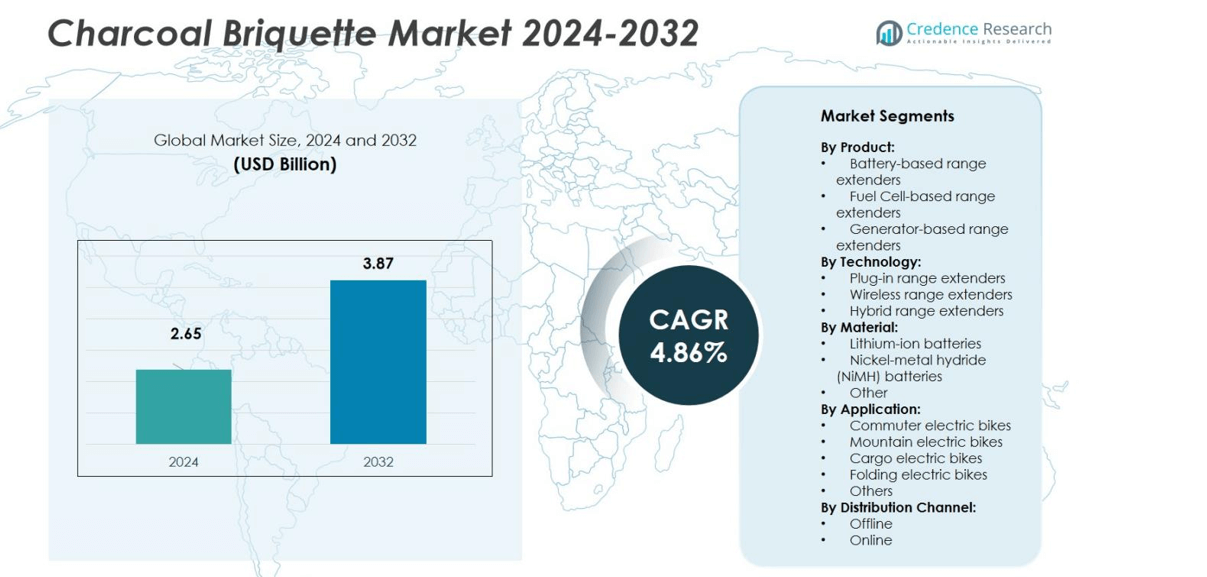
Charcoal Briquette Market size was valued USD 2.65 Billion in 2024 and is anticipated to reach USD 3.87 Billion by 2032, at a CAGR of 4.86% during the forecast period.
| REPORT ATTRIBUTE | DETAILS |
|---|---|
| Historical Period | 2020-2023 |
| Base Year | 2024 |
| Forecast Period | 2025-2032 |
| Charcoal Briquette Market Size 2024 | USD 2.65 Billion |
| Charcoal Briquette Market, CAGR | 4.86% |
| Charcoal Briquette Market Size 2032 | USD 3.87 Billion |
The Charcoal Briquette Market features Kingsford Products Company, Royal Oak Enterprises LLC, Duraflame Inc., Gryfskand, Namchar, Ignite Products, and Matsuri International. These players expand capacity, optimize retail reach, and launch low-smoke, odorless lines. Many prioritize coconut-shell sourcing and automation to improve quality and margins. Asia Pacific leads with 45% share in 2024, supported by abundant biomass and strong exports. Europe holds 22% share, driven by eco-certified demand and strict emissions norms. North America accounts for 17% share on the back of a robust barbeque culture and premium offerings. Competitors pursue private-label partnerships, greener binders, and longer-burn formulas to defend share and unlock higher price realization.
Market Insights
- The Charcoal Briquette Market was valued at USD 2.65 Billion in 2024 and is projected to reach USD 3.87 Billion by 2032, growing at a CAGR of 4.86%.
- Rising demand for low-emission, eco-friendly fuels and government support for renewable energy adoption are key market drivers.
- The market is witnessing trends like automation in production, use of sustainable raw materials such as coconut shells, and growth of eco-certified premium briquettes.
- Leading players such as Kingsford Products Company, Royal Oak Enterprises, and Duraflame focus on product innovation and strategic expansion across export-driven regions.
- Asia Pacific dominates with 45% share in 2024, followed by Europe at 22% and North America at 17%, while pillow-shaped briquettes lead with 42% share among product segments.
Market Segmentation Analysis:
By Shape:
Pillow-shaped briquettes dominate the charcoal briquette market with nearly 42% share in 2024, driven by their consistent shape, high combustion efficiency, and ease of packaging. Their uniform density ensures steady heat output, making them preferred for household cooking, barbeque, and foodservice applications. Hexagonal briquettes follow closely, favored for longer burn duration and low smoke generation, appealing to export markets in Europe and the Middle East. Square, stick, and other specialty shapes serve niche demands in artisanal cooking and industrial use, contributing to the overall diversification of the product portfolio.
- For instance, Kingsford Products Company launched a "Professional Series" pillow-shaped briquette in 2024 featuring enhanced binding technology that improves burn consistency and durability in grilling contexts.
By Type:
Hardwood charcoal briquettes hold the largest share of 58% in 2024, attributed to their high calorific value, low ash residue, and superior heat retention. These qualities make hardwood variants ideal for restaurants and outdoor barbeque applications. Softwood briquettes, although less dense, exhibit growing demand in household and camping sectors due to faster ignition and affordability. The expanding preference for high-performance fuel among hospitality and commercial users continues to reinforce hardwood briquettes’ dominance within this market segment.
- For instance, Duraflame Char·Logs™, engineered with THERMACORE™ Airflow Technology, provide quick lighting and extended burn times, catering to both commercial and premium home users seeking reliable, high-performance charcoal for grilling and smoking.
By Material:
Coconut shell charcoal briquettes lead the market with a 36% share in 2024, supported by strong availability in Southeast Asia and their eco-friendly nature. These briquettes burn longer, emit minimal smoke, and produce less odor, making them popular in residential and foodservice sectors. Bamboo and sawdust briquettes gain traction as sustainable and renewable alternatives, particularly in regions promoting green energy. Coal dust-based products remain significant in industrial applications due to lower costs, while mixed-material briquettes cater to consumers seeking balance between price and performance.
Key Growth Drivers
Rising Demand for Sustainable and Low-Emission Fuel
Growing environmental awareness and the shift toward cleaner energy sources drive charcoal briquette adoption. Consumers increasingly prefer briquettes over traditional firewood due to lower carbon emissions and consistent heat output. Governments in emerging economies promote eco-friendly fuels to reduce deforestation and indoor air pollution. This sustainability-driven demand enhances the use of biomass-based briquettes made from agricultural residues and coconut shells, fueling long-term market expansion in both residential and industrial sectors.
- For instance, Eco-charcoal Limited in Kenya produces briquettes from sustainably harvested tree trimmings, significantly reducing indoor air pollution and lowering greenhouse gas emissions while supporting local livelihoods.
Expansion of Outdoor Cooking and Barbeque Culture
The growing popularity of outdoor cooking, especially barbeques and camping, significantly boosts market growth. Charcoal briquettes offer uniform heating, portability, and easy ignition, making them ideal for such leisure activities. Urban consumers in North America, Europe, and Asia-Pacific are adopting premium briquette products for cleaner and smokeless grilling experiences. Manufacturers focus on producing odor-free and long-lasting briquettes, aligning with evolving lifestyle trends that emphasize convenience and outdoor entertainment.
- For instance, PT Coco Total Karbon Indonesia produces ISO 9001:2015-certified coconut charcoal briquettes for shisha and barbeque use, offering a clean, odorless burn with consistent heat, and ships bulk supplies to markets including the USA and Europe.
Increased Industrial Utilization and Export Demand
Rising industrial applications in metallurgy, cement, and food processing sectors enhance the demand for high-energy briquettes. Developing nations such as Indonesia and Vietnam have become leading exporters, meeting global demand for efficient, low-smoke fuel alternatives. These countries leverage abundant raw materials and low production costs to strengthen their export base. The growing international focus on renewable and sustainable fuel products supports a favorable trade environment, accelerating industry profitability.
Key Trends & Opportunities
Shift Toward Eco-Certified and Premium Briquettes
Manufacturers increasingly invest in producing eco-certified, organic, and odorless briquettes. These products appeal to environmentally conscious consumers seeking clean-burning fuel options. The trend toward premium-quality briquettes often made from coconut shells or bamboo supports higher margins and brand differentiation. With global certification standards such as FSC and ISO gaining importance, suppliers adopting sustainable production practices are likely to capture greater market share and attract export opportunities in developed regions.
- For instance, GREENLINE JSC in Vietnam produces FSC-certified briquettes from wood sources that burn hotter and longer, targeting premium markets in Japan and the Middle East.
Integration of Automation and Advanced Manufacturing
Technological innovation in briquette production offers significant opportunities. Automated presses, dryers, and carbonization systems improve output consistency, reduce labor costs, and ensure uniform quality. Smart manufacturing enables producers to scale efficiently while maintaining low emissions and minimal waste. This advancement also supports large-scale industrial users requiring high-density briquettes with stable combustion. Companies adopting these technologies gain a competitive advantage through better energy efficiency and stronger supply reliability.
- For instance, Biomass Briquette Systems’ BP-1500 mechanical press automates briquette production with a capacity of up to 1,500 pounds per hour, supporting small-scale and commercial producers with consistent two-inch diameter briquettes.
Key Challenges
Fluctuating Raw Material Availability and Cost
Dependence on biomass sources such as coconut shells, sawdust, and bamboo exposes producers to supply fluctuations. Seasonal variations and competition from other industries impact raw material pricing and availability. Inconsistent input supply often results in unstable production rates and profit margins. Manufacturers must establish robust sourcing networks and invest in waste utilization technologies to mitigate volatility and ensure consistent material quality across global markets.
Competition from Alternative Fuel Sources
The growing adoption of LPG, electricity, and natural gas in cooking and heating poses a major challenge. These fuels offer convenience and cleaner combustion, particularly in urban households. As energy infrastructure expands, traditional charcoal-based products risk losing relevance in certain markets. To stay competitive, producers must emphasize sustainability, cost-effectiveness, and performance improvements in briquette formulations to retain consumer preference and industrial demand.
Regional Analysis
Asia Pacific
Asia Pacific dominates the charcoal briquette market with a 45% share in 2024, driven by strong production and consumption across Indonesia, China, India, and Vietnam. These countries benefit from abundant raw materials such as coconut shells, bamboo, and sawdust, supporting large-scale manufacturing. Rising urbanization and growing export demand to Europe and the Middle East further enhance regional growth. Government initiatives promoting renewable biomass fuels and low-cost labor availability strengthen Asia Pacific’s leadership, positioning it as the primary global supplier of eco-friendly charcoal briquettes.
Europe
Europe accounts for a 22% market share in 2024, supported by a mature consumer base emphasizing sustainability and low-emission fuels. Countries such as Germany, the U.K., and France lead demand for premium, eco-certified briquettes for barbeque and home heating applications. The region’s stringent carbon regulations and preference for renewable biomass sources encourage adoption of clean-burning products. Growing imports from Asia, particularly coconut shell briquettes, also support the regional market. Ongoing innovation in odorless and smokeless briquette formulations sustains steady market expansion.
North America
North America holds a 17% share in 2024, fueled by a thriving barbeque culture and the increasing use of briquettes in outdoor cooking. The United States remains the largest market, with rising consumer demand for high-performance and easy-to-light briquettes. Environmental awareness and the shift toward eco-friendly grilling options are driving product diversification. Technological advancements in production and packaging enhance convenience and appeal. Manufacturers are also targeting premium segments, offering organic and long-lasting briquettes to meet the evolving lifestyle preferences of consumers across the U.S. and Canada.
Latin America
Latin America represents a 9% share in 2024, led by Brazil and Argentina, where charcoal briquettes are used extensively in cooking and hospitality sectors. The region’s rich biomass availability, particularly eucalyptus and sawdust, supports domestic production. Growing exports to Europe and North America strengthen industry profitability. Increasing focus on sustainable manufacturing and reduced deforestation promotes the adoption of renewable briquette materials. Governments across the region are encouraging formalized production processes to improve product quality and reduce environmental impact, driving consistent growth.
Middle East & Africa
The Middle East & Africa capture a 7% share in 2024, fueled by rising demand for household cooking and heating solutions. African nations such as Kenya, South Africa, and Nigeria are witnessing rapid adoption of briquettes as alternatives to traditional charcoal due to affordability and environmental benefits. In the Middle East, demand is expanding for high-quality briquettes in hotels, restaurants, and barbeque applications. Abundant agricultural waste, combined with growing investments in clean fuel technologies, supports steady market development across the region.
Market Segmentations:
By Shape:
- Pillow-shaped briquettes
- Hexagonal briquettes
- Square/rectangular briquettes
- Stick charcoal briquettes
- Other
By Type:
- Hardwood charcoal briquettes
- Softwood charcoal briquettes
By Material:
- Coconut shell charcoal briquettes
- Bamboo charcoal briquettes
- Coal dust charcoal briquettes
- Saw dust charcoal briquettes
- Other
By Application:
- Grilling
- Heating
- Barbequing
- Industrial processes
- Metallurgy
By End Use:
- Residential
- Industrial
- Commercial
By Region
- North America
- U.S.
- Canada
- Mexico
- Europe
- Germany
- France
- U.K.
- Italy
- Spain
- Rest of Europe
- Asia Pacific
- China
- Japan
- India
- South Korea
- South-east Asia
- Rest of Asia Pacific
- Latin America
- Brazil
- Argentina
- Rest of Latin America
- Middle East & Africa
- GCC Countries
- South Africa
- Rest of the Middle East and Africa
Competitive Landscape
The competitive landscape of the Charcoal Briquette Market features key players such as Kingsford Products Company, Royal Oak Enterprises LLC, Duraflame Inc., Gryfskand Sp. z o.o., The Clorox Company, Sagar Charcoal Depot, Namchar (Pty) Ltd, Matsuri International, Ignite Products, and Timber Charcoal Company. These companies focus on product innovation, sustainable sourcing, and efficient distribution to strengthen market presence. Kingsford and Royal Oak lead the segment with extensive retail networks and advanced manufacturing technologies. Several manufacturers emphasize eco-friendly production using renewable biomass materials such as coconut shells and bamboo to meet green fuel regulations. Export-driven companies in Asia-Pacific, particularly in Indonesia and Vietnam, continue to dominate global supply due to low production costs and abundant raw materials. Mergers, acquisitions, and product diversification strategies, including odorless and quick-light briquettes, remain key growth enablers, driving competition across domestic and international markets.
Key Player Analysis
- Duraflame Inc.
- Namchar (Pty) Ltd
- The Clorox Company
- Timber Charcoal Company
- Ignite Products
- Kingsford Products Company
- Gryfskand Sp. z o.o.
- Sagar Charcoal Depot
- Matsuri International
- Royal Oak Enterprises LLC
Recent Developments
- In July 2025, Duraflame reported that a fire severely damaged the W.W. Wood Inc. production facility in Pleasanton, Texas, which served as a major supplier of cooking wood fuel.
- In May 2025, Kingsford expanded its partnership with Miller Lite to relaunch the limited-edition Beercoal briquettes for the summer grilling season.
- In February 2025, Royal Oak Enterprises LLC introduced its new Super Size™ Briquets with Hickory pellets blended for enhanced flavor and longer burning performance.
Report Coverage
The research report offers an in-depth analysis based on Shape, Type, Material, Application, End Use and Region. It details leading market players, providing an overview of their business, product offerings, investments, revenue streams, and key applications. Additionally, the report includes insights into the competitive environment, SWOT analysis, current market trends, as well as the primary drivers and constraints. Furthermore, it discusses various factors that have driven market expansion in recent years. The report also explores market dynamics, regulatory scenarios, and technological advancements that are shaping the industry. It assesses the impact of external factors and global economic changes on market growth. Lastly, it provides strategic recommendations for new entrants and established companies to navigate the complexities of the market.
Future Outlook
- The market will experience steady growth driven by rising demand for sustainable fuel alternatives.
- Manufacturers will focus on eco-friendly production using renewable biomass materials.
- Asia Pacific will remain the leading producer and exporter due to strong resource availability.
- Technological innovations will improve briquette efficiency, ignition time, and burn duration.
- Premium odorless and smokeless briquettes will gain popularity among urban consumers.
- Government policies supporting clean energy will boost domestic and industrial usage.
- Expansion in barbeque and outdoor cooking trends will continue to drive global consumption.
- Strategic partnerships and mergers will enhance production capacity and market reach.
- Online retail and private-label products will increase accessibility across key regions.
- Investments in carbon-neutral manufacturing will shape the long-term competitiveness of major players.

Request a Free Sample
Fill in your details and we'll send you a free sample report.
- Sample data tables & charts
- Research methodology
Need a Custom Version of This Report?
Tailor the scope, geography, or segments to your exact requirements.
- Custom geography or segment scope
- Direct access to our analyst team
Frequently Asked Questions
What is the current market size for the Charcoal Briquette Market, and what is its projected size in 2032?
At what Compound Annual Growth Rate is the Charcoal Briquette Market projected to grow between 2025 and 2032?
Which Charcoal Briquette Market segment held the largest share in 2024?
What are the primary factors fueling the growth of the Charcoal Briquette Market?
Who are the leading companies in the Charcoal Briquette Market?
Which region commanded the largest share of the Charcoal Briquette Market in 2024?
Table of Content
Chapter 1 Market Segmentation
- 1.1 Segmentation Framework
- 1.1.1 Product and Service Classification
- 1.1.2 Application and End-Use Classification
- 1.1.3 Technology and Solution Classification
- 1.1.4 Customer and Distribution Channel Classification
- 1.1.5 Geographic Segmentation
- 1.1.6 Market Segment Definitions and Boundaries
Chapter 2 Introduction
- 2.1 Report Objectives and Scope
- 2.2 Product Definition and Industry Terminology
- 2.3 Market Inclusions and Exclusions
- 2.4 Research Process
- 2.4.1 Primary Research and Expert Interviews
- 2.4.2 Secondary Research and Source Review
- 2.4.3 Top-Down and Bottom-Up Estimation
- 2.4.4 Data Triangulation and Verification
- 2.5 Market Size Measurement Basis
- 2.5.1 2024: USD 2.65 Billion → 2032: USD 3.87 Billion
- 2.6 Historical and Forecast Reference Periods
- 2.6.1 Base Year: 2024
- 2.6.2 Forecast Period: 2024-2032
- 2.7 Research Assumptions and Limitations
Chapter 3 Executive Summary
- 3.1 Market Snapshot and Key Findings
- 3.2 Base-Year Market Size, 2024
- 3.3 Forecast Market Size, 2032
- 3.4 Revenue and Volume Growth Outlook
- 3.5 Key Demand and Supply Indicators
- 3.6 Leading Market Segments
- 3.7 Fastest-Growing Market Opportunities
- 3.8 Regional Performance Highlights
- 3.9 Technology and Industry Transformation
- 3.10 Competitive Landscape Summary
- 3.11 Analyst View and Strategic Implications
Chapter 4 Global Charcoal Briquette Market Trends and Developments
- 4.1 Historical Industry Development
- 4.2 Recent Market Trends and Developments
- 4.3 Demand and Customer Behavior Trends
- 4.4 Technology and Product Innovation
- 4.5 Artificial Intelligence, Automation and Digitalization
- 4.6 Local Manufacturing and Supply Chain Realignment
- 4.7 Industry Partnerships, Mergers and Acquisitions
- 4.8 Sustainability and Circular Economy Developments
- 4.9 Government and Private Sector Investment Trends
- 4.10 Emerging Business Models and Commercialization
- 4.11 Industry Developments and Announcements
Chapter 5 Global Charcoal Briquette Market Production, Supply and Demand Analysis
- 5.1 Demand Trend and Consumption Analysis
- 5.2 Demand Forecast, 2024-2032
- 5.3 Production and Output Trend
- 5.4 Production and Output Forecast, 2024-2032
- 5.5 Installed Capacity and Capacity Utilization
- 5.6 Company-Wise Production Plants and Statistics
- 5.6.1 Installed Production Capacity
- 5.6.2 Actual Production
- 5.6.3 Planned Capacity and Expansion Targets
- 5.7 Supply Chain Structure and Procurement Trends
- 5.8 Supply-Demand Gap and Bottlenecks
- 5.9 Import Dependence and Sourcing Structure
- 5.10 Contract Manufacturing and Outsourcing
- 5.11 Regional Supply and Demand Concentration
Chapter 6 Global Charcoal Briquette Market Pricing Analysis
- 6.1 Pricing Structure and Measurement
- 6.2 Historical Pricing Trends
- 6.3 Pricing Outlook, 2024-2032
- 6.4 Average Selling Price and Unit Economics
- 6.5 Pricing by Product and Market Segment
- 6.6 Geographic Pricing Differences
- 6.7 Key Input, Energy, Labor and Logistics Costs
- 6.8 Contract Pricing and Purchasing Models
- 6.9 Pricing Sensitivity and Competitive Positioning
- 6.10 Price, Margin and Profitability Implications
Chapter 7 Global Charcoal Briquette Market Dynamics
- 7.1 Market Growth Drivers
- 7.1.1 Demand-Side Drivers
- 7.1.2 Technology and Innovation Drivers
- 7.1.3 Infrastructure and Investment Drivers
- 7.1.4 Regulatory and Policy Drivers
- 7.2 Market Restraints
- 7.2.1 Cost and Affordability Constraints
- 7.2.2 Technology and Adoption Barriers
- 7.2.3 Supply Chain and Operational Constraints
- 7.3 Market Challenges
- 7.3.1 Competitive Pressure and Margin Erosion
- 7.3.2 Skills, Infrastructure and Implementation Gaps
- 7.4 Emerging Market Opportunities
- 7.5 Market Dynamics Impact and Time-Horizon Assessment
Chapter 8 Global Charcoal Briquette Value Chain Analysis
- 8.1 Industry Value Chain Overview
- 8.2 Upstream Suppliers and Critical Inputs
- 8.3 Technology and Component Providers
- 8.4 Manufacturing or Service Delivery
- 8.5 Distribution, Channel Partners and Integrators
- 8.6 Downstream Applications and End Users
- 8.7 Value Addition and Profit Pools
- 8.8 Vertical Integration and Outsourcing
- 8.9 Supplier Concentration and Risk
- 8.10 Supply Chain Localization and Resilience
Chapter 9 Global Charcoal Briquette Market Regulations and Policies
- 9.1 Relevant Laws, Standards and Compliance Frameworks
- 9.2 Product, Service, Safety and Quality Requirements
- 9.3 Government Policies, Incentives and Subsidies
- 9.4 Imports, Exports and Trade Barriers
- 9.5 Public Procurement and Local Content Requirements
- 9.6 Environmental and Sustainability Compliance
- 9.7 Upcoming Policy Changes and Market Implications
Chapter 10 Global Charcoal Briquette Market Hotspots and Opportunities
- 10.1 Market Opportunity Mapping and Growth Hotspots
- 10.2 High-Growth Applications and Customer Groups
- 10.3 Underserved Markets and White-Space Opportunities
- 10.4 Emerging Technology and Product Opportunities
- 10.5 New Capacity and Investment Hotspots
- 10.6 Market Entry and Expansion Opportunities
- 10.7 Distribution and Partnership Opportunities
- 10.8 Near-Term and Long-Term Commercial Potential
- 10.9 Opportunity Attractiveness and Execution Risks
Chapter 11 Global Charcoal Briquette Market Outlook, 2024-2032
- 11.1 Market Size and Analysis
- 11.1.1 Revenue (Market Measurement: 2024: USD 2.65 Billion → 2032: USD 3.87 Billion)
- 11.1.2 Market Volume and Quantity Sold
- 11.1.3 Historical Market Size
- 11.1.4 Base-Year Market Size, 2024
- 11.2 Market Forecast, 2024-2032
- 11.2.1 Revenue Forecast to 2032
- 11.2.2 Volume Forecast to 2032
- 11.2.3 CAGR and Year-on-Year Growth
- 11.2.4 Incremental Revenue Opportunity
- 11.3 Forecast Assumptions and Scenario Analysis
- 11.3.1 Base-Case Forecast
- 11.3.2 Optimistic and Conservative Scenarios
- 11.3.3 Technology, Pricing and Policy Sensitivities
- 11.4 Market Attractiveness and Growth Outlook
Chapter 12 Global Charcoal Briquette Market Segmentation and Outlook
- 12.1 Segmentation Summary and Market Shares, 2024
- 12.2 Largest and Fastest-Growing Segments
- 12.3 Segment Growth Comparison
- 12.4 Segment Attractiveness and Priority Matrix
Chapter 13 Global Charcoal Briquette Geographic Market Outlook, 2024-2032
- 13.1 Regional Market Size and Share, 2024
- 13.2 Regional Market Forecast, 2024-2032
- 13.3 Regional Pricing, Production and Demand Differences
- 13.4 North America
- 13.4.1 United States
- 13.4.2 Canada
- 13.4.3 Mexico
- 13.5 Europe
- 13.5.1 Germany
- 13.5.2 France
- 13.5.3 Italy
- 13.5.4 United Kingdom
- 13.5.5 Spain
- 13.5.6 Poland
- 13.5.7 Russia
- 13.5.8 Netherlands
- 13.5.9 Belgium
- 13.5.10 Sweden
- 13.5.11 Denmark
- 13.5.12 Norway
- 13.5.13 Rest of Europe
- 13.6 Asia Pacific
- 13.6.1 China
- 13.6.2 India
- 13.6.3 Japan
- 13.6.4 South Korea
- 13.6.5 Thailand
- 13.6.6 Indonesia
- 13.6.7 Vietnam
- 13.6.8 Malaysia
- 13.6.9 Australia
- 13.6.10 Rest of Asia Pacific
- 13.7 Latin America
- 13.7.1 Brazil
- 13.7.2 Argentina
- 13.7.3 Colombia
- 13.7.4 Chile
- 13.7.5 Rest of Latin America
- 13.8 Middle East
- 13.8.1 Saudi Arabia
- 13.8.2 United Arab Emirates
- 13.8.3 Turkey
- 13.8.4 Israel
- 13.8.5 Iran
- 13.8.6 Rest of the Middle East
- 13.9 Africa
- 13.9.1 South Africa
- 13.9.2 Egypt
- 13.9.3 Nigeria
- 13.9.4 Morocco
- 13.9.5 Rest of Africa
- 13.10 Regional Investment, Policy and Supply Chain Differences
- 13.11 Regional Competitive Landscape
- 13.12 Geographic Growth Hotspots
Chapter 14 Global Charcoal Briquette Technology, Innovation and Sustainability Outlook
- 14.1 Technology Landscape and Maturity
- 14.2 Product, Process and Service Innovation
- 14.3 AI, Automation and Digital Tools in the Industry
- 14.4 Technology Adoption and Performance Benchmarking
- 14.5 Innovation Pipeline and R&D Investment
- 14.6 Patent and Intellectual Property Trends
- 14.7 Energy Efficiency and Resource Management
- 14.8 Sustainability, Recycling and Circularity
- 14.9 Technology Roadmap, 2024-2032
- 14.10 Risks of Obsolescence and Technology Substitution
Chapter 15 Global Charcoal Briquette Market Key Strategic Imperatives
- 15.1 Growth and Market Entry Priorities
- 15.2 High-Return Products and Segments
- 15.3 Pricing, Profitability and Cost Optimization
- 15.4 Technology Investment and Product Differentiation
- 15.5 Supply Chain Localization and Resilience
- 15.6 Distribution and Customer Acquisition
- 15.7 Partnership, Acquisition and Capacity Strategy
- 15.8 Regional Expansion Priorities
- 15.9 Short-, Medium- and Long-Term Actions
Chapter 16 Competition Outlook
- 16.1 Industry Competition Characteristics
- 16.2 Market Structure and Concentration
- 16.3 Market Share and Competitive Positioning, 2024
- 16.4 Company-Wise Revenue and Product Benchmarking
- 16.5 Production and Service Capacity Benchmarking
- 16.6 Technology, Pricing and Differentiation
- 16.7 Regional Footprint and Distribution Strength
- 16.8 Mergers, Acquisitions and Strategic Alliances
- 16.9 New Entrants and Competitive Threats
- 16.10 Porter's Five Forces and Industry Attractiveness
- 16.11 Competitive Outlook, 2024-2032
Chapter 17 Company Profiles
- 17.1 Company Coverage and Selection Criteria
- 17.2 Leading Market Participants – Standard Profile Structure
- 17.2.1 Business Description
- 17.2.2 Company Ownership and Geographic Presence
- 17.2.3 Product and Service Portfolio
- 17.2.4 Manufacturing and Operating Footprint
- 17.2.5 Production Capacity and Expansion Plans
- 17.2.6 Financial Performance and Investment
- 17.2.7 Market Share and Competitive Position
- 17.2.8 Technology and Innovation Capabilities
- 17.2.9 Strategic Alliances or Partnerships
- 17.2.10 Recent Developments
- 17.2.11 Growth Strategy and Outlook
- 17.3 Other Relevant Market Participants
Note: Every listed company is profiled on the structure shown under the first company. The company list is preliminary and may change based on research findings, market developments, data availability and client requirements.
Chapter 18 Disclaimer
- 18.1 Research and Forecast Disclaimer
- 18.2 Data Source and Estimation Limitations
Note: The depth of individual sections depends on data availability for this market. Volume, capacity, trade and other unit-based metrics are included where applicable.

