Market Overviews
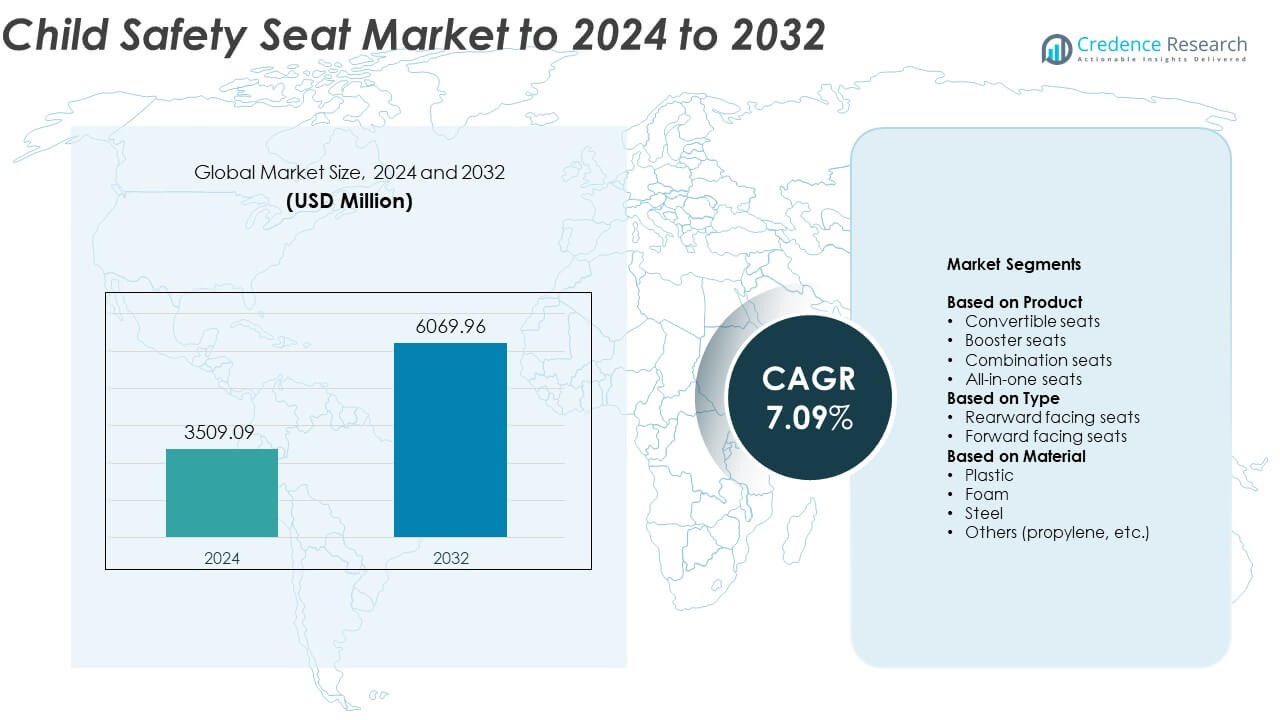
The child safety seat market size was valued at USD 3509.09 million in 2024 and is anticipated to reach USD 6069.96 million by 2032, at a CAGR of 7.09% during the forecast period.
| REPORT ATTRIBUTE |
DETAILS |
| Historical Period |
2020-2023 |
| Base Year |
2024 |
| Forecast Period |
2025-2032 |
| Child Safety Seat Market Size 2024 |
USD 3509.09 Million |
| Child Safety Seat Market, CAGR |
7.09% |
| Child Safety Seat Market Size 2032 |
USD 6069.96 Million |
The child safety seat market is driven by prominent companies such as Graco, Chicco, Britax, Maxi-Cosi, Evenflo, Recaro, Peg Perego, Clek, Safety 1st, Cybex, Joie, Dorel, Kidsembrace, Nuna, and Cosco. These players focus on innovation, safety compliance, and ergonomic design to strengthen their global presence. North America leads the market with around 37% share in 2024, supported by strict child safety regulations and high consumer awareness. Europe follows with nearly 31% share, driven by strong regulatory frameworks and premium product demand. Asia-Pacific, accounting for about 22%, is the fastest-growing region, fueled by urbanization and increasing adoption of certified safety seats across developing economies.
Access crucial information at unmatched prices!
Request your sample report today & start making informed decisions powered by Credence Research Inc.!
Download Sample
Market Insights
- The child safety seat market was valued at USD 3509.09 million in 2024 and is projected to reach USD 6069.96 million by 2032, growing at a CAGR of 7.09% during the forecast period.
- Growing government regulations mandating child restraint systems and rising parental awareness about road safety are key drivers supporting market expansion.
- Emerging trends include the integration of smart sensors, eco-friendly materials, and ergonomic designs that enhance safety and comfort.
- The market is competitive, with leading players focusing on innovation, certifications, and partnerships to strengthen their global footprint.
- North America leads with 37% share, followed by Europe at 31% and Asia-Pacific at 22%, while the convertible seat segment dominates with 44% share due to its versatility and extended usability.
Market Segmentation Analysis:
By Product
The convertible seats segment dominates the child safety seat market with nearly 44% share in 2024. Their leadership is driven by their flexibility to convert from rear-facing to forward-facing, making them suitable for infants and toddlers alike. Parents prefer these seats due to extended usability, cost-effectiveness, and enhanced safety features such as adjustable harnesses and side-impact protection. Growing awareness of long-term child protection and the adoption of advanced safety technologies, including energy-absorbing foam and reinforced frames, are further strengthening the demand for convertible seats globally.
- For instance, Evenflo’s Revolve360 Extend allows rear-facing use up to 50 lb and rotates 360°.
By Type
The forward-facing seats segment leads the child safety seat market with approximately 53% share in 2024. This dominance stems from their increasing use for toddlers and young children, offering improved restraint systems and greater comfort during travel. Manufacturers are integrating enhanced safety technologies such as five-point harnesses and impact-absorbing materials to comply with global safety regulations. The growing rate of vehicle ownership and stricter government mandates for child restraint systems across developed and emerging markets further propel the segment’s expansion.
- For instance, Britax Grow With You ClickTight supports 25–65 lb harnessed and 40–120 lb booster use.
By Material
Plastic accounts for around 57% share of the child safety seat market in 2024, making it the leading material segment. Its dominance is supported by lightweight properties, high durability, and cost-effectiveness, which enable manufacturers to produce ergonomically designed seats with strong impact resistance. The widespread use of polypropylene and other engineered plastics enhances strength while keeping production economical. Additionally, growing focus on recyclable and sustainable plastic materials aligns with environmental regulations, driving innovation in eco-friendly and impact-resistant child safety seat components.
Key Growth Drivers
Stringent Government Safety Regulations
Rising enforcement of child passenger safety laws globally is a major growth driver for the market. Governments are mandating the use of certified child restraint systems to reduce accident-related fatalities and injuries. Countries in North America and Europe have established strict standards such as FMVSS 213 and UN R129, encouraging widespread product adoption. The increasing focus on vehicle safety ratings and road safety awareness campaigns also compels parents to invest in approved and high-quality child safety seats.
- For instance, Joie i-Spin 360 is certified to ECE R129/02 and i-Size (40–105 cm).
Growing Awareness of Child Safety
Parents’ heightened awareness of child safety and protection during travel significantly boosts market growth. Educational programs and social campaigns highlighting accident prevention are influencing purchasing decisions. Expanding access to safety information through digital platforms helps consumers understand the benefits of using child safety seats. The rising middle-class population in emerging economies, combined with improved lifestyle standards, is fueling steady demand for premium safety solutions.
- For instance, Graco fields 90+ certified Child Passenger Safety technicians for caregiver education.
Technological Advancements in Design and Materials
The integration of advanced technologies in design and materials is reshaping the market. Modern safety seats now include features such as side-impact protection, energy-absorbing foams, and ISOFIX latch systems. Manufacturers are adopting lightweight yet durable materials to enhance portability without compromising safety. The trend toward ergonomic and easy-to-install designs is improving consumer convenience, driving broader acceptance among new parents and caregivers worldwide.
Key Trends and Opportunities
Sustainability and Eco-Friendly Materials
The market is witnessing a shift toward sustainable materials in child safety seat production. Manufacturers are focusing on recyclable plastics, bio-based fabrics, and eco-conscious packaging to meet environmental goals. Growing consumer preference for green products is encouraging innovation in sustainable seat components. This trend aligns with global efforts to reduce carbon footprints, creating new opportunities for brands adopting eco-friendly manufacturing processes.
- For instance, Nuna car seats are GREENGUARD Gold certified for over 360 VOC emission limits.
Integration of Smart Safety Features
The integration of smart technology presents strong opportunities in the market. Features like temperature sensors, buckle alerts, and Bluetooth connectivity are gaining popularity among tech-savvy consumers. These systems enhance child safety by monitoring conditions and alerting parents in real time. The demand for intelligent, connected safety seats is expected to rise with the expansion of smart mobility ecosystems and increasing awareness of digital safety solutions.
- For instance, CYBEX SensorSafe alerts at 95 °F or below 45 °F on supported seats.
Expansion in Emerging Economies
Rapid urbanization and rising vehicle ownership in emerging economies are creating substantial opportunities. Expanding disposable incomes and awareness about child safety standards are increasing adoption rates in regions such as Asia-Pacific and Latin America. Local manufacturers are introducing affordable and compliant models to cater to middle-income families. Government support through awareness campaigns and road safety initiatives further accelerates market penetration.
Key Challenges
High Cost of Advanced Safety Seats
The high cost of premium and technologically advanced safety seats remains a key barrier. Smart and multi-functional seats often require significant investment in materials and manufacturing, making them less accessible in developing economies. Price-sensitive consumers may opt for low-cost alternatives that lack necessary certifications, limiting the adoption of high-quality models. This challenge pressures manufacturers to balance cost efficiency with performance standards.
Lack of Awareness in Developing Regions
In several low- and middle-income countries, consumer awareness regarding child restraint systems remains limited. Many parents underestimate the importance of proper safety seats, relying instead on traditional or unsafe methods during travel. Limited enforcement of child passenger safety regulations and lack of education on installation further restrict market growth. Awareness programs and regulatory interventions are essential to overcome this persistent challenge.
Regional Analysis
North America
North America dominates the child safety seat market with around 37% share in 2024. The region’s leadership is driven by stringent safety regulations, high vehicle ownership, and strong consumer awareness of child protection. The United States enforces robust child restraint laws under standards such as FMVSS 213, which ensures consistent product quality and compliance. Continuous innovation by leading brands and government-backed awareness programs further encourage adoption. Increasing preference for technologically advanced and ergonomic seats also supports market growth, while premium product offerings gain traction among safety-conscious parents.
Europe
Europe holds nearly 31% share of the child safety seat market in 2024, supported by comprehensive safety mandates and a mature automotive sector. Countries such as Germany, France, and the United Kingdom enforce strict regulatory norms under UN R129, ensuring widespread product standardization. Rising emphasis on eco-friendly and lightweight materials enhances the regional market outlook. Consumers in Europe show a strong preference for convertible and sustainable safety seats. High disposable incomes, coupled with active safety awareness campaigns and insurance-linked incentives, further promote steady market expansion across European households.
Asia-Pacific
Asia-Pacific accounts for about 22% share of the child safety seat market in 2024 and is the fastest-growing region. Rising urbanization, growing middle-class income, and expanding vehicle ownership fuel regional demand. Governments in China, Japan, and India are tightening child passenger safety standards, encouraging wider adoption of certified seats. Local manufacturers are offering affordable options to attract first-time buyers. Increased e-commerce accessibility and educational initiatives promoting safe travel practices are improving product penetration. The trend toward compact, lightweight, and easy-to-install seats is further shaping the region’s dynamic growth pattern.
Latin America
Latin America represents nearly 6% share of the child safety seat market in 2024, with moderate yet improving adoption rates. Brazil and Mexico are leading contributors due to the gradual enforcement of road safety regulations and awareness campaigns. Expanding automotive sales and improving consumer education about child protection standards are supporting growth. However, limited affordability and uneven enforcement of safety norms remain challenges. Manufacturers are focusing on cost-effective models and collaborations with local distributors to enhance accessibility and compliance with evolving safety requirements in the region.
Middle East and Africa
The Middle East and Africa capture around 4% share of the child safety seat market in 2024. Growth is primarily influenced by rising disposable incomes and growing emphasis on child welfare and safety awareness. Countries like the United Arab Emirates and South Africa are introducing stricter road safety initiatives that promote proper child restraint use. Although adoption levels remain relatively low, increasing urbanization and expansion of retail distribution channels are improving accessibility. The region shows potential for future growth as awareness and regulatory enforcement continue to strengthen.
Market Segmentations:
By Product
- Convertible seats
- Booster seats
- Combination seats
- All-in-one seats
By Type
- Rearward facing seats
- Forward facing seats
By Material
- Plastic
- Foam
- Steel
- Others (propylene, etc.)
By Geography
- North America
- Europe
- Germany
- France
- U.K.
- Italy
- Spain
- Rest of Europe
- Asia Pacific
- China
- Japan
- India
- South Korea
- South-east Asia
- Rest of Asia Pacific
- Latin America
- Brazil
- Argentina
- Rest of Latin America
- Middle East & Africa
- GCC Countries
- South Africa
- Rest of the Middle East and Africa
Competitive Landscape
The child safety seat market is highly competitive, with leading players such as Graco, Chicco, Britax, Maxi-Cosi, Evenflo, Recaro, Peg Perego, Clek, Safety 1st, Cybex, Joie, Dorel, Kidsembrace, Nuna, and Cosco driving innovation and market growth. Competition centers around safety performance, design versatility, and regulatory compliance. Manufacturers are focusing on advanced materials, ergonomic designs, and smart technologies such as temperature sensors and impact alerts to enhance child protection and user convenience. Strategic partnerships with automobile brands and retail distributors are strengthening market reach, while continuous investment in R&D supports the development of eco-friendly and lightweight solutions. Global players are expanding in emerging economies through localized production and targeted marketing to capture rising demand from middle-income families. Certification compliance, including UN R129 and FMVSS 213 standards, remains a critical factor influencing brand credibility. The market is also witnessing consolidation through mergers and acquisitions to improve global supply chain efficiency and product portfolio diversity.
Shape Your Report to Specific Countries or Regions & Enjoy 30% Off!
Key Player Analysis
- Graco
- Chicco
- Britax
- Maxi-Cosi
- Evenflo
- Recaro
- Peg Perego
- Clek
- Safety 1st
- Cybex
- Joie
- Dorel
- Kidsembrace
- Nuna
- Cosco
Recent Developments
- In 2025, Clek introduced three new Ziip fabric colorways for select car seats: Highlands, Vintage, and Edge. These options became available in July 2025 for the Liing (infant), Foonf, Fllo (convertible), and Oobr (booster) car seats.
- In 2024, Chicco launched a rotating convertible car seat allowing 360-degree rotation to ease installation and use.
- In 2023, Dorel launched several new models across its brands (e.g., Safety 1st, Maxi-Cosi) in the U.S. and Europe, focusing on integrating sustainable materials into car seat fabrics and padding.
Report Coverage
The research report offers an in-depth analysis based on Product, Type, Material and Geography. It details leading market players, providing an overview of their business, product offerings, investments, revenue streams, and key applications. Additionally, the report includes insights into the competitive environment, SWOT analysis, current market trends, as well as the primary drivers and constraints. Furthermore, it discusses various factors that have driven market expansion in recent years. The report also explores market dynamics, regulatory scenarios, and technological advancements that are shaping the industry. It assesses the impact of external factors and global economic changes on market growth. Lastly, it provides strategic recommendations for new entrants and established companies to navigate the complexities of the market.
Future Outlook
- Growing enforcement of child safety regulations will continue to drive market expansion.
- Rising awareness among parents about vehicle safety will enhance product adoption.
- Demand for lightweight, ergonomic, and easy-to-install seats will increase.
- Integration of smart safety technologies such as sensors and alerts will gain momentum.
- Sustainability efforts will push manufacturers toward eco-friendly materials and designs.
- Online retail channels will play a larger role in product distribution and accessibility.
- Emerging economies will witness strong growth due to improving safety standards.
- Premium and multifunctional seat categories will see higher adoption among urban families.
- Partnerships between automakers and safety seat manufacturers will boost innovation.
- Continued product certification and testing advancements will strengthen consumer confidence globally.



