
| REPORT ATTRIBUTE | DETAILS |
|---|---|
| Historical Period | 2020-2023 |
| Base Year | 2024 |
| Forecast Period | 2025-2032 |
| China ESG Consulting Market Size 2024 | USD 923 million |
| China ESG Consulting Market, CAGR | 16.9% |
| China ESG Consulting Market Size 2032 | USD 3218.97 million |
Market Overview
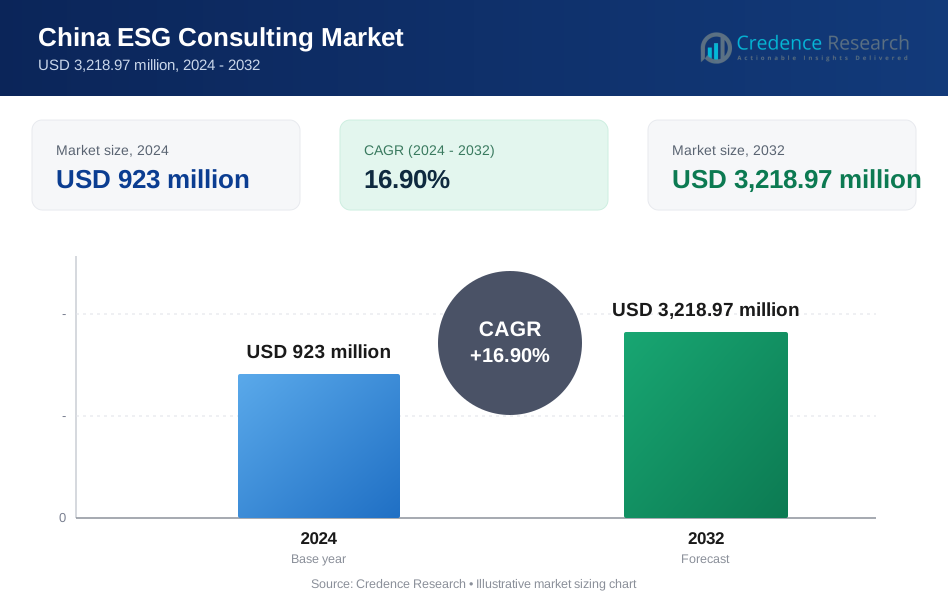
China ESG Consulting Market size was valued at USD 923 million in 2024 and is anticipated to reach USD 3218.97 million by 2032, at a CAGR of 16.9% during the forecast period.
The China ESG consulting market is experiencing robust growth as regulatory pressures and investor expectations surrounding environmental, social, and governance (ESG) practices continue to intensify. Rising demand for transparency, responsible investment, and sustainable business operations is prompting Chinese companies to integrate ESG frameworks into their core strategies. The government’s introduction of stricter ESG disclosure mandates for listed firms and state-owned enterprises, along with China’s commitment to carbon neutrality by 2060, is accelerating the adoption of ESG principles across industries. Companies increasingly seek specialized consulting to navigate complex ESG requirements, enhance risk management, and bolster global competitiveness. The market also benefits from growing awareness among stakeholders about climate risks, supply chain resilience, and ethical governance. As international investors and trading partners prioritize ESG compliance, consulting firms play a critical role in guiding Chinese enterprises through evolving standards, reporting mechanisms, and best practices, fueling ongoing market expansion and innovation.
The geographical analysis of the China ESG Consulting Market highlights dynamic growth across major economic hubs, with East China, North China, and South China leading in demand for advanced ESG advisory services. Urban centers such as Shanghai, Beijing, and Shenzhen serve as primary drivers for market expansion due to strong regulatory oversight, international business activities, and a high concentration of listed companies. Consulting demand in these regions is fueled by heightened ESG disclosure requirements, rapid industrial transformation, and increasing investor scrutiny. The market benefits from the presence of global and regional consulting leaders, enabling enterprises to access high-quality expertise and tailored solutions. Key players shaping the China ESG Consulting Market include Deloitte, Boston Consulting Group, and EY, each offering comprehensive advisory services that help companies navigate evolving ESG standards, improve risk management, and strengthen stakeholder trust. Their established track records and sector-specific knowledge ensure continued relevance and influence within the market.
Market Insights
- The China ESG Consulting Market reached USD 923 million in 2024 and is projected to achieve USD 3,218.97 million by 2032, registering a CAGR of 16.9% during the forecast period.
- Strong regulatory pressure, including mandatory ESG disclosures and China’s carbon neutrality targets, is driving widespread adoption of ESG consulting services.
- Trends show a rapid increase in digital ESG reporting tools, sector-specific advisory solutions, and integration of ESG into enterprise risk management.
- Key market players such as Deloitte, Boston Consulting Group, and EY provide comprehensive advisory, digital, and compliance services, helping clients meet global and domestic ESG expectations.
- Challenges include a complex and evolving regulatory landscape, lack of standardized frameworks, and a shortage of specialized ESG professionals and reliable data.
- East China, North China, and South China remain the primary regions for market growth, supported by strong economic activity, policy leadership, and large numbers of listed and multinational companies.
- Despite ongoing challenges, demand for ESG consulting continues to rise as Chinese enterprises seek to improve compliance, attract global investment, and enhance long-term sustainability performance.
Market Drivers
Regulatory Push and National Policy Incentives Drive ESG Adoption
The introduction of comprehensive ESG disclosure mandates and national sustainability targets significantly shapes the China ESG Consulting Market. Government agencies require listed companies and state-owned enterprises to disclose environmental, social, and governance metrics, compelling organizations to seek specialized expertise. China’s 2060 carbon neutrality pledge elevates the importance of climate strategies and transparent reporting. Consulting firms guide clients through compliance processes, helping them navigate policy complexities. The regulatory push ensures consistent market momentum by making ESG integration a legal and operational necessity. Market participants benefit from strong policy alignment, which accelerates the adoption of ESG frameworks and standards.
- For instance, according to the China Securities Regulatory Commission, a significant portion of listed companies reported increased demand for ESG reporting support following new disclosure guidelines.
Investor Demands and Access to Global Capital Propel Market Growth
Institutional investors and global asset managers prioritize ESG performance, prompting Chinese companies to seek expert consulting support. It must meet the evolving expectations of international investors who now require comprehensive ESG disclosures as a prerequisite for capital access. The China ESG Consulting Market expands as organizations strive to improve their investment profiles and credibility on the global stage. Consulting services enable firms to strengthen governance structures, manage risk, and achieve higher ESG ratings. Increased investor scrutiny and demand for accountability drive companies to align with best practices, reinforcing market growth.
- For instance, data from a survey by the Asset Management Association of China shows a significant increase in companies reporting ESG metrics to attract foreign investment and satisfy investor requirements.
Corporate Reputation, Brand Value, and Competitive Advantage Fuel Consulting Needs
Organizations recognize that robust ESG strategies enhance corporate reputation and brand value. The China ESG Consulting Market benefits as companies use consulting services to distinguish themselves in both domestic and international markets. ESG integration demonstrates a commitment to ethical business, which attracts responsible consumers, investors, and business partners. Consulting firms assist enterprises in communicating sustainability achievements, improving stakeholder relationships, and mitigating reputational risks. This growing awareness of competitive differentiation increases demand for professional guidance. Strong ESG credentials contribute to long-term business resilience.
Stakeholder Pressure, Climate Risks, and Supply Chain Demands Expand Consulting Opportunities
Companies in China experience mounting pressure from stakeholders, including customers, regulators, and non-governmental organizations, to address climate risks and ethical governance. The China ESG Consulting Market responds by offering services that enable companies to assess and manage environmental impacts across supply chains. Consultants help clients design effective risk management processes, build resilient operations, and comply with global ESG benchmarks. Greater supply chain scrutiny and sustainability requirements make professional support indispensable. The market grows as organizations aim to meet stakeholder expectations and ensure future readiness.
Market Trends
Surge in ESG Reporting and Digital Solutions Transform Market Dynamics
A surge in ESG reporting requirements is redefining consulting services within the China ESG Consulting Market. Companies face growing obligations to disclose comprehensive environmental, social, and governance data to meet regulatory and stakeholder expectations. Consulting firms introduce advanced digital platforms and analytics tools to streamline data collection, verification, and reporting processes. It creates new opportunities for technology-enabled advisory services that improve efficiency and accuracy. Firms leverage digital innovations to deliver real-time insights, scenario modeling, and automated compliance tracking. The trend toward digital transformation enhances the market’s value proposition, supporting scalable and transparent ESG reporting.
- For instance, a government-sponsored survey found a marked uptick in adoption of ESG reporting software among Chinese enterprises, with many citing improved compliance efficiency and data accuracy.
Industry-Specific ESG Strategies Gain Momentum Across Sectors
Organizations across diverse sectors seek tailored ESG strategies to address unique industry risks and opportunities. The China ESG Consulting Market responds with specialized advisory services for sectors such as manufacturing, financial services, energy, and technology. Consulting firms design sector-specific frameworks that align with local and international standards, enabling companies to address material ESG issues relevant to their business. It helps clients demonstrate sector leadership and comply with evolving benchmarks. Market participants develop customized solutions that reflect both industry nuances and broader regulatory demands. This trend fosters deeper collaboration between consultants and clients.
- For instance, the Chinese Ministry of Ecology and Environment revealed that enterprises in the energy and manufacturing sectors are increasingly turning to consultants for customized ESG solutions that help them comply with industry-specific regulations and improve their reputational standing.
Integration of ESG into Enterprise Risk Management Systems Becomes Mainstream
A rising number of organizations now embed ESG factors into enterprise risk management systems. The China ESG Consulting Market observes a shift from isolated ESG initiatives to holistic integration with business operations and risk frameworks. Consulting firms assist companies in identifying, quantifying, and mitigating ESG-related risks, such as climate transition impacts and supply chain vulnerabilities. It supports the alignment of sustainability with core business strategies and long-term planning. Market growth accelerates as enterprises recognize the value of proactive risk management and resilience. Integrated ESG risk approaches drive strategic decision-making.
Emphasis on Human Capital and Social Responsibility Shapes Advisory Offerings
Social responsibility and human capital management emerge as central trends influencing consulting services. The China ESG Consulting Market increasingly addresses issues such as employee well-being, diversity, inclusion, and community engagement. Consulting firms work with clients to set measurable social targets and implement policies that support talent attraction and retention. It enables organizations to respond to heightened scrutiny from stakeholders regarding social practices and workforce standards. Companies invest in transparent social reporting and stakeholder engagement strategies. This focus on social aspects broadens the market’s consulting portfolio and reinforces sustainable business value.
Market Challenges Analysis
Complex Regulatory Landscape and Evolving Standards Create Uncertainty
Navigating the complex regulatory environment presents a major challenge for the China ESG Consulting Market. The evolving nature of ESG regulations and reporting standards complicates compliance for both consulting firms and their clients. It must interpret frequent policy changes and reconcile conflicting requirements from domestic and international authorities. Companies face uncertainty about which frameworks to prioritize, leading to hesitancy and inconsistent adoption of best practices. This regulatory fragmentation slows the pace of ESG integration across industries. Consulting firms need to provide clear, up-to-date guidance to help clients remain compliant and competitive.
- For instance, a joint study by Tsinghua University and an industry association indicated that many enterprises report confusion when faced with multiple ESG reporting frameworks and frequent updates to policy requirements.
Limited ESG Expertise and Data Gaps Hinder Effective Implementation
The scarcity of skilled ESG professionals and gaps in reliable data restrict the effectiveness of consulting services. The China ESG Consulting Market contends with a shortage of experts capable of delivering sector-specific guidance and deep analysis. It struggles to access consistent, high-quality ESG data from clients and third-party sources, impeding comprehensive risk assessment and performance measurement. Insufficient training and awareness within companies further limit the impact of consulting engagements. The lack of standardized data collection and transparent disclosure practices weakens stakeholder trust. Building internal capabilities and robust data infrastructure remains essential for overcoming these persistent market challenges.
Market Opportunities
Expansion of Green Finance and Sustainable Investment Opens New Avenues
The growth of green finance and sustainable investment initiatives presents significant opportunities for the China ESG Consulting Market. Financial institutions and asset managers demand credible ESG assessments and reporting to attract global capital and meet evolving investor preferences. It can provide specialized advisory services on sustainable financing, impact investing, and ESG risk evaluation. Consulting firms help clients design investment strategies that align with environmental goals and international standards. The push for green bonds, sustainable funds, and responsible investment products creates a strong pipeline for new service offerings. Consulting firms that develop expertise in sustainable finance position themselves for long-term growth.
Rising Corporate Commitments to ESG and Technology Integration Drive Market Potential
The surge in corporate commitments to ESG principles expands the addressable market for advisory services. The China ESG Consulting Market stands to benefit as enterprises seek guidance on integrating ESG into core business strategies, supply chain management, and innovation. It can support clients in adopting advanced technologies such as artificial intelligence and digital platforms to enhance ESG data management and reporting. Consulting firms that offer technology-driven solutions improve efficiency and transparency for their clients. The ongoing shift toward digitalization and strategic sustainability planning increases demand for tailored, high-value consulting engagements. This environment fosters continued market expansion and service diversification.
Market Segmentation Analysis:
By Type:
Strategy & Planning services lead the market, as organizations seek comprehensive roadmaps for ESG integration to meet regulatory and stakeholder demands. Consulting firms deliver tailored strategies that align business operations with evolving ESG frameworks and global best practices. Testing services gain traction as companies require accurate environmental and social impact assessments to verify compliance and performance. Auditing & Verification emerge as critical, with clients relying on independent reviews to ensure data integrity and credibility in ESG disclosures. Technical Support addresses operational challenges, assisting clients in adopting new technologies and improving process efficiency. Sustainability Marketing enables organizations to communicate ESG achievements and enhance brand reputation, supporting efforts to attract responsible investors and customers.
By Application:
The Building & Construction sector generates significant demand for ESG consulting due to strict environmental regulations and urban sustainability initiatives. The China ESG Consulting Market provides expertise in green building certifications, waste management, and resource efficiency for this sector. Agriculture stands out as companies focus on sustainable sourcing, biodiversity, and rural development, requiring specialized support to meet rising expectations from buyers and regulators. Food & Beverage enterprises depend on consulting services to strengthen supply chain transparency, food safety, and responsible sourcing practices. Oil & Gas, Mining, and Chemicals industries face heightened scrutiny around environmental impacts and workplace safety, turning to ESG consultants for risk management, regulatory compliance, and stakeholder engagement solutions. The “Others” category includes diverse sectors such as technology, transportation, and consumer goods, where ESG priorities continue to evolve. It adapts to shifting sectoral demands by offering targeted solutions and sector-specific expertise across its comprehensive portfolio. The market’s segmentation underscores its agility in responding to the sustainability needs of China’s rapidly changing industrial landscape.
Segments:
Based on Type:
- Strategy & Planning
- Testing
- Auditing & Verification
- Technical Support
- Sustainability Marketing
Based on Application:
- Building & Construction
- Agriculture
- Food & Beverage
- Oil & Gas
- Mining
- Chemicals
- Others
Based on the Geography:
- East China
- North China
- South China
- Central China
- Western China
- Northeast China
Regional Analysis
East China
East China commands the largest share of the ESG consulting market, accounting for approximately 38% of total revenue. This dominance stems from the region’s concentration of major financial centers, multinational corporate headquarters, and advanced manufacturing hubs in cities such as Shanghai, Nanjing, and Hangzhou. These urban areas face strong regulatory oversight, international investor scrutiny, and increasing pressure to adhere to global ESG standards. Companies operating in East China often lead the adoption of ESG frameworks, driving substantial demand for consulting services focused on strategy, compliance, and digital reporting solutions. The presence of global and domestic financial institutions accelerates the integration of ESG practices, and consulting firms play a crucial role in supporting listed enterprises, facilitating sustainable finance, and advancing green investment initiatives.
North China
North China holds the second-largest market share, contributing around 27% of the China ESG Consulting Market. The region is anchored by Beijing, the nation’s capital, which acts as a policy and regulatory hub for corporate governance, environmental protection, and social responsibility. North China benefits from the presence of state-owned enterprises and leading technology firms that face mounting regulatory requirements and are often early adopters of ESG reporting. Consulting demand here centers on policy interpretation, compliance management, and independent verification of disclosures. It leverages proximity to key government bodies and international organizations to offer thought leadership and shape industry standards. The growing focus on air quality improvement, climate action, and green innovation further strengthens the market in this region.
South China
South China, including major cities such as Guangzhou, Shenzhen, and Hong Kong, represents approximately 18% of the China ESG Consulting Market. This region is a hub for international trade, logistics, and export-oriented industries, which experience unique ESG risks related to supply chain transparency, cross-border compliance, and labor practices. Demand for consulting services arises from both private sector companies and multinational corporations seeking to meet international ESG benchmarks. South China’s dynamic technology and financial sectors also prioritize ESG performance, driving growth in advisory services related to data management, sustainability marketing, and impact investing. The region’s strong ties to global markets reinforce the importance of best practices and third-party verification, allowing consulting firms to develop robust, client-focused solutions.
Central and Western China
Central and Western China together account for approximately 17% of the China ESG Consulting Market. These regions are experiencing rapid industrialization and urbanization, leading to new opportunities and challenges in sustainable development. Local governments in Chengdu, Chongqing, Wuhan, and Xi’an introduce policies aimed at improving environmental quality, encouraging responsible resource use, and promoting social equity. Consulting services in these areas focus on capacity building, risk assessment, and technical support for companies seeking to align with national and provincial ESG targets. Many enterprises in Central and Western China are at earlier stages of ESG adoption, so consulting firms often provide foundational training, strategy development, and support for initial reporting. It adapts its offerings to the maturity level of each local market, supporting the national goal of balanced and inclusive sustainable development.
Northeast China
Northeast China, comprising provinces such as Liaoning, Jilin, and Heilongjiang, holds a smaller share of about 7% of the overall market. The region is characterized by a significant presence of traditional heavy industries such as steel, chemicals, and machinery, which are under increasing pressure to reduce emissions, improve resource efficiency, and address labor and safety issues. The China ESG Consulting Market in Northeast China emphasizes compliance solutions, environmental remediation, and stakeholder engagement. Consulting firms collaborate with regional governments and industrial associations to drive transformation through ESG capacity-building and best practice dissemination. Market potential remains significant, especially as these industries modernize and respond to China’s national environmental and social objectives.
Key Player Analysis
- TATA Consultancy Services Limited
- Bain & Company, Inc.
- KPMG
- Boston Consulting Group
- DSS Sustainable Solutions Switzerland SA
- EY
- Deloitte
- PA Knowledge Limited
- McKinsey & Company
- Accenture
Competitive Analysis
The China ESG Consulting Market is characterized by a competitive landscape dominated by leading global and regional firms, including Deloitte, Boston Consulting Group, EY, KPMG, and McKinsey & Company. These key players leverage established reputations, international best practices, and extensive sector expertise to address the complex needs of Chinese enterprises adapting to evolving ESG requirements. Leading firms provide end-to-end solutions, including strategy development, compliance advisory, digital reporting tools, and assurance services tailored to China’s unique regulatory environment. Their ability to adapt global ESG frameworks to local market dynamics positions them as trusted partners for enterprises navigating complex disclosure requirements and sustainability expectations. Firms with established experience in both regulatory compliance and digital innovation tend to capture a larger client base, especially among listed companies and multinational enterprises. The competitive environment promotes high standards of professionalism, continuous service improvement, and adoption of advanced technologies in ESG reporting and risk management. This dynamic market encourages ongoing investment in talent development and sector-specific expertise, which strengthens the overall quality and credibility of ESG consulting in China. Competition also drives consultancies to develop innovative, tailored solutions, ensuring that clients receive relevant guidance and measurable outcomes aligned with evolving sustainability trends.
Recent Developments
- In July 2023, Bain & Company announced the acquisition of Max Kelsen’s consulting and managed services divisions, a provider of artificial intelligence (AI) and machine learning (ML) solutions, to provide advanced ML and AI capabilities to clients around the globe.
- In June 2023, Accenture completed the acquisition of Green Domus, a Brazil-based sustainability consulting company with experience helping clients design and implement a range of sustainability initiatives with a focus on measurable decarbonization strategies. Green Domus’ team of sustainability professionals will help in delivering personalized mitigation plans and client solutions to embed carbon data and insights into their decision-making through deep knowledge of sustainability frameworks.
- In May 2023, KPMG firms are collaborating with Microsoft to launch a range of innovative new solutions to support businesses on their social, environmental, and governance (ESG) journey.
- In May 2022, Deloitte launch the DEI Institute, created to pursue sustained equity and belonging for all. The Institute plans to provide cutting-edge research, bold points of view, and impactful events that can help business and community leaders drive meaningful change in workforces, marketplaces, and society.
Market Concentration & Characteristics
The China ESG Consulting Market exhibits moderate to high market concentration, with a small group of established international and regional firms capturing the majority of high-value engagements. It features a blend of comprehensive service providers and niche consultancies, each catering to distinct client segments across industries. Large firms typically serve multinational corporations and listed companies, offering integrated ESG solutions, regulatory guidance, and advanced digital tools. Specialized consultancies focus on sector-specific needs, including technical support and targeted risk assessments for sectors such as manufacturing, energy, and agriculture. The market demonstrates strong professionalism, rapid adoption of global ESG standards, and an increasing emphasis on digitalization and transparency. Demand for ESG consulting is driven by regulatory pressure, investor expectations, and China’s national sustainability agenda, encouraging continuous service innovation and sector expertise. The market’s evolving characteristics reflect a shift toward holistic ESG integration, combining compliance, strategic advisory, and technology-driven reporting.
Report Coverage
The research report offers an in-depth analysis based on Type, Application and Geography. It details leading market players, providing an overview of their business, product offerings, investments, revenue streams, and key applications. Additionally, the report includes insights into the competitive environment, SWOT analysis, current market trends, as well as the primary drivers and constraints. Furthermore, it discusses various factors that have driven market expansion in recent years. The report also explores market dynamics, regulatory scenarios, and technological advancements that are shaping the industry. It assesses the impact of external factors and global economic changes on market growth. Lastly, it provides strategic recommendations for new entrants and established companies to navigate the complexities of the market.
Future Outlook
- Regulatory authorities will strengthen ESG disclosure requirements and expand coverage to more industries and company sizes.
- More Chinese enterprises will integrate ESG principles into strategic decision-making and everyday business operations.
- Demand for ESG consulting services will increase from sectors such as manufacturing, energy, financial services, and technology.
- Consulting firms will expand their offerings in digital reporting, data analytics, and AI-driven ESG management platforms.
- Clients will seek tailored solutions that address industry-specific ESG challenges and regulatory compliance needs.
- Supply chain transparency and responsible sourcing will become higher priorities, driving specialized ESG advisory demand.
- Domestic ESG standards will become better aligned with international frameworks, making cross-border business easier for Chinese companies.
- More companies will seek external assurance and verification of their ESG disclosures to build investor and stakeholder trust.
- Talent development and ESG training programs will grow in importance to close the expertise gap in the consulting workforce.
- Strong growth in green finance and sustainability-linked investments will generate new advisory opportunities for consulting firms.
Request a Free Sample
Fill in your details and we'll send you a free sample report.
- Sample data tables & charts
- Research methodology
Market Dynamics
Regulatory Push and National Policy Incentives
China's government has introduced comprehensive ESG disclosure mandates and set ambitious national sustainability targets, such as the 2060 carbon neutrality pledge. These policies make ESG integration a legal and operational necessity, compelling companies to seek consulting expertise to ensure compliance and strategic alignment.
Investor Demands and Access to Global Capital
Institutional investors and global asset managers increasingly require robust ESG disclosures as a prerequisite for capital access. Chinese companies are turning to ESG consultants to improve their investment profiles, meet international expectations, and attract foreign investment.
Corporate Reputation and Competitive Advantage
Chinese enterprises recognize that strong ESG credentials enhance brand value and stakeholder trust. Consulting services are in demand as companies seek to differentiate themselves, mitigate reputational risks, and demonstrate commitment to ethical and sustainable business practices.
Stakeholder Pressure and Supply Chain Demands
Growing scrutiny from customers, regulators, and NGOs regarding climate risks, supply chain transparency, and ethical governance is driving companies to engage ESG consultants. These firms help organizations manage environmental and social impacts across complex supply chains and prepare for future regulatory and market expectations.
Need a Custom Version of This Report?
Tailor the scope, geography, or segments to your exact requirements.
- Custom geography or segment scope
- Direct access to our analyst team
Frequently Asked Questions
What is the current size of the China ESG Consulting Market?
What factors are driving the growth of the China ESG Consulting Market?
What are some challenges faced by the China ESG Consulting Market?
Who are the major players in the China ESG Consulting Market?
Table of Content
Chapter 1 Market Segmentation
- 1.1 Segmentation Framework
- 1.1.1 Product and Service Classification
- 1.1.2 Application and End-Use Classification
- 1.1.3 Technology and Solution Classification
- 1.1.4 Customer and Distribution Channel Classification
- 1.1.5 Geographic Segmentation
- 1.1.6 Market Segment Definitions and Boundaries
- 1.2 By Type
- 1.2.1 Strategy & Planning
- 1.2.2 Testing
- 1.2.3 Auditing & Verification
- 1.2.4 Technical Support
- 1.2.5 Sustainability Marketing
- 1.3 By Application
- 1.3.1 Building & Construction
- 1.3.2 Agriculture
- 1.3.3 Food & Beverage
- 1.3.4 Oil & Gas
- 1.3.5 Mining
- 1.3.6 Chemicals
- 1.3.7 Others
Chapter 2 Introduction
- 2.1 Report Objectives and Scope
- 2.2 Product Definition and Industry Terminology
- 2.3 Market Inclusions and Exclusions
- 2.4 Research Process
- 2.4.1 Primary Research and Expert Interviews
- 2.4.2 Secondary Research and Source Review
- 2.4.3 Top-Down and Bottom-Up Estimation
- 2.4.4 Data Triangulation and Verification
- 2.5 Market Size Measurement Basis
- 2.5.1 2024: USD 923 million → 2032: USD 3,218.97 million
- 2.6 Historical and Forecast Reference Periods
- 2.6.1 Base Year: 2024
- 2.6.2 Forecast Period: 2024-2032
- 2.7 Research Assumptions and Limitations
Chapter 3 Executive Summary
- 3.1 Market Snapshot and Key Findings
- 3.2 Base-Year Market Size, 2024
- 3.3 Forecast Market Size, 2032
- 3.4 Revenue and Volume Growth Outlook
- 3.5 Key Demand and Supply Indicators
- 3.6 Leading Market Segments
- 3.7 Fastest-Growing Market Opportunities
- 3.8 Regional Performance Highlights
- 3.9 Technology and Industry Transformation
- 3.10 Competitive Landscape Summary
- 3.11 Analyst View and Strategic Implications
Chapter 4 China ESG Consulting Market Trends and Developments
- 4.1 Historical Industry Development
- 4.2 Recent Market Trends and Developments
- 4.3 Demand and Customer Behavior Trends
- 4.4 Technology and Product Innovation
- 4.5 Artificial Intelligence, Automation and Digitalization
- 4.6 Local Manufacturing and Supply Chain Realignment
- 4.7 Industry Partnerships, Mergers and Acquisitions
- 4.8 Sustainability and Circular Economy Developments
- 4.9 Government and Private Sector Investment Trends
- 4.10 Emerging Business Models and Commercialization
- 4.11 Industry Developments and Announcements
Chapter 5 China ESG Consulting Market Supply and Demand Analysis
- 5.1 Demand Trend and Consumption Analysis
- 5.2 Demand Forecast, 2024-2032
- 5.3 Supply Chain Structure and Procurement Trends
- 5.4 Supply-Demand Gap and Bottlenecks
- 5.5 Import Dependence and Sourcing Structure
- 5.6 Regional Supply and Demand Concentration
Chapter 6 China ESG Consulting Market Pricing Analysis
- 6.1 Pricing Structure and Measurement
- 6.2 Historical Pricing Trends
- 6.3 Pricing Outlook, 2024-2032
- 6.4 Pricing by Product and Market Segment
- 6.5 Geographic Pricing Differences
- 6.6 Key Input, Energy, Labor and Logistics Costs
- 6.7 Contract Pricing and Purchasing Models
- 6.8 Pricing Sensitivity and Competitive Positioning
- 6.9 Price, Margin and Profitability Implications
Chapter 7 China ESG Consulting Market Dynamics
- 7.1 Market Growth Drivers
- 7.1.1 Demand-Side Drivers
- 7.1.2 Technology and Innovation Drivers
- 7.1.3 Infrastructure and Investment Drivers
- 7.1.4 Regulatory and Policy Drivers
- 7.2 Market Restraints
- 7.2.1 Cost and Affordability Constraints
- 7.2.2 Technology and Adoption Barriers
- 7.2.3 Supply Chain and Operational Constraints
- 7.3 Market Challenges
- 7.3.1 Competitive Pressure and Margin Erosion
- 7.3.2 Skills, Infrastructure and Implementation Gaps
- 7.4 Emerging Market Opportunities
- 7.5 Market Dynamics Impact and Time-Horizon Assessment
Chapter 8 China ESG Consulting Value Chain Analysis
- 8.1 Industry Value Chain Overview
- 8.2 Upstream Suppliers and Critical Inputs
- 8.3 Technology and Component Providers
- 8.4 Manufacturing or Service Delivery
- 8.5 Distribution, Channel Partners and Integrators
- 8.6 Downstream Applications and End Users
- 8.7 Value Addition and Profit Pools
- 8.8 Vertical Integration and Outsourcing
- 8.9 Supplier Concentration and Risk
- 8.10 Supply Chain Localization and Resilience
Chapter 9 China ESG Consulting Market Regulations and Policies
- 9.1 Relevant Laws, Standards and Compliance Frameworks
- 9.2 Product, Service, Safety and Quality Requirements
- 9.3 Government Policies, Incentives and Subsidies
- 9.4 Imports, Exports and Trade Barriers
- 9.5 Public Procurement and Local Content Requirements
- 9.6 Data Protection, AI and Cybersecurity Compliance
- 9.7 Upcoming Policy Changes and Market Implications
Chapter 10 China ESG Consulting Market Hotspots and Opportunities
- 10.1 Market Opportunity Mapping and Growth Hotspots
- 10.2 High-Growth Applications and Customer Groups
- 10.3 Underserved Markets and White-Space Opportunities
- 10.4 Emerging Technology and Product Opportunities
- 10.5 New Capacity and Investment Hotspots
- 10.6 Market Entry and Expansion Opportunities
- 10.7 Distribution and Partnership Opportunities
- 10.8 Near-Term and Long-Term Commercial Potential
- 10.9 Opportunity Attractiveness and Execution Risks
Chapter 11 China ESG Consulting Market Outlook, 2024-2032
- 11.1 Market Size and Analysis
- 11.1.1 Revenue (Market Measurement: 2024: USD 923 million → 2032: USD 3,218.97 million)
- 11.1.2 Historical Market Size
- 11.1.3 Base-Year Market Size, 2024
- 11.2 Market Forecast, 2024-2032
- 11.2.1 Revenue Forecast to 2032
- 11.2.2 CAGR and Year-on-Year Growth
- 11.2.3 Incremental Revenue Opportunity
- 11.3 Forecast Assumptions and Scenario Analysis
- 11.3.1 Base-Case Forecast
- 11.3.2 Optimistic and Conservative Scenarios
- 11.3.3 Technology, Pricing and Policy Sensitivities
- 11.4 Market Attractiveness and Growth Outlook
Chapter 12 China ESG Consulting Market Segmentation and Outlook
- 12.1 Segmentation Summary and Market Shares, 2024
- 12.2 Largest and Fastest-Growing Segments
- 12.3 By Type - Market Size and Forecast, 2024-2032
- 12.3.1 Segment Definition and Scope
- 12.3.2 Historical Market Size
- 12.3.3 Revenue Forecast, 2024-2032
- 12.3.4 Base-Year Market Share, 2024
- 12.3.5 Segment CAGR and Growth Drivers
- 12.3.6 Subsegment Market Size and Forecast
- 12.3.6.1 Strategy & Planning
- 12.3.6.2 Testing
- 12.3.6.3 Auditing & Verification
- 12.3.6.4 Technical Support
- 12.3.6.5 Sustainability Marketing
- 12.3.7 Subsegment Pricing and Adoption Trends
- 12.3.8 Leading Suppliers and Competition
- 12.3.9 Regional Demand and Opportunities
- 12.4 By Application - Market Size and Forecast, 2024-2032
- 12.4.1 Segment Definition and Scope
- 12.4.2 Historical Market Size
- 12.4.3 Revenue Forecast, 2024-2032
- 12.4.4 Base-Year Market Share, 2024
- 12.4.5 Segment CAGR and Growth Drivers
- 12.4.6 Subsegment Market Size and Forecast
- 12.4.6.1 Building & Construction
- 12.4.6.2 Agriculture
- 12.4.6.3 Food & Beverage
- 12.4.6.4 Oil & Gas
- 12.4.6.5 Mining
- 12.4.6.6 Chemicals
- 12.4.6.7 Others
- 12.4.7 Subsegment Pricing and Adoption Trends
- 12.4.8 Leading Suppliers and Competition
- 12.4.9 Regional Demand and Opportunities
- 12.5 Segment Growth Comparison
- 12.6 Segment Attractiveness and Priority Matrix
Chapter 13 China ESG Consulting End-Use and Application Market Outlook
- 13.1 End-Use Industry and Customer Demand Structure
- 13.2 Leading Applications and Customer Groups
- 13.3 End-Use Market Size, Share and Forecast
- 13.4 Major End-Use Industry Deep Dives
- 13.4.1 Customer Requirements and Use Cases
- 13.4.2 Demand and Replacement Cycles
- 13.4.3 Technical and Regulatory Considerations
- 13.4.4 Purchasing and Procurement Models
- 13.4.5 Leading Vendors and Distribution Channels
- 13.4.6 Forecast and Commercial Opportunities
- 13.5 Emerging Applications and Cross-Segment Demand
- 13.6 End-Use Industry Investment Priorities
Chapter 14 China ESG Consulting Geographic Market Outlook, 2024-2032
- 14.1 Domestic Market Distribution and Demand Clusters
- 14.2 State- or Province-Wise Market Size and Forecast, 2024-2032
- 14.3 City and Metropolitan Market Outlook
- 14.4 Industrial, Manufacturing and Commercial Clusters
- 14.5 Geographic Concentration of Key End Users
- 14.6 Local Pricing and Purchasing Differences
- 14.7 Domestic Production Facilities and Capacity Map
- 14.8 Local Infrastructure and Project Pipeline
- 14.9 State-Level Policy and Incentive Differences
- 14.10 Subnational Investment Hotspots and Opportunities
- 14.11 Distribution and Logistics Networks
- 14.12 Domestic Competitive Footprint
Chapter 15 China ESG Consulting Technology, Innovation and Sustainability Outlook
- 15.1 Technology Landscape and Maturity
- 15.2 Product, Process and Service Innovation
- 15.3 AI, Automation and Digital Tools in the Industry
- 15.4 Technology Adoption and Performance Benchmarking
- 15.5 Innovation Pipeline and R&D Investment
- 15.6 Energy Efficiency and Resource Management
- 15.7 Sustainability, Recycling and Circularity
- 15.8 Technology Roadmap, 2024-2032
- 15.9 Risks of Obsolescence and Technology Substitution
Chapter 16 China ESG Consulting Market Key Strategic Imperatives
- 16.1 Growth and Market Entry Priorities
- 16.2 High-Return Products and Segments
- 16.3 Pricing, Profitability and Cost Optimization
- 16.4 Technology Investment and Product Differentiation
- 16.5 Supply Chain Localization and Resilience
- 16.6 Distribution and Customer Acquisition
- 16.7 Partnership, Acquisition and Capacity Strategy
- 16.8 Regional Expansion Priorities
- 16.9 Short-, Medium- and Long-Term Actions
Chapter 17 Competition Outlook
- 17.1 Industry Competition Characteristics
- 17.2 Market Structure and Concentration
- 17.3 Market Share and Competitive Positioning, 2024
- 17.4 Company-Wise Revenue and Product Benchmarking
- 17.5 Production and Service Capacity Benchmarking
- 17.6 Technology, Pricing and Differentiation
- 17.7 Regional Footprint and Distribution Strength
- 17.8 Mergers, Acquisitions and Strategic Alliances
- 17.9 New Entrants and Competitive Threats
- 17.10 Porter's Five Forces and Industry Attractiveness
- 17.11 Competitive Outlook, 2024-2032
Chapter 18 Company Profiles
- 18.1 Company Coverage and Selection Criteria
- 18.2 Deloitte
- 18.2.1 Business Description
- 18.2.2 Company Ownership and Geographic Presence
- 18.2.3 Product and Service Portfolio
- 18.2.4 Manufacturing and Operating Footprint
- 18.2.5 Financial Performance and Investment
- 18.2.6 Market Share and Competitive Position
- 18.2.7 Technology and Innovation Capabilities
- 18.2.8 Strategic Alliances or Partnerships
- 18.2.9 Recent Developments
- 18.2.10 Growth Strategy and Outlook
- 18.3 Boston Consulting Group
- 18.4 EY
- 18.5 KPMG
- 18.6 McKinsey & Company
- 18.7 Accenture
- 18.8 Bain & Company
- 18.9 TATA Consultancy Services
- 18.10 DSS Sustainable Solutions
- 18.11 PA Knowledge Limited
- 18.12 Other Relevant Market Participants
Note: Every listed company is profiled on the structure shown under the first company. The company list is preliminary and may change based on research findings, market developments, data availability and client requirements.
Chapter 19 Disclaimer
- 19.1 Research and Forecast Disclaimer
- 19.2 Data Source and Estimation Limitations
Note: The depth of individual sections depends on data availability for this market. Volume, capacity, trade and other unit-based metrics are included where applicable.

