
| REPORT ATTRIBUTE | DETAILS |
|---|---|
| Historical Period | 2020-2023 |
| Base Year | 2024 |
| Forecast Period | 2025-2032 |
| China Gardening Tools Market Size 2024 | USD 1,153.86 Million |
| China Gardening Tools Market, CAGR | 6.12% |
| China Gardening Tools Market Size 2032 | USD 1,971.62 Million |
Market Overview
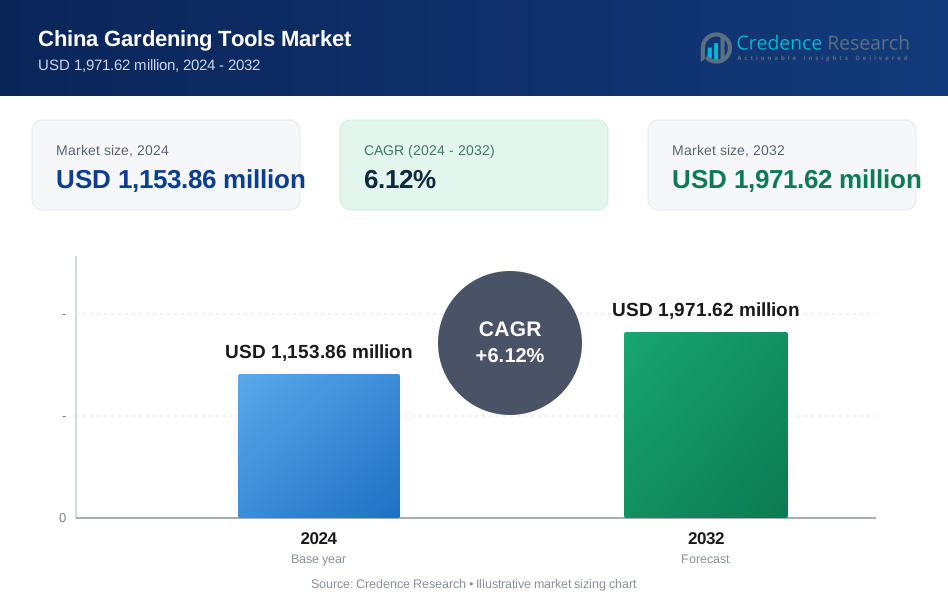
The China Gardening Tools Market is projected to grow from USD 1,153.86 million in 2024 to an estimated USD 1,971.62 million by 2032, with a compound annual growth rate (CAGR) of 6.12% from 2025 to 2032. The market's growth is driven by increasing urbanization, rising disposable incomes, and growing interest in gardening as both a hobby and a landscaping activity.
Several factors are driving the growth of the China Gardening Tools Market, including the rising popularity of gardening among urban dwellers, growing awareness about sustainability, and increasing adoption of eco-friendly tools. Moreover, the availability of advanced tools with improved ergonomics, durability, and functionality has boosted the market's growth. Changing lifestyles and the trend of home gardening and outdoor leisure activities also contribute to the growing demand for gardening tools across China.
Geographically, the market is witnessing significant growth in both urban and rural areas, with major demand originating from key regions such as Eastern and Southern China, where urbanization and disposable incomes are rapidly rising. The market is competitive, with key players such as Husqvarna, Stanley Black & Decker, and Fiskars leading the market with innovative products and strategic partnerships. These players continue to focus on expanding their product offerings and strengthening their presence in the region.
Market Insights
- The China Gardening Tools Market is expected to grow from USD 1,153.86 million in 2024 to USD 1,971.62 million by 2032, with a CAGR of 6.12% from 2025 to 2032, driven by increasing urbanization and rising consumer interest in gardening.
- The market is expanding as gardening becomes a popular hobby, supported by lifestyle changes, increased disposable incomes, and the demand for aesthetically pleasing green spaces.
- Smart and battery-powered gardening tools are gaining traction, with manufacturers focusing on IoT-enabled equipment, ergonomic designs, and sustainability-driven innovations.
- Rising environmental consciousness is driving the shift toward recyclable materials, energy-efficient tools, and eco-friendly gardening solutions, supporting long-term market growth.
- High competition and price sensitivity among consumers challenge manufacturers, making it essential to balance affordability with quality and innovation. Seasonal demand fluctuations also impact sales cycles.
- Eastern and Southern China dominate the market due to higher urbanization and disposable incomes, while Northern and Western China show emerging potential with growing landscaping projects.
- Husqvarna, Stanley Black & Decker, and Fiskars are leading market players, focusing on product expansion, strategic collaborations, and digital sales channels to strengthen their presence in China.
Market Drivers
Technological Advancements and Product Innovation
Technological innovations in gardening tools have played a crucial role in the expansion of the market in China. Manufacturers have introduced advanced products that offer enhanced performance, durability, and ease of use. For example, electric-powered tools like hedge trimmers, lawnmowers, and garden blowers have gained popularity, offering higher efficiency and reduced manual effort. Battery-powered gardening tools, in particular, have gained traction due to their convenience and environmental benefits, aligning with the growing preference for eco-friendly solutions. Furthermore, tools with ergonomic designs and lightweight materials have been developed to reduce strain and improve user comfort, making gardening more accessible to people of all ages, including elderly gardeners. The integration of smart technology into gardening tools is also making waves in the market. Tools that incorporate IoT (Internet of Things) technology allow for real-time monitoring of soil moisture levels, weather conditions, and plant health, which appeals to the tech-savvy consumer segment. As a result, the availability of these innovative and user-friendly tools has spurred market growth and positioned China as a significant player in the global gardening tools industry.
Government Initiatives and Environmental Awareness
The Chinese government’s increasing focus on environmental sustainability and green initiatives is also driving the growth of the gardening tools market. Government policies encouraging the creation of green spaces in urban areas, as well as the promotion of sustainable agricultural practices, have contributed to the rising interest in gardening. Policies that support environmental conservation, including tree planting campaigns and urban greening projects, have fostered a favorable environment for the growth of the gardening sector. Moreover, environmental awareness among Chinese consumers has led to a shift toward eco-friendly products, including gardening tools made from sustainable materials and those designed to minimize environmental impact. The growing popularity of organic gardening, composting, and eco-friendly pest control methods has also influenced consumers' purchasing decisions. With the Chinese government’s emphasis on green initiatives and sustainability, consumers are more inclined to invest in products that promote environmentally responsible practices. As these initiatives gain momentum, the demand for eco-conscious gardening tools is expected to rise, further driving market growth in the coming years.
Increasing Popularity of Gardening and Outdoor Activities
The growing interest in gardening as both a hobby and a form of relaxation has significantly boosted the demand for gardening tools in China. As urban areas expand and living spaces become more compact, residents are seeking ways to bring nature into their homes, contributing to the rise of home gardening, balcony gardens, and indoor plant cultivation. The trend is particularly strong among the millennial and Gen Z population, who value sustainability, environmental consciousness, and the aesthetic appeal of plants. This has led to a marked increase in consumer spending on gardening tools and equipment, as individuals look for high-quality, user-friendly tools to support their gardening projects. The rise in outdoor activities, such as gardening and landscaping, also stems from an increased focus on personal well-being and mental health, with many people turning to gardening as a therapeutic outlet. As a result, the demand for tools like pruners, shears, rakes, and trowels is growing steadily.For instance, the increasing popularity of gardening in China is evident in the proliferation of community gardens and urban farming initiatives. This trend is driven by urban residents seeking to bring nature into their compact living spaces, often through balcony gardens and indoor plant cultivation. Additionally, government initiatives promoting green spaces and urban beautification have encouraged more people to engage in gardening activities, leading to a rise in demand for specialized gardening tools suitable for smaller spaces. The focus on sustainability and environmental consciousness among younger generations has also contributed to this shift, with many individuals investing in high-quality, eco-friendly gardening tools to support their urban gardening projects.
Urbanization and the Shift Towards Urban Gardening
China’s rapid urbanization is another critical driver of the gardening tools market. With the continuous migration of people from rural to urban areas, the demand for residential gardening tools has surged. As urban dwellers face smaller living spaces, there has been a shift toward urban gardening, which involves cultivating plants in small spaces like balconies, terraces, and rooftop gardens. This trend is fueled by the desire for greenery in urban environments, where access to outdoor spaces is often limited. Furthermore, urban gardening has become a key part of the country's growing interest in sustainability and eco-friendly practices. Government initiatives promoting green spaces and urban beautification, along with the increased focus on environmental consciousness, have also contributed to this shift. As a result, more people are purchasing tools tailored for smaller gardening projects, such as compact hand tools, planters, and specialized equipment designed for container gardening. The continued urbanization of China will likely sustain this trend, further driving the demand for gardening tools.
Market Trends
Increased Focus on Ergonomically Designed Tools
The demand for ergonomically designed gardening tools is another prominent trend in the China Gardening Tools Market. As gardening becomes a more popular activity across all age groups, there is a growing need for tools that reduce physical strain and increase comfort. Tools that are lightweight, well-balanced, and feature ergonomic handles are becoming increasingly sought after. These innovations help reduce the risk of repetitive strain injuries, particularly for elderly gardeners and those with limited mobility. Manufacturers are designing tools that minimize effort and maximize efficiency, making gardening more enjoyable and accessible. Features like padded, adjustable handles, extended reach tools, and lightweight materials make it easier for users to perform various gardening tasks, including digging, trimming, and planting, with less physical exertion. Additionally, tools with soft-grip handles and anti-slip designs provide better control and comfort, ensuring that gardeners can work for longer periods without experiencing discomfort. The trend toward ergonomics reflects the growing need to make gardening a more inclusive and enjoyable activity for people of all ages and abilities, further enhancing the appeal of gardening tools in the market.
Expansion of Online and E-Commerce Platforms for Gardening Tools
The rapid growth of e-commerce in China has led to a significant shift in how consumers purchase gardening tools. Online retail platforms such as Alibaba, JD.com, and Tmall have become key distribution channels for gardening products, providing consumers with easy access to a wide variety of tools, equipment, and gardening accessories. The convenience of online shopping, combined with the ability to compare prices, read reviews, and access a vast range of products, has made e-commerce a preferred choice for many consumers. Additionally, many online platforms offer home delivery services, which adds to the convenience of purchasing gardening tools. Social commerce has also emerged as a key aspect of online shopping in China, where influencers and gardening enthusiasts share product recommendations and gardening tips through live-streaming and social media platforms like WeChat and Douyin. This has further fueled the popularity of gardening tools, as consumers are more likely to trust the opinions of influencers they follow. The shift toward online purchasing is not only a response to the growing preference for convenience but also reflects the increasing integration of technology into everyday shopping experiences. The expansion of e-commerce platforms has broadened the reach of gardening tools, making them more accessible to a wider audience, particularly in remote or rural areas where traditional brick-and-mortar stores may not be readily available.
Rising Popularity of Eco-Friendly and Sustainable Products
A major trend in the China Gardening Tools Market is the increasing demand for eco-friendly and sustainable products. As consumer awareness about environmental issues grows, individuals are becoming more conscious of the ecological impact of their purchasing decisions. In response to this demand, manufacturers are introducing gardening tools made from sustainable materials, such as bamboo, recycled plastics, and biodegradable composites. This trend aligns with the global movement toward sustainability and the Chinese government's initiatives to reduce carbon footprints and promote greener living.For instance, companies like Zhejiang Green Tools Co., Ltd. and Green Frog Tools are leading the way in China by producing gardening tools from sustainable materials such as steel, aluminum, and recycled plastics. These tools not only reduce environmental impact but also offer high-quality performance, aligning with consumer preferences for eco-friendly products. The shift toward organic gardening practices has led to greater interest in tools that support eco-friendly methods, such as organic fertilizers, pest control solutions, and water-efficient irrigation systems. Consumers are increasingly opting for tools that are not only effective but also environmentally responsible, reflecting their desire to reduce waste and contribute to sustainability. The rise of eco-conscious gardening tools is a direct response to growing environmental concerns and the need for a more sustainable lifestyle, and it is likely to continue influencing the market for the foreseeable future.
Growth of Smart and Connected Gardening Tools
Another significant trend in the China Gardening Tools Market is the rise of smart and connected gardening tools. The integration of Internet of Things (IoT) technology into gardening tools has revolutionized the way consumers approach gardening. Smart gardening tools are designed to provide real-time data and analytics, making it easier for consumers to monitor and maintain their plants and gardens. For instance, smart irrigation systems like those provided by Galcon in Shandong province use advanced weather-based technologies to optimize water usage. These systems can automatically adjust irrigation schedules based on weather conditions and plant needs, enhancing efficiency and reducing waste.Similarly, smart garden tools equipped with sensors and mobile app connectivity allow users to monitor soil moisture and plant health remotely, making gardening more efficient and accessible. These advancements have made gardening more appealing, particularly for tech-savvy consumers who are looking for convenience and precision in their gardening efforts. As the popularity of smart homes continues to rise in China, the demand for smart gardening tools is expected to grow, further driving innovation and the development of more advanced products.
Market Challenges
Seasonality and Limited Consumer Engagement
Another challenge in the China Gardening Tools Market is the seasonality of gardening activities. In regions with colder climates, gardening tends to be a seasonal activity, with demand for gardening tools peaking during spring and summer. During the off-season, there is a noticeable decline in sales, which can impact overall revenue generation for manufacturers and retailers. This fluctuation in demand forces companies to develop strategies for maintaining consumer engagement throughout the year. Additionally, the limited engagement in gardening activities during colder months also affects the frequency of purchases, leading to challenges in inventory management and marketing efforts. Companies need to focus on building brand loyalty and fostering year-round gardening interest through education, promotions, and offering tools for indoor gardening during the off-season. Overcoming this challenge requires a focus on consumer retention strategies and innovative marketing techniques to keep the market engaged even during the less active months.
High Competition and Price Sensitivity in the China Gardening Tools Market
One of the significant challenges facing the China gardening tools market is the intense competition among domestic and international brands. With numerous players offering a wide range of gardening tools at varying price points, distinguishing products based on quality and innovation becomes increasingly difficult. This saturation of the market puts pressure on manufacturers to maintain competitive pricing strategies while ensuring product quality.Additionally, consumers in China are highly price-sensitive, especially in rural areas where gardening is often considered a hobby rather than a necessity. Price sensitivity can hinder the growth of premium product segments, such as high-end ergonomic or technologically advanced tools, as budget-conscious consumers may opt for cheaper alternatives. As a result, brands must strike a delicate balance between offering affordable products and maintaining quality standards.For instance, the intense competition is evident in the sales dynamics of essential tools like gardening shears and shovels. Domestic brands often outsell international brands due to their lower prices, which are a result of reduced production costs. This price advantage drives consumer preference, particularly in a market where price sensitivity is high. Brands must differentiate themselves through unique value propositions, such as improved product features or eco-friendliness, to stay competitive.
Market Opportunities
Growing Demand for Urban Gardening Solutions
As urbanization continues to rise in China, there is a growing opportunity in the market for gardening tools specifically designed for urban environments. With limited outdoor space in cities, many consumers are turning to balcony, terrace, and rooftop gardening. This trend has created demand for compact, efficient, and easy-to-use gardening tools tailored to small-scale urban gardens. Manufacturers can capitalize on this opportunity by developing innovative products that cater to these unique needs, such as space-saving tools, vertical gardening solutions, and multi-functional tools that offer high utility in small spaces. Additionally, tools designed for indoor gardening, such as hydroponic systems or LED grow lights, are gaining traction, particularly among urban dwellers with limited outdoor space. This market segment presents significant growth potential as more consumers embrace urban gardening as a way to enhance their living spaces and improve their quality of life.
Expansion of E-Commerce and Online Retail Channels
The rapid expansion of e-commerce in China offers a significant opportunity for gardening tool manufacturers to reach a broader consumer base. With a growing preference for online shopping, particularly among younger, tech-savvy consumers, companies can leverage digital platforms to increase visibility and sales. By focusing on online retail channels such as Alibaba, JD.com, and Tmall, brands can cater to a wider geographic market, including remote areas where traditional brick-and-mortar stores may not be easily accessible. Additionally, the rise of social commerce and live-streaming platforms offers a unique opportunity for brands to engage with consumers, share gardening tips, and promote their products. This growing trend in online shopping, coupled with enhanced delivery services, opens up avenues for increased market penetration and revenue generation in the China Gardening Tools Market.
Market Segmentation Analysis
By Product
The market is segmented into hand tools, lawnmowers, trimmers and edgers, and water management equipment. Hand tools account for a significant share, driven by increasing consumer interest in gardening as a hobby and the affordability of these tools. Products such as pruners, shears, trowels, and rakes are widely used across both residential and commercial gardening applications. Lawnmowers hold a growing market share due to rising demand for well-maintained lawns in urban and suburban areas. Consumers are increasingly adopting electric and battery-powered lawnmowers for their convenience and environmental benefits. Trimmers and edgers are witnessing strong demand as landscaping and lawn care services expand, particularly in commercial settings. The water management equipment segment, including irrigation systems, sprinklers, and water hoses, is gaining traction due to increasing awareness about water conservation and efficient gardening practices.
By End User
The market is divided into residential and commercial end users. The residential segment dominates due to the growing trend of home gardening, balcony gardening, and small-scale landscaping. As urbanization continues, more households invest in gardening tools to enhance their outdoor and indoor green spaces. The commercial segment, comprising landscaping companies, golf courses, and municipal parks, is expanding as demand for professional gardening and maintenance services rises. Increased government initiatives for urban greening and landscaping projects further contribute to commercial market growth.
Segments
Based on product
- Hand Tools
- Lawnmowers
- Trimmers and Edgers
- Water Management Equipment
Based on End User
- Residential
- Commercial
Based on Distribution Channel
- Home Centers
- Lawn and Garden Specialty Stores
- National Retailers
- Discount Stores
- Hardware Stores
Based on Region
- Eastern China
- Southern China
- Northern China
- Western and Central China
Regional Analysis
Eastern China (35%)
Eastern China is the largest market for gardening tools, accounting for approximately 35% of the total market share. This region includes major cities like Shanghai, Jiangsu, and Zhejiang, which are highly urbanized and economically prosperous. The growing interest in home gardening, landscaping, and sustainable living among urban dwellers is a significant driver of market demand. Eastern China’s temperate climate supports year-round gardening activities, further boosting the demand for gardening tools. The region also sees strong government support for green spaces, urban beautification, and environmental sustainability, all of which contribute to the growth of the gardening tools market.
Southern China (30%)
Southern China, including provinces like Guangdong, Fujian, and Hainan, holds about 30% of the market share. The subtropical climate in this region promotes year-round gardening and landscaping, driving demand for tools that cater to both residential and commercial users. Cities such as Guangzhou and Shenzhen are seeing an increase in urban gardening, particularly rooftop and balcony gardening, as people seek ways to incorporate greenery into limited spaces. The increasing disposable incomes in these urban areas, coupled with the rising trend of gardening as a hobby, make Southern China a key market for innovative gardening products.
Key players
- Honda Motor Co., Ltd.
- Ariens Company
- Briggs & Stratton
- Deere & Company
- Falcon Garden Tools
- Fiskars
- Husqvarna Group
- Robert Bosch GmbH
- Robomow Friendly House
- The Toro Company
- Diversitech
- Union Source Co.
Competitive Analysis
The China Gardening Tools Market is highly competitive, with key players focusing on innovation, product quality, and expansion strategies to strengthen their market presence. Established brands like Honda Motor Co., Ltd., Husqvarna Group, and Deere & Company leverage advanced technology and strong brand reputation to maintain a competitive edge. Companies such as Briggs & Stratton, The Toro Company, and Robert Bosch GmbH focus on developing efficient and durable gardening tools, catering to both residential and commercial users. Additionally, Fiskars and Falcon Garden Tools capitalize on ergonomic designs and user-friendly products, appealing to home gardeners. Robomow Friendly House and Diversitech target the automated gardening tools segment, driven by increasing demand for smart gardening solutions. Union Source Co. plays a significant role in manufacturing and distribution, catering to cost-sensitive consumers. The competitive landscape is shaped by product innovation, sustainability trends, and expanding distribution networks, making it essential for companies to differentiate through quality, technology, and strategic partnerships.
Recent Developments
- In October 2024, Honda Power Sports & Products introduced an all-new line of battery-powered walk-behind lawn mowers at Equip Exposition 2024, including HRX, HRN, and HRC models, as well as a battery-powered zero-turn-radius (ZTR) lawn mower. These models are set to redefine Honda's reputation in the lawn and garden market with superior cutting performance and environmental benefits.
- In February 2025, Ariens announced a promotion offering savings of up to £966 on selected professional zero-turn mowers from March 1 to July 31, 2025.
- In September 2023 STIHL Inc. and Briggs & Stratton announced a new manufacturing relationship to produce a line of zero-turn mowers, expanding STIHL's offerings in the U.S.
- In January 2025, John Deere introduced an autonomous zero-turn mower at CES 2025, featuring electric power, reduced emissions, and advanced autonomy features. The mower is designed for commercial use and is expected to be available by 2026.
- In February 2025, Husqvarna Group introduced 13 new boundary wire-free robotic lawnmowers, expanding its range to 24 models. This launch strengthens Husqvarna's position in autonomous mowing and includes upgrades to residential and professional models.
- In March 2025, Bosch launched a new range of hand tools designed for professionals and artisans, enhancing efficiency and user experience in industrial and professional applications.
- In January 2025, The Toro Company reported strong growth in its professional segment, driven by increased shipments of golf and grounds products and zero-turn mowers. The company also showcased innovative robotic solutions at the GCSAA trade show.
Market Concentration and Characteristics
The China Gardening Tools Market is moderately fragmented, with a mix of established global brands and domestic manufacturers competing for market share. Leading players such as Honda Motor Co., Ltd., Husqvarna Group, Deere & Company, and Robert Bosch GmbH dominate the market with advanced product offerings, strong brand presence, and extensive distribution networks. However, several regional and local manufacturers cater to cost-sensitive consumers by offering affordable alternatives. The market is characterized by technological innovation, increasing demand for eco-friendly tools, and a shift toward smart gardening solutions. Companies are focusing on ergonomic designs, battery-powered equipment, and IoT-enabled gardening tools to meet evolving consumer preferences. Additionally, e-commerce platforms play a crucial role in market expansion, allowing companies to reach a wider audience. Despite competitive pressures, the rising trend of home gardening, urban landscaping projects, and government initiatives promoting green spaces continue to drive market growth, creating opportunities for both international and domestic players.
Report Coverage
The research report offers an in-depth analysis based on Product, End User, Distribution Channel and Region. It details leading market players, providing an overview of their business, product offerings, investments, revenue streams, and key applications. Additionally, the report includes insights into the competitive environment, SWOT analysis, current market trends, as well as the primary drivers and constraints. Furthermore, it discusses various factors that have driven market expansion in recent years. The report also explores market dynamics, regulatory scenarios, and technological advancements that are shaping the industry. It assesses the impact of external factors and global economic changes on market growth. Lastly, it provides strategic recommendations for new entrants and established companies to navigate the complexities of the market.
Future Outlook
- The China Gardening Tools Market is projected to expand steadily, driven by increasing urbanization, rising disposable incomes, and growing consumer interest in gardening. The market will continue to see demand for innovative and efficient tools that cater to both residential and commercial users.
- The integration of IoT and AI-powered gardening tools will gain momentum, offering features such as automated irrigation, plant health monitoring, and smart lawn maintenance, making gardening more convenient and efficient.
- Consumers will increasingly prefer gardening tools made from recycled materials, biodegradable components, and energy-efficient technologies, aligning with global sustainability trends and government green initiatives.
- With limited outdoor space in urban areas, demand for compact, space-efficient gardening tools will increase, supporting trends such as balcony gardening, rooftop gardens, and indoor hydroponic systems.
- Online retail platforms will play a dominant role in market expansion, with leading platforms such as Alibaba and JD.com offering extensive product ranges, competitive pricing, and faster delivery services to a wider customer base.
- The market will see a shift from fuel-powered tools to battery-operated and electric gardening equipment, driven by environmental concerns and the need for low-maintenance, user-friendly solutions.
- Manufacturers will invest in ergonomic, lightweight, and multi-functional gardening tools, improving user experience and accessibility, particularly for elderly gardeners and individuals with physical limitations.
- Policies promoting urban greening, sustainable landscaping, and public park developments will stimulate demand for professional-grade gardening tools, benefiting both public and private landscaping projects.
- Consumers will increasingly engage in DIY gardening projects, boosting demand for affordable, easy-to-use, and high-quality tools designed for home landscaping and personal garden maintenance.
- The market will witness increased mergers, acquisitions, and partnerships among key players, enabling companies to expand their market presence, enhance technological capabilities, and meet evolving consumer preferences.
Request a Free Sample
Fill in your details and we'll send you a free sample report.
- Sample data tables & charts
- Research methodology
Market Dynamics
Technological Advancements and Product Innovation
The introduction of battery-powered, electric, and IoT-enabled gardening tools has made gardening more accessible, efficient, and appealing to a wider range of consumers, including tech-savvy and elderly users. These innovations improve ergonomics, reduce manual effort, and align with the growing demand for eco-friendly solutions.
Government Initiatives and Environmental Awareness
Chinese government policies promoting urban greening, environmental sustainability, and the creation of green spaces are driving demand for gardening tools. Increased consumer awareness of sustainability is also shifting preferences toward eco-friendly and recyclable products.
Urbanization and Shift Toward Urban Gardening
Rapid urbanization in China is leading to smaller living spaces and a surge in urban gardening, such as balcony and rooftop gardens. This trend is increasing demand for compact, multi-functional, and easy-to-use gardening tools tailored for urban environments.
Expansion of E-Commerce and Online Retail Channels
The growth of e-commerce platforms like Alibaba and JD.com has made gardening tools more accessible to consumers across China, including those in remote or rural areas. Online retail offers convenience, wider product selection, and competitive pricing, fueling market expansion.
Rising Popularity of Gardening and Outdoor Activities
Gardening is increasingly seen as a hobby and a means of relaxation, especially among younger generations and urban dwellers. This lifestyle shift is boosting consumer spending on gardening tools and supporting the growth of both residential and commercial segments.
Need a Custom Version of This Report?
Tailor the scope, geography, or segments to your exact requirements.
- Custom geography or segment scope
- Direct access to our analyst team
Frequently Asked Questions
What was the market size of the China Gardening Tools Market in 2023, and what is its projected growth by 2032?
What are the key factors driving the growth of the China Gardening Tools Market?
Which regions in China have the highest demand for gardening tools?
Who are the major players in the China Gardening Tools Market?
How is sustainability influencing the gardening tools market in China?
Table of Content
Chapter 1 Market Segmentation
- 1.1 Segmentation Framework
- 1.1.1 Product and Service Classification
- 1.1.2 Application and End-Use Classification
- 1.1.3 Technology and Solution Classification
- 1.1.4 Customer and Distribution Channel Classification
- 1.1.5 Geographic Segmentation
- 1.1.6 Market Segment Definitions and Boundaries
- 1.2 By Product
- 1.2.1 Hand Tools
- 1.2.2 Lawnmowers
- 1.2.3 Trimmers and Edgers
- 1.2.4 Water Management Equipment
- 1.3 By End User
- 1.3.1 Residential
- 1.3.2 Commercial
Chapter 2 Introduction
- 2.1 Report Objectives and Scope
- 2.2 Product Definition and Industry Terminology
- 2.3 Market Inclusions and Exclusions
- 2.4 Research Process
- 2.4.1 Primary Research and Expert Interviews
- 2.4.2 Secondary Research and Source Review
- 2.4.3 Top-Down and Bottom-Up Estimation
- 2.4.4 Data Triangulation and Verification
- 2.5 Market Size Measurement Basis
- 2.5.1 2024: USD 1,153.86 million → 2032: USD 1,971.62 million
- 2.6 Historical and Forecast Reference Periods
- 2.6.1 Base Year: 2024
- 2.6.2 Forecast Period: 2024-2032
- 2.7 Research Assumptions and Limitations
Chapter 3 Executive Summary
- 3.1 Market Snapshot and Key Findings
- 3.2 Base-Year Market Size, 2024
- 3.3 Forecast Market Size, 2032
- 3.4 Revenue and Volume Growth Outlook
- 3.5 Key Demand and Supply Indicators
- 3.6 Leading Market Segments
- 3.7 Fastest-Growing Market Opportunities
- 3.8 Regional Performance Highlights
- 3.9 Technology and Industry Transformation
- 3.10 Competitive Landscape Summary
- 3.11 Analyst View and Strategic Implications
Chapter 4 China Gardening Tools Market Trends and Developments
- 4.1 Historical Industry Development
- 4.2 Recent Market Trends and Developments
- 4.3 Demand and Customer Behavior Trends
- 4.4 Technology and Product Innovation
- 4.5 Artificial Intelligence, Automation and Digitalization
- 4.6 Local Manufacturing and Supply Chain Realignment
- 4.7 Industry Partnerships, Mergers and Acquisitions
- 4.8 Sustainability and Circular Economy Developments
- 4.9 Government and Private Sector Investment Trends
- 4.10 Emerging Business Models and Commercialization
- 4.11 Industry Developments and Announcements
Chapter 5 China Gardening Tools Market Production, Supply and Demand Analysis
- 5.1 Demand Trend and Consumption Analysis
- 5.2 Demand Forecast, 2024-2032
- 5.3 Production and Output Trend
- 5.4 Production and Output Forecast, 2024-2032
- 5.5 Installed Capacity and Capacity Utilization
- 5.6 Company-Wise Production Plants and Statistics
- 5.6.1 Installed Production Capacity
- 5.6.2 Actual Production
- 5.6.3 Planned Capacity and Expansion Targets
- 5.7 Supply Chain Structure and Procurement Trends
- 5.8 Supply-Demand Gap and Bottlenecks
- 5.9 Import Dependence and Sourcing Structure
- 5.10 Contract Manufacturing and Outsourcing
- 5.11 Regional Supply and Demand Concentration
Chapter 6 China Gardening Tools Market Pricing Analysis
- 6.1 Pricing Structure and Measurement
- 6.2 Historical Pricing Trends
- 6.3 Pricing Outlook, 2024-2032
- 6.4 Average Selling Price and Unit Economics
- 6.5 Pricing by Product and Market Segment
- 6.6 Geographic Pricing Differences
- 6.7 Key Input, Energy, Labor and Logistics Costs
- 6.8 Contract Pricing and Purchasing Models
- 6.9 Pricing Sensitivity and Competitive Positioning
- 6.10 Price, Margin and Profitability Implications
Chapter 7 China Gardening Tools Market Dynamics
- 7.1 Market Growth Drivers
- 7.1.1 Demand-Side Drivers
- 7.1.2 Technology and Innovation Drivers
- 7.1.3 Infrastructure and Investment Drivers
- 7.1.4 Regulatory and Policy Drivers
- 7.2 Market Restraints
- 7.2.1 Cost and Affordability Constraints
- 7.2.2 Technology and Adoption Barriers
- 7.2.3 Supply Chain and Operational Constraints
- 7.3 Market Challenges
- 7.3.1 Competitive Pressure and Margin Erosion
- 7.3.2 Skills, Infrastructure and Implementation Gaps
- 7.4 Emerging Market Opportunities
- 7.5 Market Dynamics Impact and Time-Horizon Assessment
Chapter 8 China Gardening Tools Value Chain Analysis
- 8.1 Industry Value Chain Overview
- 8.2 Upstream Suppliers and Critical Inputs
- 8.3 Technology and Component Providers
- 8.4 Manufacturing or Service Delivery
- 8.5 Distribution, Channel Partners and Integrators
- 8.6 Downstream Applications and End Users
- 8.7 Value Addition and Profit Pools
- 8.8 Vertical Integration and Outsourcing
- 8.9 Supplier Concentration and Risk
- 8.10 Supply Chain Localization and Resilience
Chapter 9 China Gardening Tools Market Regulations and Policies
- 9.1 Relevant Laws, Standards and Compliance Frameworks
- 9.2 Product, Service, Safety and Quality Requirements
- 9.3 Government Policies, Incentives and Subsidies
- 9.4 Imports, Exports and Trade Barriers
- 9.5 Public Procurement and Local Content Requirements
- 9.6 Environmental and Sustainability Compliance
- 9.7 Upcoming Policy Changes and Market Implications
Chapter 10 China Gardening Tools Market Hotspots and Opportunities
- 10.1 Market Opportunity Mapping and Growth Hotspots
- 10.2 High-Growth Applications and Customer Groups
- 10.3 Underserved Markets and White-Space Opportunities
- 10.4 Emerging Technology and Product Opportunities
- 10.5 New Capacity and Investment Hotspots
- 10.6 Market Entry and Expansion Opportunities
- 10.7 Distribution and Partnership Opportunities
- 10.8 Near-Term and Long-Term Commercial Potential
- 10.9 Opportunity Attractiveness and Execution Risks
Chapter 11 China Gardening Tools Market Outlook, 2024-2032
- 11.1 Market Size and Analysis
- 11.1.1 Revenue (Market Measurement: 2024: USD 1,153.86 million → 2032: USD 1,971.62 million)
- 11.1.2 Market Volume and Quantity Sold
- 11.1.3 Historical Market Size
- 11.1.4 Base-Year Market Size, 2024
- 11.2 Market Forecast, 2024-2032
- 11.2.1 Revenue Forecast to 2032
- 11.2.2 Volume Forecast to 2032
- 11.2.3 CAGR and Year-on-Year Growth
- 11.2.4 Incremental Revenue Opportunity
- 11.3 Forecast Assumptions and Scenario Analysis
- 11.3.1 Base-Case Forecast
- 11.3.2 Optimistic and Conservative Scenarios
- 11.3.3 Technology, Pricing and Policy Sensitivities
- 11.4 Market Attractiveness and Growth Outlook
Chapter 12 China Gardening Tools Market Segmentation and Outlook
- 12.1 Segmentation Summary and Market Shares, 2024
- 12.2 Largest and Fastest-Growing Segments
- 12.3 By Product - Market Size and Forecast, 2024-2032
- 12.3.1 Segment Definition and Scope
- 12.3.2 Historical Market Size
- 12.3.3 Revenue Forecast, 2024-2032
- 12.3.4 Volume Forecast, 2024-2032
- 12.3.5 Base-Year Market Share, 2024
- 12.3.6 Segment CAGR and Growth Drivers
- 12.3.7 Subsegment Market Size and Forecast
- 12.3.7.1 Hand Tools
- 12.3.7.2 Lawnmowers
- 12.3.7.3 Trimmers and Edgers
- 12.3.7.4 Water Management Equipment
- 12.3.8 Subsegment Pricing and Adoption Trends
- 12.3.9 Leading Suppliers and Competition
- 12.3.10 Regional Demand and Opportunities
- 12.4 By End User - Market Size and Forecast, 2024-2032
- 12.4.1 Segment Definition and Scope
- 12.4.2 Historical Market Size
- 12.4.3 Revenue Forecast, 2024-2032
- 12.4.4 Volume Forecast, 2024-2032
- 12.4.5 Base-Year Market Share, 2024
- 12.4.6 Segment CAGR and Growth Drivers
- 12.4.7 Subsegment Market Size and Forecast
- 12.4.7.1 Residential
- 12.4.7.2 Commercial
- 12.4.8 Subsegment Pricing and Adoption Trends
- 12.4.9 Leading Suppliers and Competition
- 12.4.10 Regional Demand and Opportunities
- 12.5 Segment Growth Comparison
- 12.6 Segment Attractiveness and Priority Matrix
Chapter 13 China Gardening Tools End-Use and Application Market Outlook
- 13.1 End-Use Industry and Customer Demand Structure
- 13.2 Leading Applications and Customer Groups
- 13.3 End-Use Market Size, Share and Forecast
- 13.4 Major End-Use Industry Deep Dives
- 13.4.1 Customer Requirements and Use Cases
- 13.4.2 Demand and Replacement Cycles
- 13.4.3 Technical and Regulatory Considerations
- 13.4.4 Purchasing and Procurement Models
- 13.4.5 Leading Vendors and Distribution Channels
- 13.4.6 Forecast and Commercial Opportunities
- 13.5 Emerging Applications and Cross-Segment Demand
- 13.6 End-Use Industry Investment Priorities
Chapter 14 China Gardening Tools Geographic Market Outlook, 2024-2032
- 14.1 Domestic Market Distribution and Demand Clusters
- 14.2 State- or Province-Wise Market Size and Forecast, 2024-2032
- 14.3 City and Metropolitan Market Outlook
- 14.4 Industrial, Manufacturing and Commercial Clusters
- 14.5 Geographic Concentration of Key End Users
- 14.6 Local Pricing and Purchasing Differences
- 14.7 Domestic Production Facilities and Capacity Map
- 14.8 Local Infrastructure and Project Pipeline
- 14.9 State-Level Policy and Incentive Differences
- 14.10 Subnational Investment Hotspots and Opportunities
- 14.11 Distribution and Logistics Networks
- 14.12 Domestic Competitive Footprint
Chapter 15 China Gardening Tools Technology, Innovation and Sustainability Outlook
- 15.1 Technology Landscape and Maturity
- 15.2 Product, Process and Service Innovation
- 15.3 AI, Automation and Digital Tools in the Industry
- 15.4 Technology Adoption and Performance Benchmarking
- 15.5 Innovation Pipeline and R&D Investment
- 15.6 Patent and Intellectual Property Trends
- 15.7 Energy Efficiency and Resource Management
- 15.8 Sustainability, Recycling and Circularity
- 15.9 Technology Roadmap, 2024-2032
- 15.10 Risks of Obsolescence and Technology Substitution
Chapter 16 China Gardening Tools Market Key Strategic Imperatives
- 16.1 Growth and Market Entry Priorities
- 16.2 High-Return Products and Segments
- 16.3 Pricing, Profitability and Cost Optimization
- 16.4 Technology Investment and Product Differentiation
- 16.5 Supply Chain Localization and Resilience
- 16.6 Distribution and Customer Acquisition
- 16.7 Partnership, Acquisition and Capacity Strategy
- 16.8 Regional Expansion Priorities
- 16.9 Short-, Medium- and Long-Term Actions
Chapter 17 Competition Outlook
- 17.1 Industry Competition Characteristics
- 17.2 Market Structure and Concentration
- 17.3 Market Share and Competitive Positioning, 2024
- 17.4 Company-Wise Revenue and Product Benchmarking
- 17.5 Production and Service Capacity Benchmarking
- 17.6 Technology, Pricing and Differentiation
- 17.7 Regional Footprint and Distribution Strength
- 17.8 Mergers, Acquisitions and Strategic Alliances
- 17.9 New Entrants and Competitive Threats
- 17.10 Porter's Five Forces and Industry Attractiveness
- 17.11 Competitive Outlook, 2024-2032
Chapter 18 Company Profiles
- 18.1 Company Coverage and Selection Criteria
- 18.2 Honda Motor Co., Ltd.
- 18.2.1 Business Description
- 18.2.2 Company Ownership and Geographic Presence
- 18.2.3 Product and Service Portfolio
- 18.2.4 Manufacturing and Operating Footprint
- 18.2.5 Production Capacity and Expansion Plans
- 18.2.6 Financial Performance and Investment
- 18.2.7 Market Share and Competitive Position
- 18.2.8 Technology and Innovation Capabilities
- 18.2.9 Strategic Alliances or Partnerships
- 18.2.10 Recent Developments
- 18.2.11 Growth Strategy and Outlook
- 18.3 Husqvarna Group
- 18.4 Deere & Company
- 18.5 Robert Bosch GmbH
- 18.6 Fiskars
- 18.7 Stanley Black & Decker
- 18.8 Briggs & Stratton
- 18.9 The Toro Company
- 18.10 Ariens Company
- 18.11 Falcon Garden Tools
- 18.12 Other Relevant Market Participants
Note: Every listed company is profiled on the structure shown under the first company. The company list is preliminary and may change based on research findings, market developments, data availability and client requirements.
Chapter 19 Disclaimer
- 19.1 Research and Forecast Disclaimer
- 19.2 Data Source and Estimation Limitations
Note: The depth of individual sections depends on data availability for this market. Volume, capacity, trade and other unit-based metrics are included where applicable.

