Market Overview:
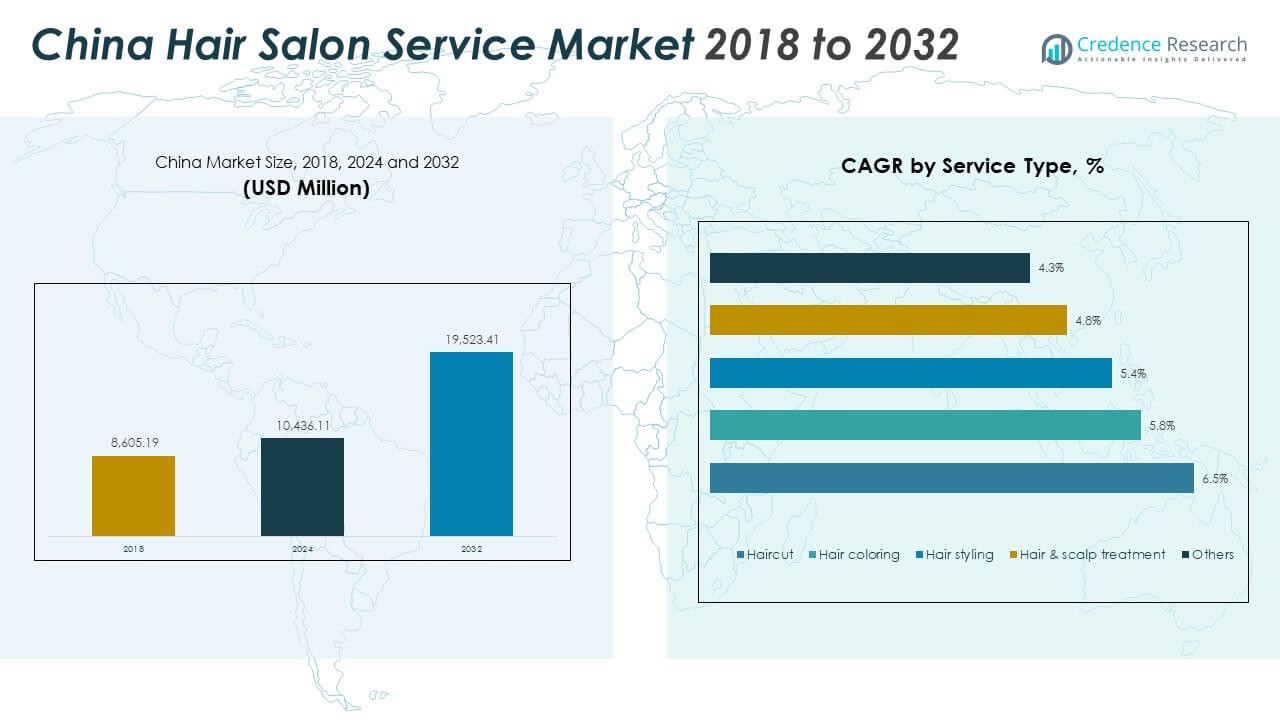
The China Hair Salon Service Market size was valued at USD 8,605.19 million in 2018, increasing to USD 10,436.11 million in 2024. It is anticipated to reach USD 19,523.41 million by 2032, at a CAGR of 8.14% during the forecast period.
| REPORT ATTRIBUTE |
DETAILS |
| Historical Period |
2020-2023 |
| Base Year |
2024 |
| Forecast Period |
2025-2032 |
| China Hair Salon Service Market Size 2024 |
USD 10,436.11 Million |
| China Hair Salon Service Market, CAGR |
8.14% |
| China Hair Salon Service Market Size 2032 |
USD 19,523.41 Million |
The market is driven by the growing middle-class population, rising disposable incomes, and increasing demand for premium hair care services. Urbanization is fueling the demand for professional salon services, especially in metropolitan areas. Additionally, technological advancements in hair treatments and the growing focus on personal grooming are also propelling market growth. Changing consumer preferences towards eco-friendly and organic products further contribute to the expansion of the industry.
The eastern coastal regions, particularly cities like Shanghai and Beijing, lead the market due to higher disposable incomes, a larger number of salons, and an inclination toward luxury hair care services. Emerging markets in second- and third-tier cities are showing rapid growth, driven by increasing consumer awareness and better access to beauty services. Regional expansion is supported by the spread of international salon chains and local operators catering to evolving customer needs.
Access crucial information at unmatched prices!
Request your sample report today & start making informed decisions powered by Credence Research Inc.!
Download Sample
Market Insights
- The China Hair Salon Service Market was valued at USD 8,605.19 million in 2018, is projected to reach USD 10,436.11 million by 2024, and grow to USD 19,523.41 million by 2032, at a CAGR of 8.14%.
- The eastern coastal regions dominate the market with approximately 40% share, driven by higher disposable income, urban population density, and a high concentration of international salon brands.
- The central regions hold 25% of the market share, with the western regions contributing 15%. These areas are showing steady growth due to rising middle-class demand and urbanization.
- The fastest-growing region is the inland central region, where consumer grooming awareness is increasing, spurred by middle-class expansion and urban development.
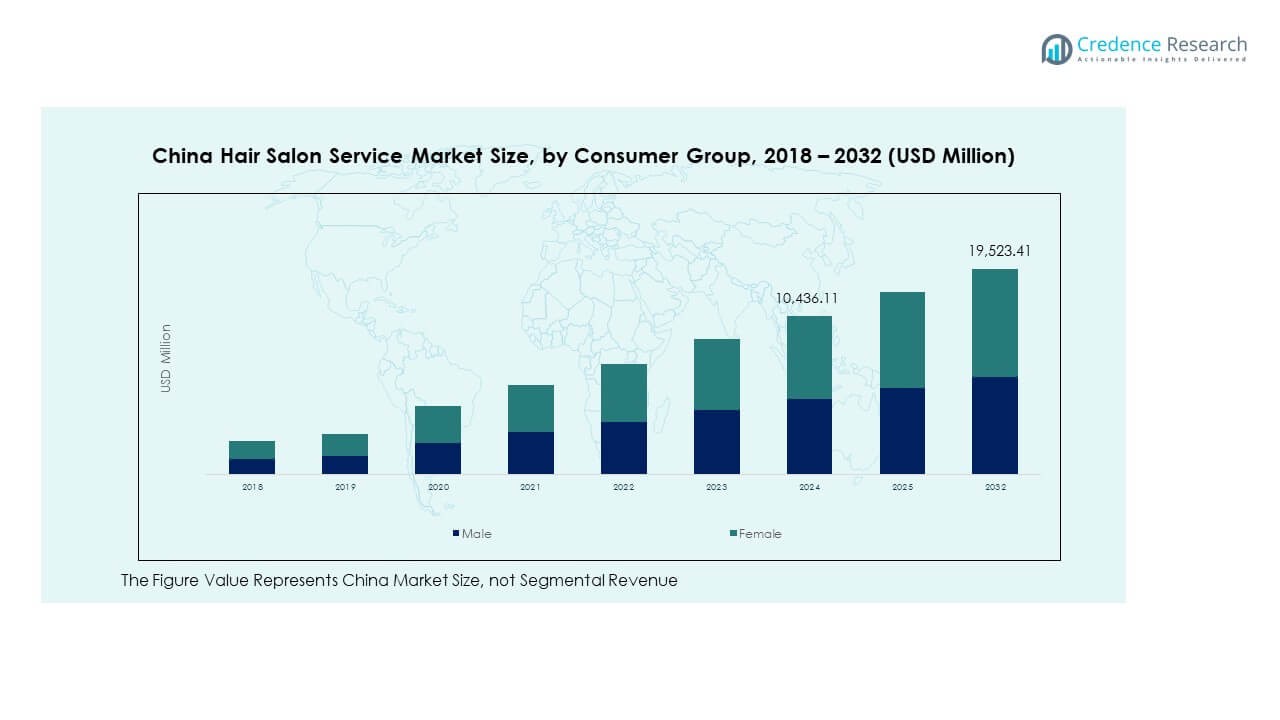
- The consumer group segment shows 60% share for females and 40% for males, highlighting a stronger demand for specialized services among women. The segment share for haircuts dominates, while hair coloring and styling services are growing rapidly.
Market Drivers:
Growing Middle-Class Population in China
The increasing middle-class population in China is driving demand in the China Hair Salon Service Market. As disposable incomes rise, consumers are willing to spend more on personal care services, including hair treatments. This demographic shift is contributing to the growing popularity of professional salon services across both urban and suburban areas. The demand for luxury and premium hair care products and services is also on the rise, fueled by the growing aspirations of middle-class consumers. Additionally, the desire for self-improvement and personal grooming continues to increase among this demographic, further expanding the market.
- For instance, Proya Cosmetics became the first Chinese beauty brand to surpass 10 billion yuan (approximately $1.4 billion) in annual revenue in 2024, achieving 21% growth year-on-year and reinforcing the premiumization trend in Chinese personal care consumption.
Influence of Urbanization and Changing Lifestyles
Urbanization has been a key factor in the expansion of the China Hair Salon Service Market. As more people move to cities, they become more accustomed to western-style beauty and grooming practices. Busy lifestyles have led many consumers to seek time-saving salon services. People are increasingly opting for regular visits to hair salons to maintain their looks, making these services an integral part of their routines. This trend has created a steady demand for salon services, especially in metropolitan areas. Salons are also responding to these demands by offering faster services and more convenient booking options to cater to the busy urban clientele.
Focus on Personal Appearance and Grooming
A significant driver in the China Hair Salon Service Market is the rising focus on personal appearance and grooming. Many consumers now view salon visits as an essential part of self-care. As the awareness of hair care and styling increases, more individuals are investing in professional treatments to maintain healthy hair. The growth of beauty trends, driven by social media and influencers, has led to more people seeking specialized hair services, such as color treatments and advanced styling. Moreover, the emergence of beauty-conscious youth culture further supports the market’s growth, as young individuals increasingly prioritize their grooming needs.
- For instance, Shiseido Professional’s Primience Enrich color range, with patented amino ceramide and hydrolyzed pearl protein for enhanced hair care, is specifically formulated for Asian hair and available in 45 tailored shades across salons in China, as validated by product releases and in-market listings.
Increasing Penetration of International Brands
International salon brands entering the Chinese market have been a major contributor to the market’s growth. These brands bring innovative hair care technologies and high-quality services, which attract a new segment of customers looking for premium treatments. The expansion of foreign salon chains has helped raise the standard of service and increased consumer expectations for quality. It has also led to the adoption of advanced tools and techniques in Chinese salons, enhancing the overall market offering. As global brands continue to establish themselves, they introduce competitive pricing models and loyalty programs, making premium services more accessible to a wider audience.
Market Trends:
Integration of Technology in Salon Operations
The China Hair Salon Service Market is witnessing an increased use of technology to improve customer experiences. Salons are adopting digital booking platforms, customer management systems, and virtual consultations. This trend has made it more convenient for customers to access services, schedule appointments, and track their service history. Salons are also using customer data to provide personalized services, further improving customer satisfaction. Through these technological advancements, salons can offer faster, more efficient services, helping them stay competitive in a crowded market.
Rise in Demand for Eco-Friendly and Sustainable Products
Sustainability has become a growing trend in the China Hair Salon Service Market. Consumers are increasingly aware of the environmental impact of beauty products and services. Many salons are responding by offering eco-friendly products, such as organic hair color and shampoos that are free from harmful chemicals. This shift towards green beauty has attracted environmentally conscious customers, and it is expected to grow as eco-friendly options become more mainstream. Salons that prioritize sustainability by reducing waste and offering green alternatives are gaining customer loyalty and a competitive edge in the market.
- For example, Aveda China has integrated sustainable manufacturing practices, including sourcing plant-based ingredients through fair-trade programs and using 100% wind and solar power in its manufacturing facilities. The company is committed to sustainability, with significant efforts to reduce environmental impact across its production processes.
Focus on Specialized Hair Treatments
The demand for specialized hair treatments is another significant trend in the market. Consumers are increasingly seeking out customized services for specific hair concerns such as hair loss, dryness, or scalp issues. Salons are responding by offering a wider variety of targeted treatments, including hair and scalp therapy, and advanced coloring options. This focus on specialized care has boosted the appeal of hair salons for a broader range of customers. Specialized treatments are also being marketed as premium offerings, contributing to the growth of the higher-end segment within the China Hair Salon Service Market.
- For example, Unilever’s professional scalp care brand, CLEAR, has a strong focus on scalp health and has previously launched advanced scalp care ranges. The brand often supports its products with research and clinical results, highlighting its commitment to scientific efficacy and innovation in the hair care market.
Growth of the Men’s Grooming Segment
The China Hair Salon Service Market is also seeing a growing demand for men’s grooming services. Traditionally, men’s grooming was limited to basic haircuts, but now more men are seeking advanced hair care and styling treatments. Services such as hair coloring, beard grooming, and scalp treatments are becoming more popular among male customers. This expansion of services tailored to men is driving growth in the market, especially in major cities where male grooming trends are gaining traction. Salons are also creating dedicated spaces for male clients, offering a more personalized and premium experience that appeals to this growing demographic.
Market Challenges Analysis:
High Competition in the Salon Industry
The China Hair Salon Service Market is facing intense competition as more salon operators enter the market. Both local and international brands are vying for a share of the growing consumer base, which has made it challenging for individual salons to stand out. Price wars, aggressive marketing, and service differentiation are all common tactics used by salon chains to attract customers. Smaller, independent salons may find it difficult to compete with the larger, more established players that offer extensive services at competitive prices. The market’s high fragmentation also means that salons must continuously innovate to maintain their customer base and market share.
Regulatory Challenges and Operational Costs
The growing regulatory environment in China poses challenges for hair salon operators. Regulations related to hygiene, employee certification, and product safety are becoming more stringent. Compliance with these regulations often requires salons to invest in staff training, certification programs, and higher quality products, which increases operational costs. Smaller salons may find it particularly difficult to absorb these costs, affecting their profitability and ability to stay competitive in the market. Additionally, meeting customer expectations for both safety and service quality requires ongoing investment in salon infrastructure, which can further strain financial resources.
Market Opportunities:
Emerging Consumer Segments and Regions
The China Hair Salon Service Market presents opportunities in emerging consumer segments, particularly among younger and middle-income groups. As more people in smaller cities and towns gain access to salon services, there is an opportunity for salons to expand their reach. These regions have seen an increase in disposable incomes, creating potential for growth in both basic and premium services. By focusing on underserved areas, salon operators can tap into new customer bases. This regional expansion also creates the potential for new salon concepts and formats that cater to local preferences and demands.
Introduction of High-Tech Services
Another opportunity in the China Hair Salon Service Market is the introduction of high-tech services, such as hair health analysis, AI-based styling, and virtual reality (VR) consultations. These innovative services offer customers a unique and personalized experience, helping salons differentiate themselves in a crowded market. As technology becomes more integrated into daily life, consumers are increasingly willing to pay for advanced, tech-enhanced hair treatments, creating new revenue streams for salons. The development of such services also strengthens brand loyalty and customer retention by providing added value.
Market Segmentation Analysis
By Service Type:
The China Hair Salon Service Market offers a variety of service types, including haircuts, hair coloring, hair styling, hair and scalp treatments, and others. Haircuts dominate the market, driven by regular maintenance needs. Hair coloring services have gained popularity due to the rising trend of personalized hair shades, while scalp treatments are seeing growth with increasing awareness of scalp health. Additionally, hair styling services are popular for special occasions, helping salons cater to diverse consumer needs.
- For instance, the adoption of automatic hair analysis machines using AI and high-resolution imaging has enabled precise diagnostics at many clinics and upscale salons across China. This technology delivers real-time hair structure and scalp moisture reports, leading to more scientifically tailored treatments.
By Salon Type:
Salons in China can be categorized into full-service salons, chain/franchise salons, barbershops, mobile/at-home salons, and salon-spas. Full-service salons offer a wide range of services, from basic cuts to high-end treatments, which attract a broad customer base. Chain and franchise salons benefit from brand recognition, while mobile salons cater to convenience-driven consumers seeking home services. Salon-spas offer a blend of beauty and relaxation services, which appeals to customers looking for a luxurious experience.
By Consumer Group:
The consumer group segmentation in the China Hair Salon Service Market includes male and female customers. Women generally account for a larger share of salon visits, driven by a wider array of services tailored to them. However, the growing demand for male grooming services is making men a significant consumer group in the market, with increased offerings for men’s styling and treatments. Salons are diversifying their service menus to cater to the evolving needs of male customers, especially in urban areas.
- For instance, in Hong Kong and major Chinese cities, Procter & Gamble maintained category leadership as male customers embraced dedicated men’s grooming salons and advanced self-care services in 2024.
By Price Range:
The market is segmented by price range into premium, mid-market, and value/economy categories. Premium salons cater to high-end consumers seeking luxurious treatments and exclusive services. Mid-market salons offer a balanced service quality at affordable prices, while value/economy salons focus on budget-conscious consumers seeking basic hair care solutions. The mid-market and value segments are growing as more consumers in smaller cities seek affordable yet quality salon experiences.
Segmentation
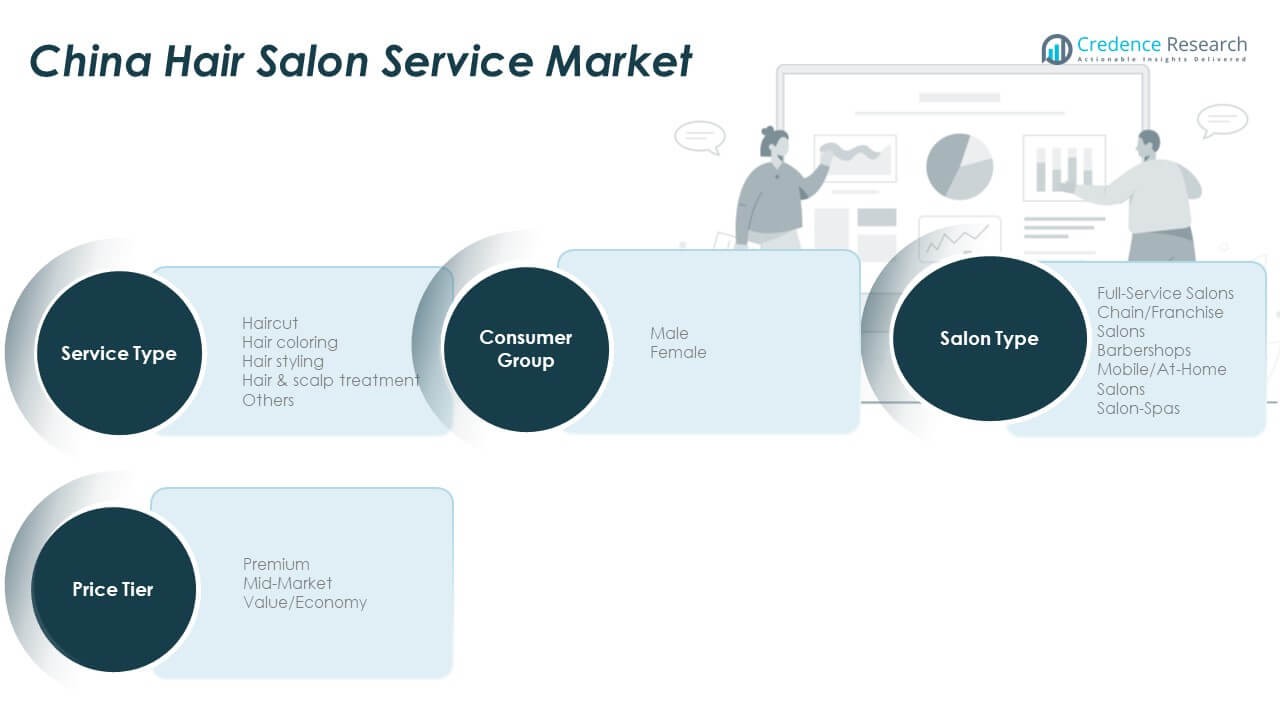
By Service Type
- Haircut
- Hair colouring
- Hair styling
- Hair & scalp treatment
- Others
By Salon Type
- Full-Service Salons
- Chain/Franchise Salons
- Barbershops
- Mobile/At-Home Salons
- Salon-Spas
By Consumer Group
By Price Range
- Premium
- Mid-Market
- Value/Economy
Regional Analysis
In the eastern coastal region of China, including provinces such as Guangdong, Zhejiang and Jiangsu, the China Hair Salon Service Market holds an estimated ~40 % market share. Rapid urbanisation, higher household incomes and strong presence of international salon brands drive demand in these metropolitan corridors. It concentrates premium‑service adoption and high‑frequency salon visits. Salon chains locate flagship stores in cities like Shanghai and Shenzhen. The demand for luxury hair treatments remains strongest here and margin levels are higher than the national average. Infrastructure advantages and dense competitive clusters help region‑players scale quickly.
In the central inland region — covering provinces such as Hubei, Henan and Sichuan — the market share is around ~25 %. This zone shows a rising middle‑class population seeking grooming and aesthetic services for the first time. It features growth driven by expansion of national salon chains into tier‑2 and tier‑3 cities. It records slower growth in premium segments but strong upward movement in mid‑market and value offerings. Local salons adapt service menus to regional preferences and cost structures. Transport, staffing and logistic limitations modestly restrict growth compared with eastern zones, but margin improvement potential remains significant.
In the western and northern hinterland including provinces such as Gansu, Xinjiang, Inner Mongolia and Yunnan, the market share stands at approximately ~15 %. Growth here remains slower due to lower disposable incomes and fewer high‑end salons. The region offers untapped potential as grooming awareness rises among younger populations and digital booking platforms expand. It hosts fewer international salon brands and more independent operators, meaning service quality and brand recognition vary widely. Operators willing to invest in training, standardization and digital outreach can capture emerging demand. Rural‑urban migration and policy‑driven urbanization trends also contribute to growth momentum.
Key Player Analysis
- L’Oréal Professionnel / L’Oréal S.A.
- Jean Louis David
- Franck Provost
- Fantastic Sams
- Supercuts
- Regis Corporation
- Camille Albane Paris
- Jean Claude Biguine
- Just Cuts
- QB House
Competitive Analysis
The China Hair Salon Service Market features a mix of national salon chains, independent operators and a growing number of international entrants. Strong global brands bring advanced techniques and premium positioning, forcing domestic chains to upgrade service standards and training programmes. Companies differentiate through loyalty programmes, digital booking systems, and value‑added services such as scalp therapy and colour innovations. Chain operators benefit from scale advantages in training, procurement and marketing, enabling pricing strategies that challenge smaller independents. Independent salons respond by emphasising local flavour, customised services and flexible pricing, but they often face higher overheads, staffing variability and weaker brand visibility. Franchising models are gaining traction, allowing newer salons to join established networks and leverage brand equity. Competitive intensity remains high given low barriers to entry in basic hair‑cut services, which compresses margins and compels service diversification. Profitability increasingly depends on premium services, efficient operations and retaining loyal clients rather than volume of standard cuts alone.
Recent Developments
- In October 2025, Beauty Farm Medical and Health Industry Inc. made headlines with its acquisition of Shanghai Siyanli Industrial Co., Ltd. for RMB 1.25 billion, which is recognized as the largest transaction in China’s beauty service sector for the year. This landmark move integrates Siyanli’s network of premium beauty outlets and clinics across major Chinese cities into the Beauty Farm ecosystem, promising to significantly strengthen the company’s presence and capabilities in the premium beauty and hair salon service space.
- In May 2025, Unilever’s professional anti-dandruff brand CLEAR introduced its new Scalpceuticals Pro Range at TANK Shanghai, aiming to set higher standards for scientific scalp care in the Chinese salon service market. This product line is rooted in research by five global laboratories, supported by collaboration with over 200 dermatologists over a decade, and includes the release of the “Scalp Health Science Expert White Paper” to further education on scalp health science in the industry.
Shape Your Report to Specific Countries or Regions & Enjoy 30% Off!
Report Coverage
The research report offers an in-depth analysis based on Service Type, Salon Type, Consumer Group and Price Range. It details leading market players, providing an overview of their business, product offerings, investments, revenue streams, and key applications. Additionally, the report includes insights into the competitive environment, SWOT analysis, current market trends, as well as the primary drivers and constraints. Furthermore, it discusses various factors that have driven market expansion in recent years. The report also explores market dynamics, regulatory scenarios, and technological advancements that are shaping the industry. It assesses the impact of external factors and global economic changes on market growth. Lastly, it provides strategic recommendations for new entrants and established companies to navigate the complexities of the market.
Future Outlook
- The demand for premium and specialized services is expected to rise, contributing to overall market growth.
- Digital transformation, including the adoption of online booking platforms and customer management systems, will enhance service accessibility.
- The expansion of mobile and at-home salons will cater to convenience-seeking consumers in tier-2 and tier-3 cities.
- Eco-friendly and organic hair care products are anticipated to gain popularity among environmentally conscious consumers.
- The growing middle class, particularly in inland regions, will be a key driver for mid-market and value segment expansion.
- International salon brands are likely to increase their presence, influencing service standards and product offerings.
- Advanced technological treatments such as AI-based styling and personalized services are expected to become mainstream.
- Men’s grooming services will see continued growth, with an increase in specialized offerings for male consumers.
- Rising disposable income in smaller cities will unlock new revenue streams for salons targeting the lower-middle-class market.
- Partnerships and franchising models are projected to expand, enabling regional operators to scale quickly.



