
| REPORT ATTRIBUTE | DETAILS |
|---|---|
| Historical Period | 2020-2023 |
| Base Year | 2024 |
| Forecast Period | 2025-2032 |
| China Writing Instruments Market Size 2023 | USD 2,672.10 Million |
| China Writing Instruments Market, CAGR | 13.25% |
| China Writing Instruments Market Size 2032 | USD 8,197.00 Million |
Market Overview
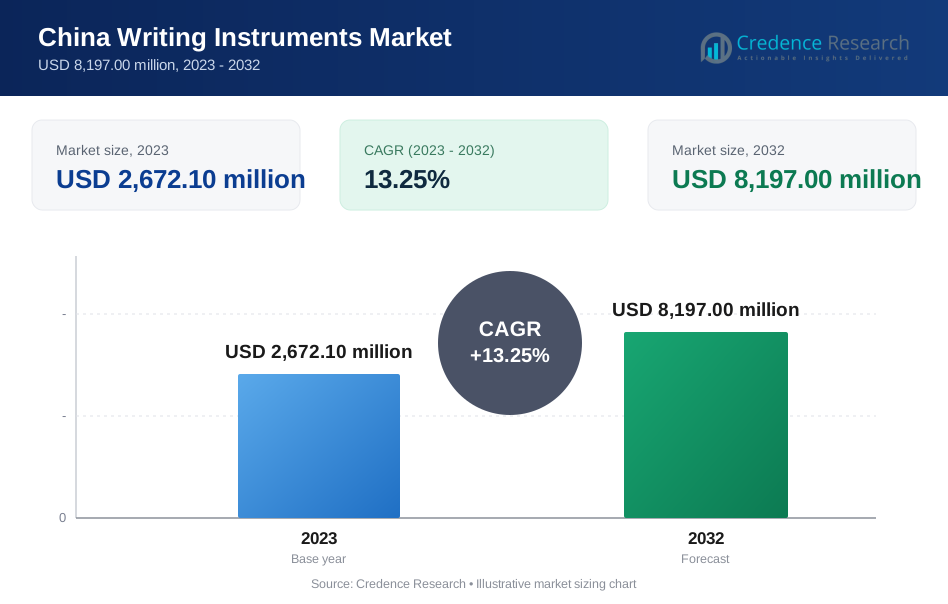
China Writing Instruments Market size was valued at USD 2,672.10 million in 2023 and is anticipated to reach USD 8,197.00 million by 2032, at a CAGR of 13.25% during the forecast period (2023-2032).
The China writing instruments market is experiencing robust growth, driven by increasing educational expenditures, a rising student population, and growing demand for high-quality stationery in both academic and professional settings. Government initiatives to enhance literacy and education infrastructure further support market expansion. Additionally, the rising popularity of premium and luxury pens as gifting items and status symbols is fueling demand. Trends such as the shift toward sustainable and refillable products are gaining traction, aligning with China’s broader environmental goals. Manufacturers are also investing in product innovation, incorporating ergonomic designs, smart features, and customizable options to cater to evolving consumer preferences. The surge in e-commerce platforms has further boosted accessibility and product visibility, enabling wider consumer reach and convenient purchasing. Moreover, collaborations between brands and artists, as well as limited-edition launches, are enhancing brand value and consumer engagement. These factors collectively position the writing instruments market for sustained growth across China.
China’s writing instruments market is geographically diverse, with major demand concentrated in key urban centers such as Beijing, Shanghai, Guangzhou, and Shenzhen. These regions exhibit varying preferences, with Beijing leading in government and educational sector demand, Shanghai being a hub for premium and luxury products, Guangzhou having a strong base in mass-market consumption, and Shenzhen driving the growth of tech-integrated writing tools. Key players in the market include established global brands like Lamy, Montblanc, and Waterman, alongside domestic leaders such as Cello Pens and Shanghai Hero Pen Company. These companies compete by offering a wide range of products, from high-end pens and pencils to eco-friendly and digital writing instruments. The market is characterized by innovation, with many players focusing on sustainability and customization to cater to evolving consumer preferences. Competitive strategies include product differentiation, branding, and leveraging both online and offline distribution channels.
Market Insights
- The China writing instruments market was valued at USD 2,672.10 million in 2023 and is projected to reach USD 8,197.00 million by 2032, growing at a CAGR of 13.25% during the forecast period.
- The Global Writing Instruments market was valued at USD 22,000.00 million in 2023 and is expected to reach USD 57,196.01 million by 2032, growing at a CAGR of 11.20% during the forecast period.
- Rising literacy rates and increased enrollment in schools and colleges are driving the demand for writing instruments across the country.
- Urban consumers are showing a growing preference for premium, eco-friendly, and customized writing tools.
- The market is witnessing a trend toward digital integration, with smart pens and hybrid writing solutions gaining popularity among students and professionals.
- Intense competition and price sensitivity are pressuring manufacturers to innovate while maintaining affordability.
- Digitalization in education and workplaces is gradually reducing the reliance on traditional writing instruments.
- Beijing leads the regional market with a 29% share, followed by Shanghai (25%), Guangzhou (23%), and Shenzhen (18%), each contributing significantly to overall market growth.
Report Scope
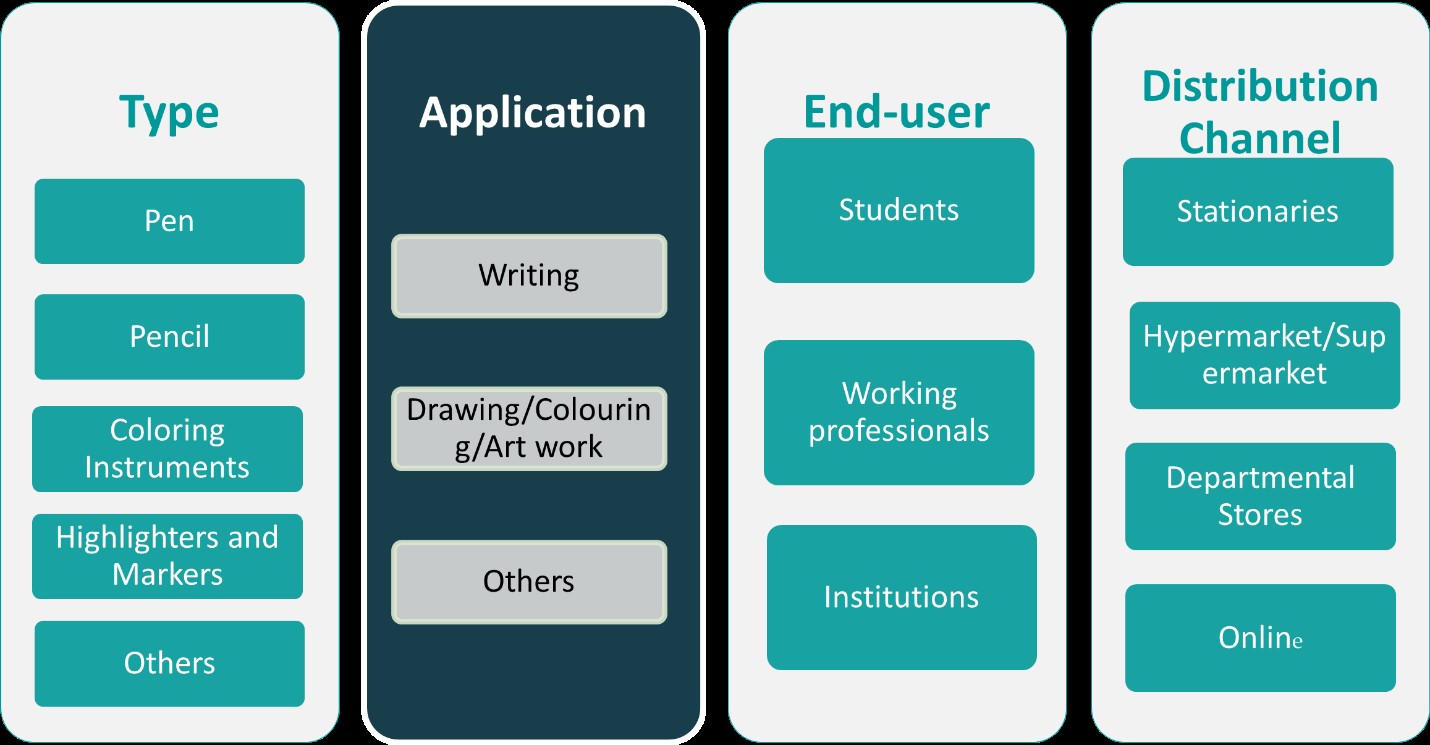
This report segments the China Writing Instruments Market as follows:
Market Drivers
Rising Educational Expenditure and Student Population Growth
China’s growing focus on education is a primary driver of the writing instruments market. For instance, the Ministry of Education of China reported that in 2022, there were 518,500 educational institutions with 293 million students enrolled, reflecting the government’s significant investment in educational infrastructure. As a result, there has been a consistent increase in school enrollments, particularly in urban and semi-urban areas. This growing student population generates sustained demand for a wide range of writing tools, from basic pens and pencils to specialized stationery used for academic purposes. The double-digit growth of the education sector, especially in private tutoring and early childhood education, further amplifies this demand. Additionally, educational reforms encouraging creative learning and skill development are promoting the use of various artistic and technical writing instruments, expanding the market beyond traditional products.
Growth in Corporate and Professional Demand
The expansion of China’s corporate sector and its evolving work culture are also fueling the demand for writing instruments. For instance, the National Bureau of Statistics of China highlights the steady growth of urban employment, which drives the use of premium pens and branded stationery in professional settings. Writing instruments are not only used in daily administrative tasks but also serve as corporate gifts, promotional items, and symbols of brand identity. Moreover, the rise of business conferences, corporate events, and academic seminars has created a consistent demand for branded writing instruments, often distributed as part of marketing and branding strategies. This trend is especially prominent in urban regions where companies are placing greater emphasis on professional presentation and communication materials. The emergence of co-working spaces and start-up culture is also contributing to the rise in demand for stylish and functional stationery items.
Rising Consumer Interest in Premium and Luxury Writing Instruments
A growing segment of Chinese consumers is now seeking premium and luxury writing instruments, viewing them as status symbols and lifestyle accessories. High-end pens, particularly those from international and heritage brands, are increasingly popular among professionals, collectors, and gift buyers. The gifting culture in China, especially during holidays and business exchanges, has created a thriving market for finely crafted pens with sophisticated designs and packaging. This has encouraged both global and domestic manufacturers to introduce exclusive collections and limited-edition models tailored to local tastes. Additionally, with increasing disposable income, urban middle-class consumers are willing to invest in better quality and aesthetically appealing writing tools that reflect personal style and taste. These preferences are significantly shaping the product development strategies of key market players.
Digital Transformation and E-commerce Penetration
The integration of digital platforms into retail operations is a major driver accelerating the growth of the writing instruments market in China. Online marketplaces such as JD.com, Taobao, and Tmall have transformed the way writing instruments are marketed and sold, offering vast product variety and competitive pricing. E-commerce provides brands with a cost-effective channel to reach a broader customer base, including those in lower-tier cities and rural areas. Moreover, digital marketing campaigns, influencer endorsements, and real-time customer feedback enable brands to adapt quickly to consumer preferences. Subscription models and bundled stationery kits promoted through online platforms are also gaining popularity among students and working professionals. The convenience of doorstep delivery and seasonal discounts further contribute to the growing penetration of online sales, making e-commerce a vital growth engine for the Chinese writing instruments market.
Market Trends
Shift Towards Eco-Friendly and Sustainable Products
Environmental consciousness is significantly influencing consumer preferences in China’s writing instruments market. For instance, the Beautiful China 2025 initiative emphasizes green development and pollution reduction, encouraging manufacturers to adopt sustainable practices. A growing number of consumers, particularly among younger demographics and urban populations, are actively seeking eco-friendly alternatives to conventional disposable pens and plastic-based products. This trend has encouraged manufacturers to invest in sustainable innovations, including biodegradable pens, refillable markers, and writing instruments made from recycled materials. Government regulations promoting green production practices and sustainable consumption are further accelerating this shift. Brands that emphasize environmental responsibility in their product lines and marketing strategies are gaining a competitive edge, particularly in education and corporate sectors where sustainability has become a key purchasing consideration.
Integration of Technology in Writing Instruments
The adoption of technology-enhanced writing tools is another notable trend shaping the Chinese market. For instance, smart pens like Livescribe and Wacom are gaining traction among students and professionals for their ability to digitize handwritten notes and sync with mobile devices. These digital writing instruments are particularly valued in educational and business environments that emphasize hybrid learning and paperless workflows. Leading companies are integrating features such as Bluetooth connectivity, pressure sensitivity, and app integration to provide a seamless transition between traditional writing and digital documentation. As China continues its push toward digital education and smart office solutions, the demand for tech-enabled writing instruments is expected to grow steadily.
Rising Popularity of Customization and Personalization
Personalization is becoming a strong trend in the China writing instruments market, especially among consumers seeking unique, aesthetically appealing stationery. Customized pens with engraved names, messages, or logos are gaining popularity in both retail and corporate gifting segments. This trend is particularly prominent during festivals, corporate events, and school ceremonies, where writing instruments are chosen for their emotional and commemorative value. Brands are responding by offering user-friendly customization tools on e-commerce platforms, enabling consumers to design their own products. Additionally, collaborations with designers, artists, and influencers are helping to drive demand for limited-edition collections that cater to niche tastes and enhance brand differentiation in a competitive market.
Growth of Online Sales and Omni-Channel Strategies
The continued expansion of e-commerce and omni-channel retailing is reshaping the distribution landscape for writing instruments in China. Online platforms offer not only convenience and variety but also an engaging shopping experience through product reviews, comparison tools, and virtual demonstrations. Leading brands are increasingly adopting direct-to-consumer (D2C) models and partnering with major digital marketplaces to enhance their reach. At the same time, brick-and-mortar stores are evolving into experience centers where customers can test products and explore curated selections. The blending of digital and physical retail strategies is enabling companies to better understand consumer behavior and tailor their offerings accordingly, thereby reinforcing brand loyalty and increasing market penetration.
Market Challenges Analysis
Rising Digitalization and Declining Paper-Based Usage
One of the most significant challenges facing the China writing instruments market is the rapid digitalization of education and workplace environments. For instance, the National Bureau of Statistics of China reported that the digital economy contributed 9.9% to the GDP in 2023, reflecting the widespread adoption of digital tools in schools and businesses. Online learning platforms, electronic whiteboards, and typing-based assessments are reducing the need for pens, pencils, and paper-based materials. Additionally, mobile devices and tablets have become the preferred mediums for note-taking and scheduling among younger generations. This shift poses a long-term threat to the demand for conventional writing instruments, compelling manufacturers to re-evaluate their product strategies. While digital transformation enhances productivity and convenience, it also creates a barrier for the growth of manual writing tools, particularly in urban and technologically advanced regions of China.
Intense Market Competition and Price Sensitivity
The China writing instruments market is highly fragmented and competitive, with a large number of domestic and international players vying for market share. This intense competition often results in aggressive pricing strategies, which can significantly erode profit margins, particularly for smaller and mid-sized manufacturers. Many consumers remain price-sensitive, especially in the student and mass-market segments, leading to a preference for low-cost alternatives over branded or premium products. Additionally, the influx of counterfeit and substandard products in online and offline retail channels undermines brand trust and affects the overall quality perception of the market. Manufacturers must continuously innovate, invest in brand differentiation, and maintain stringent quality standards to remain competitive. However, these efforts often involve high operational costs, making it challenging to balance affordability with profitability. As a result, navigating this competitive landscape while sustaining growth remains a key challenge for both established players and new entrants.
Market Opportunities
The China writing instruments market presents considerable opportunities driven by evolving consumer preferences and expanding niche segments. One key area of growth lies in the demand for premium and luxury writing tools. As disposable income rises and consumer lifestyles evolve, there is a noticeable shift toward high-end pens and personalized stationery products, particularly in urban regions. These items are increasingly viewed not only as functional tools but also as status symbols, gift items, and lifestyle accessories. This trend offers manufacturers the chance to introduce exclusive collections, collaborate with luxury brands, and offer customization services that cater to gifting and personal expression. Moreover, the integration of cultural elements and traditional Chinese artistry into product design can appeal to domestic buyers and international collectors alike, further enhancing market appeal.
Another promising opportunity arises from the increasing emphasis on sustainability and environmentally friendly products. As environmental awareness continues to grow, consumers are actively seeking alternatives to single-use plastic pens and opting for refillable, biodegradable, or recycled-material-based products. Brands that align with green manufacturing practices and effectively communicate their sustainability commitments are likely to attract a loyal customer base, particularly among younger and eco-conscious demographics. In addition, the expansion of digital commerce provides a scalable platform for both established and emerging brands to reach wider audiences. With the growing popularity of online learning, home offices, and creative hobbies, the demand for specialty writing tools such as brush pens, calligraphy sets, and drawing instruments is also on the rise. Tapping into these niche markets and leveraging digital marketing, influencer partnerships, and direct-to-consumer models can open new revenue streams for players in the industry. Overall, the convergence of premiumization, sustainability, and digital retailing presents a dynamic landscape of opportunities for growth and innovation in China’s writing instruments market.
Market Segmentation Analysis:
By Type:
The China writing instruments market, when segmented by type, includes pens, pencils, coloring instruments, highlighters and markers, and others. Among these, pens hold the largest market share due to their widespread usage in educational, professional, and domestic settings. A diverse product range—spanning from ballpoint and gel pens to fountain and rollerball pens—caters to different user preferences and price sensitivities. Pencils also remain essential, especially in academic institutions and among younger students, driven by affordability and reusability. Meanwhile, coloring instruments are gaining popularity among children, hobbyists, and artists, thanks to rising interest in creative expression and art education. Highlighters and markers are seeing increased demand in offices and schools, particularly for organizational and presentation purposes. The “others” category, including styluses and multifunctional tools, is witnessing slow but steady growth, supported by the increasing integration of traditional and digital writing solutions. Manufacturers are focusing on innovation, quality enhancement, and aesthetic appeal to maintain competitiveness across all segments.
By Application:
Based on application, the China writing instruments market is segmented into writing, drawing/colouring/artwork, and others. The writing segment dominates the market, driven by consistent demand from students, office workers, and the general public. Despite digital advancements, handwritten communication remains valued in academic assessments, business documentation, and personal note-taking. As a result, functional and comfortable writing tools continue to witness stable demand. Meanwhile, the drawing/colouring/artwork segment is rapidly expanding due to increased adoption of art education in schools and a surge in hobby-related purchases. Coloring instruments, sketch pens, and specialized drawing pencils are gaining traction among children, artists, and design professionals. Furthermore, adult coloring as a relaxation activity is also supporting growth in this segment. The “others” category includes niche applications like styluses for digital devices or hybrid writing tools used in specialized industries. This segment is expected to grow moderately as the integration of writing instruments with smart technology continues to evolve, expanding their utility beyond traditional uses.
Segments:
Based on Type:
- Pen
- Pencil
- Coloring Instruments
- Highlighters and Markers
- Others
Based on Application:
- Writing
- Drawing/Colouring/Art Work
- Others
Based on End- User:
- Students
- Working Professionals
- Institutions
Based on Distribution Channel:
- Stationaries
- Hypermarket/Supermarket
- Departmental Stores
- Online
Based on the Geography:
- Beijing
- Shanghai
- Guangzhou
- Shenzhen
Regional Analysis
Beijing
Beijing accounted for approximately 29% of the China writing instruments market share in 2023, making it one of the leading regional contributors. As the capital city and a prominent educational and administrative hub, Beijing boasts a large population of students, professionals, and government institutions that drive steady demand for various writing instruments. The city's emphasis on academic excellence, coupled with a high density of schools, colleges, and training centers, fuels the consumption of pens, pencils, and art supplies. Additionally, Beijing’s flourishing corporate ecosystem supports the use of premium pens, highlighters, and markers in business and government settings. The demand for eco-friendly and luxury writing tools is also rising among urban consumers who prioritize quality, sustainability, and personalization. Retail and e-commerce channels are well-established, giving consumers access to a wide variety of international and domestic brands.
Shanghai
Shanghai captured about 25% of the market share, positioning it as a significant growth center for writing instruments in China. As a global financial and commercial hub, Shanghai’s dynamic business environment fosters continuous demand for office and executive stationery, especially premium and customized writing tools used in corporate gifting and branding. The city also has a strong presence of design and art institutions, contributing to rising consumption of drawing instruments and color tools among artists, students, and professionals. Shanghai’s technologically advanced retail infrastructure supports both online and offline distribution channels, encouraging faster product availability and consumer engagement. Moreover, with increasing disposable income and lifestyle awareness, consumers in Shanghai are showing a growing preference for aesthetically designed and eco-conscious writing tools, pushing manufacturers to tailor their offerings accordingly.
Guangzhou
Guangzhou accounted for nearly 23% of the China writing instruments market in 2023. The region’s strong industrial base, active trade environment, and large student population make it a robust market for both mass-market and mid-range writing products. Educational institutions, tuition centers, and training academies drive bulk purchases of affordable pens and pencils, while businesses and startups fuel demand for practical and professional-grade writing instruments. Additionally, Guangzhou’s role as a major trade hub enables smooth logistics and product distribution, particularly for foreign brands seeking entry into South China. Seasonal demand during school admissions and exam periods, along with growing interest in creative arts among young learners, further supports market expansion in the region.
Shenzhen
Shenzhen held an estimated 18% market share in 2023, driven by its status as a major technology and innovation hub. While digital tools are increasingly dominant, the region continues to show steady demand for smart writing instruments that combine traditional pen-and-paper functionality with digital storage and connectivity. Shenzhen’s younger, tech-savvy population is drawn to smart pens and hybrid products designed for students, engineers, and professionals. Additionally, the city’s thriving startup and entrepreneurial culture creates consistent demand for highlighters, markers, and promotional pens used for branding and workplace communication. As sustainability and innovation gain traction, Shenzhen consumers are leaning toward reusable and multifunctional writing tools, offering new growth avenues for manufacturers that invest in product advancement and eco-design.
Key Player Analysis
- Lamy
- Montblanc
- Waterman
- Faber-Castell
- Montegrappa
- Pelikan
- Kaweco
- Diplomat
- Aurora
- Sheaffer
- Cello Pens
- Shanghai Hero Pen Company
Competitive Analysis
The China writing instruments market is highly competitive, with both international and domestic brands vying for market share. Leading global players like Lamy, Montblanc, Waterman, Faber-Castell, Montegrappa, Pelikan, Kaweco, Diplomat, Aurora, and Sheaffer dominate the premium segment by offering high-quality, luxury writing instruments. These brands differentiate themselves through craftsmanship, product innovation, and strong brand reputation. Their products, ranging from fountain pens to high-end ballpoint pens, cater to discerning consumers in urban centers who prioritize quality and status. These brands cater to consumers who value exclusivity, style, and functionality, particularly in urban areas with higher disposable incomes. They maintain a strong presence in office, corporate, and gifting sectors, with a focus on creating sophisticated designs and using premium materials. In contrast, mass-market and budget segments are served by local brands that focus on affordability and broad distribution. These brands often lead the market in volume sales, targeting educational institutions, offices, and everyday consumers. They compete by offering durable, cost-effective solutions that meet the basic needs of a wide consumer base. To stay competitive, these companies are focusing on product innovation, such as incorporating eco-friendly materials, digital integration, and customizable options. Overall, the competition is driven by the need for differentiation through product features, pricing strategies, and the ability to adapt to changing consumer preferences, particularly around sustainability and technological integration. The competitive landscape will continue to evolve as brands seek to balance tradition with innovation and meet the diverse demands of the market.
Recent Developments
- In February 2023, Zebra Pen Corp., a prominent player in the industry, announced its partnership with Liqui-Mark. This collaboration aims to enhance distribution aspects in the market, bringing about a new era of possibilities.
- In July 2023, Montblanc launched its exclusive "Meisterstück 146 LeGrand" fountain pen, featuring a handcrafted design with intricate detailing, addressing the rising demand for personalized, high-end writing tools in luxury segments.
- In April 2022, Zebra Pen Corp. announced the launch of its official website. This step was taken by the company to enhance user experience, increase e-commerce functionality, and improve brand communication, among other objectives.
Market Concentration & Characteristics
The China writing instruments market exhibits moderate concentration, with a mix of global and domestic players shaping its dynamics. While international brands dominate the premium segment with high-quality, luxury offerings, local brands control a significant share in the mass-market category. The market is characterized by a diverse product range, including pens, pencils, markers, and specialized writing tools, catering to various consumer needs from education to corporate sectors. The shift towards eco-friendly and sustainable products is a prominent characteristic, with an increasing number of consumers opting for reusable, biodegradable, and low-impact options. Technological integration, such as smart pens and hybrid writing tools, is also gaining traction, especially in urban regions where digital and traditional writing methods converge. The competitive landscape is driven by innovation in design, functionality, and sustainability, with brands focusing on differentiation through customization, premium offerings, and affordability to cater to the varied preferences of consumers across different segments.
Report Coverage
The research report offers an in-depth analysis based on Type, Application, End-User, Distribution Channel and Geography. It details leading market players, providing an overview of their business, product offerings, investments, revenue streams, and key applications. Additionally, the report includes insights into the competitive environment, SWOT analysis, current market trends, as well as the primary drivers and constraints. Furthermore, it discusses various factors that have driven market expansion in recent years. The report also explores market dynamics, regulatory scenarios, and technological advancements that are shaping the industry. It assesses the impact of external factors and global economic changes on market growth. Lastly, it provides strategic recommendations for new entrants and established companies to navigate the complexities of the market.
Future Outlook
- The growth of online education and remote work is driving increased demand for writing instruments, particularly in urban areas.
- Customization options for writing tools are gaining popularity, with consumers seeking personalized designs and branding opportunities.
- The Chinese government's focus on improving educational infrastructure and literacy rates is expected to sustain demand for basic writing instruments.
- Increasing competition from both established global players and emerging local brands is pushing innovation and quality improvements in the market.
- The shift towards digital note-taking and e-reading is influencing traditional writing habits, but demand for writing instruments in certain sectors, like art and education, remains resilient.
- Rising awareness about the importance of ergonomics and comfort in writing tools is prompting manufacturers to design pens and pencils that offer better user experiences.
- There is a growing trend toward multifunctional writing instruments that combine traditional writing with additional features like stylus tips for tablets.
- The market for art supplies, including colored pencils and sketching tools, is expected to see significant growth due to rising interest in creative hobbies.
- Brands are increasingly focusing on sustainability by using recycled materials and environmentally friendly production processes to meet eco-conscious consumer demand.
- The market is expected to see stronger growth in tier 2 and tier 3 cities, as disposable income rises and consumers seek affordable yet high-quality writing tools.
Request a Free Sample
Fill in your details and we'll send you a free sample report.
- Sample data tables & charts
- Research methodology
Need a Custom Version of This Report?
Tailor the scope, geography, or segments to your exact requirements.
- Custom geography or segment scope
- Direct access to our analyst team
Frequently Asked Questions
What is the current size of the China Writing Instruments?
What factors are driving the growth of the China Writing Instruments?
What are the key segments within the China Writing Instruments?
What are some challenges faced by the China Writing Instruments?
Who are the major players in the China Writing Instruments?
Table of Content
Chapter 1. Report Introduction
- 1.1 Report Description & Purpose
- 1.1.1 Report Title & Market Definition
- 1.1.2 Unique Selling Propositions (USP) & Key Differentiators
- 1.1.3 Value Proposition for Stakeholders
- 1.2 Research Objectives
- 1.2.1 Market Sizing Objectives (Volume & Revenue)
- 1.2.2 Segmentation Objectives
- 1.2.3 Competitive Intelligence Objectives
- 1.2.4 Forecast & Scenario Objectives
- 1.3 Report Scope
- 1.3.1 China Writing Instruments Scope – Types & Subtypes Covered
- 1.3.2 Geographic Scope – Regions & Countries Covered
- 1.3.3 Historical Period, Base Year & Forecast Period (2023; forecast to 2032)
- 1.3.4 Inclusions & Exclusions
- 1.4 HS Code & Classification Framework
- 1.5 Currency, Units & Pricing Basis
- 1.6 Target Stakeholders
- 1.7 Limitations & Assumptions
Chapter 2. Executive Summary
- 2.1 Global China Writing Instruments Market Snapshot
- 2.1.1 Market Size – Historical (2023) & Forecast (2023-2032) (2023: USD 2,672.10 million → 2032: USD 8,197.00 million)
- 2.1.2 Volume & Revenue – Global Totals
- 2.1.3 Key Market Highlights – Top Five Facts
- 2.2 China Writing Instruments Market Segmentation Snapshot
- 2.2.1 Market Split by Region – 2023 vs. 2032
- 2.3 Competitive Snapshot
- 2.3.1 Top 10 Players by Revenue Share – 2023
- 2.3.2 Top 10 Players by Volume Share – 2023
- 2.3.3 Recent Strategic Developments (18-Month Summary)
- 2.4 Key Investment Highlights & Strategic Conclusions
Chapter 3. China Writing Instruments Market Dynamics & Industry Analysis
- 3.1 Market Overview & Context
- 3.1.1 China Writing Instruments Market Position in the Broader Automotive Value Chain
- 3.1.2 OEM vs. Replacement Market Dynamics
- 3.1.3 Market Maturity & Development Stage by Region
- 3.2 China Writing Instruments Market Drivers
- 3.3 China Writing Instruments Market Restraints & Challenges
- 3.4 China Writing Instruments Market Opportunities
- 3.5 Porter's Five Forces Analysis
- 3.5.1 Threat of New Entrants
- 3.5.2 Bargaining Power of Suppliers
- 3.5.3 Bargaining Power of Buyers
- 3.5.4 Threat of Substitutes
- 3.5.5 Competitive Rivalry – Intensity Assessment
- 3.6 China Writing Instruments Value Chain Analysis
- 3.6.1 Upstream – Raw Material/Input Suppliers
- 3.6.1.1 Raw Material/Input 1
- 3.6.1.2 Raw Material/Input 2
- 3.6.1.3 Raw Material/Input 3
- 3.6.2 Midstream – Production/Manufacturing/Service Delivery
- 3.6.2.1 Production/Process Overview
- 3.6.2.2 Key Facility Locations & Capacity by Manufacturer
- 3.6.3 Downstream – Distribution & End Consumer
- 3.6.3.1 Primary Channel – B2B/OEM
- 3.6.3.2 Secondary Channels – Dealer, Retail, Online, Direct
- 3.6.4 Value Chain Profitability Analysis
- 3.6.1 Upstream – Raw Material/Input Suppliers
- 3.7 PESTEL Analysis
- 3.7.1 Political Factors
- 3.7.2 Economic Factors
- 3.7.3 Social Factors
- 3.7.4 Technological Factors
- 3.7.5 Environmental Factors
- 3.7.6 Legal Factors
- 3.8 China Writing Instruments Supply Chain Analysis
- 3.8.1 Raw Material/Input Supply Risk Assessment
- 3.8.2 Manufacturing Concentration Risk (Geographic Exposure)
- 3.8.3 Trade Disruption Impact Analysis
- 3.9 Regulatory & Policy Landscape
Note: The regulatory and policy landscape section covers regulations based on their applicability to the market, China Writing Instruments category, geography, and scope of the study. Only regulatory frameworks with a material impact on operations, compliance, trade, sustainability, or market access are analyzed in detail.
Chapter 4. Key Investment Pockets & Opportunity Analysis
- 4.1 China Writing Instruments Market Attractiveness Analysis
- 4.1.1 By Region – Investment Attractiveness Matrix (Volume × CAGR)
- 4.2 Absolute Revenue Growth Opportunity
- 4.2.1 By Region – Absolute USD Growth Through 2032
- 4.3 Incremental Volume Opportunity
- 4.3.1 By Region – Incremental Volume Through 2032
- 4.3.2 Segment – Incremental Volume
- 4.4 Emerging Submarket Opportunity Deep Dive (Subject to Applicability)
- 4.5 Emerging Market Opportunity Scorecards
- 4.5.1 United States
- 4.5.2 Europe
- 4.5.3 Asia
- 4.5.4 Middle East & Africa
Note: Emerging Market Opportunity Scorecards will be included based on relevance and strategic importance. Regions listed are indicative and may vary depending on data availability and market dynamics.
Chapter 5. China Writing Instruments Import-Export Analysis & Trade Flows
- 5.1 Global Trade Overview
- 5.1.1 Global Export Value by Country (2023)
- 5.1.2 Global Export Volume by Country (2023)
- 5.1.3 Global Import Value by Country (2023)
- 5.1.4 Global Import Volume by Country (2023)
- 5.1.5 Net Trade Balance by Country (2023)
- 5.2 Export Analysis – Segment
- 5.2.1 Type 1 (HS Code)
- 5.2.2 Type 2 (HS Code)
- 5.2.3 Type 3 (HS Code)
- 5.2.4 Type 4 (HS Code)
- 5.2.5 Type 5 (HS Code)
- 5.3 Import Analysis – Segment
- 5.3.1 Type 1 (HS Code)
- 5.3.2 Type 2 (HS Code)
- 5.3.3 Type 3 (HS Code)
- 5.3.4 Type 4 (HS Code)
- 5.3.5 Type 5 (HS Code)
- 5.4 Average Unit Trade Prices
- 5.4.1 Average Export Price – Segment & Country
- 5.4.2 Average Import Price – Segment & Source Country
- 5.4.3 Price Trends (2023)
- 5.5 Key Trade Route Analysis
- 5.5.1 Trade Route 1
- 5.5.2 Trade Route 2
- 5.5.3 Trade Route 3
- 5.5.4 Trade Route 4
- 5.5.5 Trade Route 5
- 5.6 Trade Policy Impact Assessment
- 5.6.1 US Anti-Dumping & Section 301 Tariffs
- 5.6.2 EU Customs Union Impact
- 5.6.3 Major Free Trade Agreements
- 5.6.4 USMCA Rules of Origin
Note: Trade policy analysis will be included only where relevant to the China Writing Instruments market.
Chapter 6. Competitive Landscape & Company Benchmarking
- 6.1 China Writing Instruments Market Concentration & Structure
- 6.1.1 Herfindahl-Hirschman Index (HHI) – vs. 2023
- 6.1.2 Tier 1, Tier 2 & Tier 3 Market Structure
- 6.1.3 Global, Regional & Local Player Dynamics
- 6.2 China Writing Instruments Market Share Analysis – 2023
- 6.2.1 Global Revenue Share by Company
- 6.2.2 Global Volume Share by Company
- 6.2.3 Regional Revenue Share
- 6.2.4 Market Share Evolution ( vs. 2023)
- 6.2.5 OEM Segment Share by Company
- 6.2.6 Replacement Segment Share by Company
- 6.3 Production/Delivery Capacity & Facility Analysis
- 6.3.1 Global Installed Capacity
- 6.3.2 Capacity Utilization Rates
- 6.3.3 Production/Output Volume
- 6.3.4 Facility Locations & Capacity Map
- 6.3.5 Planned Capacity Additions
- 6.4 China Writing Instruments Competitive Benchmarking Matrix
- 6.4.1 Revenue, Volume, CAGR & Profitability Comparison
- 6.4.2 Channel Revenue Mix
- 6.4.3 Geographic Revenue Exposure
- 6.4.4 R&D Intensity
- 6.4.5 Sustainability Maturity
- 6.5 Strategic Developments in China Writing Instruments (Last 24 Months)
- 6.5.1 Mergers, Acquisitions & Divestments
- 6.5.2 New China Writing Instruments Launches
- 6.5.3 Facility Expansions
- 6.5.4 Strategic Alliances, Joint Ventures & Partnerships
- 6.5.5 Distribution Expansion & Market Entry
- 6.5.6 Sustainability & ESG Initiatives
- 6.6 Competitive Strategy Mapping
- 6.6.1 Leader, Challenger, Follower & Niche Classification
- 6.6.2 Pricing Strategy Comparison
- 6.6.3 Channel Strategy Matrix
Note: Strategic developments are included based on their materiality and the availability of reliable information.
Chapter 7. Global China Writing Instruments Market – By Distribution Channel
- 7.1 Segment Overview
- 7.1.1 Volume & Revenue Split by Channel (2023 & 2032)
- 7.1.2 Channel Mix Evolution (2023-2032)
Chapter 8. Regional Market Analysis – Global Overview
- 8.1 Global Regional Overview
- 8.1.1 Regional Volume Share
- 8.1.2 Regional Revenue Share
- 8.1.3 Regional Volume by Region
- 8.1.4 Regional Revenue by Region
- 8.1.5 Regional Forecast Through 2032
- 8.2 Cross-Regional Segment Analysis
- 8.2.1 By Distribution Channel
- 8.2.2 By Brand/Price Tier
Chapter 9. North America China Writing Instruments Market
- 9.1 United States
- 9.2 Canada
- 9.3 Mexico
Chapter 10. Europe China Writing Instruments Market
- 10.1 Germany
- 10.2 France
- 10.3 Italy
- 10.4 United Kingdom
- 10.5 Spain
- 10.6 Poland
- 10.7 Russia
- 10.8 Netherlands
- 10.9 Belgium
- 10.10 Sweden
- 10.11 Denmark
- 10.12 Norway
- 10.13 Rest of Europe
Chapter 11. Asia Pacific China Writing Instruments Market
- 11.1 China
- 11.2 India
- 11.3 Japan
- 11.4 South Korea
- 11.5 Thailand
- 11.6 Indonesia
- 11.7 Vietnam
- 11.8 Malaysia
- 11.9 Australia
- 11.10 Rest of Asia Pacific
Chapter 12. Latin America China Writing Instruments Market
- 12.1 Brazil
- 12.2 Argentina
- 12.3 Colombia
- 12.4 Chile
- 12.5 Rest of Latin America
Chapter 13. Middle East China Writing Instruments Market
- 13.1 Saudi Arabia
- 13.2 United Arab Emirates
- 13.3 Turkey
- 13.4 Israel
- 13.5 Iran
- 13.6 Rest of the Middle East
Chapter 14. Africa China Writing Instruments Market
- 14.1 South Africa
- 14.2 Egypt
- 14.3 Nigeria
- 14.4 Morocco
- 14.5 Rest of Africa
Chapter 15. China Writing Instruments Company Profiles
- 15.1 [Company 01]
- 15.1.1 Company Overview
- 15.1.2 Key Management Personnel
- 15.1.3 Products & Services Portfolio
- 15.1.4 Financial Performance
- 15.1.5 Key Market Focus & Geographic Presence
- 15.1.6 Recent Developments & Strategic Initiatives
Note: The company profile list is preliminary and may change based on research findings, market developments, data availability, and client requirements.
Chapter 16. Appendices
- Appendix A – List of Abbreviations & Acronyms
- Appendix B – Industry Classification Code Reference – Full Series
- Appendix C – Production & Capacity Data Tables
- Appendix D – End-Use & Demand Base Tables
- Appendix E – Consumption & Replacement Rate Assumptions
- Appendix F – ASP Reference Tables
- Appendix G – Manufacturing & Facility Database
- Appendix H – Import-Export Data Tables
- Appendix I – Regulatory Summary Tables
- Appendix J – Primary Research Participant List (Anonymized)
- Appendix K – Primary Research Questionnaire Framework
- Appendix L – Data Sources & Bibliography
- Appendix M – Market Size Divergence & Source Comparison
Chapter 17. Research Methodology
- 17.1 Research Framework & Philosophy
- 17.2 Secondary Research – Sources, Hierarchy & Data Extraction
- 17.3 Data Modeling – Bottom-Up & Top-Down Market Sizing
- 17.4 Primary Research – Stakeholder Framework, LOI & Sample Sizes
- 17.5 Forecast Methodology – Regression, Scenario & Sensitivity Analysis
- 17.6 Quality Control – Four-Layer Validation Framework
- 17.7 Limitations & Standard Assumptions
- 17.8 Disclaimer
