Market Overview:
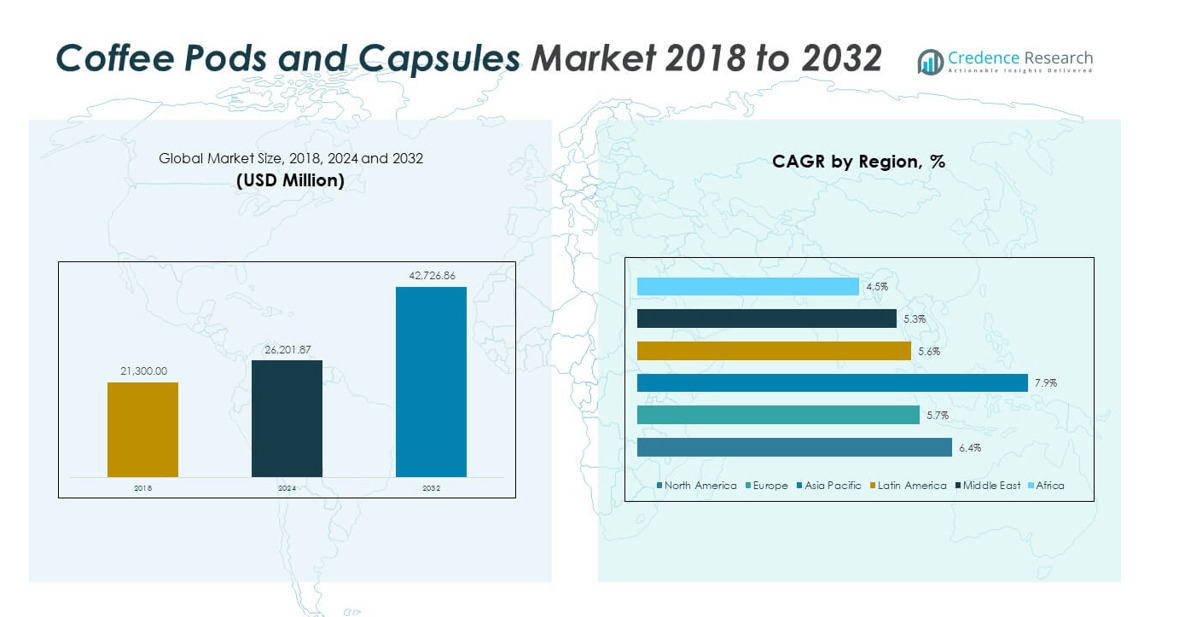
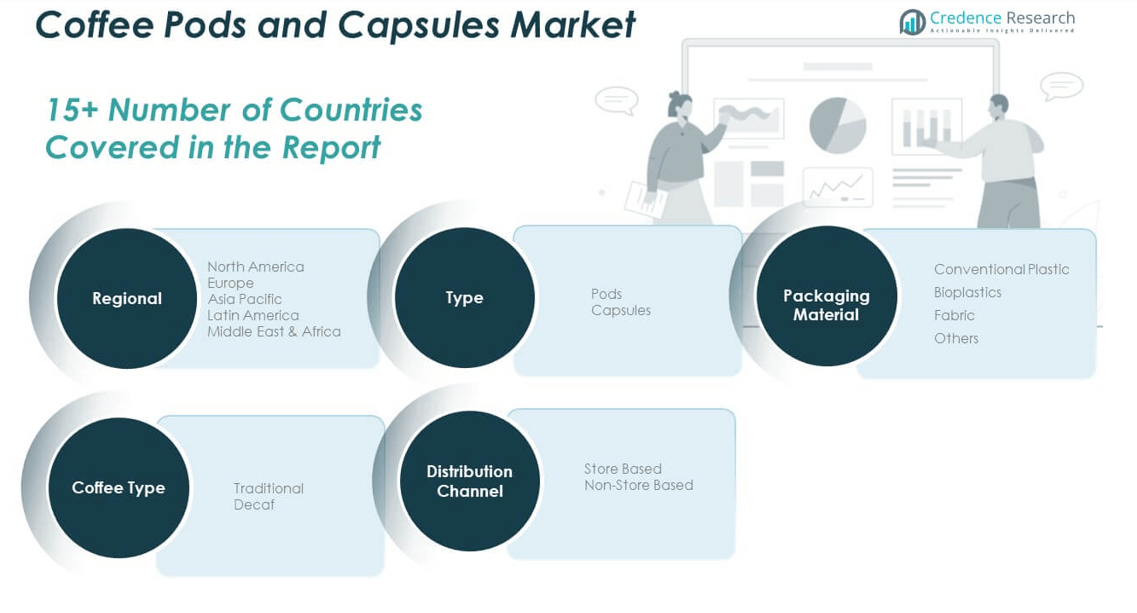
The Global Coffee Pods Capsules Market size was valued at USD 21,300.00 million in 2018 to USD 26,201.87 million in 2024 and is anticipated to reach USD 42,726.86 million by 2032, at a CAGR of 6.37% during the forecast period.
| REPORT ATTRIBUTE | DETAILS |
|---|---|
| Historical Period | 2020-2023 |
| Base Year | 2024 |
| Forecast Period | 2025-2032 |
| Coffee Pods Capsules Market Size 2024 | USD 26,201.87 million |
| Coffee Pods Capsules Market, CAGR | 6.37% |
| Coffee Pods Capsules Market Size 2032 | USD 42,726.86 million |
The Global Coffee Pods Capsules Market is driven by rising demand for convenience-based coffee solutions, premiumization, and evolving lifestyles. Consumers prefer single-serve systems that deliver consistency, speed, and high-quality taste. Growing café culture and the influence of younger demographics increase at-home consumption of premium capsules. Sustainability also plays a central role, with demand for recyclable and compostable packaging shaping product innovation. Strong retail presence, machine compatibility, and expanding e-commerce access further strengthen global adoption across diverse consumer groups.
Geographically, North America leads due to strong machine penetration and advanced retail networks, while Europe follows closely with its premium coffee culture and sustainable product adoption. Asia Pacific is emerging as a high-growth region, supported by rising disposable incomes and expanding café influence in urban centers. Latin America benefits from its strong coffee heritage, while the Middle East and Africa present long-term growth opportunities driven by increasing urbanization and modern retail expansion. Each region contributes uniquely, shaping a dynamic and competitive global landscape.
Market Insights:
- The Global Coffee Pods Capsules Market was valued at USD 21,300.00 million in 2018, reached USD 26,201.87 million in 2024, and is projected to hit USD 42,726.9 million by 2032, expanding at a CAGR of 6.37%.
- North America held 44% of the market in 2024, followed by Europe at 36% and Japan at 8%. Their dominance is supported by strong machine penetration, established coffee culture, and advanced retail infrastructure.
- Asia Pacific is the fastest-growing region, supported by urbanization, rising disposable income, and rapid café culture adoption, with Japan acting as a key growth anchor.
- Capsules accounted for the largest share in 2024, capturing around 62% of the market due to strong consumer preference for premium and machine-compatible products.
- Pods represented about 38% of the 2024 share, sustained by affordability, eco-friendly options, and wider retail accessibility in traditional coffee markets.
Market Drivers:
Rising Consumer Preference for Convenience-Oriented Coffee Consumption:
The Global Coffee Pods Capsules Market is fueled by the rising preference for convenient coffee solutions. Consumers increasingly favor single-serve systems that save time and deliver consistent taste. Urban households lead this adoption trend, supported by busy lifestyles and higher disposable income. Premium coffee culture adds momentum as buyers demand café-quality experiences at home. It benefits from compatibility with a wide range of machines and growing affordability of pod systems. Millennials and Gen Z drive consumption through demand for personalized flavors. Supermarkets, hypermarkets, and e-commerce strengthen access to diverse capsule varieties. Growing brand awareness across both developed and emerging regions accelerates the shift from traditional coffee formats.
- For instance, Nespresso's full-year sales were CHF 6.4 billion in 2024, with growth primarily driven by its Vertuo system in North America, demonstrating the strong consumer preference for premium, convenient coffee systems.
Strong Penetration of Branded Coffee Systems and Appliances:
Adoption of branded systems significantly supports growth across global markets. Established players collaborate with machine manufacturers to ensure compatibility and lock-in consumer loyalty. It creates steady repeat purchases of pods and capsules, ensuring long-term revenue streams. Premiumization strategies attract consumers willing to pay more for specialty blends and single-origin options. Expansion of machine affordability encourages adoption beyond urban elites. Promotional campaigns and bundled offers create brand stickiness in competitive markets. Retail presence enhances brand visibility and boosts impulse purchases. Coffee culture deeply rooted in regions such as Europe and North America amplifies this demand cycle.
- For instance, Keurig Dr Pepper (KDP) recorded $15.35 billion in total net sales for 2024. While K-Cup pod volume remained flat in 2024, the company saw sales growth in other beverage segments and continues to hold a strong market position for its coffee systems in North America. The company is also innovating, introducing new brewers and compostable pods.
Expanding Influence of Specialty Coffee and Premiumization Trends:
Specialty coffee formats have emerged as a major growth driver across international markets. Consumers increasingly seek artisanal blends, unique flavors, and single-origin capsules. The Global Coffee Pods Capsules Market benefits from premiumization trends supported by strong marketing strategies. Rising café culture inspires consumers to replicate experiences at home through capsules. It pushes global players to diversify offerings and highlight quality sourcing. Demand for organic, fair-trade, and ethically sourced coffee further reinforces premium adoption. Younger demographics, highly experimental in taste, drive innovation-led growth. Expansion of subscription services ensures continuous product availability and loyalty among premium buyers.
Growing E-Commerce Adoption and Direct-to-Consumer Models:
E-commerce and direct-to-consumer platforms are vital in shaping modern distribution. Online stores offer convenience, wide variety, and quick delivery. The Global Coffee Pods Capsules Market leverages these channels to expand beyond traditional retail. It allows smaller brands to compete alongside established players with innovative offerings. Subscription-based services enhance consumer stickiness through personalized options and cost benefits. Digital platforms strengthen brand-consumer interaction through loyalty programs and targeted campaigns. Growth in online grocery adoption during recent years reinforces this shift. Expanding internet penetration in emerging markets ensures future scalability of these digital-driven strategies.
Market Trends:
Sustainability and Innovation in Compostable and Bioplastic Packaging:
Sustainability is reshaping product design and packaging strategies across global markets. Consumers demand eco-friendly solutions as awareness of plastic waste intensifies. The Global Coffee Pods Capsules Market responds with bioplastics, compostable materials, and recyclable packaging. It pushes manufacturers to invest heavily in R&D for greener alternatives. Brands highlight sustainability credentials to attract eco-conscious buyers. Partnerships with recycling firms enhance the value chain and improve collection models. Adoption of regulations in Europe further accelerates sustainable innovation. These practices strengthen brand positioning and meet rising compliance requirements.
- For instance, in 2025, Starbucks collaborated with partners in Europe to launch a new, widely recyclable and home compostable takeaway cup. These initiatives contribute to the overall expansion of the global compostable coffee capsule market, which was valued at $915.2 million in 2025 and is driven by the development of innovative, bio-based materials.
Digital Integration and Smart Coffee Machine Connectivity:
Integration of smart technology with coffee machines is shaping consumer experiences. Consumers increasingly adopt IoT-enabled devices for customized brewing. The Global Coffee Pods Capsules Market benefits from these technological advancements. It enables precision brewing, remote control, and app-based personalization. Leading players leverage technology partnerships to build consumer loyalty. Smart capsules with QR codes enhance traceability and consumer education. Connectivity features improve convenience and strengthen premium positioning. Growing demand for smart homes amplifies adoption of advanced coffee solutions.
- For instance, Nestlé’s Nescafé Fusion system, launched in over 75 markets by early 2025, features app-based control allowing users to personalize brew temperature and volume remotely, enhancing convenience and loyalty.
Expansion of Flavored and Functional Coffee Capsules in Retail Channels:
Demand for flavored and functional capsules continues to expand globally. Consumers show interest in flavors such as caramel, vanilla, and hazelnut. The Global Coffee Pods Capsules Market also sees rising demand for functional options with added health benefits. It encourages innovation in caffeine-free, vitamin-infused, and wellness-oriented capsules. Supermarkets and specialty stores dedicate shelves to diverse capsule offerings. Online platforms enhance visibility for niche flavors and experimental products. Functional beverages align with the broader trend of health-conscious consumption. Retail availability ensures wider consumer engagement and trial opportunities.
Rising Influence of Private Label Brands Across Retail Segments:
Private label brands are securing stronger positions in competitive markets. Retailers launch in-house pod and capsule ranges to capture value-driven consumers. The Global Coffee Pods Capsules Market accommodates this shift with expanded offerings. It challenges established players by competing on pricing and accessibility. Consumers recognize improved quality of private label products, driving adoption. Growth of discount stores strengthens this competitive segment. Private labels also experiment with eco-friendly packaging to differentiate further. Expansion of private labels reshapes market dynamics and intensifies competition globally.
Market Challenges Analysis:
High Environmental Impact of Traditional Packaging and Waste Concerns:
Environmental sustainability remains a pressing challenge for global manufacturers. Traditional plastic-based pods contribute heavily to waste streams. The Global Coffee Pods Capsules Market faces scrutiny from regulators and consumers demanding greener solutions. It forces companies to accelerate the adoption of compostable or recyclable alternatives. Cost of sustainable packaging increases production expenses and impacts profit margins. Consumer resistance to higher pricing remains a barrier in some regions. Regulatory bodies in Europe and North America push for stricter compliance measures. Global players must balance innovation with affordability to address this sustainability challenge.
Intense Market Competition and High Dependence on Supply Chains:
Competition among global and regional players is intensifying rapidly. Leading brands face pressure from private labels offering lower-cost alternatives. The Global Coffee Pods Capsules Market experiences margin pressures in both developed and emerging economies. It also remains vulnerable to fluctuations in coffee bean supply and pricing. Global supply chain disruptions affect raw material availability and delivery timelines. Volatile commodity markets increase risks for consistent production costs. Smaller firms often struggle to compete with established distribution networks. Sustained innovation and differentiation are required to maintain competitive advantage in this evolving landscape.
Market Opportunities:
Growing Penetration in Emerging Economies with Rising Middle-Class Income:
Emerging economies represent a strong growth frontier for global expansion. Rising disposable income and changing lifestyles create fertile ground for adoption. The Global Coffee Pods Capsules Market benefits from increased urbanization and café culture. It strengthens opportunities for international players to introduce affordable capsule systems. Younger demographics show greater interest in modern coffee formats. Online retail platforms bridge accessibility gaps and expand consumer reach. Local partnerships help adapt offerings to regional taste preferences. This expansion secures long-term demand growth in untapped geographies.
Product Diversification through Health-Oriented and Specialty Capsules:
Health-conscious consumers create opportunities for diversification. Capsules enriched with functional ingredients or wellness benefits gain traction. The Global Coffee Pods Capsules Market embraces innovation in decaf, organic, and fortified options. It allows players to expand portfolios and appeal to niche segments. Specialty capsules that highlight single-origin or artisanal blends enhance brand premiumization. Collaborations with specialty roasters improve authenticity and variety. Growing demand for cleaner labels supports this product innovation. Such diversification ensures continued consumer engagement and loyalty.
Market Segmentation Analysis:
By Type
The Global Coffee Pods Capsules Market is divided into pods and capsules. Pods maintain appeal due to affordability and ease of disposal, while capsules dominate premium consumption, supported by compatibility with branded machines and strong adoption in urban households.
- For instance, Nespresso reported sales of 3.096 billion CHF for the first half of 2024, continuing its sales growth driven by the Vertuo system.
By Packaging Material
Conventional plastic continues to account for the largest share, driven by its wide availability and cost efficiency. Bioplastics are gaining momentum with rising sustainability awareness and regulatory pressure. Fabric-based pods target eco-conscious consumers, while other innovative materials offer niche opportunities for premium packaging solutions.
- For instance, Keurig has introduced compostable, plant-based K-Rounds pods in select markets in 2025, alongside its new Alta brewing system, aligning with regulatory trends and consumer demand for eco-friendly options. These new pods are not compatible with older Keurig machines, which will continue to use the original K-Cup pods.
By Coffee Type
Traditional coffee remains the leading segment, fueled by consumer preference for familiar taste profiles and daily consumption. Decaf is expanding steadily, supported by health-conscious buyers seeking reduced caffeine intake without compromising flavor. It is expected to strengthen its presence in both retail and specialty outlets.
By Distribution Channel
Store-based retail holds dominance, supported by supermarkets, hypermarkets, and specialty outlets that ensure consumer accessibility. Non-store-based channels, particularly e-commerce platforms, are growing rapidly. It benefits from convenience, wider product assortment, and direct-to-consumer strategies adopted by leading coffee brands.
Segmentation:
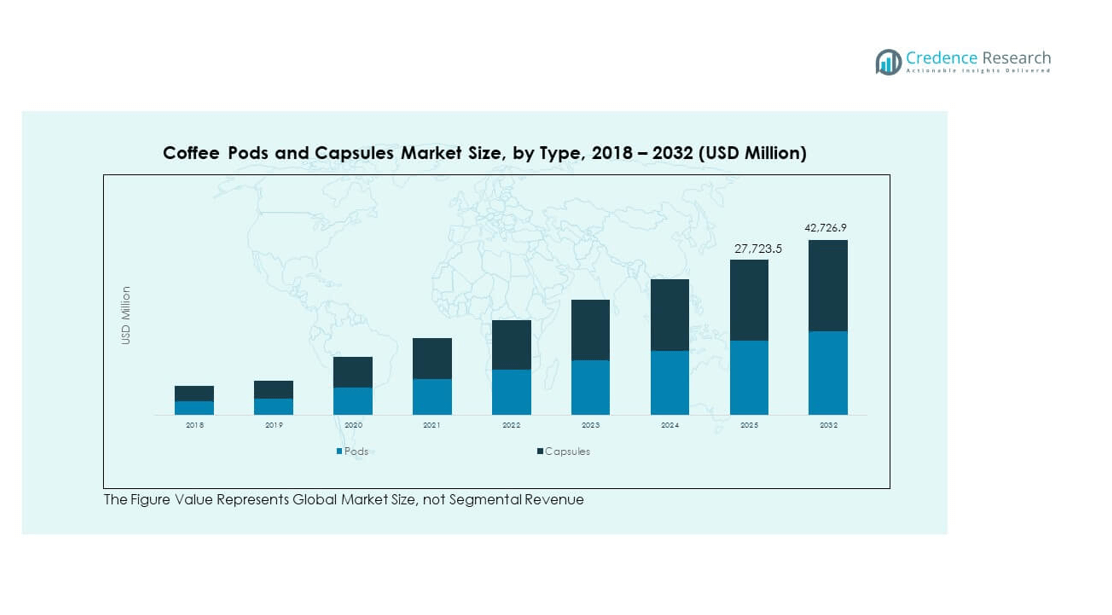
By Type
- Pods
- Capsules
By Packaging Material
- Conventional Plastic
- Bioplastics
- Fabric
- Others
By Coffee Type
- Traditional
- Decaf
By Distribution Channel
- Store Based
- Non-Store Based
By Region
- North America (U.S., Canada, Mexico)
- Europe (UK, France, Germany, Italy, Spain, Russia, Rest of Europe)
- Asia Pacific (China, Japan, South Korea, India, Australia, Southeast Asia, Rest of Asia Pacific)
- Latin America (Brazil, Argentina, Rest of Latin America)
- Middle East (GCC Countries, Israel, Turkey, Rest of Middle East)
- Africa (South Africa, Egypt, Rest of Africa)
Regional Analysis:
North America
The North America Coffee Pods Capsules Market size was valued at USD 7,540.20 million in 2018 to USD 9,160.02 million in 2024 and is anticipated to reach USD 14,916.02 million by 2032, at a CAGR of 6.28% during the forecast period. North America accounts for the largest share of the Global Coffee Pods Capsules Market with 44% in 2024. Strong consumer preference for convenience and premium coffee formats drives steady adoption across households. The U.S. dominates regional demand, supported by high penetration of single-serve machines and branded retail presence. Canada and Mexico add momentum with rising middle-class coffee culture and expansion of specialty outlets. It benefits from established distribution through supermarkets and online platforms, ensuring accessibility. Sustainability trends push adoption of recyclable and compostable capsules, encouraging innovation among key players. Growth is also reinforced by partnerships between coffee brands and appliance manufacturers. Regional players and global leaders continue to invest in product variety and eco-friendly solutions to capture evolving consumer expectations.
Europe
The Europe Coffee Pods Capsules Market size was valued at USD 6,296.28 million in 2018 to USD 7,477.30 million in 2024 and is anticipated to reach USD 11,594.05 million by 2032, at a CAGR of 5.64% during the forecast period. Europe holds 36% of the global share in 2024, led by strong cultural alignment with premium coffee consumption. Western Europe, particularly Germany, France, Italy, and the UK, drives significant adoption with established coffee traditions. Growing preference for sustainability has accelerated the shift toward bioplastics and compostable packaging. It benefits from regulatory frameworks supporting green packaging solutions, pushing innovation across the value chain. Capsules dominate the market, aligning with demand for consistent taste and variety. E-commerce and specialty stores provide strong growth channels, supported by consumer willingness to experiment with premium flavors. Regional brands maintain leadership, while international players expand aggressively through acquisitions and product diversification. This balance of tradition and innovation ensures Europe’s steady role in global growth.
Asia Pacific
The Asia Pacific Coffee Pods Capsules Market size was valued at USD 627.39 million in 2018 to USD 1,685.34 million in 2024 and is anticipated to reach USD 2,653.91 million by 2032, at a CAGR of 5.84% during the forecast period. Asia Pacific accounts for 8% of the global market in 2024, but it is emerging as a dynamic growth hub. Japan remains the key driver, supported by strong retail networks and consumer readiness for convenience-based formats. China and South Korea are expanding rapidly, with increasing urban coffee culture and rising adoption of single-serve machines. It benefits from younger consumers seeking modern formats and premiumization. India and Southeast Asia are showing potential with rising disposable income and exposure to global coffee brands. E-commerce channels are critical in expanding access to pods and capsules, supported by direct-to-consumer models. Sustainability adoption is still developing, but demand for recyclable options is growing. Regional players collaborate with international brands to address diverse consumer needs and ensure competitive growth.
Key Player Analysis:
- Keurig Dr Pepper Inc. (United States)
- JDE Peet's N.V. (Netherlands)
- Starbucks Corporation (United States)
- Luigi Lavazza S.p.A. (Italy)
- Illycaffe S.p.A. (Italy)
- The Kraft Heinz Company (United States)
- The J.M. Smucker Company (United States)
- Tata Consumer Products Limited (India)
- Melitta Group Management GmbH & Co. KG (Germany)
- Strauss Group Ltd. (Israel)
- UCC Ueshima Coffee Co., Ltd. (Japan)
- Dualit Limited (United Kingdom)
- Caffitaly System S.p.A. (Italy)
- Bestpresso Inc. (United States)
- Gourmesso (Coffee Capsules Inc.) (United States)
- Gloria Jean's Coffees (Australia)
- Mother Parkers Tea & Coffee Inc. (Canada)
- Segafredo Zanetti (Massimo Zanetti Beverage Group) (Italy)
- Mayora Indah Tbk (Indonesia)
- Coffeeza India Private Limited (India)
Competitive Analysis:
The Global Coffee Pods Capsules Market is highly competitive, with international brands, private labels, and regional players actively expanding portfolios. Leading companies emphasize product innovation, premiumization, and sustainability to differentiate offerings. It is shaped by strategic collaborations between coffee producers and appliance manufacturers, ensuring ecosystem loyalty and repeat demand. Private labels strengthen their foothold by focusing on affordability and expanding through retail chains. Sustainability commitments and investment in bioplastics packaging add competitive pressure across established firms. E-commerce accelerates competition by providing visibility to niche brands. Geographic diversification remains a key strategy, with leaders targeting high-growth emerging markets. Competitive intensity is expected to increase further with rapid innovation and shifting consumer preferences.
Recent Developments:
- In Keurig Dr Pepper Inc.'s recent developments, the company unveiled its bold new 2025 flavor lineup in the United States in February 2025, featuring new varieties such as Dr Pepper Blackberry, 7UP Tropical with mango and peach flavors, and Snapple Peach Tea & Lemonade, building on the viral success of Dr Pepper Creamy Coconut from 2024.
- In 2025, JDE Peet's outlined a strategic new direction for Peet’s Coffee in the U.S., focusing on omni-channel growth, franchising, and expanding retail distribution channels. This initiative aims to grow Peet’s into a $2.5 billion brand beyond its California stronghold under CEO Rafa Oliveira’s leadership.
- Starbucks Corporation launched new menu items in May 2025, introducing the Iced Horchata Oatmilk Shaken Espresso nationwide along with the return of Summer Berry Refreshers and a Strawberries & Cream Cake Pop, signaling their commitment to innovate seasonal offerings and capture consumer interest in warmer months
Report Coverage:
The research report offers an in-depth analysis based on By Type and By Packaging Material. It details leading market players, providing an overview of their business, product offerings, investments, revenue streams, and key applications. Additionally, the report includes insights into the competitive environment, SWOT analysis, current market trends, as well as the primary drivers and constraints. Furthermore, it discusses various factors that have driven market expansion in recent years. The report also explores market dynamics, regulatory scenarios, and technological advancements that are shaping the industry. It assesses the impact of external factors and global economic changes on market growth. Lastly, it provides strategic recommendations for new entrants and established companies to navigate the complexities of the market.
Future Outlook:
- Rising demand for sustainable and compostable packaging solutions will shape product innovation.
- Premiumization trends will expand, with growing interest in artisanal and single-origin capsules.
- E-commerce platforms and subscription services will strengthen direct-to-consumer reach.
- Private label brands will increase competitive pressure through affordability and wider retail access.
- Smart machine integration and IoT features will enhance consumer personalization.
- Flavored and functional capsules will gain momentum among health-conscious buyers.
- Emerging economies will drive new adoption through rising middle-class income and urbanization.
- Strategic partnerships between coffee brands and appliance makers will reinforce ecosystem lock-in.
- Supply chain resilience and sustainable sourcing will remain critical for long-term growth.
- Innovation in recyclable materials will become a central competitive differentiator.

Request a Free Sample
Fill in your details and we'll send you a free sample report.
- Sample data tables & charts
- Research methodology
Market Dynamics
Convenience-Oriented Coffee Consumption
Consumers increasingly prefer single-serve coffee pods and capsules for their speed, consistency, and ease of use, especially in urban households with busy lifestyles. This shift is further supported by higher disposable incomes and the desire to replicate café-quality experiences at home.
Premiumization and Specialty Coffee Trends
Demand for premium, artisanal, and single-origin coffee capsules is rising as consumers seek higher quality and unique flavors. This trend is driven by younger demographics and the influence of global café culture, pushing brands to innovate and diversify their offerings.
Sustainability and Eco-Friendly Packaging
Growing environmental awareness and regulatory pressure are driving manufacturers to develop recyclable, compostable, and bioplastic packaging for pods and capsules. Brands that invest in sustainable solutions are attracting eco-conscious consumers and gaining competitive advantage.
Expansion of E-Commerce and Direct-to-Consumer Channels
Online platforms and subscription services are making it easier for consumers to access a wide variety of coffee pods and capsules, supporting market growth beyond traditional retail. This digital shift also enables smaller brands to compete and reach new customer segments.
Strong Penetration of Branded Coffee Systems
Collaborations between coffee brands and appliance manufacturers ensure machine compatibility and foster consumer loyalty, resulting in repeat purchases of branded pods and capsules. This ecosystem approach strengthens market growth and encourages ongoing product innovation.
Need a Custom Version of This Report?
Tailor the scope, geography, or segments to your exact requirements.
- Custom geography or segment scope
- Direct access to our analyst team
Frequently Asked Questions
What is the current market size for Global Coffee Pods Capsules Market, and what is its projected size in 2032?
At what Compound Annual Growth Rate is the Global Coffee Pods Capsules Market projected to grow between 2025 and 2032?
Which Global Coffee Pods Capsules Market segment held the largest share in 2024?
What are the primary factors fueling the growth of the Global Coffee Pods Capsules Market?
Who are the leading companies in the Global Coffee Pods Capsules Market?
Table of Content
Chapter 1 Market Segmentation
- 1.1 Segmentation Framework
- 1.1.1 Product and Service Classification
- 1.1.2 Application and End-Use Classification
- 1.1.3 Technology and Solution Classification
- 1.1.4 Customer and Distribution Channel Classification
- 1.1.5 Geographic Segmentation
- 1.1.6 Market Segment Definitions and Boundaries
- 1.2 By Type
- 1.2.1 Pods
- 1.2.2 Capsules
- 1.3 By Coffee Type
- 1.3.1 Traditional
- 1.3.2 Decaf
- 1.4 By Packaging Material
- 1.4.1 Conventional Plastic
- 1.4.2 Bioplastics
- 1.4.3 Fabric
- 1.4.4 Others
Chapter 2 Introduction
- 2.1 Report Objectives and Scope
- 2.2 Product Definition and Industry Terminology
- 2.3 Market Inclusions and Exclusions
- 2.4 Research Process
- 2.4.1 Primary Research and Expert Interviews
- 2.4.2 Secondary Research and Source Review
- 2.4.3 Top-Down and Bottom-Up Estimation
- 2.4.4 Data Triangulation and Verification
- 2.5 Market Size Measurement Basis
- 2.5.1 2018: USD 21,300.00 million → 2032: USD 42,726.86 million
- 2.6 Historical and Forecast Reference Periods
- 2.6.1 Base Year: 2018
- 2.6.2 Forecast Period: 2018-2032
- 2.7 Research Assumptions and Limitations
Chapter 3 Executive Summary
- 3.1 Market Snapshot and Key Findings
- 3.2 Base-Year Market Size, 2018
- 3.3 Forecast Market Size, 2032
- 3.4 Revenue and Volume Growth Outlook
- 3.5 Key Demand and Supply Indicators
- 3.6 Leading Market Segments
- 3.7 Fastest-Growing Market Opportunities
- 3.8 Regional Performance Highlights
- 3.9 Technology and Industry Transformation
- 3.10 Competitive Landscape Summary
- 3.11 Analyst View and Strategic Implications
Chapter 4 Global Coffee Pods Capsules Market Trends and Developments
- 4.1 Historical Industry Development
- 4.2 Recent Market Trends and Developments
- 4.3 Demand and Customer Behavior Trends
- 4.4 Technology and Product Innovation
- 4.5 Artificial Intelligence, Automation and Digitalization
- 4.6 Local Manufacturing and Supply Chain Realignment
- 4.7 Industry Partnerships, Mergers and Acquisitions
- 4.8 Sustainability and Circular Economy Developments
- 4.9 Government and Private Sector Investment Trends
- 4.10 Emerging Business Models and Commercialization
- 4.11 Industry Developments and Announcements
Chapter 5 Global Coffee Pods Capsules Market Production, Supply and Demand Analysis
- 5.1 Demand Trend and Consumption Analysis
- 5.2 Demand Forecast, 2018-2032
- 5.3 Production and Output Trend
- 5.4 Production and Output Forecast, 2018-2032
- 5.5 Installed Capacity and Capacity Utilization
- 5.6 Company-Wise Production Plants and Statistics
- 5.6.1 Installed Production Capacity
- 5.6.2 Actual Production
- 5.6.3 Planned Capacity and Expansion Targets
- 5.7 Supply Chain Structure and Procurement Trends
- 5.8 Supply-Demand Gap and Bottlenecks
- 5.9 Import Dependence and Sourcing Structure
- 5.10 Contract Manufacturing and Outsourcing
- 5.11 Regional Supply and Demand Concentration
Chapter 6 Global Coffee Pods Capsules Market Pricing Analysis
- 6.1 Pricing Structure and Measurement
- 6.2 Historical Pricing Trends
- 6.3 Pricing Outlook, 2018-2032
- 6.4 Average Selling Price and Unit Economics
- 6.5 Pricing by Product and Market Segment
- 6.6 Geographic Pricing Differences
- 6.7 Key Input, Energy, Labor and Logistics Costs
- 6.8 Contract Pricing and Purchasing Models
- 6.9 Pricing Sensitivity and Competitive Positioning
- 6.10 Price, Margin and Profitability Implications
Chapter 7 Global Coffee Pods Capsules Market Dynamics
- 7.1 Market Growth Drivers
- 7.1.1 Demand-Side Drivers
- 7.1.2 Technology and Innovation Drivers
- 7.1.3 Infrastructure and Investment Drivers
- 7.1.4 Regulatory and Policy Drivers
- 7.2 Market Restraints
- 7.2.1 Cost and Affordability Constraints
- 7.2.2 Technology and Adoption Barriers
- 7.2.3 Supply Chain and Operational Constraints
- 7.3 Market Challenges
- 7.3.1 Competitive Pressure and Margin Erosion
- 7.3.2 Skills, Infrastructure and Implementation Gaps
- 7.4 Emerging Market Opportunities
- 7.5 Market Dynamics Impact and Time-Horizon Assessment
Chapter 8 Global Coffee Pods Capsules Value Chain Analysis
- 8.1 Industry Value Chain Overview
- 8.2 Upstream Suppliers and Critical Inputs
- 8.3 Technology and Component Providers
- 8.4 Manufacturing or Service Delivery
- 8.5 Distribution, Channel Partners and Integrators
- 8.6 Downstream Applications and End Users
- 8.7 Value Addition and Profit Pools
- 8.8 Vertical Integration and Outsourcing
- 8.9 Supplier Concentration and Risk
- 8.10 Supply Chain Localization and Resilience
Chapter 9 Global Coffee Pods Capsules Market Regulations and Policies
- 9.1 Relevant Laws, Standards and Compliance Frameworks
- 9.2 Product, Service, Safety and Quality Requirements
- 9.3 Government Policies, Incentives and Subsidies
- 9.4 Imports, Exports and Trade Barriers
- 9.5 Public Procurement and Local Content Requirements
- 9.6 Environmental and Sustainability Compliance
- 9.7 Upcoming Policy Changes and Market Implications
Chapter 10 Global Coffee Pods Capsules Market Hotspots and Opportunities
- 10.1 Market Opportunity Mapping and Growth Hotspots
- 10.2 High-Growth Applications and Customer Groups
- 10.3 Underserved Markets and White-Space Opportunities
- 10.4 Emerging Technology and Product Opportunities
- 10.5 New Capacity and Investment Hotspots
- 10.6 Market Entry and Expansion Opportunities
- 10.7 Distribution and Partnership Opportunities
- 10.8 Near-Term and Long-Term Commercial Potential
- 10.9 Opportunity Attractiveness and Execution Risks
Chapter 11 Global Coffee Pods Capsules Market Outlook, 2018-2032
- 11.1 Market Size and Analysis
- 11.1.1 Revenue (Market Measurement: 2018: USD 21,300.00 million → 2032: USD 42,726.86 million)
- 11.1.2 Market Volume and Quantity Sold
- 11.1.3 Historical Market Size
- 11.1.4 Base-Year Market Size, 2018
- 11.2 Market Forecast, 2018-2032
- 11.2.1 Revenue Forecast to 2032
- 11.2.2 Volume Forecast to 2032
- 11.2.3 CAGR and Year-on-Year Growth
- 11.2.4 Incremental Revenue Opportunity
- 11.3 Forecast Assumptions and Scenario Analysis
- 11.3.1 Base-Case Forecast
- 11.3.2 Optimistic and Conservative Scenarios
- 11.3.3 Technology, Pricing and Policy Sensitivities
- 11.4 Market Attractiveness and Growth Outlook
Chapter 12 Global Coffee Pods Capsules Market Segmentation and Outlook
- 12.1 Segmentation Summary and Market Shares, 2018
- 12.2 Largest and Fastest-Growing Segments
- 12.3 By Type - Market Size and Forecast, 2018-2032
- 12.3.1 Segment Definition and Scope
- 12.3.2 Historical Market Size
- 12.3.3 Revenue Forecast, 2018-2032
- 12.3.4 Volume Forecast, 2018-2032
- 12.3.5 Base-Year Market Share, 2018
- 12.3.6 Segment CAGR and Growth Drivers
- 12.3.7 Subsegment Market Size and Forecast
- 12.3.7.1 Pods
- 12.3.7.2 Capsules
- 12.3.8 Subsegment Pricing and Adoption Trends
- 12.3.9 Leading Suppliers and Competition
- 12.3.10 Regional Demand and Opportunities
- 12.4 By Coffee Type - Market Size and Forecast, 2018-2032
- 12.4.1 Segment Definition and Scope
- 12.4.2 Historical Market Size
- 12.4.3 Revenue Forecast, 2018-2032
- 12.4.4 Volume Forecast, 2018-2032
- 12.4.5 Base-Year Market Share, 2018
- 12.4.6 Segment CAGR and Growth Drivers
- 12.4.7 Subsegment Market Size and Forecast
- 12.4.7.1 Traditional
- 12.4.7.2 Decaf
- 12.4.8 Subsegment Pricing and Adoption Trends
- 12.4.9 Leading Suppliers and Competition
- 12.4.10 Regional Demand and Opportunities
- 12.5 By Packaging Material - Market Size and Forecast, 2018-2032
- 12.5.1 Segment Definition and Scope
- 12.5.2 Historical Market Size
- 12.5.3 Revenue Forecast, 2018-2032
- 12.5.4 Volume Forecast, 2018-2032
- 12.5.5 Base-Year Market Share, 2018
- 12.5.6 Segment CAGR and Growth Drivers
- 12.5.7 Subsegment Market Size and Forecast
- 12.5.7.1 Conventional Plastic
- 12.5.7.2 Bioplastics
- 12.5.7.3 Fabric
- 12.5.7.4 Others
- 12.5.8 Subsegment Pricing and Adoption Trends
- 12.5.9 Leading Suppliers and Competition
- 12.5.10 Regional Demand and Opportunities
- 12.6 Segment Growth Comparison
- 12.7 Segment Attractiveness and Priority Matrix
Chapter 13 Global Coffee Pods Capsules Geographic Market Outlook, 2018-2032
- 13.1 Regional Market Size and Share, 2018
- 13.2 Regional Market Forecast, 2018-2032
- 13.3 Regional Pricing, Production and Demand Differences
- 13.4 North America
- 13.4.1 United States
- 13.4.2 Canada
- 13.4.3 Mexico
- 13.5 Europe
- 13.5.1 Germany
- 13.5.2 France
- 13.5.3 Italy
- 13.5.4 United Kingdom
- 13.5.5 Spain
- 13.5.6 Poland
- 13.5.7 Russia
- 13.5.8 Netherlands
- 13.5.9 Belgium
- 13.5.10 Sweden
- 13.5.11 Denmark
- 13.5.12 Norway
- 13.5.13 Rest of Europe
- 13.6 Asia Pacific
- 13.6.1 China
- 13.6.2 India
- 13.6.3 Japan
- 13.6.4 South Korea
- 13.6.5 Thailand
- 13.6.6 Indonesia
- 13.6.7 Vietnam
- 13.6.8 Malaysia
- 13.6.9 Australia
- 13.6.10 Rest of Asia Pacific
- 13.7 Latin America
- 13.7.1 Brazil
- 13.7.2 Argentina
- 13.7.3 Colombia
- 13.7.4 Chile
- 13.7.5 Rest of Latin America
- 13.8 Middle East
- 13.8.1 Saudi Arabia
- 13.8.2 United Arab Emirates
- 13.8.3 Turkey
- 13.8.4 Israel
- 13.8.5 Iran
- 13.8.6 Rest of the Middle East
- 13.9 Africa
- 13.9.1 South Africa
- 13.9.2 Egypt
- 13.9.3 Nigeria
- 13.9.4 Morocco
- 13.9.5 Rest of Africa
- 13.10 Regional Investment, Policy and Supply Chain Differences
- 13.11 Regional Competitive Landscape
- 13.12 Geographic Growth Hotspots
Chapter 14 Global Coffee Pods Capsules Technology, Innovation and Sustainability Outlook
- 14.1 Technology Landscape and Maturity
- 14.2 Product, Process and Service Innovation
- 14.3 AI, Automation and Digital Tools in the Industry
- 14.4 Technology Adoption and Performance Benchmarking
- 14.5 Innovation Pipeline and R&D Investment
- 14.6 Patent and Intellectual Property Trends
- 14.7 Energy Efficiency and Resource Management
- 14.8 Sustainability, Recycling and Circularity
- 14.9 Technology Roadmap, 2018-2032
- 14.10 Risks of Obsolescence and Technology Substitution
Chapter 15 Global Coffee Pods Capsules Market Key Strategic Imperatives
- 15.1 Growth and Market Entry Priorities
- 15.2 High-Return Products and Segments
- 15.3 Pricing, Profitability and Cost Optimization
- 15.4 Technology Investment and Product Differentiation
- 15.5 Supply Chain Localization and Resilience
- 15.6 Distribution and Customer Acquisition
- 15.7 Partnership, Acquisition and Capacity Strategy
- 15.8 Regional Expansion Priorities
- 15.9 Short-, Medium- and Long-Term Actions
Chapter 16 Competition Outlook
- 16.1 Industry Competition Characteristics
- 16.2 Market Structure and Concentration
- 16.3 Market Share and Competitive Positioning, 2018
- 16.4 Company-Wise Revenue and Product Benchmarking
- 16.5 Production and Service Capacity Benchmarking
- 16.6 Technology, Pricing and Differentiation
- 16.7 Regional Footprint and Distribution Strength
- 16.8 Mergers, Acquisitions and Strategic Alliances
- 16.9 New Entrants and Competitive Threats
- 16.10 Porter's Five Forces and Industry Attractiveness
- 16.11 Competitive Outlook, 2018-2032
Chapter 17 Company Profiles
- 17.1 Company Coverage and Selection Criteria
- 17.2 Keurig Dr Pepper Inc.
- 17.2.1 Business Description
- 17.2.2 Company Ownership and Geographic Presence
- 17.2.3 Product and Service Portfolio
- 17.2.4 Manufacturing and Operating Footprint
- 17.2.5 Production Capacity and Expansion Plans
- 17.2.6 Financial Performance and Investment
- 17.2.7 Market Share and Competitive Position
- 17.2.8 Technology and Innovation Capabilities
- 17.2.9 Strategic Alliances or Partnerships
- 17.2.10 Recent Developments
- 17.2.11 Growth Strategy and Outlook
- 17.3 JDE Peet's N.V.
- 17.4 Starbucks Corporation
- 17.5 Luigi Lavazza S.p.A.
- 17.6 Illycaffe S.p.A.
- 17.7 The Kraft Heinz Company
- 17.8 The J.M. Smucker Company
- 17.9 Tata Consumer Products Limited
- 17.10 Melitta Group Management GmbH & Co. KG
- 17.11 UCC Ueshima Coffee Co., Ltd.
- 17.12 Other Relevant Market Participants
Note: Every listed company is profiled on the structure shown under the first company. The company list is preliminary and may change based on research findings, market developments, data availability and client requirements.
Chapter 18 Disclaimer
- 18.1 Research and Forecast Disclaimer
- 18.2 Data Source and Estimation Limitations
Note: The depth of individual sections depends on data availability for this market. Volume, capacity, trade and other unit-based metrics are included where applicable.