
| REPORT ATTRIBUTE | DETAILS |
|---|---|
| Historical Period | 2019-2022 |
| Base Year | 2023 |
| Forecast Period | 2024-2032 |
| Commercial Vegetable Chopper Market Size 2024 | USD 276.74 million |
| Commercial Vegetable Chopper Market , CAGR | 3.9% |
| Commercial Vegetable Chopper Market Size 2032 | USD 375.83 million |
Market Overview
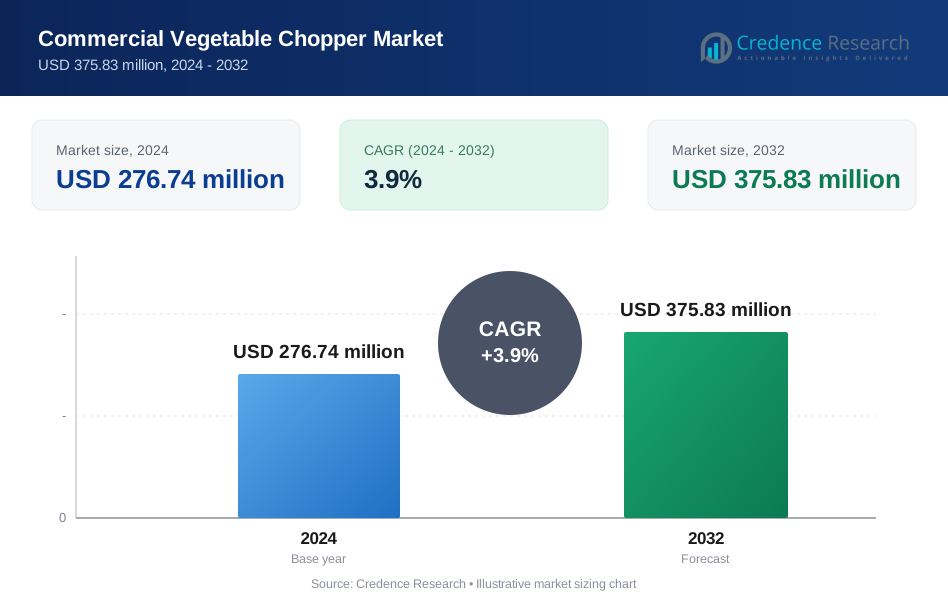
The global commercial vegetable chopper market is projected to grow from USD 276.74 million in 2024 to USD 375.83 million by 2032, reflecting a steady compound annual growth rate (CAGR) of 3.9% during the forecast period.
The commercial vegetable chopper market is driven by the rising demand for efficient and time-saving kitchen equipment in the foodservice and hospitality industries. Increasing urbanization, coupled with the growing prevalence of quick-service restaurants, has fueled the adoption of advanced chopping solutions that enhance productivity and ensure consistency in food preparation. The shift towards healthier eating habits has also encouraged the use of fresh, pre-cut vegetables in commercial kitchens, further boosting market growth. Technological advancements, such as automated and multi-functional vegetable choppers, are transforming food preparation processes by reducing manual labor and minimizing waste. Additionally, the rising awareness of food safety standards is prompting businesses to invest in high-quality choppers designed to maintain hygiene. Emerging trends, including the integration of energy-efficient and easy-to-clean designs, are gaining traction, while the increasing adoption of these solutions in developing markets is expected to create lucrative growth opportunities for the industry.
The geographical analysis of the commercial vegetable chopper market highlights North America as a dominant region, holding approximately 35% market share, driven by the strong presence of the foodservice industry and rapid adoption of advanced kitchen equipment. Asia Pacific is emerging as a key growth region, accounting for about 25% of the market, fueled by the expanding foodservice sector in countries like China and India and increasing urbanization. Other regions, including Europe and Latin America, are also witnessing steady growth due to rising demand for efficient kitchen solutions. Key players in the market include Robot Coupe, The Vollrath Company, Berkshire Hathaway, Brunner Anliker, Eurodip, Jas Enterprise, Omcan, and Tellier. These companies focus on innovation, cost-effective solutions, and strategic partnerships to expand their global footprint and cater to diverse customer needs.
Market Drivers
Rising Demand for Efficiency in Commercial Kitchens
The commercial vegetable chopper market is driven by the increasing need for efficiency and productivity in commercial kitchens. Restaurants, catering businesses, and foodservice operators are constantly seeking ways to enhance operational speed while maintaining quality and consistency in food preparation. For instance, a report by the Bureau of Energy Efficiency (BEE) in India highlighted that energy-efficient kitchen equipment can significantly reduce operational costs and improve productivity in commercial kitchens. Vegetable choppers streamline chopping processes, reducing preparation time and labor costs. As businesses strive to meet high customer expectations and tight delivery timelines, the demand for reliable and efficient chopping equipment continues to grow.
Growing Adoption in the Foodservice Industry
The expanding foodservice industry is a significant driver for the commercial vegetable chopper market. The surge in quick-service restaurants, cloud kitchens, and catering services has elevated the demand for high-performance kitchen equipment. For instance, a report by the National Restaurant Association of India (NRAI) indicated that the adoption of advanced kitchen equipment, including vegetable choppers, has improved operational efficiency and food safety standards in the foodservice industry. With the rising popularity of pre-cut vegetables and ready-to-cook meals, vegetable choppers have become essential tools for ensuring uniformity and hygiene in food preparation. The foodservice sector's focus on scalability and cost efficiency has further accelerated the adoption of these products.
Shift Toward Health-Conscious and Convenience-Oriented Consumers
Health-conscious consumers are increasingly opting for fresh and minimally processed food, driving demand for efficient vegetable preparation tools. For instance, a survey by the International Food Information Council (IFIC) found that a significant number of consumers prefer fresh salads and vegetable mixes, leading to increased demand for commercial vegetable choppers in restaurants and cafeterias. Commercial vegetable choppers cater to the growing trend of offering fresh salads, vegetable mixes, and other healthy menu options in restaurants and cafeterias. Moreover, the rising preference for convenience among consumers, coupled with the increasing popularity of meal kits and pre-packaged vegetables, has created a robust demand for high-quality vegetable choppers in commercial settings.
Technological Advancements and Product Innovation
Advancements in technology have led to the development of automated and multi-functional vegetable choppers, further boosting market growth. For instance, a report by the International Journal of Applied Science and Research highlighted the development of foot pedal-operated vegetable choppers, which enhance efficiency and safety in commercial kitchens. Features such as adjustable blade settings, energy-efficient motors, and enhanced safety mechanisms make these products highly desirable for commercial applications. Manufacturers are also focusing on creating durable, easy-to-clean, and eco-friendly designs to cater to evolving consumer preferences and regulatory standards. These innovations are transforming the market, attracting new customers and retaining existing ones.
Market Trends
Integration of Advanced Automation Technologies
The commercial vegetable chopper market is witnessing a growing trend toward automation, as businesses seek to enhance efficiency and reduce reliance on manual labor. Automated vegetable choppers equipped with programmable settings, precise cutting mechanisms, and intelligent control systems are gaining popularity in commercial kitchens. For instance, a report by the Bureau of Energy Efficiency (BEE) in India highlighted that the adoption of energy-efficient kitchen equipment, including automated vegetable choppers, can significantly reduce operational costs and improve productivity in commercial kitchens. These advanced tools offer consistent results while minimizing preparation time, making them a valuable asset in high-volume foodservice operations. The adoption of automation also aligns with the industry's goal of improving operational sustainability by reducing food waste and energy consumption.
Focus on Compact and Multi-Functional Designs
As space optimization becomes a priority in commercial kitchens, compact and multi-functional vegetable choppers are emerging as a preferred choice. These models are designed to handle various tasks, such as slicing, dicing, and shredding, in a single unit, reducing the need for multiple devices. For instance, a report by the National Restaurant Association of India (NRAI) indicated that the adoption of multi-functional kitchen equipment has improved operational efficiency and space utilization in commercial kitchens. Manufacturers are introducing innovative, space-saving designs that cater to smaller kitchens while maintaining high performance. The ability to perform multiple functions in one machine enhances versatility and appeals to cost-conscious businesses.
Rising Demand for Hygienic and Food-Safe Equipment
Hygiene and food safety standards are increasingly influencing purchasing decisions in the commercial vegetable chopper market. Businesses are prioritizing equipment with easy-to-clean designs, non-toxic materials, and components that meet regulatory compliance. For instance, the Food Safety and Standards Authority of India (FSSAI) has implemented guidelines that emphasize the use of hygienic and food-safe equipment in commercial kitchens to prevent contamination and ensure food safety. Stainless steel choppers with detachable parts and dishwasher-safe features are becoming popular for their ability to maintain cleanliness and prevent contamination. This trend reflects the growing emphasis on providing safe and high-quality food to customers.
Expansion in Emerging Markets
The adoption of commercial vegetable choppers is expanding in emerging markets due to the rapid growth of the foodservice industry in these regions. Urbanization increased disposable income, and changing consumer preferences are driving the demand for efficient kitchen equipment. For instance, a report by the Indian Brand Equity Foundation (IBEF) highlighted that the Indian food services sector is expected to grow significantly, driven by factors such as rapid urbanization and increased consumer spending. Additionally, the rise of international cuisine and modern dining experiences in countries like India, Brazil, and Southeast Asia has further fueled market growth, creating new opportunities for manufacturers and distributors.
Market Challenges Analysis
High Initial Costs and Maintenance Expenses
One of the primary challenges in the commercial vegetable chopper market is the high initial investment required for advanced chopping equipment. Small and medium-sized businesses, particularly in developing regions, often face budget constraints that limit their ability to adopt premium models with automated features and durable designs. The high upfront costs can deter potential buyers, especially for operations with lower profit margins. Additionally, the regular maintenance and occasional repairs required to keep these machines functioning efficiently add to the overall operational costs. This challenge is further compounded by the lack of affordable, high-quality options in some markets, creating a gap between demand and accessibility. Lastly, competitive pressure from substitutes such as manual cutting tools or multifunctional kitchen appliances may further limit market expansion, as businesses weigh their options between investing in specialized equipment versus versatile alternatives.
Limited Awareness and Skill Deficiencies in Emerging Markets
The market also faces challenges related to limited awareness and inadequate technical skills among users in emerging markets. Many small-scale foodservice operators remain unaware of the long-term benefits of investing in commercial vegetable choppers, such as increased efficiency, reduced labor costs, and improved food safety standards. Even when such equipment is acquired, improper handling and maintenance due to a lack of training often lead to suboptimal performance and shorter equipment lifespan. Manufacturers and distributors need to address this issue by offering educational initiatives, product demonstrations, and after-sales support to enhance user familiarity and ensure proper utilization of the equipment. Bridging this knowledge gap is critical for fostering adoption and market growth in regions with significant untapped potential. Finally, economic downturns affecting the hospitality sector can exacerbate these challenges, as reduced consumer spending directly impacts restaurant operations and their ability to invest in modern kitchen technologies.
Market Segmentation Analysis:
By Mounting Type The commercial vegetable chopper market is segmented into countertop and wall-mounted units based on mounting type. Countertop choppers dominate the market due to their versatility and ease of use in various commercial kitchen setups. These portable units are widely preferred in foodservice establishments with limited space, as they provide mobility and can be easily stored when not in use. Wall-mounted choppers, while occupying a smaller market share, are gaining traction in high-volume kitchens where space optimization and ergonomic design are crucial. These units are particularly valued for their ability to reduce clutter and enhance workflow efficiency by being securely mounted in accessible locations.
By Technology In terms of technology, the market is segmented into manual and automated vegetable choppers. Manual choppers remain popular among smaller businesses and establishments with budget constraints, offering cost-effective solutions for basic chopping needs. However, automated choppers are witnessing significant growth, driven by the rising demand for efficiency and precision in high-capacity commercial kitchens. These advanced models feature programmable settings, adjustable blade options, and multi-functionality, catering to diverse culinary requirements. Automation reduces manual effort, enhances consistency, and minimizes food wastage, making it a preferred choice for large-scale foodservice operations. Manufacturers are focusing on integrating energy-efficient technologies and user-friendly interfaces to broaden the appeal of automated choppers across various market segments.
Segments:
Based on Mounting Type:
- Wall-mounted Vegetable Chopper
- Countertop Vegetable Chopper
Based on Technology:
- Electric Vegetable Chopper
- Manual Vegetable Chopper
- Other Facilities
Based on the Geography:
- North America
- U.S.
- Canada
- Mexico
- Europe
- Germany
- France
- U.K.
- Italy
- Spain
- Rest of Europe
- Asia Pacific
- China
- Japan
- India
- South Korea
- South-east Asia
- Rest of Asia Pacific
- Latin America
- Brazil
- Argentina
- Rest of Latin America
- Middle East & Africa
- GCC Countries
- South Africa
- Rest of the Middle East and Africa
Regional Analysis
North America
North America holds a significant share of the commercial vegetable chopper market, driven by the strong presence of the foodservice and hospitality industries. With a market share of 35%, the region leads in adopting advanced kitchen equipment to enhance operational efficiency. For instance, North America has witnessed substantial growth in the commercial vegetable chopper market, supported by a thriving foodservice and hospitality sector. The high penetration of quick-service restaurants (QSRs), coupled with the growing demand for ready-to-cook and fresh-cut vegetables, has fueled the adoption of commercial vegetable choppers. Technological advancements, including automation and multi-functional features, are particularly well-received in the United States and Canada, where operational efficiency and consistency are critical. Stringent food safety regulations in these countries encourage businesses to invest in hygienic, easy-to-clean equipment, ensuring compliance with health standards. Moreover, the rising trend of health-conscious dining, which emphasizes the use of fresh vegetables in meals, has further spurred the demand for high-quality vegetable choppers in this region. Meal preparation services and catering businesses have also contributed significantly to market growth as they seek tools that streamline processes and deliver uniform results. The focus on reducing food waste and optimizing labor costs has positioned North America as a hub for innovative commercial kitchen equipment, making it a key driver in the global vegetable chopper market.
Asia Pacific
Asia Pacific is experiencing rapid growth in the commercial vegetable chopper market, accounting for 25% of the global market share. Emerging economies like China and India are at the forefront of this growth due to the expanding foodservice industry and increasing urbanization. For example, the Asia Pacific region is rapidly evolving in the commercial vegetable chopper market, driven by urbanization and changing consumer preferences. The region has seen a sharp rise in the establishment of cloud kitchens, quick-service restaurants, and international dining chains, which rely on efficient food preparation tools to meet high customer demand. The changing lifestyles and dietary preferences of consumers in Asia Pacific, driven by rising disposable incomes, have led to an increased emphasis on fresh and hygienically prepared food. As a result, foodservice operators are adopting advanced chopping equipment to maintain quality and meet customer expectations. Local manufacturers are introducing cost-effective solutions, such as manual and semi-automated choppers, to cater to small and medium-sized enterprises, making these tools more accessible across the region. Although manual choppers currently dominate the market due to affordability, the adoption of automated models is gaining momentum as businesses seek to improve efficiency and reduce dependency on labor. The demand for versatile and durable choppers is growing, with many establishments preferring multi-functional designs that optimize kitchen space. This trend, combined with the ongoing modernization of foodservice operations, positions Asia Pacific as a promising growth region for the commercial vegetable chopper market.
Key Player Analysis
- Brunner Anliker
- Omcan
- Berkshire Hathaway
- Robot Coupe
- Tellier
- Eurodip
- The Vollrath Company
- Jas Enterprise
- Robot Coupe
- The Vollrath Company
Competitive Analysis
The competitive landscape of the commercial vegetable chopper market is characterized by the presence of key players such as Robot Coupe, The Vollrath Company, Berkshire Hathaway, Brunner Anliker, Eurodip, Jas Enterprise, Omcan, and Tellier. These companies compete on factors such as product innovation, quality, and pricing. For instance, Robot Coupe and The Vollrath Company have established strong market positions with advanced automation and multi-functional solutions, catering to diverse commercial needs. A report by the National Restaurant Association of India (NRAI) highlighted that the adoption of automated kitchen equipment, including vegetable choppers, has significantly improved operational efficiency in commercial kitchens. Berkshire Hathaway leverages its extensive distribution network and brand influence to maintain a competitive edge. Meanwhile, Brunner Anliker and Eurodip focus on precision-engineered products and durability, targeting high-performance requirements. Jas Enterprise and Omcan emphasize cost-effective solutions to attract small and medium-sized enterprises, particularly in emerging markets. Tellier, known for its niche offerings, competes by catering to specific culinary applications. Collectively, these players drive innovation and cater to a wide range of customer demands, ensuring sustained market growth.
Recent Developments
- In January 2024, Brunner-Anliker expanded its U.S. market presence by appointing Food Service Solutions, Inc. (FSS USA) as its exclusive distributor. The company aims to leverage FSS USA's extensive network and industry expertise to better serve the American market.
- In July 2024, Omcan announced its expansion of the vegetable cutter product line, building on its seven-decade legacy of serving the North American food service industry. The company has been focusing on delivering quality products specifically designed for commercial food processing needs.
Market Concentration & Characteristics
The commercial vegetable chopper market exhibits a moderately concentrated structure, with a mix of global leaders and regional players competing to cater to diverse customer needs. Established brands such as Robot Coupe, The Vollrath Company, and Berkshire Hathaway dominate the market, leveraging their robust distribution networks, technological advancements, and strong brand recognition. These companies focus on high-performance, automated solutions to meet the demands of large-scale foodservice operations. In contrast, regional and emerging players, including Jas Enterprise and Omcan, target cost-sensitive markets with affordable and efficient solutions, particularly in developing economies. The market is characterized by rapid innovation, driven by advancements in automation, energy efficiency, and multi-functional designs. High product quality, compliance with food safety standards, and ease of maintenance are key differentiators in this competitive landscape. Despite the dominance of major players, opportunities exist for smaller companies to thrive by addressing niche demands and emerging market needs.
Report Coverage
The research report offers an in-depth analysis based on Mounting Type, Technology and Geography. It details leading market players, providing an overview of their business, product offerings, investments, revenue streams, and key applications. Additionally, the report includes insights into the competitive environment, SWOT analysis, current market trends, as well as the primary drivers and constraints. Furthermore, it discusses various factors that have driven market expansion in recent years. The report also explores market dynamics, regulatory scenarios, and technological advancements that are shaping the industry. It assesses the impact of external factors and global economic changes on market growth. Lastly, it provides strategic recommendations for new entrants and established companies to navigate the complexities of the market.
Future Outlook
- The commercial vegetable chopper market is expected to witness steady growth driven by the increasing adoption of automated and multi-functional equipment.
- Rising demand for time-saving and efficient solutions in the foodservice industry will fuel market expansion.
- Emerging economies in Asia Pacific and Latin America are anticipated to offer lucrative growth opportunities due to the rapid growth of quick-service restaurants and cloud kitchens.
- Advancements in technology, such as smart controls and energy-efficient motors, will enhance product appeal and drive innovation.
- The shift toward healthier eating habits and fresh, minimally processed food will sustain demand for high-quality vegetable choppers.
- Manufacturers are likely to focus on compact and portable designs to address space constraints in commercial kitchens.
- Increasing regulatory emphasis on food safety and hygiene will drive the adoption of easy-to-clean and durable equipment.
- The growth of e-commerce platforms will expand market accessibility, particularly for small and medium-sized enterprises.
- Competitive pricing strategies and product customization will play a crucial role in attracting a diverse customer base.
- Collaboration between manufacturers and distributors is expected to strengthen market penetration and global reach.
Request a Free Sample
Fill in your details and we'll send you a free sample report.
- Sample data tables & charts
- Research methodology
Need a Custom Version of This Report?
Tailor the scope, geography, or segments to your exact requirements.
- Custom geography or segment scope
- Direct access to our analyst team
Frequently Asked Questions
What is the current size of the Commercial Vegetable Chopper market?
What factors are driving the growth of the Commercial Vegetable Chopper market?
What are the key segments within the Commercial Vegetable Chopper market?
What are some challenges faced by the Commercial Vegetable Chopper market?
Who are the major players in the Commercial Vegetable Chopper market?
Table of Content
Chapter 1 Market Segmentation
- 1.1 Segmentation Framework
- 1.1.1 Product and Service Classification
- 1.1.2 Application and End-Use Classification
- 1.1.3 Technology and Solution Classification
- 1.1.4 Customer and Distribution Channel Classification
- 1.1.5 Geographic Segmentation
- 1.1.6 Market Segment Definitions and Boundaries
Chapter 2 Introduction
- 2.1 Report Objectives and Scope
- 2.2 Product Definition and Industry Terminology
- 2.3 Market Inclusions and Exclusions
- 2.4 Research Process
- 2.4.1 Primary Research and Expert Interviews
- 2.4.2 Secondary Research and Source Review
- 2.4.3 Top-Down and Bottom-Up Estimation
- 2.4.4 Data Triangulation and Verification
- 2.5 Market Size Measurement Basis
- 2.5.1 2024: USD 276.74 million → 2032: USD 375.83 million
- 2.6 Historical and Forecast Reference Periods
- 2.6.1 Base Year: 2024
- 2.6.2 Forecast Period: 2024-2032
- 2.7 Research Assumptions and Limitations
Chapter 3 Executive Summary
- 3.1 Market Snapshot and Key Findings
- 3.2 Base-Year Market Size, 2024
- 3.3 Forecast Market Size, 2032
- 3.4 Revenue and Volume Growth Outlook
- 3.5 Key Demand and Supply Indicators
- 3.6 Leading Market Segments
- 3.7 Fastest-Growing Market Opportunities
- 3.8 Regional Performance Highlights
- 3.9 Technology and Industry Transformation
- 3.10 Competitive Landscape Summary
- 3.11 Analyst View and Strategic Implications
Chapter 4 Global Commercial Vegetable Chopper Market Trends and Developments
- 4.1 Historical Industry Development
- 4.2 Recent Market Trends and Developments
- 4.3 Demand and Customer Behavior Trends
- 4.4 Technology and Product Innovation
- 4.5 Artificial Intelligence, Automation and Digitalization
- 4.6 Local Manufacturing and Supply Chain Realignment
- 4.7 Industry Partnerships, Mergers and Acquisitions
- 4.8 Sustainability and Circular Economy Developments
- 4.9 Government and Private Sector Investment Trends
- 4.10 Emerging Business Models and Commercialization
- 4.11 Industry Developments and Announcements
Chapter 5 Global Commercial Vegetable Chopper Market Production, Supply and Demand Analysis
- 5.1 Demand Trend and Consumption Analysis
- 5.2 Demand Forecast, 2024-2032
- 5.3 Production and Output Trend
- 5.4 Production and Output Forecast, 2024-2032
- 5.5 Installed Capacity and Capacity Utilization
- 5.6 Company-Wise Production Plants and Statistics
- 5.6.1 Installed Production Capacity
- 5.6.2 Actual Production
- 5.6.3 Planned Capacity and Expansion Targets
- 5.7 Supply Chain Structure and Procurement Trends
- 5.8 Supply-Demand Gap and Bottlenecks
- 5.9 Import Dependence and Sourcing Structure
- 5.10 Contract Manufacturing and Outsourcing
- 5.11 Regional Supply and Demand Concentration
Chapter 6 Global Commercial Vegetable Chopper Market Pricing Analysis
- 6.1 Pricing Structure and Measurement
- 6.2 Historical Pricing Trends
- 6.3 Pricing Outlook, 2024-2032
- 6.4 Average Selling Price and Unit Economics
- 6.5 Pricing by Product and Market Segment
- 6.6 Geographic Pricing Differences
- 6.7 Key Input, Energy, Labor and Logistics Costs
- 6.8 Contract Pricing and Purchasing Models
- 6.9 Pricing Sensitivity and Competitive Positioning
- 6.10 Price, Margin and Profitability Implications
Chapter 7 Global Commercial Vegetable Chopper Market Dynamics
- 7.1 Market Growth Drivers
- 7.1.1 Demand-Side Drivers
- 7.1.2 Technology and Innovation Drivers
- 7.1.3 Infrastructure and Investment Drivers
- 7.1.4 Regulatory and Policy Drivers
- 7.2 Market Restraints
- 7.2.1 Cost and Affordability Constraints
- 7.2.2 Technology and Adoption Barriers
- 7.2.3 Supply Chain and Operational Constraints
- 7.3 Market Challenges
- 7.3.1 Competitive Pressure and Margin Erosion
- 7.3.2 Skills, Infrastructure and Implementation Gaps
- 7.4 Emerging Market Opportunities
- 7.5 Market Dynamics Impact and Time-Horizon Assessment
Chapter 8 Global Commercial Vegetable Chopper Value Chain Analysis
- 8.1 Industry Value Chain Overview
- 8.2 Upstream Suppliers and Critical Inputs
- 8.3 Technology and Component Providers
- 8.4 Manufacturing or Service Delivery
- 8.5 Distribution, Channel Partners and Integrators
- 8.6 Downstream Applications and End Users
- 8.7 Value Addition and Profit Pools
- 8.8 Vertical Integration and Outsourcing
- 8.9 Supplier Concentration and Risk
- 8.10 Supply Chain Localization and Resilience
Chapter 9 Global Commercial Vegetable Chopper Market Regulations and Policies
- 9.1 Relevant Laws, Standards and Compliance Frameworks
- 9.2 Product, Service, Safety and Quality Requirements
- 9.3 Government Policies, Incentives and Subsidies
- 9.4 Imports, Exports and Trade Barriers
- 9.5 Public Procurement and Local Content Requirements
- 9.6 Environmental and Sustainability Compliance
- 9.7 Upcoming Policy Changes and Market Implications
Chapter 10 Global Commercial Vegetable Chopper Market Hotspots and Opportunities
- 10.1 Market Opportunity Mapping and Growth Hotspots
- 10.2 High-Growth Applications and Customer Groups
- 10.3 Underserved Markets and White-Space Opportunities
- 10.4 Emerging Technology and Product Opportunities
- 10.5 New Capacity and Investment Hotspots
- 10.6 Market Entry and Expansion Opportunities
- 10.7 Distribution and Partnership Opportunities
- 10.8 Near-Term and Long-Term Commercial Potential
- 10.9 Opportunity Attractiveness and Execution Risks
Chapter 11 Global Commercial Vegetable Chopper Market Outlook, 2024-2032
- 11.1 Market Size and Analysis
- 11.1.1 Revenue (Market Measurement: 2024: USD 276.74 million → 2032: USD 375.83 million)
- 11.1.2 Market Volume and Quantity Sold
- 11.1.3 Historical Market Size
- 11.1.4 Base-Year Market Size, 2024
- 11.2 Market Forecast, 2024-2032
- 11.2.1 Revenue Forecast to 2032
- 11.2.2 Volume Forecast to 2032
- 11.2.3 CAGR and Year-on-Year Growth
- 11.2.4 Incremental Revenue Opportunity
- 11.3 Forecast Assumptions and Scenario Analysis
- 11.3.1 Base-Case Forecast
- 11.3.2 Optimistic and Conservative Scenarios
- 11.3.3 Technology, Pricing and Policy Sensitivities
- 11.4 Market Attractiveness and Growth Outlook
Chapter 12 Global Commercial Vegetable Chopper Market Segmentation and Outlook
- 12.1 Segmentation Summary and Market Shares, 2024
- 12.2 Largest and Fastest-Growing Segments
- 12.3 Segment Growth Comparison
- 12.4 Segment Attractiveness and Priority Matrix
Chapter 13 Global Commercial Vegetable Chopper Geographic Market Outlook, 2024-2032
- 13.1 Regional Market Size and Share, 2024
- 13.2 Regional Market Forecast, 2024-2032
- 13.3 Regional Pricing, Production and Demand Differences
- 13.4 North America
- 13.4.1 United States
- 13.4.2 Canada
- 13.4.3 Mexico
- 13.5 Europe
- 13.5.1 Germany
- 13.5.2 France
- 13.5.3 Italy
- 13.5.4 United Kingdom
- 13.5.5 Spain
- 13.5.6 Poland
- 13.5.7 Russia
- 13.5.8 Netherlands
- 13.5.9 Belgium
- 13.5.10 Sweden
- 13.5.11 Denmark
- 13.5.12 Norway
- 13.5.13 Rest of Europe
- 13.6 Asia Pacific
- 13.6.1 China
- 13.6.2 India
- 13.6.3 Japan
- 13.6.4 South Korea
- 13.6.5 Thailand
- 13.6.6 Indonesia
- 13.6.7 Vietnam
- 13.6.8 Malaysia
- 13.6.9 Australia
- 13.6.10 Rest of Asia Pacific
- 13.7 Latin America
- 13.7.1 Brazil
- 13.7.2 Argentina
- 13.7.3 Colombia
- 13.7.4 Chile
- 13.7.5 Rest of Latin America
- 13.8 Middle East
- 13.8.1 Saudi Arabia
- 13.8.2 United Arab Emirates
- 13.8.3 Turkey
- 13.8.4 Israel
- 13.8.5 Iran
- 13.8.6 Rest of the Middle East
- 13.9 Africa
- 13.9.1 South Africa
- 13.9.2 Egypt
- 13.9.3 Nigeria
- 13.9.4 Morocco
- 13.9.5 Rest of Africa
- 13.10 Regional Investment, Policy and Supply Chain Differences
- 13.11 Regional Competitive Landscape
- 13.12 Geographic Growth Hotspots
Chapter 14 Global Commercial Vegetable Chopper Technology, Innovation and Sustainability Outlook
- 14.1 Technology Landscape and Maturity
- 14.2 Product, Process and Service Innovation
- 14.3 AI, Automation and Digital Tools in the Industry
- 14.4 Technology Adoption and Performance Benchmarking
- 14.5 Innovation Pipeline and R&D Investment
- 14.6 Patent and Intellectual Property Trends
- 14.7 Energy Efficiency and Resource Management
- 14.8 Sustainability, Recycling and Circularity
- 14.9 Technology Roadmap, 2024-2032
- 14.10 Risks of Obsolescence and Technology Substitution
Chapter 15 Global Commercial Vegetable Chopper Market Key Strategic Imperatives
- 15.1 Growth and Market Entry Priorities
- 15.2 High-Return Products and Segments
- 15.3 Pricing, Profitability and Cost Optimization
- 15.4 Technology Investment and Product Differentiation
- 15.5 Supply Chain Localization and Resilience
- 15.6 Distribution and Customer Acquisition
- 15.7 Partnership, Acquisition and Capacity Strategy
- 15.8 Regional Expansion Priorities
- 15.9 Short-, Medium- and Long-Term Actions
Chapter 16 Competition Outlook
- 16.1 Industry Competition Characteristics
- 16.2 Market Structure and Concentration
- 16.3 Market Share and Competitive Positioning, 2024
- 16.4 Company-Wise Revenue and Product Benchmarking
- 16.5 Production and Service Capacity Benchmarking
- 16.6 Technology, Pricing and Differentiation
- 16.7 Regional Footprint and Distribution Strength
- 16.8 Mergers, Acquisitions and Strategic Alliances
- 16.9 New Entrants and Competitive Threats
- 16.10 Porter's Five Forces and Industry Attractiveness
- 16.11 Competitive Outlook, 2024-2032
Chapter 17 Company Profiles
- 17.1 Company Coverage and Selection Criteria
- 17.2 Leading Market Participants – Standard Profile Structure
- 17.2.1 Business Description
- 17.2.2 Company Ownership and Geographic Presence
- 17.2.3 Product and Service Portfolio
- 17.2.4 Manufacturing and Operating Footprint
- 17.2.5 Production Capacity and Expansion Plans
- 17.2.6 Financial Performance and Investment
- 17.2.7 Market Share and Competitive Position
- 17.2.8 Technology and Innovation Capabilities
- 17.2.9 Strategic Alliances or Partnerships
- 17.2.10 Recent Developments
- 17.2.11 Growth Strategy and Outlook
- 17.3 Other Relevant Market Participants
Note: Every listed company is profiled on the structure shown under the first company. The company list is preliminary and may change based on research findings, market developments, data availability and client requirements.
Chapter 18 Disclaimer
- 18.1 Research and Forecast Disclaimer
- 18.2 Data Source and Estimation Limitations
Note: The depth of individual sections depends on data availability for this market. Volume, capacity, trade and other unit-based metrics are included where applicable.
