
| REPORT ATTRIBUTE | DETAILS |
|---|---|
| Historical Period | 2019-2022 |
| Base Year | 2023 |
| Forecast Period | 2024-2032 |
| Cooling Towers Market Size 2023 | USD 3,812.50 Million |
| Cooling Towers Market, CAGR | 5.00% |
| Cooling Towers Market Size 2032 | USD 5,914.43 Million |
Market Insights
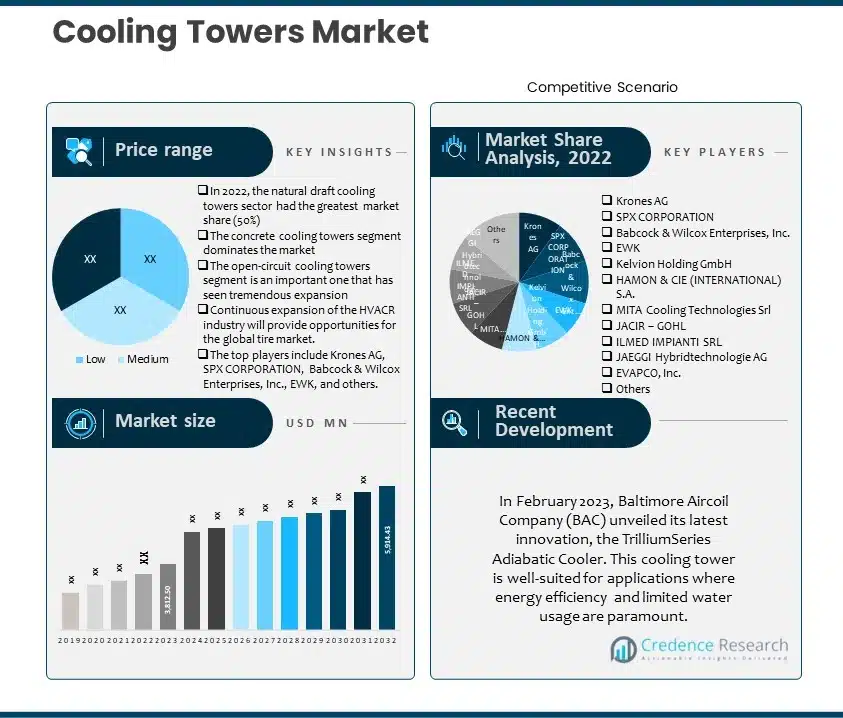
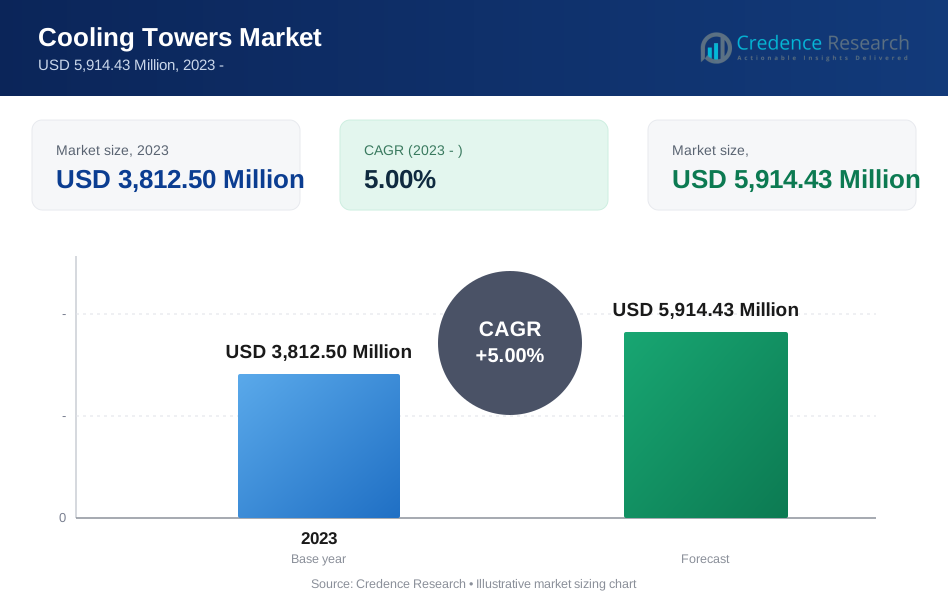
- The global demand for Cooling Towers was valued at USD 3,812.50 Million in 2023 and is expected to reach USD 5,914.43 Million in 2032, growing at a CAGR of 5.00% between 2024 and 2032.
- The natural draft cooling towers sector is the market leader by type, accounting for more than 50% of total value in 2023, while the mechanical draft cooling towers segment is expected to grow rapidly throughout the forecast period.
- The concrete cooling towers dominates the global need for Cooling Towers, accounting for more than 35% in 2023 and metal (steel or stainless steel) cooling towers is predicted to expand at a high CAGR.
- The open-circuit cooling towers sector is predicted to grow fastest over the projection period, while the closed-circuit cooling towers segment will have a market share of more than 50% in 2023.
- Over the projection period, the industrial category is expected to expand at the highest rate, while the power generation category will dominate the market in 2023 with a 55% share.
- North America is fueling the growth of the Cooling Towers industry with over one-third share in 2023, while Asia Pacific and Europe collectively account for just under 55% share in 2023. Europe held over 20% share in 2023.
- Due to the growth in power generation capacity, driven by rising energy demands globally, the market for Cooling Towers is driven by stringent environmental regulations.
- The market's primary possibilities include the significant growth potential in North America, continuous expansion of the Heating, Ventilation, Air Conditioning, and Refrigeration (HVACR) industry.
Executive Summary
Market Definition
Cooling towers are specialized heat rejection devices designed to transfer excess heat from industrial processes or building systems to the atmosphere. They play a crucial role in cooling water used in various applications, such as power plants, manufacturing facilities, and HVAC (Heating, Ventilation, and Air Conditioning) systems. Operating on the principle of evaporative cooling, cooling towers utilize a flow of air to cool water through the evaporation of a small portion of it, effectively dissipating the heat generated during industrial processes. These towers are integral components in thermal power plants, industrial facilities, and large-scale HVAC systems, providing an efficient and sustainable method for managing the thermal loads generated by diverse applications.
Market Overview
The global Cooling Towers market has witnessed steady growth in recent years and is expected to grow at a CAGR of 5.00% between 2024 and 2032. The market was valued at USD 3,812.50 million in 2023 and is expected to reach USD 5,914.43 million in 2032.
The key driver boosting the growth rate of the Cooling Towers market is the global trend of increasing industrialization and urbanization plays a pivotal role in the market's expansion. As industrial activities and urban infrastructure projects surge worldwide, the demand for efficient heat dissipation and cooling solutions rises significantly. Cooling towers are integral components in various industries, including power generation, petrochemicals, and manufacturing, where they facilitate the removal of excess heat generated during processes, ensuring optimal equipment performance and operational efficiency. The escalating need for cooling towers is particularly pronounced in developing economies undergoing rapid industrial growth, contributing to the overall market expansion.
Furthermore, stringent environmental regulations and a growing focus on sustainability are driving the adoption of cooling towers. Governments and regulatory bodies globally are imposing strict guidelines to mitigate the environmental impact of industrial processes, emphasizing water conservation and responsible resource utilization. Cooling towers, with their ability to recycle water and dissipate heat through evaporative cooling, align with these sustainability goals. Industries are increasingly investing in advanced cooling tower technologies that not only comply with environmental standards but also enhance energy efficiency, reducing the overall ecological footprint. As businesses prioritize environmentally friendly practices, the demand for cooling towers is set to rise, driving innovation and market growth.
Segmentation by Type
- Natural draft cooling towers is the leading segment by interface type and held over 50% share in value in 2023, attributable to the large-scale infrastructure development projects, such as the construction of smart cities and industrial complexes, contribute to the growth of the cooling towers market.
- The mechanical draft cooling towers segment will likely exhibit a significant CAGR during the forecast period. The manufacturing sector's increasing need for process cooling in various industries, including steel, cement, and food processing, fuels the demand for cooling towers to maintain optimal operating temperatures.
Segmentation by Material
- The concrete cooling towers segment governs the demand for Cooling Towers in the world, holding a massive share of over 35% in 2023.
- Metal (steel or stainless steel) cooling towers is also expected to grow at a rapid CAGR due to the shift towards renewable energy sources, such as solar and wind power, also drives the cooling towers market, as these sources often require efficient cooling systems to optimize energy production.
- The fiberglass reinforced plastic (FRP) cooling towers sectors segment contributes to the demand for Cooling Towers.
Segmentation by Heat Exchange Method
- The open-circuit cooling towers segment is expected to post the highest CAGR during the forecast period. This is primarily due to Ongoing innovations in cooling tower design, including the development of energy-efficient and eco-friendly models, enhance the efficiency and performance of cooling towers, driving market adoption.
- The closed-circuit cooling towers segment is leading the market share with over 50% share in 2023.
Segmentation by Application
- The industrial segment is anticipated to register the highest CAGR during the projection period.
- With a market share of nearly 55% in 2023, the power generation category is currently in the lead.
- The category of industrial application includes Chemical Processing, Oil Refining, Steel Mills, Petrochemical, HVAC (Heating, Ventilation, and Air Conditioning), and Data Centers.
Segmentation by Region
- North America is fueling the growth of the Cooling Towers industry with over one-third share in 2023 due to the region's growing emphasis on sustainability and eco-friendly practices in industries.
- Asia Pacific and Europe collectively account for just under 55% share in 2023, with Europe holding over 20% share in the same year.
- The rest of the world, including Latin America, the Middle East, and Africa, supplies the remaining demand for Cooling Towers.
The market for Cooling Towers is driven by increasing global demand for electricity, particularly in developing economies, propels the need for cooling towers in power plants to handle the heat generated during electricity generation.
North America stands as a dominating region in the Cooling Towers market, propelled by advanced industrial infrastructure, a mature manufacturing sector, and stringent environmental regulations. The United States and Canada, in particular, witness significant demand for cooling towers across diverse industries, including power generation, petrochemicals, and HVAC systems. The dominance of North America in the market is further underscored by the presence of key market players and ongoing technological advancements. The region's commitment to sustainability and the adoption of eco-friendly cooling solutions, driven by environmental awareness, contribute to the robust demand for cooling towers. Additionally, the emphasis on energy efficiency and compliance with environmental standards positions North America as a key hub for innovation and growth in the Cooling Towers market.
The Asia Pacific emerges as the fastest-growing region in the Cooling Towers market, fueled by rapid industrialization, infrastructure development, and expanding manufacturing activities. Countries like China, India, and Southeast Asian nations are witnessing a surge in demand for cooling towers as industries seek efficient heat dissipation solutions to support their growing operations. The booming power generation sector, coupled with the rise in urbanization and the construction of large-scale infrastructure projects, contributes significantly to the increased adoption of cooling towers in the region. Moreover, the awareness of environmental concerns and the implementation of stringent regulations regarding water usage and emissions drive the demand for sustainable cooling solutions, further accelerating the growth of the Cooling Towers market in Asia Pacific.
Key Highlights of the Report
The global Cooling Towers market is segmented by type, material, heat exchange method, application, and region. Natural Draft Cooling Towers-based Cooling Towers are the most popular, while mechanical draft cooling towers are the primary segments. In addition, concrete cooling towers and power generation are the most commonly used categories. However, North America leading the market growth.
One of the main factors propelling the global market for Cooling Towers is the global trend of increasing industrialization and urbanization plays a pivotal role in the market's expansion. As industrial activities and urban infrastructure projects surge worldwide, the demand for efficient heat dissipation and cooling solutions rises significantly. Furthermore, stringent environmental regulations and a growing focus on sustainability are driving the adoption of cooling towers.
Nonetheless, North America is anticipated to have the greatest share of the worldwide Cooling Towers market due to the advanced industrial infrastructure, a mature manufacturing sector, and stringent environmental regulations. Furthermore, the market is anticipated to expand at the highest rate in the Asia-Pacific (APAC) region due to the rapid industrialization, infrastructure development, and expanding manufacturing activities.
What Are The Main Drivers Of The Global Cooling Towers Market?
The main drivers of the global Cooling Towers market include increasing industrialization and urbanization, rising energy demands necessitating efficient heat dissipation in power plants, stringent environmental regulations promoting sustainable cooling solutions, and the expansion of the HVACR industry for commercial and residential applications. Additionally, the growth of the chemical and petrochemical sectors, technological advancements in cooling tower design, and the global focus on sustainability contribute to the market's positive trajectory.
What Are The Major Challenges Faced By The Global Cooling Towers Market?
The major challenges faced by the global Cooling Towers market is the need to address integration issues with existing industrial processes. Seamless integration with diverse manufacturing setups and overcoming interoperability challenges can be complex. Compliance with stringent environmental regulations, global competition among market vendors, and the need for continuous technological advancements present challenges for sustained market growth.
What Are The Growth Opportunities In The Global Cooling Towers Market?
The increasing demand for these systems in emerging markets, the development of energy-efficient and eco-friendly cooling tower models, and integration with Industry 4.0 initiatives and automation trends, is expected to boost the market development. Additionally, during the estimated period, there will be numerous new opportunities for the Cooling Towers market to grow due to the ongoing innovations in cooling tower design, the global resurgence of nuclear power, and the focus on sustainable solutions for water conservation.
Market Drivers
The global Cooling Towers market is driven by several factors. The following are the key drivers of the global Cooling Towers market:
Increasing Emphasis on Sustainable Cooling Solutions
A significant driver for the global cooling towers market is the increasing emphasis on sustainable cooling solutions. With growing awareness of environmental conservation and stringent regulations, industries are increasingly adopting cooling towers that are energy-efficient and eco-friendly. The demand for systems that enable water recycling and minimize environmental impact aligns with sustainability goals, driving market growth as businesses seek environmentally responsible solutions for heat dissipation in various industrial processes.
Market Restraints
The global Cooling Towers market faces some challenges that may hinder its growth. These include the following:
Integration Challenges with Existing Industrial Processes
A major restraint in the global cooling towers market is the challenge of seamless integration with existing industrial processes. Different manufacturing setups operate on diverse technology platforms, and ensuring the compatibility of cooling towers with various systems can be complex. Overcoming interoperability challenges and addressing integration issues pose hurdles for market players, particularly in delivering cohesive and efficient solutions to diverse industrial applications.
Opportunities
The global Cooling Towers market offers significant growth opportunities. These include the following:
Integration with Industry 4.0 and Automation Trends
An opportunity for the global cooling towers market lies in the integration of these systems with Industry 4.0 initiatives and automation trends. Connecting cooling towers with smart manufacturing processes enhances overall operational efficiency, allowing for real-time monitoring, predictive maintenance, and energy optimization. The opportunity to offer technologically advanced, automated solutions positions cooling tower providers at the forefront of innovation, meeting the evolving needs of industries for efficient and smart heat dissipation solutions.
Competitive Landscape
Key Players
The global Cooling Towers market is highly competitive, with several key players. Some of the major players in the market and their market share are as follows:
- Krones AG
- SPX CORPORATION
- Babcock & Wilcox Enterprises, Inc.
- EWK
- Kelvion Holding GmbH
- HAMON & CIE (INTERNATIONAL) S.A.
- MITA Cooling Technologies Srl
- JACIR – GOHL
- ILMED IMPIANTI SRL
- JAEGGI Hybridtechnologie AG
- EVAPCO, Inc.
- Others
These organizations prioritize product innovation, distribution channel expansion, and mergers and acquisitions to stay competitive.
The global Cooling Towers market's key players continually seek to stay ahead by offering new products and developments.
In February 2023, Baltimore Aircoil Company (BAC) unveiled its latest innovation, the TrilliumSeries Adiabatic Cooler. This cooling tower is well-suited for applications where energy efficiency and limited water usage are paramount. The design is optimized to enhance both water and energy efficiency, ultimately resulting in cost savings. Moreover, the TrilliumSeries Cooler is engineered for straightforward installation and easy ongoing maintenance.
In November 2022, Russia has officially completed the installation of a new cooling tower at the Kursk II nuclear power plant, marking a significant achievement. This cooling tower, reaching a height of 179 meters, now stands as the tallest in Russia. Designed to endure for a remarkable 100 years, it surpasses the height of the previous tallest tower in Russian history by 8 meters.
Summary of Key Findings
- The demand for cooling towers is rising due to the growth in power generation capacity, driven by rising energy demands globally, fuels the demand for cooling towers in thermal power plants and nuclear facilities, where effective heat rejection is crucial for optimal performance, which is boosting the growth of the Cooling Towers market.
- Market segmented by type, material, heat exchange method, application, and region.
- Natural Draft Cooling Towers-based Cooling Towers are the most popular, while mechanical draft cooling towers are the primary segments.
- Concrete cooling towers and power generation are the most commonly used categories.
- North America is leading market growth; the market is highly competitive with key players including Krones AG, SPX CORPORATION, Babcock & Wilcox Enterprises, Inc., EWK, Kelvion Holding GmbH, HAMON & CIE (INTERNATIONAL) S.A., MITA Cooling Technologies Srl, JACIR – GOHL, ILMED IMPIANTI SRL, JAEGGI Hybridtechnologie AG, EVAPCO, Inc., and Others.
Future Outlook
- Positive outlook for the global Cooling Towers market with significant growth potential in the North American region
- One of the main factors promoting the market's expansion is the government and business sectors' current reliance on Cooling Towers.
- During the forecast period, integration challenges with existing industrial processes is a significant factor projected to restrain the growth of the Cooling Towers market.
- Key firms must focus on product innovation, growing market reach, and maintaining competitive pricing to keep ahead of the competition.
How CXOs Can Benefit from the Credence Research Cooling Towers Market Report
The Credence Research Cooling Towers Market Report provides CXOs with a comprehensive overview of the market, including:
- Market size and growth forecast: The report provides detailed estimates of the global Cooling Towers market size, segmented by type, material, heat exchange method, application, and region. It also includes forecasts for the market through 2032, based on key trends and drivers.
- Market segmentation: The report segments the Cooling Towers market by type, material, heat exchange method, application, and region. This segmentation provides CXOs with a granular understanding of the market and the opportunities in each segment.
- Competitive landscape: The report profiles the key players in the Cooling Towers market and provides insights into their strategies, product offerings, and financial performance. This information can help CXOs to identify and assess their competition.
- Key trends and drivers: The report identifies and analyzes the key trends and drivers that are shaping the Cooling Towers This information can help CXOs to make informed decisions about their investments and strategies.
CXOs can use the insights from the Credence Research Cooling Towers Market Report to:
- Identify growth opportunities: The report can help CXOs to identify new growth opportunities in the Cooling Towers For example, the report identifies the growing demand for Cooling Towers from tower providers and industrial sectors as a key opportunity.
- Make informed investment decisions: The report can help CXOs to make informed investment decisions about Cooling Towers. For example, the report provides insights into the key factors to consider when evaluating Cooling Towers providers and selecting Cooling Towers
- Develop competitive strategies: The report can help CXOs to develop competitive strategies for their Cooling Towers For example, the report identifies the key strategies that Cooling Towers providers are using to differentiate themselves from their competitors.
- Track market developments: The report can help CXOs to track market developments and stay ahead of the curve. For example, the report provides insights into the latest trends and innovations in the Cooling Towers
Overall, the Credence Research Cooling Towers Market Report is a valuable resource for CXOs who are looking to gain a deeper understanding of the market and identify opportunities for growth.
Segmentation
- By Type
- Natural Draft Cooling Towers
- Hyperbolic Towers
- Chimney Towers
- Mechanical Draft Cooling Towers
- Crossflow Towers
- Counterflow Towers
- By Material
- Concrete Cooling Towers
- Metal (Steel or Stainless Steel) Cooling Towers
- Fiberglass Reinforced Plastic (FRP) Cooling Towers
- By Heat Exchange Method
- Open-Circuit Cooling Towers
- Closed-Circuit Cooling Towers
- By Application
- Power Generation
- Coal-Fired Plants
- Gas-Fired Plants
- Nuclear Power Plants
- Industrial
- Chemical Processing
- Oil Refining
- Steel Mills
- Petrochemical
- HVAC (Heating, Ventilation, and Air Conditioning)
- Data Centers
- By Region
- North America
- The U.S.
- Canada
- Mexico
- Europe
- Germany
- France
- The U.K.
- Italy
- Spain
- Rest of Europe
- Asia Pacific
- China
- Japan
- India
- South Korea
- South-east Asia
- Rest of Asia Pacific
- Latin America
- Brazil
- Argentina
- Rest of Latin America
- Middle East & Africa
- GCC Countries
- South Africa
- Rest of Middle East and Africa
- North America
- Power Generation
- Natural Draft Cooling Towers
Request a Free Sample
Fill in your details and we'll send you a free sample report.
- Sample data tables & charts
- Research methodology
Need a Custom Version of This Report?
Tailor the scope, geography, or segments to your exact requirements.
- Custom geography or segment scope
- Direct access to our analyst team
Frequently Asked Questions
What is the current size of the global Cooling Towers market?
What is the expected growth rate of the Cooling Towers market between 2024 and 2032?
Which segment is leading the market share in terms of type?
Which material segment governs the demand for Cooling Towers in the world?
Who are the major players in the global Cooling Towers market?
Table of Content
Chapter 1. Report Introduction
- 1.1 Report Description & Purpose
- 1.1.1 Report Title & Market Definition
- 1.1.2 Unique Selling Propositions (USP) & Key Differentiators
- 1.1.3 Value Proposition for Stakeholders
- 1.2 Research Objectives
- 1.2.1 Market Sizing Objectives (Volume & Revenue)
- 1.2.2 Segmentation Objectives
- 1.2.3 Competitive Intelligence Objectives
- 1.2.4 Forecast & Scenario Objectives
- 1.3 Report Scope
- 1.3.1 Cooling Towers Scope – Types & Subtypes Covered
- 1.3.2 Geographic Scope – Regions & Countries Covered
- 1.3.3 Historical Period, Base Year & Forecast Period (2023; forecast to the forecast period)
- 1.3.4 Inclusions & Exclusions
- 1.4 HS Code & Classification Framework
- 1.5 Currency, Units & Pricing Basis
- 1.6 Target Stakeholders
- 1.7 Limitations & Assumptions
Chapter 2. Executive Summary
- 2.1 Global Cooling Towers Market Snapshot
- 2.1.1 Market Size – Historical (2023) & Forecast (the forecast period) (2023: USD 3,812.50 Million → forecast year: USD 5,914.43 Million)
- 2.1.2 Volume & Revenue – Global Totals
- 2.1.3 Key Market Highlights – Top Five Facts
- 2.2 Cooling Towers Market Segmentation Snapshot
- 2.2.1 Market Split by Region – 2023 vs.
- 2.3 Competitive Snapshot
- 2.3.1 Top 10 Players by Revenue Share – 2023
- 2.3.2 Top 10 Players by Volume Share – 2023
- 2.3.3 Recent Strategic Developments (18-Month Summary)
- 2.4 Key Investment Highlights & Strategic Conclusions
Chapter 3. Cooling Towers Market Dynamics & Industry Analysis
- 3.1 Market Overview & Context
- 3.1.1 Cooling Towers Market Position in the Broader Automotive Value Chain
- 3.1.2 OEM vs. Replacement Market Dynamics
- 3.1.3 Market Maturity & Development Stage by Region
- 3.2 Cooling Towers Market Drivers
- 3.3 Cooling Towers Market Restraints & Challenges
- 3.4 Cooling Towers Market Opportunities
- 3.5 Porter's Five Forces Analysis
- 3.5.1 Threat of New Entrants
- 3.5.2 Bargaining Power of Suppliers
- 3.5.3 Bargaining Power of Buyers
- 3.5.4 Threat of Substitutes
- 3.5.5 Competitive Rivalry – Intensity Assessment
- 3.6 Cooling Towers Value Chain Analysis
- 3.6.1 Upstream – Raw Material/Input Suppliers
- 3.6.1.1 Raw Material/Input 1
- 3.6.1.2 Raw Material/Input 2
- 3.6.1.3 Raw Material/Input 3
- 3.6.2 Midstream – Production/Manufacturing/Service Delivery
- 3.6.2.1 Production/Process Overview
- 3.6.2.2 Key Facility Locations & Capacity by Manufacturer
- 3.6.3 Downstream – Distribution & End Consumer
- 3.6.3.1 Primary Channel – B2B/OEM
- 3.6.3.2 Secondary Channels – Dealer, Retail, Online, Direct
- 3.6.4 Value Chain Profitability Analysis
- 3.6.1 Upstream – Raw Material/Input Suppliers
- 3.7 PESTEL Analysis
- 3.7.1 Political Factors
- 3.7.2 Economic Factors
- 3.7.3 Social Factors
- 3.7.4 Technological Factors
- 3.7.5 Environmental Factors
- 3.7.6 Legal Factors
- 3.8 Cooling Towers Supply Chain Analysis
- 3.8.1 Raw Material/Input Supply Risk Assessment
- 3.8.2 Manufacturing Concentration Risk (Geographic Exposure)
- 3.8.3 Trade Disruption Impact Analysis
- 3.9 Regulatory & Policy Landscape
Note: The regulatory and policy landscape section covers regulations based on their applicability to the market, Cooling Towers category, geography, and scope of the study. Only regulatory frameworks with a material impact on operations, compliance, trade, sustainability, or market access are analyzed in detail.
Chapter 4. Key Investment Pockets & Opportunity Analysis
- 4.1 Cooling Towers Market Attractiveness Analysis
- 4.1.1 By Region – Investment Attractiveness Matrix (Volume × CAGR)
- 4.2 Absolute Revenue Growth Opportunity
- 4.2.1 By Region – Absolute USD Growth Through the forecast period
- 4.3 Incremental Volume Opportunity
- 4.3.1 By Region – Incremental Volume Through the forecast period
- 4.3.2 Segment – Incremental Volume
- 4.4 Emerging Submarket Opportunity Deep Dive (Subject to Applicability)
- 4.5 Emerging Market Opportunity Scorecards
- 4.5.1 United States
- 4.5.2 Europe
- 4.5.3 Asia
- 4.5.4 Middle East & Africa
Note: Emerging Market Opportunity Scorecards will be included based on relevance and strategic importance. Regions listed are indicative and may vary depending on data availability and market dynamics.
Chapter 5. Cooling Towers Import-Export Analysis & Trade Flows
- 5.1 Global Trade Overview
- 5.1.1 Global Export Value by Country (2023)
- 5.1.2 Global Export Volume by Country (2023)
- 5.1.3 Global Import Value by Country (2023)
- 5.1.4 Global Import Volume by Country (2023)
- 5.1.5 Net Trade Balance by Country (2023)
- 5.2 Export Analysis – Segment
- 5.2.1 Type 1 (HS Code)
- 5.2.2 Type 2 (HS Code)
- 5.2.3 Type 3 (HS Code)
- 5.2.4 Type 4 (HS Code)
- 5.2.5 Type 5 (HS Code)
- 5.3 Import Analysis – Segment
- 5.3.1 Type 1 (HS Code)
- 5.3.2 Type 2 (HS Code)
- 5.3.3 Type 3 (HS Code)
- 5.3.4 Type 4 (HS Code)
- 5.3.5 Type 5 (HS Code)
- 5.4 Average Unit Trade Prices
- 5.4.1 Average Export Price – Segment & Country
- 5.4.2 Average Import Price – Segment & Source Country
- 5.4.3 Price Trends (2023)
- 5.5 Key Trade Route Analysis
- 5.5.1 Trade Route 1
- 5.5.2 Trade Route 2
- 5.5.3 Trade Route 3
- 5.5.4 Trade Route 4
- 5.5.5 Trade Route 5
- 5.6 Trade Policy Impact Assessment
- 5.6.1 US Anti-Dumping & Section 301 Tariffs
- 5.6.2 EU Customs Union Impact
- 5.6.3 Major Free Trade Agreements
- 5.6.4 USMCA Rules of Origin
Note: Trade policy analysis will be included only where relevant to the Cooling Towers market.
Chapter 6. Competitive Landscape & Company Benchmarking
- 6.1 Cooling Towers Market Concentration & Structure
- 6.1.1 Herfindahl-Hirschman Index (HHI) – vs. 2023
- 6.1.2 Tier 1, Tier 2 & Tier 3 Market Structure
- 6.1.3 Global, Regional & Local Player Dynamics
- 6.2 Cooling Towers Market Share Analysis – 2023
- 6.2.1 Global Revenue Share by Company
- 6.2.2 Global Volume Share by Company
- 6.2.3 Regional Revenue Share
- 6.2.4 Market Share Evolution ( vs. 2023)
- 6.2.5 OEM Segment Share by Company
- 6.2.6 Replacement Segment Share by Company
- 6.3 Production/Delivery Capacity & Facility Analysis
- 6.3.1 Global Installed Capacity
- 6.3.2 Capacity Utilization Rates
- 6.3.3 Production/Output Volume
- 6.3.4 Facility Locations & Capacity Map
- 6.3.5 Planned Capacity Additions
- 6.4 Cooling Towers Competitive Benchmarking Matrix
- 6.4.1 Revenue, Volume, CAGR & Profitability Comparison
- 6.4.2 Channel Revenue Mix
- 6.4.3 Geographic Revenue Exposure
- 6.4.4 R&D Intensity
- 6.4.5 Sustainability Maturity
- 6.5 Strategic Developments in Cooling Towers (Last 24 Months)
- 6.5.1 Mergers, Acquisitions & Divestments
- 6.5.2 New Cooling Towers Launches
- 6.5.3 Facility Expansions
- 6.5.4 Strategic Alliances, Joint Ventures & Partnerships
- 6.5.5 Distribution Expansion & Market Entry
- 6.5.6 Sustainability & ESG Initiatives
- 6.6 Competitive Strategy Mapping
- 6.6.1 Leader, Challenger, Follower & Niche Classification
- 6.6.2 Pricing Strategy Comparison
- 6.6.3 Channel Strategy Matrix
Note: Strategic developments are included based on their materiality and the availability of reliable information.
Chapter 7. Global Cooling Towers Market – By Distribution Channel
- 7.1 Segment Overview
- 7.1.1 Volume & Revenue Split by Channel (2023 & )
- 7.1.2 Channel Mix Evolution (the forecast period)
Chapter 8. Regional Market Analysis – Global Overview
- 8.1 Global Regional Overview
- 8.1.1 Regional Volume Share
- 8.1.2 Regional Revenue Share
- 8.1.3 Regional Volume by Region
- 8.1.4 Regional Revenue by Region
- 8.1.5 Regional Forecast Through the forecast period
- 8.2 Cross-Regional Segment Analysis
- 8.2.1 By Distribution Channel
- 8.2.2 By Brand/Price Tier
Chapter 9. North America Cooling Towers Market
- 9.1 United States
- 9.2 Canada
- 9.3 Mexico
Chapter 10. Europe Cooling Towers Market
- 10.1 Germany
- 10.2 France
- 10.3 Italy
- 10.4 United Kingdom
- 10.5 Spain
- 10.6 Poland
- 10.7 Russia
- 10.8 Netherlands
- 10.9 Belgium
- 10.10 Sweden
- 10.11 Denmark
- 10.12 Norway
- 10.13 Rest of Europe
Chapter 11. Asia Pacific Cooling Towers Market
- 11.1 China
- 11.2 India
- 11.3 Japan
- 11.4 South Korea
- 11.5 Thailand
- 11.6 Indonesia
- 11.7 Vietnam
- 11.8 Malaysia
- 11.9 Australia
- 11.10 Rest of Asia Pacific
Chapter 12. Latin America Cooling Towers Market
- 12.1 Brazil
- 12.2 Argentina
- 12.3 Colombia
- 12.4 Chile
- 12.5 Rest of Latin America
Chapter 13. Middle East Cooling Towers Market
- 13.1 Saudi Arabia
- 13.2 United Arab Emirates
- 13.3 Turkey
- 13.4 Israel
- 13.5 Iran
- 13.6 Rest of the Middle East
Chapter 14. Africa Cooling Towers Market
- 14.1 South Africa
- 14.2 Egypt
- 14.3 Nigeria
- 14.4 Morocco
- 14.5 Rest of Africa
Chapter 15. Cooling Towers Company Profiles
- 15.1 [Company 01]
- 15.1.1 Company Overview
- 15.1.2 Key Management Personnel
- 15.1.3 Products & Services Portfolio
- 15.1.4 Financial Performance
- 15.1.5 Key Market Focus & Geographic Presence
- 15.1.6 Recent Developments & Strategic Initiatives
Note: The company profile list is preliminary and may change based on research findings, market developments, data availability, and client requirements.
Chapter 16. Appendices
- Appendix A – List of Abbreviations & Acronyms
- Appendix B – Industry Classification Code Reference – Full Series
- Appendix C – Production & Capacity Data Tables
- Appendix D – End-Use & Demand Base Tables
- Appendix E – Consumption & Replacement Rate Assumptions
- Appendix F – ASP Reference Tables
- Appendix G – Manufacturing & Facility Database
- Appendix H – Import-Export Data Tables
- Appendix I – Regulatory Summary Tables
- Appendix J – Primary Research Participant List (Anonymized)
- Appendix K – Primary Research Questionnaire Framework
- Appendix L – Data Sources & Bibliography
- Appendix M – Market Size Divergence & Source Comparison
Chapter 17. Research Methodology
- 17.1 Research Framework & Philosophy
- 17.2 Secondary Research – Sources, Hierarchy & Data Extraction
- 17.3 Data Modeling – Bottom-Up & Top-Down Market Sizing
- 17.4 Primary Research – Stakeholder Framework, LOI & Sample Sizes
- 17.5 Forecast Methodology – Regression, Scenario & Sensitivity Analysis
- 17.6 Quality Control – Four-Layer Validation Framework
- 17.7 Limitations & Standard Assumptions
- 17.8 Disclaimer
