
Market Overview:
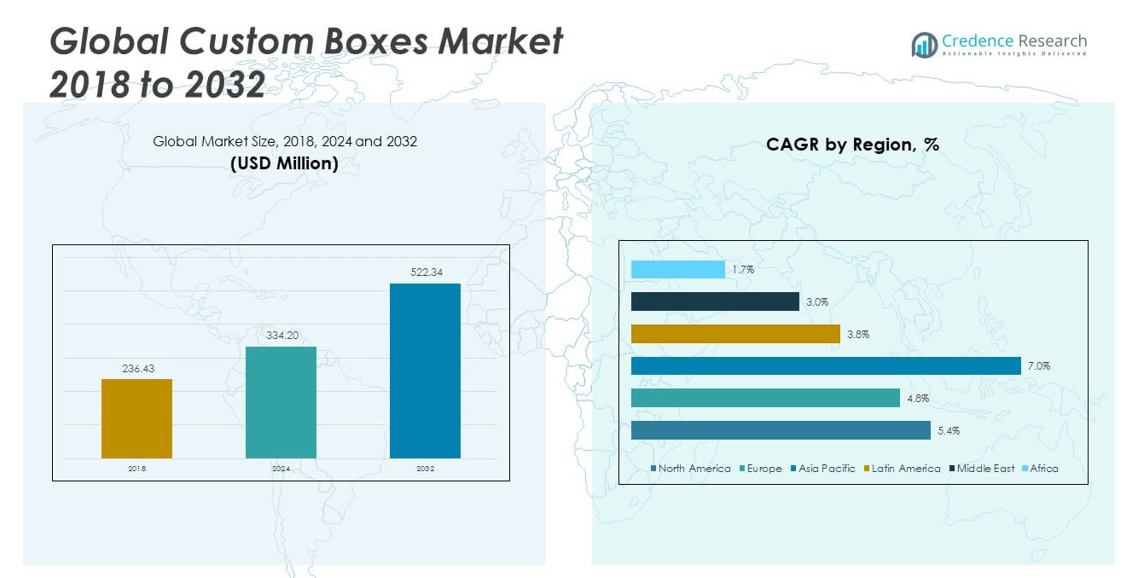
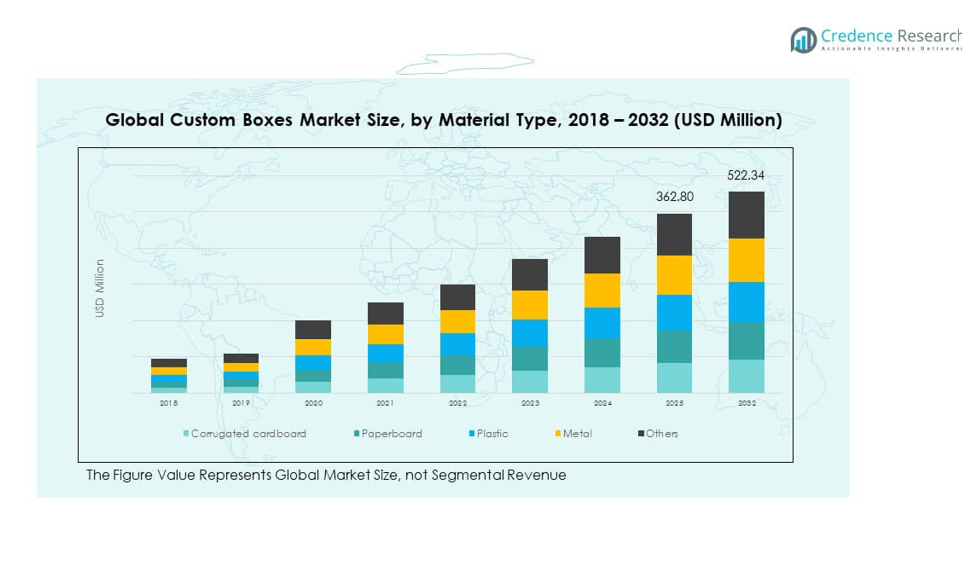
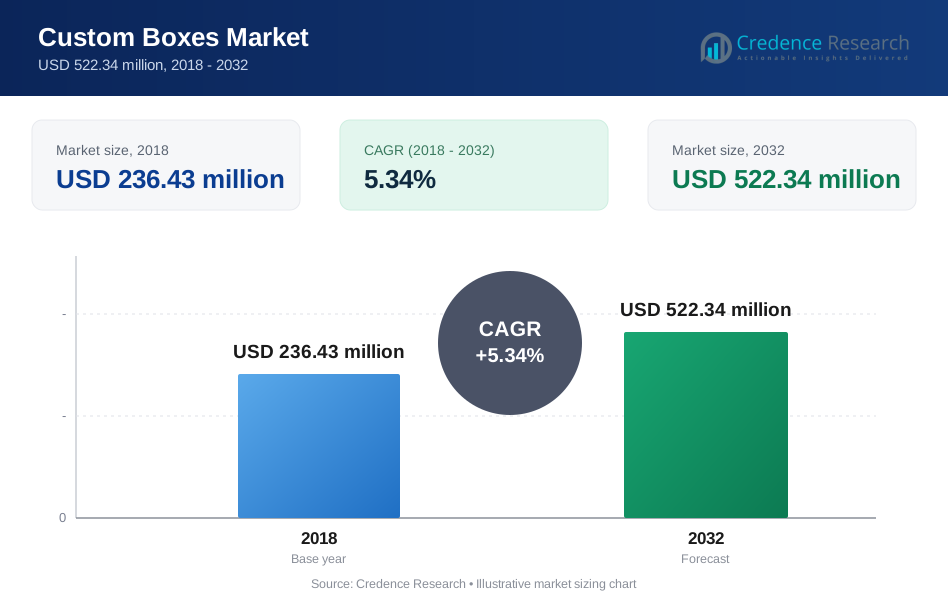
The Global Custom Boxes Market size was valued at USD 236.43 million in 2018, reached USD 334.20 million in 2024, and is anticipated to reach USD 522.34 million by 2032, expanding at a CAGR of 5.34% during the forecast period.
| REPORT ATTRIBUTE | DETAILS |
|---|---|
| Historical Period | 2020-2023 |
| Base Year | 2024 |
| Forecast Period | 2025-2032 |
| Custom Boxes Market Size 2024 | USD 334.20 million |
| Custom Boxes Market , CAGR | 5.34% |
| Custom Boxes Market Size 2032 | USD 522.34 million |
The market is primarily driven by the surge in e-commerce and digital retail platforms, where custom packaging enhances consumer experiences and strengthens brand visibility. Companies increasingly use innovative designs, digital printing, and premium finishes to differentiate their products in competitive markets. Rising consumer awareness of sustainable packaging solutions pushes manufacturers to adopt recyclable, biodegradable, and lightweight materials. Retailers use creative packaging strategies to attract attention and maintain customer retention. Digital innovations such as AI-driven design and 3D printing have improved customization, allowing businesses to cater to small-batch, on-demand production at lower costs.
Regionally, the market demonstrates significant differences in adoption patterns. Europe leads the industry due to strong regulatory pressure for eco-friendly packaging and a well-established retail and luxury sector. North America follows, supported by high e-commerce penetration and subscription box culture. Asia Pacific emerges as the fastest-growing region, with rapid industrialization, rising disposable incomes, and large-scale retail expansion in China and India. Japan and South Korea highlight advanced adoption of premium and technology-driven packaging. Latin America shows moderate growth, driven by food packaging and urban retail development, though economic instability limits widespread adoption. The Middle East emphasizes luxury and retail packaging, supported by demand from GCC nations, while Africa remains at an early stage with growth led by South Africa and Egypt.
Market Insights:
- The Global Custom Boxes Market size was USD 236.43 million in 2018, reached USD 334.20 million in 2024, and is projected to hit USD 522.34 million by 2032, growing at a CAGR of 5.34%.
- Europe leads with 43% share in 2024, driven by strong retail, cosmetics, and sustainability policies. North America follows with 28% share, supported by high e-commerce adoption and subscription models. Asia Pacific holds 20% share, fueled by industrial expansion and consumer preference for customization.
- Asia Pacific is the fastest-growing region with a 7.0% CAGR, expanding rapidly through China and India’s booming e-commerce and rising disposable incomes.
- Corrugated cardboard accounts for around 45% share of the market, reflecting its dominance in e-commerce and food packaging due to durability and cost-effectiveness.
- Paperboard holds nearly 25% share, supported by strong demand in cosmetics and personal care where lightweight and premium designs enhance brand positioning.
Market Drivers:
Rising Influence of E-commerce and Digital Retail Platforms:
The expansion of online retail plays a major role in driving the Global Custom Boxes Market. Brands use tailored packaging to enhance unboxing experiences and promote brand identity. It helps businesses reduce return rates with secure packaging. The e-commerce surge in emerging economies expands opportunities for packaging producers. Rising adoption of digital printing improves the affordability of customization. Companies also benefit from flexibility in small batch orders and fast turnaround. Sustainability regulations push e-commerce players to select eco-friendly custom boxes.
- For instance, Brands use tailored packaging to enhance unboxing experiences and promote brand identity, exemplified by Google s Pixel 8 packaging launched in October 2023, which is 100% plastic-free and reduces packaging weight and volume by at least 50% compared to previous generations.
Increasing Consumer Demand for Sustainability-Oriented Packaging Solutions:
Growing awareness of environmental issues influences buyers’ packaging preferences. Companies prioritize biodegradable and recyclable packaging options. The Global Custom Boxes Market benefits from stricter regulations on single-use plastics. Investments in green materials improve adoption across industries. Consumers associate eco-friendly packaging with premium and ethical brands. It enables businesses to align with circular economy principles. Rising government incentives support manufacturers shifting toward sustainable production methods. Sustainability-focused marketing boosts consumer loyalty and product differentiation.
- For instance, Consumer surveys correlate eco-friendly packaging with premium and ethical brands, supporting product differentiation efforts and bolstering loyalty through sustainability-focused marketing campaigns backed by third-party certifications.
Technological Innovations in Printing and Customization Processes:
Advanced printing and design technologies strengthen product visibility and personalization. The Global Custom Boxes Market leverages 3D printing, digital printing, and automated die-cutting. These innovations reduce production errors and improve efficiency. It allows companies to respond faster to changing consumer preferences. High-quality graphics and color accuracy enhance branding efforts. Digital tools make short production runs more cost-effective. Technology-driven packaging attracts both SMEs and multinational corporations. Innovations also expand applications across retail, food, and cosmetics sectors.
Expanding Applications Across Diverse End-Use Industries:
The market benefits from demand across food, cosmetics, and retail sectors. Food and beverage packaging prioritizes safety and branding. Cosmetics brands rely heavily on premium custom designs to attract consumers. Retail businesses enhance shelf visibility through creative box types. Custom packaging strengthens loyalty programs and promotional campaigns. It supports safe storage and transportation of fragile products. The Global Custom Boxes Market grows with rising penetration into luxury and subscription box markets. Growing healthcare packaging requirements also create new opportunities.
Market Trends:
Personalization and Premiumization of Packaging:
The Global Custom Boxes Market witnesses rising interest in personalized packaging designs. Brands use packaging as a marketing channel to connect emotionally with consumers. Premium textures, coatings, and unique shapes enhance consumer experience. It builds loyalty in competitive industries such as cosmetics and electronics. Companies differentiate through high-quality printing and structural innovation. Personalized QR codes and AR-enabled boxes gain traction. Premium packaging supports higher product pricing strategies. This trend fosters long-term brand recognition and customer engagement.
- For instance, QR codes printed with micro-precision and AR-enabled interactive boxes have been adopted by of luxury brands to drive consumer engagement and enable instant product authentication. These advanced print and finishing technologies have facilitated rapid customization even in small production batches, supporting frequent seasonal and promotional packaging updates.
Adoption of Smart Packaging and Digital Integration:
Smart packaging features expand within the Global Custom Boxes Market. Integration of QR codes, NFC tags, and RFID boosts traceability. Companies use packaging to deliver interactive consumer experiences. It supports product authentication and anti-counterfeit measures. Growth in digital retail increases demand for technology-driven packaging. Smart solutions enhance supply chain transparency and inventory management. Digital-enabled packaging also provides real-time consumer insights. Smart packaging aligns with Industry 4.0 trends, strengthening market adoption.
- For instance, Sensors embedded in smart packaging monitor temperature and humidity to ensure food and pharmaceutical safety, extending shelf life by validated in recent clinical studies. This digital connectivity grants brands access to granular consumer usage data while improving inventory management and logistics efficiency as part of Industry 4.0 frameworks.
Rise of Subscription and Direct-to-Consumer Business Models:
The subscription box model accelerates the demand for custom packaging solutions. Brands create memorable unboxing experiences to retain subscribers. The Global Custom Boxes Market benefits from rising demand for seasonal and themed packaging. It supports efficient branding in cost-sensitive direct-to-consumer channels. Custom boxes enhance marketing reach without significant advertisement spending. Packaging serves as a key differentiator for small businesses entering digital retail. Direct sales platforms expand globally, further increasing adoption. Unique packaging strengthens engagement in competitive consumer markets.
Sustainable Material Innovation and Circular Economy Alignment:
Market players increasingly invest in recyclable and compostable raw materials. Companies explore alternatives such as bamboo, molded fiber, and biodegradable plastics. The Global Custom Boxes Market adapts to strict environmental policies worldwide. It enhances corporate sustainability reporting and consumer perception. Manufacturers create lightweight designs that minimize shipping costs. Sustainable innovation expands beyond e-commerce into food and healthcare packaging. Circular economy adoption drives interest in reusable and returnable boxes. These practices build long-term competitiveness in global supply chains.
Market Challenges Analysis:
Volatility in Raw Material Prices and Supply Chain Disruptions:
The Global Custom Boxes Market faces challenges from rising costs of paper, cardboard, and specialty coatings. Raw material shortages increase dependency on imports in some regions. It creates difficulties for manufacturers in price-sensitive markets. Fluctuating fuel and logistics costs add further pressure. Smaller businesses struggle to maintain profitability with unpredictable input expenses. Supply chain delays disrupt timely delivery commitments. The need for sustainable sourcing further complicates procurement. Market players require strong supplier partnerships to mitigate risks.
Intense Market Competition and Compliance Complexities:
High competition limits pricing flexibility across global markets. Companies face pressure to innovate while keeping costs low. Regulatory requirements on waste management and labeling add complexities. The Global Custom Boxes Market must adapt to region-specific standards. Counterfeit packaging remains a challenge for premium brands. Intellectual property concerns arise with design similarities. Smaller players face barriers in scaling technology adoption. Ensuring compliance without losing speed-to-market becomes a critical challenge.
Market Opportunities:
Emerging E-commerce Markets and Digital Retail Expansion:
The Global Custom Boxes Market benefits from rising digital penetration in Asia-Pacific, Latin America, and Africa. New retail platforms encourage demand for unique packaging. Small enterprises adopt low-cost, custom solutions to differentiate products. E-commerce platforms provide direct consumer interaction, raising packaging importance. Growth in online food delivery services expands custom packaging use. Localized customization supports regional consumer preferences. The demand for visually engaging packaging continues to rise. Emerging markets create fresh revenue streams for global suppliers.
Integration of Advanced Technologies in Custom Packaging Solutions:
Opportunities expand through adoption of 3D printing, AI-driven design, and IoT-enabled packaging. These tools enable hyper-personalization and automation of small-batch production. The Global Custom Boxes Market leverages digital platforms to connect with consumers. Technology supports interactive branding strategies and reduces material wastage. AI-driven tools accelerate design processes and improve prototyping. Smart packaging enhances security and traceability in regulated sectors. Innovation provides growth opportunities for both established players and start-ups.
Market Segmentation Analysis:
By Material Type
Corrugated cardboard leads the Global Custom Boxes Market due to its durability and versatility. It is widely used in e-commerce and food delivery packaging because of its strength and recyclability. Paperboard follows as a lightweight option favored in cosmetics and personal care. Plastic remains relevant for industries requiring moisture resistance, though sustainability concerns limit its growth. Metals and other niche materials cater to premium or specialty packaging. The choice of material strongly depends on product safety, branding, and environmental regulations.
- For instance, Paperboard options, manufactured using coated virgin fibers, offer lightweight alternatives under 300 grams per square meter (gsm), favored in cosmetics for shelf aesthetics.
By Application
E-commerce dominates the application segment, driven by rising online shopping trends worldwide. Food and beverage brands rely on custom boxes to ensure safety, freshness, and visual appeal. Cosmetics and personal care products use premium custom packaging to enhance shelf visibility and brand image. Retail applications show consistent growth, supported by creative marketing campaigns. Other uses, including healthcare and luxury packaging, are gaining ground with growing demand for personalized experiences. This diversification highlights the market’s broad application base.
- For instance, Healthcare packaging increasingly integrates tamper-evident and track-and-trace functionalities, aligning with regulatory compliance. The diversified application of custom boxes across sectors underscores the expanding scope for technology-enabled packaging solutions.
By Box Type
Briefcase-style boxes remain popular in retail and electronics due to their portability. Five-panel boxes find wide adoption in bulk packaging across food and beverages. Seal end boxes are valued for security and easy stacking in e-commerce supply chains. Hexagon boxes serve niche markets, often used in luxury or gift packaging to create distinct appeal. The variety of box types demonstrates how packaging supports both practical and branding functions across industries.
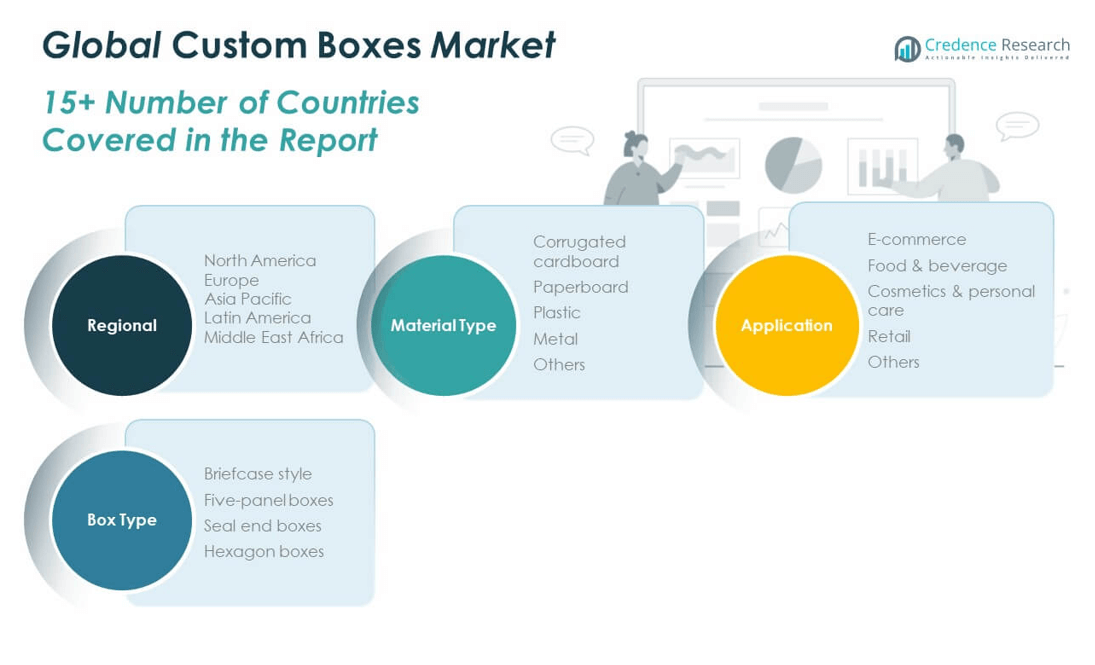
Segmentation:
By Material Type
- Corrugated Cardboard
- Paperboard
- Plastic
- Metal
- Others
By Application
- E-commerce
- Food & Beverage
- Cosmetics & Personal Care
- Retail
- Others
By Box Type
- Briefcase Style
- Five-Panel Boxes
- Seal End Boxes
- Hexagon Boxes
- North America
- U.S.
- Canada
- Mexico
- Europe
- Germany
- France
- U.K.
- Italy
- Spain
- Rest of Europe
- Asia Pacific
- China
- Japan
- India
- South Korea
- South-east Asia
- Rest of Asia Pacific
- Latin America
- Brazil
- Argentina
- Rest of Latin America
- Middle East & Africa
- GCC Countries
- South Africa
- Rest of the Middle East and Africa
Regional Analysis:
North America
The North America Global Custom Boxes Market size was valued at USD 68.15 million in 2018 to USD 94.81 million in 2024 and is anticipated to reach USD 148.81 million by 2032, at a CAGR of 5.4% during the forecast period. North America accounts for 28% market share in 2024. The region benefits from a strong e-commerce sector and high consumer spending on packaged goods. The U.S. drives demand with growing online food delivery and subscription boxes. Canada emphasizes sustainable packaging regulations, while Mexico expands manufacturing. Innovation in printing and premium packaging styles strengthens market adoption across industries.
Europe
The Europe Global Custom Boxes Market size was valued at USD 103.40 million in 2018 to USD 142.74 million in 2024 and is anticipated to reach USD 214.74 million by 2032, at a CAGR of 4.8% during the forecast period. Europe holds the 43% market share in 2024, making it the leading region. Demand is driven by strong cosmetic and personal care sectors in France and Germany. Retail chains and luxury brands rely on custom packaging for brand identity. Regulations supporting eco-friendly solutions push suppliers toward recyclable paperboard and corrugated designs. The UK and Italy also demonstrate rising demand for innovative packaging solutions.
Asia Pacific
The Asia Pacific Global Custom Boxes Market size was valued at USD 44.06 million in 2018 to USD 67.67 million in 2024 and is anticipated to reach USD 120.20 million by 2032, at a CAGR of 7.0% during the forecast period. Asia Pacific commands 20% market share in 2024, with the fastest growth rate globally. China and India dominate with rising e-commerce penetration and large-scale retail industries. Japan and South Korea lead in premium packaging adoption. Southeast Asia contributes through growing FMCG consumption. The region’s large population base and rising disposable incomes provide significant expansion opportunities.
Latin America
The Latin America Global Custom Boxes Market size was valued at USD 11.38 million in 2018 to USD 15.89 million in 2024 and is anticipated to reach USD 22.03 million by 2032, at a CAGR of 3.8% during the forecast period. Latin America represents 5% market share in 2024. Brazil leads the region, supported by a growing retail and food packaging market. Argentina shows moderate adoption due to rising cosmetics exports. E-commerce growth expands custom box demand, particularly in urban areas. However, economic instability and fluctuating input costs slow the pace of expansion in several markets.
Middle East
The Middle East Global Custom Boxes Market size was valued at USD 6.44 million in 2018 to USD 8.30 million in 2024 and is anticipated to reach USD 10.88 million by 2032, at a CAGR of 3.0% during the forecast period. The region accounts for 2.5% market share in 2024. GCC countries dominate due to retail and luxury product packaging. Saudi Arabia and UAE show strong interest in premium designs for food and cosmetics. Turkey and Israel also expand packaging production capabilities. Limited raw material availability and higher import dependence restrain growth, though luxury demand creates niche opportunities.
Africa
The Africa Global Custom Boxes Market size was valued at USD 3.01 million in 2018 to USD 4.79 million in 2024 and is anticipated to reach USD 5.67 million by 2032, at a CAGR of 1.7% during the forecast period. Africa holds 1.5% market share in 2024, reflecting modest demand compared to other regions. South Africa leads due to growing retail chains and food service expansion. Egypt demonstrates increasing use of sustainable packaging. However, low industrial infrastructure limits market growth across much of the region. Rising urbanization and growing e-commerce adoption may improve demand over time.
Key Player Analysis:
- WestRock Company
- DS Smith Packaging Ltd.
- Smurfit Kappa Group
- International Paper Company
- Mondi Group Plc
- Graphic Packaging International
- Stora Enso
- Interpak Holding B.V.
- Packsize
- Packaging Corporation of America
Competitive Analysis:
The Global Custom Boxes Market is fragmented, with global leaders and regional players competing on innovation, sustainability, and pricing. Companies such as WestRock, DS Smith, Smurfit Kappa, and International Paper dominate with large-scale production and strong distribution networks. European leaders like Mondi and Stora Enso focus on recyclable materials and premium packaging solutions. Niche players like Packsize leverage digital platforms for on-demand production. Competition is marked by investments in printing technologies, mergers, and strategic expansions. It emphasizes sustainability compliance and cost-effective customization to serve both SMEs and global enterprises.
Recent Developments:
- In 2025, Smurfit Westrock demonstrated its innovation leadership by winning 10 awards at WorldStar, including innovative eCommerce packs and sustainable product trays that eliminated 12.4 tonnes of plastic annually for customers. The company also installed a solar energy plant to power box assembly automation for a corrugated fruit tray, showcasing both technological and environmental advancements.
- In early 2025, International Paper completed the £5.8 billion acquisition of DS Smith, creating a global leader in sustainable packaging. The deal is projected to generate $514 million in cash savings within four years through operational synergies across mills and supply chains. This merger expanded product offerings and sustainability capabilities across Europe, North America, and emerging markets.
- In May 2025, International Paper broke ground on its largest greenfield corrugated box plant in Waterloo, Iowa. The facility will use advanced technology to serve the protein packaging segment, supporting sustainability and quality. It is expected to create 65 new jobs and begin operations by late 2026, reflecting the company’s commitment to innovation and local economic impact.
- Mondi completed the acquisition of Schumacher Packaging’s Western Europe operations in April 2025, adding over 1 billion square meters of packaging capacity. This acquisition enhances Mondi’s corrugated packaging business with solid board solutions tailored for eCommerce and FMCG sectors, supporting increased innovation and sustainability for customers, particularly in Western Europe.
Report Coverage:
The research report offers an in-depth analysis based on material type, application, and box type. It details leading market players, providing an overview of their business, product offerings, investments, revenue streams, and key applications. Additionally, the report includes insights into the competitive environment, SWOT analysis, current market trends, as well as the primary drivers and constraints. Furthermore, it discusses various factors that have driven market expansion in recent years. The report also explores market dynamics, regulatory scenarios, and technological advancements that are shaping the industry. It assesses the impact of external factors and global economic changes on market growth. Lastly, it provides strategic recommendations for new entrants and established companies to navigate the complexities of the market.
Future Outlook:
- Demand for premium packaging will strengthen brand differentiation strategies.
- E-commerce growth will remain the largest driver of custom box demand.
- Sustainable materials will become standard in packaging regulations worldwide.
- Smart packaging integration will expand in retail and cosmetics sectors.
- Asia Pacific will continue to show the fastest market growth.
- Europe will remain the leader in eco-friendly packaging innovations.
- North America will dominate subscription and D2C custom packaging trends.
- Latin America will witness moderate growth, led by Brazil.
- Africa will see gradual adoption with urban retail expansion.
- Global players will increase acquisitions to expand market footprint
Request a Free Sample
Fill in your details and we'll send you a free sample report.
- Sample data tables & charts
- Research methodology
Need a Custom Version of This Report?
Tailor the scope, geography, or segments to your exact requirements.
- Custom geography or segment scope
- Direct access to our analyst team
Frequently Asked Questions
What is the current market size for Global Custom Boxes Market, and what is its projected size in 2032?
At what Compound Annual Growth Rate is the Global Custom Boxes Market projected to grow between 2025 and 2032?
What are the primary factors fueling the growth of the Global Custom Boxes Market?
Who are the leading companies in the Global Custom Boxes Market?
Table of Content
Chapter 1. Report Introduction
- 1.1 Report Description & Purpose
- 1.1.1 Report Title & Market Definition
- 1.1.2 Unique Selling Propositions (USP) & Key Differentiators
- 1.1.3 Value Proposition for Stakeholders
- 1.2 Research Objectives
- 1.2.1 Market Sizing Objectives (Volume & Revenue)
- 1.2.2 Segmentation Objectives
- 1.2.3 Competitive Intelligence Objectives
- 1.2.4 Forecast & Scenario Objectives
- 1.3 Report Scope
- 1.3.1 Custom Boxes Scope – Types & Subtypes Covered
- 1.3.2 Geographic Scope – Regions & Countries Covered
- 1.3.3 Historical Period, Base Year & Forecast Period (2018; forecast to 2032)
- 1.3.4 Inclusions & Exclusions
- 1.4 HS Code & Classification Framework
- 1.5 Currency, Units & Pricing Basis
- 1.6 Target Stakeholders
- 1.7 Limitations & Assumptions
Chapter 2. Executive Summary
- 2.1 Global Custom Boxes Market Snapshot
- 2.1.1 Market Size – Historical (2018) & Forecast (2018-2032) (2018: USD 236.43 million → 2032: USD 522.34 million)
- 2.1.2 Volume & Revenue – Global Totals
- 2.1.3 Key Market Highlights – Top Five Facts
- 2.2 Custom Boxes Market Segmentation Snapshot
- 2.2.1 Market Split by Region – 2018 vs. 2032
- 2.3 Competitive Snapshot
- 2.3.1 Top 10 Players by Revenue Share – 2018
- 2.3.2 Top 10 Players by Volume Share – 2018
- 2.3.3 Recent Strategic Developments (18-Month Summary)
- 2.4 Key Investment Highlights & Strategic Conclusions
Chapter 3. Custom Boxes Market Dynamics & Industry Analysis
- 3.1 Market Overview & Context
- 3.1.1 Custom Boxes Market Position in the Broader Automotive Value Chain
- 3.1.2 OEM vs. Replacement Market Dynamics
- 3.1.3 Market Maturity & Development Stage by Region
- 3.2 Custom Boxes Market Drivers
- 3.3 Custom Boxes Market Restraints & Challenges
- 3.4 Custom Boxes Market Opportunities
- 3.5 Porter's Five Forces Analysis
- 3.5.1 Threat of New Entrants
- 3.5.2 Bargaining Power of Suppliers
- 3.5.3 Bargaining Power of Buyers
- 3.5.4 Threat of Substitutes
- 3.5.5 Competitive Rivalry – Intensity Assessment
- 3.6 Custom Boxes Value Chain Analysis
- 3.6.1 Upstream – Raw Material/Input Suppliers
- 3.6.1.1 Raw Material/Input 1
- 3.6.1.2 Raw Material/Input 2
- 3.6.1.3 Raw Material/Input 3
- 3.6.2 Midstream – Production/Manufacturing/Service Delivery
- 3.6.2.1 Production/Process Overview
- 3.6.2.2 Key Facility Locations & Capacity by Manufacturer
- 3.6.3 Downstream – Distribution & End Consumer
- 3.6.3.1 Primary Channel – B2B/OEM
- 3.6.3.2 Secondary Channels – Dealer, Retail, Online, Direct
- 3.6.4 Value Chain Profitability Analysis
- 3.6.1 Upstream – Raw Material/Input Suppliers
- 3.7 PESTEL Analysis
- 3.7.1 Political Factors
- 3.7.2 Economic Factors
- 3.7.3 Social Factors
- 3.7.4 Technological Factors
- 3.7.5 Environmental Factors
- 3.7.6 Legal Factors
- 3.8 Custom Boxes Supply Chain Analysis
- 3.8.1 Raw Material/Input Supply Risk Assessment
- 3.8.2 Manufacturing Concentration Risk (Geographic Exposure)
- 3.8.3 Trade Disruption Impact Analysis
- 3.9 Regulatory & Policy Landscape
Note: The regulatory and policy landscape section covers regulations based on their applicability to the market, Custom Boxes category, geography, and scope of the study. Only regulatory frameworks with a material impact on operations, compliance, trade, sustainability, or market access are analyzed in detail.
Chapter 4. Key Investment Pockets & Opportunity Analysis
- 4.1 Custom Boxes Market Attractiveness Analysis
- 4.1.1 By Region – Investment Attractiveness Matrix (Volume × CAGR)
- 4.2 Absolute Revenue Growth Opportunity
- 4.2.1 By Region – Absolute USD Growth Through 2032
- 4.3 Incremental Volume Opportunity
- 4.3.1 By Region – Incremental Volume Through 2032
- 4.3.2 Segment – Incremental Volume
- 4.4 Emerging Submarket Opportunity Deep Dive (Subject to Applicability)
- 4.5 Emerging Market Opportunity Scorecards
- 4.5.1 United States
- 4.5.2 Europe
- 4.5.3 Asia
- 4.5.4 Middle East & Africa
Note: Emerging Market Opportunity Scorecards will be included based on relevance and strategic importance. Regions listed are indicative and may vary depending on data availability and market dynamics.
Chapter 5. Custom Boxes Import-Export Analysis & Trade Flows
- 5.1 Global Trade Overview
- 5.1.1 Global Export Value by Country (2018)
- 5.1.2 Global Export Volume by Country (2018)
- 5.1.3 Global Import Value by Country (2018)
- 5.1.4 Global Import Volume by Country (2018)
- 5.1.5 Net Trade Balance by Country (2018)
- 5.2 Export Analysis – Segment
- 5.2.1 Type 1 (HS Code)
- 5.2.2 Type 2 (HS Code)
- 5.2.3 Type 3 (HS Code)
- 5.2.4 Type 4 (HS Code)
- 5.2.5 Type 5 (HS Code)
- 5.3 Import Analysis – Segment
- 5.3.1 Type 1 (HS Code)
- 5.3.2 Type 2 (HS Code)
- 5.3.3 Type 3 (HS Code)
- 5.3.4 Type 4 (HS Code)
- 5.3.5 Type 5 (HS Code)
- 5.4 Average Unit Trade Prices
- 5.4.1 Average Export Price – Segment & Country
- 5.4.2 Average Import Price – Segment & Source Country
- 5.4.3 Price Trends (2018)
- 5.5 Key Trade Route Analysis
- 5.5.1 Trade Route 1
- 5.5.2 Trade Route 2
- 5.5.3 Trade Route 3
- 5.5.4 Trade Route 4
- 5.5.5 Trade Route 5
- 5.6 Trade Policy Impact Assessment
- 5.6.1 US Anti-Dumping & Section 301 Tariffs
- 5.6.2 EU Customs Union Impact
- 5.6.3 Major Free Trade Agreements
- 5.6.4 USMCA Rules of Origin
Note: Trade policy analysis will be included only where relevant to the Custom Boxes market.
Chapter 6. Competitive Landscape & Company Benchmarking
- 6.1 Custom Boxes Market Concentration & Structure
- 6.1.1 Herfindahl-Hirschman Index (HHI) – vs. 2018
- 6.1.2 Tier 1, Tier 2 & Tier 3 Market Structure
- 6.1.3 Global, Regional & Local Player Dynamics
- 6.2 Custom Boxes Market Share Analysis – 2018
- 6.2.1 Global Revenue Share by Company
- 6.2.2 Global Volume Share by Company
- 6.2.3 Regional Revenue Share
- 6.2.4 Market Share Evolution ( vs. 2018)
- 6.2.5 OEM Segment Share by Company
- 6.2.6 Replacement Segment Share by Company
- 6.3 Production/Delivery Capacity & Facility Analysis
- 6.3.1 Global Installed Capacity
- 6.3.2 Capacity Utilization Rates
- 6.3.3 Production/Output Volume
- 6.3.4 Facility Locations & Capacity Map
- 6.3.5 Planned Capacity Additions
- 6.4 Custom Boxes Competitive Benchmarking Matrix
- 6.4.1 Revenue, Volume, CAGR & Profitability Comparison
- 6.4.2 Channel Revenue Mix
- 6.4.3 Geographic Revenue Exposure
- 6.4.4 R&D Intensity
- 6.4.5 Sustainability Maturity
- 6.5 Strategic Developments in Custom Boxes (Last 24 Months)
- 6.5.1 Mergers, Acquisitions & Divestments
- 6.5.2 New Custom Boxes Launches
- 6.5.3 Facility Expansions
- 6.5.4 Strategic Alliances, Joint Ventures & Partnerships
- 6.5.5 Distribution Expansion & Market Entry
- 6.5.6 Sustainability & ESG Initiatives
- 6.6 Competitive Strategy Mapping
- 6.6.1 Leader, Challenger, Follower & Niche Classification
- 6.6.2 Pricing Strategy Comparison
- 6.6.3 Channel Strategy Matrix
Note: Strategic developments are included based on their materiality and the availability of reliable information.
Chapter 7. Global Custom Boxes Market – By Distribution Channel
- 7.1 Segment Overview
- 7.1.1 Volume & Revenue Split by Channel (2018 & 2032)
- 7.1.2 Channel Mix Evolution (2018-2032)
Chapter 8. Regional Market Analysis – Global Overview
- 8.1 Global Regional Overview
- 8.1.1 Regional Volume Share
- 8.1.2 Regional Revenue Share
- 8.1.3 Regional Volume by Region
- 8.1.4 Regional Revenue by Region
- 8.1.5 Regional Forecast Through 2032
- 8.2 Cross-Regional Segment Analysis
- 8.2.1 By Distribution Channel
- 8.2.2 By Brand/Price Tier
Chapter 9. North America Custom Boxes Market
- 9.1 United States
- 9.2 Canada
- 9.3 Mexico
Chapter 10. Europe Custom Boxes Market
- 10.1 Germany
- 10.2 France
- 10.3 Italy
- 10.4 United Kingdom
- 10.5 Spain
- 10.6 Poland
- 10.7 Russia
- 10.8 Netherlands
- 10.9 Belgium
- 10.10 Sweden
- 10.11 Denmark
- 10.12 Norway
- 10.13 Rest of Europe
Chapter 11. Asia Pacific Custom Boxes Market
- 11.1 China
- 11.2 India
- 11.3 Japan
- 11.4 South Korea
- 11.5 Thailand
- 11.6 Indonesia
- 11.7 Vietnam
- 11.8 Malaysia
- 11.9 Australia
- 11.10 Rest of Asia Pacific
Chapter 12. Latin America Custom Boxes Market
- 12.1 Brazil
- 12.2 Argentina
- 12.3 Colombia
- 12.4 Chile
- 12.5 Rest of Latin America
Chapter 13. Middle East Custom Boxes Market
- 13.1 Saudi Arabia
- 13.2 United Arab Emirates
- 13.3 Turkey
- 13.4 Israel
- 13.5 Iran
- 13.6 Rest of the Middle East
Chapter 14. Africa Custom Boxes Market
- 14.1 South Africa
- 14.2 Egypt
- 14.3 Nigeria
- 14.4 Morocco
- 14.5 Rest of Africa
Chapter 15. Custom Boxes Company Profiles
- 15.1 [Company 01]
- 15.1.1 Company Overview
- 15.1.2 Key Management Personnel
- 15.1.3 Products & Services Portfolio
- 15.1.4 Financial Performance
- 15.1.5 Key Market Focus & Geographic Presence
- 15.1.6 Recent Developments & Strategic Initiatives
Note: The company profile list is preliminary and may change based on research findings, market developments, data availability, and client requirements.
Chapter 16. Appendices
- Appendix A – List of Abbreviations & Acronyms
- Appendix B – Industry Classification Code Reference – Full Series
- Appendix C – Production & Capacity Data Tables
- Appendix D – End-Use & Demand Base Tables
- Appendix E – Consumption & Replacement Rate Assumptions
- Appendix F – ASP Reference Tables
- Appendix G – Manufacturing & Facility Database
- Appendix H – Import-Export Data Tables
- Appendix I – Regulatory Summary Tables
- Appendix J – Primary Research Participant List (Anonymized)
- Appendix K – Primary Research Questionnaire Framework
- Appendix L – Data Sources & Bibliography
- Appendix M – Market Size Divergence & Source Comparison
Chapter 17. Research Methodology
- 17.1 Research Framework & Philosophy
- 17.2 Secondary Research – Sources, Hierarchy & Data Extraction
- 17.3 Data Modeling – Bottom-Up & Top-Down Market Sizing
- 17.4 Primary Research – Stakeholder Framework, LOI & Sample Sizes
- 17.5 Forecast Methodology – Regression, Scenario & Sensitivity Analysis
- 17.6 Quality Control – Four-Layer Validation Framework
- 17.7 Limitations & Standard Assumptions
- 17.8 Disclaimer
