
Market Overview:
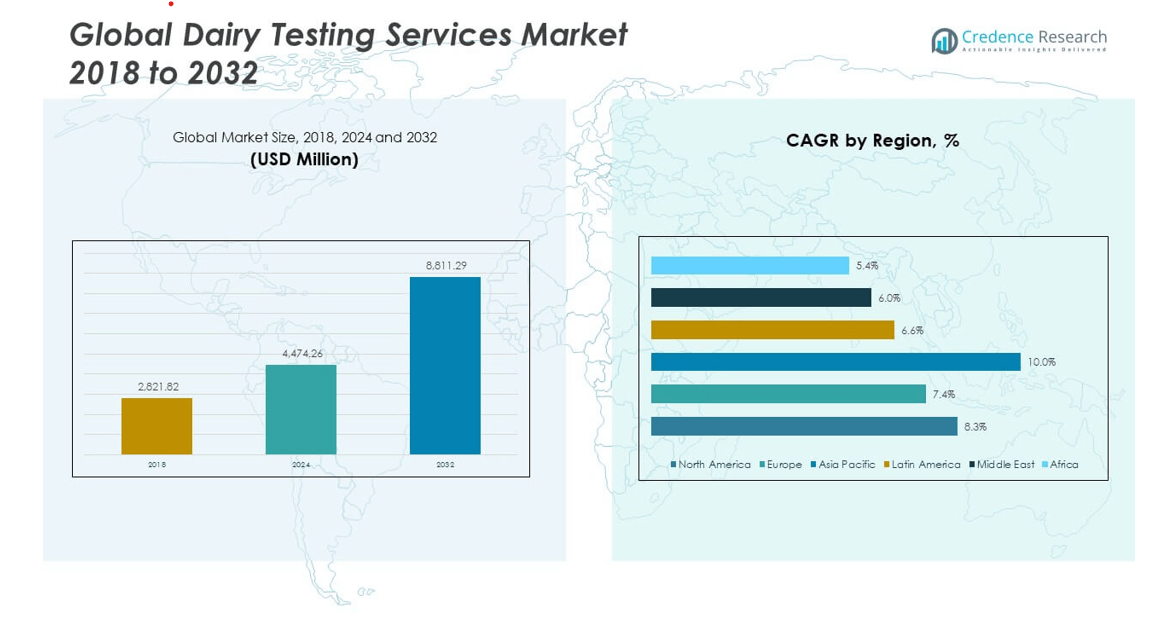
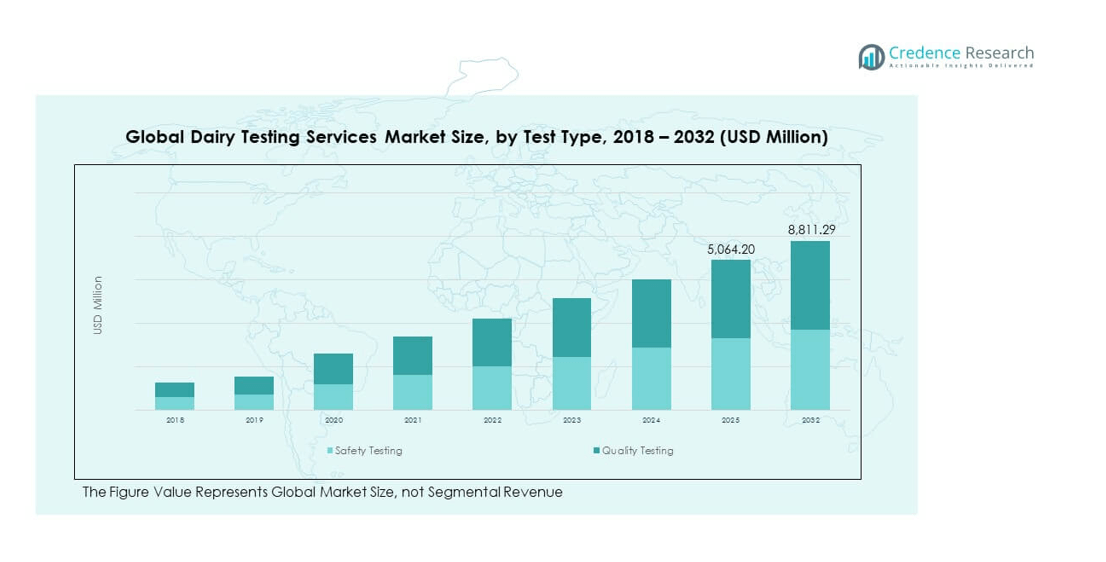
The Global Dairy Testing Services Market size was valued at USD 2,821.82 million in 2018 to USD 4,474.26 million in 2024 and is anticipated to reach USD 8,811.29 million by 2032, at a CAGR of 8.23% during the forecast period. This strong growth highlights the importance of testing in ensuring dairy quality, safety, and compliance with international food standards.
| REPORT ATTRIBUTE | DETAILS |
|---|---|
| Historical Period | 2020-2023 |
| Base Year | 2024 |
| Forecast Period | 2025-2032 |
| Dairy Testing Services Market Size 2024 | USD 4,474.26 million |
| Dairy Testing Services Market, CAGR | 8.23% |
| Dairy Testing Services Market Size 2032 | USD 8,811.29 million |
The market is driven by rising consumer awareness about foodborne illnesses, strict government regulations, and the need for accurate quality monitoring across the dairy supply chain. Growing consumption of dairy products such as milk, cheese, yogurt, and infant formula has further increased reliance on testing services. The demand for microbial, chemical, and nutritional testing has expanded across both developed and emerging markets.
Regional growth varies, with North America and Europe leading adoption due to strict compliance frameworks, while Asia Pacific shows the fastest expansion. Emerging markets in Latin America, the Middle East, and Africa are also investing in testing infrastructure as dairy consumption rises. The market continues to evolve with advanced technologies that improve accuracy, efficiency, and speed in testing processes.
Market Insights:
- The Global Dairy Testing Services Market was valued at USD 2,821.82 million in 2018, reached USD 4,474.26 million in 2024, and is projected to hit USD 8,811.29 million by 2032, registering a CAGR of 8.23%.
- North America (43.3%), Europe (27.8%), and Asia Pacific (19.8%) collectively dominate the market due to strong regulatory frameworks, advanced testing infrastructure, and high dairy consumption patterns.
- Asia Pacific, with a 19.8% share, is the fastest-growing region at a CAGR of 10.0%, driven by rising dairy demand, expanding exports, and increasing awareness of food safety.
- Safety testing accounts for around 55% of the segment share, supported by regulatory mandates to detect pathogens and contaminants in dairy products.
- Quality testing holds nearly 45% share, with growing demand for nutritional profiling, adulteration checks, and assurance of product consistency across global dairy supply chains.
Market Drivers:
Rising Importance of Stringent Food Safety Regulations:
The Global Dairy Testing Services Market is strongly influenced by strict regulatory frameworks that govern food quality and safety. Governments across developed and developing nations have intensified rules to monitor dairy supply chains more effectively. It is essential for producers to comply with microbial, chemical, and nutritional testing standards to maintain licenses and export approvals. Rising cases of contamination in milk and milk-based products have heightened the urgency for compliance testing. International trade requires strict adherence to safety certifications, which pushes producers to adopt third-party testing solutions. The presence of cross-border dairy trade creates higher scrutiny at inspection points. Global harmonization of testing standards, supported by agencies like Codex Alimentarius, encourages broader adoption of testing practices. Overall, increasing regulatory oversight remains one of the strongest catalysts for growth in this market.
- For instance, Eurofins Scientific SE operates over 900 laboratories worldwide and processes more than 1 million dairy samples annually, leveraging advanced microbiological testing technologies to ensure compliance with global safety standards.
Expanding Global Dairy Consumption and Supply Chain Complexity:
Rising consumption of dairy products globally creates a strong need for reliable testing services. Milk, cheese, yogurt, and infant formula are consumed daily, demanding consistent safety validation. It is crucial for producers to ensure their products meet quality standards across domestic and international markets. Supply chain expansion, from farm to retail shelves, increases the number of checkpoints where testing is needed. Growing middle-class populations in emerging economies drive demand for value-added dairy products, raising testing volumes. Multinational dairy brands depend on high-quality testing to maintain consumer trust and safeguard market share. The expansion of online grocery retailing also creates demand for faster quality checks. Increasing dairy consumption directly strengthens the market for safety and quality testing services.
- For instance, in 2023, global milk production surged to approximately 965.7 million tonnes, according to the UN Food and Agriculture Organization (FAO). This figure was driven by a rebound in overall output, particularly strong growth in Asia led by India and China.
Growing Concerns Over Foodborne Illnesses and Contamination Risks:
Foodborne illnesses linked to contaminated dairy products remain a critical global concern. Rising incidences of chemical residues, antibiotic traces, and pathogen outbreaks have amplified awareness of strict dairy testing. It is vital for producers to adopt preventive testing to protect consumer health and avoid costly recalls. Governments are investing in public campaigns that highlight the importance of food safety, further boosting demand. Dairy testing services play a vital role in protecting brand image in competitive markets. Companies are compelled to conduct rigorous quality checks to minimize legal liabilities. Global food safety scandals have raised consumer expectations for transparency in dairy sourcing. These risks reinforce the market’s need for accurate and timely testing solutions.
Advancements in Testing Technologies and Laboratory Capabilities:
Innovation in analytical technologies plays a crucial role in driving the Global Dairy Testing Services Market. Adoption of advanced molecular diagnostics, chromatography, and spectrometry allows faster and more precise results. It is enabling laboratories to process higher sample volumes without compromising accuracy. Automation in dairy testing reduces human error and improves efficiency for large-scale processors. Integration of digital platforms and cloud-based reporting enhances traceability across supply chains. Continuous R&D in rapid detection kits offers dairy processors cost-effective and user-friendly solutions. Emerging technologies allow real-time monitoring, which improves risk management across facilities. The growing shift toward advanced testing capabilities positions the market for sustainable long-term growth.
Market Trends:
Rising Adoption of Rapid and Portable Testing Solutions:
The Global Dairy Testing Services Market is witnessing growing use of rapid test kits and portable devices. Companies are investing in time-saving technologies that deliver accurate results within hours. It is increasingly important for processors and farmers who handle perishable dairy products with short shelf life. Portable testing enables on-site quality checks, reducing delays in supply chain distribution. This trend improves responsiveness in identifying safety concerns before reaching end consumers. Growing preference for cost-efficient and faster testing supports the adoption of portable solutions. Dairy exporters particularly value rapid testing for meeting international shipment deadlines. The shift to faster solutions indicates a strong move toward efficiency-focused testing practices.
- For instance, Rapid microbial contaminant detection, for instance, can cut product hold times by 2 to 12 days, freeing up warehouse space and shortening cash cycles for dairy producers. Technological advancements have improved the sensitivity and reliability of these rapid kits, promoting their broader use, especially by dairy exporters meeting international shipping deadlines.
Integration of Digital Platforms and Data Management Systems:
Digital transformation is reshaping how testing laboratories operate globally. The Global Dairy Testing Services Market benefits from adoption of cloud platforms for reporting and data storage. It is helping processors maintain transparency and traceability across dairy supply chains. Integration of digital systems allows real-time updates and better compliance with food safety audits. The use of AI and big data analytics improves pattern recognition and risk forecasting. Technology adoption strengthens the value of testing by linking data across regions and facilities. Dairy companies now rely on centralized dashboards to track quality benchmarks more efficiently. Growing digital integration creates long-term advantages for testing service providers.
- For instance, Centralized digital dashboards help dairy companies efficiently track quality benchmarks and comply with food safety audits. Large-scale dairy producers are adopting sensor-driven monitoring and smart systems to minimize errors and boost compliance, creating long-term benefits for testing service providers.
Rising Demand for Specialized Testing in Value-Added Dairy Products:
Global demand for specialized dairy products, including organic milk, infant formula, and fortified cheese, is creating new opportunities. The Global Dairy Testing Services Market supports this expansion by offering advanced allergen, nutritional, and residue testing. It is essential for producers to validate claims made on product packaging. Consumers are increasingly attentive to product labeling, which requires accurate laboratory-backed verification. Rising demand for plant-based and hybrid dairy products also drives unique testing requirements. Specialized testing expands beyond safety into ensuring authenticity and quality. This trend aligns with growing consumer interest in healthy, premium dairy categories. Strong focus on specialized products creates niche opportunities for testing providers.
Expansion of Dairy Testing Infrastructure in Emerging Markets:
Emerging economies are investing heavily in laboratory infrastructure to meet rising dairy safety needs. The Global Dairy Testing Services Market benefits as countries like India, China, and Brazil expand their testing capabilities. It is supported by both government-backed programs and private investments in quality control. Growing dairy exports from these regions require adherence to strict international standards. Local processors invest in advanced labs to compete globally and ensure compliance. Rising urbanization and middle-class growth contribute to demand for safer dairy products. Investments in local infrastructure reduce reliance on overseas laboratories, improving testing accessibility. Expanding infrastructure in emerging markets marks a pivotal trend for long-term market growth.\
Market Challenges Analysis:
High Costs and Limited Accessibility of Testing Services:
The Global Dairy Testing Services Market faces challenges due to the high cost of advanced testing technologies. Many small and mid-sized dairy farms struggle to afford regular testing services. It is particularly difficult in emerging markets where margins are tight and awareness is limited. Limited accessibility of accredited laboratories in rural areas restricts widespread adoption. Transporting samples to distant labs adds time and cost, reducing efficiency. Compliance with international standards often requires investment in specialized facilities. These financial barriers limit participation by smaller producers. Addressing cost-related challenges remains critical for wider market penetration.
Complexity in Global Standardization and Regulatory Frameworks:
Global dairy trade involves multiple regulatory authorities with different compliance frameworks. The Global Dairy Testing Services Market faces complexity in aligning these standards. It is challenging for multinational producers to meet varied testing requirements across export destinations. Frequent changes in regulatory norms add operational uncertainty for testing providers. Lack of uniform global standards increases duplication of testing efforts. Producers face delays in shipments due to differing inspection protocols. Regulatory overlaps create confusion and additional expenses for industry participants. Harmonizing standards remains one of the pressing challenges for this sector.
Market Opportunities:
Growing Export-Oriented Dairy Production in Emerging Economies:
The Global Dairy Testing Services Market benefits from expanding dairy exports in emerging markets. Countries such as India, China, and Brazil are ramping up production to serve global demand. It is vital for these producers to comply with safety standards enforced by importing nations. Investments in testing capabilities create opportunities for local laboratories to expand services. Exporters demand accurate testing for chemical residues and nutritional claims to ensure access to developed markets. Rising trade agreements also strengthen opportunities for regional testing providers. Expanding exports directly enhance opportunities for service growth in emerging economies.
Rising Consumer Demand for Transparency and Clean Label Products:
Consumers increasingly demand full transparency in food sourcing and labeling. The Global Dairy Testing Services Market supports this trend by validating claims such as “organic,” “antibiotic-free,” and “non-GMO.” It is essential for producers to back these claims with reliable testing evidence. Dairy companies use third-party testing as a way to strengthen brand trust. Growing consumer interest in sustainability and traceability fuels demand for broader quality checks. Expanding focus on clean label dairy creates consistent opportunities for specialized testing. Providers offering credible validation services are well positioned to capture this demand. Rising consumer scrutiny builds long-term opportunity for market growth.
Market Segmentation Analysis:
By Test Type
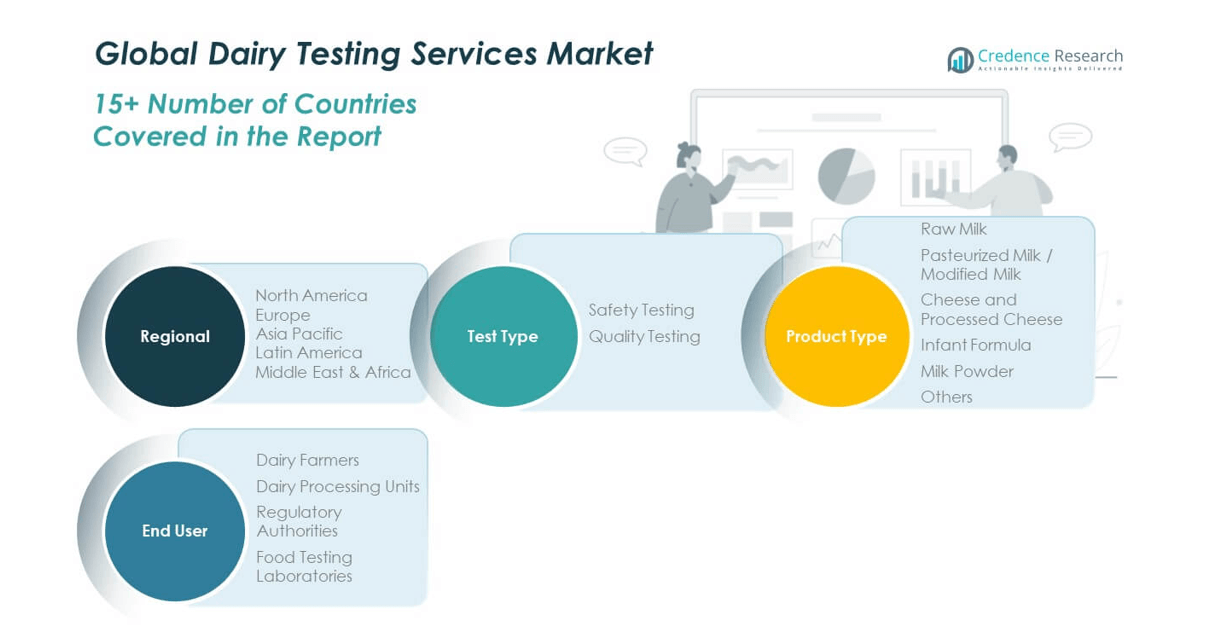
The Global Dairy Testing Services Market is segmented into safety testing and quality testing. Safety testing plays a crucial role in identifying contaminants such as pathogens, antibiotics, and chemical residues, ensuring compliance with stringent safety regulations. Quality testing focuses on nutritional value, composition, and authenticity to meet consumer expectations and labeling requirements. It is critical for producers to adopt both testing types to maintain trust and market access.
- For instance, ALS Limited expanded its testing portfolio through acquisition of Analytica Laboratories, nearly doubling microbiological testing capacity and enhancing chemical residue detection precision by 20%.
By Product Type
The market covers a wide range of dairy products including raw milk, pasteurized milk, cheese, infant formula, milk powder, and others. Raw milk testing dominates demand due to its high vulnerability to contamination during production and transport. Processed categories such as cheese and infant formula require advanced nutritional and allergen testing to meet strict export regulations. Rising consumer focus on fortified and specialty dairy expands the scope for broader product testing.
- For instance, Processed dairy products such as cheese and infant formula require advanced nutritional and allergen testing to comply with strict export standards. With rising consumer interest in fortified and specialty dairy products, the market for diverse product testing continues to expand, encompassing raw milk, pasteurized milk, cheese, infant formula, milk powder, and others.
By End User
Key end users include dairy farmers, processing units, regulatory authorities, and food testing laboratories. Dairy farmers increasingly invest in on-site and rapid testing to ensure safe supply chains. Processing units form the largest segment, driven by compliance needs and large-scale production. Regulatory authorities and independent laboratories support industry-wide enforcement, strengthening credibility and traceability across dairy networks.
Segmentation:
By Test Type:
- Safety Testing
- Quality Testing
By Product Type:
- Raw Milk
- Pasteurized/Modified Milk
- Cheese and Processed Cheese
- Infant Formula
- Milk Powder
- Others
By End User:
- Dairy Farmers
- Dairy Processing Units
- Regulatory Authorities
- Food Testing Laboratories
By Region:
- North America
- U.S.
- Canada
- Mexico
- Europe
- UK
- France
- Germany
- Italy
- Spain
- Russia
- Belgium
- Netherlands
- Austria
- Sweden
- Poland
- Denmark
- Switzerland
- Rest of Europe
- Asia Pacific
- China
- Japan
- South Korea
- India
- Australia
- Thailand
- Indonesia
- Vietnam
- Malaysia
- Philippines
- Taiwan
- Rest of Asia Pacific
- Latin America
- Brazil
- Argentina
- Peru
- Chile
- Colombia
- Rest of Latin America
- Middle East
- UAE
- KSA
- Israel
- Turkey
- Iran
- Rest of Middle East
- Africa
- Egypt
- Nigeria
- Algeria
- Morocco
- Rest of Africa
Regional Analysis:
North America
The North America Global Dairy Testing Services Market size was valued at USD 1,234.11 million in 2018 to USD 1,936.51 million in 2024 and is anticipated to reach USD 3,824.19 million by 2032, at a CAGR of 8.3% during the forecast period. North America accounts for nearly 35% market share in 2024, making it the largest regional contributor. Strong enforcement of food safety regulations by agencies such as the FDA drives high adoption of testing services. The region’s large dairy industry, particularly in the U.S., requires continuous monitoring of raw milk, processed milk, and cheese. It is further supported by consumer demand for transparency in labeling and nutrition claims. Advanced laboratory infrastructure and strong presence of global testing service providers enhance market growth. Canada and Mexico also contribute steadily with expanding dairy exports. High consumer awareness and technological integration reinforce North America’s leadership in this market.
Europe
The Europe Global Dairy Testing Services Market size was valued at USD 813.66 million in 2018 to USD 1,244.37 million in 2024 and is anticipated to reach USD 2,309.59 million by 2032, at a CAGR of 7.4% during the forecast period. Europe holds around 28% market share in 2024, driven by strict EU regulations on dairy quality and safety. Countries like Germany, France, and the UK lead with robust dairy production and export volumes. The EU’s emphasis on standardized food safety protocols creates consistent demand for testing. Quality testing for cheese, infant formula, and processed milk is particularly strong in Europe. It is supported by a mature regulatory environment and established testing laboratories across the region. Rising demand for organic and specialty dairy creates additional need for authentication testing. Eastern Europe is emerging as a growth hotspot, driven by expanding dairy exports. Europe remains a highly regulated but lucrative market for testing services.
Asia Pacific
The Asia Pacific Global Dairy Testing Services Market size was valued at USD 514.54 million in 2018 to USD 888.05 million in 2024 and is anticipated to reach USD 1,992.41 million by 2032, at a CAGR of 10.0% during the forecast period. Asia Pacific contributes around 20% market share in 2024, but it is the fastest-growing region. Rapid urbanization and increasing dairy consumption in China, India, and Southeast Asia fuel demand. Rising middle-class populations prefer processed and fortified dairy, creating testing needs. Governments are investing in stricter safety frameworks and expanding laboratory capacity. It is also supported by growing export demand from countries like India and New Zealand. Technology adoption in testing labs is accelerating, with portable kits gaining popularity. Local dairy processors seek international certifications to access global markets. Asia Pacific is expected to surpass Europe in share by the forecast period due to its high growth rate.
Latin America
The Latin America Global Dairy Testing Services Market size was valued at USD 133.29 million in 2018 to USD 208.71 million in 2024 and is anticipated to reach USD 363.79 million by 2032, at a CAGR of 6.6% during the forecast period. Latin America represents about 5% market share in 2024, led by Brazil and Argentina. Expanding dairy exports to North America and Europe drive testing demand. Dairy processors are focusing on meeting international safety certifications to strengthen competitiveness. Growing consumer awareness in urban centers encourages investments in quality and safety assurance. It is also supported by government-led initiatives to modernize food testing laboratories. Small and medium dairy producers face cost barriers, limiting adoption in rural areas. Regional demand for cheese, powdered milk, and infant formula supports steady testing growth. Latin America remains an emerging but promising market for international service providers.
Middle East
The Middle East Global Dairy Testing Services Market size was valued at USD 79.67 million in 2018 to USD 115.56 million in 2024 and is anticipated to reach USD 192.33 million by 2032, at a CAGR of 6.0% during the forecast period. The region holds around 3% market share in 2024, reflecting its smaller but expanding base. Rising demand for packaged milk and processed dairy products supports testing adoption. GCC countries lead growth due to higher consumer awareness and stronger regulatory enforcement. Investments in local food safety infrastructure also improve testing accessibility. It is critical for the region’s dairy imports, which must meet international safety standards. Local producers in Saudi Arabia and UAE are increasing compliance to build trust. Growing demand for infant nutrition products further strengthens the need for strict testing. While relatively small, the Middle East market shows steady upward growth momentum.
Africa
The Africa Global Dairy Testing Services Market size was valued at USD 46.55 million in 2018 to USD 81.06 million in 2024 and is anticipated to reach USD 128.98 million by 2032, at a CAGR of 5.4% during the forecast period. Africa contributes about 2% market share in 2024, reflecting limited but developing potential. Dairy testing adoption is hindered by high costs and limited infrastructure. South Africa and Egypt lead in regional growth due to relatively advanced dairy industries. Most African countries still face challenges in building accredited testing laboratories. Growing international trade partnerships create pressure to comply with global food safety standards. It is supported by foreign investment in agricultural modernization and food safety initiatives. Rising urban populations increase demand for safer packaged dairy products. Africa remains a long-term opportunity market with gradual expansion of testing services.
Key Player Analysis:
- Eurofins Scientific SE
- SGS SA
- Bureau Veritas
- Intertek Group plc
- ALS Limited
- Merieux NutriSciences
- IDEXX Laboratories Inc.
- TUV SUD
- Agilent Technologies Inc.
- Thermo Fisher Scientific Inc.
Competitive Analysis:
The Global Dairy Testing Services Market is highly competitive with a mix of multinational corporations and regional providers. Key players like Eurofins Scientific, SGS, Bureau Veritas, and Intertek dominate through global networks and advanced testing capabilities. It is marked by ongoing investments in automation, molecular diagnostics, and digital integration to enhance service quality. Strategic partnerships with dairy producers and regulatory agencies strengthen competitive positioning. Market leaders expand footprints through acquisitions and regional laboratory openings. Smaller providers compete by offering cost-effective and specialized services tailored to local markets. Intense competition fosters innovation, service diversification, and faster adoption of portable testing solutions. The industry remains moderately concentrated, with top players controlling a significant global share.
Recent Developments:
- In October 2024, Mérieux NutriSciences announced its agreement to acquire the food testing business of Bureau Veritas for an enterprise value of EUR 360 million. This acquisition significantly enhances Mérieux NutriSciences' global presence by adding 34 laboratories and nearly 1,900 technical staff across 15 countries in the Americas, Africa, and Asia Pacific, doubling its footprint in Canada and Asia-Pacific. The deal expands microbiological, chemical, and molecular testing services in the dairy segment, reinforcing its leadership in food safety and sustainability globally.
- In November 2024, SGS expanded its environmental and food testing services by acquiring Beta Analytic, a leading provider of Carbon-14 age dating and biobased product validation, enhancing SGS's capabilities in sustainability testing in North America. This acquisition supports SGS's objective to innovate and expand its testing solutions in line with increasing regulatory demands and sustainability goals across multiple industries including dairy.
- Intertek Group plc remains a dominant player offering comprehensive dairy industry testing, auditing, and certification services worldwide. Its UKAS accredited labs provide shelf life testing, nutritional analysis, residue detection, and microbiological testing, coupled with customized auditing programs to meet evolving regulatory and industry standards.
- TUV SUD announced in March 2025 an expansion of its chemical testing capabilities with new laboratory facilities to broaden testing options and meet increasing demand for food safety and quality services, including dairy product testing.
Report Coverage:
The research report offers an in-depth analysis based on test type, product type, end user, and region. It details leading market players, providing an overview of their business, product offerings, investments, revenue streams, and key applications. Additionally, the report includes insights into the competitive environment, SWOT analysis, current market trends, as well as the primary drivers and constraints. Furthermore, it discusses various factors that have driven market expansion in recent years. The report also explores market dynamics, regulatory scenarios, and technological advancements that are shaping the industry. It assesses the impact of external factors and global economic changes on market growth. Lastly, it provides strategic recommendations for new entrants and established companies to navigate the complexities of the market.
Future Outlook:
- Rising consumer demand for transparency will fuel testing adoption.
- Growth in dairy exports from Asia Pacific will drive laboratory expansion.
- Portable rapid testing kits will see strong adoption among farmers.
- Regulatory frameworks will continue to tighten across global markets.
- Investment in automation and AI-based analytics will boost accuracy.
- North America and Europe will maintain leadership through compliance enforcement.
- Asia Pacific will emerge as the fastest-growing regional market.
- Specialized testing for organic and fortified products will expand.
- Partnerships between regulators and testing firms will strengthen compliance.
- Smaller players will find niche opportunities in cost-effective local services.

Request a Free Sample
Fill in your details and we'll send you a free sample report.
- Sample data tables & charts
- Research methodology
Market Dynamics
Stringent Food Safety Regulations
Governments worldwide are enforcing stricter regulations on dairy quality and safety, requiring producers to comply with microbial, chemical, and nutritional testing standards. This regulatory pressure drives demand for comprehensive dairy testing services to ensure compliance and maintain export eligibility.
Expanding Global Dairy Consumption and Supply Chain Complexity
Rising consumption of dairy products and increasingly complex supply chains necessitate frequent and reliable testing at multiple checkpoints. This ensures product safety and quality from farm to consumer, especially as international trade and processed dairy categories grow.
Growing Concerns Over Foodborne Illnesses and Contamination
High-profile contamination incidents and foodborne illness outbreaks have heightened awareness among consumers and regulators, compelling dairy producers to adopt rigorous testing protocols to protect public health and brand reputation.
Advancements in Testing Technologies
Innovations such as rapid test kits, molecular diagnostics, and digital data management systems are making dairy testing faster, more accurate, and more accessible. These advancements enable higher testing volumes and real-time monitoring, supporting market growth.
Expansion of Testing Infrastructure in Emerging Markets
Emerging economies are investing in laboratory infrastructure and quality control capabilities to meet rising dairy demand and export requirements. This expansion increases accessibility to testing services and supports market penetration in new regions.
Need a Custom Version of This Report?
Tailor the scope, geography, or segments to your exact requirements.
- Custom geography or segment scope
- Direct access to our analyst team
Frequently Asked Questions
What is the current market size for Global Dairy Testing Services Market, and what is its projected size in 2032?
At what Compound Annual Growth Rate is the Global Dairy Testing Services Market projected to grow between 2025 and 2032?
Which Global Dairy Testing Services Market segment held the largest share in 2024?
Who are the leading companies in the Global Dairy Testing Services Market?
Table of Content
Chapter 1 Market Segmentation
- 1.1 Segmentation Framework
- 1.1.1 Product and Service Classification
- 1.1.2 Application and End-Use Classification
- 1.1.3 Technology and Solution Classification
- 1.1.4 Customer and Distribution Channel Classification
- 1.1.5 Geographic Segmentation
- 1.1.6 Market Segment Definitions and Boundaries
- 1.2 By End User
- 1.2.1 Dairy Farmers
- 1.2.2 Dairy Processing Units
- 1.2.3 Regulatory Authorities
- 1.2.4 Food Testing Laboratories
- 1.3 By Test Type
- 1.3.1 Safety Testing
- 1.3.2 Quality Testing
- 1.4 By Product Type
- 1.4.1 Raw Milk
- 1.4.2 Pasteurized/Modified Milk
- 1.4.3 Cheese and Processed Cheese
- 1.4.4 Infant Formula
- 1.4.5 Milk Powder
- 1.4.6 Others
Chapter 2 Introduction
- 2.1 Report Objectives and Scope
- 2.2 Product Definition and Industry Terminology
- 2.3 Market Inclusions and Exclusions
- 2.4 Research Process
- 2.4.1 Primary Research and Expert Interviews
- 2.4.2 Secondary Research and Source Review
- 2.4.3 Top-Down and Bottom-Up Estimation
- 2.4.4 Data Triangulation and Verification
- 2.5 Market Size Measurement Basis
- 2.5.1 2018: USD 2,821.82 million → 2032: USD 8,811.29 million
- 2.6 Historical and Forecast Reference Periods
- 2.6.1 Base Year: 2018
- 2.6.2 Forecast Period: 2018-2032
- 2.7 Research Assumptions and Limitations
Chapter 3 Executive Summary
- 3.1 Market Snapshot and Key Findings
- 3.2 Base-Year Market Size, 2018
- 3.3 Forecast Market Size, 2032
- 3.4 Revenue and Volume Growth Outlook
- 3.5 Key Demand and Supply Indicators
- 3.6 Leading Market Segments
- 3.7 Fastest-Growing Market Opportunities
- 3.8 Regional Performance Highlights
- 3.9 Technology and Industry Transformation
- 3.10 Competitive Landscape Summary
- 3.11 Analyst View and Strategic Implications
Chapter 4 Global Dairy Testing Services Market Trends and Developments
- 4.1 Historical Industry Development
- 4.2 Recent Market Trends and Developments
- 4.3 Demand and Customer Behavior Trends
- 4.4 Technology and Product Innovation
- 4.5 Artificial Intelligence, Automation and Digitalization
- 4.6 Local Manufacturing and Supply Chain Realignment
- 4.7 Industry Partnerships, Mergers and Acquisitions
- 4.8 Sustainability and Circular Economy Developments
- 4.9 Government and Private Sector Investment Trends
- 4.10 Emerging Business Models and Commercialization
- 4.11 Industry Developments and Announcements
Chapter 5 Global Dairy Testing Services Market Supply and Demand Analysis
- 5.1 Demand Trend and Consumption Analysis
- 5.2 Demand Forecast, 2018-2032
- 5.3 Supply Chain Structure and Procurement Trends
- 5.4 Supply-Demand Gap and Bottlenecks
- 5.5 Import Dependence and Sourcing Structure
- 5.6 Regional Supply and Demand Concentration
Chapter 6 Global Dairy Testing Services Market Pricing Analysis
- 6.1 Pricing Structure and Measurement
- 6.2 Historical Pricing Trends
- 6.3 Pricing Outlook, 2018-2032
- 6.4 Pricing by Product and Market Segment
- 6.5 Geographic Pricing Differences
- 6.6 Key Input, Energy, Labor and Logistics Costs
- 6.7 Contract Pricing and Purchasing Models
- 6.8 Pricing Sensitivity and Competitive Positioning
- 6.9 Price, Margin and Profitability Implications
Chapter 7 Global Dairy Testing Services Market Dynamics
- 7.1 Market Growth Drivers
- 7.1.1 Demand-Side Drivers
- 7.1.2 Technology and Innovation Drivers
- 7.1.3 Infrastructure and Investment Drivers
- 7.1.4 Regulatory and Policy Drivers
- 7.2 Market Restraints
- 7.2.1 Cost and Affordability Constraints
- 7.2.2 Technology and Adoption Barriers
- 7.2.3 Supply Chain and Operational Constraints
- 7.3 Market Challenges
- 7.3.1 Competitive Pressure and Margin Erosion
- 7.3.2 Skills, Infrastructure and Implementation Gaps
- 7.4 Emerging Market Opportunities
- 7.5 Market Dynamics Impact and Time-Horizon Assessment
Chapter 8 Global Dairy Testing Services Value Chain Analysis
- 8.1 Industry Value Chain Overview
- 8.2 Upstream Suppliers and Critical Inputs
- 8.3 Technology and Component Providers
- 8.4 Manufacturing or Service Delivery
- 8.5 Distribution, Channel Partners and Integrators
- 8.6 Downstream Applications and End Users
- 8.7 Value Addition and Profit Pools
- 8.8 Vertical Integration and Outsourcing
- 8.9 Supplier Concentration and Risk
- 8.10 Supply Chain Localization and Resilience
Chapter 9 Global Dairy Testing Services Market Regulations and Policies
- 9.1 Relevant Laws, Standards and Compliance Frameworks
- 9.2 Product, Service, Safety and Quality Requirements
- 9.3 Government Policies, Incentives and Subsidies
- 9.4 Imports, Exports and Trade Barriers
- 9.5 Public Procurement and Local Content Requirements
- 9.6 Data Protection, AI and Cybersecurity Compliance
- 9.7 Upcoming Policy Changes and Market Implications
Chapter 10 Global Dairy Testing Services Market Hotspots and Opportunities
- 10.1 Market Opportunity Mapping and Growth Hotspots
- 10.2 High-Growth Applications and Customer Groups
- 10.3 Underserved Markets and White-Space Opportunities
- 10.4 Emerging Technology and Product Opportunities
- 10.5 New Capacity and Investment Hotspots
- 10.6 Market Entry and Expansion Opportunities
- 10.7 Distribution and Partnership Opportunities
- 10.8 Near-Term and Long-Term Commercial Potential
- 10.9 Opportunity Attractiveness and Execution Risks
Chapter 11 Global Dairy Testing Services Market Outlook, 2018-2032
- 11.1 Market Size and Analysis
- 11.1.1 Revenue (Market Measurement: 2018: USD 2,821.82 million → 2032: USD 8,811.29 million)
- 11.1.2 Historical Market Size
- 11.1.3 Base-Year Market Size, 2018
- 11.2 Market Forecast, 2018-2032
- 11.2.1 Revenue Forecast to 2032
- 11.2.2 CAGR and Year-on-Year Growth
- 11.2.3 Incremental Revenue Opportunity
- 11.3 Forecast Assumptions and Scenario Analysis
- 11.3.1 Base-Case Forecast
- 11.3.2 Optimistic and Conservative Scenarios
- 11.3.3 Technology, Pricing and Policy Sensitivities
- 11.4 Market Attractiveness and Growth Outlook
Chapter 12 Global Dairy Testing Services Market Segmentation and Outlook
- 12.1 Segmentation Summary and Market Shares, 2018
- 12.2 Largest and Fastest-Growing Segments
- 12.3 By End User - Market Size and Forecast, 2018-2032
- 12.3.1 Segment Definition and Scope
- 12.3.2 Historical Market Size
- 12.3.3 Revenue Forecast, 2018-2032
- 12.3.4 Base-Year Market Share, 2018
- 12.3.5 Segment CAGR and Growth Drivers
- 12.3.6 Subsegment Market Size and Forecast
- 12.3.6.1 Dairy Farmers
- 12.3.6.2 Dairy Processing Units
- 12.3.6.3 Regulatory Authorities
- 12.3.6.4 Food Testing Laboratories
- 12.3.7 Subsegment Pricing and Adoption Trends
- 12.3.8 Leading Suppliers and Competition
- 12.3.9 Regional Demand and Opportunities
- 12.4 By Test Type - Market Size and Forecast, 2018-2032
- 12.4.1 Segment Definition and Scope
- 12.4.2 Historical Market Size
- 12.4.3 Revenue Forecast, 2018-2032
- 12.4.4 Base-Year Market Share, 2018
- 12.4.5 Segment CAGR and Growth Drivers
- 12.4.6 Subsegment Market Size and Forecast
- 12.4.6.1 Safety Testing
- 12.4.6.2 Quality Testing
- 12.4.7 Subsegment Pricing and Adoption Trends
- 12.4.8 Leading Suppliers and Competition
- 12.4.9 Regional Demand and Opportunities
- 12.5 By Product Type - Market Size and Forecast, 2018-2032
- 12.5.1 Segment Definition and Scope
- 12.5.2 Historical Market Size
- 12.5.3 Revenue Forecast, 2018-2032
- 12.5.4 Base-Year Market Share, 2018
- 12.5.5 Segment CAGR and Growth Drivers
- 12.5.6 Subsegment Market Size and Forecast
- 12.5.6.1 Raw Milk
- 12.5.6.2 Pasteurized/Modified Milk
- 12.5.6.3 Cheese and Processed Cheese
- 12.5.6.4 Infant Formula
- 12.5.6.5 Milk Powder
- 12.5.6.6 Others
- 12.5.7 Subsegment Pricing and Adoption Trends
- 12.5.8 Leading Suppliers and Competition
- 12.5.9 Regional Demand and Opportunities
- 12.6 Segment Growth Comparison
- 12.7 Segment Attractiveness and Priority Matrix
Chapter 13 Global Dairy Testing Services End-Use and Application Market Outlook
- 13.1 End-Use Industry and Customer Demand Structure
- 13.2 Leading Applications and Customer Groups
- 13.3 End-Use Market Size, Share and Forecast
- 13.4 Major End-Use Industry Deep Dives
- 13.4.1 Customer Requirements and Use Cases
- 13.4.2 Demand and Replacement Cycles
- 13.4.3 Technical and Regulatory Considerations
- 13.4.4 Purchasing and Procurement Models
- 13.4.5 Leading Vendors and Distribution Channels
- 13.4.6 Forecast and Commercial Opportunities
- 13.5 Emerging Applications and Cross-Segment Demand
- 13.6 End-Use Industry Investment Priorities
Chapter 14 Global Dairy Testing Services Geographic Market Outlook, 2018-2032
- 14.1 Regional Market Size and Share, 2018
- 14.2 Regional Market Forecast, 2018-2032
- 14.3 Regional Pricing, Production and Demand Differences
- 14.4 North America
- 14.4.1 United States
- 14.4.2 Canada
- 14.4.3 Mexico
- 14.5 Europe
- 14.5.1 Germany
- 14.5.2 France
- 14.5.3 Italy
- 14.5.4 United Kingdom
- 14.5.5 Spain
- 14.5.6 Poland
- 14.5.7 Russia
- 14.5.8 Netherlands
- 14.5.9 Belgium
- 14.5.10 Sweden
- 14.5.11 Denmark
- 14.5.12 Norway
- 14.5.13 Rest of Europe
- 14.6 Asia Pacific
- 14.6.1 China
- 14.6.2 India
- 14.6.3 Japan
- 14.6.4 South Korea
- 14.6.5 Thailand
- 14.6.6 Indonesia
- 14.6.7 Vietnam
- 14.6.8 Malaysia
- 14.6.9 Australia
- 14.6.10 Rest of Asia Pacific
- 14.7 Latin America
- 14.7.1 Brazil
- 14.7.2 Argentina
- 14.7.3 Colombia
- 14.7.4 Chile
- 14.7.5 Rest of Latin America
- 14.8 Middle East
- 14.8.1 Saudi Arabia
- 14.8.2 United Arab Emirates
- 14.8.3 Turkey
- 14.8.4 Israel
- 14.8.5 Iran
- 14.8.6 Rest of the Middle East
- 14.9 Africa
- 14.9.1 South Africa
- 14.9.2 Egypt
- 14.9.3 Nigeria
- 14.9.4 Morocco
- 14.9.5 Rest of Africa
- 14.10 Regional Investment, Policy and Supply Chain Differences
- 14.11 Regional Competitive Landscape
- 14.12 Geographic Growth Hotspots
Chapter 15 Global Dairy Testing Services Technology, Innovation and Sustainability Outlook
- 15.1 Technology Landscape and Maturity
- 15.2 Product, Process and Service Innovation
- 15.3 AI, Automation and Digital Tools in the Industry
- 15.4 Technology Adoption and Performance Benchmarking
- 15.5 Innovation Pipeline and R&D Investment
- 15.6 Energy Efficiency and Resource Management
- 15.7 Sustainability, Recycling and Circularity
- 15.8 Technology Roadmap, 2018-2032
- 15.9 Risks of Obsolescence and Technology Substitution
Chapter 16 Global Dairy Testing Services Market Key Strategic Imperatives
- 16.1 Growth and Market Entry Priorities
- 16.2 High-Return Products and Segments
- 16.3 Pricing, Profitability and Cost Optimization
- 16.4 Technology Investment and Product Differentiation
- 16.5 Supply Chain Localization and Resilience
- 16.6 Distribution and Customer Acquisition
- 16.7 Partnership, Acquisition and Capacity Strategy
- 16.8 Regional Expansion Priorities
- 16.9 Short-, Medium- and Long-Term Actions
Chapter 17 Competition Outlook
- 17.1 Industry Competition Characteristics
- 17.2 Market Structure and Concentration
- 17.3 Market Share and Competitive Positioning, 2018
- 17.4 Company-Wise Revenue and Product Benchmarking
- 17.5 Production and Service Capacity Benchmarking
- 17.6 Technology, Pricing and Differentiation
- 17.7 Regional Footprint and Distribution Strength
- 17.8 Mergers, Acquisitions and Strategic Alliances
- 17.9 New Entrants and Competitive Threats
- 17.10 Porter's Five Forces and Industry Attractiveness
- 17.11 Competitive Outlook, 2018-2032
Chapter 18 Company Profiles
- 18.1 Company Coverage and Selection Criteria
- 18.2 Eurofins Scientific SE
- 18.2.1 Business Description
- 18.2.2 Company Ownership and Geographic Presence
- 18.2.3 Product and Service Portfolio
- 18.2.4 Manufacturing and Operating Footprint
- 18.2.5 Financial Performance and Investment
- 18.2.6 Market Share and Competitive Position
- 18.2.7 Technology and Innovation Capabilities
- 18.2.8 Strategic Alliances or Partnerships
- 18.2.9 Recent Developments
- 18.2.10 Growth Strategy and Outlook
- 18.3 SGS SA
- 18.4 Bureau Veritas
- 18.5 Intertek Group plc
- 18.6 ALS Limited
- 18.7 Merieux NutriSciences
- 18.8 IDEXX Laboratories Inc.
- 18.9 TUV SUD
- 18.10 Agilent Technologies Inc.
- 18.11 Thermo Fisher Scientific Inc.
- 18.12 Other Relevant Market Participants
Note: Every listed company is profiled on the structure shown under the first company. The company list is preliminary and may change based on research findings, market developments, data availability and client requirements.
Chapter 19 Disclaimer
- 19.1 Research and Forecast Disclaimer
- 19.2 Data Source and Estimation Limitations
Note: The depth of individual sections depends on data availability for this market. Volume, capacity, trade and other unit-based metrics are included where applicable.

