Market Overview:
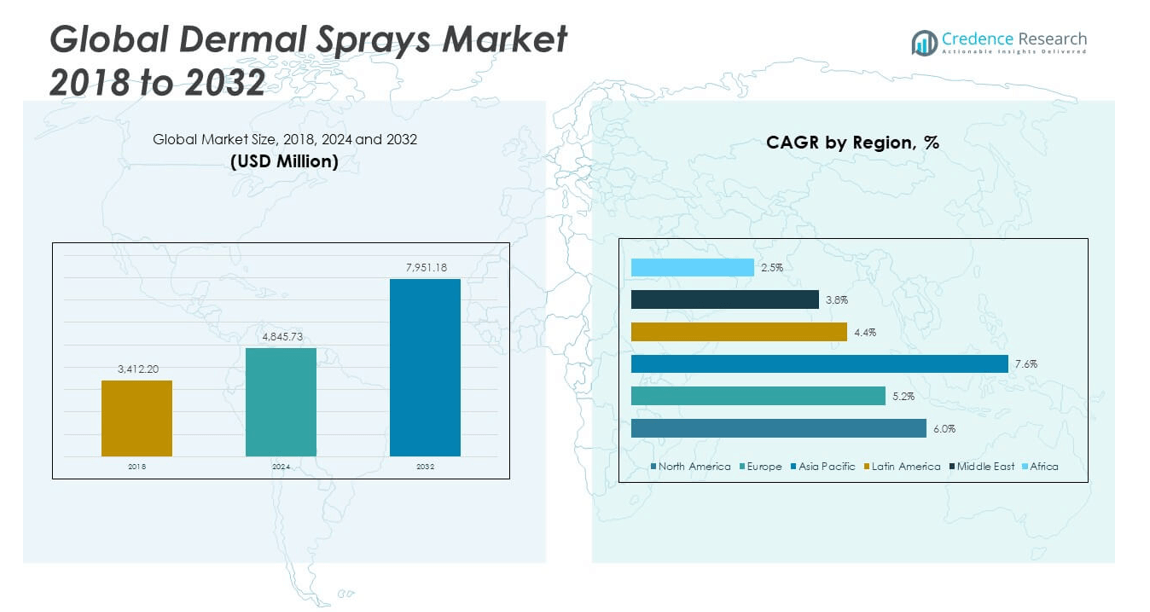
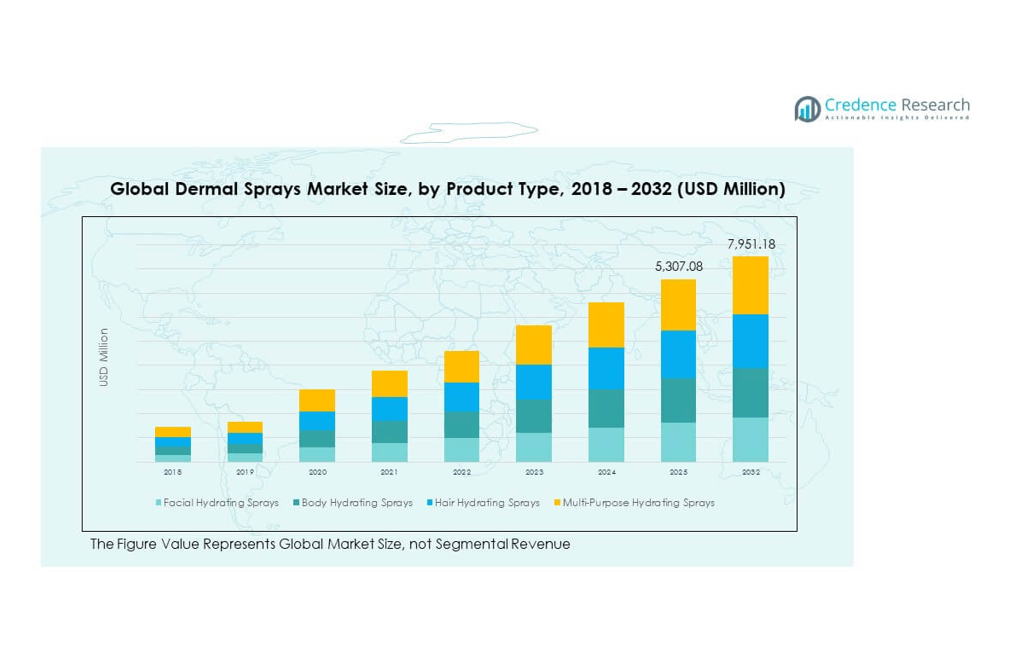
The Global Dermal Sprays Market size was valued at USD 3,412.20 million in 2018 to USD 4,845.73 million in 2024 and is anticipated to reach USD 7,951.18 million by 2032, at a CAGR of 5.95% during the forecast period.
| REPORT ATTRIBUTE | DETAILS |
|---|---|
| Historical Period | 2020-2023 |
| Base Year | 2024 |
| Forecast Period | 2025-2032 |
| Dermal Sprays Market Size 2024 | USD 4,845.73 million |
| Dermal Sprays Market, CAGR | 5.95% |
| Dermal Sprays Market Size 2032 | USD 7,951.18 million |
The market growth is driven by the increasing prevalence of skin disorders, rising consumer awareness about advanced wound care, and the demand for convenient drug delivery formats. Expanding applications of dermal sprays in treating burns, chronic wounds, and infections support their adoption across healthcare settings. The growing preference for non-invasive treatment methods, combined with product innovation focusing on faster healing, is reinforcing market momentum.
Geographically, North America leads due to advanced healthcare infrastructure and strong adoption of innovative skin therapies, while Europe follows with significant demand for chronic wound management solutions. Asia Pacific is emerging as the fastest-growing region, driven by increasing healthcare investments, rising patient awareness, and expanding access to dermatology treatments. Latin America and the Middle East & Africa also show growth potential, supported by improving medical infrastructure and increasing demand for affordable dermal care products.

Market Insights:
- The Global Dermal Sprays Market was valued at USD 3,412.20 million in 2018, reached USD 4,845.73 million in 2024, and is projected to hit USD 7,951.18 million by 2032, growing at a CAGR of 5.95%.
- North America held the largest share of 43.2% in 2024, driven by advanced healthcare infrastructure, followed by Europe with 27.6% due to strong dermatology adoption, and Asia Pacific with 20.2% supported by rising disposable incomes.
- Asia Pacific is the fastest-growing region, supported by a CAGR of 7.6% and driven by expanding middle-class demand, digital retail penetration, and rising skincare awareness.
- Facial hydrating sprays accounted for 41% of the 2024 market share, reflecting their dominance in skincare routines and cosmetic applications.
- Body hydrating sprays captured 28% of the market in 2024, supported by rising demand for after-sun and all-day hydration solutions, particularly in warmer climates.
Market Drivers
Rising Demand for Advanced Wound Care Solutions Across Healthcare Facilities
The demand for advanced wound care is one of the strongest growth factors. Hospitals and clinics increasingly prefer dermal sprays for their efficiency in wound management. They offer faster application, reduced contamination risks, and better healing outcomes. The Global Dermal Sprays Market benefits from rising cases of chronic wounds and burns. Growing patient awareness about modern wound care solutions also supports adoption. It strengthens the role of dermal sprays in reducing infection rates. Healthcare professionals recognize their ease of use in emergency and critical care. This preference drives consistent market expansion. Enhanced government support for advanced wound management also encourages broader adoption.
- For example, Smith+Nephew’s PICO Single-Use Negative Pressure Wound Therapy system has been recognized by NICE in 2024 for improving outcomes by reducing surgical site infections and complications compared to standard dressings. This highlights the value of advanced wound care technologies in supporting recovery and lowering infection risks.
Expanding Applications in Skin Disorders and Post-Surgical Care Treatments
Dermal sprays are finding wider applications in dermatology and post-surgical care. They provide non-invasive options for treating infections, ulcers, and burns. The Global Dermal Sprays Market experiences strong demand due to rising incidences of skin disorders. It offers effective drug delivery in post-surgical recovery where topical healing is crucial. Sprays are designed to improve compliance among patients seeking painless alternatives. Growing acceptance across dermatology clinics further strengthens their role. Patients and caregivers find them more convenient than traditional ointments. These applications drive continuous growth momentum across healthcare segments. Increasing R&D investment enhances treatment potential for complex conditions.
Technological Advancements Leading to Improved Formulations and Delivery Systems
Innovation plays a crucial role in shaping demand for dermal sprays. Companies invest in advanced formulations with faster absorption and better skin penetration. The Global Dermal Sprays Market grows stronger due to integration of smart delivery systems. It enables targeted therapy and controlled release for better clinical outcomes. Manufacturers also introduce sprays with natural and biocompatible ingredients. This innovation improves safety and reduces side effects for sensitive users. Enhanced packaging and spray mechanisms boost usability and storage convenience. Technology adoption makes dermal sprays highly competitive within the wound care market. Strategic partnerships with research institutes further accelerate innovation pipelines.
- For example, in April 2025, Convatec received regulatory approval for ConvaNiox™, a nitric oxide–generating multimodal dressing that demonstrated faster healing in diabetic foot ulcers compared to standard care.
Growing Consumer Preference for Non-Invasive and User-Friendly Healthcare Solutions
Consumers today increasingly favor non-invasive treatment options. Dermal sprays meet this demand by offering painless application. The Global Dermal Sprays Market benefits from strong consumer inclination toward convenient healthcare. It aligns with the trend of at-home treatments and over-the-counter care. Patients find sprays easy to use without professional supervision. This trend reduces reliance on invasive procedures and drives market adoption. Growing awareness campaigns highlight their benefits over creams and gels. Manufacturers strengthen consumer trust through branding and educational efforts. Expanding retail accessibility ensures these products reach wider consumer groups.
Market Trends
Increasing Adoption of Natural and Sustainable Formulations by Manufacturers
Manufacturers are focusing on natural formulations with eco-friendly components. The Global Dermal Sprays Market reflects this shift as demand rises for safer options. It addresses consumer concerns about chemical exposure and long-term side effects. Sprays now feature plant-based extracts and biodegradable packaging. This approach also aligns with regulatory support for sustainable healthcare. Growing environmental awareness pushes brands to highlight green credentials. Many companies integrate clean-label claims to attract health-conscious users. The trend enhances competitive differentiation across both developed and emerging regions. Expanding global sustainability targets are expected to drive future product development.
Integration of Digital Tools and Smart Packaging for Consumer Engagement
The use of digital solutions is reshaping how dermal sprays reach consumers. Smart packaging with QR codes enables instant access to usage instructions. The Global Dermal Sprays Market benefits as companies link sprays with apps for reminders. It helps improve patient compliance and treatment effectiveness. Brands use digital platforms to educate users about safe application. Smart packaging also strengthens supply chain monitoring and authenticity checks. Consumers trust products with traceable and transparent labeling. This trend connects healthcare with digital transformation in patient care. Growing demand for connected healthcare tools reinforces adoption of such innovations.
- For example, QR-enabled packaging is increasingly being adopted in wound care products to provide consumers with easy access to usage instructions and product information, supporting stronger engagement and trust.
Rising Penetration of Over-the-Counter and E-Commerce Distribution Channels
E-commerce platforms are expanding access to dermal sprays globally. The Global Dermal Sprays Market grows as consumers prefer online purchasing convenience. It provides wider product availability and competitive pricing. Over-the-counter sales are also rising in pharmacies and retail outlets. This trend supports stronger adoption in emerging economies with growing healthcare retail. Direct-to-consumer brands invest heavily in digital-first strategies. Increased online visibility builds consumer trust and accessibility. The expansion of distribution channels reshapes demand dynamics across regions. Strong collaborations with retail giants further expand market presence.
- For example, E-commerce platforms such as Amazon and Walmart play a growing role in dermal spray distribution, reflecting strong consumer adoption through digital channels.
Strong Focus on Personalization and Niche Product Development Strategies
Consumers increasingly seek personalized skin and wound care solutions. The Global Dermal Sprays Market responds with niche formulations for specific conditions. It includes sprays tailored for burns, acne, diabetic wounds, and infections. Customization helps brands build stronger consumer loyalty. Manufacturers differentiate with specialized packaging and product sizes. The trend also creates opportunities for premium pricing. Healthcare providers recommend products designed for targeted needs. This focus on personalization is reshaping product innovation and competitive positioning. Increasing adoption of AI in product design supports deeper personalization.

Market Challenges Analysis
High Regulatory Barriers and Complex Approval Processes for New Products
The regulatory environment poses challenges for manufacturers. The Global Dermal Sprays Market faces strict approval processes for new formulations. It requires significant investment in clinical trials and safety testing. Regulatory frameworks differ across regions, complicating global launches. Delays in approvals slow innovation and time-to-market. Smaller companies struggle with high compliance costs. Complex documentation also raises barriers for emerging market entry. These challenges limit the speed of adoption across healthcare systems. Continuous changes in standards further add to compliance burdens.
Price Sensitivity and Limited Awareness Across Developing Markets
Price sensitivity restricts access to dermal sprays in cost-conscious regions. The Global Dermal Sprays Market experiences slower adoption where healthcare spending is low. It creates barriers for penetration into rural and underserved populations. Consumers often lack awareness of modern wound care solutions. Traditional remedies remain preferred in certain areas. Limited distribution networks further reduce availability in developing countries. It restricts growth potential despite growing healthcare needs. Addressing these challenges requires strong education and pricing strategies. Government-led awareness programs could play a critical role in overcoming barriers.
Market Opportunities
Expansion Potential in Emerging Economies with Growing Healthcare Infrastructure
Emerging economies offer strong opportunities for growth. The Global Dermal Sprays Market benefits from expanding healthcare infrastructure in Asia and Latin America. It aligns with rising patient awareness and demand for advanced wound care. Governments invest in better healthcare delivery across urban and rural areas. Growing medical tourism also creates opportunities for global brands. Increasing disposable incomes allow higher spending on modern treatments. Companies targeting these regions can achieve significant revenue growth. Strategic distribution partnerships will further accelerate penetration in emerging economies.
Product Innovation for Specialized Applications and Wider Consumer Segments
Product innovation opens new opportunities across consumer and medical segments. The Global Dermal Sprays Market expands as brands design sprays for specific conditions. It includes diabetic wound sprays, acne control, and scar management products. Personalized healthcare fuels demand for such targeted solutions. Innovation also supports premium product positioning. Companies offering unique features gain competitive advantage. This opportunity strengthens long-term market growth strategies. Rising collaborations between research labs and manufacturers will foster breakthrough products.
Market Segmentation Analysis:
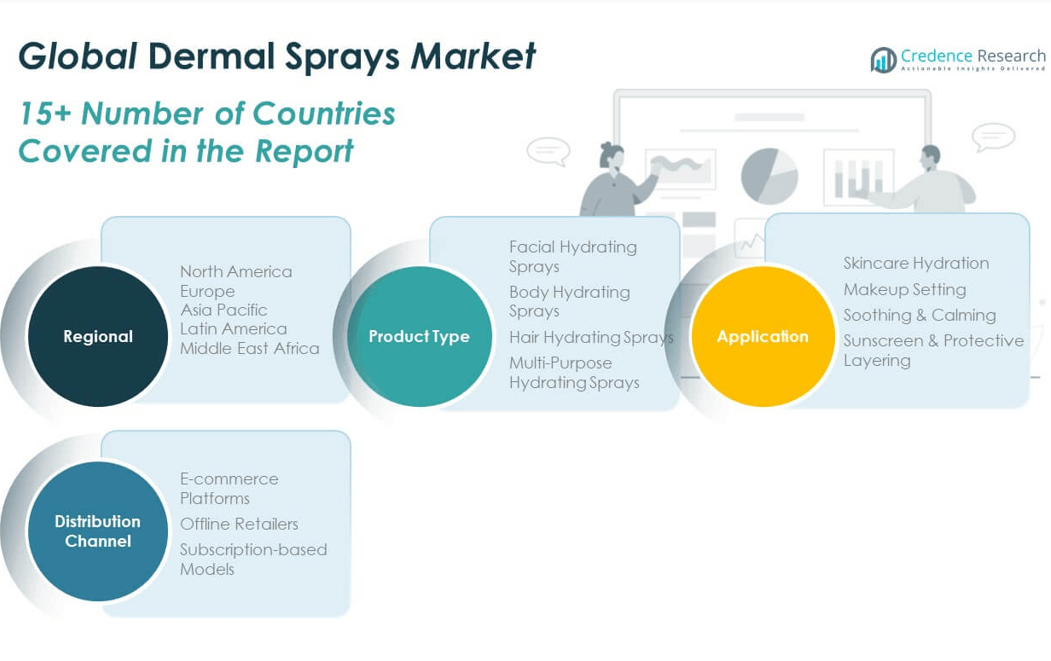
The Global Dermal Sprays Market is segmented
By product type into facial hydrating sprays, body hydrating sprays, hair hydrating sprays, and multi-purpose hydrating sprays. Facial hydrating sprays hold a strong position due to their wide use in skincare and cosmetic routines. Body hydrating sprays follow with growing demand for all-day moisture and after-sun care. Hair hydrating sprays capture niche demand from consumers seeking scalp-friendly and styling solutions. Multi-purpose sprays gain traction for their versatility across skin, hair, and daily refreshment needs, offering value-driven options to consumers.
- For example, Hanni’s Water Balm Mist features hyaluronic acid and red algae extract, offering deep hydration and supporting the skin barrier. It comes in a 6.76 oz travel-friendly size and is praised for summer and after-sun care.
By application, segmentation includes skincare hydration, makeup setting, soothing and calming, and sunscreen and protective layering. Skincare hydration dominates due to high daily usage and dermatologist recommendations. Makeup setting sprays drive growth within beauty-focused consumers seeking long-lasting wear. Soothing and calming sprays appeal to sensitive skin users and those managing irritations. Sunscreen and protective layering sprays expand as consumers prefer lightweight formats for sun protection and pollution defense.
- For example, ZEESEA’s Vitamin C Hydrating Makeup Setting Spray highlights a long-lasting and hydrating formula, gaining popularity among makeup users seeking extended wear. It has performed strongly in online sales channels.
By distribution channel segmentation covers e-commerce platforms, offline retailers, and subscription-based models. E-commerce platforms lead growth by offering convenience, product variety, and price transparency. Offline retailers retain importance through experiential shopping and brand visibility. Subscription-based models gain popularity for recurring skincare needs, fostering stronger brand loyalty. Together, these channels shape a dynamic distribution landscape that ensures accessibility and global consumer reach.

Segmentation:
By Product Type
- Facial Hydrating Sprays
- Body Hydrating Sprays
- Hair Hydrating Sprays
- Multi-Purpose Hydrating Sprays
By Application
- Skincare Hydration
- Makeup Setting
- Soothing & Calming
- Sunscreen & Protective Layering
By Distribution Channel
- E-commerce Platforms
- Offline Retailers
- Subscription-based Models
By Region
- North America
- U.S.
- Canada
- Mexico
- Europe
- UK
- France
- Germany
- Italy
- Spain
- Russia
- Belgium
- Netherlands
- Austria
- Sweden
- Poland
- Denmark
- Switzerland
- Rest of Europe
- Asia Pacific
- China
- Japan
- South Korea
- India
- Australia
- Thailand
- Indonesia
- Vietnam
- Malaysia
- Philippines
- Taiwan
- Rest of Asia Pacific
- Latin America
- Brazil
- Argentina
- Peru
- Chile
- Colombia
- Rest of Latin America
- Middle East
- UAE
- KSA
- Israel
- Turkey
- Iran
- Rest of Middle East
- Africa
- Egypt
- Nigeria
- Algeria
- Morocco
- Rest of Africa
Regional Analysis:
North America
The North America Global Dermal Sprays Market size was valued at USD 1,488.90 million in 2018 to USD 2,092.44 million in 2024 and is anticipated to reach USD 3,442.94 million by 2032, at a CAGR of 6.0% during the forecast period. North America holds the largest regional market share of 43.2% in 2024. The region benefits from strong healthcare infrastructure and rising demand for advanced wound care solutions. The Global Dermal Sprays Market in North America is supported by widespread adoption of premium skincare and beauty products. It gains further strength from high awareness of non-invasive treatments and growing consumer spending. The presence of global cosmetic brands drives innovation and competitive intensity. E-commerce expansion ensures wider consumer reach, while offline retail continues to play a critical role. The U.S. leads the market, with Canada and Mexico showing steady growth.
Europe
The Europe Global Dermal Sprays Market size was valued at USD 976.69 million in 2018 to USD 1,337.46 million in 2024 and is anticipated to reach USD 2,067.36 million by 2032, at a CAGR of 5.2% during the forecast period. Europe accounts for 27.6% of the market share in 2024. Strong consumer preference for dermatology-backed products drives adoption. The Global Dermal Sprays Market in Europe is reinforced by rising incidences of chronic skin conditions and burn cases. It benefits from well-regulated cosmetic and pharmaceutical industries across Germany, France, and the UK. Growth is also supported by increasing use of sprays in post-surgical care. Natural and sustainable formulations gain popularity, reflecting European consumer values. Retail pharmacies dominate distribution, though online sales are expanding. Southern and Eastern Europe show rising potential due to evolving healthcare infrastructure.
Asia Pacific
The Asia Pacific Global Dermal Sprays Market size was valued at USD 635.85 million in 2018 to USD 981.16 million in 2024 and is anticipated to reach USD 1,829.73 million by 2032, at a CAGR of 7.6% during the forecast period. Asia Pacific captures 20.2% of the global market share in 2024. Strong growth is driven by rising healthcare investments, rapid urbanization, and increasing skincare awareness. The Global Dermal Sprays Market in this region gains momentum from the expanding middle-class population with higher disposable incomes. It benefits from the popularity of K-beauty and J-beauty trends influencing product innovation. China, Japan, South Korea, and India are leading contributors. E-commerce platforms are critical for distribution due to high digital penetration. Local and global brands compete aggressively, offering affordable and premium products. Medical tourism further enhances adoption of advanced dermal solutions.
Latin America
The Latin America Global Dermal Sprays Market size was valued at USD 164.96 million in 2018 to USD 231.42 million in 2024 and is anticipated to reach USD 337.11 million by 2032, at a CAGR of 4.4% during the forecast period. Latin America holds a 4.8% share of the market in 2024. Growth is supported by increasing demand for affordable skincare and wound care solutions. The Global Dermal Sprays Market in Latin America is influenced by rising adoption of cosmetic sprays in Brazil and Mexico. Urban centers show strong interest in personal care products. Distribution channels are expanding through retail partnerships and online platforms. Consumer awareness is improving, though price sensitivity remains a challenge. Multinational players are investing in regional expansion to capture the growing base. Rising healthcare programs also create demand for advanced wound care sprays.
Middle East
The Middle East Global Dermal Sprays Market size was valued at USD 99.75 million in 2018 to USD 130.00 million in 2024 and is anticipated to reach USD 181.51 million by 2032, at a CAGR of 3.8% during the forecast period. It accounts for 2.7% of the global market share in 2024. The Global Dermal Sprays Market in the Middle East benefits from rising investments in healthcare and dermatology clinics. Demand is driven by lifestyle-related skincare needs and a growing beauty-conscious population. GCC countries dominate with higher spending on premium skincare. Expansion of modern retail formats and e-commerce platforms supports product penetration. Consumers increasingly seek imported brands for quality and effectiveness. Limited local manufacturing offers opportunities for international players. Awareness campaigns are gradually improving adoption beyond urban centers.
Africa
The Africa Global Dermal Sprays Market size was valued at USD 46.05 million in 2018 to USD 73.25 million in 2024 and is anticipated to reach USD 92.53 million by 2032, at a CAGR of 2.5% during the forecast period. Africa holds a 1.5% market share in 2024. The Global Dermal Sprays Market in Africa is constrained by limited awareness and affordability issues. Growth is mainly concentrated in South Africa, Egypt, and urban areas with expanding retail networks. Demand is rising for basic hydration sprays and protective solutions. Distribution challenges and reliance on imports slow wider adoption. Governments and NGOs promoting healthcare access could improve market reach. E-commerce penetration is growing but remains limited outside major cities. International companies entering the region focus on affordable and accessible product lines.
Key Player Analysis:
- L’Oréal S.A.
- Estée Lauder Companies
- Shiseido Company, Limited
- Unilever PLC
- Beiersdorf AG
- Coty Inc.
- Clarins Group
- Johnson & Johnson Consumer Inc.
- Amorepacific Corporation
- Procter & Gamble Co.
- The Body Shop International
- Avon Products, Inc.
Competitive Analysis:
The Global Dermal Sprays Market is highly competitive, with multinational corporations and regional players driving innovation and growth. Leading companies such as L’Oréal, Estée Lauder, Shiseido, Unilever, Beiersdorf, Coty, Clarins, Johnson & Johnson, Amorepacific, Procter & Gamble, The Body Shop, and Avon dominate through strong brand equity and diverse product portfolios. It benefits from continuous investment in R&D, enabling the launch of advanced formulations with natural ingredients and multifunctional benefits. Companies compete on product differentiation, distribution reach, and consumer engagement strategies. E-commerce expansion allows emerging brands to challenge established players through direct-to-consumer models. Strategic mergers, acquisitions, and regional partnerships strengthen global presence. Competitive intensity remains high due to growing consumer preference for sustainable, personalized, and non-invasive solutions. Innovation pipelines and marketing campaigns continue to shape market positioning while pricing strategies influence adoption across both premium and mass-market segments.
Recent Developments:
- In May 2025, Aptar Beauty made a significant move in the global dermal sprays market by launching its new Derma Series, featuring high-performance packaging and dispensing solutions tailored for dermocosmetic and medical aesthetics products.
Report Coverage:
The research report offers an in-depth analysis based on Product Type, Application, Distribution Channel. It details leading market players, providing an overview of their business, product offerings, investments, revenue streams, and key applications. Additionally, the report includes insights into the competitive environment, SWOT analysis, current market trends, as well as the primary drivers and constraints. Furthermore, it discusses various factors that have driven market expansion in recent years. The report also explores market dynamics, regulatory scenarios, and technological advancements that are shaping the industry. It assesses the impact of external factors and global economic changes on market growth. Lastly, it provides strategic recommendations for new entrants and established companies to navigate the complexities of the market.
Future Outlook:
- Growing preference for non-invasive skincare solutions will accelerate adoption among diverse consumer groups.
- Rising use of dermal sprays in wound care will expand applications across clinical settings.
- Increased focus on natural and sustainable ingredients will shape product development strategies.
- Expanding e-commerce penetration will enhance consumer accessibility and strengthen direct-to-consumer models.
- Innovation in multifunctional sprays will capture demand for versatile skincare and protective solutions.
- Personalized formulations will gain momentum as consumers seek tailored skincare experiences.
- Strong marketing campaigns and influencer collaborations will drive brand visibility and loyalty.
- Emerging markets with rising disposable incomes will offer significant growth opportunities for global players.
- Technological integration in packaging and delivery will improve compliance and product differentiation.
- Strategic partnerships and acquisitions will help leading companies consolidate market positions.

Request a Free Sample
Fill in your details and we'll send you a free sample report.
- Sample data tables & charts
- Research methodology
Need a Custom Version of This Report?
Tailor the scope, geography, or segments to your exact requirements.
- Custom geography or segment scope
- Direct access to our analyst team
Frequently Asked Questions
What is the current market size for Global Dermal Sprays Market, and what is its projected size in 2032?
Which Global Dermal Sprays Market segment held the largest share in 2024?
What are the primary factors fueling the growth of the Global Dermal Sprays Market?
Who are the leading companies in the Global Dermal Sprays Market?
Table of Content
Chapter 1. Report Introduction
- 1.1 Report Description & Purpose
- 1.1.1 Report Title & Market Definition
- 1.1.2 Unique Selling Propositions (USP) & Key Differentiators
- 1.1.3 Value Proposition for Stakeholders
- 1.2 Research Objectives
- 1.2.1 Market Sizing Objectives (Volume & Revenue)
- 1.2.2 Segmentation Objectives
- 1.2.3 Competitive Intelligence Objectives
- 1.2.4 Forecast & Scenario Objectives
- 1.3 Report Scope
- 1.3.1 Dermal Sprays Scope – Types & Subtypes Covered
- 1.3.2 Geographic Scope – Regions & Countries Covered
- 1.3.3 Historical Period, Base Year & Forecast Period (2024; forecast to 2032)
- 1.3.4 Inclusions & Exclusions
- 1.4 HS Code & Classification Framework
- 1.5 Currency, Units & Pricing Basis
- 1.6 Target Stakeholders
- 1.7 Limitations & Assumptions
Chapter 2. Executive Summary
- 2.1 Global Dermal Sprays Market Snapshot
- 2.1.1 Market Size – Historical (2024) & Forecast (2024-2032) (2024: USD 4,845.73 million → 2032: USD 7,951.18 million)
- 2.1.2 Volume & Revenue – Global Totals
- 2.1.3 Key Market Highlights – Top Five Facts
- 2.2 Dermal Sprays Market Segmentation Snapshot
- 2.2.1 Market Split by Region – 2024 vs. 2032
- 2.3 Competitive Snapshot
- 2.3.1 Top 10 Players by Revenue Share – 2024
- 2.3.2 Top 10 Players by Volume Share – 2024
- 2.3.3 Recent Strategic Developments (18-Month Summary)
- 2.4 Key Investment Highlights & Strategic Conclusions
Chapter 3. Dermal Sprays Market Dynamics & Industry Analysis
- 3.1 Market Overview & Context
- 3.1.1 Dermal Sprays Market Position in the Broader Automotive Value Chain
- 3.1.2 OEM vs. Replacement Market Dynamics
- 3.1.3 Market Maturity & Development Stage by Region
- 3.2 Dermal Sprays Market Drivers
- 3.3 Dermal Sprays Market Restraints & Challenges
- 3.4 Dermal Sprays Market Opportunities
- 3.5 Porter's Five Forces Analysis
- 3.5.1 Threat of New Entrants
- 3.5.2 Bargaining Power of Suppliers
- 3.5.3 Bargaining Power of Buyers
- 3.5.4 Threat of Substitutes
- 3.5.5 Competitive Rivalry – Intensity Assessment
- 3.6 Dermal Sprays Value Chain Analysis
- 3.6.1 Upstream – Raw Material/Input Suppliers
- 3.6.1.1 Raw Material/Input 1
- 3.6.1.2 Raw Material/Input 2
- 3.6.1.3 Raw Material/Input 3
- 3.6.2 Midstream – Production/Manufacturing/Service Delivery
- 3.6.2.1 Production/Process Overview
- 3.6.2.2 Key Facility Locations & Capacity by Manufacturer
- 3.6.3 Downstream – Distribution & End Consumer
- 3.6.3.1 Primary Channel – B2B/OEM
- 3.6.3.2 Secondary Channels – Dealer, Retail, Online, Direct
- 3.6.4 Value Chain Profitability Analysis
- 3.6.1 Upstream – Raw Material/Input Suppliers
- 3.7 PESTEL Analysis
- 3.7.1 Political Factors
- 3.7.2 Economic Factors
- 3.7.3 Social Factors
- 3.7.4 Technological Factors
- 3.7.5 Environmental Factors
- 3.7.6 Legal Factors
- 3.8 Dermal Sprays Supply Chain Analysis
- 3.8.1 Raw Material/Input Supply Risk Assessment
- 3.8.2 Manufacturing Concentration Risk (Geographic Exposure)
- 3.8.3 Trade Disruption Impact Analysis
- 3.9 Regulatory & Policy Landscape
Note: The regulatory and policy landscape section covers regulations based on their applicability to the market, Dermal Sprays category, geography, and scope of the study. Only regulatory frameworks with a material impact on operations, compliance, trade, sustainability, or market access are analyzed in detail.
Chapter 4. Key Investment Pockets & Opportunity Analysis
- 4.1 Dermal Sprays Market Attractiveness Analysis
- 4.1.1 By Region – Investment Attractiveness Matrix (Volume × CAGR)
- 4.2 Absolute Revenue Growth Opportunity
- 4.2.1 By Region – Absolute USD Growth Through 2032
- 4.3 Incremental Volume Opportunity
- 4.3.1 By Region – Incremental Volume Through 2032
- 4.3.2 Segment – Incremental Volume
- 4.4 Emerging Submarket Opportunity Deep Dive (Subject to Applicability)
- 4.5 Emerging Market Opportunity Scorecards
- 4.5.1 United States
- 4.5.2 Europe
- 4.5.3 Asia
- 4.5.4 Middle East & Africa
Note: Emerging Market Opportunity Scorecards will be included based on relevance and strategic importance. Regions listed are indicative and may vary depending on data availability and market dynamics.
Chapter 5. Dermal Sprays Import-Export Analysis & Trade Flows
- 5.1 Global Trade Overview
- 5.1.1 Global Export Value by Country (2024)
- 5.1.2 Global Export Volume by Country (2024)
- 5.1.3 Global Import Value by Country (2024)
- 5.1.4 Global Import Volume by Country (2024)
- 5.1.5 Net Trade Balance by Country (2024)
- 5.2 Export Analysis – Segment
- 5.2.1 Type 1 (HS Code)
- 5.2.2 Type 2 (HS Code)
- 5.2.3 Type 3 (HS Code)
- 5.2.4 Type 4 (HS Code)
- 5.2.5 Type 5 (HS Code)
- 5.3 Import Analysis – Segment
- 5.3.1 Type 1 (HS Code)
- 5.3.2 Type 2 (HS Code)
- 5.3.3 Type 3 (HS Code)
- 5.3.4 Type 4 (HS Code)
- 5.3.5 Type 5 (HS Code)
- 5.4 Average Unit Trade Prices
- 5.4.1 Average Export Price – Segment & Country
- 5.4.2 Average Import Price – Segment & Source Country
- 5.4.3 Price Trends (2024)
- 5.5 Key Trade Route Analysis
- 5.5.1 Trade Route 1
- 5.5.2 Trade Route 2
- 5.5.3 Trade Route 3
- 5.5.4 Trade Route 4
- 5.5.5 Trade Route 5
- 5.6 Trade Policy Impact Assessment
- 5.6.1 US Anti-Dumping & Section 301 Tariffs
- 5.6.2 EU Customs Union Impact
- 5.6.3 Major Free Trade Agreements
- 5.6.4 USMCA Rules of Origin
Note: Trade policy analysis will be included only where relevant to the Dermal Sprays market.
Chapter 6. Competitive Landscape & Company Benchmarking
- 6.1 Dermal Sprays Market Concentration & Structure
- 6.1.1 Herfindahl-Hirschman Index (HHI) – vs. 2024
- 6.1.2 Tier 1, Tier 2 & Tier 3 Market Structure
- 6.1.3 Global, Regional & Local Player Dynamics
- 6.2 Dermal Sprays Market Share Analysis – 2024
- 6.2.1 Global Revenue Share by Company
- 6.2.2 Global Volume Share by Company
- 6.2.3 Regional Revenue Share
- 6.2.4 Market Share Evolution ( vs. 2024)
- 6.2.5 OEM Segment Share by Company
- 6.2.6 Replacement Segment Share by Company
- 6.3 Production/Delivery Capacity & Facility Analysis
- 6.3.1 Global Installed Capacity
- 6.3.2 Capacity Utilization Rates
- 6.3.3 Production/Output Volume
- 6.3.4 Facility Locations & Capacity Map
- 6.3.5 Planned Capacity Additions
- 6.4 Dermal Sprays Competitive Benchmarking Matrix
- 6.4.1 Revenue, Volume, CAGR & Profitability Comparison
- 6.4.2 Channel Revenue Mix
- 6.4.3 Geographic Revenue Exposure
- 6.4.4 R&D Intensity
- 6.4.5 Sustainability Maturity
- 6.5 Strategic Developments in Dermal Sprays (Last 24 Months)
- 6.5.1 Mergers, Acquisitions & Divestments
- 6.5.2 New Dermal Sprays Launches
- 6.5.3 Facility Expansions
- 6.5.4 Strategic Alliances, Joint Ventures & Partnerships
- 6.5.5 Distribution Expansion & Market Entry
- 6.5.6 Sustainability & ESG Initiatives
- 6.6 Competitive Strategy Mapping
- 6.6.1 Leader, Challenger, Follower & Niche Classification
- 6.6.2 Pricing Strategy Comparison
- 6.6.3 Channel Strategy Matrix
Note: Strategic developments are included based on their materiality and the availability of reliable information.
Chapter 7. Global Dermal Sprays Market – By Distribution Channel
- 7.1 Segment Overview
- 7.1.1 Volume & Revenue Split by Channel (2024 & 2032)
- 7.1.2 Channel Mix Evolution (2024-2032)
Chapter 8. Regional Market Analysis – Global Overview
- 8.1 Global Regional Overview
- 8.1.1 Regional Volume Share
- 8.1.2 Regional Revenue Share
- 8.1.3 Regional Volume by Region
- 8.1.4 Regional Revenue by Region
- 8.1.5 Regional Forecast Through 2032
- 8.2 Cross-Regional Segment Analysis
- 8.2.1 By Distribution Channel
- 8.2.2 By Brand/Price Tier
Chapter 9. North America Dermal Sprays Market
- 9.1 United States
- 9.2 Canada
- 9.3 Mexico
Chapter 10. Europe Dermal Sprays Market
- 10.1 Germany
- 10.2 France
- 10.3 Italy
- 10.4 United Kingdom
- 10.5 Spain
- 10.6 Poland
- 10.7 Russia
- 10.8 Netherlands
- 10.9 Belgium
- 10.10 Sweden
- 10.11 Denmark
- 10.12 Norway
- 10.13 Rest of Europe
Chapter 11. Asia Pacific Dermal Sprays Market
- 11.1 China
- 11.2 India
- 11.3 Japan
- 11.4 South Korea
- 11.5 Thailand
- 11.6 Indonesia
- 11.7 Vietnam
- 11.8 Malaysia
- 11.9 Australia
- 11.10 Rest of Asia Pacific
Chapter 12. Latin America Dermal Sprays Market
- 12.1 Brazil
- 12.2 Argentina
- 12.3 Colombia
- 12.4 Chile
- 12.5 Rest of Latin America
Chapter 13. Middle East Dermal Sprays Market
- 13.1 Saudi Arabia
- 13.2 United Arab Emirates
- 13.3 Turkey
- 13.4 Israel
- 13.5 Iran
- 13.6 Rest of the Middle East
Chapter 14. Africa Dermal Sprays Market
- 14.1 South Africa
- 14.2 Egypt
- 14.3 Nigeria
- 14.4 Morocco
- 14.5 Rest of Africa
Chapter 15. Dermal Sprays Company Profiles
- 15.1 [Company 01]
- 15.1.1 Company Overview
- 15.1.2 Key Management Personnel
- 15.1.3 Products & Services Portfolio
- 15.1.4 Financial Performance
- 15.1.5 Key Market Focus & Geographic Presence
- 15.1.6 Recent Developments & Strategic Initiatives
Note: The company profile list is preliminary and may change based on research findings, market developments, data availability, and client requirements.
Chapter 16. Appendices
- Appendix A – List of Abbreviations & Acronyms
- Appendix B – Industry Classification Code Reference – Full Series
- Appendix C – Production & Capacity Data Tables
- Appendix D – End-Use & Demand Base Tables
- Appendix E – Consumption & Replacement Rate Assumptions
- Appendix F – ASP Reference Tables
- Appendix G – Manufacturing & Facility Database
- Appendix H – Import-Export Data Tables
- Appendix I – Regulatory Summary Tables
- Appendix J – Primary Research Participant List (Anonymized)
- Appendix K – Primary Research Questionnaire Framework
- Appendix L – Data Sources & Bibliography
- Appendix M – Market Size Divergence & Source Comparison
Chapter 17. Research Methodology
- 17.1 Research Framework & Philosophy
- 17.2 Secondary Research – Sources, Hierarchy & Data Extraction
- 17.3 Data Modeling – Bottom-Up & Top-Down Market Sizing
- 17.4 Primary Research – Stakeholder Framework, LOI & Sample Sizes
- 17.5 Forecast Methodology – Regression, Scenario & Sensitivity Analysis
- 17.6 Quality Control – Four-Layer Validation Framework
- 17.7 Limitations & Standard Assumptions
- 17.8 Disclaimer