
Market Overview:
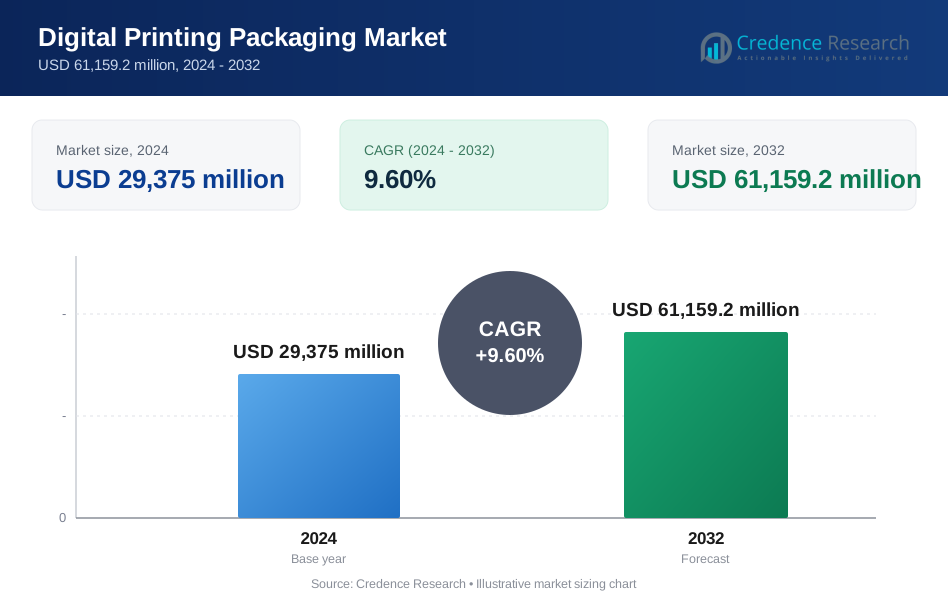
The Digital Printing Packaging Market size was valued at USD 29375 million in 2024 and is anticipated to reach USD 61159.2 million by 2032, at a CAGR of 9.6% during the forecast period (2024-2032).
| REPORT ATTRIBUTE | DETAILS |
|---|---|
| Historical Period | 2020-2023 |
| Base Year | 2024 |
| Forecast Period | 2025-2032 |
| Digital Printing Packaging Market Size 2024 | USD 29375 million |
| Digital Printing Packaging Market, CAGR | 9.6% |
| Digital Printing Packaging Market Size 2032 | USD 61159.2 million |
Key drivers of the Digital Printing Packaging Market include the shift towards personalized packaging, the need for reduced lead times, and the growing demand for eco-friendly packaging solutions. Digital printing enables higher quality, quicker production cycles, and better cost efficiency compared to traditional methods, driving its widespread adoption in industries such as food and beverage, pharmaceuticals, and consumer goods. Additionally, the ability to integrate brand-specific designs with minimal waste aligns with sustainability goals, further boosting market growth. Furthermore, the increasing demand for small-batch and on-demand production further accelerates the market's expansion.
Regionally, North America holds the largest market share due to the strong presence of major packaging manufacturers and high demand for innovative packaging solutions. The region's advanced infrastructure and technology adoption in the packaging sector are contributing factors to its dominance. The Asia Pacific region is anticipated to witness the highest growth rate, driven by rapid industrialization, the expanding e-commerce sector, and increasing consumer preference for customized and eco-friendly packaging in countries like China and India. The rising middle-class population and growing disposable income in these countries also contribute to the increasing demand for digital printing packaging solutions.

Market Insights:
- The Child Resistant Packaging Market was valued at USD 28,434 million in 2024 and is expected to reach USD 50,036 million by 2032, growing at a CAGR of 7.32%.
- Increased regulatory pressure for enhanced product safety and rising awareness about child poisoning contribute to market growth.
- Advancements in packaging technologies enhance convenience and safety, further boosting market demand.
- North America holds the largest market share, driven by stringent regulations and a focus on safety in pharmaceuticals and chemicals.
- Asia Pacific is expected to experience the highest growth rate, driven by expanding manufacturing and regulatory safety emphasis.
- The demand for sustainable packaging solutions is increasing, with digital printing enabling the use of recyclable and biodegradable materials.
- High initial investment costs and limited substrate compatibility present challenges, particularly for small and medium-sized businesses.
Market Drivers:
Growing Demand for Personalized and Custom Packaging Solutions
The Digital Printing Packaging Market is witnessing a surge in demand for personalized packaging solutions. Consumers are increasingly seeking products that reflect their individual preferences and tastes. This shift towards customization allows brands to connect with consumers on a deeper level, enhancing brand loyalty and driving consumer engagement. Digital printing technology plays a key role in facilitating the mass customization of packaging by enabling the production of unique designs on small runs, reducing the need for large inventory. The ability to print personalized designs at a lower cost than traditional methods supports the market's expansion.
- For instance, the Nutella Unica campaign used digital printing to create and sell 7 million individually unique jars in just one month.
Reduction in Lead Times and Cost Efficiency
Digital printing offers significant reductions in lead times, which is crucial for businesses looking to respond quickly to market demands. Traditional printing methods require longer setup times and are less flexible when it comes to modifications. Digital printing technology enables fast turnaround times, allowing companies to adapt quickly to consumer trends and changing market conditions. This enhanced efficiency leads to reduced production costs, making it an attractive option for industries such as food and beverage, pharmaceuticals, and consumer goods. Its ability to streamline the printing process contributes to its growing adoption.
- For instance, Columbine Label, using HP Indigo digital presses, reduced its standard turnaround time from the industry norm of 10 business days to just 3–5 business days after proof approval, enabling clients to respond quickly to shifting market demands.
Increasing Focus on Eco-friendly and Sustainable Packaging
Sustainability continues to be a driving factor in the Digital Printing Packaging Market. Consumers and businesses are increasingly concerned about the environmental impact of packaging waste. Digital printing supports eco-friendly initiatives by minimizing waste through precise printing and allowing for the use of recyclable or biodegradable materials. It reduces the need for excess materials, which helps companies align with sustainability goals. The ability to print on sustainable substrates further contributes to the appeal of digital printing in packaging.
Advancements in Technology and Enhanced Packaging Capabilities
Technological advancements in digital printing are continually improving packaging quality and performance. Innovations such as high-definition printing and improved color accuracy are allowing companies to produce visually appealing packaging that stands out in the marketplace. The ability to integrate complex designs and variable data printing enhances packaging functionality, making it more attractive to brands looking to create distinctive and high-quality packaging solutions. These advancements in technology are solidifying the position of digital printing as a preferred solution for packaging applications across various industries.
Market Trends:
Rising Demand for Smart and Interactive Packaging Solutions
One of the key trends in the Digital Printing Packaging Market is the growing demand for smart and interactive packaging solutions. Brands are increasingly incorporating technologies such as QR codes, augmented reality (AR), and NFC (Near Field Communication) into their packaging to engage consumers and provide a more personalized experience. Digital printing enables seamless integration of these technologies, offering businesses an efficient and cost-effective way to enhance the consumer experience. Consumers are increasingly attracted to packaging that not only serves its functional purpose but also delivers additional value, such as product information, promotions, or interactive experiences. This trend is particularly prominent in industries like cosmetics, food and beverage, and consumer electronics, where packaging plays a crucial role in driving customer interaction and loyalty.
- For instance, Sephora, 1 AR mirror, 8.5 million AR experience visits in the first 18 months of rollout.
Shift Toward Smaller Production Runs and On-Demand Printing
Another significant trend in the Digital Printing Packaging Market is the shift toward smaller production runs and on-demand printing. Traditional printing methods often involve large-scale runs to achieve cost-efficiency, which is not suitable for brands seeking flexibility or short-run packaging. Digital printing allows for smaller, on-demand runs without the need for costly setup processes. This flexibility is becoming increasingly important as companies adapt to rapidly changing market conditions and consumer preferences. The rise of e-commerce and the demand for packaging solutions tailored to specific products or markets further fuel this trend. Small and medium-sized enterprises (SMEs) are benefiting from digital printing's cost-effective and flexible nature, which enables them to compete with larger businesses in packaging innovation.
- For instance, ePac achieved a record of over 20 million B1 impressions in just one month across 10 HP Indigo 20000-equipped sites in January 2020.
Market Challenges Analysis:
High Initial Investment and Equipment Costs
One of the key challenges in the Digital Printing Packaging Market is the high initial investment required for digital printing equipment. The cost of digital printing machines, along with necessary software and maintenance, can be prohibitively expensive for small and medium-sized businesses. While digital printing offers long-term cost savings and operational efficiencies, the upfront capital investment may limit adoption, particularly for companies with limited budgets. The complexity of the technology and the need for specialized skills to operate these systems further add to the costs. This financial barrier can restrict the market's growth, particularly in emerging economies where smaller businesses dominate.
Limited Substrate Compatibility and Material Costs
Another challenge facing the Digital Printing Packaging Market is the limited compatibility of digital printing technology with certain substrates. While digital printing can be used on a wide range of materials, it is not always compatible with every type of packaging substrate, particularly those requiring specialized coatings or finishes. This can restrict its use in certain industries or product categories. Furthermore, the cost of materials compatible with digital printing can be higher compared to traditional printing methods. This can affect the overall cost-effectiveness of the solution, particularly for high-volume packaging applications, making it less appealing for large-scale production.
Market Opportunities:
Expansion in E-commerce and Consumer Goods Packaging
A significant opportunity in the Digital Printing Packaging Market lies in the expansion of e-commerce and the increasing demand for consumer goods packaging. The growth of online shopping has created a need for packaging solutions that are not only protective but also customizable and engaging. Digital printing offers brands the ability to print unique, on-demand packaging designs that cater to individual customer preferences. It also allows for efficient short-run production, reducing waste and inventory costs. As e-commerce continues to expand globally, the need for innovative packaging that stands out in a crowded market presents a key growth opportunity for digital printing.
Sustainability and Eco-friendly Packaging Solutions
Sustainability is another important opportunity within the Digital Printing Packaging Market. With increasing consumer awareness around environmental issues, businesses are seeking eco-friendly packaging options that reduce their carbon footprint. Digital printing supports this trend by enabling the use of sustainable materials and reducing waste through precise, on-demand production. It also offers the flexibility to use eco-friendly inks and coatings that align with sustainability goals. Companies can leverage digital printing to meet both consumer expectations for environmentally responsible packaging and regulatory requirements for reduced environmental impact, creating a significant growth opportunity in the market.
Market Segmentation Analysis:
By Product Type
The Digital Printing Packaging Market is segmented into labels, corrugated boxes, flexible packaging, and others. Labels dominate the market due to their extensive use in consumer goods and pharmaceuticals. Flexible packaging is gaining popularity, particularly in the food and beverage sector, because of its versatility, cost-effectiveness, and ability to adapt to different packaging needs.
- For instance, HP Indigo 200K can print labels at a maximum speed of 56 meters per minute.
By Technology
The market is divided into inkjet, electrophotography, and other technologies. Inkjet printing holds the largest share because of its high-speed capabilities, flexibility, and ability to print on a wide range of substrates. Electrophotography technology is also growing, offering high-quality prints and efficiency in small to medium batch production, making it ideal for industries like pharmaceuticals and personal care.
- For instance, Panasonic's industrial inkjet system enables uniform 4K printing on 56-inch OLED panels, reducing production costs by at least 15% compared to vacuum deposition methods.
By End-User Industry
The Digital Printing Packaging Market is further categorized into food and beverage, pharmaceuticals, personal care, and others. The food and beverage sector leads, driven by the increasing demand for customized and eco-friendly packaging. The pharmaceutical industry follows, with a growing need for child-resistant and tamper-evident packaging solutions to meet regulatory requirements. Personal care is an emerging sector, where brands are increasingly turning to digital printing for personalized and differentiated packaging.
Segmentations:
By Product Type
- Labels
- Corrugated Boxes
- Flexible Packaging
- Others
By Technology
- Inkjet
- Electrophotography
- Others
By End-User Industry
- Food and Beverage
- Pharmaceuticals
- Personal Care
- Others
By Region
- North America
- U.S.
- Canada
- Mexico
- Europe
- Germany
- France
- U.K.
- Italy
- Spain
- Rest of Europe
- Asia Pacific
- China
- Japan
- India
- South Korea
- South-east Asia
- Rest of Asia Pacific
- Latin America
- Brazil
- Argentina
- Rest of Latin America
- Middle East & Africa
- GCC Countries
- South Africa
- Rest of the Middle East and Africa
Regional Analysis:
North America: Leading the Digital Printing Packaging Market
North America accounts for 35% of the Digital Printing Packaging Market share, driven by a strong presence of established packaging manufacturers and an increasing demand for innovative packaging solutions across various industries. The U.S. leads the region in adopting digital printing technology due to its advanced infrastructure and high investment in packaging innovation. Companies in the food and beverage, pharmaceutical, and consumer goods sectors are increasingly adopting digital printing for personalized and eco-friendly packaging. Furthermore, stringent regulatory standards in the region push companies to focus on sustainable packaging, which further fuels growth. The ongoing expansion of e-commerce also contributes to the increasing demand for customized packaging solutions.
Asia Pacific: Expanding Rapidly with Industrial Growth
Asia Pacific holds 30% of the Digital Printing Packaging Market share and is expected to experience the highest growth rate during the forecast period. Rapid industrialization, growing urbanization, and the expansion of e-commerce are the key drivers of this growth. Countries like China, India, and Japan are seeing significant adoption of digital printing technology as companies in various sectors seek to meet the rising demand for personalized, small-batch, and cost-effective packaging solutions. The growing middle-class population in these countries is driving consumer demand for premium and customized products, further propelling the need for innovative packaging. Additionally, the increasing focus on sustainability in the region is encouraging businesses to adopt digital printing for eco-friendly packaging solutions.
Europe: Strong Demand for Sustainable Packaging Solutions
Europe commands 25% of the Digital Printing Packaging Market share, supported by stringent environmental regulations and the high demand for sustainable packaging solutions. Countries such as Germany, France, and the UK lead the region in the adoption of digital printing technology for packaging. The region's commitment to reducing carbon footprints and promoting recycling has pushed companies to look for packaging solutions that align with these goals. Digital printing provides the flexibility to use recyclable and biodegradable materials, which makes it an attractive choice for European businesses. Additionally, the increasing focus on luxury packaging in sectors like cosmetics and pharmaceuticals in Europe is contributing to growth.
Key Player Analysis:
- Huhtamaki (Finland)
- Graphic Packaging International (U.S.)
- Packman Packaging (India)
- ePac Holdings, LLC (U.S.)
- Mondi (U.K.)
- DS Smith (U.K.)
- Smurfit Kappa (Ireland)
- Stora Enso (Finland)
- InstaPac Flexible Packaging (India)
- CCL Industries Inc. (Canada)
- Quad (U.S.)
- Swisspac Packaging (India)
Competitive Analysis:
The Digital Printing Packaging Market is highly competitive, with several key players driving innovation and market growth. Leading companies include HP Inc., Xerox Corporation, and Canon Inc., which provide advanced digital printing solutions across various product types, including labels, flexible packaging, and corrugated boxes. These companies focus on technological advancements, such as inkjet and electrophotography, to meet the growing demand for high-quality, customizable, and eco-friendly packaging. Smaller players, including Durst Group and EFI, are also gaining market share by offering specialized solutions tailored to niche industries, such as pharmaceuticals and personal care. The increasing demand for sustainable packaging solutions and rapid adoption of digital printing technology are encouraging new entrants to explore opportunities in emerging markets. Competitive strategies focus on product differentiation, technological innovation, and expanding regional presence to maintain a strong foothold in the market.
Recent Developments:
- In July 2025, Huhtamaki launched new compostable ice cream cups that are both home and industrial compostable, made from certified paperboard with a bio-based coating, reducing plastic use to below 10%.
- In January 2025, DS Smith launched TailorTemp®, a fiber-based temperature-controlled packaging solution optimized for pharmaceutical logistics, debuting it at PharmaPack Europe in Paris.
- In April 2025, Stora Enso launched Performa Nova, a high-yield folding boxboard designed for consumer packaging, reflecting ongoing investment in fiber-based, sustainable packaging technology.
Market Concentration & Characteristics:
The Digital Printing Packaging Market is moderately concentrated, with a few dominant players holding significant market share, including HP Inc., Xerox Corporation, and Canon Inc. These companies lead by offering cutting-edge digital printing technologies and scalable solutions across various product types. The market also includes smaller players such as Durst Group and EFI, which focus on specialized segments like pharmaceuticals and personal care. Market characteristics include a strong emphasis on technological innovation, especially in inkjet and electrophotography, and a growing demand for customizable, eco-friendly packaging solutions. Competition is driven by the need for high-quality prints, cost efficiency, and sustainability. As consumer preferences shift towards personalized packaging and rapid production cycles, companies are focusing on product differentiation and expanding regional footprints to stay competitive in the evolving market landscape.
Report Coverage:
The research report offers an in-depth analysis based on Product Type, Technology, End-User Industry and Region. It details leading market players, providing an overview of their business, product offerings, investments, revenue streams, and key applications. Additionally, the report includes insights into the competitive environment, SWOT analysis, current market trends, as well as the primary drivers and constraints. Furthermore, it discusses various factors that have driven market expansion in recent years. The report also explores market dynamics, regulatory scenarios, and technological advancements that are shaping the industry. It assesses the impact of external factors and global economic changes on market growth. Lastly, it provides strategic recommendations for new entrants and established companies to navigate the complexities of the market.
Future Outlook:
- Technological advancements in inkjet and electrophotography will continue to enhance print quality, speed, and substrate compatibility.
- Growing consumer and regulatory demand for eco-friendly packaging solutions will drive the adoption of recyclable and biodegradable materials.
- Brands will increasingly seek personalized packaging solutions to engage consumers and differentiate products in competitive markets.
- The rise of e-commerce will necessitate packaging that is both protective and visually appealing, fueling further adoption of digital printing.
- The integration of smart packaging technologies such as QR codes and NFC will enhance functionality and consumer interaction.
- The Asia Pacific region is expected to experience significant growth driven by industrialization and a growing middle-class consumer base.
- Digital printing's ability to reduce setup times and waste will continue to offer cost-effective solutions for short-run and on-demand production.
- Stricter regulations in sectors like pharmaceuticals and food and beverage will create increased demand for secure and compliant packaging solutions.
- Digital printing will help optimize supply chains through on-demand production, reducing the need for large inventory stockpiles.
- A mix of established players and new entrants will foster innovation and diverse offerings, maintaining a competitive market environment.
Request a Free Sample
Fill in your details and we'll send you a free sample report.
- Sample data tables & charts
- Research methodology
Market Dynamics
Personalized and Custom Packaging Demand
Brands are leveraging digital printing to offer personalized packaging that resonates with individual consumer preferences, enhancing brand loyalty and engagement. The ability to efficiently produce unique designs in small batches supports mass customization and reduces inventory costs.
Reduction in Lead Times and Cost Efficiency
Digital printing enables faster turnaround and lower setup costs compared to traditional methods, allowing companies to quickly respond to market trends and reduce production expenses. This agility is particularly valuable for industries with rapidly changing product lines or promotional needs.
Sustainability and Eco-friendly Packaging
Digital printing minimizes waste through precise, on-demand production and supports the use of recyclable and biodegradable materials. This aligns with growing consumer and regulatory demands for environmentally responsible packaging solutions.
Advancements in Digital Printing Technology
Continuous improvements in inkjet and electrophotography technologies are enhancing print quality, speed, and substrate compatibility. These advancements enable more complex, high-definition designs and expand the range of packaging applications.
Growth of E-commerce and On-demand Production
The expansion of e-commerce is driving demand for packaging that is both protective and visually distinctive. Digital printing's flexibility for short-run and on-demand production allows brands to efficiently meet the diverse and dynamic needs of online retail.
Need a Custom Version of This Report?
Tailor the scope, geography, or segments to your exact requirements.
- Custom geography or segment scope
- Direct access to our analyst team
Frequently Asked Questions
What is the current size of the digital printing packaging market?
What factors are driving the growth of the digital printing packaging market?
What are some challenges faced by the digital printing packaging market?
Who are the major players in the digital printing packaging market?
Table of Content
Chapter 1 Market Segmentation
- 1.1 Segmentation Framework
- 1.1.1 Product and Service Classification
- 1.1.2 Application and End-Use Classification
- 1.1.3 Technology and Solution Classification
- 1.1.4 Customer and Distribution Channel Classification
- 1.1.5 Geographic Segmentation
- 1.1.6 Market Segment Definitions and Boundaries
- 1.2 By Technology
- 1.2.1 Inkjet
- 1.2.2 Electrophotography
- 1.2.3 Others
- 1.3 By Product Type
- 1.3.1 Labels
- 1.3.2 Corrugated Boxes
- 1.3.3 Flexible Packaging
- 1.3.4 Others
- 1.4 By End-User Industry
- 1.4.1 Food and Beverage
- 1.4.2 Pharmaceuticals
- 1.4.3 Personal Care
- 1.4.4 Others
Chapter 2 Introduction
- 2.1 Report Objectives and Scope
- 2.2 Product Definition and Industry Terminology
- 2.3 Market Inclusions and Exclusions
- 2.4 Research Process
- 2.4.1 Primary Research and Expert Interviews
- 2.4.2 Secondary Research and Source Review
- 2.4.3 Top-Down and Bottom-Up Estimation
- 2.4.4 Data Triangulation and Verification
- 2.5 Market Size Measurement Basis
- 2.5.1 2024: USD 29,375 million → 2032: USD 61,159.2 million
- 2.6 Historical and Forecast Reference Periods
- 2.6.1 Base Year: 2024
- 2.6.2 Forecast Period: 2024-2032
- 2.7 Research Assumptions and Limitations
Chapter 3 Executive Summary
- 3.1 Market Snapshot and Key Findings
- 3.2 Base-Year Market Size, 2024
- 3.3 Forecast Market Size, 2032
- 3.4 Revenue and Volume Growth Outlook
- 3.5 Key Demand and Supply Indicators
- 3.6 Leading Market Segments
- 3.7 Fastest-Growing Market Opportunities
- 3.8 Regional Performance Highlights
- 3.9 Technology and Industry Transformation
- 3.10 Competitive Landscape Summary
- 3.11 Analyst View and Strategic Implications
Chapter 4 Global Digital Printing Packaging Market Trends and Developments
- 4.1 Historical Industry Development
- 4.2 Recent Market Trends and Developments
- 4.3 Demand and Customer Behavior Trends
- 4.4 Technology and Product Innovation
- 4.5 Artificial Intelligence, Automation and Digitalization
- 4.6 Local Manufacturing and Supply Chain Realignment
- 4.7 Industry Partnerships, Mergers and Acquisitions
- 4.8 Sustainability and Circular Economy Developments
- 4.9 Government and Private Sector Investment Trends
- 4.10 Emerging Business Models and Commercialization
- 4.11 Industry Developments and Announcements
Chapter 5 Global Digital Printing Packaging Market Production, Supply and Demand Analysis
- 5.1 Demand Trend and Consumption Analysis
- 5.2 Demand Forecast, 2024-2032
- 5.3 Production and Output Trend
- 5.4 Production and Output Forecast, 2024-2032
- 5.5 Installed Capacity and Capacity Utilization
- 5.6 Company-Wise Production Plants and Statistics
- 5.6.1 Installed Production Capacity
- 5.6.2 Actual Production
- 5.6.3 Planned Capacity and Expansion Targets
- 5.7 Supply Chain Structure and Procurement Trends
- 5.8 Supply-Demand Gap and Bottlenecks
- 5.9 Import Dependence and Sourcing Structure
- 5.10 Contract Manufacturing and Outsourcing
- 5.11 Regional Supply and Demand Concentration
Chapter 6 Global Digital Printing Packaging Market Pricing Analysis
- 6.1 Pricing Structure and Measurement
- 6.2 Historical Pricing Trends
- 6.3 Pricing Outlook, 2024-2032
- 6.4 Average Selling Price and Unit Economics
- 6.5 Pricing by Product and Market Segment
- 6.6 Geographic Pricing Differences
- 6.7 Key Input, Energy, Labor and Logistics Costs
- 6.8 Contract Pricing and Purchasing Models
- 6.9 Pricing Sensitivity and Competitive Positioning
- 6.10 Price, Margin and Profitability Implications
Chapter 7 Global Digital Printing Packaging Market Dynamics
- 7.1 Market Growth Drivers
- 7.1.1 Demand-Side Drivers
- 7.1.2 Technology and Innovation Drivers
- 7.1.3 Infrastructure and Investment Drivers
- 7.1.4 Regulatory and Policy Drivers
- 7.2 Market Restraints
- 7.2.1 Cost and Affordability Constraints
- 7.2.2 Technology and Adoption Barriers
- 7.2.3 Supply Chain and Operational Constraints
- 7.3 Market Challenges
- 7.3.1 Competitive Pressure and Margin Erosion
- 7.3.2 Skills, Infrastructure and Implementation Gaps
- 7.4 Emerging Market Opportunities
- 7.5 Market Dynamics Impact and Time-Horizon Assessment
Chapter 8 Global Digital Printing Packaging Value Chain Analysis
- 8.1 Industry Value Chain Overview
- 8.2 Upstream Suppliers and Critical Inputs
- 8.3 Technology and Component Providers
- 8.4 Manufacturing or Service Delivery
- 8.5 Distribution, Channel Partners and Integrators
- 8.6 Downstream Applications and End Users
- 8.7 Value Addition and Profit Pools
- 8.8 Vertical Integration and Outsourcing
- 8.9 Supplier Concentration and Risk
- 8.10 Supply Chain Localization and Resilience
Chapter 9 Global Digital Printing Packaging Market Regulations and Policies
- 9.1 Relevant Laws, Standards and Compliance Frameworks
- 9.2 Product, Service, Safety and Quality Requirements
- 9.3 Government Policies, Incentives and Subsidies
- 9.4 Imports, Exports and Trade Barriers
- 9.5 Public Procurement and Local Content Requirements
- 9.6 Environmental and Sustainability Compliance
- 9.7 Upcoming Policy Changes and Market Implications
Chapter 10 Global Digital Printing Packaging Market Hotspots and Opportunities
- 10.1 Market Opportunity Mapping and Growth Hotspots
- 10.2 High-Growth Applications and Customer Groups
- 10.3 Underserved Markets and White-Space Opportunities
- 10.4 Emerging Technology and Product Opportunities
- 10.5 New Capacity and Investment Hotspots
- 10.6 Market Entry and Expansion Opportunities
- 10.7 Distribution and Partnership Opportunities
- 10.8 Near-Term and Long-Term Commercial Potential
- 10.9 Opportunity Attractiveness and Execution Risks
Chapter 11 Global Digital Printing Packaging Market Outlook, 2024-2032
- 11.1 Market Size and Analysis
- 11.1.1 Revenue (Market Measurement: 2024: USD 29,375 million → 2032: USD 61,159.2 million)
- 11.1.2 Market Volume and Quantity Sold
- 11.1.3 Historical Market Size
- 11.1.4 Base-Year Market Size, 2024
- 11.2 Market Forecast, 2024-2032
- 11.2.1 Revenue Forecast to 2032
- 11.2.2 Volume Forecast to 2032
- 11.2.3 CAGR and Year-on-Year Growth
- 11.2.4 Incremental Revenue Opportunity
- 11.3 Forecast Assumptions and Scenario Analysis
- 11.3.1 Base-Case Forecast
- 11.3.2 Optimistic and Conservative Scenarios
- 11.3.3 Technology, Pricing and Policy Sensitivities
- 11.4 Market Attractiveness and Growth Outlook
Chapter 12 Global Digital Printing Packaging Market Segmentation and Outlook
- 12.1 Segmentation Summary and Market Shares, 2024
- 12.2 Largest and Fastest-Growing Segments
- 12.3 By Technology - Market Size and Forecast, 2024-2032
- 12.3.1 Segment Definition and Scope
- 12.3.2 Historical Market Size
- 12.3.3 Revenue Forecast, 2024-2032
- 12.3.4 Volume Forecast, 2024-2032
- 12.3.5 Base-Year Market Share, 2024
- 12.3.6 Segment CAGR and Growth Drivers
- 12.3.7 Subsegment Market Size and Forecast
- 12.3.7.1 Inkjet
- 12.3.7.2 Electrophotography
- 12.3.7.3 Others
- 12.3.8 Subsegment Pricing and Adoption Trends
- 12.3.9 Leading Suppliers and Competition
- 12.3.10 Regional Demand and Opportunities
- 12.4 By Product Type - Market Size and Forecast, 2024-2032
- 12.4.1 Segment Definition and Scope
- 12.4.2 Historical Market Size
- 12.4.3 Revenue Forecast, 2024-2032
- 12.4.4 Volume Forecast, 2024-2032
- 12.4.5 Base-Year Market Share, 2024
- 12.4.6 Segment CAGR and Growth Drivers
- 12.4.7 Subsegment Market Size and Forecast
- 12.4.7.1 Labels
- 12.4.7.2 Corrugated Boxes
- 12.4.7.3 Flexible Packaging
- 12.4.7.4 Others
- 12.4.8 Subsegment Pricing and Adoption Trends
- 12.4.9 Leading Suppliers and Competition
- 12.4.10 Regional Demand and Opportunities
- 12.5 By End-User Industry - Market Size and Forecast, 2024-2032
- 12.5.1 Segment Definition and Scope
- 12.5.2 Historical Market Size
- 12.5.3 Revenue Forecast, 2024-2032
- 12.5.4 Volume Forecast, 2024-2032
- 12.5.5 Base-Year Market Share, 2024
- 12.5.6 Segment CAGR and Growth Drivers
- 12.5.7 Subsegment Market Size and Forecast
- 12.5.7.1 Food and Beverage
- 12.5.7.2 Pharmaceuticals
- 12.5.7.3 Personal Care
- 12.5.7.4 Others
- 12.5.8 Subsegment Pricing and Adoption Trends
- 12.5.9 Leading Suppliers and Competition
- 12.5.10 Regional Demand and Opportunities
- 12.6 Segment Growth Comparison
- 12.7 Segment Attractiveness and Priority Matrix
Chapter 13 Global Digital Printing Packaging End-Use and Application Market Outlook
- 13.1 End-Use Industry and Customer Demand Structure
- 13.2 Leading Applications and Customer Groups
- 13.3 End-Use Market Size, Share and Forecast
- 13.4 Major End-Use Industry Deep Dives
- 13.4.1 Customer Requirements and Use Cases
- 13.4.2 Demand and Replacement Cycles
- 13.4.3 Technical and Regulatory Considerations
- 13.4.4 Purchasing and Procurement Models
- 13.4.5 Leading Vendors and Distribution Channels
- 13.4.6 Forecast and Commercial Opportunities
- 13.5 Emerging Applications and Cross-Segment Demand
- 13.6 End-Use Industry Investment Priorities
Chapter 14 Global Digital Printing Packaging Geographic Market Outlook, 2024-2032
- 14.1 Regional Market Size and Share, 2024
- 14.2 Regional Market Forecast, 2024-2032
- 14.3 Regional Pricing, Production and Demand Differences
- 14.4 North America
- 14.4.1 United States
- 14.4.2 Canada
- 14.4.3 Mexico
- 14.5 Europe
- 14.5.1 Germany
- 14.5.2 France
- 14.5.3 Italy
- 14.5.4 United Kingdom
- 14.5.5 Spain
- 14.5.6 Poland
- 14.5.7 Russia
- 14.5.8 Netherlands
- 14.5.9 Belgium
- 14.5.10 Sweden
- 14.5.11 Denmark
- 14.5.12 Norway
- 14.5.13 Rest of Europe
- 14.6 Asia Pacific
- 14.6.1 China
- 14.6.2 India
- 14.6.3 Japan
- 14.6.4 South Korea
- 14.6.5 Thailand
- 14.6.6 Indonesia
- 14.6.7 Vietnam
- 14.6.8 Malaysia
- 14.6.9 Australia
- 14.6.10 Rest of Asia Pacific
- 14.7 Latin America
- 14.7.1 Brazil
- 14.7.2 Argentina
- 14.7.3 Colombia
- 14.7.4 Chile
- 14.7.5 Rest of Latin America
- 14.8 Middle East
- 14.8.1 Saudi Arabia
- 14.8.2 United Arab Emirates
- 14.8.3 Turkey
- 14.8.4 Israel
- 14.8.5 Iran
- 14.8.6 Rest of the Middle East
- 14.9 Africa
- 14.9.1 South Africa
- 14.9.2 Egypt
- 14.9.3 Nigeria
- 14.9.4 Morocco
- 14.9.5 Rest of Africa
- 14.10 Regional Investment, Policy and Supply Chain Differences
- 14.11 Regional Competitive Landscape
- 14.12 Geographic Growth Hotspots
Chapter 15 Global Digital Printing Packaging Technology, Innovation and Sustainability Outlook
- 15.1 Technology Landscape and Maturity
- 15.2 Product, Process and Service Innovation
- 15.3 AI, Automation and Digital Tools in the Industry
- 15.4 Technology Adoption and Performance Benchmarking
- 15.5 Innovation Pipeline and R&D Investment
- 15.6 Patent and Intellectual Property Trends
- 15.7 Energy Efficiency and Resource Management
- 15.8 Sustainability, Recycling and Circularity
- 15.9 Technology Roadmap, 2024-2032
- 15.10 Risks of Obsolescence and Technology Substitution
Chapter 16 Global Digital Printing Packaging Market Key Strategic Imperatives
- 16.1 Growth and Market Entry Priorities
- 16.2 High-Return Products and Segments
- 16.3 Pricing, Profitability and Cost Optimization
- 16.4 Technology Investment and Product Differentiation
- 16.5 Supply Chain Localization and Resilience
- 16.6 Distribution and Customer Acquisition
- 16.7 Partnership, Acquisition and Capacity Strategy
- 16.8 Regional Expansion Priorities
- 16.9 Short-, Medium- and Long-Term Actions
Chapter 17 Competition Outlook
- 17.1 Industry Competition Characteristics
- 17.2 Market Structure and Concentration
- 17.3 Market Share and Competitive Positioning, 2024
- 17.4 Company-Wise Revenue and Product Benchmarking
- 17.5 Production and Service Capacity Benchmarking
- 17.6 Technology, Pricing and Differentiation
- 17.7 Regional Footprint and Distribution Strength
- 17.8 Mergers, Acquisitions and Strategic Alliances
- 17.9 New Entrants and Competitive Threats
- 17.10 Porter's Five Forces and Industry Attractiveness
- 17.11 Competitive Outlook, 2024-2032
Chapter 18 Company Profiles
- 18.1 Company Coverage and Selection Criteria
- 18.2 HP Inc.
- 18.2.1 Business Description
- 18.2.2 Company Ownership and Geographic Presence
- 18.2.3 Product and Service Portfolio
- 18.2.4 Manufacturing and Operating Footprint
- 18.2.5 Production Capacity and Expansion Plans
- 18.2.6 Financial Performance and Investment
- 18.2.7 Market Share and Competitive Position
- 18.2.8 Technology and Innovation Capabilities
- 18.2.9 Strategic Alliances or Partnerships
- 18.2.10 Recent Developments
- 18.2.11 Growth Strategy and Outlook
- 18.3 Xerox Corporation
- 18.4 Canon Inc.
- 18.5 Mondi
- 18.6 DS Smith
- 18.7 Smurfit Kappa
- 18.8 Stora Enso
- 18.9 Quad
- 18.10 CCL Industries Inc.
- 18.11 ePac Holdings, LLC
- 18.12 Other Relevant Market Participants
Note: Every listed company is profiled on the structure shown under the first company. The company list is preliminary and may change based on research findings, market developments, data availability and client requirements.
Chapter 19 Disclaimer
- 19.1 Research and Forecast Disclaimer
- 19.2 Data Source and Estimation Limitations
Note: The depth of individual sections depends on data availability for this market. Volume, capacity, trade and other unit-based metrics are included where applicable.

