
Market Overview:
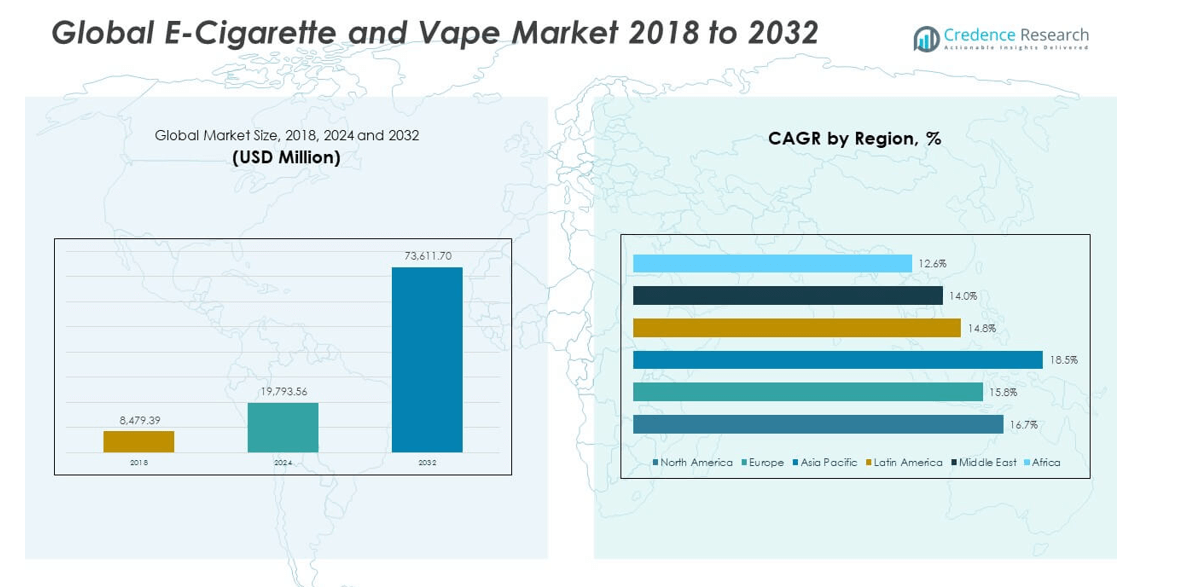
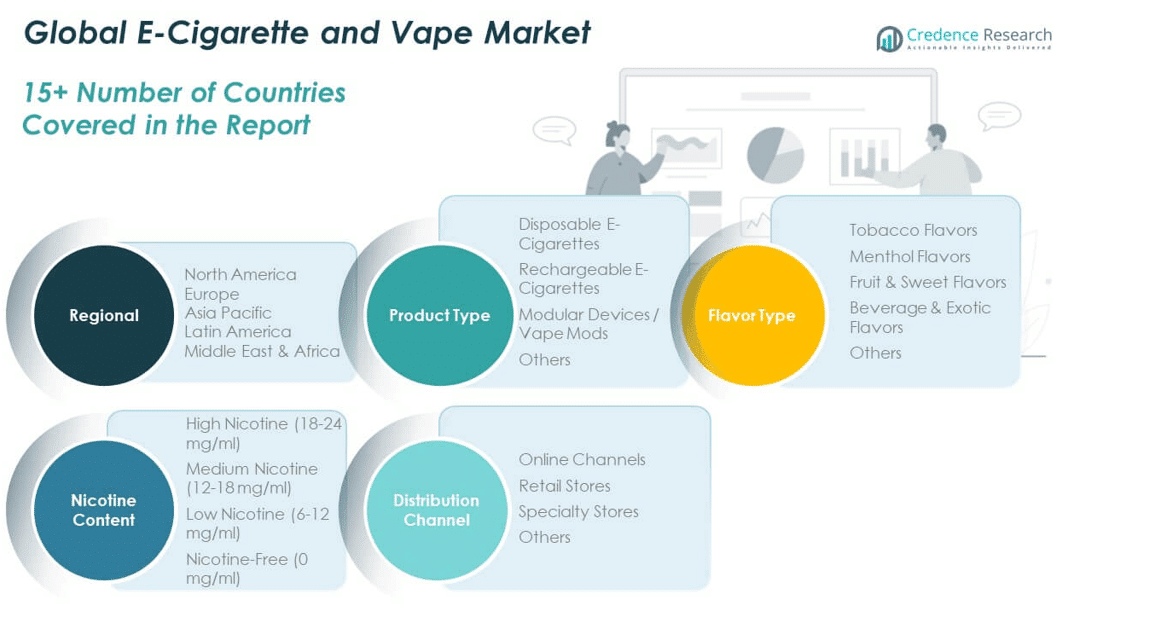
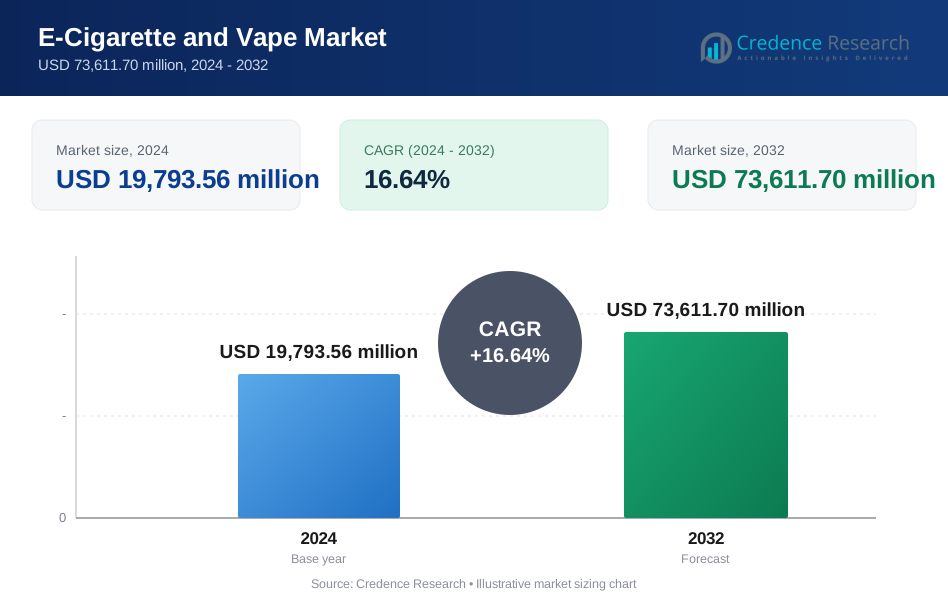
The Global E-Cigarette and Vape Market size was valued at USD 8,479.39 million in 2018 to USD 19,793.56 million in 2024 and is anticipated to reach USD 73,611.70 million by 2032, at a CAGR of 16.64% during the forecast period.
| REPORT ATTRIBUTE | DETAILS |
|---|---|
| Historical Period | 2020-2023 |
| Base Year | 2024 |
| Forecast Period | 2025-2032 |
| E-Cigarette and Vape Market Size 2024 | USD 19,793.56 million |
| E-Cigarette and Vape Market, CAGR | 16.64% |
| E-Cigarette and Vape Market Size 2032 | USD 73,611.70 million |
The market is driven by rising demand for smoke-free alternatives and growing consumer awareness of harm reduction options. Product innovation in device design, battery performance, and flavor diversity fuels adoption across diverse age groups. Expanding retail availability, e-commerce platforms, and favorable policies in select countries strengthen accessibility. It benefits from lifestyle shifts, health-conscious choices, and the preference for premium and customizable experiences.
Regionally, North America leads with strong infrastructure, high adoption rates, and regulatory support, while Europe maintains steady growth due to progressive public health policies and consumer trust. Asia Pacific is emerging as the fastest-growing region, supported by manufacturing hubs, urbanization, and rising disposable incomes. Latin America, the Middle East, and Africa show gradual uptake, shaped by expanding retail access and evolving regulatory frameworks.
Market Insights:
- The Global E-Cigarette and Vape Market size was valued at USD 8,479.39 million in 2018, reached USD 19,793.56 million in 2024, and is projected to attain USD 73,611.70 million by 2032, growing at a CAGR of 16.64%.
- North America leads with a 43.7% share, supported by strong infrastructure, regulatory acceptance, and widespread adoption of premium devices. Europe follows with 27.3% due to favorable policies and consumer trust, while Asia Pacific holds 20.7% backed by manufacturing strength and urban demand.
- Asia Pacific is the fastest-growing region, expanding at 18.5% CAGR, driven by urbanization, rising disposable incomes, and strong e-commerce penetration across China, Japan, and India.
- In 2024, rechargeable e-cigarettes captured the largest share at 41%, reflecting consumer preference for durability and cost efficiency.
- Disposable e-cigarettes followed with a 33% share, propelled by convenience, affordability, and rapid adoption among younger demographics.
Market Drivers
Rising Consumer Shift Toward Smoke-Free Alternatives Across Different Demographics
The Global E-Cigarette and Vape Market benefits from rising demand for smoke-free products. Consumers are shifting away from combustible tobacco due to health awareness. Increasing education on nicotine alternatives fosters growth in urban and semi-urban areas. Young adults adopt these devices due to social acceptance and perception of reduced harm. Availability of varied nicotine strengths attracts both beginners and experienced users. Retail expansion across specialty stores and online platforms makes access convenient. It supports consumer adoption by offering product diversity. This broad base of appeal positions the industry for sustained demand.
- For instance, Philip Morris International reported in July 2025 that the number of adult users of its smoke-free (non-combustible) products globally reached 39.3 million as of June 2025, as disclosed in its Q2 2025 earnings release and sustainability reporting.
Product Innovation in Devices and Flavors Supporting Adoption Rates
Innovation remains a strong driver for the Global E-Cigarette and Vape Market. Companies introduce compact, user-friendly devices with efficient nicotine delivery. Customizable features such as adjustable wattage enhance the user experience. Wide flavor portfolios encourage experimentation and repeated purchases. Partnerships with design and technology firms ensure performance upgrades. It enables companies to meet diverse consumer expectations. Innovation in pod-based systems creates strong brand loyalty. These advancements not only attract smokers but also strengthen competitive differentiation.
Government Supportive Measures and Policies in Selected Regions
The Global E-Cigarette and Vape Market gains momentum from supportive measures in certain regions. Governments in parts of Europe promote reduced-risk products through structured policies. Tax benefits in a few markets encourage regulated growth. Regulatory acceptance provides a formal framework for responsible product distribution. It improves industry credibility and consumer trust. Certification standards ensure safety and quality consistency. International health organizations recognize potential harm reduction. This regulatory environment creates pathways for sustainable adoption.
- For instance, the U.S. FDA highlighted in its 2024 annual progress update that it issued the first marketing granted orders for menthol-flavored e-cigarette products and, since 2020, has acted on more than 26 million applications under the PMTA pathway while issuing hundreds of warning letters to firms and retailers for unauthorized sales.
Growing Retail Penetration and Expanding Distribution Channels Worldwide
The Global E-Cigarette and Vape Market expands with robust distribution across multiple channels. Specialized vape shops remain critical touchpoints for consumer education. Convenience stores and supermarkets are increasing shelf presence. Online platforms allow wider product reach with competitive pricing. Retail chains highlight product visibility in urban centers. It enhances consumer confidence through trusted outlets. Direct-to-consumer channels further build brand identity. This distribution diversity supports revenue expansion across geographies.
Market Trends
Integration of Smart Technology Features Into Vaping Devices for User Control
The Global E-Cigarette and Vape Market is experiencing demand for technology-enabled devices. Smart vapes offer Bluetooth connectivity for usage monitoring. Mobile apps provide data on nicotine intake and battery life. Users gain control over settings such as temperature and puff count. Integration of digital solutions enhances safety and user trust. It aligns product development with tech-savvy consumer preferences. Companies gain differentiation by marketing these connected devices. This convergence of electronics and nicotine delivery elevates product sophistication.
- For instance, ALD has explored smart vaping technologies such as Bluetooth connectivity and app-controlled customization, which aligns with broader industry trends in advanced device functionality.
Sustainability Focus in Packaging and Materials to Align With Consumer Values
Eco-friendly innovation is a key trend in the Global E-Cigarette and Vape Market. Companies adopt biodegradable packaging to reduce environmental impact. Use of recyclable materials supports global sustainability goals. Consumers increasingly favor brands promoting responsible practices. It enhances long-term brand loyalty across environmentally aware demographics. Corporate strategies now highlight green credentials to attract wider acceptance. Governments emphasize eco-compliance through stricter packaging laws. Sustainability integration strengthens competitive positioning.
Premiumization of Product Categories Through Advanced Features and Branding
The Global E-Cigarette and Vape Market is influenced by premium product adoption. Consumers seek high-performance devices with sleek designs. Companies focus on metal finishes, durable batteries, and sophisticated branding. Premium flavors with unique blends create exclusivity. It drives higher margins for manufacturers. Retailers highlight premium ranges in targeted campaigns. Growing disposable incomes support willingness to pay more. This premiumization trend reinforces market segmentation.
- For instance, MR FOG has expanded its disposable vape portfolio with high-capacity devices featuring upgraded batteries and enhanced coil technology, reflecting the industry’s push toward extended device life and improved performance.
Expansion of Cross-Industry Collaborations Between Tobacco and Tech Players
Collaborations define a growing trend in the Global E-Cigarette and Vape Market. Traditional tobacco firms invest heavily in vaping subsidiaries. Technology partners contribute expertise in design and digital integration. Joint ventures ensure faster product development cycles. It accelerates innovation while strengthening market credibility. Collaborations also expand distribution reach globally. This synergy between industries supports competitive strength. The strategy delivers consumer trust and technical superiority.
Market Challenges Analysis
Stringent Regulatory Frameworks and Uncertainty in Government Policies Across Nations
The Global E-Cigarette and Vape Market faces challenges due to regulatory complexity. Governments differ widely in their stance on e-cigarettes. Bans in certain regions hinder global uniformity. Licensing requirements create delays for new entrants. It restricts flexibility for multinational companies. Taxation policies increase product costs for consumers. Shifting compliance rules require continuous adaptation. The uncertainty limits growth potential and raises operational risks.
Rising Public Health Concerns and Growing Social Stigma Around Usage
Public perception presents a major challenge for the Global E-Cigarette and Vape Market. Concerns about youth addiction raise negative sentiment. Reports of health risks impact consumer confidence. It forces companies to invest more in awareness campaigns. Educational institutions and advocacy groups push for stricter control. Social stigma prevents broader adoption across conservative societies. Negative press coverage undermines innovation benefits. These challenges slow expansion despite technological advances.
Market Opportunities
Expansion Into Emerging Economies With Rising Middle-Class Populations and Urbanization
The Global E-Cigarette and Vape Market holds vast opportunity in emerging economies. Growing middle-class consumers seek affordable tobacco alternatives. Urban centers create demand for trendy, tech-oriented devices. Expansion of retail infrastructure supports product availability. It allows firms to establish brand recognition early. Increased disposable income drives premium product adoption. Local partnerships provide efficient distribution. This expansion offers high long-term potential.
Development of Wellness-Oriented Products Targeting Health-Conscious Consumer Segments
The Global E-Cigarette and Vape Market can leverage health-conscious trends. Low-nicotine and herbal variants gain popularity. Focus on controlled nicotine delivery attracts former smokers. It appeals to consumers seeking harm reduction. Brands investing in wellness-focused messaging gain trust. Regulatory approvals for such products improve credibility. This creates differentiation in competitive markets. Wellness-driven innovations expand consumer base globally.
Market Segmentation Analysis:
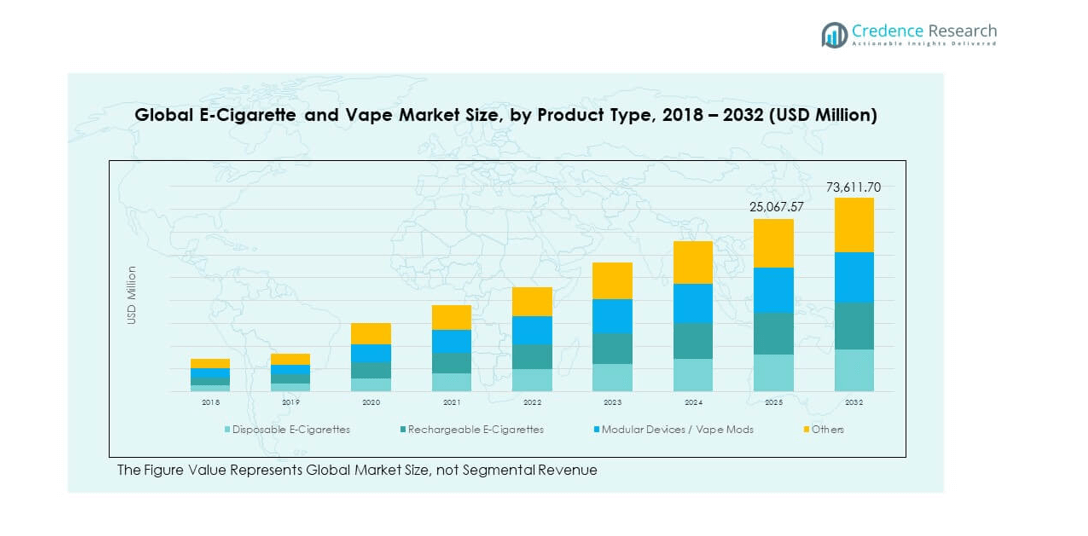
The Global E-Cigarette and Vape Market is structured across product type, flavor type, nicotine content, and distribution channels.
By product type, disposable e-cigarettes are gaining traction due to affordability and convenience, while rechargeable devices dominate through durability and long-term value. Modular devices or vape mods attract experienced users seeking customization, and the others category reflects niche innovations.
By flavor type, tobacco flavors remain strong among transitioning smokers, menthol continues to hold steady appeal, and fruit and sweet flavors drive popularity among younger demographics. Beverage and exotic blends highlight experimentation, while other unique options broaden consumer engagement.
- For instance, MR FOG Max Air and Switch 5500 disposables come in over 38 distinct flavors including tobacco, menthol, fruits, and desserts and use Mesh Coil technology for intensified and stable taste delivery.
By nicotine content, high nicotine devices address heavy smokers, medium and low nicotine levels capture gradual reduction segments, and nicotine-free products appeal to wellness-conscious consumers.
- For instance, the Geek Bar Pulse 15000 is pre-filled with 16 ml of e-liquid at 5% nicotine (50mg/ml) strength, making it suitable for adult users seeking high-nicotine options in a consistent disposable format.
By distribution channel, online platforms expand access globally with competitive pricing, retail stores strengthen presence in urban areas, and specialty shops provide personalized guidance and premium products. It benefits from this diverse segmentation, which supports widespread adoption across consumer categories and regions.
Segmentation:
By Product Type
- Disposable E-Cigarettes
- Rechargeable E-Cigarettes
- Modular Devices / Vape Mods
- Others
By Flavor Type
- Tobacco Flavors
- Menthol Flavors
- Fruit & Sweet Flavors
- Beverage & Exotic Flavors
- Others
By Nicotine Content
- High Nicotine (18–24 mg/ml)
- Medium Nicotine (12–18 mg/ml)
- Low Nicotine (6–12 mg/ml)
- Nicotine-Free (0 mg/ml)
By Distribution Channel
- Online Channels
- Retail Stores
- Specialty Stores
- Others
By Region
- North America
- U.S.
- Canada
- Mexico
- Europe
- Germany
- France
- U.K.
- Italy
- Spain
- Rest of Europe
- Asia Pacific
- China
- Japan
- India
- South Korea
- South-east Asia
- Rest of Asia Pacific
- Latin America
- Brazil
- Argentina
- Rest of Latin America
- Middle East & Africa
- GCC Countries
- South Africa
- Rest of the Middle East and Africa
Regional Analysis:
North America
The North America Global E-Cigarette and Vape Market size was valued at USD 3,741.39 million in 2018 to USD 8,643.83 million in 2024 and is anticipated to reach USD 32,234.49 million by 2032, at a CAGR of 16.7% during the forecast period. North America holds a 43.7% market share in 2024, making it the leading region. The U.S. drives adoption through a large consumer base, extensive retail channels, and significant product innovation. Regulatory frameworks support harm reduction products, enhancing consumer confidence. Canada contributes with rising acceptance of flavored vapes, while Mexico experiences steady growth from urban populations. It benefits from a well-developed e-commerce ecosystem that drives direct-to-consumer sales. Strong R&D investments from global brands strengthen leadership. The region’s demand remains tied to high smoking cessation awareness. North America continues to dominate due to advanced infrastructure and consumer willingness to adopt premium devices.
Europe
The Europe Global E-Cigarette and Vape Market size was valued at USD 2,403.53 million in 2018 to USD 5,408.17 million in 2024 and is anticipated to reach USD 18,935.04 million by 2032, at a CAGR of 15.8% during the forecast period. Europe represents a 27.3% share in 2024, ranking second globally. The UK leads with a robust regulatory framework and strong public health campaigns encouraging vaping. Germany, France, and Italy show strong demand, driven by consumer preference for reduced-risk alternatives. It benefits from widespread acceptance of smoke-free products across the EU. Retail availability through vape shops and supermarkets strengthens market penetration. Flavored products remain popular among younger consumers, supporting growth. Regulatory clarity in Europe enhances investor confidence. The region maintains strong momentum due to progressive policies and consumer trust.
Asia Pacific
The Asia Pacific Global E-Cigarette and Vape Market size was valued at USD 1,621.55 million in 2018 to USD 4,104.57 million in 2024 and is anticipated to reach USD 17,299.41 million by 2032, at a CAGR of 18.5% during the forecast period. Asia Pacific accounts for 20.7% of the 2024 market share, showing the fastest growth potential. China dominates manufacturing, supplying both domestic and global demand. Japan and South Korea lead in premium device adoption, supported by technology-driven innovation. India and Southeast Asia provide emerging opportunities through urban youth adoption. It benefits from rapid expansion of online platforms that make products accessible. Increasing disposable incomes encourage demand for high-quality devices. Regulatory diversity across the region creates both opportunities and risks. Asia Pacific’s expansion is anchored in consumer shifts toward affordable and technologically advanced options.
Latin America
The Latin America Global E-Cigarette and Vape Market size was valued at USD 383.56 million in 2018 to USD 883.72 million in 2024 and is anticipated to reach USD 2,891.97 million by 2032, at a CAGR of 14.8% during the forecast period. Latin America contributes a 4.5% share in 2024, reflecting steady expansion. Brazil leads with strong demand in urban centers, while Argentina follows with rising consumer interest. Regional adoption is supported by growing awareness of reduced-risk alternatives. It benefits from expanding retail penetration and online availability. Consumer shifts in metropolitan areas create long-term opportunities. Local manufacturers gradually enter the market to address price-sensitive segments. Regulatory uncertainty in certain countries restricts broader adoption. Latin America shows consistent growth driven by urban demand and gradual acceptance of smoke-free products.
Middle East
The Middle East Global E-Cigarette and Vape Market size was valued at USD 222.45 million in 2018 to USD 471.63 million in 2024 and is anticipated to reach USD 1,459.54 million by 2032, at a CAGR of 14.0% during the forecast period. The Middle East holds a 2.4% share in 2024, reflecting a developing market. GCC countries, led by the UAE and Saudi Arabia, drive strong demand through rising disposable incomes. Israel shows rapid adoption supported by regulatory acceptance. Turkey emerges as a key contributor with expanding retail access. It benefits from a younger population seeking alternatives to traditional smoking. Import reliance on global brands shapes market dynamics. Regulatory frameworks remain fragmented, affecting consistent growth. The Middle East provides opportunities for premium and luxury device positioning.
Africa
The Africa Global E-Cigarette and Vape Market size was valued at USD 106.91 million in 2018 to USD 281.64 million in 2024 and is anticipated to reach USD 791.26 million by 2032, at a CAGR of 12.6% during the forecast period. Africa accounts for a 1.3% share in 2024, reflecting early-stage adoption. South Africa leads regional growth due to strong retail presence and consumer awareness. Egypt follows with rising adoption in metropolitan areas. It faces challenges from limited distribution networks in less urbanized regions. Price sensitivity influences consumer preferences for disposable products. Global brands see opportunities in expanding urban retail chains. Regulatory developments vary across markets, impacting uniform adoption. Africa holds long-term potential as awareness of reduced-risk alternatives increases among younger populations.
Key Player Analysis:
- British American Tobacco (Vuse)
- Elf Bar (Ritchy Group)
- JUUL Labs
- SMOK (Shenzhen IVPS Technology)
- NJOY
- Logic (Japan Tobacco)
- Philip Morris International
- PAX Labs
Competitive Analysis:
The Global E-Cigarette and Vape Market features intense competition among multinational corporations and regional players striving for market dominance. Leading companies such as British American Tobacco, Philip Morris International, JUUL Labs, SMOK, and Elf Bar focus on product innovation, device design, and flavor variety to capture consumer loyalty. It is shaped by mergers, acquisitions, and strategic partnerships that expand distribution and accelerate technological development. Companies invest heavily in R&D to improve nicotine delivery efficiency, battery performance, and sustainability of materials. Regulatory compliance and certifications strengthen brand credibility across developed markets. E-commerce platforms and specialty stores enhance visibility, driving customer engagement and higher sales. Price competitiveness remains vital, with disposable and rechargeable segments witnessing strong rivalry. The industry landscape reflects a blend of aggressive expansion strategies, brand diversification, and continuous adaptation to evolving consumer preferences.
Recent Developments:
- In August 2025, JUUL Labs filed new patent infringement complaints against NJOY and Altria, emphasizing continued legal activity to protect its intellectual property in the fast-evolving vape market.
- In July 2025, the FDA approved Juul Labs’ sale of its e-cigarette device and refill cartridges in tobacco and menthol flavors after years of regulatory scrutiny. This reinstated Juul’s product line into the U.S. market under conditions judged appropriate for public health.
- In June 2025, CEA Industries Inc. completed the acquisition of Fat Panda Ltd., a leading vape retailer and manufacturer in Central Canada. Fat Panda operates 33 stores and also runs e-liquid manufacturing, bringing strong regional market share to CEA
Report Coverage:
The research report offers an in-depth analysis based on Product Type, Flavor Type, Nicotine Content and Distribution Channel. It details leading market players, providing an overview of their business, product offerings, investments, revenue streams, and key applications. Additionally, the report includes insights into the competitive environment, SWOT analysis, current market trends, as well as the primary drivers and constraints. Furthermore, it discusses various factors that have driven market expansion in recent years. The report also explores market dynamics, regulatory scenarios, and technological advancements that are shaping the industry. It assesses the impact of external factors and global economic changes on market growth. Lastly, it provides strategic recommendations for new entrants and established companies to navigate the complexities of the market.
Future Outlook:
- The Global E-Cigarette and Vape Market will expand with strong demand for smoke-free alternatives supported by consumer health awareness.
- Innovation in compact devices, smart features, and advanced nicotine delivery will strengthen competitive advantage.
- Flavor diversification will continue to attract younger demographics and sustain high customer retention.
- Regulatory frameworks across regions will shape market accessibility, influencing company strategies and product rollouts.
- E-commerce will remain a vital distribution channel, boosting global accessibility and enhancing direct-to-consumer engagement.
- Premiumization of products will gain traction, supported by rising disposable incomes and brand-driven marketing.
- Emerging markets in Asia Pacific, Latin America, and Africa will present new growth opportunities for manufacturers.
- Cross-industry collaborations between tobacco and technology firms will accelerate product development and global reach.
- Sustainability initiatives in packaging and device materials will play a critical role in brand positioning.
- Regional market dynamics will create distinct growth patterns, with North America leading while Asia Pacific grows fastest.
Request a Free Sample
Fill in your details and we'll send you a free sample report.
- Sample data tables & charts
- Research methodology
Need a Custom Version of This Report?
Tailor the scope, geography, or segments to your exact requirements.
- Custom geography or segment scope
- Direct access to our analyst team
Frequently Asked Questions
What is the current market size for Global E-Cigarette and Vape Market, and what is its projected size in 2032?
At what Compound Annual Growth Rate is the Global E-Cigarette and Vape Market projected to grow between 2024 and 2032?
Which Global E-Cigarette and Vape Market market segment held the largest share in 2024?
What are the primary factors fueling the growth of the Global E-Cigarette and Vape Market?
Who are the leading companies in the Global E-Cigarette and Vape Market?
Table of Content
Chapter 1. Report Introduction
- 1.1 Report Description & Purpose
- 1.1.1 Report Title & Market Definition
- 1.1.2 Unique Selling Propositions (USP) & Key Differentiators
- 1.1.3 Value Proposition for Stakeholders
- 1.2 Research Objectives
- 1.2.1 Market Sizing Objectives (Volume & Revenue)
- 1.2.2 Segmentation Objectives
- 1.2.3 Competitive Intelligence Objectives
- 1.2.4 Forecast & Scenario Objectives
- 1.3 Report Scope
- 1.3.1 E-Cigarette and Vape Scope – Types & Subtypes Covered
- 1.3.2 Geographic Scope – Regions & Countries Covered
- 1.3.3 Historical Period, Base Year & Forecast Period (2024; forecast to 2032)
- 1.3.4 Inclusions & Exclusions
- 1.4 HS Code & Classification Framework
- 1.5 Currency, Units & Pricing Basis
- 1.6 Target Stakeholders
- 1.7 Limitations & Assumptions
Chapter 2. Executive Summary
- 2.1 Global E-Cigarette and Vape Market Snapshot
- 2.1.1 Market Size – Historical (2024) & Forecast (2024-2032) (2024: USD 19,793.56 million → 2032: USD 73,611.70 million)
- 2.1.2 Volume & Revenue – Global Totals
- 2.1.3 Key Market Highlights – Top Five Facts
- 2.2 E-Cigarette and Vape Market Segmentation Snapshot
- 2.2.1 Market Split by Region – 2024 vs. 2032
- 2.3 Competitive Snapshot
- 2.3.1 Top 10 Players by Revenue Share – 2024
- 2.3.2 Top 10 Players by Volume Share – 2024
- 2.3.3 Recent Strategic Developments (18-Month Summary)
- 2.4 Key Investment Highlights & Strategic Conclusions
Chapter 3. E-Cigarette and Vape Market Dynamics & Industry Analysis
- 3.1 Market Overview & Context
- 3.1.1 E-Cigarette and Vape Market Position in the Broader Automotive Value Chain
- 3.1.2 OEM vs. Replacement Market Dynamics
- 3.1.3 Market Maturity & Development Stage by Region
- 3.2 E-Cigarette and Vape Market Drivers
- 3.3 E-Cigarette and Vape Market Restraints & Challenges
- 3.4 E-Cigarette and Vape Market Opportunities
- 3.5 Porter's Five Forces Analysis
- 3.5.1 Threat of New Entrants
- 3.5.2 Bargaining Power of Suppliers
- 3.5.3 Bargaining Power of Buyers
- 3.5.4 Threat of Substitutes
- 3.5.5 Competitive Rivalry – Intensity Assessment
- 3.6 E-Cigarette and Vape Value Chain Analysis
- 3.6.1 Upstream – Raw Material/Input Suppliers
- 3.6.1.1 Raw Material/Input 1
- 3.6.1.2 Raw Material/Input 2
- 3.6.1.3 Raw Material/Input 3
- 3.6.2 Midstream – Production/Manufacturing/Service Delivery
- 3.6.2.1 Production/Process Overview
- 3.6.2.2 Key Facility Locations & Capacity by Manufacturer
- 3.6.3 Downstream – Distribution & End Consumer
- 3.6.3.1 Primary Channel – B2B/OEM
- 3.6.3.2 Secondary Channels – Dealer, Retail, Online, Direct
- 3.6.4 Value Chain Profitability Analysis
- 3.6.1 Upstream – Raw Material/Input Suppliers
- 3.7 PESTEL Analysis
- 3.7.1 Political Factors
- 3.7.2 Economic Factors
- 3.7.3 Social Factors
- 3.7.4 Technological Factors
- 3.7.5 Environmental Factors
- 3.7.6 Legal Factors
- 3.8 E-Cigarette and Vape Supply Chain Analysis
- 3.8.1 Raw Material/Input Supply Risk Assessment
- 3.8.2 Manufacturing Concentration Risk (Geographic Exposure)
- 3.8.3 Trade Disruption Impact Analysis
- 3.9 Regulatory & Policy Landscape
Note: The regulatory and policy landscape section covers regulations based on their applicability to the market, E-Cigarette and Vape category, geography, and scope of the study. Only regulatory frameworks with a material impact on operations, compliance, trade, sustainability, or market access are analyzed in detail.
Chapter 4. Key Investment Pockets & Opportunity Analysis
- 4.1 E-Cigarette and Vape Market Attractiveness Analysis
- 4.1.1 By Region – Investment Attractiveness Matrix (Volume × CAGR)
- 4.2 Absolute Revenue Growth Opportunity
- 4.2.1 By Region – Absolute USD Growth Through 2032
- 4.3 Incremental Volume Opportunity
- 4.3.1 By Region – Incremental Volume Through 2032
- 4.3.2 Segment – Incremental Volume
- 4.4 Emerging Submarket Opportunity Deep Dive (Subject to Applicability)
- 4.5 Emerging Market Opportunity Scorecards
- 4.5.1 United States
- 4.5.2 Europe
- 4.5.3 Asia
- 4.5.4 Middle East & Africa
Note: Emerging Market Opportunity Scorecards will be included based on relevance and strategic importance. Regions listed are indicative and may vary depending on data availability and market dynamics.
Chapter 5. E-Cigarette and Vape Import-Export Analysis & Trade Flows
- 5.1 Global Trade Overview
- 5.1.1 Global Export Value by Country (2024)
- 5.1.2 Global Export Volume by Country (2024)
- 5.1.3 Global Import Value by Country (2024)
- 5.1.4 Global Import Volume by Country (2024)
- 5.1.5 Net Trade Balance by Country (2024)
- 5.2 Export Analysis – Segment
- 5.2.1 Type 1 (HS Code)
- 5.2.2 Type 2 (HS Code)
- 5.2.3 Type 3 (HS Code)
- 5.2.4 Type 4 (HS Code)
- 5.2.5 Type 5 (HS Code)
- 5.3 Import Analysis – Segment
- 5.3.1 Type 1 (HS Code)
- 5.3.2 Type 2 (HS Code)
- 5.3.3 Type 3 (HS Code)
- 5.3.4 Type 4 (HS Code)
- 5.3.5 Type 5 (HS Code)
- 5.4 Average Unit Trade Prices
- 5.4.1 Average Export Price – Segment & Country
- 5.4.2 Average Import Price – Segment & Source Country
- 5.4.3 Price Trends (2024)
- 5.5 Key Trade Route Analysis
- 5.5.1 Trade Route 1
- 5.5.2 Trade Route 2
- 5.5.3 Trade Route 3
- 5.5.4 Trade Route 4
- 5.5.5 Trade Route 5
- 5.6 Trade Policy Impact Assessment
- 5.6.1 US Anti-Dumping & Section 301 Tariffs
- 5.6.2 EU Customs Union Impact
- 5.6.3 Major Free Trade Agreements
- 5.6.4 USMCA Rules of Origin
Note: Trade policy analysis will be included only where relevant to the E-Cigarette and Vape market.
Chapter 6. Competitive Landscape & Company Benchmarking
- 6.1 E-Cigarette and Vape Market Concentration & Structure
- 6.1.1 Herfindahl-Hirschman Index (HHI) – vs. 2024
- 6.1.2 Tier 1, Tier 2 & Tier 3 Market Structure
- 6.1.3 Global, Regional & Local Player Dynamics
- 6.2 E-Cigarette and Vape Market Share Analysis – 2024
- 6.2.1 Global Revenue Share by Company
- 6.2.2 Global Volume Share by Company
- 6.2.3 Regional Revenue Share
- 6.2.4 Market Share Evolution ( vs. 2024)
- 6.2.5 OEM Segment Share by Company
- 6.2.6 Replacement Segment Share by Company
- 6.3 Production/Delivery Capacity & Facility Analysis
- 6.3.1 Global Installed Capacity
- 6.3.2 Capacity Utilization Rates
- 6.3.3 Production/Output Volume
- 6.3.4 Facility Locations & Capacity Map
- 6.3.5 Planned Capacity Additions
- 6.4 E-Cigarette and Vape Competitive Benchmarking Matrix
- 6.4.1 Revenue, Volume, CAGR & Profitability Comparison
- 6.4.2 Channel Revenue Mix
- 6.4.3 Geographic Revenue Exposure
- 6.4.4 R&D Intensity
- 6.4.5 Sustainability Maturity
- 6.5 Strategic Developments in E-Cigarette and Vape (Last 24 Months)
- 6.5.1 Mergers, Acquisitions & Divestments
- 6.5.2 New E-Cigarette and Vape Launches
- 6.5.3 Facility Expansions
- 6.5.4 Strategic Alliances, Joint Ventures & Partnerships
- 6.5.5 Distribution Expansion & Market Entry
- 6.5.6 Sustainability & ESG Initiatives
- 6.6 Competitive Strategy Mapping
- 6.6.1 Leader, Challenger, Follower & Niche Classification
- 6.6.2 Pricing Strategy Comparison
- 6.6.3 Channel Strategy Matrix
Note: Strategic developments are included based on their materiality and the availability of reliable information.
Chapter 7. Global E-Cigarette and Vape Market – By Distribution Channel
- 7.1 Segment Overview
- 7.1.1 Volume & Revenue Split by Channel (2024 & 2032)
- 7.1.2 Channel Mix Evolution (2024-2032)
Chapter 8. Regional Market Analysis – Global Overview
- 8.1 Global Regional Overview
- 8.1.1 Regional Volume Share
- 8.1.2 Regional Revenue Share
- 8.1.3 Regional Volume by Region
- 8.1.4 Regional Revenue by Region
- 8.1.5 Regional Forecast Through 2032
- 8.2 Cross-Regional Segment Analysis
- 8.2.1 By Distribution Channel
- 8.2.2 By Brand/Price Tier
Chapter 9. North America E-Cigarette and Vape Market
- 9.1 United States
- 9.2 Canada
- 9.3 Mexico
Chapter 10. Europe E-Cigarette and Vape Market
- 10.1 Germany
- 10.2 France
- 10.3 Italy
- 10.4 United Kingdom
- 10.5 Spain
- 10.6 Poland
- 10.7 Russia
- 10.8 Netherlands
- 10.9 Belgium
- 10.10 Sweden
- 10.11 Denmark
- 10.12 Norway
- 10.13 Rest of Europe
Chapter 11. Asia Pacific E-Cigarette and Vape Market
- 11.1 China
- 11.2 India
- 11.3 Japan
- 11.4 South Korea
- 11.5 Thailand
- 11.6 Indonesia
- 11.7 Vietnam
- 11.8 Malaysia
- 11.9 Australia
- 11.10 Rest of Asia Pacific
Chapter 12. Latin America E-Cigarette and Vape Market
- 12.1 Brazil
- 12.2 Argentina
- 12.3 Colombia
- 12.4 Chile
- 12.5 Rest of Latin America
Chapter 13. Middle East E-Cigarette and Vape Market
- 13.1 Saudi Arabia
- 13.2 United Arab Emirates
- 13.3 Turkey
- 13.4 Israel
- 13.5 Iran
- 13.6 Rest of the Middle East
Chapter 14. Africa E-Cigarette and Vape Market
- 14.1 South Africa
- 14.2 Egypt
- 14.3 Nigeria
- 14.4 Morocco
- 14.5 Rest of Africa
Chapter 15. E-Cigarette and Vape Company Profiles
- 15.1 [Company 01]
- 15.1.1 Company Overview
- 15.1.2 Key Management Personnel
- 15.1.3 Products & Services Portfolio
- 15.1.4 Financial Performance
- 15.1.5 Key Market Focus & Geographic Presence
- 15.1.6 Recent Developments & Strategic Initiatives
Note: The company profile list is preliminary and may change based on research findings, market developments, data availability, and client requirements.
Chapter 16. Appendices
- Appendix A – List of Abbreviations & Acronyms
- Appendix B – Industry Classification Code Reference – Full Series
- Appendix C – Production & Capacity Data Tables
- Appendix D – End-Use & Demand Base Tables
- Appendix E – Consumption & Replacement Rate Assumptions
- Appendix F – ASP Reference Tables
- Appendix G – Manufacturing & Facility Database
- Appendix H – Import-Export Data Tables
- Appendix I – Regulatory Summary Tables
- Appendix J – Primary Research Participant List (Anonymized)
- Appendix K – Primary Research Questionnaire Framework
- Appendix L – Data Sources & Bibliography
- Appendix M – Market Size Divergence & Source Comparison
Chapter 17. Research Methodology
- 17.1 Research Framework & Philosophy
- 17.2 Secondary Research – Sources, Hierarchy & Data Extraction
- 17.3 Data Modeling – Bottom-Up & Top-Down Market Sizing
- 17.4 Primary Research – Stakeholder Framework, LOI & Sample Sizes
- 17.5 Forecast Methodology – Regression, Scenario & Sensitivity Analysis
- 17.6 Quality Control – Four-Layer Validation Framework
- 17.7 Limitations & Standard Assumptions
- 17.8 Disclaimer
