
| REPORT ATTRIBUTE | DETAILS |
|---|---|
| Historical Period | 2019-2022 |
| Base Year | 2023 |
| Forecast Period | 2024-2032 |
| Email Encryption Market Size 2023 | USD 6415.2 Million |
| Email Encryption Market, CAGR | 22.10% |
| Email Encryption Market Size 2032 | USD 38694.67 Million |
Market Insights
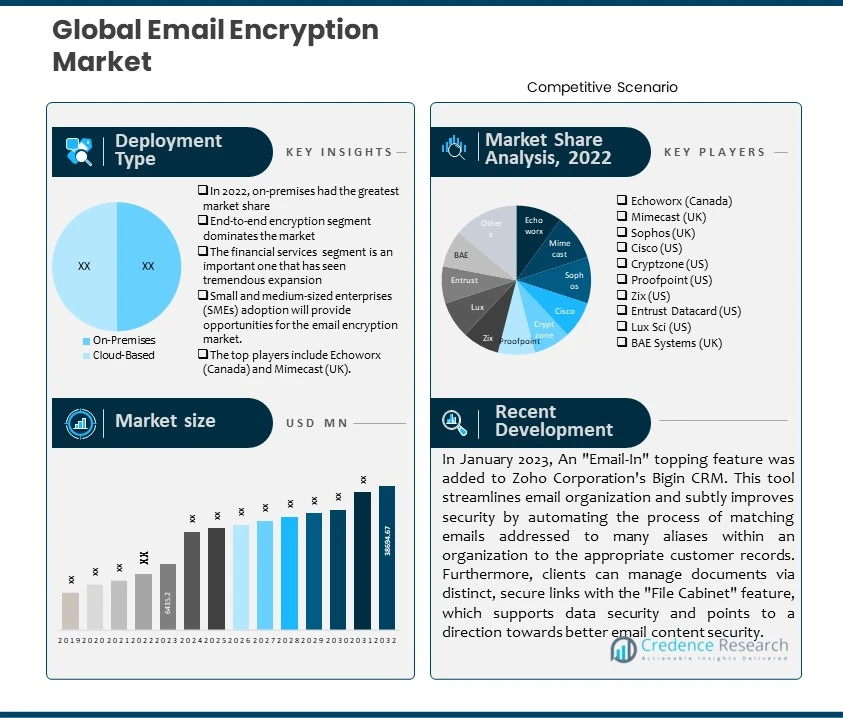
- The demand for email encryption market is expected to grow at a compound annual growth rate (CAGR) of 22.10% between 2024 and 2032, from its estimated USD 6415.2 million in 2023 to USD 38694.67 million in 2032.
- The largest deployment type section is on-premises. On the other hand, cloud-based is expected to grow at a strong CAGR.
- End-to-end encryption is the leading encryption type segment.
- The CAGR for financial services is expected to be the highest during the projection period.
- Throughout the prediction period, large enterprises will probably have the highest CAGR.
- Software is estimated to have the greatest CAGR during the forecast period.
- The business users segment will likely have the highest CAGR during the prediction period.
- During forecasting, enterprise-level solutions will probably have the highest CAGR.
- North America dominated the email encryption market.
- Regarding email encryption market share, Europe is expected to come second.
- In the email encryption market, Asia Pacific is anticipated to grow fastest.
- The primary drivers of market expansion are the growing awareness of cyber threats and data breaches, the expanding cyber threat landscape, cloud service integration, and insider threat protection.
- Numerous opportunities were created for the email encryption industry by the adoption of small and medium-sized enterprises (SMEs), their integration with collaboration platforms, and the integration of artificial intelligence for real-time threat detection.
Executive Summary
Market Definition
The email encryption market is occupied by companies that develop, implement, and maintain systems and solutions designed to encrypt email content and safeguard email correspondence. Secure email exchanges aim to prevent sensitive data from being accessed, intercepted, or manipulated by third parties. One essential aspect of cybersecurity is email encryption.
Market Overview
The global email encryption market is estimated to develop at a compound annual growth rate (CAGR) of 22.10% between 2024 and 2032, continuing its recent trend of steady expansion. The market was valued at USD 6415.2 million in 2023 and is expected to reach USD 38694.67 million in 2032.
The market for email encryption is being driven by integration with cloud services, which meets the changing needs of businesses for effective and safe communication in a cloud-centric environment. Popular email platforms like Google Workspace, Microsoft Office 365, and other cloud-based email services are easily integrated with email encryption solutions. Organizations' deployment processes are made simpler by this ease of integration, which eliminates the need for intricate setups or infrastructure modifications. Email encryption solutions hosted in the cloud can easily grow to meet the demands of expanding businesses. They provide flexible deployment options, enabling businesses to select between public, private, or hybrid cloud models according to their unique needs and preferences. As more businesses move their email systems to the cloud, concerns about data security and compliance with laws like the CCPA, GDPR, and HIPAA are becoming more pressing. Email encryption helps businesses ensure that sensitive data is secure during transmission and cloud storage.
Premises-based email encryption solutions demand upfront investments in software, hardware, and ongoing maintenance; cloud-based solutions, on the other hand, usually have a subscription-based pricing structure that can be more economical for businesses. Cloud-based solutions cut operational costs by removing the requirement for enterprises to devote resources to managing and maintaining encryption infrastructure. Integrating email encryption with these services is crucial to ensuring end-to-end security for sensitive information shared through emails, attachments, or collaborative documents, as business communication and file sharing increasingly rely on cloud-based collaboration tools and platforms.
Segmentation by Deployment Type
- On-premises is the market leader by deployment type. Organizations have more control over the data and email encryption procedures due to on-premises solutions. Because the system is hosted internally, the company is directly in control and can apply security measures to its policies and requirements.
- The cloud-based category will exhibit a sizable CAGR during the projected period. Cloud service providers' infrastructure is necessary for cloud-based email encryption. This implies that businesses use resources and services from cloud providers instead of managing and maintaining their servers and hardware.
Segmentation by Encryption Type
- The main encryption type is end-to-end encryption. Regarding the email encryption market, end-to-end encryption, or E2EE, is a security mechanism that guarantees the privacy and confidentiality of email exchanges. This technique protects data from unauthorized access by service providers, hackers, and other parties by encrypting it so that only the intended recipient can decrypt and read it.
- The gateway encryption category will likely register a significant CAGR during forecasting. Encrypting an organization's email system at its entry point, or gateway is known as gateway encryption. This is frequently done to protect emails traveling through the company's network.
Segmentation by Verticals/Industries
- It is projected that over the projection period, the category of financial services will grow at the fastest rate. The financial industry uses secure communication techniques, which are applied in financial services provided by the email encryption market. For financial institutions, including banks, insurance companies, and investment firms, email encryption is essential to protecting sensitive financial information sent via email.
- Other verticals/industries, such as healthcare, government and defense, and legal services, also contribute to the demand for email encryption.
Segmentation by Organization Size
- The large enterprises category will likely have the highest CAGR during the projection period. Many employees, clients, and partners are involved in large enterprises' extensive internal and external communication networks. Email encryption is essential for handling large amounts of emails that contain sensitive information because strong security measures are needed.
- Other organization sizes, such as small and medium-sized enterprises (SMEs), also contribute to the demand for email encryption.
Segmentation by Component
- Software will be expected to have the foremost CAGR during the prediction period. The email content is jumbled using a variety of encryption algorithms by email encryption software. PGP (Pretty Good Privacy), AES, and RSA are common algorithms. These algorithms encrypt data using mathematical operations, making it challenging for unauthorized users to decrypt and comprehend the content.
- Other components, such as services, also contribute to the demand for email encryption.
Segmentation by End-User
- Throughout the forecast duration, the category for business users is anticipated to have the greatest CAGR. Sensitive data, including financial information, customer information, intellectual property, and strategic plans, are frequently handled by business users. This data must be shielded from illegal access and transmission interception.
- Other end-users, such as individuals, also contribute to the demand for email encryption.
Segmentation by Price Range
- Throughout the forecast period, enterprise-level solutions are anticipated to have the highest CAGR. End-to-end encryption, which guarantees that the email content is encrypted from the sender's device to the recipient's device, is frequently implemented by enterprise solutions. This stops intermediaries from accessing private data, such as email service providers.
- Other price ranges, such as SMB solutions, also contribute to the demand for email encryption.
Segmentation by Region
- North America leads the email encryption industry. This is due to its sophisticated regulatory compliance requirements, technological infrastructure, and increased awareness of cybersecurity threats.
- Europe is estimated to rank second in market size for email encryption.
- Asia Pacific will witness the most rapid growth of the email encryption market.
- The remaining need for email encryption is met by parts of the world such as Africa, the Middle East, and Latin America.
The market for email encryption is mainly influenced by initiatives sponsored by the government, collaborative efforts, incorporated data loss prevention (DLP), incident response integration, and prevention of identity theft and email spoofing.
Regarding forecasting, the email encryption market is leading in North America due to several important factors. Strict data protection laws, like the United States' Sarbanes-Oxley Act (SOX) and the Health Insurance Portability and Accountability Act (HIPAA), are in place in North America. These laws require secure communication methods, such as email encryption, particularly in sectors like healthcare and finance. North America is home to many large corporations and enterprises, especially in technology, healthcare, and finance industries. The need for email encryption services is boosted by these organizations, which frequently place a high priority on effective email security solutions to safeguard confidential information and intellectual property.
Moreover, businesses and consumers in North America are generally more conscious of the risks associated with cybersecurity and the value of protecting sensitive data. As a result, there is a higher willingness to spend money on email encryption solutions to reduce the risk of cyberattacks and data breaches. To meet changing security requirements and stay ahead of competitors, businesses in North America are driven to continuously improve their email encryption offerings due to the competitive market landscape. The IT infrastructure in North America is strong. It includes cutting-edge networking technologies and dependable internet access, all necessary for the efficient setup and administration of email encryption programs. The widespread use of email in business communications in North America emphasizes the need for secure email transmission even more, propelling the development of encryption technologies.
According to the estimate, growth in the Asia Pacific area is anticipated to be the fastest. Cyber threats and attacks have significantly increased in the Asia Pacific area. Email encryption solutions have probably become more in demand as people and businesses realize the dangers of communicating over unsecured networks. It's possible that governments throughout the Asia-Pacific area have strengthened or implemented laws about privacy and data protection. To comply with these regulations, businesses-especially those handling sensitive information-will likely implement email encryption solutions. Organizations must improve their email security measures due to increased ransomware, sophisticated phishing attacks, and other email-based threats. An essential part of any comprehensive cybersecurity plan is email encryption.
Furthermore, industries and individuals are more likely to invest in technologies like email encryption to protect their sensitive data as awareness of the value of cybersecurity and data protection grows. Businesses in the Asia Pacific region are spending more on IT due to economic growth. This includes spending money on cybersecurity measures to guard against possible online attacks, with email encryption a major area of attention.
Key Highlights of the Report
The global email encryption market is segmented by deployment type, encryption type, verticals/industries, organization size, component, end-user, price range, and region. As far as the deployment type is concerned, on-premises is the market spearhead. End-to-end encryption is the top encryption type segment. The financial services category is anticipated to increase at the highest CAGR throughout the projection period. The business users will experience the highest CAGR during the forecast period. The email encryption market is expanding mostly in North America.
The integrated approach of machine learning and artificial intelligence has accelerated the email encryption industry. Encoding email content prevents unauthorized parties from accessing confidential information. AI systems can examine email patterns and behaviors to find anomalies and possible security risks. The accuracy of threat detection can be increased by machine learning models' ongoing learning and adaptation to new threats, and machine learning can examine user behavior in an organization to create a standard operating procedure baseline. Alerts for potential security incidents can be triggered by deviations from this baseline, such as odd login locations or unusual email-sending patterns. AI can help with more effective encryption key management. Machine learning can be used to optimize automated key generation, rotation, and distribution procedures, providing strong encryption without sacrificing user experience. AI-driven email encryption solutions can be tailored to meet a company's unique security requirements. Scalability is made possible by machine learning, which enables the system to handle an increasing amount of emails and adjust to shifting security requirements.
However, according to forecasts, North America will hold the largest market share for email encryption globally. There are strict privacy and data protection laws in North America, especially in the US and Canada. Email encryption is one of the secure communication practices that organizations are forced to implement due to compliance requirements, such as the Health Insurance Portability and Accountability Act in the healthcare sector and various state-level data breach notification laws. The market is anticipated to grow fastest in the Asia Pacific region. Cybersecurity concerns have increased due to the swift pace of digital transformation and the growing dependence on digital communication. Email encryption is an essential part of protecting private information sent and received through email. Email encryption solutions are in greater demand as businesses in the Asia Pacific region grow and integrate digitally.
Which Key Factors Are Driving The Global Email Encryption Market?
The need for user-friendly encryption solutions, the need to secure business-critical communications, and the need for secure communication in financial transactions are some of the factors driving the growth of the email encryption market.
What Are The Key Challenges In The Global Market For Email Encryption?
Several obstacles stand in the way of the email encryption market's growth, including the effect on email search and retrieval, opposition from outside communication partners, difficulties securing attachments, and a lack of funding for cybersecurity initiatives.
What Market Opportunities Exist For Email Encryption Globally?
The email encryption market is gaining prominence due to features including Internet of Things applications, cross-platform interoperability, blockchain-based email security, and mobile email encryption solutions.
Market Drivers
Multiple factors propel the email encryption industry across the globe. The primary factors propelling the global email encryption market are as follows:
Technological Developments in Encryption
Technological advancements in encryption largely drive the email encryption market. Email encryption is a security protocol that encrypts emails to prevent unauthorized access to sensitive data. Encryption techniques also advance with technology to improve overall security posture and stay up to date with new threats. To fend off increasingly complex attacks, encryption algorithms must grow more resilient as processing power rises. Advanced Encryption Standard, one of the more recent algorithms with longer bit lengths and stronger cryptography, is extensively used to protect email correspondence. The development of quantum computing could potentially jeopardize established encryption techniques. Researchers are developing quantum-resistant encryption techniques to combat this. By securing communication channels using the ideas of quantum mechanics, quantum key distribution (QKD) technology offers a degree of security impervious to quantum attacks in theory. Only the intended recipient can decrypt and view the contents of an email due to end-to-end encryption. Because it removes the possibility of interception during transmission or storage, this technique has grown in popularity. Email end-to-end encryption is made possible by technologies such as Pretty Good Privacy and S/MIME (Secure/Multipurpose Internet Mail Extensions).
Market Restraints
There are several obstacles that the global email encryption market must overcome to continue growing. Among them are the following:
Email Encryption Solutions' Financial Constraints
Businesses are primarily deterred from implementing email encryption solutions by the substantial financial outlay required. These tools significantly increase operating costs, even though they are essential for stopping data breaches. The increased IT infrastructure required for secure email communication is the primary cause of this increase. Such solutions are usually based on a monthly fee per user, ranging from USD 4 to USD 10. Depending on the size of the encrypted files, this cost may increase. Free encryption tools are available, but they frequently lack the sophistication needed to provide sufficient data protection. Moreover, the financial consequences are especially noticeable for SMEs that are tight on funds. The total financial burden is increased by ongoing expenses like software maintenance, licensing fees, and technical support in addition to the initial outlay. As a result, adding these solutions to already-existing IT systems adds another level of complexity and possible expense.
Opportunities
There are plenty of potential prospects in the global email encryption industry. Among these are the following:
Hybrid Cloud Environment Customization
Private and public cloud services are frequently combined with on-premises infrastructure in hybrid cloud environments. The ability to customize email encryption solutions guarantees compatibility and smooth integration with different components of the hybrid infrastructure by allowing them to be adjusted to different deployment models. Computing requirements fluctuate for businesses operating in hybrid cloud environments. Email encryption products can be tailored to an organization's needs, allowing them to grow or shrink. The encryption solution's adaptability to fluctuations in email traffic and data storage volume is guaranteed by its flexibility. E-mail encryption solutions can be easily integrated with current security protocols and email systems through customization. In hybrid email environments, businesses can use both on-premises email servers and cloud-based email services (like Microsoft 365 or Google Workspace). Email encryption in hybrid environments can be developed with centralized management and monitoring capabilities thanks to customization. Consistent policy enforcement, visibility into security events, and effective encryption key management are all made possible by this centralized control. Users may access email services from different devices and locations in hybrid cloud environments. By offering safe and simple ways for users to access encrypted emails from any location or device, customization enables email encryption solutions to maximize the user experience.
Competitive Landscape
Key Players
There are several major competitors in the fiercely competitive global email encryption market. The following are a few of the leading market participants and their market shares:
- Echoworx (Canada)
- Mimecast (UK)
- Sophos (UK)
- Cisco (US)
- Cryptzone (US)
- Proofpoint (US)
- Zix (US)
- Entrust Datacard (US)
- Lux Sci (US)
- BAE Systems (UK)
- Intemedia (US)
- Virtru (US)
- Micro Focus (UK)
- Egress Software (UK)
- Trend Micro (Japan)
- Symantech (US)
- Others
To remain competitive, these companies prioritize product innovation, Component expansion, mergers, and acquisitions.
The major global email encryption market players always try to remain ahead of the competition by introducing innovations and products.
In July 2023, In order to improve email security for medium-sized businesses, Telefónica Tech (Spain) and Proofpoint partnered to introduce Clean Email Business in Spain. Advanced features like spam filtering, analysis of malicious attachments and URLs, and defense against BEC attacks are all included in the service. The goal of the initiative is to guarantee its users' security, legal compliance, and continuous business continuity.
In April 2023, For the purpose of increasing its market share in the Gulf, Barracuda Networks, Inc. and Ingram Micro negotiated a strategic distribution deal. Barracuda's complete cybersecurity solutions, which address email, apps, cloud, networks, and data protection, will be distributed by Ingram Micro as per this agreement. Through this partnership, Barracuda's state-of-the-art cybersecurity products will be accessible to resellers in the UAE, Kuwait, Qatar, Oman, Bahrain, Yemen, and Pakistan.
Summary of Key Findings
- The market for email encryption is still growing due to the integration of artificial intelligence into the email encryption industry.
- The market is segmented by deployment type, encryption type, verticals/industries, organization size, component, end-user, price range, and region.
- The most popular deployment type in the market is on-premises.
- End-to-end encryption is the foremost category.
- Large enterprises are expected to grow fastest during the forecast period regarding CAGR.
- The category for enterprise-level solutions will likely see the highest CAGR during the anticipated time frame.
- North America is leading market development; the market is highly competitive with key players including Echoworx (Canada), Mimecast (UK), Sophos (UK), Cisco (US), Cryptzone (US), Proofpoint (US), Zix (US), Entrust Datacard (US), Lux Sci (US), BAE Systems (UK), Intemedia (US), Virtru (US), Micro Focus (UK), Egress Software (UK), Trend Micro (Japan), Symantech (US), and Others.
Future Outlook
- The email encryption industry is expected to increase significantly in North America and has a positive outlook worldwide.
- The market for email encryption is growing as concerns about data security grow.
- The cost of implementation and maintenance is one of the key factors anticipated to hamper the development of the email encryption market during the forecast timeframe.
- Major businesses need to innovate, grow their market reach, and keep their prices competitive to maintain a competitive edge.
How CXOs Can Benefit from the Credence Research Email Encryption Market Report
CXOs may get a detailed picture of the market in the Credence Research Email Encryption Market Report, which includes:
- Market size and growth forecast: The report provides detailed estimates of the global email encryption market size, segmented by deployment type, encryption type, verticals/industries, organization size, component, end-user, price range, and region. In addition, projections for the market through 2032 based on significant drivers and trends are included.
- Market segmentation: The research report breaks down the market for email encryption into segments based on the deployment type, encryption type, verticals/industries, organization size, component, end-user, price range, and region. CXOs are given a detailed grasp of the market and the opportunities within each segment due to this segmentation.
- Competitive landscape: The research report offers a detailed analysis of the major companies in the email encryption industry, including information on their business plans, line of products, and earnings. CXOs can use this information to evaluate and identify their competitors.
- Key trends and drivers: The research report identifies and evaluates the main trends and factors influencing the market for email encryption. CXOs can use this information to make well-informed choices regarding their plans and investments.
CXOs can use the insights from the Credence Research Email Encryption Market Report to:
- Identify growth opportunities: With the help of this analysis, CXOs may identify new growth opportunities in the email encryption sector. For example, the report identifies the growing demand for email encryption from financial services as a key opportunity.
- Make informed investment decisions: With the help of the report, CXOs can choose email encryption wisely. For example, the research study provides information on the critical factors to consider while selecting email encryption solutions and evaluating email encryption suppliers.
- Develop competitive strategies: The research report can be used by CXOs to develop competitive strategies for their email encryption businesses. For example, the research paper outlines the main strategies suppliers of email encryption utilize to differentiate themselves from competitors.
- Track market developments: CXOs may stay ahead of the curve by tracking market developments with the aid of this research report. For instance, the research report offers insights into the most recent developments and trends in the market for email encryption.
In general, CXOs seeking to expand their industry knowledge and spot growth prospects will find the Credence Research Email Encryption Market Report a useful tool.
Segmentation
- By Deployment Type
- On-premises
- Cloud-based
- By Encryption Type
- End-to-End Encryption
- Gateway Encryption
- By Verticals/Industries
- Financial Services
- Healthcare
- Government and Defense
- Legal Services
- By Organization Size
- Large Enterprises
- Small and Medium-sized Enterprises (SMEs)
- By Component
- Software
- Services
- By End-User
- Business Users
- Individuals
- By Price Range
- Enterprise-Level Solutions
- SMB Solutions
- By Region
- North America
- The U.S.
- Canada
- Mexico
- Europe
- Germany
- France
- The U.K.
- Italy
- Spain
- Rest of Europe
- Asia Pacific
- China
- Japan
- India
- South Korea
- South-east Asia
- Rest of Asia Pacific
- Latin America
- Brazil
- Argentina
- Rest of Latin America
- Middle East & Africa
- GCC Countries
- South Africa
- Rest of Middle East and Africa
- North America

Request a Free Sample
Fill in your details and we'll send you a free sample report.
- Sample data tables & charts
- Research methodology
Market Dynamics
Rising Cyber Threats and Data Breaches
The increasing frequency and sophistication of cyberattacks, including phishing and ransomware, are driving organizations to adopt robust email encryption solutions to protect sensitive communications and prevent data breaches.
Regulatory Compliance Requirements
Stringent data protection regulations such as GDPR, HIPAA, and CCPA require organizations to secure email communications, making encryption a necessity for compliance in sectors like healthcare, finance, and government.
Cloud Service Integration
The shift to cloud-based email platforms like Microsoft Office 365 and Google Workspace is fueling demand for encryption solutions that seamlessly integrate with these services, ensuring secure communication in cloud-centric environments.
Growth of Financial Services and Digital Transactions
The financial sector's reliance on secure digital communication and the need to protect sensitive financial data are accelerating the adoption of advanced email encryption, especially as online transactions and digital banking expand.
Adoption by SMEs and AI Integration
Small and medium-sized enterprises are increasingly implementing email encryption as solutions become more affordable and user-friendly, while the integration of AI and machine learning enhances threat detection and automated response capabilities.
Need a Custom Version of This Report?
Tailor the scope, geography, or segments to your exact requirements.
- Custom geography or segment scope
- Direct access to our analyst team
Frequently Asked Questions
How big is the global email encryption market right now?
What is the projected growth rate of the email encryption market between 2024 and 2032?
Which market segment is leading in terms of deployment type?
Regarding encryption type, which market category is in the lead?
Who are the key participants in the global market for email encryption?
Table of Content
Chapter 1 Market Segmentation
- 1.1 Segmentation Framework
- 1.1.1 Product and Service Classification
- 1.1.2 Application and End-Use Classification
- 1.1.3 Technology and Solution Classification
- 1.1.4 Customer and Distribution Channel Classification
- 1.1.5 Geographic Segmentation
- 1.1.6 Market Segment Definitions and Boundaries
- 1.2 By Deployment Type
- 1.2.1 On-premises
- 1.2.2 Cloud-based
- 1.3 By Encryption Type
- 1.3.1 End-to-End Encryption
- 1.3.2 Gateway Encryption
- 1.4 By Organization Size
- 1.4.1 Large Enterprises
- 1.4.2 Small and Medium-sized Enterprises (SMEs)
- 1.5 By Verticals/Industries
- 1.5.1 Financial Services
- 1.5.2 Healthcare
- 1.5.3 Government and Defense
- 1.5.4 Legal Services
Chapter 2 Introduction
- 2.1 Report Objectives and Scope
- 2.2 Product Definition and Industry Terminology
- 2.3 Market Inclusions and Exclusions
- 2.4 Research Process
- 2.4.1 Primary Research and Expert Interviews
- 2.4.2 Secondary Research and Source Review
- 2.4.3 Top-Down and Bottom-Up Estimation
- 2.4.4 Data Triangulation and Verification
- 2.5 Research Assumptions and Limitations
Chapter 3 Executive Summary
- 3.1 Market Snapshot and Key Findings
- 3.2 Base-Year Market Size
- 3.3 Forecast Market Size
- 3.4 Revenue and Volume Growth Outlook
- 3.5 Key Demand and Supply Indicators
- 3.6 Leading Market Segments
- 3.7 Fastest-Growing Market Opportunities
- 3.8 Regional Performance Highlights
- 3.9 Technology and Industry Transformation
- 3.10 Competitive Landscape Summary
- 3.11 Analyst View and Strategic Implications
Chapter 4 Global Email Encryption Market Trends and Developments
- 4.1 Historical Industry Development
- 4.2 Recent Market Trends and Developments
- 4.3 Demand and Customer Behavior Trends
- 4.4 Technology and Product Innovation
- 4.5 Artificial Intelligence, Automation and Digitalization
- 4.6 Local Manufacturing and Supply Chain Realignment
- 4.7 Industry Partnerships, Mergers and Acquisitions
- 4.8 Sustainability and Circular Economy Developments
- 4.9 Government and Private Sector Investment Trends
- 4.10 Emerging Business Models and Commercialization
- 4.11 Industry Developments and Announcements
Chapter 5 Global Email Encryption Market Production, Supply and Demand Analysis
- 5.1 Demand Trend and Consumption Analysis
- 5.2 Demand Forecast
- 5.3 Production and Output Trend
- 5.4 Production and Output Forecast
- 5.5 Installed Capacity and Capacity Utilization
- 5.6 Company-Wise Production Plants and Statistics
- 5.6.1 Installed Production Capacity
- 5.6.2 Actual Production
- 5.6.3 Planned Capacity and Expansion Targets
- 5.7 Supply Chain Structure and Procurement Trends
- 5.8 Supply-Demand Gap and Bottlenecks
- 5.9 Import Dependence and Sourcing Structure
- 5.10 Contract Manufacturing and Outsourcing
- 5.11 Regional Supply and Demand Concentration
Chapter 6 Global Email Encryption Market Pricing Analysis
- 6.1 Pricing Structure and Measurement
- 6.2 Historical Pricing Trends
- 6.3 Pricing Outlook
- 6.4 Average Selling Price and Unit Economics
- 6.5 Pricing by Product and Market Segment
- 6.6 Geographic Pricing Differences
- 6.7 Key Input, Energy, Labor and Logistics Costs
- 6.8 Contract Pricing and Purchasing Models
- 6.9 Pricing Sensitivity and Competitive Positioning
- 6.10 Price, Margin and Profitability Implications
Chapter 7 Global Email Encryption Market Dynamics
- 7.1 Market Growth Drivers
- 7.1.1 Demand-Side Drivers
- 7.1.2 Technology and Innovation Drivers
- 7.1.3 Infrastructure and Investment Drivers
- 7.1.4 Regulatory and Policy Drivers
- 7.2 Market Restraints
- 7.2.1 Cost and Affordability Constraints
- 7.2.2 Technology and Adoption Barriers
- 7.2.3 Supply Chain and Operational Constraints
- 7.3 Market Challenges
- 7.3.1 Competitive Pressure and Margin Erosion
- 7.3.2 Skills, Infrastructure and Implementation Gaps
- 7.4 Emerging Market Opportunities
- 7.5 Market Dynamics Impact and Time-Horizon Assessment
Chapter 8 Global Email Encryption Value Chain Analysis
- 8.1 Industry Value Chain Overview
- 8.2 Upstream Suppliers and Critical Inputs
- 8.3 Technology and Component Providers
- 8.4 Manufacturing or Service Delivery
- 8.5 Distribution, Channel Partners and Integrators
- 8.6 Downstream Applications and End Users
- 8.7 Value Addition and Profit Pools
- 8.8 Vertical Integration and Outsourcing
- 8.9 Supplier Concentration and Risk
- 8.10 Supply Chain Localization and Resilience
Chapter 9 Global Email Encryption Market Regulations and Policies
- 9.1 Relevant Laws, Standards and Compliance Frameworks
- 9.2 Product, Service, Safety and Quality Requirements
- 9.3 Government Policies, Incentives and Subsidies
- 9.4 Imports, Exports and Trade Barriers
- 9.5 Public Procurement and Local Content Requirements
- 9.6 Environmental and Sustainability Compliance
- 9.7 Data Protection, AI and Cybersecurity Compliance
- 9.8 Upcoming Policy Changes and Market Implications
Chapter 10 Global Email Encryption Market Hotspots and Opportunities
- 10.1 Market Opportunity Mapping and Growth Hotspots
- 10.2 High-Growth Applications and Customer Groups
- 10.3 Underserved Markets and White-Space Opportunities
- 10.4 Emerging Technology and Product Opportunities
- 10.5 New Capacity and Investment Hotspots
- 10.6 Market Entry and Expansion Opportunities
- 10.7 Distribution and Partnership Opportunities
- 10.8 Near-Term and Long-Term Commercial Potential
- 10.9 Opportunity Attractiveness and Execution Risks
Chapter 11 Global Email Encryption Market Outlook
- 11.1 Market Size and Analysis
- 11.1.1 Revenue
- 11.1.2 Market Volume and Quantity Sold
- 11.1.3 Historical Market Size
- 11.1.4 Base-Year Market Size
- 11.2 Market Forecast
- 11.2.1 Revenue Forecast
- 11.2.2 Volume Forecast
- 11.2.3 CAGR and Year-on-Year Growth
- 11.2.4 Incremental Revenue Opportunity
- 11.3 Forecast Assumptions and Scenario Analysis
- 11.3.1 Base-Case Forecast
- 11.3.2 Optimistic and Conservative Scenarios
- 11.3.3 Technology, Pricing and Policy Sensitivities
- 11.4 Market Attractiveness and Growth Outlook
Chapter 12 Global Email Encryption Market Segmentation and Outlook
- 12.1 Segmentation Summary and Market Shares
- 12.2 Largest and Fastest-Growing Segments
- 12.3 By Deployment Type - Market Size and Forecast
- 12.3.1 Segment Definition and Scope
- 12.3.2 Historical Market Size
- 12.3.3 Revenue Forecast
- 12.3.4 Volume Forecast
- 12.3.5 Base-Year Market Share
- 12.3.6 Segment CAGR and Growth Drivers
- 12.3.7 Subsegment Market Size and Forecast
- 12.3.7.1 On-premises
- 12.3.7.2 Cloud-based
- 12.3.8 Subsegment Pricing and Adoption Trends
- 12.3.9 Leading Suppliers and Competition
- 12.3.10 Regional Demand and Opportunities
- 12.4 By Encryption Type - Market Size and Forecast
- 12.4.1 Segment Definition and Scope
- 12.4.2 Historical Market Size
- 12.4.3 Revenue Forecast
- 12.4.4 Volume Forecast
- 12.4.5 Base-Year Market Share
- 12.4.6 Segment CAGR and Growth Drivers
- 12.4.7 Subsegment Market Size and Forecast
- 12.4.7.1 End-to-End Encryption
- 12.4.7.2 Gateway Encryption
- 12.4.8 Subsegment Pricing and Adoption Trends
- 12.4.9 Leading Suppliers and Competition
- 12.4.10 Regional Demand and Opportunities
- 12.5 By Organization Size - Market Size and Forecast
- 12.5.1 Segment Definition and Scope
- 12.5.2 Historical Market Size
- 12.5.3 Revenue Forecast
- 12.5.4 Volume Forecast
- 12.5.5 Base-Year Market Share
- 12.5.6 Segment CAGR and Growth Drivers
- 12.5.7 Subsegment Market Size and Forecast
- 12.5.7.1 Large Enterprises
- 12.5.7.2 Small and Medium-sized Enterprises (SMEs)
- 12.5.8 Subsegment Pricing and Adoption Trends
- 12.5.9 Leading Suppliers and Competition
- 12.5.10 Regional Demand and Opportunities
- 12.6 By Verticals/Industries - Market Size and Forecast
- 12.6.1 Segment Definition and Scope
- 12.6.2 Historical Market Size
- 12.6.3 Revenue Forecast
- 12.6.4 Volume Forecast
- 12.6.5 Base-Year Market Share
- 12.6.6 Segment CAGR and Growth Drivers
- 12.6.7 Subsegment Market Size and Forecast
- 12.6.7.1 Financial Services
- 12.6.7.2 Healthcare
- 12.6.7.3 Government and Defense
- 12.6.7.4 Legal Services
- 12.6.8 Subsegment Pricing and Adoption Trends
- 12.6.9 Leading Suppliers and Competition
- 12.6.10 Regional Demand and Opportunities
- 12.7 Segment Growth Comparison
- 12.8 Segment Attractiveness and Priority Matrix
Chapter 13 Global Email Encryption End-Use and Application Market Outlook
- 13.1 End-Use Industry and Customer Demand Structure
- 13.2 Leading Applications and Customer Groups
- 13.3 End-Use Market Size, Share and Forecast
- 13.4 Major End-Use Industry Deep Dives
- 13.4.1 Customer Requirements and Use Cases
- 13.4.2 Demand and Replacement Cycles
- 13.4.3 Technical and Regulatory Considerations
- 13.4.4 Purchasing and Procurement Models
- 13.4.5 Leading Vendors and Distribution Channels
- 13.4.6 Forecast and Commercial Opportunities
- 13.5 Emerging Applications and Cross-Segment Demand
- 13.6 End-Use Industry Investment Priorities
Chapter 14 Global Email Encryption Geographic Market Outlook
- 14.1 Regional Market Size and Share
- 14.2 Regional Market Forecast
- 14.3 Regional Pricing, Production and Demand Differences
- 14.4 North America
- 14.4.1 United States
- 14.4.2 Canada
- 14.4.3 Mexico
- 14.5 Europe
- 14.5.1 Germany
- 14.5.2 France
- 14.5.3 Italy
- 14.5.4 United Kingdom
- 14.5.5 Spain
- 14.5.6 Poland
- 14.5.7 Russia
- 14.5.8 Netherlands
- 14.5.9 Belgium
- 14.5.10 Sweden
- 14.5.11 Denmark
- 14.5.12 Norway
- 14.5.13 Rest of Europe
- 14.6 Asia Pacific
- 14.6.1 China
- 14.6.2 India
- 14.6.3 Japan
- 14.6.4 South Korea
- 14.6.5 Thailand
- 14.6.6 Indonesia
- 14.6.7 Vietnam
- 14.6.8 Malaysia
- 14.6.9 Australia
- 14.6.10 Rest of Asia Pacific
- 14.7 Latin America
- 14.7.1 Brazil
- 14.7.2 Argentina
- 14.7.3 Colombia
- 14.7.4 Chile
- 14.7.5 Rest of Latin America
- 14.8 Middle East
- 14.8.1 Saudi Arabia
- 14.8.2 United Arab Emirates
- 14.8.3 Turkey
- 14.8.4 Israel
- 14.8.5 Iran
- 14.8.6 Rest of the Middle East
- 14.9 Africa
- 14.9.1 South Africa
- 14.9.2 Egypt
- 14.9.3 Nigeria
- 14.9.4 Morocco
- 14.9.5 Rest of Africa
- 14.10 Regional Investment, Policy and Supply Chain Differences
- 14.11 Regional Competitive Landscape
- 14.12 Geographic Growth Hotspots
Chapter 15 Global Email Encryption Technology, Innovation and Sustainability Outlook
- 15.1 Technology Landscape and Maturity
- 15.2 Product, Process and Service Innovation
- 15.3 AI, Automation and Digital Tools in the Industry
- 15.4 Technology Adoption and Performance Benchmarking
- 15.5 Innovation Pipeline and R&D Investment
- 15.6 Patent and Intellectual Property Trends
- 15.7 Energy Efficiency and Resource Management
- 15.8 Sustainability, Recycling and Circularity
- 15.9 Technology Roadmap
- 15.10 Risks of Obsolescence and Technology Substitution
Chapter 16 Global Email Encryption Market Key Strategic Imperatives
- 16.1 Growth and Market Entry Priorities
- 16.2 High-Return Products and Segments
- 16.3 Pricing, Profitability and Cost Optimization
- 16.4 Technology Investment and Product Differentiation
- 16.5 Supply Chain Localization and Resilience
- 16.6 Distribution and Customer Acquisition
- 16.7 Partnership, Acquisition and Capacity Strategy
- 16.8 Regional Expansion Priorities
- 16.9 Short-, Medium- and Long-Term Actions
Chapter 17 Competition Outlook
- 17.1 Industry Competition Characteristics
- 17.2 Market Structure and Concentration
- 17.3 Market Share and Competitive Positioning
- 17.4 Company-Wise Revenue and Product Benchmarking
- 17.5 Production and Service Capacity Benchmarking
- 17.6 Technology, Pricing and Differentiation
- 17.7 Regional Footprint and Distribution Strength
- 17.8 Mergers, Acquisitions and Strategic Alliances
- 17.9 New Entrants and Competitive Threats
- 17.10 Porter's Five Forces and Industry Attractiveness
- 17.11 Competitive Outlook
Chapter 18 Company Profiles
- 18.1 Company Coverage and Selection Criteria
- 18.2 Cisco
- 18.2.1 Business Description
- 18.2.2 Company Ownership and Geographic Presence
- 18.2.3 Product and Service Portfolio
- 18.2.4 Manufacturing and Operating Footprint
- 18.2.5 Production Capacity and Expansion Plans
- 18.2.6 Financial Performance and Investment
- 18.2.7 Market Share and Competitive Position
- 18.2.8 Technology and Innovation Capabilities
- 18.2.9 Strategic Alliances or Partnerships
- 18.2.10 Recent Developments
- 18.2.11 Growth Strategy and Outlook
- 18.3 Proofpoint
- 18.4 Mimecast
- 18.5 Sophos
- 18.6 Zix
- 18.7 Echoworx
- 18.8 Trend Micro
- 18.9 Micro Focus
- 18.10 BAE Systems
- 18.11 Entrust Datacard
- 18.12 Other Relevant Market Participants
Note: Every listed company is profiled on the structure shown under the first company. The company list is preliminary and may change based on research findings, market developments, data availability and client requirements.
Chapter 19 Disclaimer
- 19.1 Research and Forecast Disclaimer
- 19.2 Data Source and Estimation Limitations
Note: The depth of individual sections depends on data availability for this market. Volume, capacity, trade and other unit-based metrics are included where applicable.

