
| REPORT ATTRIBUTE | DETAILS |
|---|---|
| Historical Period | 2019-2022 |
| Base Year | 2023 |
| Forecast Period | 2024-2032 |
| Europe Gas Cutting Machine Market Size 2024 | USD 169.86 million |
| Europe Gas Cutting Machine Market, CAGR | 2.72% |
| Europe Gas Cutting Machine Market Size 2032 | USD 217.59 million |
Market Overview
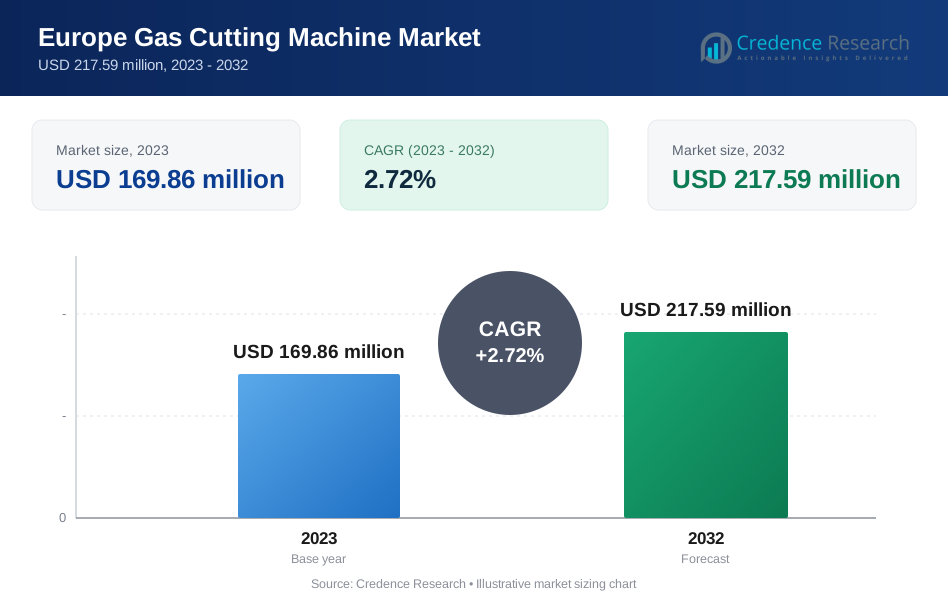
The Europe gas cutting machine market is projected to grow from USD 169.86 million in 2023 to an estimated USD 217.59 million by 2032, with a compound annual growth rate (CAGR) of 2.72% from 2024 to 2032. This growth reflects increasing demand across various industries, including construction, automotive, and shipbuilding, where precision cutting of metal materials is critical.
Key drivers in this market include technological advancements that enhance cutting efficiency and precision, leading to reduced operational costs and increased productivity. Additionally, the growing emphasis on automation and the adoption of Industry 4.0 principles are significantly influencing the market. Trends such as the integration of IoT and AI in cutting machines are also shaping the future of the industry, providing real-time data and improved operational control.
Geographically, Germany, France, and the UK are leading the market, driven by their strong industrial base and continuous innovation in manufacturing technologies. These countries hold a significant market share due to their established infrastructure and high demand from key industries. Key players in the Europe gas cutting machine market include ESAB, Lincoln Electric, and Messer Cutting Systems, which are known for their advanced product offerings and strong market presence. These companies are focusing on expanding their product portfolios and investing in research and development to maintain their competitive edge.
Market Drivers
Technological Advancements in Cutting Technologies
The Europe gas cutting machine market is significantly influenced by rapid technological advancements. For instance, GCE Group, a global leader in oxy-fuel cutting technology, offers innovative solutions supported by several patents to achieve high performance, excellent cut quality, and easy handling of equipment. The continuous development of cutting technologies, such as CNC (Computer Numerical Control) and laser-guided systems, has enhanced the precision and efficiency of gas cutting machines. These advancements allow for more accurate and cleaner cuts, reducing material waste and operational costs. The integration of advanced control systems and automation technologies also facilitates the seamless operation of cutting machines, making them more user-friendly and versatile for various industrial applications. The demand for such technologically advanced equipment is particularly high in industries where precision is paramount, such as aerospace, automotive, and shipbuilding.
Growing Demand from Key End-Use Industries
The demand for gas cutting machines in Europe is bolstered by the robust growth of key end-use industries, including construction, automotive, and metal fabrication. The construction industry, in particular, is experiencing a surge due to ongoing urbanization and infrastructure development projects across the region. Gas cutting machines are crucial in these industries for cutting and shaping metals into required forms and sizes. For example, GCE Cutting and Welding Technologies (GCE CWT) provides a full range of gas pressure regulators, arc welding equipment, gas economizers, safety equipment, and torches designed to meet international standards and local market requirements. In the automotive sector, the need for lightweight and durable materials necessitates precise cutting technologies, further driving the adoption of advanced gas cutting machines. Additionally, the metal fabrication industry, which serves a wide range of sectors, relies heavily on efficient cutting technologies to meet diverse customer specifications.
Increasing Focus on Automation and Industry 4.0
The trend towards automation and the adoption of Industry 4.0 principles are key drivers in the Europe gas cutting machine market. Automation in gas cutting processes not only increases productivity but also ensures consistency in quality, which is crucial for maintaining competitive standards in the global market. The incorporation of IoT (Internet of Things) and AI (Artificial Intelligence) technologies in gas cutting machines enables real-time monitoring and predictive maintenance, reducing downtime and operational costs. For instance, Industry 4.0 machines continuously record gas, energy, and filler consumption, providing valuable data for optimization. This shift towards smart manufacturing systems enhances overall efficiency and safety, making it a significant factor in the market's growth. Companies are increasingly investing in automated solutions to streamline their operations and improve their production capabilities.
Sustainability and Environmental Regulations
The growing emphasis on sustainability and adherence to stringent environmental regulations in Europe is another key driver of the gas cutting machine market. The European Union's regulatory framework mandates strict control over emissions and waste management in industrial processes. Gas cutting machines that offer cleaner operations and lower emissions are in high demand, as they help companies comply with these regulations. Moreover, the industry is witnessing a shift towards more energy-efficient technologies, which not only reduce environmental impact but also lower operational costs. The development of eco-friendly cutting methods and the use of alternative fuels in gas cutting processes are expected to gain traction, driven by both regulatory requirements and corporate sustainability initiatives.
Market Trends
Integration of Advanced Technologies
One of the most notable trends in the Europe gas cutting machine market is the integration of advanced technologies such as IoT, AI, and automation. These technologies are revolutionizing the way gas cutting machines operate, enhancing their efficiency, precision, and ease of use. For instance, ZINSER GmbH, a leading German manufacturer of CNC cutting machines, emphasizes the importance of Industry 4.0 technologies in their products. Their machines are equipped with IoT capabilities, allowing for real-time monitoring, data collection, and predictive maintenance. IoT-enabled machines allow for real-time monitoring and data collection, which aids in predictive maintenance and reduces unexpected downtime. AI is being used to optimize cutting processes, offering features like adaptive control systems that adjust parameters in real time based on the material being cut. Automation is also playing a significant role, enabling more streamlined operations, reducing labor costs, and improving safety. This trend is driven by the increasing demand for high-quality, consistent outputs in industries such as automotive, aerospace, and metal fabrication.
Shift Towards Eco-friendly and Energy-efficient Solutions
Another key trend is the growing emphasis on eco-friendly and energy-efficient solutions in the gas cutting machine market. With stringent environmental regulations and a rising focus on sustainability, manufacturers are developing machines that minimize emissions and energy consumption. This includes the adoption of alternative fuel sources and the development of technologies that reduce the carbon footprint of cutting operations. For instance, Messer Cutting Systems' HyCut technology offers an environmentally friendly alternative to traditional oxyfuel cutting, reducing emissions and improving energy efficiency. The market is seeing a shift towards the use of more sustainable materials and processes, with an emphasis on reducing waste and improving the recyclability of components. Energy-efficient machines not only help in complying with environmental standards but also offer cost savings to users, making them a preferred choice in various industries. This trend aligns with broader industrial goals of sustainability and responsible resource management, which are becoming increasingly important in the European market context.
Market Restraints and Challenges
High Initial Investment and Operational Costs
One of the primary restraints in the Europe gas cutting machine market is the high initial investment and operational costs associated with advanced cutting technologies. While these machines offer significant benefits in terms of precision and efficiency, their acquisition and maintenance require substantial financial outlays. The cost of integrating modern technologies like IoT and AI further escalates the overall expenditure, which can be prohibitive for small and medium-sized enterprises (SMEs). Additionally, the operational costs, including energy consumption and regular maintenance, add to the financial burden. This challenge is particularly acute in markets with tight profit margins, where companies may struggle to justify the investment in high-end equipment, leading to slower adoption rates.
Stringent Environmental and Safety Regulations
Another significant challenge facing the Europe gas cutting machine market is compliance with stringent environmental and safety regulations. The European Union enforces rigorous standards to control emissions and ensure workplace safety, which can impact the design and operation of gas cutting machines. Companies are required to invest in advanced filtration and exhaust systems to minimize harmful emissions, which increases production costs. Moreover, ensuring that machines meet safety standards necessitates additional features and certifications, further raising the complexity and cost of these systems. These regulatory requirements can slow down the introduction of new technologies and innovations, as manufacturers must navigate complex compliance processes. Additionally, the evolving regulatory landscape requires continuous monitoring and adaptation, posing a challenge for companies aiming to stay ahead in the market.
Market Segmentation Analysis
By Product Type
The Europe gas cutting machine market is segmented by product type into in-place gas cutting machines and portable gas cutting machines. In-place gas cutting machines are primarily used in industrial settings where large-scale metal cutting is required, offering high precision and stability. They are commonly utilized in factories and workshops for repetitive cutting tasks. On the other hand, portable gas cutting machines provide flexibility and mobility, making them suitable for on-site operations in construction, repair, and maintenance activities. The growing demand for portable solutions is driven by their versatility and ease of use, especially in remote or challenging environments.
By Application
The market is also segmented by application, with major segments including automotive, aerospace and defense, industrial machinery and equipment, and others. The automotive sector utilizes gas cutting machines for precise cutting of metal parts, essential for vehicle manufacturing and assembly processes. The aerospace and defense industries demand high-precision cutting for producing complex components, where gas cutting machines play a critical role. Industrial machinery and equipment manufacturing also heavily rely on gas cutting for fabricating machine parts and structures. Other applications include shipbuilding, construction, and metal fabrication industries, which require efficient and accurate cutting solutions.
Segments
Based on Product Type
- In-Place Gas Cutting Machine
- Portable Gas Cutting Machine
Based on Application
- Automotive
- Aerospace and Defense
- Industrial Machinery and Equipment
- Others
Based on Type of Fuel Gas Used
- Acetylene
- Propane
- Propylene
- Natural Gas
- Others
Based on Type of Nozzle
- Acetylene Cutting Nozzle
- Liquefied Petroleum Gas (LPG) Cutting Nozzle
- Lateral Cutting Nozzle
Based on Region
- Germany
- France
- UK
- Italy
- Other European Regions
Regional Analysis
Germany (30%):
Germany dominates the Europe gas cutting machine market, accounting for approximately 30% of the market share. This leadership position is attributed to the country's robust industrial base and strong focus on advanced manufacturing technologies. Germany's automotive and machinery industries are significant drivers of demand for gas cutting machines, particularly for precision cutting and high-volume production. The presence of leading manufacturers and continuous innovation in industrial processes further bolster Germany's market position.
France (20%):
France holds around 20% of the market share, driven by its thriving aerospace and defense sectors. The country's well-established infrastructure and strong emphasis on technological advancements contribute to the demand for high-quality gas cutting machines. The French market is characterized by a growing interest in automation and environmentally friendly technologies, aligning with the broader European focus on sustainability and efficiency in industrial operations.
Key players
- ESAB
- Nissan Tanaka Corporation
- Esprit Automation Ltd
- ARCBRO CNC Cutting Machine
- Haco Group
- Ador Welding Limited
- Colfax Corp.
- Hornet Cutting Systems
- KALTENBACH GmbH + Co. KG
- Koike Aronson Inc.
- Messer Cutting Systems Inc.
- SteelTailor
- The Lincoln Electric Co.
Competitive Analysis
The Europe gas cutting machine market is highly competitive, with key players such as ESAB, Messer Cutting Systems Inc., and The Lincoln Electric Co. leading the industry. These companies are recognized for their extensive product portfolios, technological innovations, and strong global distribution networks. They compete on factors like product quality, cutting precision, and advanced features, including automation and IoT integration. Mid-sized companies like Esprit Automation Ltd and ARCBRO CNC Cutting Machine also contribute significantly, focusing on niche markets and customized solutions. The competitive landscape is further shaped by the emphasis on sustainability, with many companies investing in eco-friendly technologies and energy-efficient systems to meet regulatory requirements and customer preferences.
Recent Developments
In March 2023, ESAB launched the Cutmaster 60i, a portable and powerful plasma cutter designed for heavy-duty industrial applications. This cutting-edge product boasts advanced technology that enhances cutting speed and efficiency, making it ideal for a wide range of materials and thicknesses. The Cutmaster 60i is tailored to meet the rigorous demands of modern industrial cutting, offering users a reliable and efficient solution for their cutting needs.
In July 2023, Messer Cutting Systems introduced a major software upgrade for its OmniWin 2023 software. This upgrade features enhanced nesting algorithms, an improved user interface, and advanced reporting capabilities. The new software aims to boost operational efficiency and precision in cutting processes, helping industries streamline their production workflows and optimize resource use.
In October 2023, Ador Welding Limited launched the WeldPro 400, a state-of-the-art gas cutting machine designed for high-performance applications. The WeldPro 400 is equipped with advanced safety features, automated controls, and superior cutting capabilities. This new product is engineered to enhance productivity and safety in various industrial sectors, reinforcing Ador Welding Limited's market presence.
In January 2017, GCE Cutting & Welding Technologies introduced the Oxy-Fuel Machine Cutting Torch FIT+ two with Integrated Ignition. This torch features a unique IHT height sensing system and integrated electronics, easily connectable to CNC systems. The FIT+ two offers enhanced precision and control in cutting operations, making it a valuable addition to modern cutting technologies.
In June 2017, Voortman launched the HYPERTHERM XPR300, designed for cutting mild steel, stainless steel, and aluminum. This new technology is available across Voortman's product range, including the V310, V304, V320, V330, V302, and V808 models. The HYPERTHERM XPR300 enhances cutting performance and versatility, catering to a wide range of industrial applications.
Market Concentration and Characteristics
The Europe gas cutting machine market is moderately concentrated, with a mix of well-established multinational corporations and regional players competing for market share. Key characteristics of this market include a strong emphasis on technological innovation, with leading companies investing heavily in advanced cutting technologies such as CNC systems, automation, and IoT integration. The market is characterized by a high level of competition based on product quality, efficiency, and technological features. Additionally, there is a growing focus on eco-friendly and energy-efficient solutions, driven by stringent environmental regulations and a broader shift towards sustainable industrial practices.
Report Coverage
The research report offers an in-depth analysis based on Product Type, Application, Type of fuel gas used, Type of Nozzle and Region. It details leading market players, providing an overview of their business, product offerings, investments, revenue streams, and key applications. Additionally, the report includes insights into the competitive environment, SWOT analysis, current market trends, as well as the primary drivers and constraints. Furthermore, it discusses various factors that have driven market expansion in recent years. The report also explores market dynamics, regulatory scenarios, and technological advancements that are shaping the industry. It assesses the impact of external factors and global economic changes on market growth. Lastly, it provides strategic recommendations for new entrants and established companies to navigate the complexities of the market.
Future Outlook
- The market will continue to witness advancements in CNC technology and automation, enhancing precision and operational efficiency.
- The integration of IoT in gas cutting machines is expected to grow, providing real-time data analytics and predictive maintenance capabilities.
- There will be a stronger emphasis on developing eco-friendly cutting solutions, with companies prioritizing low-emission and energy-efficient technologies.
- The automotive, aerospace, and construction industries will drive demand for advanced gas cutting machines, supporting market growth.
- Manufacturers will increasingly offer customizable machines to meet specific industry requirements, enhancing product appeal.
- The demand for portable gas cutting machines will rise, driven by their flexibility and suitability for on-site operations.
- Companies will continue to adapt to stringent environmental and safety regulations, influencing product design and features.
- Ongoing investment in research and development will lead to innovative products, keeping the market competitive and dynamic.
- The market may experience consolidation as larger companies acquire smaller players to expand their technological capabilities and market reach.
- The shift towards digitalization and smart manufacturing practices will be a significant trend, enhancing operational efficiencies and reducing costs.
Request a Free Sample
Fill in your details and we'll send you a free sample report.
- Sample data tables & charts
- Research methodology
Need a Custom Version of This Report?
Tailor the scope, geography, or segments to your exact requirements.
- Custom geography or segment scope
- Direct access to our analyst team
Frequently Asked Questions
What is the projected growth of the Europe gas cutting machine market?
What are the key drivers of growth in this market?
What are the key drivers of growth in this market?
What government initiatives are supporting this market's growth?
Who are the leading players in the Europe gas cutting machine market?
Table of Content
Chapter 1. Report Introduction
- 1.1 Report Description & Purpose
- 1.1.1 Report Title & Market Definition
- 1.1.2 Unique Selling Propositions (USP) & Key Differentiators
- 1.1.3 Value Proposition for Stakeholders
- 1.2 Research Objectives
- 1.2.1 Market Sizing Objectives (Volume & Revenue)
- 1.2.2 Segmentation Objectives
- 1.2.3 Competitive Intelligence Objectives
- 1.2.4 Forecast & Scenario Objectives
- 1.3 Report Scope
- 1.3.1 Europe Gas Cutting Machine Scope – Types & Subtypes Covered
- 1.3.2 Geographic Scope – Regions & Countries Covered
- 1.3.3 Historical Period, Base Year & Forecast Period (2023; forecast to 2032)
- 1.3.4 Inclusions & Exclusions
- 1.4 HS Code & Classification Framework
- 1.5 Currency, Units & Pricing Basis
- 1.6 Target Stakeholders
- 1.7 Limitations & Assumptions
Chapter 2. Executive Summary
- 2.1 Global Europe Gas Cutting Machine Market Snapshot
- 2.1.1 Market Size – Historical (2023) & Forecast (2023-2032) (2023: USD 169.86 million → 2032: USD 217.59 million)
- 2.1.2 Volume & Revenue – Global Totals
- 2.1.3 Key Market Highlights – Top Five Facts
- 2.2 Europe Gas Cutting Machine Market Segmentation Snapshot
- 2.2.1 Market Split by Region – 2023 vs. 2032
- 2.3 Competitive Snapshot
- 2.3.1 Top 10 Players by Revenue Share – 2023
- 2.3.2 Top 10 Players by Volume Share – 2023
- 2.3.3 Recent Strategic Developments (18-Month Summary)
- 2.4 Key Investment Highlights & Strategic Conclusions
Chapter 3. Europe Gas Cutting Machine Market Dynamics & Industry Analysis
- 3.1 Market Overview & Context
- 3.1.1 Europe Gas Cutting Machine Market Position in the Broader Automotive Value Chain
- 3.1.2 OEM vs. Replacement Market Dynamics
- 3.1.3 Market Maturity & Development Stage by Region
- 3.2 Europe Gas Cutting Machine Market Drivers
- 3.3 Europe Gas Cutting Machine Market Restraints & Challenges
- 3.4 Europe Gas Cutting Machine Market Opportunities
- 3.5 Porter's Five Forces Analysis
- 3.5.1 Threat of New Entrants
- 3.5.2 Bargaining Power of Suppliers
- 3.5.3 Bargaining Power of Buyers
- 3.5.4 Threat of Substitutes
- 3.5.5 Competitive Rivalry – Intensity Assessment
- 3.6 Europe Gas Cutting Machine Value Chain Analysis
- 3.6.1 Upstream – Raw Material/Input Suppliers
- 3.6.1.1 Raw Material/Input 1
- 3.6.1.2 Raw Material/Input 2
- 3.6.1.3 Raw Material/Input 3
- 3.6.2 Midstream – Production/Manufacturing/Service Delivery
- 3.6.2.1 Production/Process Overview
- 3.6.2.2 Key Facility Locations & Capacity by Manufacturer
- 3.6.3 Downstream – Distribution & End Consumer
- 3.6.3.1 Primary Channel – B2B/OEM
- 3.6.3.2 Secondary Channels – Dealer, Retail, Online, Direct
- 3.6.4 Value Chain Profitability Analysis
- 3.6.1 Upstream – Raw Material/Input Suppliers
- 3.7 PESTEL Analysis
- 3.7.1 Political Factors
- 3.7.2 Economic Factors
- 3.7.3 Social Factors
- 3.7.4 Technological Factors
- 3.7.5 Environmental Factors
- 3.7.6 Legal Factors
- 3.8 Europe Gas Cutting Machine Supply Chain Analysis
- 3.8.1 Raw Material/Input Supply Risk Assessment
- 3.8.2 Manufacturing Concentration Risk (Geographic Exposure)
- 3.8.3 Trade Disruption Impact Analysis
- 3.9 Regulatory & Policy Landscape
Note: The regulatory and policy landscape section covers regulations based on their applicability to the market, Europe Gas Cutting Machine category, geography, and scope of the study. Only regulatory frameworks with a material impact on operations, compliance, trade, sustainability, or market access are analyzed in detail.
Chapter 4. Key Investment Pockets & Opportunity Analysis
- 4.1 Europe Gas Cutting Machine Market Attractiveness Analysis
- 4.1.1 By Region – Investment Attractiveness Matrix (Volume × CAGR)
- 4.2 Absolute Revenue Growth Opportunity
- 4.2.1 By Region – Absolute USD Growth Through 2032
- 4.3 Incremental Volume Opportunity
- 4.3.1 By Region – Incremental Volume Through 2032
- 4.3.2 Segment – Incremental Volume
- 4.4 Emerging Submarket Opportunity Deep Dive (Subject to Applicability)
- 4.5 Emerging Market Opportunity Scorecards
- 4.5.1 United States
- 4.5.2 Europe
- 4.5.3 Asia
- 4.5.4 Middle East & Africa
Note: Emerging Market Opportunity Scorecards will be included based on relevance and strategic importance. Regions listed are indicative and may vary depending on data availability and market dynamics.
Chapter 5. Europe Gas Cutting Machine Import-Export Analysis & Trade Flows
- 5.1 Global Trade Overview
- 5.1.1 Global Export Value by Country (2023)
- 5.1.2 Global Export Volume by Country (2023)
- 5.1.3 Global Import Value by Country (2023)
- 5.1.4 Global Import Volume by Country (2023)
- 5.1.5 Net Trade Balance by Country (2023)
- 5.2 Export Analysis – Segment
- 5.2.1 Type 1 (HS Code)
- 5.2.2 Type 2 (HS Code)
- 5.2.3 Type 3 (HS Code)
- 5.2.4 Type 4 (HS Code)
- 5.2.5 Type 5 (HS Code)
- 5.3 Import Analysis – Segment
- 5.3.1 Type 1 (HS Code)
- 5.3.2 Type 2 (HS Code)
- 5.3.3 Type 3 (HS Code)
- 5.3.4 Type 4 (HS Code)
- 5.3.5 Type 5 (HS Code)
- 5.4 Average Unit Trade Prices
- 5.4.1 Average Export Price – Segment & Country
- 5.4.2 Average Import Price – Segment & Source Country
- 5.4.3 Price Trends (2023)
- 5.5 Key Trade Route Analysis
- 5.5.1 Trade Route 1
- 5.5.2 Trade Route 2
- 5.5.3 Trade Route 3
- 5.5.4 Trade Route 4
- 5.5.5 Trade Route 5
- 5.6 Trade Policy Impact Assessment
- 5.6.1 US Anti-Dumping & Section 301 Tariffs
- 5.6.2 EU Customs Union Impact
- 5.6.3 Major Free Trade Agreements
- 5.6.4 USMCA Rules of Origin
Note: Trade policy analysis will be included only where relevant to the Europe Gas Cutting Machine market.
Chapter 6. Competitive Landscape & Company Benchmarking
- 6.1 Europe Gas Cutting Machine Market Concentration & Structure
- 6.1.1 Herfindahl-Hirschman Index (HHI) – vs. 2023
- 6.1.2 Tier 1, Tier 2 & Tier 3 Market Structure
- 6.1.3 Global, Regional & Local Player Dynamics
- 6.2 Europe Gas Cutting Machine Market Share Analysis – 2023
- 6.2.1 Global Revenue Share by Company
- 6.2.2 Global Volume Share by Company
- 6.2.3 Regional Revenue Share
- 6.2.4 Market Share Evolution ( vs. 2023)
- 6.2.5 OEM Segment Share by Company
- 6.2.6 Replacement Segment Share by Company
- 6.3 Production/Delivery Capacity & Facility Analysis
- 6.3.1 Global Installed Capacity
- 6.3.2 Capacity Utilization Rates
- 6.3.3 Production/Output Volume
- 6.3.4 Facility Locations & Capacity Map
- 6.3.5 Planned Capacity Additions
- 6.4 Europe Gas Cutting Machine Competitive Benchmarking Matrix
- 6.4.1 Revenue, Volume, CAGR & Profitability Comparison
- 6.4.2 Channel Revenue Mix
- 6.4.3 Geographic Revenue Exposure
- 6.4.4 R&D Intensity
- 6.4.5 Sustainability Maturity
- 6.5 Strategic Developments in Europe Gas Cutting Machine (Last 24 Months)
- 6.5.1 Mergers, Acquisitions & Divestments
- 6.5.2 New Europe Gas Cutting Machine Launches
- 6.5.3 Facility Expansions
- 6.5.4 Strategic Alliances, Joint Ventures & Partnerships
- 6.5.5 Distribution Expansion & Market Entry
- 6.5.6 Sustainability & ESG Initiatives
- 6.6 Competitive Strategy Mapping
- 6.6.1 Leader, Challenger, Follower & Niche Classification
- 6.6.2 Pricing Strategy Comparison
- 6.6.3 Channel Strategy Matrix
Note: Strategic developments are included based on their materiality and the availability of reliable information.
Chapter 7. Global Europe Gas Cutting Machine Market – By Distribution Channel
- 7.1 Segment Overview
- 7.1.1 Volume & Revenue Split by Channel (2023 & 2032)
- 7.1.2 Channel Mix Evolution (2023-2032)
Chapter 8. Regional Market Analysis – Global Overview
- 8.1 Global Regional Overview
- 8.1.1 Regional Volume Share
- 8.1.2 Regional Revenue Share
- 8.1.3 Regional Volume by Region
- 8.1.4 Regional Revenue by Region
- 8.1.5 Regional Forecast Through 2032
- 8.2 Cross-Regional Segment Analysis
- 8.2.1 By Distribution Channel
- 8.2.2 By Brand/Price Tier
Chapter 9. North America Europe Gas Cutting Machine Market
- 9.1 United States
- 9.2 Canada
- 9.3 Mexico
Chapter 10. Europe Europe Gas Cutting Machine Market
- 10.1 Germany
- 10.2 France
- 10.3 Italy
- 10.4 United Kingdom
- 10.5 Spain
- 10.6 Poland
- 10.7 Russia
- 10.8 Netherlands
- 10.9 Belgium
- 10.10 Sweden
- 10.11 Denmark
- 10.12 Norway
- 10.13 Rest of Europe
Chapter 11. Asia Pacific Europe Gas Cutting Machine Market
- 11.1 China
- 11.2 India
- 11.3 Japan
- 11.4 South Korea
- 11.5 Thailand
- 11.6 Indonesia
- 11.7 Vietnam
- 11.8 Malaysia
- 11.9 Australia
- 11.10 Rest of Asia Pacific
Chapter 12. Latin America Europe Gas Cutting Machine Market
- 12.1 Brazil
- 12.2 Argentina
- 12.3 Colombia
- 12.4 Chile
- 12.5 Rest of Latin America
Chapter 13. Middle East Europe Gas Cutting Machine Market
- 13.1 Saudi Arabia
- 13.2 United Arab Emirates
- 13.3 Turkey
- 13.4 Israel
- 13.5 Iran
- 13.6 Rest of the Middle East
Chapter 14. Africa Europe Gas Cutting Machine Market
- 14.1 South Africa
- 14.2 Egypt
- 14.3 Nigeria
- 14.4 Morocco
- 14.5 Rest of Africa
Chapter 15. Europe Gas Cutting Machine Company Profiles
- 15.1 [Company 01]
- 15.1.1 Company Overview
- 15.1.2 Key Management Personnel
- 15.1.3 Products & Services Portfolio
- 15.1.4 Financial Performance
- 15.1.5 Key Market Focus & Geographic Presence
- 15.1.6 Recent Developments & Strategic Initiatives
Note: The company profile list is preliminary and may change based on research findings, market developments, data availability, and client requirements.
Chapter 16. Appendices
- Appendix A – List of Abbreviations & Acronyms
- Appendix B – Industry Classification Code Reference – Full Series
- Appendix C – Production & Capacity Data Tables
- Appendix D – End-Use & Demand Base Tables
- Appendix E – Consumption & Replacement Rate Assumptions
- Appendix F – ASP Reference Tables
- Appendix G – Manufacturing & Facility Database
- Appendix H – Import-Export Data Tables
- Appendix I – Regulatory Summary Tables
- Appendix J – Primary Research Participant List (Anonymized)
- Appendix K – Primary Research Questionnaire Framework
- Appendix L – Data Sources & Bibliography
- Appendix M – Market Size Divergence & Source Comparison
Chapter 17. Research Methodology
- 17.1 Research Framework & Philosophy
- 17.2 Secondary Research – Sources, Hierarchy & Data Extraction
- 17.3 Data Modeling – Bottom-Up & Top-Down Market Sizing
- 17.4 Primary Research – Stakeholder Framework, LOI & Sample Sizes
- 17.5 Forecast Methodology – Regression, Scenario & Sensitivity Analysis
- 17.6 Quality Control – Four-Layer Validation Framework
- 17.7 Limitations & Standard Assumptions
- 17.8 Disclaimer
