
Market Overview:
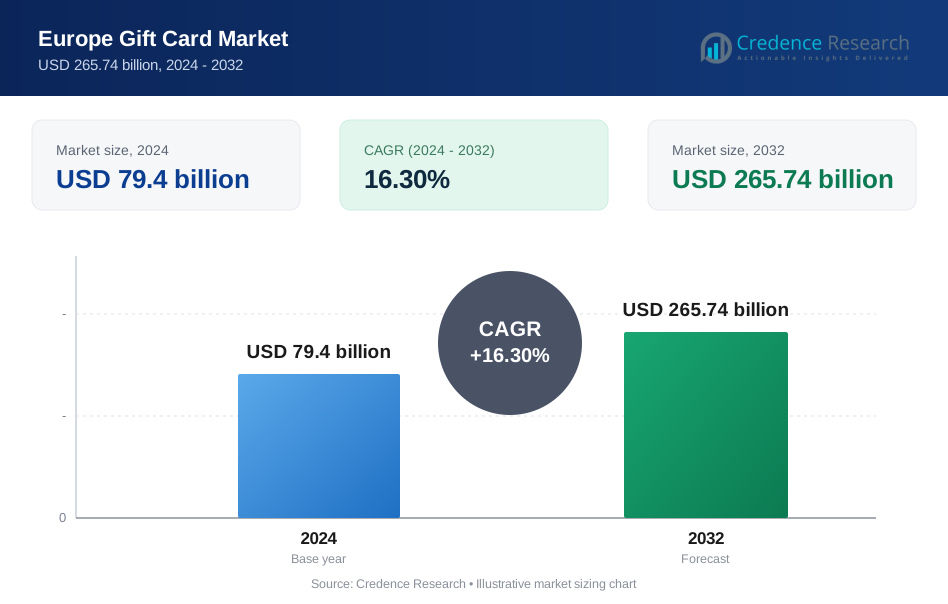
The Europe Gift Card market was valued at USD 79.4 billion in 2024 and is anticipated to reach USD 273.9 billion by 2032, registering a CAGR of 16.3% during the forecast period.
| REPORT ATTRIBUTE | DETAILS |
|---|---|
| Historical Period | 2020-2023 |
| Base Year | 2024 |
| Forecast Period | 2025-2032 |
| Europe Gift Card Market Size 2024 | USD 79.4 billion |
| Europe Gift Card Market, CAGR | 16.3% |
| Europe Gift Card Market Size 2032 | USD 273.9 billion |
The Europe gift card market is shaped by major players such as Amazon.com, Inc., Apple Inc., Best Buy Co., Inc., Blackhawk Network Holdings, Inc., Edenred, First Data Corporation, InComm Payments™, Qwikcilver Solutions Pvt. Ltd., Starbucks Corporation, and Target Corporation. These companies strengthen their positions through e-commerce integration, mobile-first solutions, and corporate reward programs. Amazon leads with its strong digital ecosystem, while Edenred and Blackhawk Network focus on corporate and prepaid offerings. Regionally, Western Europe dominates the market with over 40% share, supported by advanced retail infrastructure and high consumer spending, while Northern Europe follows with rapid digital adoption and strong demand for e-gifting solutions.
Market Insights
- The Europe Gift Card market was valued at USD 79.4 billion in 2024 and is projected to reach USD 273.9 billion by 2032, growing at a CAGR of 16.3%.
- Rising demand for digital payments and e-gifting drives growth, with retail closed loop cards holding the dominant share due to strong adoption by major retailers.
- Key trends include increasing personalization, loyalty program integration, and rapid shift toward mobile-based gift cards, particularly appealing to younger demographics.
- The market is competitive, with Amazon, WeGift, Tango Card, OptioPay GmbH, and Swile focusing on digital innovation, corporate solutions, and strategic retail partnerships.
- Western Europe leads with over 40% market share, followed by Northern Europe with strong e-gifting penetration; low-value cards (0–200 US$) dominate by price range, while individuals remain the largest end-user segment, supported by high consumer spending during festivals and holidays.
Market Segmentation Analysis:
By Type
The Europe Gift Card market is led by retail closed loop cards, holding the largest share due to their strong adoption by major retail chains and supermarkets. Consumers prefer these cards for convenience, promotional discounts, and seasonal offers. Retailers actively push them to boost customer loyalty and repeat purchases. Universal accepted open loop cards follow, driven by flexibility across multiple merchants. E-gifting also grows quickly, supported by digital platforms and rising mobile payment adoption. Restaurant and miscellaneous closed loop cards remain smaller, but they find steady demand in niche categories.
- For instance, Amazon delivered over 2 billion items in Europe on the same or next day in 2023, indicating significant operational activity.
By Price Range
Low-value cards, priced between 0–200 US$, dominate the market with the highest share. These cards attract wide adoption among individuals for everyday gifting, festive occasions, and corporate rewards. The segment grows as consumers view them as affordable and flexible options. Businesses also issue low-value gift cards to employees and customers as quick incentives. Medium-value cards between 200–400 US$ show consistent demand, particularly in enterprise gifting. High-value cards, above 400 US$, occupy a smaller niche, often preferred for luxury gifting, corporate bonuses, or premium customer engagement strategies.
- For instance, Starbucks reported 34.3 million active U.S. Rewards members in Q1 FY2024, reflecting heavy stored-value and gift-card use in small, frequent purchases.
By End-User
Individuals account for the dominant share in the Europe Gift Card market, supported by frequent usage for birthdays, holidays, and personal gifting. Rising e-commerce adoption and digital wallets further strengthen this segment. Within businesses, large enterprises represent a significant share, using gift cards for employee recognition, sales promotions, and customer engagement campaigns. Small and medium enterprises also contribute steadily, driven by loyalty programs and cost-effective rewards. However, individuals remain the primary growth driver as consumer preference for personalized and flexible gifting solutions accelerates across both physical and digital formats.
Market Overview
Rising Consumer Preference for Cashless Payments
The shift toward digital and cashless transactions strongly drives the Europe gift card market. Consumers increasingly prefer secure, convenient, and contactless payment methods, particularly in urban areas with advanced digital infrastructure. Gift cards, both physical and digital, fit this trend by offering flexibility in usage across retail, restaurants, and e-commerce platforms. Growing smartphone penetration and the popularity of digital wallets further accelerate adoption. The integration of gift cards with loyalty programs and discounts also boosts usage, making them an attractive alternative to traditional cash gifting.
- For instance, Zalando is actively investing in improving digital customer experiences and has seen its active customer base in Europe grow. As of November 2024 (Q3 2024), the total number of active customers reached 50.3 million.
Expansion of E-Commerce and Online Retailing
Rapid growth of e-commerce platforms significantly strengthens the demand for gift cards across Europe. Online marketplaces, retailers, and digital platforms actively promote gift cards to enhance sales and customer engagement. Consumers use gift cards to shop conveniently online, avoiding payment complexities while enjoying promotions and seasonal discounts. E-gifting adds momentum, allowing instant delivery of cards through email or mobile apps. As cross-border online shopping expands, open loop cards and retailer-issued gift cards gain wider acceptance. This strong link between online retail and gifting continues to fuel steady market growth.
- For instance, according to an Amazon statement in late 2024, its Amazon Pay service surpassed 1 billion gift cards delivered in India since its launch, reflecting the growing adoption of its gifting solutions in that country.
Corporate Adoption for Incentives and Rewards
Businesses across Europe increasingly rely on gift cards as part of employee reward programs and customer loyalty schemes. Large enterprises use them to enhance employee engagement, offering cards for recognition, bonuses, and incentives. Small and medium enterprises follow the same path, as gift cards provide a cost-effective solution compared to direct cash rewards. Companies also distribute gift cards during marketing campaigns to attract and retain customers. The corporate push for structured and scalable reward systems makes gift cards a dominant tool for driving engagement, supporting consistent market expansion.
Key Trends & Opportunities
Growth of Digital and Mobile Gift Cards
The transition from physical to digital gift cards presents a strong growth opportunity in Europe. Mobile-based solutions are gaining traction as consumers prefer instant, secure, and shareable formats. Digital gift cards integrate seamlessly with mobile wallets, making them easy to redeem across multiple platforms. Retailers increasingly adopt e-gifting strategies to reach tech-savvy consumers, boosting cross-selling and customer loyalty. Enhanced personalization options, such as customized messages and designs, further attract younger demographics. This digital shift ensures broader adoption and creates long-term opportunities for retailers and service providers in the region.
- For instance, in November 2023, following its fiscal fourth-quarter results, Apple reported a record-high installed base of active devices, which includes all Apple products like iPhones, iPads, and Macs. The specific number of active iPhones was higher than 750 million.
Personalization and Loyalty Program Integration
Consumers increasingly seek personalized gifting solutions, creating a major trend in the Europe gift card market. Retailers and service providers integrate gift cards with loyalty programs to strengthen customer retention. Personalized cards featuring unique designs, tailored discounts, or specific product bundles enhance consumer appeal. Companies leverage data analytics to provide targeted offers, maximizing customer satisfaction and repeat purchases. This trend creates opportunities for businesses to differentiate their offerings and build stronger brand connections. Personalized digital gifting also aligns with consumer demand for flexibility and emotional value in gifting experiences.
Key Challenges
Risk of Fraud and Security Concerns
Fraudulent activities, such as card cloning, phishing, and unauthorized usage, remain a significant challenge for the Europe gift card market. Cybersecurity risks increase as adoption of digital gift cards grows, exposing both businesses and consumers to potential financial losses. Retailers and issuers must invest heavily in advanced encryption, authentication systems, and fraud detection mechanisms. Any breach in trust reduces consumer confidence, slowing adoption rates. Addressing these risks with strong regulatory frameworks and technological safeguards is critical for sustaining the credibility and growth of the gift card ecosystem in Europe.
Regulatory Complexity Across Countries
The fragmented regulatory environment across European countries poses barriers to seamless market growth. Each country enforces different compliance rules on prepaid instruments, taxation, and anti-money laundering measures. This variation increases operational costs for multinational retailers and card issuers, limiting cross-border adoption. Complex compliance requirements also slow the introduction of new digital gifting solutions in certain regions. Companies must constantly adapt to evolving legal frameworks, which adds to administrative burdens. Streamlining regulations and harmonizing standards across Europe would help improve efficiency and unlock broader growth opportunities in the market.
Regional Analysis
Western Europe
Western Europe holds the largest share of the Europe gift card market, driven by strong consumer spending, advanced retail infrastructure, and high digital payment adoption. Countries like Germany, France, and the United Kingdom lead the region with widespread use of both physical and digital gift cards. Retailers and e-commerce platforms actively promote gift cards as tools for customer engagement and seasonal sales. The corporate sector also contributes significantly, using gift cards for employee incentives and client rewards. High internet penetration and mobile wallet integration further boost the market, ensuring Western Europe maintains a dominant position.
Northern Europe
Northern Europe accounts for a notable share in the Europe gift card market, supported by high living standards, strong online retail growth, and advanced digital ecosystems. Countries such as Sweden, Norway, Denmark, and Finland drive adoption with rapid uptake of e-gifting and mobile-based solutions. Consumers favor digital cards for convenience and security, while retailers integrate them into loyalty programs to boost repeat sales. Corporate usage also rises, particularly in employee recognition programs. With government support for cashless economies and increasing demand for personalized gifting, Northern Europe continues to expand its share steadily in the overall market.
Southern Europe
Southern Europe represents a growing share of the Europe gift card market, led by countries like Italy, Spain, and Portugal. Rising consumer interest in digital gifting, along with expanding e-commerce platforms, supports the region’s growth. Seasonal demand during holidays and festivals plays a key role in boosting retail closed loop cards. Businesses in the region also embrace gift cards as cost-effective tools for marketing and customer retention. Despite lower penetration compared to Western and Northern Europe, the region shows strong potential, with improving digital infrastructure and increasing corporate adoption driving steady market expansion.
Eastern Europe
Eastern Europe holds a smaller share in the Europe gift card market but shows strong growth potential. Countries such as Poland, Czech Republic, and Hungary are witnessing rising adoption as e-commerce platforms expand and consumers become more digitally connected. Retail closed loop and low-value cards dominate due to affordability and preference for accessible gifting solutions. Businesses in the region are beginning to incorporate gift cards into loyalty and promotional programs, supporting further adoption. Although the market faces challenges from lower disposable incomes, increasing smartphone penetration and digital payment growth are expected to lift the region’s market share.
Market Segmentations:
By Type:
- Universal Accepted open Loop Cards
- Restaurant Closed Loop Cards
- Retail Closed Loop
- Miscellaneous Closed Loop
- E-Gifting
By Price Range:
- High (Above 400 US$)
- Medium (200-400 US$)
- Low (0-200 US$)
By End-User:
- Business
- Small & Medium Enterprises
- Large Enterprises
- Individuals
By Type of Program:
- Employee Rewards
- Customer Rewards
- Sales Incentives
- Channel Incentives
By Sales Channel:
- Online
- Offline
By Merchant Type:
- Hypermarkets/Supermarkets
- Discount Stores
- Coffee Shops
- Entertainment
- Salons/Spa
- Book Store
- Home Décor Store
- Gas Station
- Restaurants
- Department Stores
- Grocery Stores
- Electronics
- Sporting Goods
- Clothing Apparel
- Travel
- Accessories & Jewellery
By Geography:
- UK.
- Germany
- France
- Italy
- Russia
- Nordic
- Benelux
- Rest of Europe
Competitive Landscape
The Europe gift card market is highly competitive, with global and regional players focusing on innovation, partnerships, and digital transformation to strengthen their positions. Leading companies such as Amazon.com, Inc., Apple Inc., Best Buy Co., Inc., Blackhawk Network Holdings, Inc., Edenred, Europe Payments Direct, Inc., First Data Corporation, InComm Payments™, NGC US, LLC, Qwikcilver Solutions Pvt. Ltd., Starbucks Corporation, and Target Corporation actively expand their portfolios to meet diverse consumer and business needs. Amazon dominates through its vast e-commerce platform and extensive retail partnerships, while Apple leverages its strong ecosystem with digital and mobile-first solutions. Edenred and Blackhawk Network focus on corporate and prepaid solutions, catering to enterprise demand. InComm Payments and Qwikcilver emphasize digital innovation and seamless integration across retail channels. These players compete on personalization, security, and mobile-based offerings, with Western Europe providing the largest market share and Northern Europe emerging as a high-growth hub for digital gift card adoption.
Key Player Analysis
- Apple Inc.
- Best Buy Co., Inc.
- Blackhawk Network Holdings, Inc.
- Edenred
- Europe Payments Direct, Inc.
- First Data Corporation
- InComm Payments™
- NGC US, LLC
- Qwikcilver Solutions Pvt. Ltd.
- Starbucks Corporation
- Target Corporation
Recent Developments
- In October 2024, Hallmark introduced its innovative “Gift Card Greetings”, merging traditional greeting cards with embedded QR‑coded digital gift cards. Priced at $4.99 and available via Hallmark’s Gold Crown stores and website, this hybrid solution combines tangible sentiment with the convenience of digital gifting, redeemable at over 100 major retailers.
- In February 2024, Roblox, a worldwide immersive platform for communication and engagement, and Blackhawk Network (BHN) have teamed up to provide digital gift cards in the following currencies: Austrian (EUR), Belgian (EUR), Swiss Franc (CFH), and Brazilian Real (BRL) on Roblox's gift card website, Roblox.com/giftcards. Customers in each nation can now use local currencies to purchase Roblox digital gift cards.
- In July 2024, Air India launched Air India Gift Cards for both domestic and international flights. These cards provide a great way for travelers to gift traveling experiences to their loved ones. These cards are available from Rs 1,000 to Rs 200,000
Report Coverage
The research report offers an in-depth analysis based on Type, Price Range, End-User, Type of Program, Sales Channel, Merchant Type and Geography. It details leading market players, providing an overview of their business, product offerings, investments, revenue streams, and key applications. Additionally, the report includes insights into the competitive environment, SWOT analysis, current market trends, as well as the primary drivers and constraints. Furthermore, it discusses various factors that have driven market expansion in recent years. The report also explores market dynamics, regulatory scenarios, and technological advancements that are shaping the industry. It assesses the impact of external factors and global economic changes on market growth. Lastly, it provides strategic recommendations for new entrants and established companies to navigate the complexities of the market.
Future Outlook
- The market will expand steadily with double-digit growth through the forecast period.
- Digital and mobile gift cards will replace traditional physical formats at a faster rate.
- Retail closed loop cards will continue to dominate supported by strong adoption from major chains.
- Corporate usage will increase as businesses integrate gift cards into reward and loyalty programs.
- Personalization features will enhance customer engagement and drive higher redemption rates.
- E-gifting will grow rapidly with rising smartphone penetration and mobile wallet adoption.
- Security enhancements and fraud prevention measures will shape digital platform development.
- Western Europe will retain leadership, while Northern Europe will see faster digital adoption.
- Low-value cards will remain the most popular, especially among individuals and SMEs.
- Partnerships between fintech companies and retailers will accelerate market innovation and adoption.
Request a Free Sample
Fill in your details and we'll send you a free sample report.
- Sample data tables & charts
- Research methodology
Need a Custom Version of This Report?
Tailor the scope, geography, or segments to your exact requirements.
- Custom geography or segment scope
- Direct access to our analyst team
Frequently Asked Questions
What is the expected growth rate of the European Gift Cards Market?
What factors are driving the growth of the European Gift Cards Market?
Which country holds the largest market share in the European Gift Cards Market?
How are gift cards being used by businesses in Europe?
Table of Content
Chapter 1. Report Introduction
- 1.1 Report Description & Purpose
- 1.1.1 Report Title & Market Definition
- 1.1.2 Unique Selling Propositions (USP) & Key Differentiators
- 1.1.3 Value Proposition for Stakeholders
- 1.2 Research Objectives
- 1.2.1 Market Sizing Objectives (Volume & Revenue) (Volume Where Applicable)
- 1.2.2 Segmentation Objectives
- 1.2.3 Competitive Intelligence Objectives
- 1.2.4 Forecast & Scenario Objectives
- 1.3 Report Scope
- 1.3.1 Europe Gift Card Scope – Segments & Subsegments Covered
- 1.3.2 Geographic Scope – Regions & Countries Covered
- 1.3.3 Historical Period, Base Year & Forecast Period (2024; forecast to 2032)
- 1.3.4 Inclusions & Exclusions
- 1.4 Industry Classification & Applicable Codes
- 1.5 Currency, Measurement Units & Valuation Basis
- 1.6 Target Stakeholders
- 1.7 Limitations & Assumptions
Chapter 2. Executive Summary
- 2.1 Global Europe Gift Card Market Snapshot
- 2.1.1 Market Size – Historical (2024) & Forecast (2024-2032) (2024: USD 79.4 billion → 2032: USD 265.74 billion)
- 2.1.2 Volume & Revenue – Global Totals (Volume Where Applicable)
- 2.1.3 Key Market Highlights – Top Five Facts
- 2.2 Europe Gift Card Market Segmentation Snapshot
- 2.2.1 Market Split by Region – 2024 vs. 2032
- 2.3 Competitive Snapshot
- 2.3.1 Top 10 Players by Revenue Share – 2024
- 2.3.2 Top 10 Players by Volume Share – 2024 (Volume Where Applicable)
- 2.3.3 Recent Strategic Developments (18-Month Summary)
- 2.4 Key Investment Highlights & Strategic Conclusions
Chapter 3. Europe Gift Card Market Dynamics & Industry Analysis
- 3.1 Market Overview & Context
- 3.1.1 Europe Gift Card Market Position in the Broader Industry Value Chain
- 3.1.2 Demand Structure & Purchasing Dynamics
- 3.1.3 Market Maturity & Development Stage by Region
- 3.2 Europe Gift Card Market Drivers
- 3.3 Europe Gift Card Market Restraints & Challenges
- 3.4 Europe Gift Card Market Opportunities
- 3.5 Porter's Five Forces Analysis
- 3.5.1 Threat of New Entrants
- 3.5.2 Bargaining Power of Suppliers
- 3.5.3 Bargaining Power of Buyers
- 3.5.4 Threat of Substitutes
- 3.5.5 Competitive Rivalry – Intensity Assessment
- 3.6 Europe Gift Card Value Chain Analysis
- 3.6.1 Upstream – Key Inputs, Resources & Suppliers
- 3.6.1.1 Key Input/Resource 1
- 3.6.1.2 Key Input/Resource 2
- 3.6.1.3 Key Input/Resource 3
- 3.6.2 Midstream – Core Operations & Value Creation
- 3.6.2.1 Operating Model & Process Overview
- 3.6.2.2 Key Operating Locations & Capabilities by Company
- 3.6.3 Downstream – Market Channels & End Users
- 3.6.3.1 Direct Sales & Customer Engagement Channels
- 3.6.3.2 Indirect Sales, Intermediaries & Partner Channels
- 3.6.4 Value Chain Profitability Analysis
- 3.6.1 Upstream – Key Inputs, Resources & Suppliers
- 3.7 PESTEL Analysis
- 3.7.1 Political Factors
- 3.7.2 Economic Factors
- 3.7.3 Social Factors
- 3.7.4 Technological Factors
- 3.7.5 Environmental Factors
- 3.7.6 Legal Factors
- 3.8 Europe Gift Card Supply Chain Analysis
- 3.8.1 Critical Input & Resource Availability Risk Assessment
- 3.8.2 Supplier & Operational Concentration Risk (Geographic Exposure)
- 3.8.3 Supply & Service Disruption Impact Analysis
- 3.9 Regulatory & Policy Landscape
Note: The regulatory and policy landscape section covers regulations based on their applicability to the market, Europe Gift Card category, geography, and scope of the study. Only regulatory frameworks with a material impact on operations, compliance, trade, sustainability, or market access are analyzed in detail.
Chapter 4. Key Investment Pockets & Opportunity Analysis
- 4.1 Europe Gift Card Market Attractiveness Analysis
- 4.1.1 By Region – Investment Attractiveness Matrix (Market Size × CAGR)
- 4.2 Absolute Revenue Growth Opportunity
- 4.2.1 By Region – Absolute Revenue Growth Through 2032
- 4.3 Incremental Demand Opportunity
- 4.3.1 By Region – Incremental Demand Through 2032
- 4.3.2 Segment – Incremental Demand
- 4.4 Emerging Submarket Opportunity Deep Dive (Subject to Applicability)
- 4.5 Priority Market Opportunity Scorecards
- 4.5.1 United States
- 4.5.2 Europe
- 4.5.3 Asia
- 4.5.4 Middle East & Africa
Note: Priority market opportunity scorecards reflect the geographic scope and strategic relevance of the study. Listed markets are indicative and may be adapted to the industry.
Chapter 5. Europe Gift Card Cross-Border Trade & Market Access Analysis
- 5.1 International Trade & Cross-Border Activity Overview
- 5.1.1 Global Export Value by Country (2024)
- 5.1.2 Global Export Volume by Country (2024) (Volume Where Applicable)
- 5.1.3 Global Import Value by Country (2024)
- 5.1.4 Global Import Volume by Country (2024) (Volume Where Applicable)
- 5.1.5 Net Trade Balance by Country (2024)
- 5.2 Export Analysis – Segment
- 5.2.1 Category 1 (Applicable Classification Code)
- 5.2.2 Category 2 (Applicable Classification Code)
- 5.2.3 Category 3 (Applicable Classification Code)
- 5.2.4 Category 4 (Applicable Classification Code)
- 5.2.5 Category 5 (Applicable Classification Code)
- 5.3 Import Analysis – Segment
- 5.3.1 Category 1 (Applicable Classification Code)
- 5.3.2 Category 2 (Applicable Classification Code)
- 5.3.3 Category 3 (Applicable Classification Code)
- 5.3.4 Category 4 (Applicable Classification Code)
- 5.3.5 Category 5 (Applicable Classification Code)
- 5.4 Cross-Border Pricing & Transaction Benchmarks
- 5.4.1 Export Pricing – Segment & Country
- 5.4.2 Import Pricing – Segment & Source Country
- 5.4.3 Price Trends (2024)
- 5.5 Key Cross-Border Trade & Delivery Routes
- 5.5.1 Cross-Border Trade/Delivery Route 1
- 5.5.2 Cross-Border Trade/Delivery Route 2
- 5.5.3 Cross-Border Trade/Delivery Route 3
- 5.5.4 Cross-Border Trade/Delivery Route 4
- 5.5.5 Cross-Border Trade/Delivery Route 5
- 5.6 Trade Policy & Market Access Impact Assessment
- 5.6.1 Tariff & Non-Tariff Barriers
- 5.6.2 Regional Trade & Economic Integration Frameworks
- 5.6.3 Bilateral & Multilateral Trade Agreements
- 5.6.4 Cross-Border Operating, Licensing & Localization Requirements
Note: This chapter applies where cross-border trade or delivery is relevant to Europe Gift Card. Goods, services, and digital offerings are assessed using applicable classifications and transaction measures. Import-export volumes, trade balances, and route analyses are included only where meaningful to the market.
Chapter 6. Competitive Landscape & Company Benchmarking
- 6.1 Europe Gift Card Market Concentration & Structure
- 6.1.1 Herfindahl-Hirschman Index (HHI) – vs. 2024
- 6.1.2 Leading, Mid-Sized & Emerging Player Structure
- 6.1.3 Global, Regional & Local Player Dynamics
- 6.2 Europe Gift Card Market Share Analysis – 2024
- 6.2.1 Global Revenue Share by Company
- 6.2.2 Global Volume Share by Company (Volume Where Applicable)
- 6.2.3 Regional Revenue Share
- 6.2.4 Market Share Evolution ( vs. 2024)
- 6.2.5 Company Market Share by Key Segment
- 6.2.6 Company Market Share by Customer Group
- 6.3 Operating Scale, Capacity & Infrastructure Analysis
- 6.3.1 Global Operating Scale & Supply Capacity
- 6.3.2 Resource Utilization & Operating Efficiency
- 6.3.3 Output, Service Delivery & Activity Metrics
- 6.3.4 Operating Footprint & Infrastructure Map
- 6.3.5 Planned Operational & Capacity Expansion
- 6.4 Europe Gift Card Competitive Benchmarking Matrix
- 6.4.1 Revenue, Growth, Profitability & Operating Metric Comparison
- 6.4.2 Channel Revenue Mix
- 6.4.3 Geographic Revenue Exposure
- 6.4.4 R&D Intensity
- 6.4.5 Sustainability Maturity
- 6.5 Strategic Developments in Europe Gift Card (Last 24 Months)
- 6.5.1 Mergers, Acquisitions & Divestments
- 6.5.2 New Products, Services & Solutions in Europe Gift Card
- 6.5.3 Operational & Infrastructure Expansions
- 6.5.4 Strategic Alliances, Joint Ventures & Partnerships
- 6.5.5 Distribution Expansion & Market Entry
- 6.5.6 Sustainability & ESG Initiatives
- 6.6 Competitive Strategy Mapping
- 6.6.1 Leader, Challenger, Follower & Niche Classification
- 6.6.2 Pricing Strategy Comparison
- 6.6.3 Channel Strategy Matrix
Note: Strategic developments are included based on their materiality and the availability of reliable information.
Chapter 7. Global Europe Gift Card Market – By Sales & Delivery Channel
- 7.1 Segment Overview
- 7.1.1 Volume & Revenue Split by Channel (2024 & 2032) (Volume Where Applicable)
- 7.1.2 Channel Mix Evolution (2024-2032)
Chapter 8. Regional Market Analysis – Global Overview
- 8.1 Global Regional Overview
- 8.1.1 Regional Volume Share (Volume Where Applicable)
- 8.1.2 Regional Revenue Share
- 8.1.3 Regional Volume by Region (Volume Where Applicable)
- 8.1.4 Regional Revenue by Region
- 8.1.5 Regional Forecast Through 2032
- 8.2 Cross-Regional Segment Analysis
- 8.2.1 By Sales & Delivery Channel
- 8.2.2 By Competitive Positioning & Price Tier
Chapter 9. North America Europe Gift Card Market
- 9.1 United States
- 9.2 Canada
- 9.3 Mexico
Chapter 10. Europe Europe Gift Card Market
- 10.1 Germany
- 10.2 France
- 10.3 Italy
- 10.4 United Kingdom
- 10.5 Spain
- 10.6 Poland
- 10.7 Russia
- 10.8 Netherlands
- 10.9 Belgium
- 10.10 Sweden
- 10.11 Denmark
- 10.12 Norway
- 10.13 Rest of Europe
Chapter 11. Asia Pacific Europe Gift Card Market
- 11.1 China
- 11.2 India
- 11.3 Japan
- 11.4 South Korea
- 11.5 Thailand
- 11.6 Indonesia
- 11.7 Vietnam
- 11.8 Malaysia
- 11.9 Australia
- 11.10 Rest of Asia Pacific
Chapter 12. Latin America Europe Gift Card Market
- 12.1 Brazil
- 12.2 Argentina
- 12.3 Colombia
- 12.4 Chile
- 12.5 Rest of Latin America
Chapter 13. Middle East Europe Gift Card Market
- 13.1 Saudi Arabia
- 13.2 United Arab Emirates
- 13.3 Turkey
- 13.4 Israel
- 13.5 Iran
- 13.6 Rest of the Middle East
Chapter 14. Africa Europe Gift Card Market
- 14.1 South Africa
- 14.2 Egypt
- 14.3 Nigeria
- 14.4 Morocco
- 14.5 Rest of Africa
Chapter 15. Europe Gift Card Company Profiles
- 15.1 [Company 01]
- 15.1.1 Company Overview
- 15.1.2 Key Management Personnel
- 15.1.3 Products & Services Portfolio
- 15.1.4 Financial Performance
- 15.1.5 Key Market Focus & Geographic Presence
- 15.1.6 Recent Developments & Strategic Initiatives
Note: The company profile list is preliminary and may change based on research findings, market developments, data availability, and client requirements.
Chapter 16. Appendices
- Appendix A – List of Abbreviations & Acronyms
- Appendix B – Industry Classification Code Reference – Full Series
- Appendix C – Supply, Output & Operating Capacity Data Tables
- Appendix D – End-Use & Demand Base Tables
- Appendix E – Demand, Adoption & Usage Assumptions
- Appendix F – Pricing & Revenue Metric Reference Tables
- Appendix G – Company Operations & Infrastructure Database
- Appendix H – Cross-Border Trade & Activity Data Tables (Where Applicable)
- Appendix I – Regulatory Summary Tables
- Appendix J – Primary Research Participant List (Anonymized)
- Appendix K – Primary Research Questionnaire Framework
- Appendix L – Data Sources & Bibliography
- Appendix M – Market Size Divergence & Source Comparison
Chapter 17. Research Methodology
- 17.1 Research Framework & Philosophy
- 17.2 Secondary Research – Sources, Hierarchy & Data Extraction
- 17.3 Data Modeling – Bottom-Up & Top-Down Market Sizing
- 17.4 Primary Research – Stakeholder Framework, LOI & Sample Sizes
- 17.5 Forecast Methodology – Regression, Scenario & Sensitivity Analysis
- 17.6 Quality Control – Four-Layer Validation Framework
- 17.7 Limitations & Standard Assumptions
- 17.8 Disclaimer
