
| REPORT ATTRIBUTE | DETAILS |
|---|---|
| Historical Period | 2020-2023 |
| Base Year | 2024 |
| Forecast Period | 2025-2032 |
| Europe Print On Demand Market Size 2024 | USD 1,589.00 Million |
| Europe Print On Demand Market, CAGR | 25.3% |
| Europe Print On Demand Market Size 2032 | USD 12,097.10 Million |
Market Overview
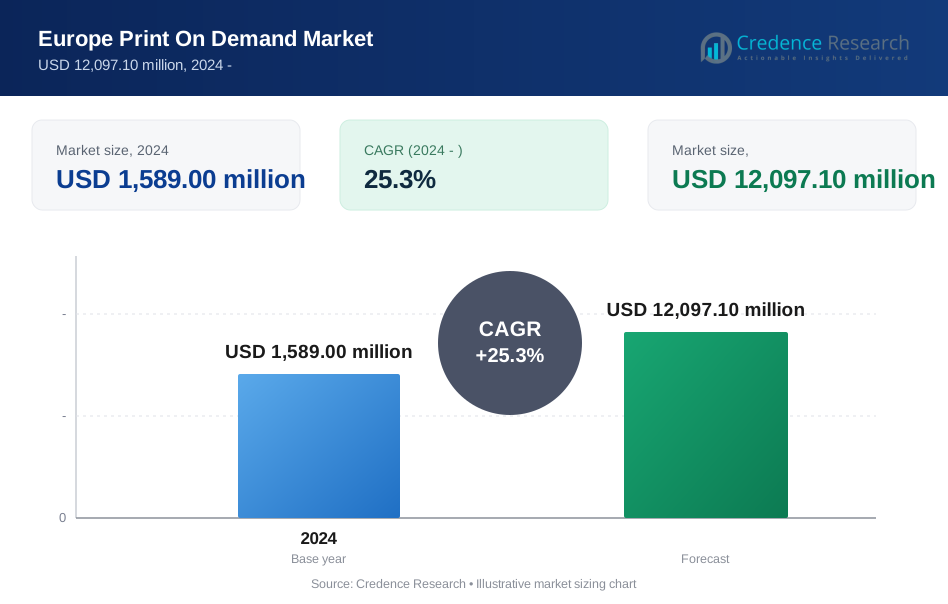
The Europe Print On Demand Market is projected to grow from USD 1,589.00 million in 2024 to an estimated USD 12,097.10 million by 2032, with a compound annual growth rate (CAGR) of 25.3% from 2025 to 2032. The market growth is driven by increasing consumer demand for custom products, advancements in printing technologies, and the growing e-commerce sector.
Key drivers of the Europe Print on Demand market include the rise of personalized consumer products, growing online retail platforms, and an increasing number of small and medium-sized businesses adopting print-on-demand services. Additionally, the convenience and cost efficiency of print-on-demand solutions are fueling market expansion. Trends such as customization of apparel, home décor, and accessories are expected to further support market growth, while advancements in digital printing technology and environmentally friendly materials continue to transform the industry.
Geographically, the Europe Print on Demand market is anticipated to grow significantly, with strong demand from countries like Germany, the United Kingdom, and France. These countries are witnessing robust e-commerce growth and increasing consumer interest in customized products. Key players in the market include Printful, Printify, Gooten, and TeeSpring, which are actively expanding their presence in the region to capitalize on the growing demand for print-on-demand services.
Market Insights
• The Europe Print on Demand Market is expected to grow from USD 1,589.00 million in 2024 to USD 12,097.10 million by 2032, with a CAGR of 25.3% from 2025 to 2032. • Key drivers include increasing consumer demand for personalized products, the rapid expansion of e-commerce, and the flexibility and cost-efficiency offered by print-on-demand services. • Challenges include supply chain complexities, quality control issues, and competition from mass production models that may offer lower prices. • Advancements in digital printing technology, such as direct-to-garment and eco-friendly printing methods, are enhancing product quality and operational efficiency. • The United Kingdom, Germany, and France are the largest markets, driven by their strong e-commerce ecosystems and rising demand for customized products. • The market is seeing an expansion in customizable products beyond apparel, including home décor, accessories, drinkware, and eco-friendly products. • The market is poised for sustained growth, driven by innovation, increased consumer interest in unique, personalized products, and the ongoing shift towards e-commerce.
Market Drivers
Rising Consumer Demand for Personalized Products
One of the primary drivers fueling the growth of the Europe Print on Demand Market is the increasing consumer preference for personalized products. In recent years, consumers have sought unique, custom-made items that reflect their personal tastes and styles. The Print on Demand model allows customers to design products like apparel, accessories, and home decor, which can be tailored to their individual preferences. This has led to significant demand for on-demand customization across a wide array of products. As consumers continue to seek products that resonate with their identity and offer distinctiveness, print on demand has become an ideal solution. The ability to create products that are not mass-produced, coupled with the option for quick turnaround times, aligns perfectly with modern consumer behavior.For instance, consumers are increasingly seeking unique items that reflect their personal styles, such as customized apparel and home decor. This demand is driven by the desire for products that resonate with individual identities and offer distinctiveness, which print on demand services can fulfill by allowing customers to design products tailored to their preferences. As a result, the demand for personalized items in sectors such as fashion, homeware, and gifts has surged, further propelling the growth of the print-on-demand market in Europe.
Advancement of E-Commerce Platforms
The rapid expansion of e-commerce platforms is another significant factor contributing to the rise of the Europe Print on Demand Market. The ease of online shopping has led to a paradigm shift in consumer purchasing habits, where convenience, accessibility, and product variety are paramount. Print on demand seamlessly integrates with e-commerce platforms, allowing small businesses and entrepreneurs to offer customized products without the upfront investment in inventory. This integration provides a flexible business model that is particularly appealing to startups and niche businesses looking to scale quickly and cost-effectively. Major e-commerce platforms such as Shopify, Etsy, and WooCommerce offer simple integration with print-on-demand services, providing businesses with the tools to create personalized products on demand and ship directly to customers.For example, major e-commerce platforms like Shopify and Etsy integrate seamlessly with print-on-demand services, enabling businesses to offer customized products without upfront inventory investments. This integration has been particularly beneficial during the digital transformation accelerated by the COVID-19 pandemic. As consumers continue to shift towards online purchasing, print on demand becomes an essential part of e-commerce strategies.
Cost-Effectiveness and Reduction in Inventory Risks
A significant advantage driving the Print on Demand Market is its cost-effectiveness, which benefits both businesses and consumers. Traditional retail models often involve holding large inventories of products, leading to significant overhead costs and the risk of unsold stock. In contrast, the print-on-demand model eliminates the need for businesses to maintain inventory, as products are only printed after an order is placed. This not only reduces the risks associated with overstocking and understocking but also ensures that businesses do not incur upfront production costs. Furthermore, businesses can save on warehousing, handling, and inventory management expenses, which are often a burden for small or new companies.For instance, traditional retail models often require holding large inventories, leading to significant overhead costs and risks associated with unsold stock. In contrast, print on demand eliminates these risks by producing products only after orders are placed, thereby reducing inventory management expenses and allowing businesses to scale cost-effectively. This cost-efficient model enables smaller businesses to enter the market without a large financial investment, making it an attractive option for entrepreneurs.
Technological Advancements in Digital Printing
Technological advancements in digital printing technology have had a profound impact on the Europe Print on Demand Market. Innovations in printing methods, such as direct-to-garment (DTG) printing and sublimation printing, have significantly enhanced the quality and speed of print-on-demand services. These technologies allow businesses to print high-resolution designs directly onto garments, textiles, and various other products with greater accuracy and efficiency. The rise of eco-friendly printing technologies, such as water-based inks and sustainable production methods, has also resonated with environmentally-conscious consumers, driving further adoption of print-on-demand services.For example, innovations in printing technologies like direct-to-garment and sublimation printing have enhanced the quality and speed of print-on-demand services. Additionally, the adoption of eco-friendly printing methods has aligned with consumer preferences for sustainable products, further driving the adoption of print-on-demand services in Europe. As digital printing technologies continue to evolve, enabling faster, more precise, and more cost-effective production, the print-on-demand market in Europe will benefit from a continued expansion in capabilities and customer expectations.
Market Trends
Sustainability and Eco-friendly Practices
One of the most prominent trends shaping the Europe Print on Demand Market is the growing demand for sustainability and eco-friendly practices. As environmental concerns continue to rise, both consumers and businesses are increasingly focused on minimizing the ecological impact of production. In response, print-on-demand companies in Europe are adopting greener methods such as water-based inks, organic fabrics, and recyclable packaging materials. These sustainable practices are helping companies appeal to environmentally conscious consumers who are looking for ethical and sustainable alternatives in the products they purchase. Additionally, many print-on-demand providers are prioritizing local manufacturing to reduce the carbon footprint associated with long-distance shipping. This shift toward sustainability not only aligns with the broader consumer movement for ethical consumption but also positions businesses to meet regulatory pressures in Europe, where environmental regulations are becoming stricter. As a result, sustainability is no longer just a marketing tool but a critical component of business strategy in the print-on-demand industry.
Expansion of Product Offerings
Another significant trend in the Europe Print on Demand Market is the broadening of product offerings. Initially, print-on-demand services were primarily associated with apparel, such as t-shirts, hoodies, and mugs. However, as the market matures, businesses are now offering an increasingly diverse range of customizable products. These include home décor items like wall art, throw pillows, and blankets, as well as office supplies, phone cases, bags, and even pet products. This diversification is fueled by consumer demand for unique and personalized items across various categories. In particular, the rise of the "gifts" segment has driven the growth of customized products for special occasions such as birthdays, weddings, and holidays. The trend toward a more extensive range of print-on-demand products is also supported by advancements in printing technology, which allow for the creation of high-quality designs on a wide variety of materials. With this expanded product offering, businesses can tap into multiple consumer niches and target new market segments, significantly enhancing their potential for growth. The wide variety of customizable products helps businesses reach different types of customers, ranging from individual consumers seeking personalized gifts to larger organizations looking for branded merchandise.
Integration with E-Commerce Platforms and Marketplaces
The seamless integration of print-on-demand services with popular e-commerce platforms and marketplaces is another defining trend in the Europe market. The ease with which entrepreneurs and small businesses can integrate print-on-demand solutions with their online stores has opened up new opportunities for both established brands and startups. Leading e-commerce platforms like Shopify, Etsy, WooCommerce, and BigCommerce now offer built-in integrations with print-on-demand providers. This integration allows businesses to easily create and sell custom products without worrying about inventory, warehousing, or fulfillment logistics. Additionally, marketplaces like Amazon and eBay have also introduced print-on-demand services, further streamlining the process for businesses that want to sell their products on these large, established platforms. The integration of print-on-demand solutions with these platforms has made it easier for businesses to reach a broader audience, automate their processes, and scale their operations with minimal upfront investment. As e-commerce continues to grow in Europe, this trend toward seamless integration will only accelerate, creating even more opportunities for businesses to thrive in the print-on-demand sector.
Focus on Technology and Automation As the Europe Print on Demand Market becomes more competitive, a significant trend is the increased emphasis on technology and automation to enhance operational efficiency and improve customer experiences. Print-on-demand businesses are investing in automation tools, advanced design software, and artificial intelligence (AI) to streamline production, optimize inventory management, and personalize customer experiences. One key development in this area is the rise of AI-driven design tools that allow customers to create their own personalized products easily and intuitively. These tools offer automated design assistance, helping users generate unique designs quickly, which can then be printed on a variety of products. Moreover, automation in fulfillment processes has significantly reduced lead times, ensuring faster order processing and delivery to customers. Print-on-demand businesses are also leveraging data analytics to better understand customer preferences, predict trends, and improve product offerings. Automation is not only beneficial for operational efficiency but also enhances the scalability of businesses, allowing them to manage high volumes of orders without compromising on quality. As technology continues to evolve, the role of automation and advanced software solutions in the print-on-demand sector will only increase, driving further market growth.
Market Challenges
Supply Chain and Logistics Complexity
One of the key challenges facing the Europe Print on Demand Market is the complexity and variability in supply chain and logistics operations. While the print-on-demand model offers many advantages, such as eliminating the need for inventory, it also creates dependencies on third-party suppliers for printing, packaging, and shipping. This reliance on external partners can introduce supply chain vulnerabilities, especially in times of increased demand, logistical disruptions, or global events such as the COVID-19 pandemic. Furthermore, shipping delays, high delivery costs, and international customs regulations can create challenges, particularly for businesses aiming to offer cross-border services within Europe. These logistical hurdles can affect customer satisfaction, as consumers expect fast and reliable delivery. Managing these challenges while maintaining quality control over the end-to-end process is crucial for businesses in the print-on-demand space. To mitigate this, businesses must carefully select reliable print partners, integrate robust tracking systems, and develop contingency plans for unforeseen disruptions. Additionally, as customers become more conscious of environmental sustainability, businesses must balance the need for faster shipping with eco-friendly practices, adding another layer of complexity to the logistics operations.
Maintaining Quality and Consistency
Another significant challenge in the Europe Print on Demand Market is ensuring consistent product quality and meeting customer expectations. The nature of print-on-demand means that each product is created on demand, often with customized designs, making it difficult to maintain the same level of quality control as traditional mass production. Variability in print quality, material consistency, and the durability of the final product can become points of contention with customers, particularly when expectations for personalized items are high. Inconsistent product quality can lead to negative reviews, returns, and reputational damage for businesses. To overcome this challenge, businesses need to establish stringent quality control processes, invest in advanced printing technologies, and collaborate closely with reliable production partners. Additionally, providing clear product descriptions, high-quality mockups, and samples for customers can help set accurate expectations. As consumer demand for high-quality, customized products continues to rise, businesses in the print-on-demand market must focus on maintaining a consistent, high-quality output to retain customer loyalty and avoid the costs associated with returns and dissatisfied clients.
Market Opportunities
Expansion of Niche Market Segments
The Europe Print on Demand Market presents significant opportunities for businesses to tap into niche market segments. As consumer demand for personalized and unique products continues to rise, businesses can cater to specific interests, hobbies, and lifestyles by offering tailored solutions. This includes custom designs for niche groups such as pet owners, fitness enthusiasts, eco-conscious consumers, and fans of particular sports or entertainment genres. By targeting these specialized segments, print-on-demand businesses can differentiate themselves from larger competitors and foster customer loyalty. With the flexibility of the print-on-demand model, businesses can quickly pivot and introduce new product lines, keeping pace with emerging trends and consumer preferences. This approach not only opens up new revenue streams but also positions businesses to benefit from the growing desire for individuality and bespoke products across various consumer demographics.
Growth in E-Commerce and Digital Transformation
The ongoing growth of e-commerce presents a substantial market opportunity for the Print on Demand industry in Europe. As more consumers turn to online shopping, especially for personalized products, print-on-demand businesses are poised to meet this demand without the need for significant upfront investments in inventory. The rise of platforms like Shopify, Etsy, and Amazon, which allow easy integration of print-on-demand services, makes it easier for entrepreneurs to enter the market and scale their operations. Additionally, the increasing adoption of mobile commerce and social media platforms as sales channels offers further opportunities for businesses to reach new customers and promote their products. The convergence of digital transformation in retail and the rise of consumer customization creates a favorable environment for the continued expansion of the print-on-demand market in Europe.
Market Segmentation Analysis
By Platform
The Print on Demand market is divided into two primary segments: software and service platforms. The software segment includes platforms that provide tools and applications for businesses to design and sell customized products. These platforms are integral in streamlining the print-on-demand process, offering ease of integration with e-commerce stores. The service segment involves businesses that offer complete print-on-demand solutions, from product printing to fulfillment and shipping. Both segments are witnessing growth, with increasing demand for integrated services that can handle production and logistics seamlessly. The service segment is expected to hold a larger share as businesses continue to adopt full-service solutions to streamline operations.
By Product
The apparel segment leads the Europe Print on Demand market, accounting for a substantial portion of the revenue. Custom t-shirts, hoodies, and activewear are highly popular, driven by the trend of personalization and unique designs. The home décor segment follows, with customized items like pillows, blankets, and wall art becoming increasingly sought after by consumers. Drinkware such as personalized mugs and bottles also represents a growing segment, especially for gifts and promotional products. Accessories, including bags, hats, and jewelry, are gaining traction, alongside other miscellaneous products like phone cases and stationery, which offer customization opportunities across various niches. As consumers continue to seek distinctive, personalized items, the demand for diverse products is expected to rise.
Segments
Based on Platform
- Software
- Service
Based on Product
- Apparel
- Home Decor
- Drinkware
- Accessories
- Others
Based on End User
- E-commerce
- Publishing
- Fashion & Apparel
- Art & Creative
- Corporate
- Education
- Others
Based on Technology
- Digital Printing
- Offset Printing
- Flexographic Printing
- Screen Printing
Based on Region
- United Kingdom
- Germany
- France
Regional Analysis
United Kingdom (30%) The United Kingdom holds the largest market share in the Europe Print on Demand Market, accounting for approximately 30% of the total market. The UK's advanced e-commerce ecosystem, coupled with high consumer demand for personalized products, positions it as the dominant region in Europe. The adoption of print-on-demand services by entrepreneurs, small businesses, and established brands is accelerating, particularly in the fashion, home décor, and corporate promotional product segments. Additionally, the UK's growing sustainability trend, where consumers favor eco-friendly production processes, is boosting the demand for sustainable print-on-demand solutions.
Germany (25%) Germany is the second-largest market in Europe, contributing around 25% to the overall market share. Known for its strong manufacturing base and leading e-commerce platforms, Germany is a key player in the print-on-demand industry. The country's focus on digital printing technology and innovation has made it a hub for print-on-demand services, especially in the fashion and publishing sectors. Germany's sophisticated logistics network and its position as a central e-commerce player in Europe further enhance its prominence in the print-on-demand landscape. The demand for personalized products in Germany is growing across several verticals, from apparel to corporate gifts and promotional products.
Key players
• Amplifier • Apliiq • Gelato • Gooten • Printful, Inc. • Printify, Inc. • Printsome • Vistaprint • Customcat • Printed Mint LLC • Teelaunch • Zazzle • Canva Pty Ltd.
Competitive Analysis
The Europe Print on Demand market is highly competitive, with several key players vying for market share by offering diverse product portfolios and innovative business models. Companies like Printful, Inc. and Printify, Inc. dominate the market with extensive offerings in apparel, accessories, and home décor, supported by seamless e-commerce integrations and global fulfillment networks. Gelato and Gooten are also prominent players, focusing on technology-driven solutions and scalable fulfillment options for businesses of all sizes. Meanwhile, niche players like Apliiq and Teelaunch are making strides by catering to specific customer needs, such as custom fashion items and specialized print services. Vistaprint leverages its strong brand reputation in the printing industry to provide a broader range of personalized products, while Zazzle and Canva Pty Ltd. capitalize on user-friendly design platforms to enhance customer experience. Overall, these players compete on factors such as product variety, quality, customer experience, and integration capabilities with e-commerce platforms.
Recent Developments
• In March 2024, Apliiq continues to offer specialized customization options for fashion brands, integrating with platforms like Shopify and WooCommerce. They provide direct-to-garment (DTG) and direct-to-film (DTF) printing services, allowing for high-quality apparel products.
• In September 2024, Gelato expanded its local production capabilities across Europe, offering 24/7 support and easy integration for creating and selling custom print-on-demand items. This includes reducing shipping times by producing products in countries closest to customers.
• In February 2025, Gooten highlighted the strategic transformations in the print-on-demand industry, including industry consolidation and strategic partnerships. However, specific developments for Gooten in Europe were not detailed7. Market Concentration and Characteristics
The Europe Print on Demand Market is moderately concentrated, with a few dominant players holding significant market share while numerous smaller companies cater to niche segments. Major players like Printful, Printify, and Vistaprint dominate the market through broad product offerings, extensive e-commerce integrations, and robust fulfillment networks. However, the market also features a variety of specialized providers such as Gelato, Apliiq, and Teelaunch, which focus on specific customer needs, including unique apparel designs and personalized fashion items. The market is characterized by low entry barriers, allowing small businesses and entrepreneurs to establish a presence with minimal investment. This results in a competitive landscape, where companies differentiate themselves through product diversity, technological innovation, and customer service. The overall market is expected to continue growing as more businesses adopt print-on-demand solutions due to their flexibility, cost-effectiveness, and alignment with the increasing demand for customization.
Report Coverage
The research report offers an in-depth analysis based on Platform, Product, End User, Technology and Region. It details leading market players, providing an overview of their business, product offerings, investments, revenue streams, and key applications. Additionally, the report includes insights into the competitive environment, SWOT analysis, current market trends, as well as the primary drivers and constraints. Furthermore, it discusses various factors that have driven market expansion in recent years. The report also explores market dynamics, regulatory scenarios, and technological advancements that are shaping the industry. It assesses the impact of external factors and global economic changes on market growth. Lastly, it provides strategic recommendations for new entrants and established companies to navigate the complexities of the market.
Future Outlook
1. The Europe Print on Demand Market is expected to experience strong growth, driven by increasing consumer demand for customized products and expanding e-commerce platforms. The market is projected to reach significant milestones in terms of revenue and market share by 2032.
2. As consumers seek more personalized experiences, demand for custom products across various categories, including fashion and home décor, will continue to rise. This trend will fuel the growth of print-on-demand services in Europe.
3. Advancements in digital printing technology, such as direct-to-garment and eco-friendly printing methods, will enhance product quality and efficiency. This will improve the overall competitiveness of print-on-demand businesses.
4. E-commerce platforms will increasingly integrate print-on-demand services, enabling businesses to streamline operations and reach a larger customer base. Seamless integration will be key to supporting business scalability.
5. Sustainability will become a major factor in shaping the market, with print-on-demand providers adopting environmentally friendly materials, processes, and packaging to meet growing consumer and regulatory demands for eco-conscious products.
6. The range of customizable products will expand beyond apparel and home décor, with categories such as tech accessories, stationery, and eco-friendly products gaining popularity. This diversification will attract new customer segments.
7. Print on demand will increasingly cater to niche markets, offering custom products for specific industries such as pet care, fitness, and entertainment. These specialized offerings will allow businesses to target diverse consumer groups.
8. SMEs will continue to adopt print-on-demand models due to low upfront costs and the ability to offer personalized products without significant inventory investment. This will drive market expansion, especially in emerging businesses.
9. As consumer expectations for fast delivery grow, print-on-demand providers will focus on improving fulfillment processes and logistics. Expedited shipping and efficient inventory management will be critical to maintaining customer satisfaction.
10. While the market in Western Europe is growing, print-on-demand services are expected to expand into emerging markets in Eastern Europe. Increasing e-commerce penetration and demand for customizable products will drive growth in these regions.
Request a Free Sample
Fill in your details and we'll send you a free sample report.
- Sample data tables & charts
- Research methodology
Market Dynamics
Personalization and Customization Demand
Consumers in Europe are increasingly seeking unique, custom-made products that reflect their individual tastes and identities. Print on demand enables this personalization at scale, driving adoption among both consumers and businesses.
E-Commerce Expansion and Integration
The rapid growth of e-commerce platforms and seamless integration of print-on-demand services with online stores like Shopify and Etsy have made it easier for businesses to offer customized products without inventory risk, fueling market growth.
Advancements in Digital Printing Technology
Innovations such as direct-to-garment and eco-friendly printing methods have improved product quality, speed, and sustainability, making print-on-demand solutions more attractive to both businesses and environmentally conscious consumers.
Cost Efficiency and Inventory Risk Reduction
Print on demand eliminates the need for upfront inventory investment and reduces warehousing costs, allowing small and medium-sized businesses to enter the market with minimal financial risk and scale operations flexibly.
Sustainability and Eco-Friendly Practices
Growing consumer and regulatory focus on sustainability in Europe is pushing print-on-demand providers to adopt greener materials and processes, which enhances their appeal and aligns with market expectations for ethical production.
Need a Custom Version of This Report?
Tailor the scope, geography, or segments to your exact requirements.
- Custom geography or segment scope
- Direct access to our analyst team
Frequently Asked Questions
What is the market size of the Europe Print on Demand Market in 2023 and 2032?
What are the key drivers of the Europe Print on Demand Market?
How is technology influencing the Print on Demand Market in Europe?
What regions are leading the growth of the Europe Print on Demand Market?
What is the future outlook for the Europe Print on Demand Market?
Table of Content
Chapter 1 Market Segmentation
- 1.1 Segmentation Framework
- 1.1.1 Product and Service Classification
- 1.1.2 Application and End-Use Classification
- 1.1.3 Technology and Solution Classification
- 1.1.4 Customer and Distribution Channel Classification
- 1.1.5 Geographic Segmentation
- 1.1.6 Market Segment Definitions and Boundaries
- 1.2 By Product
- 1.2.1 Apparel
- 1.2.2 Home Decor
- 1.2.3 Drinkware
- 1.2.4 Accessories
- 1.2.5 Others
- 1.3 By End User
- 1.3.1 E-commerce
- 1.3.2 Publishing
- 1.3.3 Fashion & Apparel
- 1.3.4 Art & Creative
- 1.3.5 Corporate
- 1.3.6 Education
- 1.3.7 Others
- 1.4 By Platform
- 1.4.1 Software
- 1.4.2 Service
- 1.5 By Technology
- 1.5.1 Digital Printing
- 1.5.2 Offset Printing
- 1.5.3 Flexographic Printing
- 1.5.4 Screen Printing
Chapter 2 Introduction
- 2.1 Report Objectives and Scope
- 2.2 Product Definition and Industry Terminology
- 2.3 Market Inclusions and Exclusions
- 2.4 Research Process
- 2.4.1 Primary Research and Expert Interviews
- 2.4.2 Secondary Research and Source Review
- 2.4.3 Top-Down and Bottom-Up Estimation
- 2.4.4 Data Triangulation and Verification
- 2.5 Market Size Measurement Basis
- 2.5.1 2024: USD 1,589.00 million → 2032: USD 12,097.10 million
- 2.6 Historical and Forecast Reference Periods
- 2.6.1 Base Year: 2024
- 2.6.2 Forecast Period: 2024-2032
- 2.7 Research Assumptions and Limitations
Chapter 3 Executive Summary
- 3.1 Market Snapshot and Key Findings
- 3.2 Base-Year Market Size, 2024
- 3.3 Forecast Market Size, 2032
- 3.4 Revenue and Volume Growth Outlook
- 3.5 Key Demand and Supply Indicators
- 3.6 Leading Market Segments
- 3.7 Fastest-Growing Market Opportunities
- 3.8 Regional Performance Highlights
- 3.9 Technology and Industry Transformation
- 3.10 Competitive Landscape Summary
- 3.11 Analyst View and Strategic Implications
Chapter 4 Europe Print On Demand Market Trends and Developments
- 4.1 Historical Industry Development
- 4.2 Recent Market Trends and Developments
- 4.3 Demand and Customer Behavior Trends
- 4.4 Technology and Product Innovation
- 4.5 Artificial Intelligence, Automation and Digitalization
- 4.6 Local Manufacturing and Supply Chain Realignment
- 4.7 Industry Partnerships, Mergers and Acquisitions
- 4.8 Sustainability and Circular Economy Developments
- 4.9 Government and Private Sector Investment Trends
- 4.10 Emerging Business Models and Commercialization
- 4.11 Industry Developments and Announcements
Chapter 5 Europe Print On Demand Market Production, Supply and Demand Analysis
- 5.1 Demand Trend and Consumption Analysis
- 5.2 Demand Forecast, 2024-2032
- 5.3 Production and Output Trend
- 5.4 Production and Output Forecast, 2024-2032
- 5.5 Installed Capacity and Capacity Utilization
- 5.6 Company-Wise Production Plants and Statistics
- 5.6.1 Installed Production Capacity
- 5.6.2 Actual Production
- 5.6.3 Planned Capacity and Expansion Targets
- 5.7 Supply Chain Structure and Procurement Trends
- 5.8 Supply-Demand Gap and Bottlenecks
- 5.9 Import Dependence and Sourcing Structure
- 5.10 Contract Manufacturing and Outsourcing
- 5.11 Regional Supply and Demand Concentration
Chapter 6 Europe Print On Demand Market Pricing Analysis
- 6.1 Pricing Structure and Measurement
- 6.2 Historical Pricing Trends
- 6.3 Pricing Outlook, 2024-2032
- 6.4 Average Selling Price and Unit Economics
- 6.5 Pricing by Product and Market Segment
- 6.6 Geographic Pricing Differences
- 6.7 Key Input, Energy, Labor and Logistics Costs
- 6.8 Contract Pricing and Purchasing Models
- 6.9 Pricing Sensitivity and Competitive Positioning
- 6.10 Price, Margin and Profitability Implications
Chapter 7 Europe Print On Demand Market Dynamics
- 7.1 Market Growth Drivers
- 7.1.1 Demand-Side Drivers
- 7.1.2 Technology and Innovation Drivers
- 7.1.3 Infrastructure and Investment Drivers
- 7.1.4 Regulatory and Policy Drivers
- 7.2 Market Restraints
- 7.2.1 Cost and Affordability Constraints
- 7.2.2 Technology and Adoption Barriers
- 7.2.3 Supply Chain and Operational Constraints
- 7.3 Market Challenges
- 7.3.1 Competitive Pressure and Margin Erosion
- 7.3.2 Skills, Infrastructure and Implementation Gaps
- 7.4 Emerging Market Opportunities
- 7.5 Market Dynamics Impact and Time-Horizon Assessment
Chapter 8 Europe Print On Demand Value Chain Analysis
- 8.1 Industry Value Chain Overview
- 8.2 Upstream Suppliers and Critical Inputs
- 8.3 Technology and Component Providers
- 8.4 Manufacturing or Service Delivery
- 8.5 Distribution, Channel Partners and Integrators
- 8.6 Downstream Applications and End Users
- 8.7 Value Addition and Profit Pools
- 8.8 Vertical Integration and Outsourcing
- 8.9 Supplier Concentration and Risk
- 8.10 Supply Chain Localization and Resilience
Chapter 9 Europe Print On Demand Market Regulations and Policies
- 9.1 Relevant Laws, Standards and Compliance Frameworks
- 9.2 Product, Service, Safety and Quality Requirements
- 9.3 Government Policies, Incentives and Subsidies
- 9.4 Imports, Exports and Trade Barriers
- 9.5 Public Procurement and Local Content Requirements
- 9.6 Environmental and Sustainability Compliance
- 9.7 Data Protection, AI and Cybersecurity Compliance
- 9.8 Upcoming Policy Changes and Market Implications
Chapter 10 Europe Print On Demand Market Hotspots and Opportunities
- 10.1 Market Opportunity Mapping and Growth Hotspots
- 10.2 High-Growth Applications and Customer Groups
- 10.3 Underserved Markets and White-Space Opportunities
- 10.4 Emerging Technology and Product Opportunities
- 10.5 New Capacity and Investment Hotspots
- 10.6 Market Entry and Expansion Opportunities
- 10.7 Distribution and Partnership Opportunities
- 10.8 Near-Term and Long-Term Commercial Potential
- 10.9 Opportunity Attractiveness and Execution Risks
Chapter 11 Europe Print On Demand Market Outlook, 2024-2032
- 11.1 Market Size and Analysis
- 11.1.1 Revenue (Market Measurement: 2024: USD 1,589.00 million → 2032: USD 12,097.10 million)
- 11.1.2 Market Volume and Quantity Sold
- 11.1.3 Historical Market Size
- 11.1.4 Base-Year Market Size, 2024
- 11.2 Market Forecast, 2024-2032
- 11.2.1 Revenue Forecast to 2032
- 11.2.2 Volume Forecast to 2032
- 11.2.3 CAGR and Year-on-Year Growth
- 11.2.4 Incremental Revenue Opportunity
- 11.3 Forecast Assumptions and Scenario Analysis
- 11.3.1 Base-Case Forecast
- 11.3.2 Optimistic and Conservative Scenarios
- 11.3.3 Technology, Pricing and Policy Sensitivities
- 11.4 Market Attractiveness and Growth Outlook
Chapter 12 Europe Print On Demand Market Segmentation and Outlook
- 12.1 Segmentation Summary and Market Shares, 2024
- 12.2 Largest and Fastest-Growing Segments
- 12.3 By Product - Market Size and Forecast, 2024-2032
- 12.3.1 Segment Definition and Scope
- 12.3.2 Historical Market Size
- 12.3.3 Revenue Forecast, 2024-2032
- 12.3.4 Volume Forecast, 2024-2032
- 12.3.5 Base-Year Market Share, 2024
- 12.3.6 Segment CAGR and Growth Drivers
- 12.3.7 Subsegment Market Size and Forecast
- 12.3.7.1 Apparel
- 12.3.7.2 Home Decor
- 12.3.7.3 Drinkware
- 12.3.7.4 Accessories
- 12.3.7.5 Others
- 12.3.8 Subsegment Pricing and Adoption Trends
- 12.3.9 Leading Suppliers and Competition
- 12.3.10 Regional Demand and Opportunities
- 12.4 By End User - Market Size and Forecast, 2024-2032
- 12.4.1 Segment Definition and Scope
- 12.4.2 Historical Market Size
- 12.4.3 Revenue Forecast, 2024-2032
- 12.4.4 Volume Forecast, 2024-2032
- 12.4.5 Base-Year Market Share, 2024
- 12.4.6 Segment CAGR and Growth Drivers
- 12.4.7 Subsegment Market Size and Forecast
- 12.4.7.1 E-commerce
- 12.4.7.2 Publishing
- 12.4.7.3 Fashion & Apparel
- 12.4.7.4 Art & Creative
- 12.4.7.5 Corporate
- 12.4.7.6 Education
- 12.4.7.7 Others
- 12.4.8 Subsegment Pricing and Adoption Trends
- 12.4.9 Leading Suppliers and Competition
- 12.4.10 Regional Demand and Opportunities
- 12.5 By Platform - Market Size and Forecast, 2024-2032
- 12.5.1 Segment Definition and Scope
- 12.5.2 Historical Market Size
- 12.5.3 Revenue Forecast, 2024-2032
- 12.5.4 Volume Forecast, 2024-2032
- 12.5.5 Base-Year Market Share, 2024
- 12.5.6 Segment CAGR and Growth Drivers
- 12.5.7 Subsegment Market Size and Forecast
- 12.5.7.1 Software
- 12.5.7.2 Service
- 12.5.8 Subsegment Pricing and Adoption Trends
- 12.5.9 Leading Suppliers and Competition
- 12.5.10 Regional Demand and Opportunities
- 12.6 By Technology - Market Size and Forecast, 2024-2032
- 12.6.1 Segment Definition and Scope
- 12.6.2 Historical Market Size
- 12.6.3 Revenue Forecast, 2024-2032
- 12.6.4 Volume Forecast, 2024-2032
- 12.6.5 Base-Year Market Share, 2024
- 12.6.6 Segment CAGR and Growth Drivers
- 12.6.7 Subsegment Market Size and Forecast
- 12.6.7.1 Digital Printing
- 12.6.7.2 Offset Printing
- 12.6.7.3 Flexographic Printing
- 12.6.7.4 Screen Printing
- 12.6.8 Subsegment Pricing and Adoption Trends
- 12.6.9 Leading Suppliers and Competition
- 12.6.10 Regional Demand and Opportunities
- 12.7 Segment Growth Comparison
- 12.8 Segment Attractiveness and Priority Matrix
Chapter 13 Europe Print On Demand End-Use and Application Market Outlook
- 13.1 End-Use Industry and Customer Demand Structure
- 13.2 Leading Applications and Customer Groups
- 13.3 End-Use Market Size, Share and Forecast
- 13.4 Major End-Use Industry Deep Dives
- 13.4.1 Customer Requirements and Use Cases
- 13.4.2 Demand and Replacement Cycles
- 13.4.3 Technical and Regulatory Considerations
- 13.4.4 Purchasing and Procurement Models
- 13.4.5 Leading Vendors and Distribution Channels
- 13.4.6 Forecast and Commercial Opportunities
- 13.5 Emerging Applications and Cross-Segment Demand
- 13.6 End-Use Industry Investment Priorities
Chapter 14 Europe Print On Demand Geographic Market Outlook, 2024-2032
- 14.1 Regional Market Size and Country-Level Shares, 2024
- 14.2 Country Market Size Comparison, 2024
- 14.3 Country Market Forecasts, 2024-2032
- 14.4 Subregional Industrial and Demand Clusters
- 14.5 Intra-Regional Pricing and Cost Differences
- 14.6 Cross-Border Trade and Supply Networks
- 14.7 Regional Supply and Demand Balances
- 14.8 Country Opportunity Comparison and Prioritization
Note: Every listed country is covered on the structure shown under the first country.
Chapter 15 Europe Print On Demand Technology, Innovation and Sustainability Outlook
- 15.1 Technology Landscape and Maturity
- 15.2 Product, Process and Service Innovation
- 15.3 AI, Automation and Digital Tools in the Industry
- 15.4 Technology Adoption and Performance Benchmarking
- 15.5 Innovation Pipeline and R&D Investment
- 15.6 Patent and Intellectual Property Trends
- 15.7 Energy Efficiency and Resource Management
- 15.8 Sustainability, Recycling and Circularity
- 15.9 Technology Roadmap, 2024-2032
- 15.10 Risks of Obsolescence and Technology Substitution
Chapter 16 Europe Print On Demand Market Key Strategic Imperatives
- 16.1 Growth and Market Entry Priorities
- 16.2 High-Return Products and Segments
- 16.3 Pricing, Profitability and Cost Optimization
- 16.4 Technology Investment and Product Differentiation
- 16.5 Supply Chain Localization and Resilience
- 16.6 Distribution and Customer Acquisition
- 16.7 Partnership, Acquisition and Capacity Strategy
- 16.8 Regional Expansion Priorities
- 16.9 Short-, Medium- and Long-Term Actions
Chapter 17 Competition Outlook
- 17.1 Industry Competition Characteristics
- 17.2 Market Structure and Concentration
- 17.3 Market Share and Competitive Positioning, 2024
- 17.4 Company-Wise Revenue and Product Benchmarking
- 17.5 Production and Service Capacity Benchmarking
- 17.6 Technology, Pricing and Differentiation
- 17.7 Regional Footprint and Distribution Strength
- 17.8 Mergers, Acquisitions and Strategic Alliances
- 17.9 New Entrants and Competitive Threats
- 17.10 Porter's Five Forces and Industry Attractiveness
- 17.11 Competitive Outlook, 2024-2032
Chapter 18 Company Profiles
- 18.1 Company Coverage and Selection Criteria
- 18.2 Printful, Inc.
- 18.2.1 Business Description
- 18.2.2 Company Ownership and Geographic Presence
- 18.2.3 Product and Service Portfolio
- 18.2.4 Manufacturing and Operating Footprint
- 18.2.5 Production Capacity and Expansion Plans
- 18.2.6 Financial Performance and Investment
- 18.2.7 Market Share and Competitive Position
- 18.2.8 Technology and Innovation Capabilities
- 18.2.9 Strategic Alliances or Partnerships
- 18.2.10 Recent Developments
- 18.2.11 Growth Strategy and Outlook
- 18.3 Printify, Inc.
- 18.4 Gelato
- 18.5 Gooten
- 18.6 Vistaprint
- 18.7 Apliiq
- 18.8 Zazzle
- 18.9 Canva Pty Ltd.
- 18.10 Teelaunch
- 18.11 Customcat
- 18.12 Other Relevant Market Participants
Note: Every listed company is profiled on the structure shown under the first company. The company list is preliminary and may change based on research findings, market developments, data availability and client requirements.
Chapter 19 Disclaimer
- 19.1 Research and Forecast Disclaimer
- 19.2 Data Source and Estimation Limitations
Note: The depth of individual sections depends on data availability for this market. Volume, capacity, trade and other unit-based metrics are included where applicable.

