Market Overview
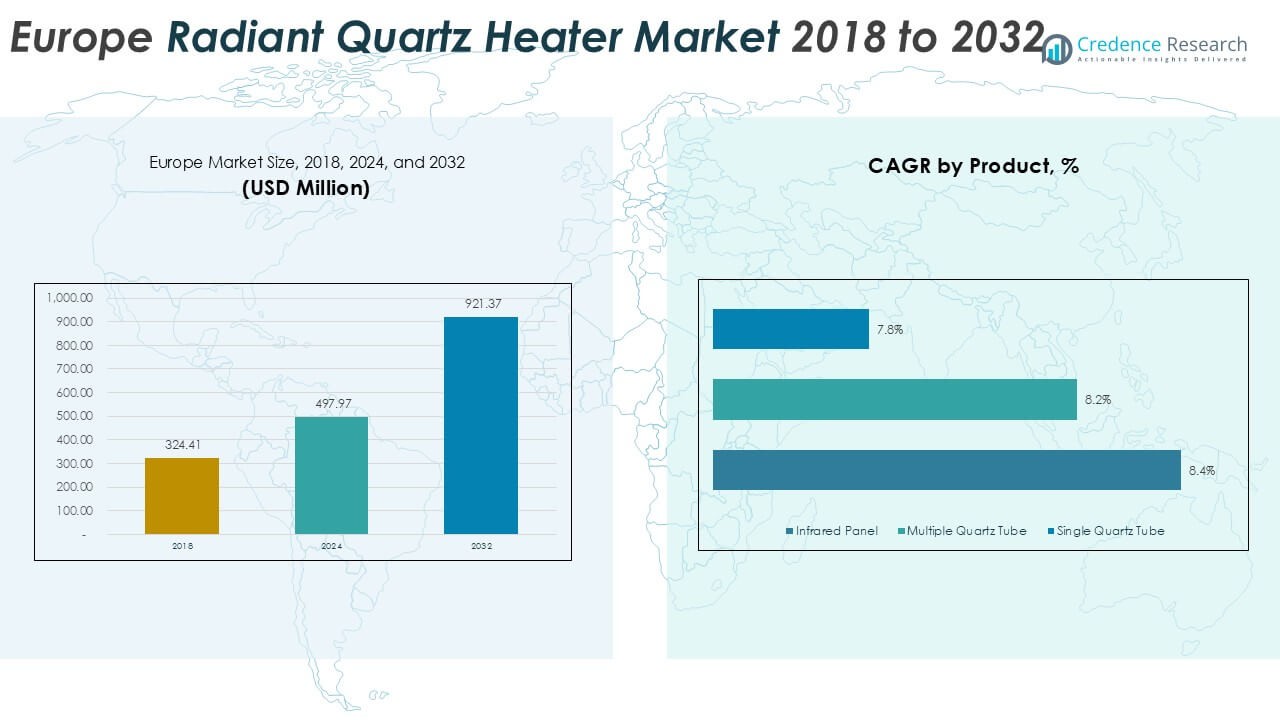
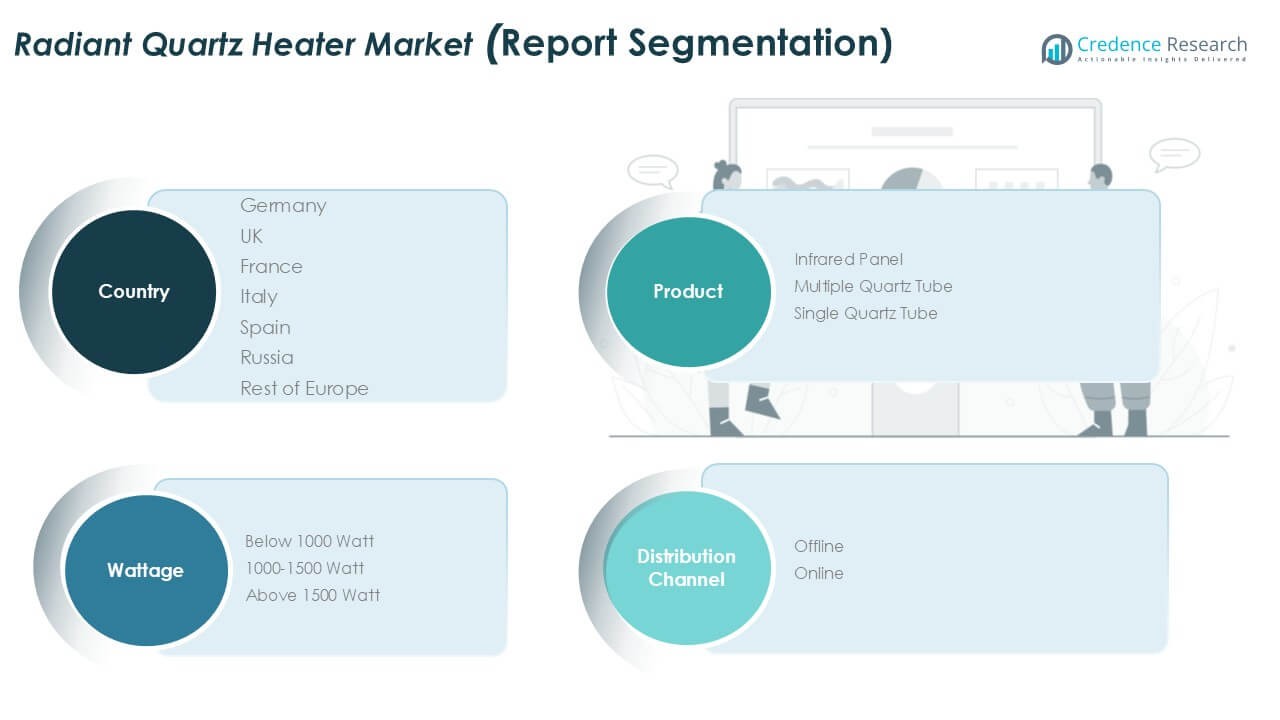
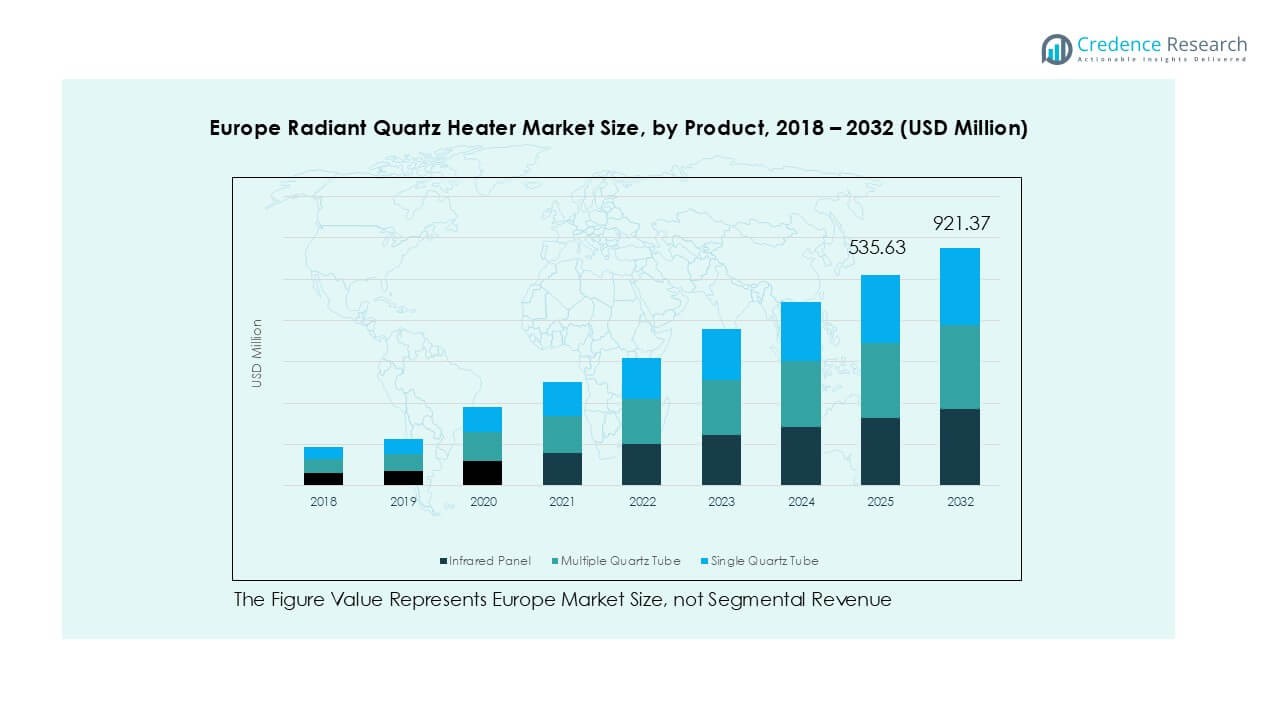
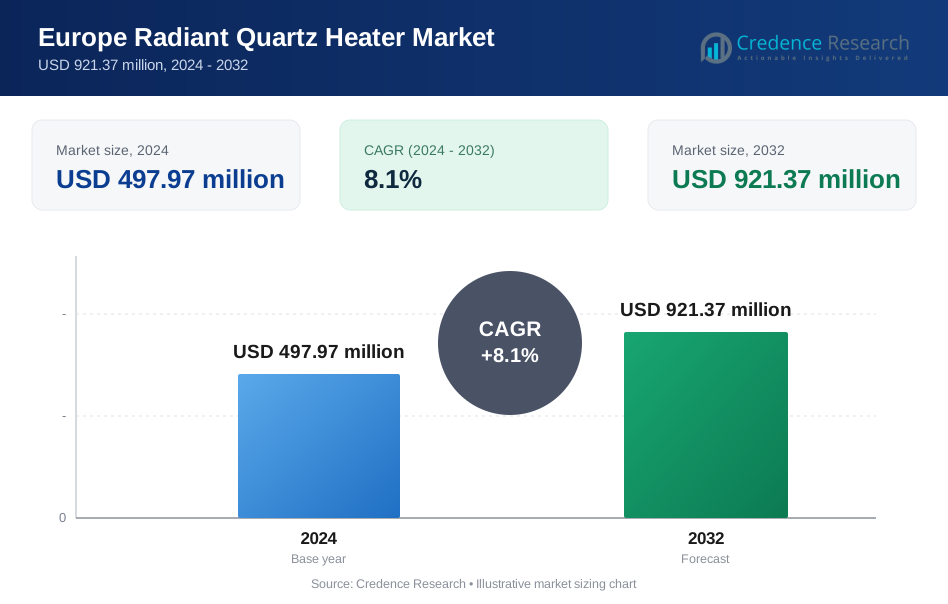
Europe Radiant Quartz Heater market size was valued at USD 324.41 million in 2018 to USD 497.97 million in 2024 and is anticipated to reach USD 921.37 million by 2032, at a CAGR of 8.1% during the forecast period.
| REPORT ATTRIBUTE | DETAILS |
|---|---|
| Historical Period | 2020-2023 |
| Base Year | 2024 |
| Forecast Period | 2025-2032 |
| Europe Radiant Quartz Heater Market Size 2024 | USD 497.97 Million |
| Europe Radiant Quartz Heater Market, CAGR | 8.1% |
| Europe Radiant Quartz Heater Market Size 2032 | USD 921.37 Million |
The Europe radiant quartz heater market features several established players with strong brand presence. De’Longhi Appliance S.r.l., Honeywell International Inc., Lasko Products, and Tansun lead through broad product portfolios and strong retail reach. These companies compete on energy efficiency, safety features, and design innovation. Italy and Spain form the leading regional cluster, holding about 23% market share due to seasonal heating demand. Germany follows with nearly 19%, driven by efficiency-focused consumers and regulatory compliance. The United Kingdom accounts for around 16%, supported by supplemental heating needs in older housing stock. Together, these regions dominate demand, while competitive intensity remains high across both premium and value segments.
Market Insights
- The Europe radiant quartz heater market reached USD 497.97 million in 2024 and is projected to grow at a CAGR of 8.1%, reaching USD 921.37 million by 2032.
- Rising demand for energy-efficient and fast-heating solutions drives adoption across residential and rental housing, especially for supplemental and spot heating needs.
- Infrared panel heaters dominate with about 42–45% segment share, supported by slim design, uniform heat output, and suitability for modern apartments and urban homes.
- Competition remains moderate, with brands focusing on design upgrades, safety features, smart controls, and strong offline and online retail presence across Europe.
- Italy and Spain lead regionally with around 23% share, followed by Germany at 19% and the UK at 16%, while high electricity costs act as a key restraint on prolonged usage.
Market Segmentation Analysis:
By Product
The product segment shows clear preference toward infrared panel radiant quartz heaters. Infrared panel models hold about 42–45% market share across Europe. Growth comes from slim design, uniform heat output, and wall-mounted flexibility. These heaters fit modern interiors and urban apartments well. Multiple quartz tube heaters follow, driven by faster heating and higher output for larger rooms. Single quartz tube models serve basic and low-cost needs. However, limited coverage and lower efficiency restrict adoption. Design-focused innovation and premium positioning continue to strengthen infrared panel dominance across residential and light commercial applications.
- For instance, Atlantic Groupe’s Solius radiant panel heater delivers 1,500 watts of radiant output, uses a wall-mounted body depth of less than 130 mm (for the horizontal model) or 117 mm (for the vertical model), and provides an instantaneous feeling of warmth, supporting apartments and light commercial spaces.
By Wattage Segment
The 1000–1500-watt segment dominates the market with nearly 48–50% share. This range balances energy efficiency, heating performance, and safety compliance. Consumers prefer these heaters for bedrooms, living rooms, and small offices. Below 1000-watt units serve localized and personal heating needs, mainly in mild climates. Above 1500-watt models target garages and large spaces but face higher power consumption concerns. Rising electricity costs and efficiency labeling regulations favor mid-range wattage products, supporting steady demand growth across households and urban rental properties.
- For instance, Tansun’s Rio Grande electric quartz heater operates at 1,500 watts, mounts at heights up to 2.5 meters, and provides effective radiant coverage for areas up to 12 square meters, making it suitable for residential and café environments.
By Distribution Channel
Offline channels remain dominant, accounting for around 58–60% of total sales. Specialty appliance stores and large-format retailers drive trust through physical product inspection and after-sales support. Installation guidance and warranty assurance strengthen offline preference. Online channels grow rapidly due to price transparency, seasonal discounts, and wider product access. Younger buyers favor e-commerce platforms for smart and compact heater models. Improved logistics for bulky appliances further support online growth. Despite this shift, offline retail maintains leadership due to higher-value purchases and consumer confidence factors.
Key Growth Drivers
Rising Demand for Energy-Efficient Heating Solutions
Energy efficiency strongly drives the Europe radiant quartz heater market. Households face rising electricity prices across major European economies. Consumers actively seek heaters that convert power directly into heat. Radiant quartz heaters deliver instant warmth with minimal energy loss. Infrared radiation heats objects instead of surrounding air. This mechanism improves efficiency in closed indoor spaces. European energy labeling standards encourage efficient appliance adoption. Governments promote reduced carbon footprints through efficient electric heating. Quartz heaters align well with decarbonization goals. Urban apartments prefer compact, efficient heaters for supplemental heating. Seasonal usage further supports adoption. These factors sustain strong demand across residential and small commercial environments.
- For instance, Stiebel Eltron’s IW 120 quartz infrared heater operates at 1,200 watts, reaches full radiant output in under 2 seconds, and delivers targeted heat for rooms up to 12 square meters, supporting efficient supplemental heating.
Growth in Urban Housing and Rental Apartments
Urbanization continues to reshape European housing demand. Compact apartments dominate new residential construction. Central heating systems often fail to meet individual comfort needs. Radiant quartz heaters provide localized and fast heating. Renters favor portable and non-permanent heating solutions. Quartz heaters require no fixed installation. Property owners avoid infrastructure modifications. Students and migrant workers increase rental housing demand. Seasonal mobility also supports portable heater usage. Space-saving designs fit small living areas. Urban housing density directly supports market expansion. This driver remains strong across Western and Central Europe.
- For instance, Eveready's QH800 quartz heater uses 800 watts, weighs approximately 2.2 kilograms, and operates without fixed installation, making it suitable for rental apartments and student housing.
Product Innovation and Design Differentiation
Manufacturers invest heavily in product innovation. Slim designs match modern interior preferences. Wall-mounted and panel-style heaters gain popularity. Improved quartz tubes extend product lifespan. Enhanced reflectors increase heat distribution efficiency. Safety features reduce overheating and fire risks. Smart thermostats and timers improve control. Remote operation enhances convenience. Premium design supports higher pricing strategies. Retailers highlight aesthetics alongside performance. Innovation strengthens brand differentiation. This driver pushes adoption beyond basic heating needs into lifestyle-oriented purchases.
Key Trends & Opportunities
Shift Toward Smart and Connected Heaters
Smart heating integration presents strong growth opportunities. Consumers increasingly adopt connected home appliances. Radiant quartz heaters now include app-based controls. Smart timers optimize energy usage. Remote operation improves safety during unattended use. Energy monitoring supports cost control awareness. Smart features attract tech-savvy urban buyers. Premium segments benefit most from this trend. Retailers promote smart heaters during winter campaigns. Online platforms support feature-based comparisons. Integration with home ecosystems increases value perception. This trend enables higher margins and long-term brand loyalty.
- For instance, Mill International’s WiFi-enabled infrared heater supports 2.4 GHz connectivity, allows temperature settings from 5 °C to 35 °C, and enables weekly scheduling with 24 hourly control points per day through a mobile app.
Expansion of Online and Direct-to-Consumer Sales
E-commerce plays a growing role in heater sales. Consumers prefer online price comparisons. Reviews influence purchase decisions strongly. Online platforms expand access across regions. Seasonal promotions boost digital volumes. Direct-to-consumer models improve manufacturer margins. Improved logistics handle bulky appliance delivery. Easy return policies build buyer confidence. Younger consumers prefer digital purchasing journeys. Brands invest in digital marketing content. Online growth complements offline retail channels. This shift accelerates market penetration and brand visibility.
- For instance, Klarstein’s infrared panel heaters sold online list precise specifications, including 1,200-watt output, 100 x 120 cm panel dimensions, and a unit weight of 7.5 kg, enabling informed digital purchases.
Key Challenges
High Electricity Costs and Usage Sensitivity
Electricity price volatility challenges market growth. European power costs remain high in many regions. Consumers reduce discretionary heating usage. Quartz heaters face scrutiny during peak tariff periods. Prolonged use increases monthly energy bills. Price-sensitive households delay replacement purchases. Energy cost concerns affect high-wattage models more. Manufacturers must emphasize efficiency benefits clearly. Failure to communicate savings limits adoption. Regulatory energy surcharges add pressure. This challenge affects demand consistency, especially during economic uncertainty periods.
Competition from Alternative Heating Technologies
Radiant quartz heaters face strong competition. Heat pumps gain popularity for whole-home heating. Oil-filled radiators offer longer heat retention. Convection heaters remain widely available. Underfloor heating expands in new buildings. Alternative technologies promise lower long-term costs. Government incentives favor renewable heating systems. Quartz heaters remain supplemental solutions. Limited suitability for large spaces restricts use cases. Competitive pricing pressures margins. Differentiation through design and efficiency becomes essential. This challenge requires continuous innovation and targeted positioning.
Regional Analysis
Italy and Spain
Italy and Spain together account for around 22–24% of the Europe radiant quartz heater market. Mild winters and seasonal heating needs support strong demand. Consumers prefer portable and mid-wattage heaters for short-term use. Apartments and rental homes drive steady replacement sales. Energy efficiency awareness influences buying decisions. Infrared panel models gain popularity due to slim designs. Retail chains and regional appliance stores dominate distribution. Online sales grow during winter promotions. Tourism-linked residential rentals also support demand. Overall growth remains stable, supported by urban living trends and cost-conscious consumers.
Germany
Germany holds nearly 18–20% of the European market share. Energy efficiency regulations strongly shape purchasing behavior. Consumers prioritize certified and compliant heating appliances. Radiant quartz heaters serve as supplemental heating solutions. Apartments with centralized heating systems drive secondary heater demand. Infrared panel heaters lead due to efficiency and design appeal. High electricity prices encourage controlled usage. Offline retail remains strong through specialty appliance stores. Smart heater adoption grows steadily. Sustainability awareness supports demand for efficient electric heating products across residential settings.
United Kingdom
The United Kingdom represents approximately 15–17% of the regional market. Older housing stock supports supplemental heating demand. Consumers use quartz heaters for spot heating. Rising energy bills influence product selection. Mid-wattage models dominate residential purchases. Portable heaters suit rented and shared housing. Online channels play a major role in sales growth. Seasonal discounts strongly impact volumes. Design-focused infrared heaters attract urban consumers. Safety standards and certifications remain key buying criteria. Demand remains resilient due to housing diversity and flexible heating needs.
Turkey
Turkey accounts for about 8–10% of the European radiant quartz heater market. Cold winters in inland regions support strong seasonal demand. Consumers favor affordable and high-output models. Multiple quartz tube heaters perform well in larger rooms. Price sensitivity influences purchasing decisions. Offline retail dominates due to local dealer networks. Urban population growth supports replacement demand. Energy efficiency awareness gradually improves. Imports play a key role in product availability. Market growth remains steady, driven by climate conditions and rising urban households.
France
France holds roughly 10–12% market share across Europe. Electric heating remains common in residential buildings. Radiant quartz heaters serve as supplementary heat sources. Consumers prefer energy-efficient and compact models. Infrared panel heaters gain traction in urban apartments. Regulatory focus on energy performance influences product choices. Offline channels dominate due to trust and service support. Online sales grow among younger buyers. Seasonal demand peaks during colder months. Stable housing demand supports consistent market performance.
Russia
Russia represents around 12–14% of the European market share. Long and harsh winters drive strong heating demand. Radiant quartz heaters support localized indoor heating. High-output and multiple tube models perform well. Consumers value durability and fast heating. Apartments and older buildings drive replacement sales. Offline retail dominates due to product size and service needs. Price sensitivity remains moderate. Energy costs influence usage patterns. Climate conditions continue to support steady demand across residential and small commercial spaces.
Market Segmentations:
By Product
- Infrared Panel
- Multiple Quartz Tube
- Single Quartz Tube
By Wattage Segment
- Below 1000 Watt
- 1000–1500 Watt
- Above 1500 Watt
By Distribution Channel
- Offline
- Online
By Geography
- Italy and Spain
- Germany
- United Kingdom
- Turkey
- France
- Russia
Competitive Landscape
The Europe radiant quartz heater market features moderate fragmentation with strong brand competition. Established appliance brands compete alongside specialized heating manufacturers. Companies focus on product efficiency, safety features, and design differentiation. Infrared panel heaters form a key competitive area. Energy labeling compliance remains a critical requirement. Leading players leverage wide distribution networks and seasonal promotions. Offline retail continues to support premium and bulky models. Online platforms enable aggressive pricing and feature comparisons. Innovation in smart controls strengthens competitive positioning. Private-label products increased price competition in value segments. Strategic investments target compact, energy-efficient models. Brand reputation, warranty support, and regulatory compliance shape purchasing decisions.
Key Player Analysis
- Backer Hotwatt, Inc.
- Jaye Industry Co., Ltd
- De'Longhi Appliance S.r.l.
- Honeywell International Inc.
- Lasko Products, LLC
- TEN24
- Pelonis Technologies, Inc.
- Duraflame, Inc.
- Tansun
- Döbeln Elektrowärme GmbH
Recent Developments
- In June 2023, The European Union revised its overarching Energy Efficiency Directive, and new, stricter Ecodesign standards for local space heaters, including radiant heaters, were adopted in April 2024 and will apply from July 1, 2025.
- In January 2023, Honeywell announced a new line of smart radiant quartz heaters with integrated Wi-Fi capabilities.
Report Coverage
The research report offers an in-depth analysis based on Product, Wattage Segment, Distribution Channel and Geography. It details leading market players, providing an overview of their business, product offerings, investments, revenue streams, and key applications. Additionally, the report includes insights into the competitive environment, SWOT analysis, current market trends, as well as the primary drivers and constraints. Furthermore, it discusses various factors that have driven market expansion in recent years. The report also explores market dynamics, regulatory scenarios, and technological advancements that are shaping the industry. It assesses the impact of external factors and global economic changes on market growth. Lastly, it provides strategic recommendations for new entrants and established companies to navigate the complexities of the market.
Future Outlook
- The market will continue to grow due to rising demand for energy-efficient supplemental heating.
- Infrared panel heaters will gain higher adoption across urban residential spaces.
- Smart controls and connected features will increasingly influence purchase decisions.
- Design-focused and slim form factors will attract premium and mid-income consumers.
- Online sales channels will expand faster than traditional retail formats.
- Mid-wattage heaters will remain the preferred choice for households.
- Seasonal demand patterns will continue to shape sales volumes.
- Manufacturers will focus on safety, durability, and compliance standards.
- Competition will intensify through pricing and feature differentiation.
- Regional demand will remain strong in Southern and Western Europe.
Request a Free Sample
Fill in your details and we'll send you a free sample report.
- Sample data tables & charts
- Research methodology
Need a Custom Version of This Report?
Tailor the scope, geography, or segments to your exact requirements.
- Custom geography or segment scope
- Direct access to our analyst team
Frequently Asked Questions
What is the current market size for the Europe Radiant Quartz Heater market, and what is its projected size in 2032?
At what Compound Annual Growth Rate is the Europe Radiant Quartz Heater market projected to grow between 2024 and 2032?
Which Europe Radiant Quartz Heater market segment held the largest share in 2024?
What are the primary factors fueling the growth of the Europe Radiant Quartz Heater market?
Who are the leading companies in the Europe Radiant Quartz Heater market?
Which region commanded the largest share of the Europe Radiant Quartz Heater market in 2024?
Table of Content
Chapter 1 Market Segmentation
- 1.1 Segmentation Framework
- 1.1.1 Product and Service Classification
- 1.1.2 Application and End-Use Classification
- 1.1.3 Technology and Solution Classification
- 1.1.4 Customer and Distribution Channel Classification
- 1.1.5 Geographic Segmentation
- 1.1.6 Market Segment Definitions and Boundaries
Chapter 2 Introduction
- 2.1 Report Objectives and Scope
- 2.2 Product Definition and Industry Terminology
- 2.3 Market Inclusions and Exclusions
- 2.4 Research Process
- 2.4.1 Primary Research and Expert Interviews
- 2.4.2 Secondary Research and Source Review
- 2.4.3 Top-Down and Bottom-Up Estimation
- 2.4.4 Data Triangulation and Verification
- 2.5 Market Size Measurement Basis
- 2.5.1 2024: USD 497.97 million → 2032: USD 921.37 million
- 2.6 Historical and Forecast Reference Periods
- 2.6.1 Base Year: 2024
- 2.6.2 Forecast Period: 2024-2032
- 2.7 Research Assumptions and Limitations
Chapter 3 Executive Summary
- 3.1 Market Snapshot and Key Findings
- 3.2 Base-Year Market Size, 2024
- 3.3 Forecast Market Size, 2032
- 3.4 Revenue and Volume Growth Outlook
- 3.5 Key Demand and Supply Indicators
- 3.6 Leading Market Segments
- 3.7 Fastest-Growing Market Opportunities
- 3.8 Regional Performance Highlights
- 3.9 Technology and Industry Transformation
- 3.10 Competitive Landscape Summary
- 3.11 Analyst View and Strategic Implications
Chapter 4 Europe Radiant Quartz Heater Market Trends and Developments
- 4.1 Historical Industry Development
- 4.2 Recent Market Trends and Developments
- 4.3 Demand and Customer Behavior Trends
- 4.4 Technology and Product Innovation
- 4.5 Artificial Intelligence, Automation and Digitalization
- 4.6 Local Manufacturing and Supply Chain Realignment
- 4.7 Industry Partnerships, Mergers and Acquisitions
- 4.8 Sustainability and Circular Economy Developments
- 4.9 Government and Private Sector Investment Trends
- 4.10 Emerging Business Models and Commercialization
- 4.11 Industry Developments and Announcements
Chapter 5 Europe Radiant Quartz Heater Market Production, Supply and Demand Analysis
- 5.1 Demand Trend and Consumption Analysis
- 5.2 Demand Forecast, 2024-2032
- 5.3 Production and Output Trend
- 5.4 Production and Output Forecast, 2024-2032
- 5.5 Installed Capacity and Capacity Utilization
- 5.6 Company-Wise Production Plants and Statistics
- 5.6.1 Installed Production Capacity
- 5.6.2 Actual Production
- 5.6.3 Planned Capacity and Expansion Targets
- 5.7 Supply Chain Structure and Procurement Trends
- 5.8 Supply-Demand Gap and Bottlenecks
- 5.9 Import Dependence and Sourcing Structure
- 5.10 Contract Manufacturing and Outsourcing
- 5.11 Regional Supply and Demand Concentration
Chapter 6 Europe Radiant Quartz Heater Market Pricing Analysis
- 6.1 Pricing Structure and Measurement
- 6.2 Historical Pricing Trends
- 6.3 Pricing Outlook, 2024-2032
- 6.4 Average Selling Price and Unit Economics
- 6.5 Pricing by Product and Market Segment
- 6.6 Geographic Pricing Differences
- 6.7 Key Input, Energy, Labor and Logistics Costs
- 6.8 Contract Pricing and Purchasing Models
- 6.9 Pricing Sensitivity and Competitive Positioning
- 6.10 Price, Margin and Profitability Implications
Chapter 7 Europe Radiant Quartz Heater Market Dynamics
- 7.1 Market Growth Drivers
- 7.1.1 Demand-Side Drivers
- 7.1.2 Technology and Innovation Drivers
- 7.1.3 Infrastructure and Investment Drivers
- 7.1.4 Regulatory and Policy Drivers
- 7.2 Market Restraints
- 7.2.1 Cost and Affordability Constraints
- 7.2.2 Technology and Adoption Barriers
- 7.2.3 Supply Chain and Operational Constraints
- 7.3 Market Challenges
- 7.3.1 Competitive Pressure and Margin Erosion
- 7.3.2 Skills, Infrastructure and Implementation Gaps
- 7.4 Emerging Market Opportunities
- 7.5 Market Dynamics Impact and Time-Horizon Assessment
Chapter 8 Europe Radiant Quartz Heater Value Chain Analysis
- 8.1 Industry Value Chain Overview
- 8.2 Upstream Suppliers and Critical Inputs
- 8.3 Technology and Component Providers
- 8.4 Manufacturing or Service Delivery
- 8.5 Distribution, Channel Partners and Integrators
- 8.6 Downstream Applications and End Users
- 8.7 Value Addition and Profit Pools
- 8.8 Vertical Integration and Outsourcing
- 8.9 Supplier Concentration and Risk
- 8.10 Supply Chain Localization and Resilience
Chapter 9 Europe Radiant Quartz Heater Market Regulations and Policies
- 9.1 Relevant Laws, Standards and Compliance Frameworks
- 9.2 Product, Service, Safety and Quality Requirements
- 9.3 Government Policies, Incentives and Subsidies
- 9.4 Imports, Exports and Trade Barriers
- 9.5 Public Procurement and Local Content Requirements
- 9.6 Environmental and Sustainability Compliance
- 9.7 Upcoming Policy Changes and Market Implications
Chapter 10 Europe Radiant Quartz Heater Market Hotspots and Opportunities
- 10.1 Market Opportunity Mapping and Growth Hotspots
- 10.2 High-Growth Applications and Customer Groups
- 10.3 Underserved Markets and White-Space Opportunities
- 10.4 Emerging Technology and Product Opportunities
- 10.5 New Capacity and Investment Hotspots
- 10.6 Market Entry and Expansion Opportunities
- 10.7 Distribution and Partnership Opportunities
- 10.8 Near-Term and Long-Term Commercial Potential
- 10.9 Opportunity Attractiveness and Execution Risks
Chapter 11 Europe Radiant Quartz Heater Market Outlook, 2024-2032
- 11.1 Market Size and Analysis
- 11.1.1 Revenue (Market Measurement: 2024: USD 497.97 million → 2032: USD 921.37 million)
- 11.1.2 Market Volume and Quantity Sold
- 11.1.3 Historical Market Size
- 11.1.4 Base-Year Market Size, 2024
- 11.2 Market Forecast, 2024-2032
- 11.2.1 Revenue Forecast to 2032
- 11.2.2 Volume Forecast to 2032
- 11.2.3 CAGR and Year-on-Year Growth
- 11.2.4 Incremental Revenue Opportunity
- 11.3 Forecast Assumptions and Scenario Analysis
- 11.3.1 Base-Case Forecast
- 11.3.2 Optimistic and Conservative Scenarios
- 11.3.3 Technology, Pricing and Policy Sensitivities
- 11.4 Market Attractiveness and Growth Outlook
Chapter 12 Europe Radiant Quartz Heater Market Segmentation and Outlook
- 12.1 Segmentation Summary and Market Shares, 2024
- 12.2 Largest and Fastest-Growing Segments
- 12.3 Segment Growth Comparison
- 12.4 Segment Attractiveness and Priority Matrix
Chapter 13 Europe Radiant Quartz Heater Geographic Market Outlook, 2024-2032
- 13.1 Regional Market Size and Country-Level Shares, 2024
- 13.2 Country Market Size Comparison, 2024
- 13.3 Country Market Forecasts, 2024-2032
- 13.4 Subregional Industrial and Demand Clusters
- 13.5 Intra-Regional Pricing and Cost Differences
- 13.6 Cross-Border Trade and Supply Networks
- 13.7 Regional Supply and Demand Balances
- 13.8 Country Opportunity Comparison and Prioritization
Note: Every listed country is covered on the structure shown under the first country.
Chapter 14 Europe Radiant Quartz Heater Technology, Innovation and Sustainability Outlook
- 14.1 Technology Landscape and Maturity
- 14.2 Product, Process and Service Innovation
- 14.3 AI, Automation and Digital Tools in the Industry
- 14.4 Technology Adoption and Performance Benchmarking
- 14.5 Innovation Pipeline and R&D Investment
- 14.6 Patent and Intellectual Property Trends
- 14.7 Energy Efficiency and Resource Management
- 14.8 Sustainability, Recycling and Circularity
- 14.9 Technology Roadmap, 2024-2032
- 14.10 Risks of Obsolescence and Technology Substitution
Chapter 15 Europe Radiant Quartz Heater Market Key Strategic Imperatives
- 15.1 Growth and Market Entry Priorities
- 15.2 High-Return Products and Segments
- 15.3 Pricing, Profitability and Cost Optimization
- 15.4 Technology Investment and Product Differentiation
- 15.5 Supply Chain Localization and Resilience
- 15.6 Distribution and Customer Acquisition
- 15.7 Partnership, Acquisition and Capacity Strategy
- 15.8 Regional Expansion Priorities
- 15.9 Short-, Medium- and Long-Term Actions
Chapter 16 Competition Outlook
- 16.1 Industry Competition Characteristics
- 16.2 Market Structure and Concentration
- 16.3 Market Share and Competitive Positioning, 2024
- 16.4 Company-Wise Revenue and Product Benchmarking
- 16.5 Production and Service Capacity Benchmarking
- 16.6 Technology, Pricing and Differentiation
- 16.7 Regional Footprint and Distribution Strength
- 16.8 Mergers, Acquisitions and Strategic Alliances
- 16.9 New Entrants and Competitive Threats
- 16.10 Porter's Five Forces and Industry Attractiveness
- 16.11 Competitive Outlook, 2024-2032
Chapter 17 Company Profiles
- 17.1 Company Coverage and Selection Criteria
- 17.2 Leading Market Participants – Standard Profile Structure
- 17.2.1 Business Description
- 17.2.2 Company Ownership and Geographic Presence
- 17.2.3 Product and Service Portfolio
- 17.2.4 Manufacturing and Operating Footprint
- 17.2.5 Production Capacity and Expansion Plans
- 17.2.6 Financial Performance and Investment
- 17.2.7 Market Share and Competitive Position
- 17.2.8 Technology and Innovation Capabilities
- 17.2.9 Strategic Alliances or Partnerships
- 17.2.10 Recent Developments
- 17.2.11 Growth Strategy and Outlook
- 17.3 Other Relevant Market Participants
Note: Every listed company is profiled on the structure shown under the first company. The company list is preliminary and may change based on research findings, market developments, data availability and client requirements.
Chapter 18 Disclaimer
- 18.1 Research and Forecast Disclaimer
- 18.2 Data Source and Estimation Limitations
Note: The depth of individual sections depends on data availability for this market. Volume, capacity, trade and other unit-based metrics are included where applicable.