
Market Overview
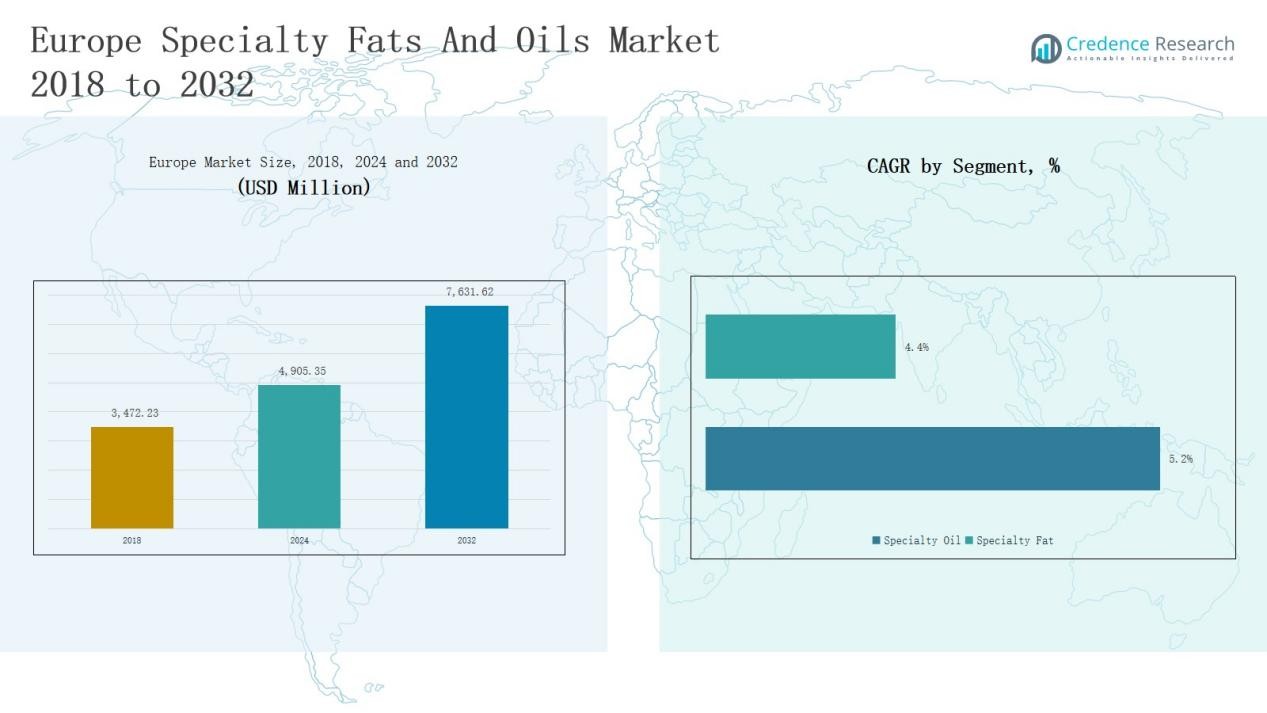
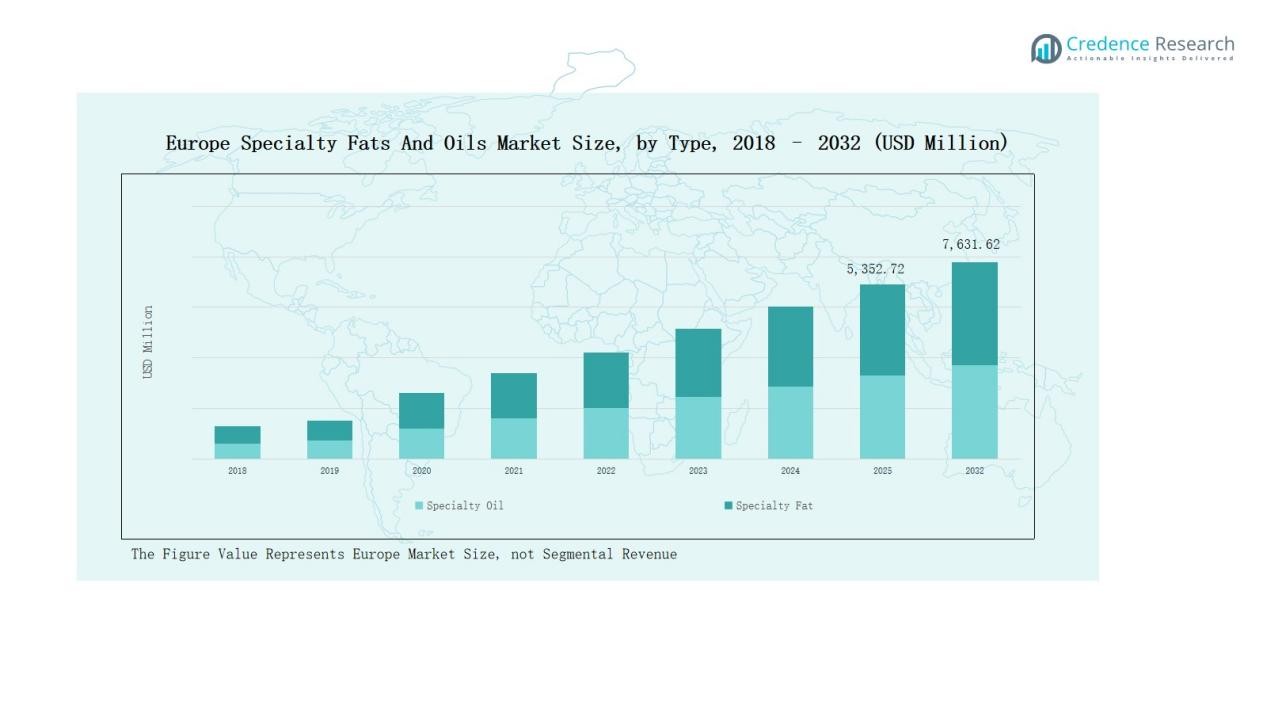
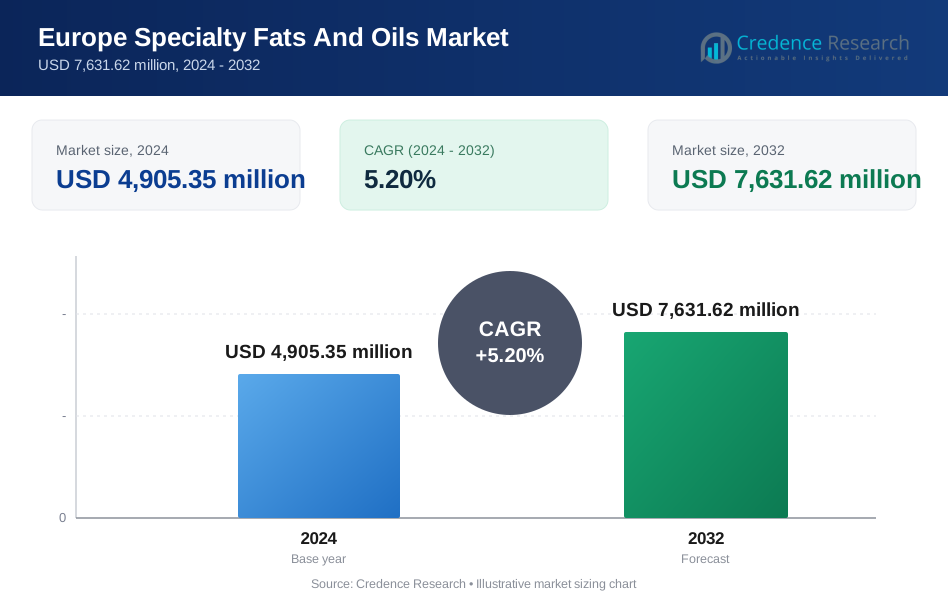
Europe Specialty Fats And Oils Market size was valued at USD 3,472.23 million in 2018 to USD 4,905.35 million in 2024 and is anticipated to reach USD 7,631.62 million by 2032, at a CAGR of 5.20% during the forecast period.
| REPORT ATTRIBUTE | DETAILS |
|---|---|
| Historical Period | 2020-2023 |
| Base Year | 2024 |
| Forecast Period | 2025-2032 |
| Europe Specialty Fats And Oils Market Size 2024 | USD 4,905.35 Million |
| Europe Specialty Fats And Oils Market, CAGR | 5.20% |
| Europe Specialty Fats And Oils Market Size 2032 | USD 7,631.62 Million |
The Europe Specialty Fats and Oils Market is shaped by prominent players including BASF SE, Dow, Solvay, Ashland, Lubrizol, Evonik, dsm-firmenich, Givaudan Active Beauty, Croda, Nouryon, CP Kelco, Gelymar, KitoZyme, EcoSynthetix, and Clariant. These companies maintain competitive strength through product innovation, sustainable sourcing practices, and partnerships with leading food manufacturers. They focus on developing trans-fat-free solutions, functional fats, and clean-label specialty oils to align with strict EU regulations and evolving consumer health preferences. Regionally, Germany leads the market with a 20% share, supported by its strong processed food, bakery, and chocolate industries, making it the largest contributor within Europe.
Market Insights
- The Europe Specialty Fats and Oils Market grew from USD 3,472.23 million in 2018 to USD 4,905.35 million in 2024, projected at USD 7,631.62 million by 2032.
- Specialty oils lead with 58% revenue share, where palm oil dominates at 28%, while bakery fats hold 18% within specialty fats, supported by industrial bakery demand.
- The industry application segment accounts for 46% share, with households contributing 32% and restaurants 15%, driven by Mediterranean cuisine and premium oil usage.
- By end user, chocolate dominates with 30% share, followed by bakery at 25%, while confectioneries account for 18% and infant food holds 12% market contribution.
- Germany leads regionally with 20% share, followed by France at 16%, the UK at 18%, Italy at 12%, Spain at 11%, Russia at 9%, and Rest of Europe with 14%.
Market Segment Insights
By Type
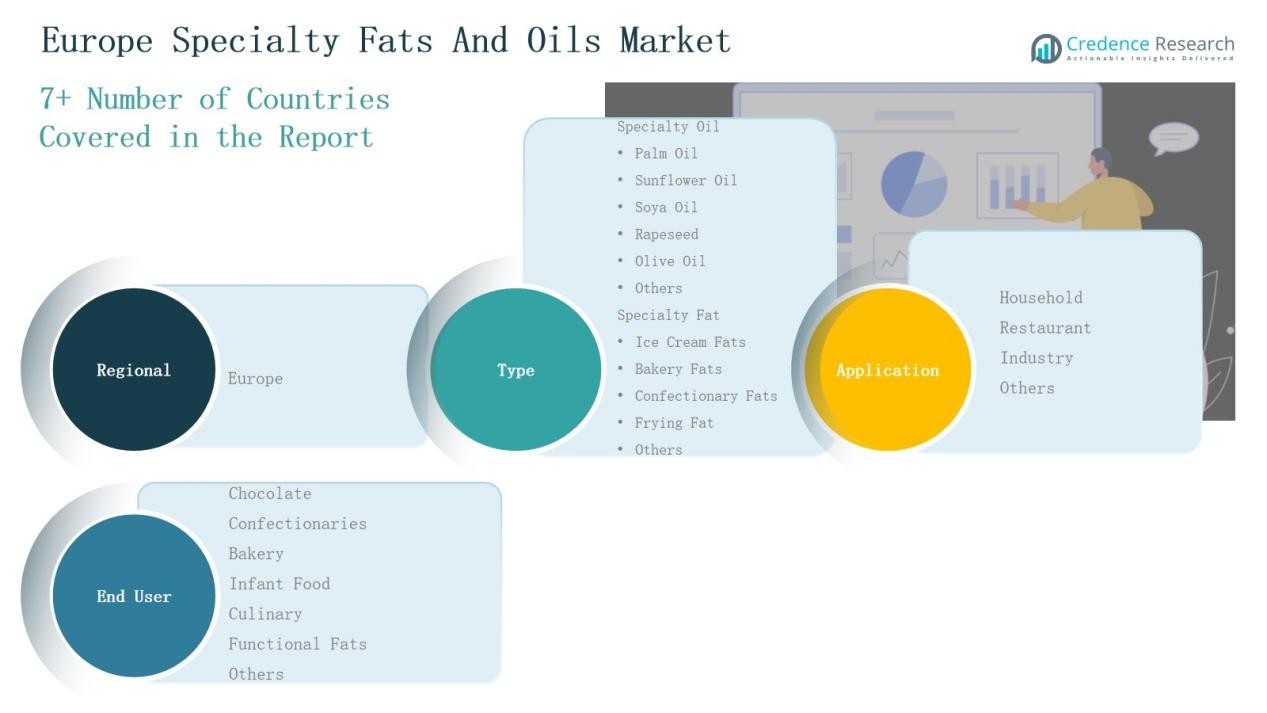
In Europe, specialty oils account for around 58% of market revenue, with palm oil dominating at nearly 28% due to its versatility in bakery, confectionery, and processed foods. Sunflower and olive oils follow, driven by consumer preference for healthier oils rich in unsaturated fats. Specialty fats contribute the remaining 42%, where bakery fats lead with 18% share, supported by demand from industrial bakeries and premium pastries. Growing interest in trans-fat alternatives and clean-label products continues to drive this segment’s expansion.
- For instance, Cargill offers its Clear Valley® line of high-oleic sunflower oils, a clean-label, non-GMO solution for the food industry, including bakery and snack foods.
By Application
The industry segment holds the largest share at approximately 46%, fueled by large-scale chocolate, bakery, and dairy processing facilities across Europe. The household segment contributes about 32%, supported by rising home cooking trends and health-oriented oil usage. Restaurants capture nearly 15%, where premium olive and sunflower oils drive consumption in Mediterranean cuisine. The growing “food away from home” culture and emphasis on sustainable sourcing further strengthen application-based demand.
- For instance, Upfield expanded its Flora Plant-based spreads in the UK, using rapeseed and sunflower oils to cater to household consumers seeking healthier, plant-based cooking options.
By End User
The chocolate segment dominates with an estimated 30% share, as specialty fats such as cocoa butter equivalents and replacers are extensively used in European chocolate manufacturing. The bakery segment follows at 25%, driven by demand for specialty fats in pastries, biscuits, and bread. Confectioneries hold 18%, while infant food accounts for 12%, reflecting consumer trust in high-quality specialty oils for nutritional products. Rising adoption of functional fats in health-oriented foods contributes nearly 10%, supported by demand for omega-enriched and plant-based alternatives.
Key Growth Drivers
Rising Demand from Bakery and Confectionery Industry
The bakery and confectionery industry remains the largest consumer of specialty fats and oils in Europe. Increasing consumption of pastries, biscuits, and chocolates continues to push demand for palm oil, cocoa butter equivalents, and bakery fats. Industrial bakeries rely heavily on these products for texture, stability, and shelf-life extension. Furthermore, premium confectionery products across markets like Germany, France, and Belgium fuel consistent uptake. This strong linkage between specialty fats and Europe’s mature bakery sector underpins sustained market growth.
- For instance, AAK introduced its range of specialty fats for European biscuit makers, formulated to improve shelf-life and reduce fat bloom in chocolate-coated applications.
Shift Toward Healthier Oils and Clean Labels
Health-conscious consumers across Europe are driving demand for specialty oils like sunflower, olive, and rapeseed due to their unsaturated fatty acid profile. Rising preference for trans-fat-free and low-cholesterol products accelerates adoption of clean-label and functional oils in both household and industrial use. Regulatory support, including EU restrictions on trans fats, further propels reformulation in food processing. This shift is encouraging manufacturers to innovate with healthier alternatives, boosting specialty oil penetration in multiple applications.
- For instance, Bunge Loders Croklaan expanded its Vream Elite range of specialty rapeseed and sunflower oils in Europe to reduce saturated fats in bakery margarines while maintaining functionality.
Expansion of Processed Food and Convenience Sector
Growing urbanization and busy lifestyles across Europe are increasing reliance on packaged and ready-to-eat products. Specialty fats and oils play a critical role in processed foods, providing consistency, flavor enhancement, and stability. The rising popularity of frozen bakery, confectionery snacks, and dairy-based desserts strengthens demand for high-performance fats. Countries like the UK, Germany, and Spain show strong momentum in convenience food consumption, creating long-term opportunities for specialty fat and oil suppliers.
Key Trends & Opportunities
Growth of Plant-Based and Functional Fats
The surge in veganism and flexitarian diets across Europe is boosting demand for plant-based specialty fats and oils. Functional fats enriched with omega-3, omega-6, or tailored for nutritional enhancement are gaining prominence in infant food and dietary supplements. Manufacturers are capitalizing on this trend by offering sustainable, plant-derived solutions that meet consumer health priorities. The convergence of plant-based eating and functional nutrition presents a strong growth opportunity for specialty oil producers.
- For instance, Avril Group's subsidiary Oleon produces plant-based fats, and Roquette also creates plant-based ingredients for the vegan and flexitarian market.
Increasing Focus on Sustainable and Ethical Sourcing
Sustainability has become a major trend shaping Europe’s specialty fats and oils market. Consumers and regulators demand traceable, ethically sourced palm and cocoa alternatives to minimize deforestation and carbon footprints. Certification programs like RSPO (Roundtable on Sustainable Palm Oil) and industry collaborations with NGOs are strengthening credibility. This shift is not only ensuring compliance but also creating opportunities for brands to differentiate through responsible sourcing. Sustainability is evolving into a competitive advantage in the market.
- For instance, AAK partnered with the NGO Solidaridad to train more than 12,500 smallholders in Latin America and West Africa on sustainable palm cultivation, enhancing both supply chain transparency and farmer livelihoods.
Key Challenges
Price Volatility of Raw Materials
The specialty fats and oils market in Europe faces significant challenges from fluctuations in raw material prices, particularly palm, soybean, and sunflower oils. Supply chain disruptions, geopolitical tensions, and climate variability in producing regions often impact availability and cost. These fluctuations directly affect production margins for manufacturers and pricing stability for end users. Managing raw material risk while ensuring affordability remains a critical hurdle for market participants.
Stringent Regulatory Environment
Europe’s regulatory landscape around food safety, labeling, and trans-fat content is among the strictest globally. While these frameworks encourage healthier formulations, they increase compliance costs for manufacturers. Continuous reformulation to meet evolving EU standards requires investment in R&D and testing, straining smaller producers. Additionally, regulations surrounding sustainability reporting and packaging further add to operational pressures. Companies must balance compliance with cost efficiency to remain competitive.
Rising Competition from Substitutes
The specialty fats and oils market also faces rising competition from substitutes such as synthetic emulsifiers, butter, and other fat alternatives. Health-conscious consumers are increasingly opting for natural substitutes like nut-based oils, which can reduce demand for conventional specialty fats. Furthermore, the growing appeal of innovative fat replacers in the food industry poses a risk to traditional segments like bakery and confectionery fats. This competitive pressure may limit growth potential if not addressed through innovation and differentiation.
Regional Analysis
United Kingdom
The United Kingdom accounts for 18% share of the Europe Specialty Fats and Oils Market, driven by strong demand from bakery and confectionery sectors. Consumers in the UK show high preference for clean-label oils and sustainable sourcing. Growth is also supported by the presence of major chocolate and biscuit manufacturers. The retail sector remains vital, with packaged food products using specialty oils to improve texture and shelf life. It benefits from rising home cooking culture, which has increased household oil consumption.
Germany
Germany holds 20% share, the largest in Europe, supported by its strong processed food and chocolate manufacturing industry. German consumers prioritize high-quality oils, especially sunflower and rapeseed, due to health awareness. Industrial bakeries and confectioneries form the backbone of demand. The presence of global and regional food brands ensures consistent market expansion. It is also witnessing rising interest in functional fats, aligning with consumer demand for nutritional enhancements.
France
France contributes 16% share, led by its dominant bakery and patisserie culture. Specialty fats are widely used to maintain quality and taste in premium baked goods. French consumers also drive demand for olive oil, reinforcing cultural and dietary preferences. Strong culinary traditions sustain market growth across both household and restaurant applications. It benefits from consistent adoption of sustainable sourcing practices within its food industry.
Italy
Italy represents 12% share, with demand supported by its Mediterranean diet, which emphasizes olive and sunflower oils. Italian bakeries and confectionery producers remain important end users of specialty fats. Growth is reinforced by the popularity of artisanal and premium food products. The household sector continues to prefer healthier oil choices, boosting rapeseed and olive oil usage. It also reflects strong consumer alignment with sustainability certifications.
Spain
Spain accounts for 11% share, with olive oil dominating specialty oil demand. The restaurant sector forms a key growth driver, using premium oils in traditional cuisine. Spain’s food industry incorporates specialty fats in confectionery and dairy products to enhance shelf stability. Household adoption also remains strong due to cultural reliance on olive oil. It demonstrates steady growth supported by both domestic consumption and export demand.
Russia
Russia contributes 9% share, supported by increasing demand for specialty fats in confectionery production. Chocolate and bakery industries rely on palm and soya oils for large-scale output. Consumer focus on affordable products encourages manufacturers to adopt cost-efficient specialty fats. It shows growing adoption of frying fats in the fast-food sector. Demand from households is rising, driven by packaged food consumption.
Rest of Europe
The Rest of Europe segment holds 14% share, reflecting demand across Eastern and Northern countries. Markets such as Poland, the Netherlands, and Belgium remain vital due to strong food processing industries. Specialty oils like sunflower and rapeseed dominate due to regional production advantages. Growth is also supported by exports of bakery and confectionery goods. It demonstrates resilience, with rising adoption of functional fats in niche applications.
Market Segmentations:
By Type
Specialty Oils
- Palm Oil
- Sunflower Oil
- Soya Oil
- Rapeseed
- Olive Oil
- Others
Specialty Fats
- Ice Cream Fats
- Bakery Fats
- Confectionery Fats
- Frying Fat
- Others
By Application
- Household
- Restaurant
- Industry
- Others
By End User
- Chocolate
- Confectionaries
- Bakery
- Infant Food
- Culinary
- Functional Fats
- Other
By Region
- UK
- France
- Germany
- Italy
- Spain
- Russia
- Rest of Europe
Competitive Landscape
The Europe Specialty Fats and Oils Market is highly competitive, shaped by multinational corporations and regional specialists that focus on innovation, sustainability, and product differentiation. Leading players such as BASF SE, Dow, Solvay, Ashland, Lubrizol, Evonik, dsm-firmenich, Givaudan Active Beauty, Croda, Nouryon, CP Kelco, Gelymar, KitoZyme, EcoSynthetix, and Clariant maintain strong positions through diverse portfolios. These companies emphasize R&D to develop trans-fat alternatives, functional fats, and clean-label oils aligned with EU regulations. Partnerships with food and beverage producers further strengthen their market reach, while certifications such as RSPO enhance brand credibility in sustainable sourcing. Regional players complement this landscape by offering customized solutions tailored to bakery, confectionery, and household applications. Price competition, regulatory compliance, and raw material volatility remain core challenges, pushing firms to optimize supply chains and invest in efficiency. The market demonstrates moderate consolidation, with innovation, health focus, and sustainability serving as the primary differentiators among competitors.
Key Players
- BASF SE
- Dow
- Solvay
- Ashland
- Lubrizol
- Evonik
- dsm-firmenich
- Givaudan Active Beauty
- Croda
- Nouryon
- CP Kelco
- Gelymar
- KitoZyme
- EcoSynthetix
- Clariant
Recent Developments
- In June 2024, OMV launched a co-processing facility at its Schwechat refinery in Austria with nearly EUR 200 million investment to convert up to 160,000 metric tons of liquid biomass into premium renewable hydrogenated vegetable oil components.
- In 2025, Marubeni Corporation acquired Gemsa Enterprises to broaden its specialty oils portfolio, showing ongoing mergers and acquisitions in the market.
- In February 2025, SD Guthrie International Ltd. acquired a 48% stake in Marvesa Supply Chain Services B.V. to expand its specialty oils and fats presence across Europe.
- In March 2025, Bunge agreed to sell its European margarines and spreads business to Vandemoortele, a family-owned European food group. This transaction allows Bunge to realign its focus toward its core operations in specialty plant-based oils and fats.
Report Coverage
The research report offers an in-depth analysis based on Type, Application, End User and Region. It details leading market players, providing an overview of their business, product offerings, investments, revenue streams, and key applications. Additionally, the report includes insights into the competitive environment, SWOT analysis, current market trends, as well as the primary drivers and constraints. Furthermore, it discusses various factors that have driven market expansion in recent years. The report also explores market dynamics, regulatory scenarios, and technological advancements that are shaping the industry. It assesses the impact of external factors and global economic changes on market growth. Lastly, it provides strategic recommendations for new entrants and established companies to navigate the complexities of the market.
Future Outlook
- Demand for trans-fat-free and clean-label products will continue to drive specialty fat adoption.
- Sunflower, rapeseed, and olive oils will gain wider use due to health-conscious preferences.
- Chocolate and bakery industries will remain the strongest end users of specialty fats.
- Functional fats enriched with nutrients will expand presence in infant food and dietary supplements.
- Sustainable and certified sourcing will become a critical factor in purchasing decisions.
- Household demand will rise as consumers increasingly use premium oils in cooking.
- Restaurants will adopt more specialty oils to align with Mediterranean and health-driven menus.
- Manufacturers will invest in R&D to develop plant-based fat alternatives for vegan diets.
- Regional players will grow by offering customized solutions for local bakery and confectionery markets.
- Competitive intensity will increase as companies balance innovation with regulatory compliance and cost efficiency.
Request a Free Sample
Fill in your details and we'll send you a free sample report.
- Sample data tables & charts
- Research methodology
Need a Custom Version of This Report?
Tailor the scope, geography, or segments to your exact requirements.
- Custom geography or segment scope
- Direct access to our analyst team
Frequently Asked Questions
What is the current market size for Europe Specialty Fats And Oils Market, and what is its projected size in 2032?
At what Compound Annual Growth Rate is the Europe Specialty Fats And Oils Market projected to grow between 2025 and 2032?
Which Europe Specialty Fats And Oils Market segment held the largest share in 2024?
What are the primary factors fueling the growth of the Europe Specialty Fats And Oils Market?
Who are the leading companies in the Europe Specialty Fats And Oils Market?
Which region commanded the largest share of the Europe Specialty Fats And Oils Market market in 2024?
Table of Content
Chapter 1. Report Introduction
- 1.1 Report Description & Purpose
- 1.1.1 Report Title & Market Definition
- 1.1.2 Unique Selling Propositions (USP) & Key Differentiators
- 1.1.3 Value Proposition for Stakeholders
- 1.2 Research Objectives
- 1.2.1 Market Sizing Objectives (Volume & Revenue)
- 1.2.2 Segmentation Objectives
- 1.2.3 Competitive Intelligence Objectives
- 1.2.4 Forecast & Scenario Objectives
- 1.3 Report Scope
- 1.3.1 Europe Specialty Fats And Oils Scope – Types & Subtypes Covered
- 1.3.2 Geographic Scope – Regions & Countries Covered
- 1.3.3 Historical Period, Base Year & Forecast Period (2024; forecast to 2032)
- 1.3.4 Inclusions & Exclusions
- 1.4 HS Code & Classification Framework
- 1.5 Currency, Units & Pricing Basis
- 1.6 Target Stakeholders
- 1.7 Limitations & Assumptions
Chapter 2. Executive Summary
- 2.1 Global Europe Specialty Fats And Oils Market Snapshot
- 2.1.1 Market Size – Historical (2024) & Forecast (2024-2032) (2024: USD 4,905.35 million → 2032: USD 7,631.62 million)
- 2.1.2 Volume & Revenue – Global Totals
- 2.1.3 Key Market Highlights – Top Five Facts
- 2.2 Europe Specialty Fats And Oils Market Segmentation Snapshot
- 2.2.1 Market Split by Region – 2024 vs. 2032
- 2.3 Competitive Snapshot
- 2.3.1 Top 10 Players by Revenue Share – 2024
- 2.3.2 Top 10 Players by Volume Share – 2024
- 2.3.3 Recent Strategic Developments (18-Month Summary)
- 2.4 Key Investment Highlights & Strategic Conclusions
Chapter 3. Europe Specialty Fats And Oils Market Dynamics & Industry Analysis
- 3.1 Market Overview & Context
- 3.1.1 Europe Specialty Fats And Oils Market Position in the Broader Automotive Value Chain
- 3.1.2 OEM vs. Replacement Market Dynamics
- 3.1.3 Market Maturity & Development Stage by Region
- 3.2 Europe Specialty Fats And Oils Market Drivers
- 3.3 Europe Specialty Fats And Oils Market Restraints & Challenges
- 3.4 Europe Specialty Fats And Oils Market Opportunities
- 3.5 Porter's Five Forces Analysis
- 3.5.1 Threat of New Entrants
- 3.5.2 Bargaining Power of Suppliers
- 3.5.3 Bargaining Power of Buyers
- 3.5.4 Threat of Substitutes
- 3.5.5 Competitive Rivalry – Intensity Assessment
- 3.6 Europe Specialty Fats And Oils Value Chain Analysis
- 3.6.1 Upstream – Raw Material/Input Suppliers
- 3.6.1.1 Raw Material/Input 1
- 3.6.1.2 Raw Material/Input 2
- 3.6.1.3 Raw Material/Input 3
- 3.6.2 Midstream – Production/Manufacturing/Service Delivery
- 3.6.2.1 Production/Process Overview
- 3.6.2.2 Key Facility Locations & Capacity by Manufacturer
- 3.6.3 Downstream – Distribution & End Consumer
- 3.6.3.1 Primary Channel – B2B/OEM
- 3.6.3.2 Secondary Channels – Dealer, Retail, Online, Direct
- 3.6.4 Value Chain Profitability Analysis
- 3.6.1 Upstream – Raw Material/Input Suppliers
- 3.7 PESTEL Analysis
- 3.7.1 Political Factors
- 3.7.2 Economic Factors
- 3.7.3 Social Factors
- 3.7.4 Technological Factors
- 3.7.5 Environmental Factors
- 3.7.6 Legal Factors
- 3.8 Europe Specialty Fats And Oils Supply Chain Analysis
- 3.8.1 Raw Material/Input Supply Risk Assessment
- 3.8.2 Manufacturing Concentration Risk (Geographic Exposure)
- 3.8.3 Trade Disruption Impact Analysis
- 3.9 Regulatory & Policy Landscape
Note: The regulatory and policy landscape section covers regulations based on their applicability to the market, Europe Specialty Fats And Oils category, geography, and scope of the study. Only regulatory frameworks with a material impact on operations, compliance, trade, sustainability, or market access are analyzed in detail.
Chapter 4. Key Investment Pockets & Opportunity Analysis
- 4.1 Europe Specialty Fats And Oils Market Attractiveness Analysis
- 4.1.1 By Region – Investment Attractiveness Matrix (Volume × CAGR)
- 4.2 Absolute Revenue Growth Opportunity
- 4.2.1 By Region – Absolute USD Growth Through 2032
- 4.3 Incremental Volume Opportunity
- 4.3.1 By Region – Incremental Volume Through 2032
- 4.3.2 Segment – Incremental Volume
- 4.4 Emerging Submarket Opportunity Deep Dive (Subject to Applicability)
- 4.5 Emerging Market Opportunity Scorecards
- 4.5.1 United States
- 4.5.2 Europe
- 4.5.3 Asia
- 4.5.4 Middle East & Africa
Note: Emerging Market Opportunity Scorecards will be included based on relevance and strategic importance. Regions listed are indicative and may vary depending on data availability and market dynamics.
Chapter 5. Europe Specialty Fats And Oils Import-Export Analysis & Trade Flows
- 5.1 Global Trade Overview
- 5.1.1 Global Export Value by Country (2024)
- 5.1.2 Global Export Volume by Country (2024)
- 5.1.3 Global Import Value by Country (2024)
- 5.1.4 Global Import Volume by Country (2024)
- 5.1.5 Net Trade Balance by Country (2024)
- 5.2 Export Analysis – Segment
- 5.2.1 Type 1 (HS Code)
- 5.2.2 Type 2 (HS Code)
- 5.2.3 Type 3 (HS Code)
- 5.2.4 Type 4 (HS Code)
- 5.2.5 Type 5 (HS Code)
- 5.3 Import Analysis – Segment
- 5.3.1 Type 1 (HS Code)
- 5.3.2 Type 2 (HS Code)
- 5.3.3 Type 3 (HS Code)
- 5.3.4 Type 4 (HS Code)
- 5.3.5 Type 5 (HS Code)
- 5.4 Average Unit Trade Prices
- 5.4.1 Average Export Price – Segment & Country
- 5.4.2 Average Import Price – Segment & Source Country
- 5.4.3 Price Trends (2024)
- 5.5 Key Trade Route Analysis
- 5.5.1 Trade Route 1
- 5.5.2 Trade Route 2
- 5.5.3 Trade Route 3
- 5.5.4 Trade Route 4
- 5.5.5 Trade Route 5
- 5.6 Trade Policy Impact Assessment
- 5.6.1 US Anti-Dumping & Section 301 Tariffs
- 5.6.2 EU Customs Union Impact
- 5.6.3 Major Free Trade Agreements
- 5.6.4 USMCA Rules of Origin
Note: Trade policy analysis will be included only where relevant to the Europe Specialty Fats And Oils market.
Chapter 6. Competitive Landscape & Company Benchmarking
- 6.1 Europe Specialty Fats And Oils Market Concentration & Structure
- 6.1.1 Herfindahl-Hirschman Index (HHI) – vs. 2024
- 6.1.2 Tier 1, Tier 2 & Tier 3 Market Structure
- 6.1.3 Global, Regional & Local Player Dynamics
- 6.2 Europe Specialty Fats And Oils Market Share Analysis – 2024
- 6.2.1 Global Revenue Share by Company
- 6.2.2 Global Volume Share by Company
- 6.2.3 Regional Revenue Share
- 6.2.4 Market Share Evolution ( vs. 2024)
- 6.2.5 OEM Segment Share by Company
- 6.2.6 Replacement Segment Share by Company
- 6.3 Production/Delivery Capacity & Facility Analysis
- 6.3.1 Global Installed Capacity
- 6.3.2 Capacity Utilization Rates
- 6.3.3 Production/Output Volume
- 6.3.4 Facility Locations & Capacity Map
- 6.3.5 Planned Capacity Additions
- 6.4 Europe Specialty Fats And Oils Competitive Benchmarking Matrix
- 6.4.1 Revenue, Volume, CAGR & Profitability Comparison
- 6.4.2 Channel Revenue Mix
- 6.4.3 Geographic Revenue Exposure
- 6.4.4 R&D Intensity
- 6.4.5 Sustainability Maturity
- 6.5 Strategic Developments in Europe Specialty Fats And Oils (Last 24 Months)
- 6.5.1 Mergers, Acquisitions & Divestments
- 6.5.2 New Europe Specialty Fats And Oils Launches
- 6.5.3 Facility Expansions
- 6.5.4 Strategic Alliances, Joint Ventures & Partnerships
- 6.5.5 Distribution Expansion & Market Entry
- 6.5.6 Sustainability & ESG Initiatives
- 6.6 Competitive Strategy Mapping
- 6.6.1 Leader, Challenger, Follower & Niche Classification
- 6.6.2 Pricing Strategy Comparison
- 6.6.3 Channel Strategy Matrix
Note: Strategic developments are included based on their materiality and the availability of reliable information.
Chapter 7. Global Europe Specialty Fats And Oils Market – By Distribution Channel
- 7.1 Segment Overview
- 7.1.1 Volume & Revenue Split by Channel (2024 & 2032)
- 7.1.2 Channel Mix Evolution (2024-2032)
Chapter 8. Regional Market Analysis – Global Overview
- 8.1 Global Regional Overview
- 8.1.1 Regional Volume Share
- 8.1.2 Regional Revenue Share
- 8.1.3 Regional Volume by Region
- 8.1.4 Regional Revenue by Region
- 8.1.5 Regional Forecast Through 2032
- 8.2 Cross-Regional Segment Analysis
- 8.2.1 By Distribution Channel
- 8.2.2 By Brand/Price Tier
Chapter 9. North America Europe Specialty Fats And Oils Market
- 9.1 United States
- 9.2 Canada
- 9.3 Mexico
Chapter 10. Europe Europe Specialty Fats And Oils Market
- 10.1 Germany
- 10.2 France
- 10.3 Italy
- 10.4 United Kingdom
- 10.5 Spain
- 10.6 Poland
- 10.7 Russia
- 10.8 Netherlands
- 10.9 Belgium
- 10.10 Sweden
- 10.11 Denmark
- 10.12 Norway
- 10.13 Rest of Europe
Chapter 11. Asia Pacific Europe Specialty Fats And Oils Market
- 11.1 China
- 11.2 India
- 11.3 Japan
- 11.4 South Korea
- 11.5 Thailand
- 11.6 Indonesia
- 11.7 Vietnam
- 11.8 Malaysia
- 11.9 Australia
- 11.10 Rest of Asia Pacific
Chapter 12. Latin America Europe Specialty Fats And Oils Market
- 12.1 Brazil
- 12.2 Argentina
- 12.3 Colombia
- 12.4 Chile
- 12.5 Rest of Latin America
Chapter 13. Middle East Europe Specialty Fats And Oils Market
- 13.1 Saudi Arabia
- 13.2 United Arab Emirates
- 13.3 Turkey
- 13.4 Israel
- 13.5 Iran
- 13.6 Rest of the Middle East
Chapter 14. Africa Europe Specialty Fats And Oils Market
- 14.1 South Africa
- 14.2 Egypt
- 14.3 Nigeria
- 14.4 Morocco
- 14.5 Rest of Africa
Chapter 15. Europe Specialty Fats And Oils Company Profiles
- 15.1 [Company 01]
- 15.1.1 Company Overview
- 15.1.2 Key Management Personnel
- 15.1.3 Products & Services Portfolio
- 15.1.4 Financial Performance
- 15.1.5 Key Market Focus & Geographic Presence
- 15.1.6 Recent Developments & Strategic Initiatives
Note: The company profile list is preliminary and may change based on research findings, market developments, data availability, and client requirements.
Chapter 16. Appendices
- Appendix A – List of Abbreviations & Acronyms
- Appendix B – Industry Classification Code Reference – Full Series
- Appendix C – Production & Capacity Data Tables
- Appendix D – End-Use & Demand Base Tables
- Appendix E – Consumption & Replacement Rate Assumptions
- Appendix F – ASP Reference Tables
- Appendix G – Manufacturing & Facility Database
- Appendix H – Import-Export Data Tables
- Appendix I – Regulatory Summary Tables
- Appendix J – Primary Research Participant List (Anonymized)
- Appendix K – Primary Research Questionnaire Framework
- Appendix L – Data Sources & Bibliography
- Appendix M – Market Size Divergence & Source Comparison
Chapter 17. Research Methodology
- 17.1 Research Framework & Philosophy
- 17.2 Secondary Research – Sources, Hierarchy & Data Extraction
- 17.3 Data Modeling – Bottom-Up & Top-Down Market Sizing
- 17.4 Primary Research – Stakeholder Framework, LOI & Sample Sizes
- 17.5 Forecast Methodology – Regression, Scenario & Sensitivity Analysis
- 17.6 Quality Control – Four-Layer Validation Framework
- 17.7 Limitations & Standard Assumptions
- 17.8 Disclaimer
