
Market Overview:
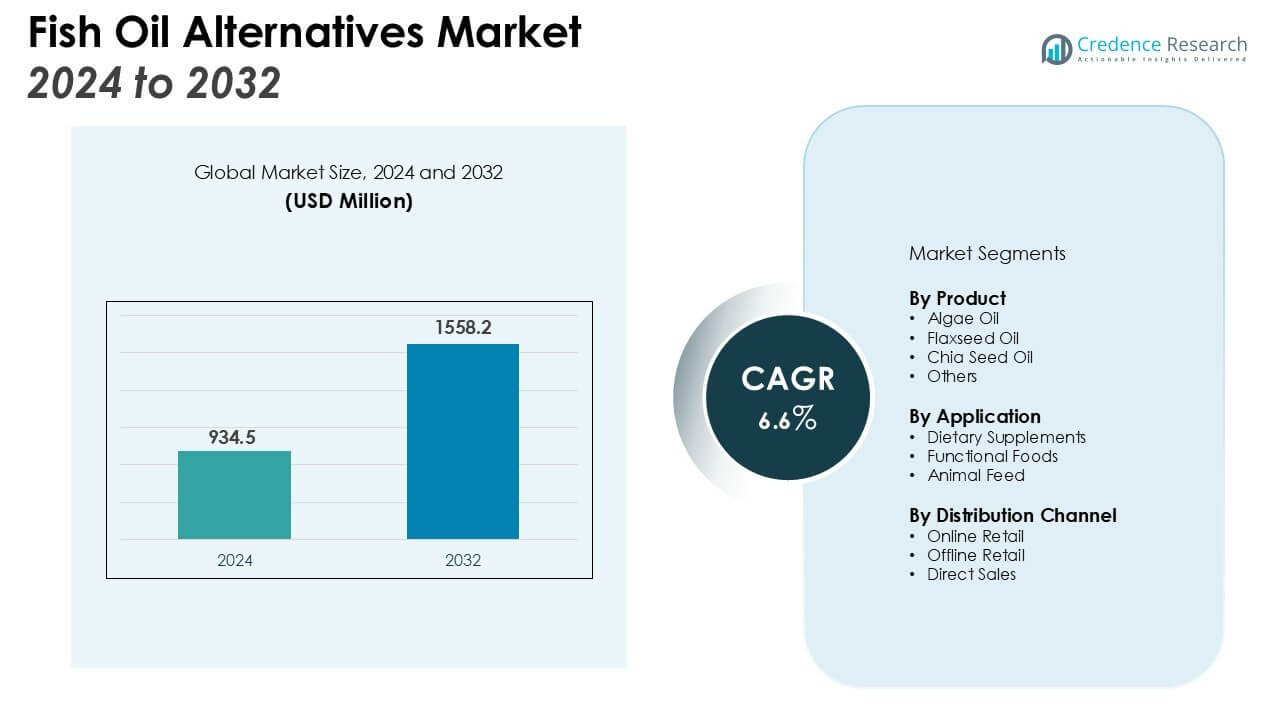
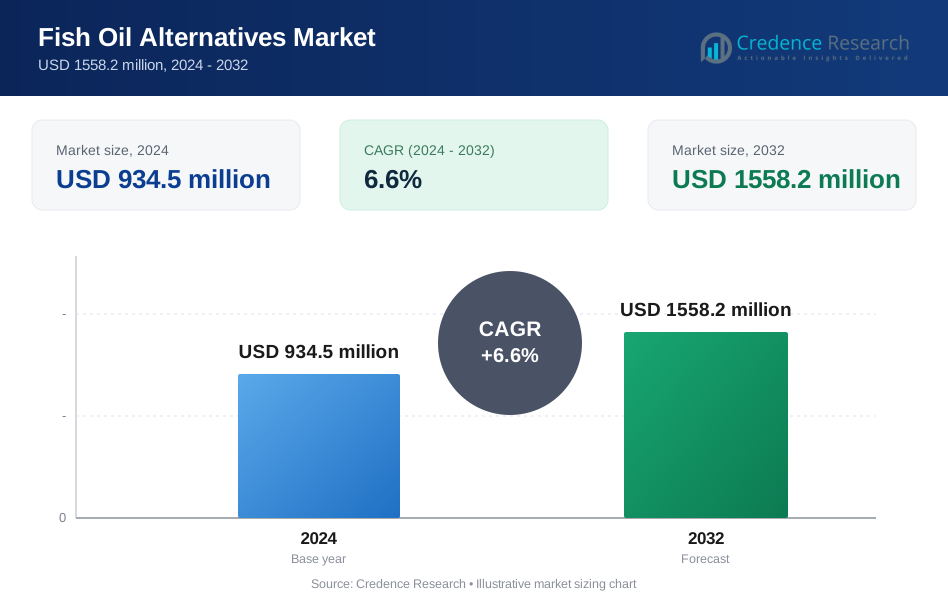
The Fish Oil Alternatives Market size was valued at USD 934.5 million in 2024 and is anticipated to reach USD 1558.2 million by 2032, at a CAGR of 6.6% during the forecast period (2024-2032).
| REPORT ATTRIBUTE | DETAILS |
|---|---|
| Historical Period | 2020-2023 |
| Base Year | 2024 |
| Forecast Period | 2025-2032 |
| Fish Oil Alternatives Market Size 2024 | USD 934.5 Million |
| Fish Oil Alternatives Market, CAGR | 6.6% |
| Fish Oil Alternatives Market Size 2032 | USD 1558.2 Million |
The primary drivers for this market include the rising awareness of the health benefits associated with omega-3 fatty acids, such as supporting cardiovascular health, improving brain function, and reducing inflammation. As consumers turn towards plant-based diets and sustainable products, alternatives like algae oil and flaxseed oil are gaining popularity. Moreover, the growing number of vegan and vegetarian consumers is further propelling the demand for plant-based omega-3 supplements. The increasing trend towards clean label products, which emphasize transparency and natural ingredients, also supports the market growth.
Regionally, North America and Europe are the dominant markets for fish oil alternatives, driven by high consumer awareness and demand for sustainable health products. The Asia-Pacific region is expected to witness the highest growth, fueled by increasing health consciousness and dietary changes in emerging economies like China and India. Additionally, the rising disposable income in these regions is further accelerating the adoption of premium health supplements.
Market Insights:
- The Fish Oil Alternatives Market was valued at USD 934.5 million in 2024 and is expected to reach USD 1558.2 million by 2032, growing at a CAGR of 6.6% from 2024 to 2032.
- Rising consumer awareness of omega-3 fatty acids’ health benefits, such as supporting heart health and brain function, is propelling demand for plant-based alternatives like algae and flaxseed oil.
- The increasing trend toward vegan and plant-based diets continues to drive the demand for non-animal-derived omega-3 sources, further expanding the market for fish oil alternatives.
- Sustainable products remain a primary market driver, as eco-conscious consumers seek alternatives like algae oil that do not harm marine ecosystems or contribute to overfishing.
- North America accounts for 40% of the global market, with high consumer demand for sustainable and clean-label omega-3 products, ensuring its dominance in the market.
- Europe, holding a 30% market share, benefits from rising veganism and a strong preference for environmentally conscious and plant-based products, driving the market’s expansion.
- The Asia-Pacific region, with a 20% market share, is the fastest-growing, driven by increasing health awareness, rising disposable incomes, and shifting dietary preferences toward sustainable omega-3 alternatives.
Market Drivers:
Increasing Consumer Awareness of Health Benefits
The growing recognition of the health benefits associated with omega-3 fatty acids drives the Fish Oil Alternatives Market. Consumers increasingly understand the importance of omega-3s in supporting cardiovascular health, improving brain function, and reducing inflammation. This heightened awareness has fueled the demand for plant-based alternatives, such as algae oil and flaxseed oil, which offer similar health benefits without relying on fish-derived sources. As a result, more consumers are seeking sustainable and plant-based omega-3 supplements.
- For instance, DSM's life'sDHA B54-0100 product delivers 545 mg of DHA and 80 mg of EPA per gram, offering an effective plant-based omega-3 source extracted from sustainably cultivated algae for enhanced cardiovascular and cognitive health support.
Rising Demand for Sustainable and Eco-Friendly Products
Sustainability has become a significant factor influencing consumer choices, leading to the growth of the Fish Oil Alternatives Market. Consumers are becoming more environmentally conscious, seeking alternatives that do not contribute to overfishing or harm marine ecosystems. Plant-based omega-3 alternatives, such as algae oil, provide an eco-friendly option for consumers looking to reduce their environmental footprint. This shift toward sustainability is expected to remain a primary market driver as eco-conscious consumer behavior continues to evolve.
Expanding Plant-Based and Vegan Diets
The increase in plant-based and vegan diets also contributes to the rising demand for fish oil alternatives. Many consumers adopting these diets seek non-animal-derived sources of essential nutrients like omega-3 fatty acids. Fish oil alternatives, such as algae oil, offer an excellent plant-based option to meet the omega-3 needs of these consumers. This growing trend of veganism and plant-based eating has further fueled the market's expansion.
Innovations in Algae and Other Plant-Based Oils
The development of innovative algae-based oils has played a key role in driving the Fish Oil Alternatives Market. These innovations provide a sustainable and high-quality alternative to traditional fish oil while offering similar omega-3 content. Algae oils are rich in DHA and EPA, the two most essential omega-3 fatty acids, and are gaining popularity among consumers due to their purity, effectiveness, and environmental benefits. These advancements have opened new opportunities for manufacturers and expanded the market reach.Top of Form
- For instance, clinical studies demonstrate that microalgal oil providing 2.4 grams per day of combined DHA and EPA lowers triglycerides to an extent comparable to fish oil, validating its effectiveness as a health supplement.
Market Trends:
Rising Demand for Algae Oil and Plant-Based Omega-3 Alternatives
The Fish Oil Alternatives Market is experiencing a shift toward algae oil as the leading source of plant-based omega-3 fatty acids. Algae oil offers a sustainable and effective alternative to traditional fish oil, providing high levels of DHA and EPA. As consumers become more conscious of environmental and health impacts, algae oil’s popularity has surged due to its plant-based origin and ability to deliver the same omega-3 benefits without harming marine ecosystems. The growing demand for clean-label products, which prioritize transparency and natural ingredients, further supports the trend. This has led to increased investments in algae oil production and research, expanding its availability in the market. With more consumers opting for plant-based supplements, algae oil is expected to dominate the Fish Oil Alternatives Market in the coming years.
- For instance, Corbion produces AlgaPrime™ DHA through proprietary fermentation techniques in Brazil, delivering high-quality omega-3-rich microalgae oil in a scalable process that transforms sugarcane into omega-3 biomass within days.
Growing Focus on Personalized and Functional Nutrition
There is a growing trend in the Fish Oil Alternatives Market towards personalized and functional nutrition. Consumers are seeking dietary supplements that are tailored to meet their individual health needs, which includes omega-3 alternatives. Companies are capitalizing on this trend by offering personalized omega-3 supplements that cater to specific health goals, such as improved heart health, cognitive function, and joint support. The integration of functional ingredients into omega-3 supplements, like antioxidants and vitamins, is also gaining traction. This trend is further supported by advancements in nutraceuticals and an increase in consumer interest in bioavailability and efficacy. As the demand for customized nutrition solutions increases, the market for fish oil alternatives continues to expand.
- For instance, Elo Health provides personalized omega-3 supplements tailored through AI-driven analysis of blood biomarker tests, wearable data, and health questionnaires, with customers receiving custom dosages updated every 90 days.
Market Challenges Analysis:
High Cost of Plant-Based Omega-3 Alternatives
One of the key challenges facing the Fish Oil Alternatives Market is the high cost associated with plant-based omega-3 sources like algae oil. The extraction and production of algae oil are complex processes that require significant investment in technology and infrastructure. This results in higher production costs compared to traditional fish oil. As demand increases, it becomes essential for manufacturers to find cost-effective production methods to make these alternatives more accessible to a broader consumer base. While premium prices are often associated with eco-friendly products, the high cost remains a barrier for some consumers, limiting the market’s full potential.
Limited Consumer Awareness of Plant-Based Omega-3 Sources
Another challenge in the Fish Oil Alternatives Market is the relatively limited consumer awareness regarding plant-based omega-3 sources. While traditional fish oil has been widely known for its health benefits, alternatives like algae oil and flaxseed oil are still gaining recognition. The market faces the task of educating consumers about the nutritional benefits and sustainability of these alternatives. Without proper awareness campaigns, many consumers remain hesitant to switch from traditional fish oil to plant-based options. Increased consumer education is crucial for expanding the market share of fish oil alternatives.
Market Opportunities:
Expansion of Plant-Based Diets and Veganism
The growing popularity of plant-based diets and veganism presents significant opportunities for the Fish Oil Alternatives Market. As more consumers adopt plant-based and vegan lifestyles, the demand for non-animal-derived omega-3 supplements continues to rise. Products like algae oil and flaxseed oil offer plant-based alternatives that meet the omega-3 needs of these health-conscious consumers. Manufacturers can capitalize on this trend by developing innovative, plant-based omega-3 products that cater to the needs of vegans, vegetarians, and flexitarians. The increasing shift towards sustainable, cruelty-free products further supports the market’s growth, offering a promising opportunity for companies to expand their offerings in this segment.
Advancements in Omega-3 Extraction Technologies
Technological advancements in omega-3 extraction and production processes present another opportunity for the Fish Oil Alternatives Market. Research into more efficient and cost-effective extraction methods for algae and other plant-based omega-3 sources can reduce production costs, making these alternatives more competitive with traditional fish oil. With improvements in processing technologies, the market could see a reduction in product prices, increasing accessibility to a broader range of consumers. As new methods are developed to enhance the purity, bioavailability, and nutritional value of plant-based omega-3s, manufacturers will be able to meet rising consumer demand for high-quality, sustainable omega-3 alternatives.
Market Segmentation Analysis:
By Product
The Fish Oil Alternatives Market is segmented by product into algae oil, flaxseed oil, chia seed oil, and others. Algae oil holds the largest market share due to its high DHA and EPA content, making it a preferred choice for omega-3 supplementation. Flaxseed oil is also growing in popularity, especially among consumers seeking plant-based alternatives to traditional fish-derived omega-3s. This segment is primarily driven by the rising demand for vegan and sustainable health solutions, contributing to the overall growth of the market.
- For instance, Mason Vitamins markets flaxseed oil softgels delivering 1000 mg per capsule, widely used in supporting cardiovascular and immune health.
By Application
The Fish Oil Alternatives Market serves various applications, including dietary supplements, functional foods, and animal feed. Dietary supplements lead the market, driven by increasing consumer awareness of the health benefits of omega-3 fatty acids, such as improved cardiovascular health and enhanced brain function. Functional foods are also gaining traction, as consumers seek ways to integrate essential nutrients into their daily diets. The demand for omega-3-enriched foods continues to rise, fueled by health-conscious consumers seeking more natural sources of omega-3s in their meals.
- For example, DSM-Firmenich’s life’sDHA® B54-0100 product delivers 545 mg DHA and 80 mg EPA per gram of algal oil, optimized for use in functional food fortification to provide a balanced omega-3 profile.
By Distribution Channel
The Fish Oil Alternatives Market is distributed through online retail, offline retail, and direct sales. Online retail has experienced significant growth, driven by the convenience of shopping and the wider product range available on e-commerce platforms. This channel appeals to consumers looking for easy access to plant-based omega-3 supplements. Offline retail, including supermarkets and health food stores, remains essential for consumers who prefer in-person shopping experiences. These channels continue to support market growth and reach diverse consumer segments.
Segmentations:
By Product
- Algae Oil
- Flaxseed Oil
- Chia Seed Oil
- Others
By Application
- Dietary Supplements
- Functional Foods
- Animal Feed
By Distribution Channel
- Online Retail
- Offline Retail
- Direct Sales
By Region
- North America
- U.S.
- Canada
- Mexico
- Europe
- UK
- France
- Germany
- Italy
- Spain
- Russia
- Belgium
- Netherlands
- Austria
- Sweden
- Poland
- Denmark
- Switzerland
- Rest of Europe
- Asia Pacific
- China
- Japan
- South Korea
- India
- Australia
- Thailand
- Indonesia
- Vietnam
- Malaysia
- Philippines
- Taiwan
- Rest of Asia Pacific
- Latin America
- Brazil
- Argentina
- Peru
- Chile
- Colombia
- Rest of Latin America
- Middle East
- UAE
- KSA
- Israel
- Turkey
- Iran
- Rest of Middle East
- Africa
- Egypt
- Nigeria
- Algeria
- Morocco
- Rest of Africa
Regional Analysis:
North America: Leading Market Driven by Demand for Sustainable Products
North America holds a significant share of the Fish Oil Alternatives Market, accounting for 40% of the global market in 2024. High consumer awareness and a strong preference for sustainable, plant-based products drive this dominance. The growing trend toward plant-based diets, along with an increasing number of vegan and vegetarian consumers, boosts the demand for alternatives like algae oil. The region's robust health-conscious consumer base continues to seek eco-friendly, clean-label products that align with both sustainability goals and health benefits. Key players are investing in research and development to improve the availability and quality of plant-based omega-3 alternatives, ensuring North America's continued dominance in the market.
Europe: Expanding Market Driven by Vegan and Plant-Based Trends
Europe commands 30% of the Fish Oil Alternatives Market, benefiting from an expanding population of vegan and environmentally conscious consumers. The increasing awareness of health and sustainability trends in the region supports a rising demand for alternatives such as algae oil and flaxseed oil. As European consumers seek natural, plant-based products, companies are focusing on creating innovative, sustainable omega-3 supplements. Government initiatives promoting sustainable food sources further contribute to market growth. The strong preference for non-animal-derived omega-3 sources positions Europe as a key player in the global market.
Asia-Pacific: Fastest-Growing Market with Increased Health Consciousness
The Asia-Pacific region holds a 20% share of the Fish Oil Alternatives Market, with rapid industrialization and rising health consciousness in countries like China and India driving growth. As disposable incomes increase, more consumers are opting for plant-based omega-3 supplements to support their health. Shifting dietary preferences, along with a growing awareness of the environmental impact of overfishing, are contributing to this shift toward sustainable omega-3 sources. The region's focus on nutrition and wellness, along with its expanding middle class, positions Asia-Pacific as the fastest-growing market for fish oil alternatives.
Key Player Analysis:
- Sotexpro
- Burcon
- Cargill Inc.
- CHS Inc.
- Archer-Daniels-Midland Company (ADM)
- Dupont
- Chaitanya Chemicals
- Wilmar International
- Prinova Group LLC
- Farbest Brands
- Sonic Biochem
- Medix Laboratories
Competitive Analysis:
The Fish Oil Alternatives Market is highly competitive, with leading players such as Cargill and Wilmar International focusing on sustainable and innovative plant-based oils like algae and flaxseed oil. These companies dominate by leveraging advanced extraction technologies, scalable production, and robust distribution networks to meet the rising demand across food, nutraceutical, and personal care sectors. Regional players like Nutiva and Ming Chyi Biotechnology capitalize on local market knowledge and regulatory compliance to expand their reach. The market is shaped by ongoing innovations in extraction and purification processes, improving product quality and bioavailability. As demand for clean-label, eco-friendly alternatives grows, the competition continues to intensify, pushing companies to innovate and maintain sustainable practices.
Recent Developments:
- In August 2025, ADM announced a streamlining of its soy protein production network to optimize operations and increase competitiveness in the soy protein market.
- In July 2025, PepsiCo and Cargill collaborated to empower farmers by advancing sustainable agriculture practices across 240,000 acres in Iowa from 2025 to 2030.
- In February 2025, Burcon agreed to terms with its alliance partner for a protein production facility in North America, facilitating commercial production capabilities for its plant protein ingredients.
Report Coverage:
The research report offers an in-depth analysis based on Product, Application, Distribution Channel and Region. It details leading market players, providing an overview of their business, product offerings, investments, revenue streams, and key applications. Additionally, the report includes insights into the competitive environment, SWOT analysis, current market trends, as well as the primary drivers and constraints. Furthermore, it discusses various factors that have driven market expansion in recent years. The report also explores market dynamics, regulatory scenarios, and technological advancements that are shaping the industry. It assesses the impact of external factors and global economic changes on market growth. Lastly, it provides strategic recommendations for new entrants and established companies to navigate the complexities of the market.
Future Outlook:
- The Fish Oil Alternatives Market will continue to grow as consumer awareness of the health benefits of omega-3 fatty acids increases.
- Demand for plant-based and vegan products will drive market expansion, with algae oil and flaxseed oil gaining further popularity.
- Sustainable sourcing practices will remain a key focus, with more companies prioritizing eco-friendly production methods.
- Innovations in extraction technologies will enhance product quality, bioavailability, and purity, offering a competitive edge to manufacturers.
- The rise of clean-label products will push manufacturers to offer more transparent and natural omega-3 alternatives.
- As more consumers shift towards plant-based diets, the demand for non-animal-derived omega-3 sources will increase significantly.
- Increased focus on functional foods and dietary supplements will expand market applications, particularly in the health and wellness sectors.
- Regional growth will be led by North America and Europe, with the Asia-Pacific region seeing the fastest adoption due to rising disposable incomes.
- Regulatory support for sustainable and health-focused products will further boost market growth, particularly in developed markets.
- The market will experience increased competition, leading to more partnerships and collaborations aimed at improving product offerings and expanding reach.
Request a Free Sample
Fill in your details and we'll send you a free sample report.
- Sample data tables & charts
- Research methodology
Need a Custom Version of This Report?
Tailor the scope, geography, or segments to your exact requirements.
- Custom geography or segment scope
- Direct access to our analyst team
Frequently Asked Questions
What is the current market size for Fish Oil Alternatives, and what is its projected size in 2032?
At what Compound Annual Growth Rate is the Fish Oil Alternatives market projected to grow between 2024 and 2032?
Which Fish Oil Alternatives market segment held the largest share in 2024?
What are the primary factors fueling the growth of the Fish Oil Alternatives market?
Who are the leading companies in the Fish Oil Alternatives market?
Which region commanded the largest share of the Fish Oil Alternatives market in 2024?
Table of Content
Chapter 1. Report Introduction
- 1.1 Report Description & Purpose
- 1.1.1 Report Title & Market Definition
- 1.1.2 Unique Selling Propositions (USP) & Key Differentiators
- 1.1.3 Value Proposition for Stakeholders
- 1.2 Research Objectives
- 1.2.1 Market Sizing Objectives (Volume & Revenue)
- 1.2.2 Segmentation Objectives
- 1.2.3 Competitive Intelligence Objectives
- 1.2.4 Forecast & Scenario Objectives
- 1.3 Report Scope
- 1.3.1 Fish Oil Alternatives Scope – Types & Subtypes Covered
- 1.3.2 Geographic Scope – Regions & Countries Covered
- 1.3.3 Historical Period, Base Year & Forecast Period (2024; forecast to 2032)
- 1.3.4 Inclusions & Exclusions
- 1.4 HS Code & Classification Framework
- 1.5 Currency, Units & Pricing Basis
- 1.6 Target Stakeholders
- 1.7 Limitations & Assumptions
Chapter 2. Executive Summary
- 2.1 Global Fish Oil Alternatives Market Snapshot
- 2.1.1 Market Size – Historical (2024) & Forecast (2024-2032) (2024: USD 934.5 million → 2032: USD 1558.2 million)
- 2.1.2 Volume & Revenue – Global Totals
- 2.1.3 Key Market Highlights – Top Five Facts
- 2.2 Fish Oil Alternatives Market Segmentation Snapshot
- 2.2.1 Market Split by Region – 2024 vs. 2032
- 2.3 Competitive Snapshot
- 2.3.1 Top 10 Players by Revenue Share – 2024
- 2.3.2 Top 10 Players by Volume Share – 2024
- 2.3.3 Recent Strategic Developments (18-Month Summary)
- 2.4 Key Investment Highlights & Strategic Conclusions
Chapter 3. Fish Oil Alternatives Market Dynamics & Industry Analysis
- 3.1 Market Overview & Context
- 3.1.1 Fish Oil Alternatives Market Position in the Broader Automotive Value Chain
- 3.1.2 OEM vs. Replacement Market Dynamics
- 3.1.3 Market Maturity & Development Stage by Region
- 3.2 Fish Oil Alternatives Market Drivers
- 3.3 Fish Oil Alternatives Market Restraints & Challenges
- 3.4 Fish Oil Alternatives Market Opportunities
- 3.5 Porter's Five Forces Analysis
- 3.5.1 Threat of New Entrants
- 3.5.2 Bargaining Power of Suppliers
- 3.5.3 Bargaining Power of Buyers
- 3.5.4 Threat of Substitutes
- 3.5.5 Competitive Rivalry – Intensity Assessment
- 3.6 Fish Oil Alternatives Value Chain Analysis
- 3.6.1 Upstream – Raw Material/Input Suppliers
- 3.6.1.1 Raw Material/Input 1
- 3.6.1.2 Raw Material/Input 2
- 3.6.1.3 Raw Material/Input 3
- 3.6.2 Midstream – Production/Manufacturing/Service Delivery
- 3.6.2.1 Production/Process Overview
- 3.6.2.2 Key Facility Locations & Capacity by Manufacturer
- 3.6.3 Downstream – Distribution & End Consumer
- 3.6.3.1 Primary Channel – B2B/OEM
- 3.6.3.2 Secondary Channels – Dealer, Retail, Online, Direct
- 3.6.4 Value Chain Profitability Analysis
- 3.6.1 Upstream – Raw Material/Input Suppliers
- 3.7 PESTEL Analysis
- 3.7.1 Political Factors
- 3.7.2 Economic Factors
- 3.7.3 Social Factors
- 3.7.4 Technological Factors
- 3.7.5 Environmental Factors
- 3.7.6 Legal Factors
- 3.8 Fish Oil Alternatives Supply Chain Analysis
- 3.8.1 Raw Material/Input Supply Risk Assessment
- 3.8.2 Manufacturing Concentration Risk (Geographic Exposure)
- 3.8.3 Trade Disruption Impact Analysis
- 3.9 Regulatory & Policy Landscape
Note: The regulatory and policy landscape section covers regulations based on their applicability to the market, Fish Oil Alternatives category, geography, and scope of the study. Only regulatory frameworks with a material impact on operations, compliance, trade, sustainability, or market access are analyzed in detail.
Chapter 4. Key Investment Pockets & Opportunity Analysis
- 4.1 Fish Oil Alternatives Market Attractiveness Analysis
- 4.1.1 By Region – Investment Attractiveness Matrix (Volume × CAGR)
- 4.2 Absolute Revenue Growth Opportunity
- 4.2.1 By Region – Absolute USD Growth Through 2032
- 4.3 Incremental Volume Opportunity
- 4.3.1 By Region – Incremental Volume Through 2032
- 4.3.2 Segment – Incremental Volume
- 4.4 Emerging Submarket Opportunity Deep Dive (Subject to Applicability)
- 4.5 Emerging Market Opportunity Scorecards
- 4.5.1 United States
- 4.5.2 Europe
- 4.5.3 Asia
- 4.5.4 Middle East & Africa
Note: Emerging Market Opportunity Scorecards will be included based on relevance and strategic importance. Regions listed are indicative and may vary depending on data availability and market dynamics.
Chapter 5. Fish Oil Alternatives Import-Export Analysis & Trade Flows
- 5.1 Global Trade Overview
- 5.1.1 Global Export Value by Country (2024)
- 5.1.2 Global Export Volume by Country (2024)
- 5.1.3 Global Import Value by Country (2024)
- 5.1.4 Global Import Volume by Country (2024)
- 5.1.5 Net Trade Balance by Country (2024)
- 5.2 Export Analysis – Segment
- 5.2.1 Type 1 (HS Code)
- 5.2.2 Type 2 (HS Code)
- 5.2.3 Type 3 (HS Code)
- 5.2.4 Type 4 (HS Code)
- 5.2.5 Type 5 (HS Code)
- 5.3 Import Analysis – Segment
- 5.3.1 Type 1 (HS Code)
- 5.3.2 Type 2 (HS Code)
- 5.3.3 Type 3 (HS Code)
- 5.3.4 Type 4 (HS Code)
- 5.3.5 Type 5 (HS Code)
- 5.4 Average Unit Trade Prices
- 5.4.1 Average Export Price – Segment & Country
- 5.4.2 Average Import Price – Segment & Source Country
- 5.4.3 Price Trends (2024)
- 5.5 Key Trade Route Analysis
- 5.5.1 Trade Route 1
- 5.5.2 Trade Route 2
- 5.5.3 Trade Route 3
- 5.5.4 Trade Route 4
- 5.5.5 Trade Route 5
- 5.6 Trade Policy Impact Assessment
- 5.6.1 US Anti-Dumping & Section 301 Tariffs
- 5.6.2 EU Customs Union Impact
- 5.6.3 Major Free Trade Agreements
- 5.6.4 USMCA Rules of Origin
Note: Trade policy analysis will be included only where relevant to the Fish Oil Alternatives market.
Chapter 6. Competitive Landscape & Company Benchmarking
- 6.1 Fish Oil Alternatives Market Concentration & Structure
- 6.1.1 Herfindahl-Hirschman Index (HHI) – vs. 2024
- 6.1.2 Tier 1, Tier 2 & Tier 3 Market Structure
- 6.1.3 Global, Regional & Local Player Dynamics
- 6.2 Fish Oil Alternatives Market Share Analysis – 2024
- 6.2.1 Global Revenue Share by Company
- 6.2.2 Global Volume Share by Company
- 6.2.3 Regional Revenue Share
- 6.2.4 Market Share Evolution ( vs. 2024)
- 6.2.5 OEM Segment Share by Company
- 6.2.6 Replacement Segment Share by Company
- 6.3 Production/Delivery Capacity & Facility Analysis
- 6.3.1 Global Installed Capacity
- 6.3.2 Capacity Utilization Rates
- 6.3.3 Production/Output Volume
- 6.3.4 Facility Locations & Capacity Map
- 6.3.5 Planned Capacity Additions
- 6.4 Fish Oil Alternatives Competitive Benchmarking Matrix
- 6.4.1 Revenue, Volume, CAGR & Profitability Comparison
- 6.4.2 Channel Revenue Mix
- 6.4.3 Geographic Revenue Exposure
- 6.4.4 R&D Intensity
- 6.4.5 Sustainability Maturity
- 6.5 Strategic Developments in Fish Oil Alternatives (Last 24 Months)
- 6.5.1 Mergers, Acquisitions & Divestments
- 6.5.2 New Fish Oil Alternatives Launches
- 6.5.3 Facility Expansions
- 6.5.4 Strategic Alliances, Joint Ventures & Partnerships
- 6.5.5 Distribution Expansion & Market Entry
- 6.5.6 Sustainability & ESG Initiatives
- 6.6 Competitive Strategy Mapping
- 6.6.1 Leader, Challenger, Follower & Niche Classification
- 6.6.2 Pricing Strategy Comparison
- 6.6.3 Channel Strategy Matrix
Note: Strategic developments are included based on their materiality and the availability of reliable information.
Chapter 7. Global Fish Oil Alternatives Market – By Distribution Channel
- 7.1 Segment Overview
- 7.1.1 Volume & Revenue Split by Channel (2024 & 2032)
- 7.1.2 Channel Mix Evolution (2024-2032)
Chapter 8. Regional Market Analysis – Global Overview
- 8.1 Global Regional Overview
- 8.1.1 Regional Volume Share
- 8.1.2 Regional Revenue Share
- 8.1.3 Regional Volume by Region
- 8.1.4 Regional Revenue by Region
- 8.1.5 Regional Forecast Through 2032
- 8.2 Cross-Regional Segment Analysis
- 8.2.1 By Distribution Channel
- 8.2.2 By Brand/Price Tier
Chapter 9. North America Fish Oil Alternatives Market
- 9.1 United States
- 9.2 Canada
- 9.3 Mexico
Chapter 10. Europe Fish Oil Alternatives Market
- 10.1 Germany
- 10.2 France
- 10.3 Italy
- 10.4 United Kingdom
- 10.5 Spain
- 10.6 Poland
- 10.7 Russia
- 10.8 Netherlands
- 10.9 Belgium
- 10.10 Sweden
- 10.11 Denmark
- 10.12 Norway
- 10.13 Rest of Europe
Chapter 11. Asia Pacific Fish Oil Alternatives Market
- 11.1 China
- 11.2 India
- 11.3 Japan
- 11.4 South Korea
- 11.5 Thailand
- 11.6 Indonesia
- 11.7 Vietnam
- 11.8 Malaysia
- 11.9 Australia
- 11.10 Rest of Asia Pacific
Chapter 12. Latin America Fish Oil Alternatives Market
- 12.1 Brazil
- 12.2 Argentina
- 12.3 Colombia
- 12.4 Chile
- 12.5 Rest of Latin America
Chapter 13. Middle East Fish Oil Alternatives Market
- 13.1 Saudi Arabia
- 13.2 United Arab Emirates
- 13.3 Turkey
- 13.4 Israel
- 13.5 Iran
- 13.6 Rest of the Middle East
Chapter 14. Africa Fish Oil Alternatives Market
- 14.1 South Africa
- 14.2 Egypt
- 14.3 Nigeria
- 14.4 Morocco
- 14.5 Rest of Africa
Chapter 15. Fish Oil Alternatives Company Profiles
- 15.1 [Company 01]
- 15.1.1 Company Overview
- 15.1.2 Key Management Personnel
- 15.1.3 Products & Services Portfolio
- 15.1.4 Financial Performance
- 15.1.5 Key Market Focus & Geographic Presence
- 15.1.6 Recent Developments & Strategic Initiatives
Note: The company profile list is preliminary and may change based on research findings, market developments, data availability, and client requirements.
Chapter 16. Appendices
- Appendix A – List of Abbreviations & Acronyms
- Appendix B – Industry Classification Code Reference – Full Series
- Appendix C – Production & Capacity Data Tables
- Appendix D – End-Use & Demand Base Tables
- Appendix E – Consumption & Replacement Rate Assumptions
- Appendix F – ASP Reference Tables
- Appendix G – Manufacturing & Facility Database
- Appendix H – Import-Export Data Tables
- Appendix I – Regulatory Summary Tables
- Appendix J – Primary Research Participant List (Anonymized)
- Appendix K – Primary Research Questionnaire Framework
- Appendix L – Data Sources & Bibliography
- Appendix M – Market Size Divergence & Source Comparison
Chapter 17. Research Methodology
- 17.1 Research Framework & Philosophy
- 17.2 Secondary Research – Sources, Hierarchy & Data Extraction
- 17.3 Data Modeling – Bottom-Up & Top-Down Market Sizing
- 17.4 Primary Research – Stakeholder Framework, LOI & Sample Sizes
- 17.5 Forecast Methodology – Regression, Scenario & Sensitivity Analysis
- 17.6 Quality Control – Four-Layer Validation Framework
- 17.7 Limitations & Standard Assumptions
- 17.8 Disclaimer
