
Market Overview
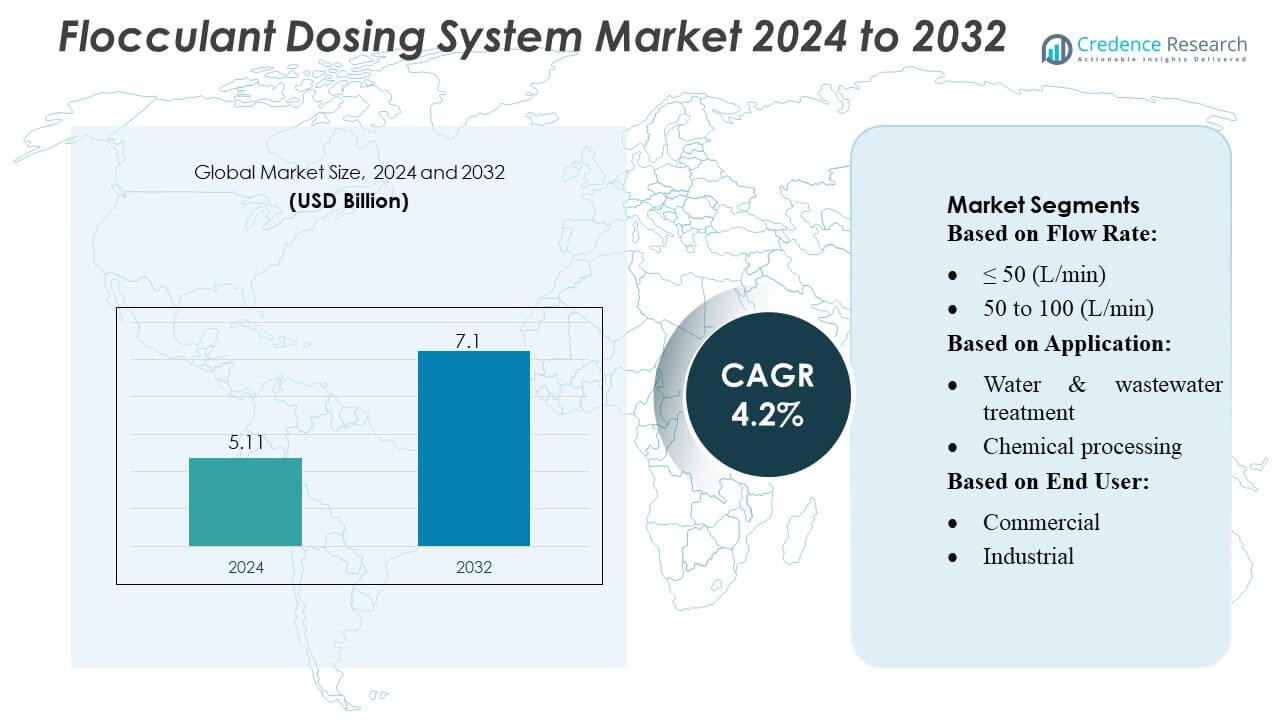
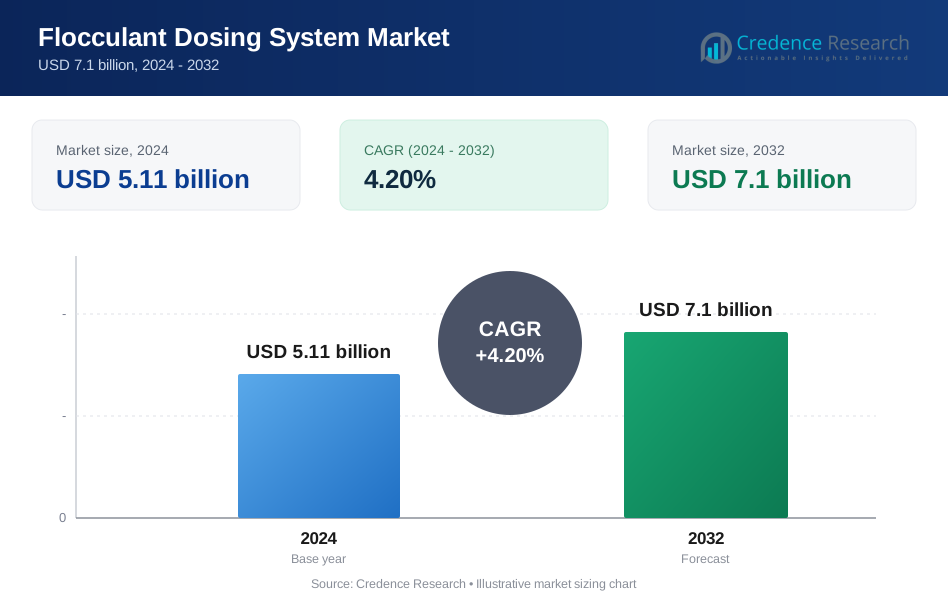
Flocculant Dosing System Market size was valued USD 5.11 billion in 2024 and is anticipated to reach USD 7.1 billion by 2032, at a CAGR of 4.2% during the forecast period.
| REPORT ATTRIBUTE | DETAILS |
|---|---|
| Historical Period | 2020-2023 |
| Base Year | 2024 |
| Forecast Period | 2025-2032 |
| Flocculant Dosing System Market Size 2024 | USD 5.11 Billion |
| Flocculant Dosing System Market, CAGR | 4.2% |
| Flocculant Dosing System Market Size 2032 | USD 7.1 Billion |
The Flocculant Dosing System Market is shaped by a competitive group of global manufacturers that focus on precision dosing technologies, automated polymer activation, and digital monitoring capabilities to support municipal and industrial treatment needs. These companies strengthen their market positions through continuous product innovation, integration of smart control systems, and expansion into high-growth regions. Asia Pacific emerges as the leading regional market with an approximate 34–36% share, driven by rapid industrialization, expanding wastewater treatment infrastructure, and tightening regulatory requirements across major economies. Growing investments in modernization and sustainable water management further reinforce the region’s dominance.
Market Insights
- The Flocculant Dosing System Market reached USD 5.11 billion in 2024 and is projected to hit USD 7.1 billion by 2032, reflecting a 4.2% CAGR driven by rising demand for efficient chemical dosing and sludge management optimization.
- Increasing regulatory pressure on wastewater treatment and industrial effluent quality acts as a major driver, boosting adoption of automated and precision-controlled dosing systems across municipal and industrial facilities.
- Smart dosing technologies, IoT-enabled monitoring, and modular system designs represent key market trends, supporting higher accuracy, reduced chemical consumption, and improved operational efficiency.
- Competitive intensity remains high as manufacturers prioritize innovation in digital controls, energy-efficient pumps, and advanced polymer activation, while cost constraints and operational complexities act as notable restraints.
- Asia Pacific leads the market with 34–36% share, supported by rapid urbanization and expanding treatment infrastructure, while the ≤50 L/min flow-rate segment holds the dominant share due to its suitability for small and mid-scale applications.
Market Segmentation Analysis:
By Flow Rate
The ≤50 L/min segment holds the dominant share, accounting for around 42–45% of the Flocculant Dosing System Market, driven by its strong adoption in small and mid-scale treatment units that require precise polymer dosing and energy-efficient operation. This flow range supports compact plant layouts, reduces operational costs, and ensures easy integration with automated control systems. Its popularity in decentralized wastewater systems and industrial pretreatment facilities reinforces demand, while upgrades in dosing accuracy, modular design, and low-maintenance components continue to expand adoption across diverse end-use environments.
- For instance, Watson-Marlow’s pump portfolio includes the “530 process pumps,” which deliver flow rates up to 3.5 L/min and operate at pressures up to 7 bar, making them well suited for compact or smaller-scale chemical dosing applications.
By Application
Water and wastewater treatment remains the leading application, representing over 48–50% of the market, supported by expanding municipal utilities, stricter discharge regulations, and the growing need for sludge management optimization. The segment benefits from widespread deployment of flocculants for solid–liquid separation, clarification, and effluent polishing across municipal and industrial treatment plants. Rising global investments in wastewater recycling, membrane pretreatment, and advanced treatment infrastructure further strengthen the segment’s dominance. Increasing adoption of automated dosing platforms and polymer optimization programs continues to drive system upgrades and new installations.
- For instance, SPX FLOW supplies high-efficiency mixing and fluid-handling equipment — such as its “Lightnin Series 700/800 High Torque Mixers” — widely used for flocculation and sludge mixing in treatment plants, ensuring stable mixing of polymers and chemicals in tanks ranging from 5 m³ to over 1,000 m³.
By End User
The municipal segment dominates the market with approximately 40–42% share, driven by large-scale investments in urban wastewater treatment, aging infrastructure modernization, and regulatory mandates emphasizing water quality improvement. Municipal utilities rely heavily on flocculant dosing systems for sludge dewatering, primary clarification, and tertiary treatment, boosting demand for accurate, continuous-flow dosing technologies. The segment also benefits from long-term operational contracts and public spending on centralized treatment facilities. Rising focus on water reuse, smart plant automation, and sustainable chemical consumption further accelerates municipal adoption and system replacement cycles.
Key Growth Drivers
- Rising Demand for Advanced Water & Wastewater Treatment
Growing global pressure to improve water quality, reduce pollutant loads, and expand wastewater recycling drives strong adoption of flocculant dosing systems. Municipal utilities and industries invest in automated dosing technologies to enhance solid–liquid separation efficiency, optimize sludge handling, and meet stringent environmental regulations. Increasing industrial effluent generation in sectors such as chemicals, food processing, and pharmaceuticals further accelerates system installations. The push for sustainable water management and expanding urban infrastructure continues to reinforce demand for high-precision flocculant dosing solutions.
- For instance, Blue-White’s “PRO Series” peristaltic dosing pumps can deliver flow rates from 0.1 mL/min to 20 L/min with operating pressures up to 7 bar, making them suitable for small to medium-scale municipal and industrial water treatment systems.
- Expansion of Industrial Automation and Digital Dosing Controls
The market benefits from the rapid integration of automation, digital monitoring, and smart dosing algorithms that significantly improve treatment accuracy and operational efficiency. Industries increasingly adopt PLC-controlled and IoT-enabled dosing platforms to reduce manual intervention, enhance chemical utilization, and lower operational costs. Real-time viscosity measurement, polymer activation optimization, and remote diagnostics strengthen reliability in continuous treatment processes. As industries prioritize predictive maintenance and data-driven process optimization, digitally enabled dosing systems see rising preference across small, mid-scale, and large installations.
- For instance, ProMinent’s gamma/ X digital metering pumps incorporate PLC interfaces and IoT connectivity, enabling remote monitoring and precise dosing control across small to mid-scale treatment units. The pump is designed for high-precision micro-metering of chemicals with flow rates typically up to around 45 L/h, depending on the specific pump configuration and pressure rating.
- Growth in Sludge Management and Dewatering Operations
Rising sludge volumes from municipal and industrial wastewater plants fuel demand for optimized flocculant dosing systems that improve dewatering efficiency and reduce downstream handling costs. As plants modernize their sludge treatment lines, they increasingly adopt automated polymer preparation units and high-accuracy dosing pumps. The emphasis on reducing sludge disposal costs, improving cake dryness, and minimizing energy consumption strengthens market growth. Regulatory pressure on landfill usage and biosolids management further accelerates adoption of flocculant-based treatment processes supported by optimized dosing infrastructure.
Key Trends & Opportunities
- Increasing Shift Toward Smart, Sensor-Integrated Dosing Systems
The market experiences a strong trend toward intelligent dosing solutions equipped with sensors for turbidity, flow rate, and polymer viscosity monitoring. These systems enable adaptive, closed-loop control that significantly enhances treatment stability and minimizes overdosing. The shift toward Industry 4.0 technologies creates opportunities for manufacturers to integrate cloud analytics, digital twins, and automated calibration features. Growing end-user preference for remote monitoring and performance dashboards supports the transition to highly automated, data-centric flocculant dosing platforms.
- For instance, Nikkiso’s Smart Dosing Pump Systems integrate with external flow sensors and control systems capable of handling process flows across a wide range, often up to 50 L/min for specific models.
- Growing Opportunity in Decentralized and Modular Treatment Plants
Rising urbanization, resource constraints, and the need for localized treatment systems create new opportunities for compact and modular flocculant dosing units. Small and decentralized wastewater plants in industrial estates, residential communities, and remote regions increasingly adopt portable dosing systems due to their low footprint and simplified operation. Manufacturers capitalize on this trend by offering plug-and-play units with flexible flow-rate configurations. The expanding use of containerized treatment systems in developing regions continues to boost demand for modular, energy-efficient dosing technologies.
- For instance, Grundfos’ ME/ME X compact dosing pumps support flow rates from 0.2 L/h to 100 L/h with operating pressures up to 16 bar, allowing deployment in small-scale, decentralized wastewater plants.
- Expansion of Eco-Friendly and Low-Chemical Treatment Solutions
End users show growing interest in reducing chemical consumption and improving environmental sustainability, creating opportunities for flocculant dosing systems that support bio-based polymers and high-efficiency formulations. Advanced dosing platforms that optimize polymer activation and minimize wastage gain traction across municipal and industrial applications. The wider shift toward green treatment technologies, including natural coagulants and biodegradable polymers, encourages investment in systems capable of precise low-dosage control. This trend positions environmentally aligned dosing solutions for accelerated market penetration.
Key Challenges
- High Capital Costs and Budget Constraints in Municipal Projects
High initial investment requirements for automated and sensor-integrated flocculant dosing systems remain a major barrier, especially for small municipalities and budget-constrained utilities. Upfront expenditures for preparation tanks, control systems, dosing pumps, and calibration units limit adoption despite long-term savings. Delays in public funding cycles and competition with other water infrastructure priorities further slow procurement. The challenge becomes more prominent in developing regions where treatment facilities operate with limited modernization budgets.
- Operational Complexity and Skilled Workforce Limitations
Despite technological advancements, many flocculant dosing systems require skilled operators to manage polymer activation, adjust dosing rates, and maintain system calibration. Plants lacking trained personnel face risks of overdosing, underdosing, or inconsistent treatment performance. Limited knowledge of polymer behavior, viscosity changes, and equipment troubleshooting increases operational challenges. Workforce shortages in water utilities and industrial facilities intensify the issue, compelling vendors to offer extensive training and simplified system designs, yet skill gaps remain a significant adoption barrier.
Regional Analysis
North America
North America holds around 30–32% of the Flocculant Dosing System Market, supported by mature wastewater treatment infrastructure, strong regulatory frameworks, and continuous investments in plant modernization. Municipal utilities adopt automated dosing technologies to improve sludge handling, optimize chemical usage, and comply with stringent effluent discharge norms. Industrial sectors such as oil & gas, chemicals, and food processing further reinforce demand through expanding process-water treatment operations. The region also benefits from early adoption of digital monitoring systems, remote diagnostics, and energy-efficient dosing platforms, strengthening long-term market growth.
Europe
Europe accounts for approximately 26–28% share, driven by strict environmental regulations, widespread focus on wastewater recycling, and ongoing upgrades to aging treatment plants. The region’s strong chemical, pharmaceutical, and food-processing industries contribute significantly to industrial demand for high-precision dosing solutions. Countries such as Germany, the UK, and France prioritize chemical optimization, automated polymer activation, and advanced sludge management technologies. Growing adoption of Industry 4.0 and digital water management platforms accelerates integration of smart dosing systems. Sustainability pressures and circular-economy initiatives also stimulate investment in energy-efficient, low-chemical dosing infrastructures.
Asia Pacific
Asia Pacific leads the global market with approximately 34–36% share, fueled by rapid industrialization, expanding municipal wastewater treatment capacity, and rising environmental compliance requirements. China, India, and Southeast Asian countries invest heavily in new treatment infrastructure, driving large-scale demand for flocculant dosing systems across municipal, industrial, and decentralized plants. Industrial sectors—including chemicals, textiles, mining, and electronics—strengthen installations due to high effluent loads and growing water reuse initiatives. The region’s shift toward smart automation, coupled with government-backed water sustainability programs, continues to boost adoption of advanced dosing technologies.
Latin America
Latin America holds roughly 8–9% of the market, supported by growing investments in urban wastewater treatment, industrial expansion, and environmental compliance initiatives. Countries such as Brazil, Mexico, and Chile increasingly adopt flocculant dosing systems to improve water quality and reduce sludge handling costs across municipal utilities and mining operations. Industrial wastewater from food processing, chemicals, and pulp & paper sectors also contributes to demand. Budget limitations and uneven infrastructure development remain challenges, yet rising interest in modular, cost-efficient dosing units strengthens market penetration in both urban and semi-urban regions.
Middle East & Africa
The Middle East & Africa region represents around 6–7% share, driven by growing demand for water treatment solutions in water-scarce economies and expanding industrial projects. Countries such as Saudi Arabia, the UAE, and South Africa adopt flocculant dosing systems to support desalination pretreatment, industrial effluent management, and municipal wastewater operations. The mining and oil & gas sectors significantly influence adoption due to high flocculant consumption for clarification and sludge control. Despite infrastructure gaps and funding constraints, ongoing investments in wastewater recycling and industrial expansion sustain steady market growth.
Market Segmentations:
By Flow Rate:
- ≤ 50 (L/min)
- 50 to 100 (L/min)
By Application:
- Water & wastewater treatment
- Chemical processing
By End User:
- Commercial
- Industrial
By Geography
- North America
- U.S.
- Canada
- Mexico
- Europe
- Germany
- France
- U.K.
- Italy
- Spain
- Rest of Europe
- Asia Pacific
- China
- Japan
- India
- South Korea
- South-east Asia
- Rest of Asia Pacific
- Latin America
- Brazil
- Argentina
- Rest of Latin America
- Middle East & Africa
- GCC Countries
- South Africa
- Rest of the Middle East and Africa
Competitive Landscape
The Flocculant Dosing System Market features a competitive landscape shaped by leading global manufacturers such as Watson-Marlow Fluid Technology Solutions, SPX Flow, Blue White Pumps, ProMinent Group, Nikkiso Co. Ltd., Grundfos Holding A/S, SEKO S.P.A., IDEX Corporation, Netzsch Pumps, and Verder Liquid B.V. the Flocculant Dosing System Market is defined by continuous innovation in automated dosing technologies, digital monitoring capabilities, and high-precision pump systems tailored for both municipal and industrial treatment facilities. Manufacturers focus on developing intelligent dosing platforms that enhance polymer activation efficiency, minimize chemical wastage, and improve process stability across varying flow conditions. The market also sees strong competition in offering modular, energy-efficient, and low-maintenance systems suited for decentralized and large-scale plants. Companies increasingly prioritize integration with IoT, real-time analytics, and predictive maintenance tools to strengthen operational reliability. Strategic partnerships, expansion into emerging markets, and investments in R&D reinforce competitive positioning, while sustainability-driven solutions and advanced control systems continue to shape differentiation across the industry.
Key Player Analysis
- Watson-Marlow Fluid Technology Solutions
- SPX Flow
- Blue White Pumps
- ProMinent Group
- Nikkiso Co. Ltd.
- Grundfos Holding A/S
- SEKO S.P.A.
- IDEX Corporation
- Netzsch Pumps
- Verder Liquid B.V.
Recent Developments
- In June 2025, Ingersoll Rand acquired Lead Fluid Intelligent Equipment manufacturing, reinforcing its in-region, for region growth strategy. Lead Fluid specializes in design and manufacturing of precision fluid handling solutions, including peristaltic pumps, syringe pumps, gear pumps, and pump heads.
- In March 2025, Grundfos launched the new DDA Smart Digital Dosing Pump for industrial, commercial, and utility applications, which enhances safety, user-friendliness, and dosing precision. This new pump uses a variable-speed stepper motor and a turn-down ratio.
- In November 2024, NETZSCH launched the PERIPRO tube pump, designed for continuous operation in demanding applications like wastewater treatment. The pump has a hermetically sealed design with a built-in leakage sensor to prevent contamination.
- In May 2024, The Verder Group acquired a majority stake in ITC, a Spanish manufacturer of dosing pumps for agricultural and water treatment applications. This acquisition strengthens Verder Liquid, the group's pump division, by expanding its presence in the global dosing pump sector.
Report Coverage
The research report offers an in-depth analysis based on Flow Rate, Application, End-User and Geography. It details leading market players, providing an overview of their business, product offerings, investments, revenue streams, and key applications. Additionally, the report includes insights into the competitive environment, SWOT analysis, current market trends, as well as the primary drivers and constraints. Furthermore, it discusses various factors that have driven market expansion in recent years. The report also explores market dynamics, regulatory scenarios, and technological advancements that are shaping the industry. It assesses the impact of external factors and global economic changes on market growth. Lastly, it provides strategic recommendations for new entrants and established companies to navigate the complexities of the market.
Future Outlook
- The market will advance through wider adoption of automated and smart dosing systems that enhance treatment accuracy and operational efficiency.
- Digital monitoring, IoT connectivity, and predictive maintenance will become standard features across new installations.
- Municipal wastewater treatment expansion will continue to drive strong demand for high-precision dosing technologies.
- Industrial sectors will increase investments in optimized polymer dosing to improve effluent quality and meet stricter environmental regulations.
- Modular and compact dosing units will gain traction in decentralized and small-scale treatment facilities.
- Sustainability priorities will accelerate the use of low-chemical and energy-efficient dosing solutions.
- Integration of AI-driven dosing algorithms will improve performance consistency under varying operating conditions.
- Vendors will expand service-based models offering remote support, real-time diagnostics, and performance optimization.
- Developing regions will emerge as high-potential markets due to rising infrastructure investments and regulatory enforcement.
- Continuous R&D in advanced polymers and activation technologies will enhance treatment outcomes and boost system upgrades.
Request a Free Sample
Fill in your details and we'll send you a free sample report.
- Sample data tables & charts
- Research methodology
Need a Custom Version of This Report?
Tailor the scope, geography, or segments to your exact requirements.
- Custom geography or segment scope
- Direct access to our analyst team
Frequently Asked Questions
What is the current market size for the Flocculant Dosing System Market, and what is its projected size in 2032?
At what Compound Annual Growth Rate is the Flocculant Dosing System Market projected to grow between 2025 and 2032?
Which Flocculant Dosing System Market segment held the largest share in 2024?
What are the primary factors fueling the growth of the Flocculant Dosing System Market?
Who are the leading companies in the Flocculant Dosing System Market?
Which region commanded the largest share of the Flocculant Dosing System Market in 2024?
Table of Content
Chapter 1. Report Introduction
- 1.1 Report Description & Purpose
- 1.1.1 Report Title & Market Definition
- 1.1.2 Unique Selling Propositions (USP) & Key Differentiators
- 1.1.3 Value Proposition for Stakeholders
- 1.2 Research Objectives
- 1.2.1 Market Sizing Objectives (Volume & Revenue)
- 1.2.2 Segmentation Objectives
- 1.2.3 Competitive Intelligence Objectives
- 1.2.4 Forecast & Scenario Objectives
- 1.3 Report Scope
- 1.3.1 Flocculant Dosing System Scope – Types & Subtypes Covered
- 1.3.2 Geographic Scope – Regions & Countries Covered
- 1.3.3 Historical Period, Base Year & Forecast Period (2024; forecast to 2032)
- 1.3.4 Inclusions & Exclusions
- 1.4 HS Code & Classification Framework
- 1.5 Currency, Units & Pricing Basis
- 1.6 Target Stakeholders
- 1.7 Limitations & Assumptions
Chapter 2. Executive Summary
- 2.1 Global Flocculant Dosing System Market Snapshot
- 2.1.1 Market Size – Historical (2024) & Forecast (2024-2032) (2024: USD 5.11 billion → 2032: USD 7.1 billion)
- 2.1.2 Volume & Revenue – Global Totals
- 2.1.3 Key Market Highlights – Top Five Facts
- 2.2 Flocculant Dosing System Market Segmentation Snapshot
- 2.2.1 Market Split by Region – 2024 vs. 2032
- 2.3 Competitive Snapshot
- 2.3.1 Top 10 Players by Revenue Share – 2024
- 2.3.2 Top 10 Players by Volume Share – 2024
- 2.3.3 Recent Strategic Developments (18-Month Summary)
- 2.4 Key Investment Highlights & Strategic Conclusions
Chapter 3. Flocculant Dosing System Market Dynamics & Industry Analysis
- 3.1 Market Overview & Context
- 3.1.1 Flocculant Dosing System Market Position in the Broader Automotive Value Chain
- 3.1.2 OEM vs. Replacement Market Dynamics
- 3.1.3 Market Maturity & Development Stage by Region
- 3.2 Flocculant Dosing System Market Drivers
- 3.3 Flocculant Dosing System Market Restraints & Challenges
- 3.4 Flocculant Dosing System Market Opportunities
- 3.5 Porter's Five Forces Analysis
- 3.5.1 Threat of New Entrants
- 3.5.2 Bargaining Power of Suppliers
- 3.5.3 Bargaining Power of Buyers
- 3.5.4 Threat of Substitutes
- 3.5.5 Competitive Rivalry – Intensity Assessment
- 3.6 Flocculant Dosing System Value Chain Analysis
- 3.6.1 Upstream – Raw Material/Input Suppliers
- 3.6.1.1 Raw Material/Input 1
- 3.6.1.2 Raw Material/Input 2
- 3.6.1.3 Raw Material/Input 3
- 3.6.2 Midstream – Production/Manufacturing/Service Delivery
- 3.6.2.1 Production/Process Overview
- 3.6.2.2 Key Facility Locations & Capacity by Manufacturer
- 3.6.3 Downstream – Distribution & End Consumer
- 3.6.3.1 Primary Channel – B2B/OEM
- 3.6.3.2 Secondary Channels – Dealer, Retail, Online, Direct
- 3.6.4 Value Chain Profitability Analysis
- 3.6.1 Upstream – Raw Material/Input Suppliers
- 3.7 PESTEL Analysis
- 3.7.1 Political Factors
- 3.7.2 Economic Factors
- 3.7.3 Social Factors
- 3.7.4 Technological Factors
- 3.7.5 Environmental Factors
- 3.7.6 Legal Factors
- 3.8 Flocculant Dosing System Supply Chain Analysis
- 3.8.1 Raw Material/Input Supply Risk Assessment
- 3.8.2 Manufacturing Concentration Risk (Geographic Exposure)
- 3.8.3 Trade Disruption Impact Analysis
- 3.9 Regulatory & Policy Landscape
Note: The regulatory and policy landscape section covers regulations based on their applicability to the market, Flocculant Dosing System category, geography, and scope of the study. Only regulatory frameworks with a material impact on operations, compliance, trade, sustainability, or market access are analyzed in detail.
Chapter 4. Key Investment Pockets & Opportunity Analysis
- 4.1 Flocculant Dosing System Market Attractiveness Analysis
- 4.1.1 By Region – Investment Attractiveness Matrix (Volume × CAGR)
- 4.2 Absolute Revenue Growth Opportunity
- 4.2.1 By Region – Absolute USD Growth Through 2032
- 4.3 Incremental Volume Opportunity
- 4.3.1 By Region – Incremental Volume Through 2032
- 4.3.2 Segment – Incremental Volume
- 4.4 Emerging Submarket Opportunity Deep Dive (Subject to Applicability)
- 4.5 Emerging Market Opportunity Scorecards
- 4.5.1 United States
- 4.5.2 Europe
- 4.5.3 Asia
- 4.5.4 Middle East & Africa
Note: Emerging Market Opportunity Scorecards will be included based on relevance and strategic importance. Regions listed are indicative and may vary depending on data availability and market dynamics.
Chapter 5. Flocculant Dosing System Import-Export Analysis & Trade Flows
- 5.1 Global Trade Overview
- 5.1.1 Global Export Value by Country (2024)
- 5.1.2 Global Export Volume by Country (2024)
- 5.1.3 Global Import Value by Country (2024)
- 5.1.4 Global Import Volume by Country (2024)
- 5.1.5 Net Trade Balance by Country (2024)
- 5.2 Export Analysis – Segment
- 5.2.1 Type 1 (HS Code)
- 5.2.2 Type 2 (HS Code)
- 5.2.3 Type 3 (HS Code)
- 5.2.4 Type 4 (HS Code)
- 5.2.5 Type 5 (HS Code)
- 5.3 Import Analysis – Segment
- 5.3.1 Type 1 (HS Code)
- 5.3.2 Type 2 (HS Code)
- 5.3.3 Type 3 (HS Code)
- 5.3.4 Type 4 (HS Code)
- 5.3.5 Type 5 (HS Code)
- 5.4 Average Unit Trade Prices
- 5.4.1 Average Export Price – Segment & Country
- 5.4.2 Average Import Price – Segment & Source Country
- 5.4.3 Price Trends (2024)
- 5.5 Key Trade Route Analysis
- 5.5.1 Trade Route 1
- 5.5.2 Trade Route 2
- 5.5.3 Trade Route 3
- 5.5.4 Trade Route 4
- 5.5.5 Trade Route 5
- 5.6 Trade Policy Impact Assessment
- 5.6.1 US Anti-Dumping & Section 301 Tariffs
- 5.6.2 EU Customs Union Impact
- 5.6.3 Major Free Trade Agreements
- 5.6.4 USMCA Rules of Origin
Note: Trade policy analysis will be included only where relevant to the Flocculant Dosing System market.
Chapter 6. Competitive Landscape & Company Benchmarking
- 6.1 Flocculant Dosing System Market Concentration & Structure
- 6.1.1 Herfindahl-Hirschman Index (HHI) – vs. 2024
- 6.1.2 Tier 1, Tier 2 & Tier 3 Market Structure
- 6.1.3 Global, Regional & Local Player Dynamics
- 6.2 Flocculant Dosing System Market Share Analysis – 2024
- 6.2.1 Global Revenue Share by Company
- 6.2.2 Global Volume Share by Company
- 6.2.3 Regional Revenue Share
- 6.2.4 Market Share Evolution ( vs. 2024)
- 6.2.5 OEM Segment Share by Company
- 6.2.6 Replacement Segment Share by Company
- 6.3 Production/Delivery Capacity & Facility Analysis
- 6.3.1 Global Installed Capacity
- 6.3.2 Capacity Utilization Rates
- 6.3.3 Production/Output Volume
- 6.3.4 Facility Locations & Capacity Map
- 6.3.5 Planned Capacity Additions
- 6.4 Flocculant Dosing System Competitive Benchmarking Matrix
- 6.4.1 Revenue, Volume, CAGR & Profitability Comparison
- 6.4.2 Channel Revenue Mix
- 6.4.3 Geographic Revenue Exposure
- 6.4.4 R&D Intensity
- 6.4.5 Sustainability Maturity
- 6.5 Strategic Developments in Flocculant Dosing System (Last 24 Months)
- 6.5.1 Mergers, Acquisitions & Divestments
- 6.5.2 New Flocculant Dosing System Launches
- 6.5.3 Facility Expansions
- 6.5.4 Strategic Alliances, Joint Ventures & Partnerships
- 6.5.5 Distribution Expansion & Market Entry
- 6.5.6 Sustainability & ESG Initiatives
- 6.6 Competitive Strategy Mapping
- 6.6.1 Leader, Challenger, Follower & Niche Classification
- 6.6.2 Pricing Strategy Comparison
- 6.6.3 Channel Strategy Matrix
Note: Strategic developments are included based on their materiality and the availability of reliable information.
Chapter 7. Global Flocculant Dosing System Market – By Distribution Channel
- 7.1 Segment Overview
- 7.1.1 Volume & Revenue Split by Channel (2024 & 2032)
- 7.1.2 Channel Mix Evolution (2024-2032)
Chapter 8. Regional Market Analysis – Global Overview
- 8.1 Global Regional Overview
- 8.1.1 Regional Volume Share
- 8.1.2 Regional Revenue Share
- 8.1.3 Regional Volume by Region
- 8.1.4 Regional Revenue by Region
- 8.1.5 Regional Forecast Through 2032
- 8.2 Cross-Regional Segment Analysis
- 8.2.1 By Distribution Channel
- 8.2.2 By Brand/Price Tier
Chapter 9. North America Flocculant Dosing System Market
- 9.1 United States
- 9.2 Canada
- 9.3 Mexico
Chapter 10. Europe Flocculant Dosing System Market
- 10.1 Germany
- 10.2 France
- 10.3 Italy
- 10.4 United Kingdom
- 10.5 Spain
- 10.6 Poland
- 10.7 Russia
- 10.8 Netherlands
- 10.9 Belgium
- 10.10 Sweden
- 10.11 Denmark
- 10.12 Norway
- 10.13 Rest of Europe
Chapter 11. Asia Pacific Flocculant Dosing System Market
- 11.1 China
- 11.2 India
- 11.3 Japan
- 11.4 South Korea
- 11.5 Thailand
- 11.6 Indonesia
- 11.7 Vietnam
- 11.8 Malaysia
- 11.9 Australia
- 11.10 Rest of Asia Pacific
Chapter 12. Latin America Flocculant Dosing System Market
- 12.1 Brazil
- 12.2 Argentina
- 12.3 Colombia
- 12.4 Chile
- 12.5 Rest of Latin America
Chapter 13. Middle East Flocculant Dosing System Market
- 13.1 Saudi Arabia
- 13.2 United Arab Emirates
- 13.3 Turkey
- 13.4 Israel
- 13.5 Iran
- 13.6 Rest of the Middle East
Chapter 14. Africa Flocculant Dosing System Market
- 14.1 South Africa
- 14.2 Egypt
- 14.3 Nigeria
- 14.4 Morocco
- 14.5 Rest of Africa
Chapter 15. Flocculant Dosing System Company Profiles
- 15.1 [Company 01]
- 15.1.1 Company Overview
- 15.1.2 Key Management Personnel
- 15.1.3 Products & Services Portfolio
- 15.1.4 Financial Performance
- 15.1.5 Key Market Focus & Geographic Presence
- 15.1.6 Recent Developments & Strategic Initiatives
Note: The company profile list is preliminary and may change based on research findings, market developments, data availability, and client requirements.
Chapter 16. Appendices
- Appendix A – List of Abbreviations & Acronyms
- Appendix B – Industry Classification Code Reference – Full Series
- Appendix C – Production & Capacity Data Tables
- Appendix D – End-Use & Demand Base Tables
- Appendix E – Consumption & Replacement Rate Assumptions
- Appendix F – ASP Reference Tables
- Appendix G – Manufacturing & Facility Database
- Appendix H – Import-Export Data Tables
- Appendix I – Regulatory Summary Tables
- Appendix J – Primary Research Participant List (Anonymized)
- Appendix K – Primary Research Questionnaire Framework
- Appendix L – Data Sources & Bibliography
- Appendix M – Market Size Divergence & Source Comparison
Chapter 17. Research Methodology
- 17.1 Research Framework & Philosophy
- 17.2 Secondary Research – Sources, Hierarchy & Data Extraction
- 17.3 Data Modeling – Bottom-Up & Top-Down Market Sizing
- 17.4 Primary Research – Stakeholder Framework, LOI & Sample Sizes
- 17.5 Forecast Methodology – Regression, Scenario & Sensitivity Analysis
- 17.6 Quality Control – Four-Layer Validation Framework
- 17.7 Limitations & Standard Assumptions
- 17.8 Disclaimer
