| REPORT ATTRIBUTE | DETAILS |
|---|---|
| Historical Period | 2020-2023 |
| Base Year | 2024 |
| Forecast Period | 2025-2032 |
| Foam-Based Weaponry Toy MarketSize 2024 | USD 21,805.29 million |
| Foam-Based Weaponry Toy Market, CAGR | 4.87% |
| Foam-Based Weaponry Toy Market Size 2032 | USD 31,907.81 million |
Market Overview
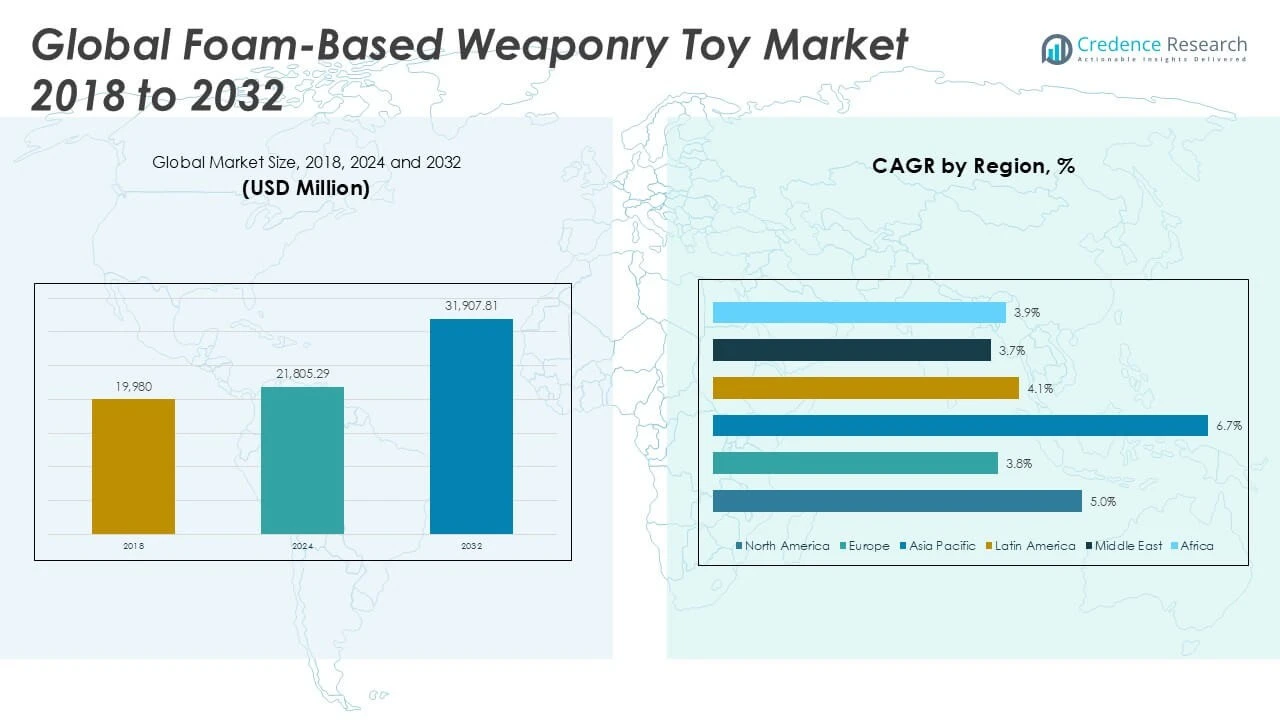
The Global Foam-Based Weaponry Toy Market is projected to grow from USD 21,805.29 million in 2024 to an estimated USD 31,907.81 million by 2032, registering a compound annual growth rate (CAGR) of 4.87% from 2025 to 2032.
Key drivers fueling the market include rising safety concerns among parents, which promote foam-based toys as safer alternatives to traditional hard plastic or metal toys. Additionally, the surge in outdoor and role-playing activities among children and teenagers propels demand. Trends such as incorporating advanced features like electronic sound effects and enhanced ergonomics improve user experience and engagement. Moreover, growing awareness about non-toxic and environmentally friendly materials further encourages adoption. The integration of licensed themes from popular media franchises also boosts market appeal.
Geographically, North America holds a significant share of the foam-based weaponry toy market due to high consumer spending and widespread acceptance of interactive play toys. Europe follows closely, driven by stringent safety regulations and increasing demand for innovative products. The Asia-Pacific region is expected to witness the fastest growth, supported by rising disposable incomes, urbanization, and expanding retail channels. Prominent players in this market include Hasbro, Nerf (a subsidiary of Hasbro), Mattel, Buzz Bee Toys, and ZURU, which focus on product innovation, strategic partnerships, and expanding distribution networks to strengthen their market presence.
 Market Insights
- The Global Foam-Based Weaponry Toy Market is projected to grow from USD 21,805.29 million in 2024 to USD 31,907.81 million by 2032, exhibiting a CAGR of 4.87% from 2025 to 2032.
- Rising parental concerns about child safety drive demand for foam-based toys as safer alternatives to hard plastic and metal weaponry toys.
- Increasing popularity of outdoor play and role-playing activities among children and teenagers boosts market growth worldwide.
- Strict safety regulations and compliance requirements in major markets pose challenges that increase production costs and delay product launches.
- North America holds the largest market share due to high consumer spending and widespread acceptance of interactive toys.
- Asia-Pacific represents the fastest-growing region, supported by urbanization, rising disposable incomes, and expanding retail channels.
- Manufacturers focus on product innovation, including electronic sound effects and ergonomic designs, to enhance play experiences and gain competitive advantage.
Market Drivers
Growing Preference for Safe and Non-Toxic Toys Encourages Market Expansion
The increasing consumer preference for safe and non-toxic toys drives the Global Foam-Based Weaponry Toy Market. Parents prioritize products that reduce injury risks during playtime, making foam-based weaponry toys a preferred choice. These toys offer cushioning and soft materials, minimizing harm compared to conventional hard plastic or metal alternatives. Manufacturers respond by enhancing product safety features, gaining consumer trust. Rising awareness about the harmful effects of toxic materials in children’s products supports demand. It also aligns with stricter regulations on toy safety enforced in many regions. This trend maintains steady market growth and influences product development strategies.
- For instance, bans on single-use plastics in several countries have encouraged toy manufacturers to adopt biodegradable and non-toxic materials in their product lines.
Rising Popularity of Outdoor and Role-Playing Activities Fuels Demand
Outdoor and imaginative play continue to gain traction among children and teenagers, contributing significantly to market growth. Foam-based weaponry toys support active and social play experiences, encouraging physical exercise and creativity. It engages children in group activities, which strengthens social skills and teamwork. The appeal of immersive play scenarios, such as mock battles or adventure games, boosts product attractiveness. Schools and recreational centers increasingly incorporate such toys in their activity programs. This shift towards interactive, physical play directly benefits the market. It also drives manufacturers to introduce innovative designs tailored for varied age groups and play styles.
- For instance, the number of outdoor recreation participants in the U.S. increased by 2.3% in 2022, reaching 168.1 million people, reflecting a growing trend toward active and social play.
Technological Enhancements and Licensing Collaborations Stimulate Consumer Interest
Incorporating technological features like electronic sound effects and improved ergonomics enhances the user experience of foam-based weaponry toys. These advancements increase engagement levels and extend product lifecycle. Licensing agreements with popular entertainment franchises expand market reach by attracting fans of movies, TV shows, and video games. This strategy strengthens brand visibility and encourages repeat purchases. It also facilitates entry into new demographic segments. Companies continuously invest in research and development to maintain competitive advantage. These initiatives contribute to sustained growth within the Global Foam-Based Weaponry Toy Market.
Expanding Retail Channels and Growing Disposable Income Support Market Penetration
The expansion of retail channels, including e-commerce platforms, improves product accessibility and convenience for consumers worldwide. Online sales provide detailed product information and customer reviews, boosting buyer confidence. Rising disposable income in emerging markets increases purchasing power for premium and branded foam-based weaponry toys. Urbanization trends further support demand by increasing exposure to modern retail formats. It enables manufacturers to reach a broader audience efficiently. Strategic partnerships with retailers and digital marketing campaigns strengthen distribution networks. These factors collectively drive market penetration and revenue growth.
Market Trends
Increased Integration of Advanced Features Enhances Product Appeal and User Engagement
The Global Foam-Based Weaponry Toy Market experiences a notable shift toward incorporating advanced features such as electronic sound effects, LED lights, and improved ergonomics. These enhancements improve realism and interactive play, attracting a wider age group of users. Manufacturers focus on combining technology with traditional foam-based designs to create more immersive experiences. It encourages prolonged usage and repeat purchases. Continuous innovation in product features differentiates brands in a competitive market. Consumers respond positively to toys that offer multisensory engagement and customization options. This trend pushes companies to invest in research and development.
- For instance, the foam-based weaponry toy market saw the introduction of over 50 new models featuring electronic sound effects and LED lighting in 2024. 10 major manufacturers invested in ergonomic design improvements to enhance user experience.
Rising Popularity of Licensed Products Based on Entertainment Franchises Boosts Market Growth
Licensing agreements with popular movies, television shows, and video games create strong demand for foam-based weaponry toys linked to well-known characters and themes. These collaborations expand the target audience beyond children to include collectors and fans of all ages. It increases brand recognition and consumer loyalty by tapping into existing fan bases. Retailers benefit from higher sales volumes due to the popularity of licensed products. The trend encourages companies to secure partnerships with major entertainment studios and invest in marketing campaigns. This strategic approach fuels revenue growth and market expansion.
- For instance, licensed foam-based weaponry toys linked to blockbuster franchises accounted for a significant portion of sales, with over 30 new themed products launched in collaboration with major entertainment studios in 2024.
Growing Emphasis on Eco-Friendly and Sustainable Materials Influences Product Development
Consumers increasingly demand environmentally responsible products, prompting the Global Foam-Based Weaponry Toy Market to explore sustainable materials and manufacturing processes. Companies develop foam formulations that reduce environmental impact without compromising safety or quality. It aligns with global efforts toward sustainability and regulatory pressures on plastic use. Brands that adopt eco-friendly practices differentiate themselves and appeal to environmentally conscious buyers. This trend also drives transparency in sourcing and production methods. Manufacturers respond by promoting green certifications and recyclable packaging. Sustainability becomes a key competitive factor within the market.
Expansion of Online Retail Channels Facilitates Wider Market Reach and Consumer Access
The rapid growth of e-commerce platforms plays a crucial role in distributing foam-based weaponry toys globally. Online channels offer convenience, detailed product information, and customer reviews, which influence purchasing decisions positively. It enables manufacturers to reach niche markets and international customers without heavy investment in physical stores. The trend supports the rise of direct-to-consumer sales and subscription-based models. Social media and influencer marketing further amplify product visibility. Retailers optimize digital strategies to engage tech-savvy consumers effectively. This expansion drives sales growth and increases market penetration worldwide.
Market Challenges
Stringent Safety Regulations and Compliance Requirements Pose Significant Operational Challenges
The Global Foam-Based Weaponry Toy Market faces strict safety regulations imposed by various governments and industry bodies. Meeting these standards requires rigorous testing and certification processes, which increase production costs and extend time-to-market. It limits the use of certain materials and design features that could compromise safety. Non-compliance risks product recalls, legal penalties, and reputational damage. Manufacturers must invest in quality control and regulatory expertise to navigate these complexities effectively. These regulatory pressures challenge smaller companies with limited resources. Ensuring consistent adherence to evolving safety norms remains a persistent obstacle.
- For instance, Hasbro, a leading toy manufacturer, has implemented over 100 safety tests for its foam-based toy weapons to comply with international safety standards and reduce the risk of recalls
Market Saturation and Intense Competition Limit Growth Opportunities for New Entrants
The market experiences significant competition among established brands and numerous smaller players offering similar foam-based weaponry toys. It creates pressure on pricing, profit margins, and innovation cycles. Brand loyalty and strong distribution networks favor existing companies, making market entry difficult for newcomers. Consumers expect continuous product improvements, increasing research and development costs. It also leads to challenges in differentiating products and maintaining consumer interest. Marketing expenses escalate as companies strive to capture market share. This competitive environment slows expansion and challenges sustainable growth
Market Opportunities
Expansion into Emerging Markets Presents Significant Growth Potential for Industry Players
The Global Foam-Based Weaponry Toy Market holds substantial growth opportunities in emerging economies where rising disposable incomes and urbanization drive consumer spending on recreational products. It enables manufacturers to tap into new customer bases with tailored products suited to local preferences. Growing awareness of safety benefits encourages adoption in regions previously dominated by traditional toy options. Expanding retail infrastructure and e-commerce penetration further support market entry and distribution. Companies that establish early presence in these markets can build strong brand loyalty. Collaborating with local distributors and leveraging digital marketing channels enhances reach and engagement. This expansion offers a path to diversify revenue streams and increase global market share.
Innovation in Product Design and Technology Opens New Avenues for Market Differentiation
The market presents opportunities for companies to innovate through integrating smart technologies, interactive features, and eco-friendly materials into foam-based weaponry toys. It allows brands to meet evolving consumer demands for enhanced play experiences and sustainability. Developing customizable and modular toys can attract a broader audience, including collectors and adult enthusiasts. Strategic partnerships with entertainment franchises offer chances to capitalize on popular culture and boost sales. Investing in research and development can lead to patented technologies, providing competitive advantages. This focus on innovation drives product differentiation and strengthens market positioning. It also enables companies to command premium pricing and foster long-term customer loyalty.
Market Segmentation Analysis
By Product Type
The Global Foam-Based Weaponry Toy Market categorizes products primarily into accessories, ammo, and blasters. Accessories include items that enhance the overall play experience, such as targets, protective gear, and customization parts. Ammo refers to foam darts or projectiles used in blasters, representing a recurring purchase segment. Blasters form the core product category and consist of various foam-based weapon models designed for different age groups and play styles. Blasters hold the largest revenue share due to their central role in gameplay and continuous innovation in design and functionality. Accessories and ammo complement the blaster segment, driving supplementary sales.
By Application
Applications in the market include competitive shooting, indoor play, outdoor play, and skill development. Competitive shooting targets consumers seeking precision and challenge, often appealing to teenagers and adults. Indoor play emphasizes safety and space-efficient designs, making it popular in urban settings. Outdoor play benefits from durable, weather-resistant products suitable for group activities and extended use. Skill development focuses on toys that promote coordination, focus, and strategic thinking, attracting parents who value educational benefits alongside entertainment. Each application segment contributes to diversified demand patterns across age groups and regions.
By Age Group
The market divides consumers into adults, children, teenagers, and toddlers. Children and teenagers represent the largest consumer base due to their interest in active and imaginative play. Adults participate mainly in competitive shooting or as collectors, while toddlers demand simpler, safer designs with softer materials. Products targeting younger age groups incorporate enhanced safety features and ergonomic designs. Age-specific marketing and product customization support user engagement and brand loyalty across these segments.
By Material Type
Material types include foam, plastic, and rubber. Foam dominates due to its safety advantages, flexibility, and comfort during play. Plastic components often reinforce structural elements of blasters and accessories, providing durability. Rubber materials contribute to grips and cushioning parts to improve handling and impact absorption. The choice of material influences product performance, cost, and consumer perception of safety and quality.
By Sales Channel
Sales channels encompass direct sales, offline retailers, and online retailers. Offline retailers, including specialty toy stores and mass merchandisers, maintain significant market presence by offering hands-on product experience. Online retailers continue to gain traction due to convenience, broader product ranges, and detailed customer reviews. Direct sales include company-owned stores and events that strengthen brand-consumer relationships. Each channel plays a strategic role in expanding market reach and optimizing revenue streams.
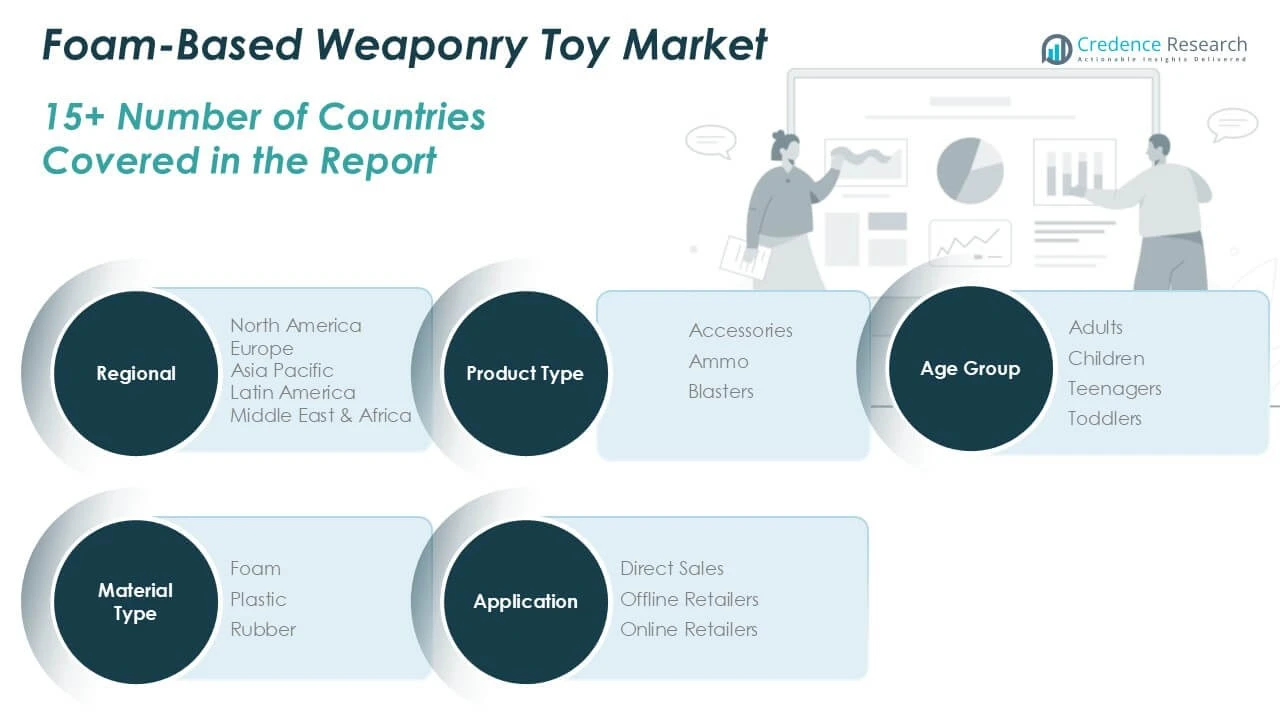
Segments
Based on Product Type
- Accessories
- Ammo
- Blasters
Based on Application
- Competitive Shooting
- Indoor Play
- Outdoor Play
- Skill Development
Based on Age Group
- Adults
- Children
- Teenagers
- Toddlers
Based on Material Type
- Foam
- Plastic
- Rubber
Based on Sales Channel
- Direct Sales
- Offline Retailers
- Online Retailers
Based on Region
- North America
- U.S.
- Canada
- Mexico
- Europe
- UK
- France
- Germany
- Italy
- Spain
- Russia
- Belgium
- Netherlands
- Austria
- Sweden
- Poland
- Denmark
- Switzerland
- Rest of Europe
- Asia Pacific
- China
- Japan
- South Korea
- India
- Australia
- Thailand
- Indonesia
- Vietnam
- Malaysia
- Philippines
- Taiwan
- Rest of Asia Pacific
- Latin America
- Brazil
- Argentina
- Peru
- Chile
- Colombia
- Rest of Latin America
- Middle East
- UAE
- KSA
- Israel
- Turkey
- Iran
- Rest of Middle East
- Africa
- Egypt
- Nigeria
- Algeria
- Morocco
- Rest of Africa
Regional Analysis
North America Foam-Based Weaponry Toy Market
The North America Foam-Based Weaponry Toy Market holds a leading position with a market size of USD 9,097.71 million in 2024, projected to reach USD 13,351.02 million by 2032 at a CAGR of 5.0%. It accounts for approximately 41.7% of the global market share in 2024, making it the largest regional segment. High consumer spending and widespread acceptance of interactive play toys support its dominance. Strong distribution networks, extensive retail presence, and early adoption of innovative products contribute significantly. The region’s stringent safety standards promote foam-based toys over traditional alternatives. The U.S. and Canada remain key contributors, driven by a growing preference for safe, engaging recreational products across multiple age groups.
Europe Foam-Based Weaponry Toy Market
Europe accounts for a significant share of the market, with a value of USD 4,399.71 million in 2024, expected to grow to USD 5,927.60 million by 2032 at a CAGR of 3.8%. It holds around 20.2% of the global market share in 2024. The region benefits from strong regulatory frameworks focused on toy safety and quality, fostering consumer confidence and innovation. Germany, the U.K., and France lead the region due to high disposable incomes and demand for licensed, high-quality toys. Europe’s moderate growth rate reflects mature demand and increasing interest in sustainable and eco-friendly products.
Asia Pacific Foam-Based Weaponry Toy Market
The Asia Pacific region demonstrates the fastest growth with a CAGR of 6.7%, expanding from USD 4,259.55 million in 2024 to USD 7,114.96 million in 2032. It commands roughly 19.5% of the global market share in 2024 and is expected to increase its share with rapid urbanization and rising disposable incomes. China, Japan, India, and Australia serve as key markets, with e-commerce playing a critical role in market penetration. The young population and growing parental awareness about toy safety drive demand. Expanding retail infrastructure further boosts regional market share.
Latin America Foam-Based Weaponry Toy Market
Latin America holds a market size of USD 1,975.34 million in 2024, forecasted to reach USD 2,719.50 million by 2032 with a CAGR of 4.1%. It accounts for about 9.1% of the global market share in 2024. Brazil and Mexico are primary contributors, driven by urbanization and a growing youth demographic. Increased availability of foam-based toys via offline and online channels supports gradual market share expansion. Focus on affordable, safe products for middle-income consumers further stimulates growth.
Middle East Foam-Based Weaponry Toy Market
The Middle East market is valued at USD 1,013.80 million in 2024, projected to grow to USD 1,355.87 million by 2032 at a CAGR of 3.7%. It holds roughly 4.6% of the global market share in 2024. Rising disposable incomes and growing retail infrastructure in Saudi Arabia, UAE, and Qatar drive demand for innovative and branded foam-based weaponry toys. Expanding e-commerce platforms facilitate accessibility, while localized marketing strategies aim to strengthen regional presence.
Africa Foam-Based Weaponry Toy Market
Africa’s Foam-Based Weaponry Toy Market stands at USD 1,059.17 million in 2024, expected to reach USD 1,438.85 million by 2032 with a CAGR of 3.9%. It holds about 4.9% of the global market share in 2024. South Africa and Nigeria lead demand, with consumers favoring safe and affordable recreational products. Economic challenges and limited awareness constrain faster growth. However, investments in distribution and marketing can improve penetration and increase regional share over time.
Key players
- Adventure Force
- Alex Brands
- Basic Fun, Inc.
- Buzz Bee Toys
- Hasbro, Inc.
- JT SplatMaster
- Les Jeux MGA
- Marshmallow Fun Company
- Mattel, Inc.
- Prime Time Toys Ltd.
- Skullduggery, Inc.
- Umarex USA
- ZING
- ZURU, Inc
Competitive Analysis
The Foam-Based Weaponry Toy Market features intense competition among established global players and emerging companies. Market leaders such as Hasbro, Mattel, and ZURU leverage strong brand recognition, extensive product portfolios, and wide distribution networks to maintain dominance. It forces competitors to focus on innovation, safety enhancements, and licensing partnerships to differentiate their offerings. Companies invest heavily in research and development to introduce technologically advanced and customizable products. Cost competitiveness and marketing strategies also shape market dynamics. Smaller players like Buzz Bee Toys and Adventure Force capitalize on niche segments with affordable, specialized products. The market demands continuous adaptation to shifting consumer preferences and regulatory standards. It rewards firms that combine product innovation with strategic collaborations to capture market share and sustain growth.
Recent Developments
- In November 2024, Buzz Bee Toys introduced the Air Warriors Twist Fury, a performance-oriented blaster featuring an 8-dart magazine and AccuBlast darts. Developed in collaboration with hobbyist designer "Taffy," the Twist Fury showcases Buzz Bee's commitment to innovation and community engagement.
- In October 2024, Hasbro released the NERF LMTD Destiny 2 Ace of Spades Blaster, a motorized blaster inspired by the Destiny 2 game. The launch faced controversy due to the design's similarity to fan art, leading to an apology and compensation to the original artist
- In 2024, ZURU's X-SHOT Skins Pro Series Fury-X Blaster was introduced, featuring a 20-dart capacity and a range of up to 140 feet. This blaster is part of ZURU's strategy to enhance product performance and appeal to a broader audience.
Market Concentration and Characteristics
The Foam-Based Weaponry Toy Market exhibits a moderately concentrated structure dominated by a few major players such as Hasbro, Mattel, and ZURU, which command significant market shares through strong brand presence and extensive distribution channels. It features a competitive landscape where innovation, safety, and licensing agreements drive differentiation. Smaller companies focus on niche segments and cost-effective products to maintain relevance. The market characteristics include rapid product development cycles and evolving consumer preferences, pushing manufacturers to continuously enhance features and materials. Regulatory compliance and quality standards remain critical factors influencing market entry and growth. It rewards firms that balance innovation with affordability while building robust supply chains and customer loyalty. This competitive yet dynamic environment fosters both consolidation and opportunities for emerging players.
Report Coverage
The research report offers an in-depth analysis based on Product Type, Application, Age Group, Material Type, Sales Channel and Region. It details leading market players, providing an overview of their business, product offerings, investments, revenue streams, and key applications. Additionally, the report includes insights into the competitive environment, SWOT analysis, current market trends, as well as the primary drivers and constraints. Furthermore, it discusses various factors that have driven market expansion in recent years. The report also explores market dynamics, regulatory scenarios, and technological advancements that are shaping the industry. It assesses the impact of external factors and global economic changes on market growth. Lastly, it provides strategic recommendations for new entrants and established companies to navigate the complexities of the market.
Future Outlook
- The Foam-Based Weaponry Toy Market will continue to grow steadily, driven by increasing consumer demand for safe and interactive play options worldwide. Innovations in product design and technology will further enhance market appeal.
- Manufacturers will prioritize eco-friendly and sustainable materials to meet rising environmental concerns and regulatory requirements, fostering a shift toward greener production practices.
- The integration of smart features such as electronic sounds, LED lights, and connectivity with mobile applications will become more prevalent, creating immersive and engaging user experiences.
- Emerging markets in Asia Pacific, Latin America, and Africa will witness accelerated growth due to rising disposable incomes, urbanization, and expanding retail infrastructure, offering significant revenue opportunities.
- Strategic partnerships with entertainment franchises and licensing agreements will increase, allowing companies to leverage popular culture and attract diverse consumer segments.
- E-commerce platforms will play a critical role in market expansion, enabling brands to reach a wider audience while offering convenient shopping experiences and personalized marketing.
- Safety regulations will continue to tighten globally, pushing manufacturers to invest in quality control and certification processes to maintain consumer trust and comply with standards.
- The demand for customizable and modular foam-based weaponry toys will rise, catering to consumers seeking personalized and adaptable products to enhance play value.
- Marketing strategies will evolve to focus on digital engagement, influencer collaborations, and community building to strengthen brand loyalty and attract younger demographics.
- The Foam-Based Weaponry Toy Market will see consolidation through mergers and acquisitions, as companies seek to expand portfolios, access new technologies, and improve competitive positioning for sustained growth.

Request a Free Sample
Fill in your details and we'll send you a free sample report.
- Sample data tables & charts
- Research methodology
Market Dynamics
Preference for Safe and Non-Toxic Toys
Parents increasingly seek toys that minimize injury risk, making foam-based weaponry toys attractive due to their soft, cushioned materials and compliance with strict safety standards.
Rising Popularity of Outdoor and Role-Playing Activities
The trend toward active, social, and imaginative play among children and teenagers boosts demand for foam-based weaponry toys, which are well-suited for group activities and skill development.
Technological Advancements and Licensing Collaborations
Manufacturers are integrating features like electronic sound effects and partnering with popular entertainment franchises, enhancing product appeal and expanding the consumer base to include fans and collectors.
Expansion of Retail and E-Commerce Channels
The growth of online and offline retail infrastructure increases accessibility and convenience, allowing manufacturers to reach broader audiences and penetrate emerging markets more effectively.
Growing Emphasis on Eco-Friendly Materials
Increasing consumer and regulatory focus on sustainability is driving manufacturers to adopt biodegradable and non-toxic materials, differentiating their products and appealing to environmentally conscious buyers.
Need a Custom Version of This Report?
Tailor the scope, geography, or segments to your exact requirements.
- Custom geography or segment scope
- Direct access to our analyst team
Frequently Asked Questions
What was the market size of the Global Foam-Based Weaponry Toy Market in 2023, and what is its forecast for 2032 including the CAGR?
What are the primary factors driving growth in the Foam-Based Weaponry Toy Market?
How are manufacturers enhancing the appeal of foam-based weaponry toys?
Who are the key players in the Global Foam-Based Weaponry Toy Market?
Table of Content
Chapter 1 Market Segmentation
- 1.1 Segmentation Framework
- 1.1.1 Product and Service Classification
- 1.1.2 Application and End-Use Classification
- 1.1.3 Technology and Solution Classification
- 1.1.4 Customer and Distribution Channel Classification
- 1.1.5 Geographic Segmentation
- 1.1.6 Market Segment Definitions and Boundaries
- 1.2 By Age Group
- 1.2.1 Children
- 1.2.2 Teenagers
- 1.2.3 Adults
- 1.2.4 Toddlers
- 1.3 By Application
- 1.3.1 Outdoor Play
- 1.3.2 Indoor Play
- 1.3.3 Competitive Shooting
- 1.3.4 Skill Development
- 1.4 By Product Type
- 1.4.1 Blasters
- 1.4.2 Ammo
- 1.4.3 Accessories
- 1.5 By Sales Channel
- 1.5.1 Offline Retailers
- 1.5.2 Online Retailers
- 1.5.3 Direct Sales
Chapter 2 Introduction
- 2.1 Report Objectives and Scope
- 2.2 Product Definition and Industry Terminology
- 2.3 Market Inclusions and Exclusions
- 2.4 Research Process
- 2.4.1 Primary Research and Expert Interviews
- 2.4.2 Secondary Research and Source Review
- 2.4.3 Top-Down and Bottom-Up Estimation
- 2.4.4 Data Triangulation and Verification
- 2.5 Market Size Measurement Basis
- 2.5.1 2024: USD 21,805.29 million → 2032: USD 31,907.81 million
- 2.6 Historical and Forecast Reference Periods
- 2.6.1 Base Year: 2024
- 2.6.2 Forecast Period: 2024-2032
- 2.7 Research Assumptions and Limitations
Chapter 3 Executive Summary
- 3.1 Market Snapshot and Key Findings
- 3.2 Base-Year Market Size, 2024
- 3.3 Forecast Market Size, 2032
- 3.4 Revenue and Volume Growth Outlook
- 3.5 Key Demand and Supply Indicators
- 3.6 Leading Market Segments
- 3.7 Fastest-Growing Market Opportunities
- 3.8 Regional Performance Highlights
- 3.9 Technology and Industry Transformation
- 3.10 Competitive Landscape Summary
- 3.11 Analyst View and Strategic Implications
Chapter 4 Global Foam-Based Weaponry Toy Market Trends and Developments
- 4.1 Historical Industry Development
- 4.2 Recent Market Trends and Developments
- 4.3 Demand and Customer Behavior Trends
- 4.4 Technology and Product Innovation
- 4.5 Artificial Intelligence, Automation and Digitalization
- 4.6 Local Manufacturing and Supply Chain Realignment
- 4.7 Industry Partnerships, Mergers and Acquisitions
- 4.8 Sustainability and Circular Economy Developments
- 4.9 Government and Private Sector Investment Trends
- 4.10 Emerging Business Models and Commercialization
- 4.11 Industry Developments and Announcements
Chapter 5 Global Foam-Based Weaponry Toy Market Production, Supply and Demand Analysis
- 5.1 Demand Trend and Consumption Analysis
- 5.2 Demand Forecast, 2024-2032
- 5.3 Production and Output Trend
- 5.4 Production and Output Forecast, 2024-2032
- 5.5 Installed Capacity and Capacity Utilization
- 5.6 Company-Wise Production Plants and Statistics
- 5.6.1 Installed Production Capacity
- 5.6.2 Actual Production
- 5.6.3 Planned Capacity and Expansion Targets
- 5.7 Supply Chain Structure and Procurement Trends
- 5.8 Supply-Demand Gap and Bottlenecks
- 5.9 Import Dependence and Sourcing Structure
- 5.10 Contract Manufacturing and Outsourcing
- 5.11 Regional Supply and Demand Concentration
Chapter 6 Global Foam-Based Weaponry Toy Market Pricing Analysis
- 6.1 Pricing Structure and Measurement
- 6.2 Historical Pricing Trends
- 6.3 Pricing Outlook, 2024-2032
- 6.4 Average Selling Price and Unit Economics
- 6.5 Pricing by Product and Market Segment
- 6.6 Geographic Pricing Differences
- 6.7 Key Input, Energy, Labor and Logistics Costs
- 6.8 Contract Pricing and Purchasing Models
- 6.9 Pricing Sensitivity and Competitive Positioning
- 6.10 Price, Margin and Profitability Implications
Chapter 7 Global Foam-Based Weaponry Toy Market Dynamics
- 7.1 Market Growth Drivers
- 7.1.1 Demand-Side Drivers
- 7.1.2 Technology and Innovation Drivers
- 7.1.3 Infrastructure and Investment Drivers
- 7.1.4 Regulatory and Policy Drivers
- 7.2 Market Restraints
- 7.2.1 Cost and Affordability Constraints
- 7.2.2 Technology and Adoption Barriers
- 7.2.3 Supply Chain and Operational Constraints
- 7.3 Market Challenges
- 7.3.1 Competitive Pressure and Margin Erosion
- 7.3.2 Skills, Infrastructure and Implementation Gaps
- 7.4 Emerging Market Opportunities
- 7.5 Market Dynamics Impact and Time-Horizon Assessment
Chapter 8 Global Foam-Based Weaponry Toy Value Chain Analysis
- 8.1 Industry Value Chain Overview
- 8.2 Upstream Suppliers and Critical Inputs
- 8.3 Technology and Component Providers
- 8.4 Manufacturing or Service Delivery
- 8.5 Distribution, Channel Partners and Integrators
- 8.6 Downstream Applications and End Users
- 8.7 Value Addition and Profit Pools
- 8.8 Vertical Integration and Outsourcing
- 8.9 Supplier Concentration and Risk
- 8.10 Supply Chain Localization and Resilience
Chapter 9 Global Foam-Based Weaponry Toy Market Regulations and Policies
- 9.1 Relevant Laws, Standards and Compliance Frameworks
- 9.2 Product, Service, Safety and Quality Requirements
- 9.3 Government Policies, Incentives and Subsidies
- 9.4 Imports, Exports and Trade Barriers
- 9.5 Public Procurement and Local Content Requirements
- 9.6 Environmental and Sustainability Compliance
- 9.7 Upcoming Policy Changes and Market Implications
Chapter 10 Global Foam-Based Weaponry Toy Market Hotspots and Opportunities
- 10.1 Market Opportunity Mapping and Growth Hotspots
- 10.2 High-Growth Applications and Customer Groups
- 10.3 Underserved Markets and White-Space Opportunities
- 10.4 Emerging Technology and Product Opportunities
- 10.5 New Capacity and Investment Hotspots
- 10.6 Market Entry and Expansion Opportunities
- 10.7 Distribution and Partnership Opportunities
- 10.8 Near-Term and Long-Term Commercial Potential
- 10.9 Opportunity Attractiveness and Execution Risks
Chapter 11 Global Foam-Based Weaponry Toy Market Outlook, 2024-2032
- 11.1 Market Size and Analysis
- 11.1.1 Revenue (Market Measurement: 2024: USD 21,805.29 million → 2032: USD 31,907.81 million)
- 11.1.2 Market Volume and Quantity Sold
- 11.1.3 Historical Market Size
- 11.1.4 Base-Year Market Size, 2024
- 11.2 Market Forecast, 2024-2032
- 11.2.1 Revenue Forecast to 2032
- 11.2.2 Volume Forecast to 2032
- 11.2.3 CAGR and Year-on-Year Growth
- 11.2.4 Incremental Revenue Opportunity
- 11.3 Forecast Assumptions and Scenario Analysis
- 11.3.1 Base-Case Forecast
- 11.3.2 Optimistic and Conservative Scenarios
- 11.3.3 Technology, Pricing and Policy Sensitivities
- 11.4 Market Attractiveness and Growth Outlook
Chapter 12 Global Foam-Based Weaponry Toy Market Segmentation and Outlook
- 12.1 Segmentation Summary and Market Shares, 2024
- 12.2 Largest and Fastest-Growing Segments
- 12.3 By Age Group - Market Size and Forecast, 2024-2032
- 12.3.1 Segment Definition and Scope
- 12.3.2 Historical Market Size
- 12.3.3 Revenue Forecast, 2024-2032
- 12.3.4 Volume Forecast, 2024-2032
- 12.3.5 Base-Year Market Share, 2024
- 12.3.6 Segment CAGR and Growth Drivers
- 12.3.7 Subsegment Market Size and Forecast
- 12.3.7.1 Children
- 12.3.7.2 Teenagers
- 12.3.7.3 Adults
- 12.3.7.4 Toddlers
- 12.3.8 Subsegment Pricing and Adoption Trends
- 12.3.9 Leading Suppliers and Competition
- 12.3.10 Regional Demand and Opportunities
- 12.4 By Application - Market Size and Forecast, 2024-2032
- 12.4.1 Segment Definition and Scope
- 12.4.2 Historical Market Size
- 12.4.3 Revenue Forecast, 2024-2032
- 12.4.4 Volume Forecast, 2024-2032
- 12.4.5 Base-Year Market Share, 2024
- 12.4.6 Segment CAGR and Growth Drivers
- 12.4.7 Subsegment Market Size and Forecast
- 12.4.7.1 Outdoor Play
- 12.4.7.2 Indoor Play
- 12.4.7.3 Competitive Shooting
- 12.4.7.4 Skill Development
- 12.4.8 Subsegment Pricing and Adoption Trends
- 12.4.9 Leading Suppliers and Competition
- 12.4.10 Regional Demand and Opportunities
- 12.5 By Product Type - Market Size and Forecast, 2024-2032
- 12.5.1 Segment Definition and Scope
- 12.5.2 Historical Market Size
- 12.5.3 Revenue Forecast, 2024-2032
- 12.5.4 Volume Forecast, 2024-2032
- 12.5.5 Base-Year Market Share, 2024
- 12.5.6 Segment CAGR and Growth Drivers
- 12.5.7 Subsegment Market Size and Forecast
- 12.5.7.1 Blasters
- 12.5.7.2 Ammo
- 12.5.7.3 Accessories
- 12.5.8 Subsegment Pricing and Adoption Trends
- 12.5.9 Leading Suppliers and Competition
- 12.5.10 Regional Demand and Opportunities
- 12.6 By Sales Channel - Market Size and Forecast, 2024-2032
- 12.6.1 Segment Definition and Scope
- 12.6.2 Historical Market Size
- 12.6.3 Revenue Forecast, 2024-2032
- 12.6.4 Volume Forecast, 2024-2032
- 12.6.5 Base-Year Market Share, 2024
- 12.6.6 Segment CAGR and Growth Drivers
- 12.6.7 Subsegment Market Size and Forecast
- 12.6.7.1 Offline Retailers
- 12.6.7.2 Online Retailers
- 12.6.7.3 Direct Sales
- 12.6.8 Subsegment Pricing and Adoption Trends
- 12.6.9 Leading Suppliers and Competition
- 12.6.10 Regional Demand and Opportunities
- 12.7 Segment Growth Comparison
- 12.8 Segment Attractiveness and Priority Matrix
Chapter 13 Global Foam-Based Weaponry Toy End-Use and Application Market Outlook
- 13.1 End-Use Industry and Customer Demand Structure
- 13.2 Leading Applications and Customer Groups
- 13.3 End-Use Market Size, Share and Forecast
- 13.4 Major End-Use Industry Deep Dives
- 13.4.1 Customer Requirements and Use Cases
- 13.4.2 Demand and Replacement Cycles
- 13.4.3 Technical and Regulatory Considerations
- 13.4.4 Purchasing and Procurement Models
- 13.4.5 Leading Vendors and Distribution Channels
- 13.4.6 Forecast and Commercial Opportunities
- 13.5 Emerging Applications and Cross-Segment Demand
- 13.6 End-Use Industry Investment Priorities
Chapter 14 Global Foam-Based Weaponry Toy Geographic Market Outlook, 2024-2032
- 14.1 Regional Market Size and Share, 2024
- 14.2 Regional Market Forecast, 2024-2032
- 14.3 Regional Pricing, Production and Demand Differences
- 14.4 North America
- 14.4.1 United States
- 14.4.2 Canada
- 14.4.3 Mexico
- 14.5 Europe
- 14.5.1 Germany
- 14.5.2 France
- 14.5.3 Italy
- 14.5.4 United Kingdom
- 14.5.5 Spain
- 14.5.6 Poland
- 14.5.7 Russia
- 14.5.8 Netherlands
- 14.5.9 Belgium
- 14.5.10 Sweden
- 14.5.11 Denmark
- 14.5.12 Norway
- 14.5.13 Rest of Europe
- 14.6 Asia Pacific
- 14.6.1 China
- 14.6.2 India
- 14.6.3 Japan
- 14.6.4 South Korea
- 14.6.5 Thailand
- 14.6.6 Indonesia
- 14.6.7 Vietnam
- 14.6.8 Malaysia
- 14.6.9 Australia
- 14.6.10 Rest of Asia Pacific
- 14.7 Latin America
- 14.7.1 Brazil
- 14.7.2 Argentina
- 14.7.3 Colombia
- 14.7.4 Chile
- 14.7.5 Rest of Latin America
- 14.8 Middle East
- 14.8.1 Saudi Arabia
- 14.8.2 United Arab Emirates
- 14.8.3 Turkey
- 14.8.4 Israel
- 14.8.5 Iran
- 14.8.6 Rest of the Middle East
- 14.9 Africa
- 14.9.1 South Africa
- 14.9.2 Egypt
- 14.9.3 Nigeria
- 14.9.4 Morocco
- 14.9.5 Rest of Africa
- 14.10 Regional Investment, Policy and Supply Chain Differences
- 14.11 Regional Competitive Landscape
- 14.12 Geographic Growth Hotspots
Chapter 15 Global Foam-Based Weaponry Toy Technology, Innovation and Sustainability Outlook
- 15.1 Technology Landscape and Maturity
- 15.2 Product, Process and Service Innovation
- 15.3 AI, Automation and Digital Tools in the Industry
- 15.4 Technology Adoption and Performance Benchmarking
- 15.5 Innovation Pipeline and R&D Investment
- 15.6 Patent and Intellectual Property Trends
- 15.7 Energy Efficiency and Resource Management
- 15.8 Sustainability, Recycling and Circularity
- 15.9 Technology Roadmap, 2024-2032
- 15.10 Risks of Obsolescence and Technology Substitution
Chapter 16 Global Foam-Based Weaponry Toy Market Key Strategic Imperatives
- 16.1 Growth and Market Entry Priorities
- 16.2 High-Return Products and Segments
- 16.3 Pricing, Profitability and Cost Optimization
- 16.4 Technology Investment and Product Differentiation
- 16.5 Supply Chain Localization and Resilience
- 16.6 Distribution and Customer Acquisition
- 16.7 Partnership, Acquisition and Capacity Strategy
- 16.8 Regional Expansion Priorities
- 16.9 Short-, Medium- and Long-Term Actions
Chapter 17 Competition Outlook
- 17.1 Industry Competition Characteristics
- 17.2 Market Structure and Concentration
- 17.3 Market Share and Competitive Positioning, 2024
- 17.4 Company-Wise Revenue and Product Benchmarking
- 17.5 Production and Service Capacity Benchmarking
- 17.6 Technology, Pricing and Differentiation
- 17.7 Regional Footprint and Distribution Strength
- 17.8 Mergers, Acquisitions and Strategic Alliances
- 17.9 New Entrants and Competitive Threats
- 17.10 Porter's Five Forces and Industry Attractiveness
- 17.11 Competitive Outlook, 2024-2032
Chapter 18 Company Profiles
- 18.1 Company Coverage and Selection Criteria
- 18.2 Hasbro, Inc.
- 18.2.1 Business Description
- 18.2.2 Company Ownership and Geographic Presence
- 18.2.3 Product and Service Portfolio
- 18.2.4 Manufacturing and Operating Footprint
- 18.2.5 Production Capacity and Expansion Plans
- 18.2.6 Financial Performance and Investment
- 18.2.7 Market Share and Competitive Position
- 18.2.8 Technology and Innovation Capabilities
- 18.2.9 Strategic Alliances or Partnerships
- 18.2.10 Recent Developments
- 18.2.11 Growth Strategy and Outlook
- 18.3 Mattel, Inc.
- 18.4 ZURU, Inc.
- 18.5 Buzz Bee Toys
- 18.6 Prime Time Toys Ltd.
- 18.7 Adventure Force
- 18.8 Basic Fun, Inc.
- 18.9 Marshmallow Fun Company
- 18.10 JT SplatMaster
- 18.11 Alex Brands
- 18.12 Other Relevant Market Participants
Note: Every listed company is profiled on the structure shown under the first company. The company list is preliminary and may change based on research findings, market developments, data availability and client requirements.
Chapter 19 Disclaimer
- 19.1 Research and Forecast Disclaimer
- 19.2 Data Source and Estimation Limitations
Note: The depth of individual sections depends on data availability for this market. Volume, capacity, trade and other unit-based metrics are included where applicable.