
Market Overview:
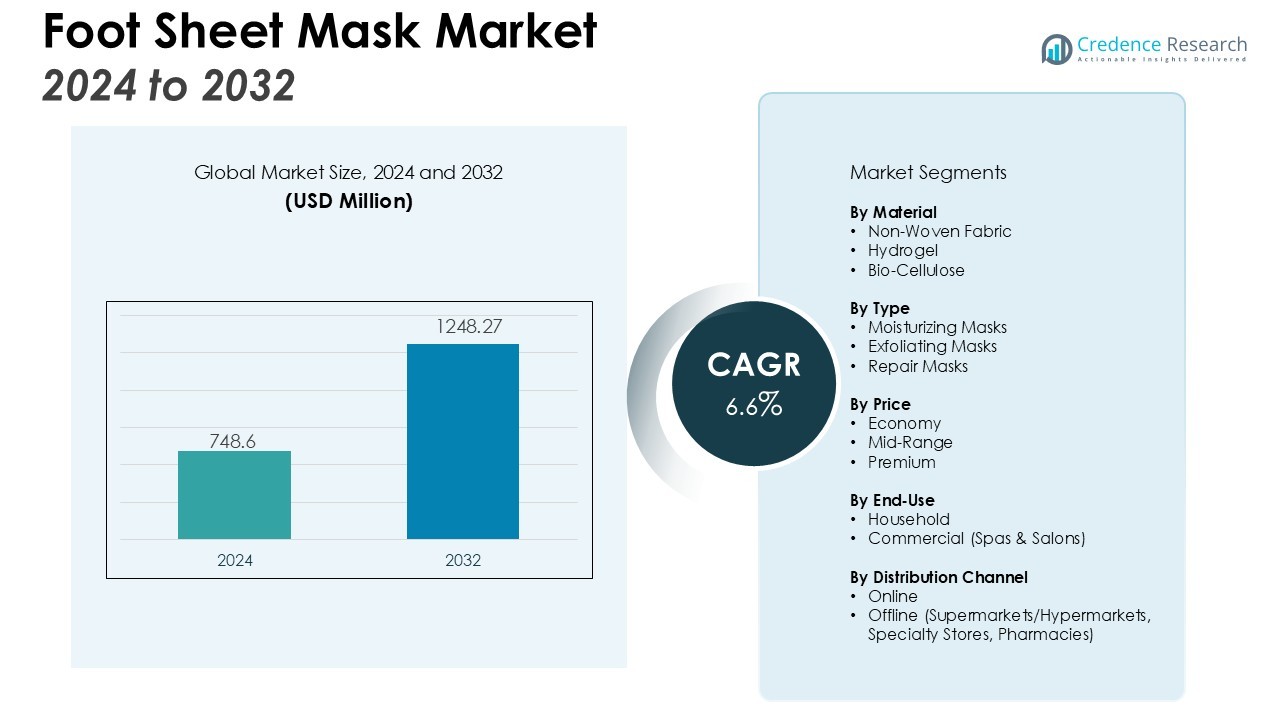
The Foot Sheet Mask Market size was valued at USD 748.6 million in 2024 and is anticipated to reach USD 1248.27 million by 2032, at a CAGR of 6.6% during the forecast period (2024-2032).
| REPORT ATTRIBUTE | DETAILS |
|---|---|
| Historical Period | 2020-2023 |
| Base Year | 2024 |
| Forecast Period | 2025-2032 |
| Foot Sheet Mask Market Size 2024 | USD 748.6 Million |
| Foot Sheet Mask Market, CAGR | 6.6% |
| Foot Sheet Mask Market Size 2032 | USD 1248.27 Million |
Key drivers of this market include the increasing adoption of self-care routines and rising awareness of foot health. Consumers are seeking effective solutions for hydration, exfoliation, and repair, which foot sheet masks deliver through advanced formulations infused with natural extracts and active ingredients. The popularity of clean-label and eco-friendly beauty products further drives innovation, encouraging manufacturers to introduce sustainable packaging and cruelty-free solutions. The growing presence of e-commerce platforms also enhances accessibility, making products more widely available to diverse consumer bases.
Regionally, Asia-Pacific dominates the market due to its strong beauty and personal care industry, with South Korea and Japan leading innovations in skincare masks. North America follows, fueled by rising wellness trends and increasing consumer spending on premium personal care. Europe also shows strong growth, supported by demand for sustainable and natural beauty products. This regional momentum highlights the global appeal and expansion potential of foot sheet masks.
Market Insights:
- The Foot Sheet Mask Market size was valued at USD 748.6 million in 2024 and is projected to reach USD 1248.27 million by 2032, expanding at a CAGR of 6.6%.
- Rising consumer focus on self-care and wellness supports consistent demand for hydration, exfoliation, and repair solutions.
- Increasing awareness of foot health drives adoption, with products addressing dryness, calluses, and cracked heels effectively.
- Clean-label and eco-friendly innovations, including natural extracts and sustainable packaging, strengthen consumer trust and brand loyalty.
- Asia-Pacific leads with 42% share in 2024, fueled by innovation from South Korea and Japan alongside strong adoption in China and India.
- North America holds 28% share, supported by wellness lifestyles, premium personal care spending, and robust digital retail networks.
- Europe captures 21% share, benefiting from demand for sustainable beauty, regulatory compliance, and rising preference for cruelty-free formulations.
Market Drivers:
Rising Focus on Personal Care and Wellness Trends
The Foot Sheet Mask Market benefits from consumers’ growing emphasis on wellness and self-care. Individuals invest in convenient solutions that improve skin hydration, exfoliation, and repair. The popularity of at-home treatments increases demand for foot sheet masks as part of daily routines. It reflects the shift from occasional spa visits to consistent personal care practices. This focus strengthens market penetration across diverse consumer groups.
- For instance, the Burt's Bees Hydrating Sheet Mask with Watermelon offers a convenient at-home treatment that requires just 5 minutes to apply, improving skin texture and hydration.
Increasing Awareness of Foot Health and Hygiene
Rising awareness about foot health drives adoption of specialized skincare products. Consumers understand the importance of treating dry skin, calluses, and cracked heels with effective solutions. The Foot Sheet Mask Market addresses these needs by offering easy-to-use, targeted treatments. It provides immediate relief and visible results, which enhances consumer loyalty. This awareness expands product use beyond beauty-conscious buyers to broader health-focused audiences.
Innovation Through Natural Ingredients and Clean Labels
Manufacturers respond to demand for natural and safe products by reformulating offerings. The Foot Sheet Mask Market integrates botanical extracts, essential oils, and eco-friendly packaging to align with consumer values. It attracts buyers seeking cruelty-free, vegan, or sustainable solutions. These innovations boost brand differentiation and encourage premium pricing strategies. Clean-label positioning secures trust and builds long-term brand credibility in competitive markets.
- For instance, The Body Shop reinforces its commitment to natural and ethical sourcing through its Community Fair Trade program, which works with 25 suppliers to acquire its ingredients.
Expansion of E-Commerce and Digital Retail Channels
Digital platforms play a vital role in strengthening global product accessibility. The Foot Sheet Mask Market leverages online channels to reach urban and rural consumers efficiently. It benefits from influencer marketing, social media promotions, and subscription models. The convenience of home delivery and wider product variety accelerates adoption rates. Strong e-commerce growth ensures brands expand their consumer base while improving visibility worldwide.
Market Trends:
Growing Demand for Premium and Specialized Formulations
The Foot Sheet Mask Market is experiencing strong demand for premium solutions tailored to specific needs. Consumers prefer masks enriched with natural extracts, vitamins, and essential oils that target hydration, exfoliation, and repair. It appeals to buyers seeking effective yet gentle skincare for sensitive or damaged feet. The shift toward multifunctional products, such as masks offering anti-aging or soothing properties, highlights evolving expectations. Brands introduce innovative textures and advanced serum-infused sheets to stand out in a crowded space. Eco-friendly packaging and cruelty-free claims further strengthen adoption among health-conscious and ethically driven consumers.
- For instance, Ariul's Smooth & Pure Foot Peeling Mask is a specialized formula that uses a combination of fruit-derived acids, AHA, and BHA to complete the peeling process within 7-10 days of one application.
Rising Influence of E-Commerce and Digital Consumer Engagement
The digital marketplace continues to shape product visibility and customer behavior across the Foot Sheet Mask Market. It benefits from online platforms that provide consumers with diverse product choices and easy access to global brands. Influencer partnerships, social media promotions, and user reviews increase consumer confidence and drive higher adoption. Subscription models and limited-edition releases create recurring sales and enhance brand loyalty. Cross-border e-commerce also expands the reach of Asian brands, particularly from South Korea and Japan, into Western markets. The trend emphasizes digital innovation as a central driver of future growth, making online retail indispensable for industry success.
- For instance, Amorepacific, a leading South Korean cosmetics company, recorded consolidated sales of KRW 1.1648 trillion in the first quarter of 2025, driven by strong performance in online channels and the introduction of innovative new products.
Market Challenges Analysis:
High Competition and Low Product Differentiation
The Foot Sheet Mask Market faces intense competition with many brands offering similar solutions. It creates challenges for differentiation, leading to price pressure and reduced margins for smaller players. Consumers often perceive limited variation in benefits, which weakens brand loyalty. Companies struggle to balance innovation with cost control in a market dominated by affordable alternatives. The ease of entry for new brands further intensifies rivalry. Sustaining visibility requires continuous investment in marketing, packaging, and product upgrades.
Regulatory Compliance and Sustainability Concerns
The industry must address strict regulatory standards for skincare formulations and labeling across global markets. The Foot Sheet Mask Market experiences delays and higher costs when companies adapt to varying compliance rules. It also faces consumer scrutiny over sustainability, as single-use masks contribute to packaging waste. Growing demand for eco-friendly and cruelty-free options pressures firms to rethink sourcing and production. Smaller companies find it difficult to invest in green solutions while maintaining affordability. Failure to meet these expectations risks reputational challenges and limited growth opportunities.
Market Opportunities:
Rising Demand for Natural and Functional Beauty Solutions
The Foot Sheet Mask Market holds strong opportunities through the growing preference for natural and multifunctional skincare. Consumers are seeking products with herbal extracts, vitamins, and organic oils that deliver visible results. It creates scope for premium lines that address hydration, exfoliation, and soothing in one product. Brands can strengthen their position by focusing on clean-label and cruelty-free innovations. The rising appeal of wellness-driven beauty supports adoption among health-conscious and eco-aware buyers. Expanding product lines with dermatologist-tested and hypoallergenic options further enhances trust and market reach.
Expanding Reach Through Digital and Cross-Border Channels
Global e-commerce platforms provide a strategic path to expand visibility and distribution. The Foot Sheet Mask Market can leverage cross-border trade to bring Asian innovations, especially from South Korea and Japan, to Western markets. It benefits from influencer-driven promotions and subscription-based models that build recurring revenue. Personalized recommendations through AI-powered platforms improve consumer engagement and brand loyalty. Growing demand in emerging economies presents new avenues for mid-range and affordable solutions. This opportunity strengthens international growth potential while allowing brands to capture diverse consumer segments.
Market Segmentation Analysis:
By Material
The Foot Sheet Mask Market is segmented by material into non-woven fabrics, hydrogel, and bio-cellulose. Non-woven fabrics hold significant share due to their affordability and wide usage in mass-market products. It remains the most accessible choice for daily skincare routines. Hydrogel and bio-cellulose are gaining traction for their superior adherence, moisture retention, and premium appeal. Brands focusing on advanced materials strengthen differentiation in a competitive landscape.
- For instance, When Beauty developed a premium bio-cellulose sheet from fermented coconut water that can hold fluids up to 100 times its dry weight, a capacity 10 times greater than average fabric sheets.
By Type
The market is divided into moisturizing masks, exfoliating masks, and repair-focused masks. Moisturizing masks lead the segment, driven by demand for hydration and nourishment in daily care. It appeals to consumers seeking simple, effective solutions for dry skin. Exfoliating masks are growing due to their ability to remove dead cells and improve skin texture. Repair-focused masks serve niche demand, targeting cracked heels and severe dryness. Expanding formulations across these categories broadens consumer adoption.
- For instance, the exfoliating peel from the brand Baby Foot has been used to treat over 30 million feet globally, showing its wide adoption for improving skin texture.
By Price
The Foot Sheet Mask Market is segmented into economy, mid-range, and premium categories. Economy masks dominate due to high availability and affordability for mass consumers. It supports wide penetration across emerging markets. Mid-range products balance quality and price, gaining popularity among urban buyers. Premium masks grow steadily with demand for natural extracts, innovative materials, and eco-friendly packaging. This segment appeals to health-conscious and sustainability-driven consumers seeking elevated skincare solutions.
Segmentations:
By Material- Non-Woven Fabric
- Hydrogel
- Bio-Cellulose
- Moisturizing Masks
- Exfoliating Masks
- Repair Masks
- Economy
- Mid-Range
- Premium
- Household
- Commercial (Spas & Salons)
- Online
- Offline (Supermarkets/Hypermarkets, Specialty Stores, Pharmacies)
- North America
- U.S.
- Canada
- Mexico
- Europe
- Germany
- France
- U.K.
- Italy
- Spain
- Rest of Europe
- Asia Pacific
- China
- Japan
- India
- South Korea
- South-east Asia
- Rest of Asia Pacific
- Latin America
- Brazil
- Argentina
- Rest of Latin America
- Middle East & Africa
- GCC Countries
- South Africa
- Rest of the Middle East and Africa
Regional Analysis:
Asia-Pacific Leading with Innovation and High Consumer Adoption
Asia-Pacific accounted for 42% share of the Foot Sheet Mask Market in 2024, making it the largest regional segment. South Korea and Japan drive growth through advanced skincare formulations and trendsetting product innovation. It benefits from established cosmetic industries emphasizing natural ingredients, multifunctional benefits, and premium packaging. Rising disposable income and urban lifestyles in China, India, and Southeast Asia further strengthen demand. Consumers prioritize foot care as part of holistic wellness routines, creating high adoption rates. Regional brands gain a competitive edge by exporting K-beauty and J-beauty solutions globally.
North America Driven by Wellness Lifestyle and Premium Demand
North America held 28% share of the Foot Sheet Mask Market in 2024, supported by strong consumer preference for self-care. It benefits from higher spending on skincare, robust retail channels, and advanced e-commerce adoption. Premium, clean-label, and dermatologist-tested solutions remain popular across diverse consumer segments. Influencer campaigns and subscription models further enhance engagement and repeat purchases. The region also creates opportunities for imported Asian brands that align with wellness and sustainability values. It continues to expand due to rising awareness of holistic foot health and preventive care.
Europe Shaped by Sustainability and Regulatory Standards
Europe represented 21% share of the Foot Sheet Mask Market in 2024, driven by strong consumer demand for sustainable beauty. It expands with growing preference for eco-friendly packaging, cruelty-free testing, and natural formulations. Established skincare industries in France, Germany, and the United Kingdom support innovation and adoption. Regulatory frameworks ensure quality compliance, building trust among health-conscious consumers. Retailers highlight premium and niche brands that align with environmental goals, improving market visibility. It continues to strengthen as green cosmetics gain higher acceptance across regional markets.
Key Player Analysis:
- ADWIN
- Baby Foot
- Barefoot Scientist
- Jart+
- Earth Therapeutics
- Freeman
- Karuna Skin LLC
- LuxaDerme
- Oh K!
- Sally Hansen
- Patchology
- Sephora USA, Inc.
Competitive Analysis:
The Foot Sheet Mask Market is highly competitive with global, regional, and niche players driving innovation. Leading brands focus on natural formulations, advanced materials, and sustainable packaging to strengthen consumer trust. It emphasizes clean-label claims, cruelty-free certifications, and dermatologist-tested solutions to meet evolving expectations. Asian companies, particularly from South Korea and Japan, influence trends through K-beauty and J-beauty innovations that shape global demand. Western brands compete by integrating premium positioning, influencer marketing, and subscription models to build loyalty. Strong online distribution networks further intensify competition by allowing smaller players to expand visibility and market reach. Companies continue to invest in research and product differentiation to secure consumer engagement and long-term growth.
Recent Developments:
- In August 2025, Baby Foot unveiled a refreshed version of its best-selling Spa Bundle, featuring redesigned packaging, an upgraded foot soak, and a new citrus scent.
- In July 2025, Patchology announced a limited-edition skincare collaboration with the national bakery Sprinkles.
Report Coverage:
The research report offers an in-depth analysis based on Material, Type, Price, End-Use, Distribution Channel and Region. It details leading market players, providing an overview of their business, product offerings, investments, revenue streams, and key applications. Additionally, the report includes insights into the competitive environment, SWOT analysis, current market trends, as well as the primary drivers and constraints. Furthermore, it discusses various factors that have driven market expansion in recent years. The report also explores market dynamics, regulatory scenarios, and technological advancements that are shaping the industry. It assesses the impact of external factors and global economic changes on market growth. Lastly, it provides strategic recommendations for new entrants and established companies to navigate the complexities of the market.
Future Outlook:
- The Foot Sheet Mask Market will continue expanding with stronger demand for wellness-driven beauty solutions.
- Brands will prioritize natural formulations, plant extracts, and cruelty-free certifications to strengthen consumer trust.
- Sustainable packaging innovations will gain momentum as eco-conscious buyers influence purchasing behavior.
- E-commerce and subscription-based models will expand accessibility, enabling wider reach across urban and rural markets.
- Asian brands, particularly from South Korea and Japan, will maintain leadership in innovation and trendsetting.
- Western markets will adopt premium and dermatologist-tested solutions, supporting growth in higher-value segments.
- Personalization through AI and digital platforms will shape consumer engagement and product recommendations.
- Increasing awareness of foot health will expand demand beyond beauty-conscious users to broader wellness audiences.
- Emerging economies will drive adoption of affordable and mid-range masks, creating strong opportunities for mass-market players.
- Strategic collaborations, influencer marketing, and product diversification will remain vital for long-term competitiveness.

Request a Free Sample
Fill in your details and we'll send you a free sample report.
- Sample data tables & charts
- Research methodology
Need a Custom Version of This Report?
Tailor the scope, geography, or segments to your exact requirements.
- Custom geography or segment scope
- Direct access to our analyst team
Frequently Asked Questions
What is the current market size for Foot Sheet Mask Market, and what is its projected size in 2032?
At what Compound Annual Growth Rate is the Foot Sheet Mask Market projected to grow between 2024 and 2032?
Which Foot Sheet Mask Market segment held the largest share in 2024?
What are the primary factors fueling the growth of the Foot Sheet Mask Market?
Which region commanded the largest share of the Foot Sheet Mask Market in 2024?
Table of Content
Chapter 1. Report Introduction
- 1.1 Report Description & Purpose
- 1.1.1 Report Title & Market Definition
- 1.1.2 Unique Selling Propositions (USP) & Key Differentiators
- 1.1.3 Value Proposition for Stakeholders
- 1.2 Research Objectives
- 1.2.1 Market Sizing Objectives (Volume & Revenue) (Volume Where Applicable)
- 1.2.2 Segmentation Objectives
- 1.2.3 Competitive Intelligence Objectives
- 1.2.4 Forecast & Scenario Objectives
- 1.3 Report Scope
- 1.3.1 Foot Sheet Mask Scope – Segments & Subsegments Covered
- 1.3.2 Geographic Scope – Regions & Countries Covered
- 1.3.3 Historical Period, Base Year & Forecast Period (2024; forecast to 2032)
- 1.3.4 Inclusions & Exclusions
- 1.4 Industry Classification & Applicable Codes
- 1.5 Currency, Measurement Units & Valuation Basis
- 1.6 Target Stakeholders
- 1.7 Limitations & Assumptions
Chapter 2. Executive Summary
- 2.1 Global Foot Sheet Mask Market Snapshot
- 2.1.1 Market Size – Historical (2024) & Forecast (2024-2032) (2024: USD 748.6 million → 2032: USD 1248.27 million)
- 2.1.2 Volume & Revenue – Global Totals (Volume Where Applicable)
- 2.1.3 Key Market Highlights – Top Five Facts
- 2.2 Foot Sheet Mask Market Segmentation Snapshot
- 2.2.1 Market Split by Region – 2024 vs. 2032
- 2.3 Competitive Snapshot
- 2.3.1 Top 10 Players by Revenue Share – 2024
- 2.3.2 Top 10 Players by Volume Share – 2024 (Volume Where Applicable)
- 2.3.3 Recent Strategic Developments (18-Month Summary)
- 2.4 Key Investment Highlights & Strategic Conclusions
Chapter 3. Foot Sheet Mask Market Dynamics & Industry Analysis
- 3.1 Market Overview & Context
- 3.1.1 Foot Sheet Mask Market Position in the Broader Industry Value Chain
- 3.1.2 Demand Structure & Purchasing Dynamics
- 3.1.3 Market Maturity & Development Stage by Region
- 3.2 Foot Sheet Mask Market Drivers
- 3.3 Foot Sheet Mask Market Restraints & Challenges
- 3.4 Foot Sheet Mask Market Opportunities
- 3.5 Porter's Five Forces Analysis
- 3.5.1 Threat of New Entrants
- 3.5.2 Bargaining Power of Suppliers
- 3.5.3 Bargaining Power of Buyers
- 3.5.4 Threat of Substitutes
- 3.5.5 Competitive Rivalry – Intensity Assessment
- 3.6 Foot Sheet Mask Value Chain Analysis
- 3.6.1 Upstream – Key Inputs, Resources & Suppliers
- 3.6.1.1 Key Input/Resource 1
- 3.6.1.2 Key Input/Resource 2
- 3.6.1.3 Key Input/Resource 3
- 3.6.2 Midstream – Core Operations & Value Creation
- 3.6.2.1 Operating Model & Process Overview
- 3.6.2.2 Key Operating Locations & Capabilities by Company
- 3.6.3 Downstream – Market Channels & End Users
- 3.6.3.1 Direct Sales & Customer Engagement Channels
- 3.6.3.2 Indirect Sales, Intermediaries & Partner Channels
- 3.6.4 Value Chain Profitability Analysis
- 3.6.1 Upstream – Key Inputs, Resources & Suppliers
- 3.7 PESTEL Analysis
- 3.7.1 Political Factors
- 3.7.2 Economic Factors
- 3.7.3 Social Factors
- 3.7.4 Technological Factors
- 3.7.5 Environmental Factors
- 3.7.6 Legal Factors
- 3.8 Foot Sheet Mask Supply Chain Analysis
- 3.8.1 Critical Input & Resource Availability Risk Assessment
- 3.8.2 Supplier & Operational Concentration Risk (Geographic Exposure)
- 3.8.3 Supply & Service Disruption Impact Analysis
- 3.9 Regulatory & Policy Landscape
Note: The regulatory and policy landscape section covers regulations based on their applicability to the market, Foot Sheet Mask category, geography, and scope of the study. Only regulatory frameworks with a material impact on operations, compliance, trade, sustainability, or market access are analyzed in detail.
Chapter 4. Key Investment Pockets & Opportunity Analysis
- 4.1 Foot Sheet Mask Market Attractiveness Analysis
- 4.1.1 By Region – Investment Attractiveness Matrix (Market Size × CAGR)
- 4.2 Absolute Revenue Growth Opportunity
- 4.2.1 By Region – Absolute Revenue Growth Through 2032
- 4.3 Incremental Demand Opportunity
- 4.3.1 By Region – Incremental Demand Through 2032
- 4.3.2 Segment – Incremental Demand
- 4.4 Emerging Submarket Opportunity Deep Dive (Subject to Applicability)
- 4.5 Priority Market Opportunity Scorecards
- 4.5.1 United States
- 4.5.2 Europe
- 4.5.3 Asia
- 4.5.4 Middle East & Africa
Note: Priority market opportunity scorecards reflect the geographic scope and strategic relevance of the study. Listed markets are indicative and may be adapted to the industry.
Chapter 5. Foot Sheet Mask Cross-Border Trade & Market Access Analysis
- 5.1 International Trade & Cross-Border Activity Overview
- 5.1.1 Global Export Value by Country (2024)
- 5.1.2 Global Export Volume by Country (2024) (Volume Where Applicable)
- 5.1.3 Global Import Value by Country (2024)
- 5.1.4 Global Import Volume by Country (2024) (Volume Where Applicable)
- 5.1.5 Net Trade Balance by Country (2024)
- 5.2 Export Analysis – Segment
- 5.2.1 Category 1 (Applicable Classification Code)
- 5.2.2 Category 2 (Applicable Classification Code)
- 5.2.3 Category 3 (Applicable Classification Code)
- 5.2.4 Category 4 (Applicable Classification Code)
- 5.2.5 Category 5 (Applicable Classification Code)
- 5.3 Import Analysis – Segment
- 5.3.1 Category 1 (Applicable Classification Code)
- 5.3.2 Category 2 (Applicable Classification Code)
- 5.3.3 Category 3 (Applicable Classification Code)
- 5.3.4 Category 4 (Applicable Classification Code)
- 5.3.5 Category 5 (Applicable Classification Code)
- 5.4 Cross-Border Pricing & Transaction Benchmarks
- 5.4.1 Export Pricing – Segment & Country
- 5.4.2 Import Pricing – Segment & Source Country
- 5.4.3 Price Trends (2024)
- 5.5 Key Cross-Border Trade & Delivery Routes
- 5.5.1 Cross-Border Trade/Delivery Route 1
- 5.5.2 Cross-Border Trade/Delivery Route 2
- 5.5.3 Cross-Border Trade/Delivery Route 3
- 5.5.4 Cross-Border Trade/Delivery Route 4
- 5.5.5 Cross-Border Trade/Delivery Route 5
- 5.6 Trade Policy & Market Access Impact Assessment
- 5.6.1 Tariff & Non-Tariff Barriers
- 5.6.2 Regional Trade & Economic Integration Frameworks
- 5.6.3 Bilateral & Multilateral Trade Agreements
- 5.6.4 Cross-Border Operating, Licensing & Localization Requirements
Note: This chapter applies where cross-border trade or delivery is relevant to Foot Sheet Mask. Goods, services, and digital offerings are assessed using applicable classifications and transaction measures. Import-export volumes, trade balances, and route analyses are included only where meaningful to the market.
Chapter 6. Competitive Landscape & Company Benchmarking
- 6.1 Foot Sheet Mask Market Concentration & Structure
- 6.1.1 Herfindahl-Hirschman Index (HHI) – vs. 2024
- 6.1.2 Leading, Mid-Sized & Emerging Player Structure
- 6.1.3 Global, Regional & Local Player Dynamics
- 6.2 Foot Sheet Mask Market Share Analysis – 2024
- 6.2.1 Global Revenue Share by Company
- 6.2.2 Global Volume Share by Company (Volume Where Applicable)
- 6.2.3 Regional Revenue Share
- 6.2.4 Market Share Evolution ( vs. 2024)
- 6.2.5 Company Market Share by Key Segment
- 6.2.6 Company Market Share by Customer Group
- 6.3 Operating Scale, Capacity & Infrastructure Analysis
- 6.3.1 Global Operating Scale & Supply Capacity
- 6.3.2 Resource Utilization & Operating Efficiency
- 6.3.3 Output, Service Delivery & Activity Metrics
- 6.3.4 Operating Footprint & Infrastructure Map
- 6.3.5 Planned Operational & Capacity Expansion
- 6.4 Foot Sheet Mask Competitive Benchmarking Matrix
- 6.4.1 Revenue, Growth, Profitability & Operating Metric Comparison
- 6.4.2 Channel Revenue Mix
- 6.4.3 Geographic Revenue Exposure
- 6.4.4 R&D Intensity
- 6.4.5 Sustainability Maturity
- 6.5 Strategic Developments in Foot Sheet Mask (Last 24 Months)
- 6.5.1 Mergers, Acquisitions & Divestments
- 6.5.2 New Products, Services & Solutions in Foot Sheet Mask
- 6.5.3 Operational & Infrastructure Expansions
- 6.5.4 Strategic Alliances, Joint Ventures & Partnerships
- 6.5.5 Distribution Expansion & Market Entry
- 6.5.6 Sustainability & ESG Initiatives
- 6.6 Competitive Strategy Mapping
- 6.6.1 Leader, Challenger, Follower & Niche Classification
- 6.6.2 Pricing Strategy Comparison
- 6.6.3 Channel Strategy Matrix
Note: Strategic developments are included based on their materiality and the availability of reliable information.
Chapter 7. Global Foot Sheet Mask Market – By Sales & Delivery Channel
- 7.1 Segment Overview
- 7.1.1 Volume & Revenue Split by Channel (2024 & 2032) (Volume Where Applicable)
- 7.1.2 Channel Mix Evolution (2024-2032)
Chapter 8. Regional Market Analysis – Global Overview
- 8.1 Global Regional Overview
- 8.1.1 Regional Volume Share (Volume Where Applicable)
- 8.1.2 Regional Revenue Share
- 8.1.3 Regional Volume by Region (Volume Where Applicable)
- 8.1.4 Regional Revenue by Region
- 8.1.5 Regional Forecast Through 2032
- 8.2 Cross-Regional Segment Analysis
- 8.2.1 By Sales & Delivery Channel
- 8.2.2 By Competitive Positioning & Price Tier
Chapter 9. North America Foot Sheet Mask Market
- 9.1 United States
- 9.2 Canada
- 9.3 Mexico
Chapter 10. Europe Foot Sheet Mask Market
- 10.1 Germany
- 10.2 France
- 10.3 Italy
- 10.4 United Kingdom
- 10.5 Spain
- 10.6 Poland
- 10.7 Russia
- 10.8 Netherlands
- 10.9 Belgium
- 10.10 Sweden
- 10.11 Denmark
- 10.12 Norway
- 10.13 Rest of Europe
Chapter 11. Asia Pacific Foot Sheet Mask Market
- 11.1 China
- 11.2 India
- 11.3 Japan
- 11.4 South Korea
- 11.5 Thailand
- 11.6 Indonesia
- 11.7 Vietnam
- 11.8 Malaysia
- 11.9 Australia
- 11.10 Rest of Asia Pacific
Chapter 12. Latin America Foot Sheet Mask Market
- 12.1 Brazil
- 12.2 Argentina
- 12.3 Colombia
- 12.4 Chile
- 12.5 Rest of Latin America
Chapter 13. Middle East Foot Sheet Mask Market
- 13.1 Saudi Arabia
- 13.2 United Arab Emirates
- 13.3 Turkey
- 13.4 Israel
- 13.5 Iran
- 13.6 Rest of the Middle East
Chapter 14. Africa Foot Sheet Mask Market
- 14.1 South Africa
- 14.2 Egypt
- 14.3 Nigeria
- 14.4 Morocco
- 14.5 Rest of Africa
Chapter 15. Foot Sheet Mask Company Profiles
- 15.1 [Company 01]
- 15.1.1 Company Overview
- 15.1.2 Key Management Personnel
- 15.1.3 Products & Services Portfolio
- 15.1.4 Financial Performance
- 15.1.5 Key Market Focus & Geographic Presence
- 15.1.6 Recent Developments & Strategic Initiatives
Note: The company profile list is preliminary and may change based on research findings, market developments, data availability, and client requirements.
Chapter 16. Appendices
- Appendix A – List of Abbreviations & Acronyms
- Appendix B – Industry Classification Code Reference – Full Series
- Appendix C – Supply, Output & Operating Capacity Data Tables
- Appendix D – End-Use & Demand Base Tables
- Appendix E – Demand, Adoption & Usage Assumptions
- Appendix F – Pricing & Revenue Metric Reference Tables
- Appendix G – Company Operations & Infrastructure Database
- Appendix H – Cross-Border Trade & Activity Data Tables (Where Applicable)
- Appendix I – Regulatory Summary Tables
- Appendix J – Primary Research Participant List (Anonymized)
- Appendix K – Primary Research Questionnaire Framework
- Appendix L – Data Sources & Bibliography
- Appendix M – Market Size Divergence & Source Comparison
Chapter 17. Research Methodology
- 17.1 Research Framework & Philosophy
- 17.2 Secondary Research – Sources, Hierarchy & Data Extraction
- 17.3 Data Modeling – Bottom-Up & Top-Down Market Sizing
- 17.4 Primary Research – Stakeholder Framework, LOI & Sample Sizes
- 17.5 Forecast Methodology – Regression, Scenario & Sensitivity Analysis
- 17.6 Quality Control – Four-Layer Validation Framework
- 17.7 Limitations & Standard Assumptions
- 17.8 Disclaimer
