Central computing and small onshore fields shape spending
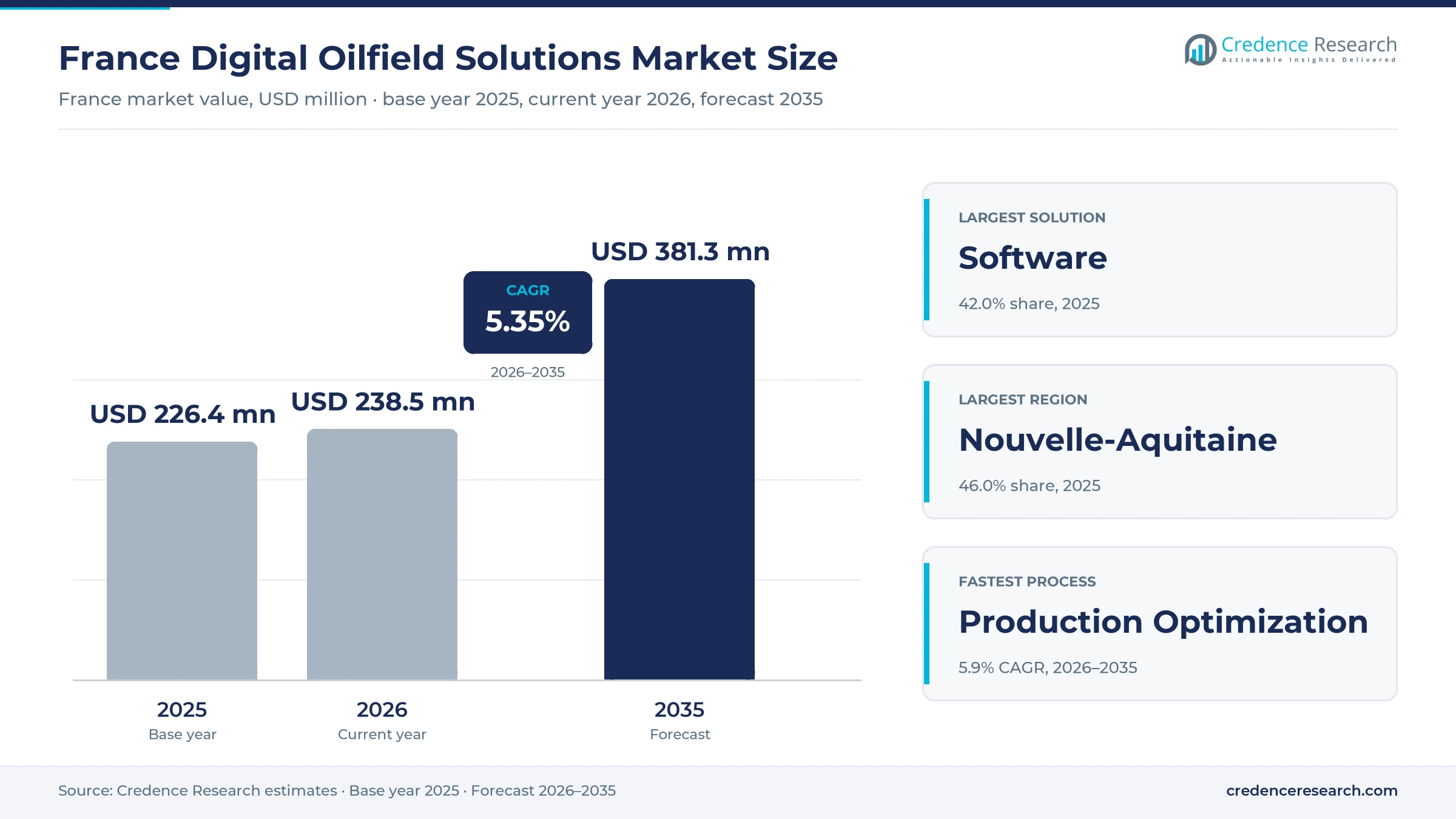
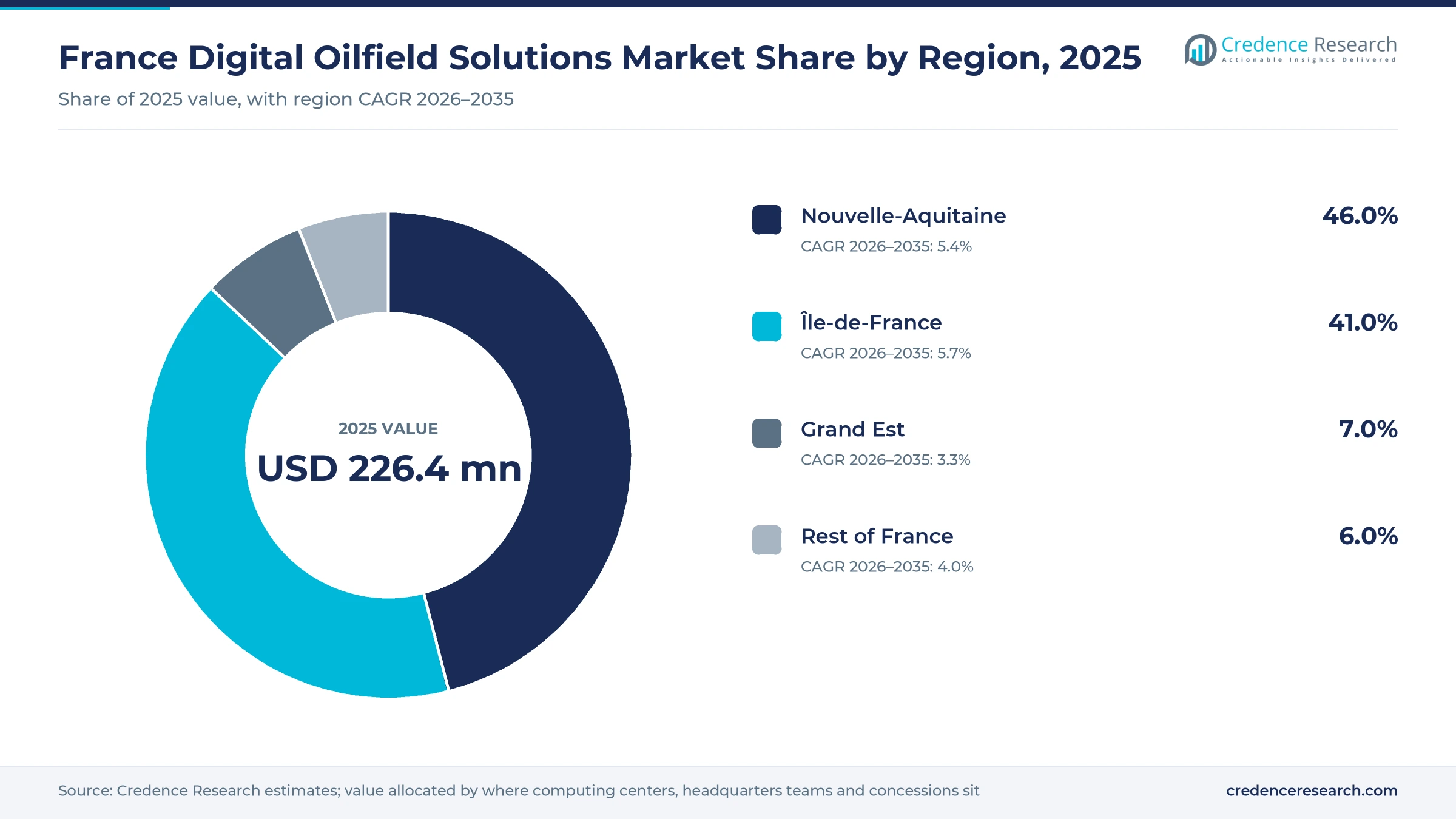
The France digital oilfield solutions market was valued at USD 226.4 million in 2025 and is projected to increase from USD 238.5 million in 2026 to USD 381.3 million by 2035, registering a CAGR of 5.35% during 2026–2035. Demand comes from TotalEnergies, which runs subsurface computing, data platforms and remote monitoring for its global upstream portfolio from Pau and Paris, and from domestic onshore producers led by Vermilion, IPC Petroleum France and Geopetrol. France banned new hydrocarbon exploration permits in 2017, so domestic fields form a small and shrinking part of value. Nouvelle-Aquitaine held the largest regional share, 46.0% in 2025, because the Pau scientific center and Aquitaine Basin fields sit there. Île-de-France is the fastest-growing zone at 5.7% a year, as headquarters teams sign group-wide data and AI platform contracts. Methane measurement rules and a new supercomputer generation in Pau shape spending through 2027.
Which buyers and systems this French market counts
The market counts sensors, telemetry, control and monitoring hardware, subsurface and production software, high-performance computing bought for oil and gas work, and the integration and support services purchased by operators and service firms in France. It includes systems that France-based teams buy and run centrally for fields abroad, because those contracts are signed, hosted and supported in France.
Rigs, wellheads, pipes and seismic vessels are excluded, as are digital tools that French suppliers sell to operators in other countries. Domestic output is only about 10,000 barrels a day, so the estimate rests mainly on centrally run upstream systems. Public data on domestic field spending are thin, which widens the error band on that part of the estimate.
France Digital Oilfield Solutions Market Insights
- The France digital oilfield solutions market rises from USD 226.4 million in 2025 to USD 381.3 million by 2035, a 5.35% CAGR during 2026–2035, as central subsurface computing and data platforms expand.
- Nouvelle-Aquitaine held 46.0% of 2025 value, because the Pau scientific center, the Lacq test platform and Aquitaine Basin fields sit in the zone.
- Software led with 42.0% of 2025 value, because subsurface and data platform licenses are bought centrally in France for a global upstream portfolio.
- TotalEnergies selected Dell and NVIDIA in May 2026 for Pangea 5, a new supercomputer in Pau due in 2027 with six times the computing power of earlier systems.
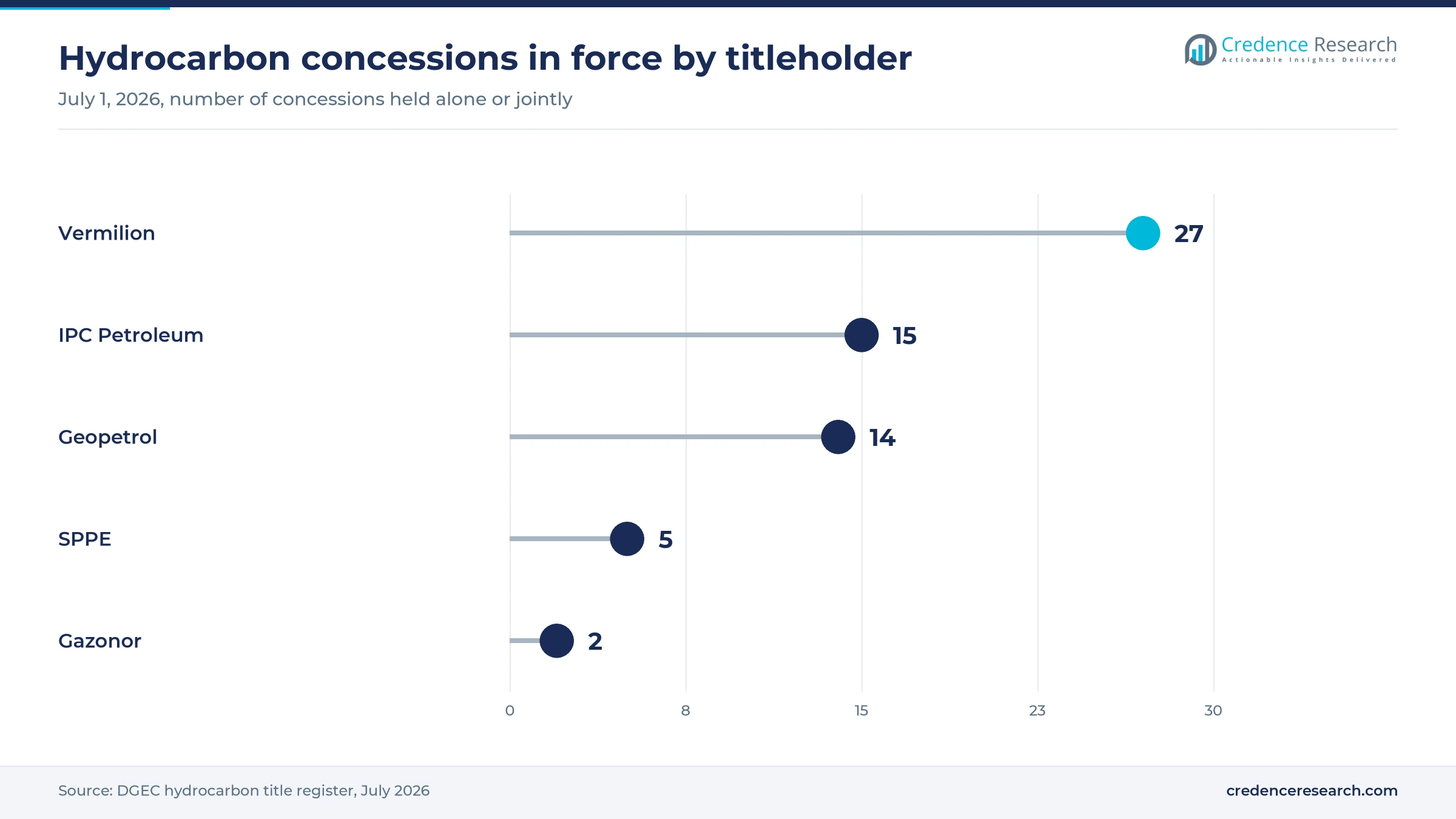
- The state register of July 2026 lists 61 hydrocarbon concessions in force, and Vermilion produces about two-thirds of the oil still extracted in France.
Software leads while hardware and production tools gain
Software leads while computing hardware grows fastest
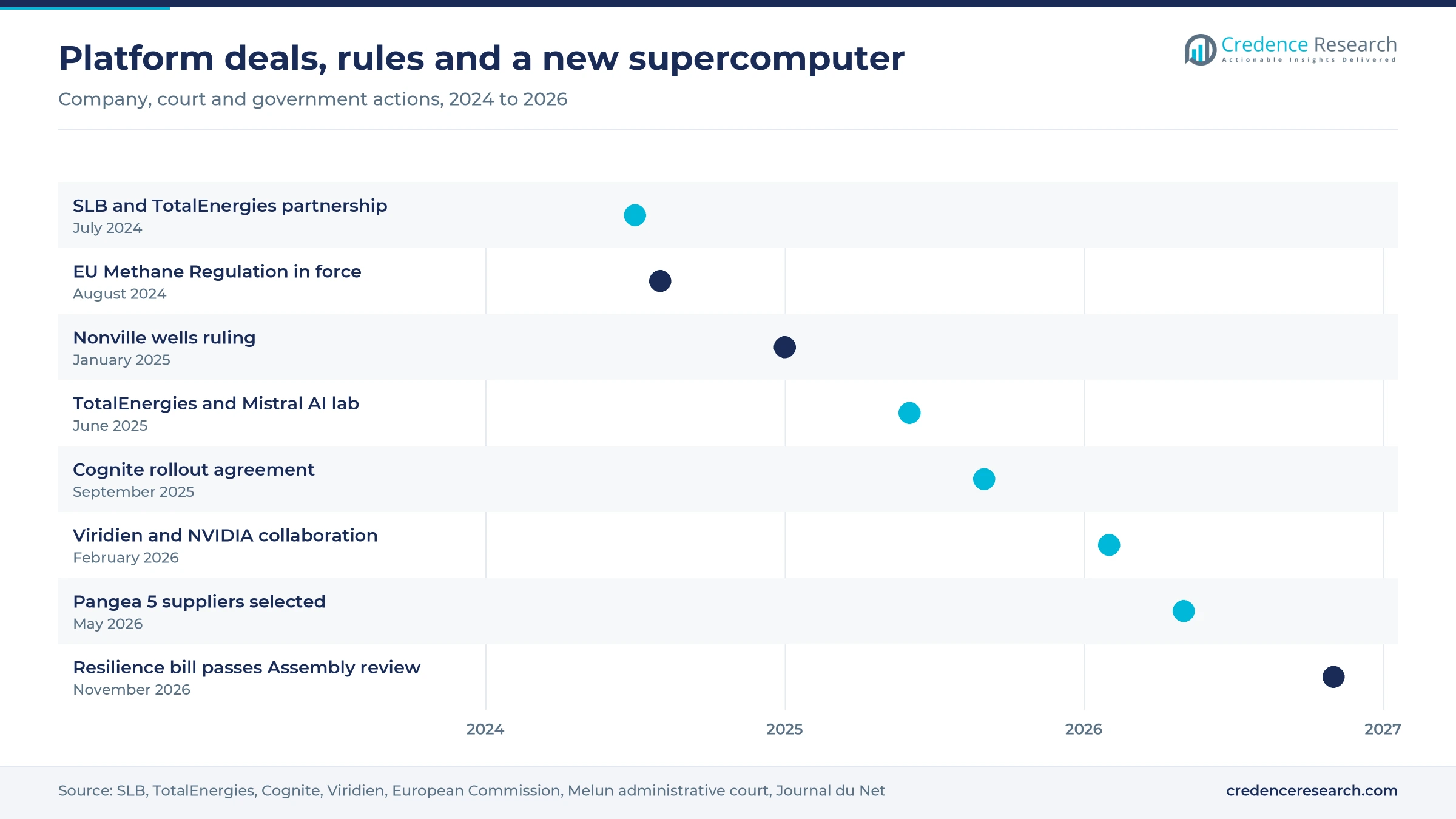
Based on solution, the market is categorized into hardware, software and services. Software led with 42.0% of 2025 value because subsurface and data licenses are bought centrally in France for the whole TotalEnergies upstream portfolio. SLB and TotalEnergies announced a 10-year partnership on July 2, 2024, to co-develop applications on the SLB Delfi platform under the OSDU data standard, World Oil reported. Hardware grows fastest at 6.0% a year, as TotalEnergies chose Dell and NVIDIA in May 2026 to build Pangea 5 in Pau, a system it expects to multiply computing power by six when commissioned in 2027, Le Monde Informatique reported. Hardware spending stays lumpy because it follows the replacement cycle of computer generations.
Offshore assets lead while large onshore projects grow
Based on application, the market is categorized into onshore and offshore. Offshore led with 64.0% of 2025 value because this split follows the assets served by systems run from France, and the deepwater fields those teams support abroad carry the most sensors and subsea controls. TotalEnergies started BEGONIA and CLOV Phase 3 offshore Angola in July 2025, with nine subsea wells in total, the company said. Onshore grows fastest at 5.9% a year, because large onshore developments modeled and monitored from Pau, such as the 420-well Tilenga project in Uganda, add wells faster than French fields decline, according to project data reported by The Uganda Standard.
Reservoir work leads while production tools grow fastest
Based on process, the market is categorized into reservoir optimization, production optimization and drilling optimization. Reservoir Optimization led with 47.0% of 2025 value because seismic imaging and reservoir simulation absorb most of the computing, software and geoscience services bought in France. French geoscience group Viridien agreed with NVIDIA in February 2026 to adapt its seismic imaging algorithms to accelerated computing, Offshore Engineer reported, work that also serves buyers of seismic surveys. Production Optimization grows fastest at 5.9% a year, as TotalEnergies said in September 2025 that it would deploy the Cognite industrial data and AI platform across all its operated upstream assets over three years.
On-premises systems lead while cloud capacity grows
Based on deployment, the market is categorized into on-premises and cloud-based. On-Premises led with 66.0% of 2025 value because operating data from TotalEnergies sites is sent to headquarters in France and verified in the AVEVA PI System data archive and Asset Framework, AVEVA says in a customer case study. Seismic and reservoir computing also runs on machines the operator owns in Pau. Cloud-Based grows fastest at 6.5% a year, as Pangea 4, which entered service in early 2024, pairs an on-site machine with Pangea@Cloud capacity for peak workloads, TotalEnergies says. Data control rules still limit which workloads move off site.
| Segment Group | Leading Sub-segment | Share, 2025 | Fastest-growing Sub-segment | CAGR, 2026–2035 |
|---|---|---|---|---|
| By Solution | Software | 42.0% | Hardware | 6.0% |
| By Application | Offshore | 64.0% | Onshore | 5.9% |
| By Process | Reservoir Optimization | 47.0% | Production Optimization | 5.9% |
| By Deployment | On-Premises | 66.0% | Cloud-Based | 6.5% |
Computing orders and subscriptions set digital prices
Digital oilfield work bought in France is priced in three ways, as periodic hardware purchases for central computing, as multiyear software subscriptions and framework licenses, and as service and support fees. Public prices are rare, so most ranges below are Credence Research estimates with wide error bands. The Pangea 5 order is the clearest public price point, at about EUR 100 million, or roughly USD 113 million at the 2025 average rate of 1.13 dollars per euro. Exchange rates matter because many licenses are priced in U.S. dollars while domestic operators budget in euros, and lower oil prices push buyers toward fees tied to measured uptime.
| Offer or input | Typical price or fee | Basis |
|---|---|---|
| Pangea 5 supercomputer from Dell and NVIDIA, Pau | About EUR 100 million in total | Le Monde Informatique, May 2026 |
| Subsurface interpretation and simulation software | USD 30,000 to USD 90,000 per seat per year | Credence Research estimate; no public list price |
| Industrial data platform subscription | USD 150,000 to USD 600,000 per operated asset per year | Credence Research estimate from deployment scope |
| Production monitoring software for onshore wells | USD 500 to USD 2,000 per well per month | Credence Research estimate |
| Onshore well telemetry kit with sensors and remote terminal unit | USD 5,000 to USD 20,000 per well | Credence Research estimate; excludes software fees |
Request a Free Sample
Fill in your details and we'll send you a free sample report.
- Sample data tables & charts
- Research methodology
Pau computing, upstream growth and methane rules
Central subsurface computing in Pau anchors spending
TotalEnergies runs much of its global subsurface work from Pau, which keeps a large part of upstream digital spending inside France. The CSTJF scientific and technical center hosts more than 2,500 people, and Pangea III, commissioned in 2019 with a theoretical power of 31.7 petaflops, remains in service there. TotalEnergies says its newer Pangea 4 uses 87% less electricity than Pangea II while supporting seismic acquisition and image processing. Each supercomputer generation brings new storage, cooling, code porting and support contracts. Suppliers that can tune seismic and reservoir codes for new processors therefore gain repeat work with each refresh cycle, while late entrants must prove performance on existing workloads first.
Upstream growth managed from France widens the asset base
Production growth at the largest French operator adds wells, platforms and data streams that central teams in Paris and Pau must monitor and model. TotalEnergies produced 2,529 thousand barrels of oil equivalent per day in 2025, nearly 4% more than in 2024, enlarging the base for monitoring demand, according to its fourth-quarter results. Organic investment in exploration and production reached USD 9.6 billion in 2025, and the company guides to a further 3% rise in oil and gas output for 2026. New assets join group-wide data, monitoring and simulation tools rather than local systems, so each start-up raises license counts and support hours. Vendors with group-level framework agreements capture this growth at little extra sales cost.
EU methane rules make measurement a compliance purchase
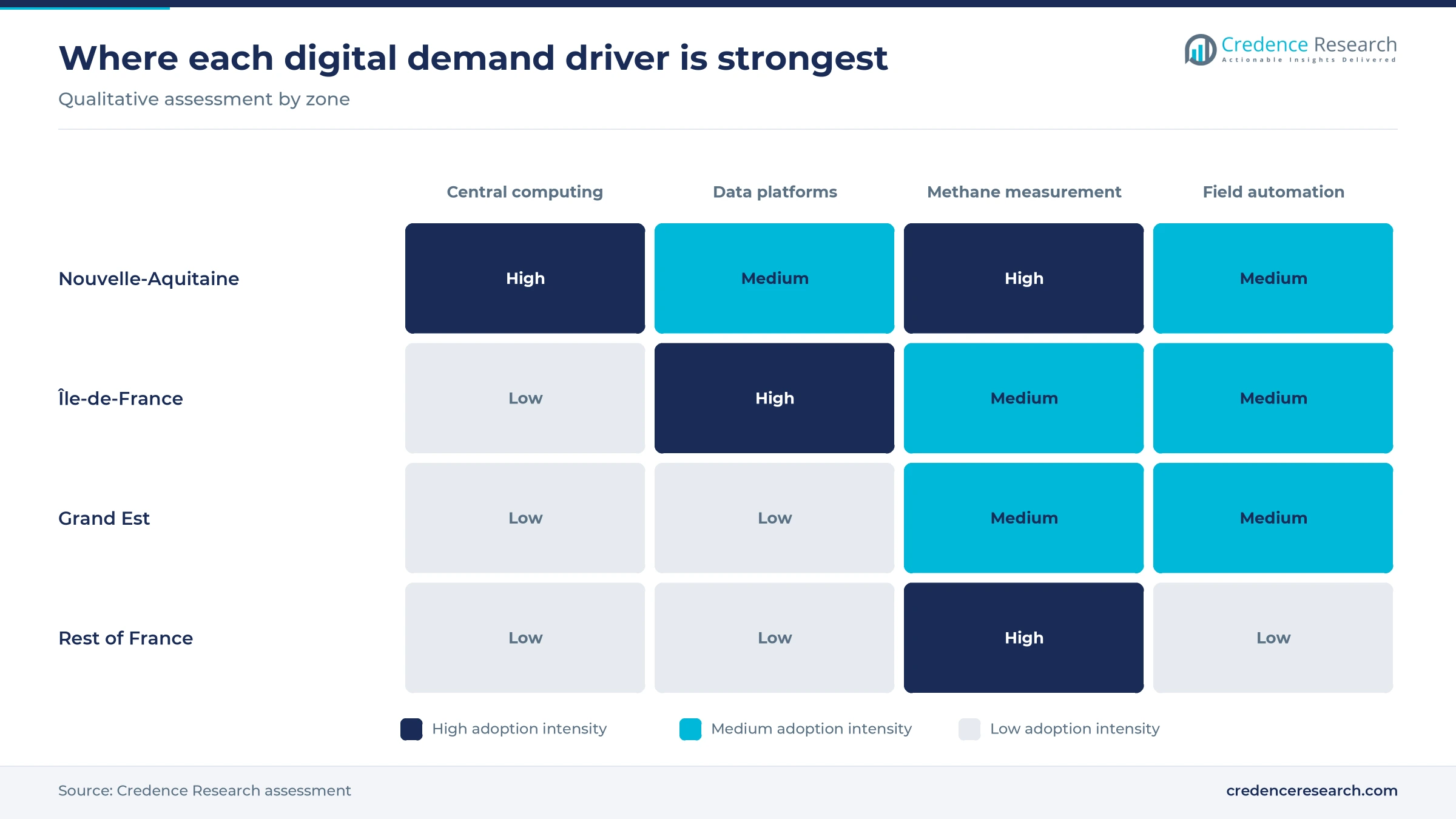
Methane rules turn leak detection and emissions measurement from voluntary programs into compliance spending for operators in France. The EU Methane Regulation entered into force on Aug. 4, 2024, requires repair of most detected leaks within 5 or 15 working days and bans routine venting, the European Commission says. TotalEnergies has tested acoustic, infrared and laser sensors at its TADI platform in Lacq since 2015, and the site ran more than 400 tests in 2022, the company says. The Commission proposed in October 2026 to postpone reporting provisions by one year, a proposal aimed at reporting rather than survey and repair duties. Sensor, pipeline leak detection and emissions software suppliers gain most.
Proven remote monitoring savings justify wider rollouts
Measured results from remote monitoring give buyers in France a business case for extending it to more equipment. The TotalEnergies RAID remote monitoring system, built on AVEVA PI Server and AVEVA Predictive Analytics, covers 320 shaft lines and has generated 36,000 alerts, including 429 catches on critical equipment, AVEVA says. The same case study credits it with avoiding an upstream production shortfall of almost 500,000 barrels, a result that strengthens demand for wider coverage. Half of the 105 breakdowns recorded in the critical equipment fleet could have been avoided with proper early warning, the study adds. Each avoided outage pays for years of software fees, so operators extend rotating-equipment monitoring first, which favors historian and analytics vendors already installed.
AI labs and heat reuse reshape operator spending
AI work shifts from pilots toward joint research labs
Energy groups in France are shifting from vendor-led AI pilots toward joint labs that pair a model developer with in-house engineers. TotalEnergies and Mistral AI agreed on June 11, 2025, to set up a joint AI innovation lab, with an assistant for the group's 1,000 researchers among the first use cases, TotalEnergies said. The partners also plan to examine AI infrastructure on European digital sovereignty grounds, which remains at the study stage. The TotalEnergies OneTech branch counts 3,400 engineers, researchers, technicians and support staff, AVEVA reports, a large internal user base for such tools. The release names no upstream use case, so evidence for oilfield applications remains indirect, and model developers compete with incumbent subsurface vendors for the same budgets.
Domestic producers shift oil wells toward heat supply
Domestic producers are shifting part of their field infrastructure toward heat supply, which creates new monitoring needs for flow, temperature and water handling. Vermilion has used produced water from the Parentis field to heat greenhouses since 2012, and the cluster now covers 27 hectares, the company says. At La Teste-de-Buch, about 1,000 cubic meters a day of hot produced water from three small fields meet heat demand in 550 apartments under a long-term partnership with the city. Vermilion also began supplying heat to a spirulina facility at Vic-Bilh in 2021. Heat contracts can outlast oil sales, so operators need metering and remote supervision suited to utility customers, a niche that favors local automation integrators.
CO2 storage siting opens new subsurface modeling work
Carbon storage siting in southwestern France creates an opening for reservoir modeling, monitoring design and simulation services that reuse oilfield tools. Teréga dropped the Lacq site for the Pycasso storage project in October 2024 after local opposition, a project that aimed to store 5 million metric tons of CO2 a year by 2030, AFP reported through Connaissance des Énergies. The consortium is now considering 10 other sites in the Occitanie and Nouvelle-Aquitaine regions, each of which needs new geological models. TotalEnergies plans to use Pangea 4 for CO2 capture and storage simulation, and the SLB partnership described above also covers carbon capture work, World Oil reported. Subsurface software vendors and geoscience firms with French permitting experience are best placed.
Ageing concessions open demand for well integrity data
The remaining domestic fields create an opening for well integrity, abandonment planning and emissions inventory tools sold to a small group of operators. The state hydrocarbon title register of July 1, 2026 lists 61 concessions in force and three exclusive research permits, with Vermilion entities named on 27 of the concessions. Vermilion produces about two-thirds of domestic oil, the company says, which makes it the anchor buyer. The EU methane rules described above also require member states to identify and reduce emissions from closed and abandoned wells. Vendors that package integrity monitoring for dozens of small onshore sites at low cost can win multi-field contracts as fields approach the legal end date.
Legal sunset, litigation and price swings weigh
A 2040 legal end date shortens payback on field upgrades
Law 2017-1839 of Dec. 30, 2017, banned new hydrocarbon exploration permits and bars new concessions and renewals from running beyond Jan. 1, 2040, although existing titles can be extended under conditions set by the law, according to Connaissance des Énergies. Most domestic operators therefore have about 14 years left to recover any investment in field automation. Small titleholders such as Geopetrol and SPPE are most exposed, because their fields produce little and cannot carry long contracts. Suppliers that rent equipment or sell short subscriptions face less risk than those selling capital systems.
Permit litigation delays new domestic wells
The administrative court of Melun ruled on Jan. 30, 2025, that the prefect's authorization for two new wells at the Nonville field was illegal and gave the State and operator Bridge Énergies ten months to correct it, the court said. Its concerns covered the protected species study and missing financial guarantees for accident response. Drilling services and well data suppliers are most exposed, because each new domestic well now carries legal risk. Operators favor work on existing wells, which shifts spending toward production tools.
Lower oil prices tighten discretionary digital budgets
Brent averaged USD 69.1 a barrel in 2025, down from USD 80.8 in 2024, and TotalEnergies guides to net investments of about USD 15 billion in 2026 against USD 17.1 billion in 2025, its February 2026 results show. Digital projects without a direct link to output or safety are the easiest to defer when budgets fall. Software vendors selling open-ended pilots are most exposed, while suppliers that price on measured savings or uptime face less cancellation risk.
Late NIS2 transposition leaves security duties unclear
France missed the Oct. 17, 2024, deadline to transpose the NIS2 cybersecurity directive, and the National Assembly finished its article-by-article review of the resilience bill on Nov. 10, 2026, ahead of a joint committee with the Senate, Journal du Net reported. The bill could cover 15,000 to 20,000 entities, including energy companies above size thresholds. Until decrees and agency rules appear, operators linking control networks to cloud platforms face unclear industrial cybersecurity duties, which can delay connected-field projects.
Nouvelle-Aquitaine leads while Île-de-France grows
| Region | Value, 2025 (USD million) | Share, 2025 | CAGR, 2026–2035 |
|---|---|---|---|
| Nouvelle-Aquitaine | 104.1 | 46.0% | 5.4% |
| Île-de-France | 92.8 | 41.0% | 5.7% |
| Grand Est | 15.8 | 7.0% | 3.3% |
| Rest of France | 13.6 | 6.0% | 4.0% |
Nouvelle-Aquitaine leads on Pau computing and Aquitaine fields
Nouvelle-Aquitaine held a regional share of 46.0% in 2025 and grows at 5.4% a year. The zone hosts the Pau scientific center described above, where subsurface computing and the planned Pangea 5 system sit, and the TADI test platform at Lacq. Aquitaine Basin concessions such as Parentis and Cazaux, held by Vermilion according to the state register, add sensor, telemetry and maintenance work.
Paris region combines headquarters buying and Paris Basin output
Île-de-France held a regional share of 41.0% in 2025 and grows at 5.7% a year, the fastest of the four zones. Group headquarters, software partners and AI teams sit in the Paris region, so central license and platform contracts are often signed there. France produced 584,114 metric tons of crude oil in 2023, and nearly 60% of domestic output came from the Paris Basin, Connaissance des Énergies reports. Seine-et-Marne and Essonne concessions such as Chaunoy and Vert-le-Grand keep field automation work close to Paris.
Grand Est hosts small Paris Basin and Alsace fields
Grand Est held a regional share of 7.0% in 2025 and grows at 3.3% a year. The state register lists IPC Petroleum France concessions such as Soudron and Courdemanges in the Marne area, and Geopetrol titles such as Eschau and Scheibenhard in Alsace. These fields are small and mature, so buyers favor low-cost telemetry, artificial lift monitoring and shared maintenance contracts. Growth is the slowest of the four zones, because the legal end date set out in the challenges limits new investment.
Rest of France covers mine gas and southern fields
The rest of France held a regional share of 6.0% in 2025 and grows at 4.0% a year. The zone includes the Désirée and Poissonnière concessions in the north held by Gazonor, part of La Française de l'Énergie, and Geopetrol titles in Occitanie such as Castéra-Lou. Gas metering, emissions measurement and remote supervision dominate demand here, and the EU methane rules described above raise the measurement load on these small producers relative to their output.
Platform deals, a new supercomputer and cyber law
| Development | Status and market relevance |
|---|---|
| In July 2024, SLB and TotalEnergies announced a 10-year partnership to co-develop subsurface applications on the SLB Delfi platform. | Partnership announced; initial focus on reservoir engineering and geoscience modeling. |
| In September 2025, TotalEnergies expanded its partnership with Cognite to deploy its data and AI platform across all operated upstream assets. | Agreement signed; three-year rollout planned. |
| In February 2026, Viridien and NVIDIA announced a collaboration to accelerate seismic imaging on NVIDIA computing platforms. | Collaboration announced; no performance results published yet. |
| In May 2026, TotalEnergies selected Dell and NVIDIA to build the Pangea 5 supercomputer at its Pau scientific center. | Suppliers selected; the system is under construction and not yet in service. |
| In November 2026, the National Assembly completed its review of the resilience bill that transposes the NIS2 directive into French law. | Bill adopted by deputies; joint committee, promulgation and decrees still pending. |
Hybrid computing, data platforms and leak sensors
- Hybrid supercomputing combines on-site GPU and CPU clusters with cloud capacity, which lets subsurface teams absorb seismic workload peaks without oversizing machines.
- Industrial data platforms link historians, maintenance records and engineering data, which gives AI models a consistent view of each asset.
- Optical gas imaging and laser sensors detect and quantify methane leaks, which supports the survey and repair duties under EU rules.
- Open subsurface data standards such as OSDU let operators move interpretation data between vendor applications without costly conversions.
Need a Custom Version of This Report?
Tailor the scope, geography, or segments to your exact requirements.
- Custom geography or segment scope
- Direct access to our analyst team
Group-level frameworks decide central contracts
Competition in the France digital oilfield solutions market is shaped by a few large buyers and a small group of suppliers that hold group-level frameworks. SLB competes on subsurface software through its Delfi partnership with TotalEnergies, while Viridien brings French geoscience imaging and managed high-performance computing. Schneider Electric, through AVEVA, supplies the PI System historian and predictive analytics behind remote monitoring. Cognite competes as the industrial data layer across operated upstream assets. Dell Technologies and NVIDIA supply the computing hardware under subsurface workloads in Pau. Domestic onshore operators buy smaller packages from automation integrators and service crews, often through maintenance contracts rather than software tenders. Buyers judge suppliers on integration with existing systems, security, performance on seismic codes and proven savings. Price pressure is strongest in hardware tenders, while software renewals favor incumbents because switching data platforms is costly.
Few buyers and group-level frameworks shape supply
The supply side serving buyers in France runs in three tiers. Subsurface software and geoscience firms, led by SLB and Viridien, sell licenses, imaging and managed computing under multiyear frameworks. Data, historian and analytics vendors, including AVEVA under Schneider Electric and Cognite, sell subscriptions priced by asset or data volume. Computing suppliers such as Dell Technologies and NVIDIA compete in periodic hardware tenders. In the Credence Research estimate, one integrated operator accounts for most central spending, while domestic field work is fragmented among small titleholders. Entry barriers sit in data integration and security approval, and margins sit in software renewals and support.
Software, data and computing suppliers that buyers in France shortlist
| Company | Type | Role in the market |
|---|---|---|
| SLB | Integrated service and software company | Co-develops Delfi subsurface applications with TotalEnergies under a 10-year partnership |
| Viridien | Geoscience specialist | Sells seismic imaging, geoscience data and managed high-performance computing services |
| Schneider Electric (AVEVA) | Industrial software vendor | Supplies the PI System historian and predictive analytics behind TotalEnergies remote monitoring |
| Cognite | Industrial data platform vendor | Deploys its data and AI platform across TotalEnergies operated upstream assets |
| Dell Technologies | Computing supplier | Selected to build the Pangea 5 supercomputer at the Pau scientific center |
| NVIDIA | Accelerated computing supplier | Supplies GPUs and networking for Pangea 5 and Viridien seismic imaging work |
Value shifts from field kit to central platforms
Credence Research's view is that value in this market is shifting from field hardware toward central software, data and computing platforms. Domestic fields will keep buying telemetry and integrity tools until their legal end date, but their weight falls each year. Growth comes from group-wide frameworks signed in France, from the Pangea 5 refresh and from methane measurement duties. Suppliers that integrate with existing historians and subsurface platforms, meet French security rules and price on measured savings should gain the most share. The main evidence gap is domestic field spending, which no operator discloses.
Estimates rest on operator spending and intensity
The report uses 2025 as the base year and 2026 to 2035 as the forecast period. The earlier Credence Research estimate for this market was revised down after a check against domestic oil output, the upstream spending of France-based operators and typical digital spending intensity showed that the previous level was too high for the activity bought in France. Market values come from the Credence Research model, and the regional, solution, application, process and deployment splits are Credence Research estimates informed by public data. Sources include the state hydrocarbon title register, EU regulatory pages, company releases and results, court decisions and business publishers. No interviews or surveys were used to build these estimates.
Pangea 5 and the 2040 domestic sunset set the path
Credence Research expects the market to reach USD 381.3 million by 2035, as Pangea 5 enters service, group-wide data platforms cover operated upstream assets and methane measurement becomes routine. Growth is strongest in production optimization and cloud-based deployment, while hardware spending rises around computing refresh cycles. Domestic onshore fields add integrity, abandonment and heat-supply monitoring work as they approach the 2040 end date. Oil prices, permit disputes and the pace of French cybersecurity rules are the main risks to that path.
Oil prices and computing refresh timing set the range
The range to 2035 depends on oil prices, the timing of new computing generations in Pau and how fast domestic fields wind down before their legal end date. Group-level software frameworks support every case, because most run for several years. A delayed Pangea 5 or lower upstream budgets would push spending later, while new carbon storage sites and faster AI adoption would add subsurface and data work.
| Scenario | CAGR, 2026–2035 | Value, 2035 | What has to hold |
|---|---|---|---|
| Downside | 3.7% | USD 332.2 million | Brent stays below USD 65 and TotalEnergies trims upstream and digital budgets |
| Base | 5.35% | USD 381.3 million | Pangea 5 starts in 2027 and the Cognite rollout covers operated upstream assets |
| Upside | 6.6% | USD 425.7 million | New CO2 storage sites advance and AI tools spread into subsurface workflows |
Frequently Asked Questions
How big is the France digital oilfield solutions market?
Does France still produce oil, and how much?
Can new oil exploration take place in France?
Why is so much digital oilfield spending booked in France?
What is the Pangea 5 supercomputer?
How do EU methane rules affect operators in France?
Which region leads digital oilfield spending in France?
Who are the main suppliers in this market?
Table of Content
Chapter 1 Market Segmentation
- 1.1 Segmentation Framework
- 1.1.1 Product and Service Classification
- 1.1.2 Application and End-Use Classification
- 1.1.3 Technology and Solution Classification
- 1.1.4 Customer and Distribution Channel Classification
- 1.1.5 Geographic Segmentation
- 1.1.6 Market Segment Definitions and Boundaries
- 1.2 By Solution
- 1.2.1 Software
- 1.2.2 Services
- 1.2.3 Hardware
- 1.3 By Application
- 1.3.1 Offshore
- 1.3.2 Onshore
- 1.4 By Process
- 1.4.1 Reservoir Optimization
- 1.4.2 Production Optimization
- 1.4.3 Drilling Optimization
- 1.5 By Deployment
- 1.5.1 On-Premises
- 1.5.2 Cloud-Based
Chapter 2 Introduction
- 2.1 Report Objectives and Scope
- 2.2 Product Definition and Industry Terminology
- 2.3 Market Inclusions and Exclusions
- 2.4 Research Process
- 2.4.1 Primary Research and Expert Interviews
- 2.4.2 Secondary Research and Source Review
- 2.4.3 Top-Down and Bottom-Up Estimation
- 2.4.4 Data Triangulation and Verification
- 2.5 Market Size Measurement Basis
- 2.5.1 2025: USD 226.4 million → 2035: USD 381.3 million
- 2.6 Historical and Forecast Reference Periods
- 2.6.1 Historical Period: 2018-2025
- 2.6.2 Base Year: 2025
- 2.6.3 Forecast Period: 2025-2035
- 2.7 Research Assumptions and Limitations
Chapter 3 Executive Summary
- 3.1 Market Snapshot and Key Findings
- 3.2 Base-Year Market Size, 2025
- 3.3 Forecast Market Size, 2035
- 3.4 Revenue and Volume Growth Outlook
- 3.5 Key Demand and Supply Indicators
- 3.6 Leading Market Segments
- 3.7 Fastest-Growing Market Opportunities
- 3.8 Regional Performance Highlights
- 3.9 Technology and Industry Transformation
- 3.10 Competitive Landscape Summary
- 3.11 Analyst View and Strategic Implications
Chapter 4 France Digital Oilfield Solutions Market Trends and Developments
- 4.1 Historical Industry Development, 2018-2025
- 4.2 Recent Market Trends and Developments
- 4.3 Demand and Customer Behavior Trends
- 4.4 Technology and Product Innovation
- 4.5 Artificial Intelligence, Automation and Digitalization
- 4.6 Local Manufacturing and Supply Chain Realignment
- 4.7 Industry Partnerships, Mergers and Acquisitions
- 4.8 Sustainability and Circular Economy Developments
- 4.9 Government and Private Sector Investment Trends
- 4.10 Emerging Business Models and Commercialization
- 4.11 Industry Developments and Announcements
Chapter 5 France Digital Oilfield Solutions Market Production, Supply and Demand Analysis
- 5.1 Demand Trend and Consumption Analysis, 2018-2025
- 5.2 Demand Forecast, 2025-2035
- 5.3 Production and Output Trend, 2018-2025
- 5.4 Production and Output Forecast, 2025-2035
- 5.5 Installed Capacity and Capacity Utilization
- 5.6 Company-Wise Production Plants and Statistics
- 5.6.1 Installed Production Capacity
- 5.6.2 Actual Production
- 5.6.3 Planned Capacity and Expansion Targets
- 5.7 Supply Chain Structure and Procurement Trends
- 5.8 Supply-Demand Gap and Bottlenecks
- 5.9 Import Dependence and Sourcing Structure
- 5.10 Contract Manufacturing and Outsourcing
- 5.11 Regional Supply and Demand Concentration
Chapter 6 France Digital Oilfield Solutions Market Pricing Analysis
- 6.1 Pricing Structure and Measurement
- 6.2 Historical Pricing Trends, 2018-2025
- 6.3 Pricing Outlook, 2025-2035
- 6.4 Average Selling Price and Unit Economics
- 6.5 Pricing by Product and Market Segment
- 6.6 Geographic Pricing Differences
- 6.7 Key Input, Energy, Labor and Logistics Costs
- 6.8 Contract Pricing and Purchasing Models
- 6.9 Pricing Sensitivity and Competitive Positioning
- 6.10 Price, Margin and Profitability Implications
Chapter 7 France Digital Oilfield Solutions Market Dynamics
- 7.1 Market Growth Drivers
- 7.1.1 Demand-Side Drivers
- 7.1.2 Technology and Innovation Drivers
- 7.1.3 Infrastructure and Investment Drivers
- 7.1.4 Regulatory and Policy Drivers
- 7.2 Market Restraints
- 7.2.1 Cost and Affordability Constraints
- 7.2.2 Technology and Adoption Barriers
- 7.2.3 Supply Chain and Operational Constraints
- 7.3 Market Challenges
- 7.3.1 Competitive Pressure and Margin Erosion
- 7.3.2 Skills, Infrastructure and Implementation Gaps
- 7.4 Emerging Market Opportunities
- 7.5 Market Dynamics Impact and Time-Horizon Assessment
Chapter 8 France Digital Oilfield Solutions Value Chain Analysis
- 8.1 Industry Value Chain Overview
- 8.2 Upstream Suppliers and Critical Inputs
- 8.3 Technology and Component Providers
- 8.4 Manufacturing or Service Delivery
- 8.5 Distribution, Channel Partners and Integrators
- 8.6 Downstream Applications and End Users
- 8.7 Value Addition and Profit Pools
- 8.8 Vertical Integration and Outsourcing
- 8.9 Supplier Concentration and Risk
- 8.10 Supply Chain Localization and Resilience
Chapter 9 France Digital Oilfield Solutions Market Regulations and Policies
- 9.1 Relevant Laws, Standards and Compliance Frameworks
- 9.2 Product, Service, Safety and Quality Requirements
- 9.3 Government Policies, Incentives and Subsidies
- 9.4 Imports, Exports and Trade Barriers
- 9.5 Public Procurement and Local Content Requirements
- 9.6 Environmental and Sustainability Compliance
- 9.7 Upcoming Policy Changes and Market Implications
Chapter 10 France Digital Oilfield Solutions Market Hotspots and Opportunities
- 10.1 Market Opportunity Mapping and Growth Hotspots
- 10.2 High-Growth Applications and Customer Groups
- 10.3 Underserved Markets and White-Space Opportunities
- 10.4 Emerging Technology and Product Opportunities
- 10.5 New Capacity and Investment Hotspots
- 10.6 Market Entry and Expansion Opportunities
- 10.7 Distribution and Partnership Opportunities
- 10.8 Near-Term and Long-Term Commercial Potential
- 10.9 Opportunity Attractiveness and Execution Risks
Chapter 11 France Digital Oilfield Solutions Market Outlook, 2025-2035
- 11.1 Market Size and Analysis
- 11.1.1 Revenue (Market Measurement: 2025: USD 226.4 million → 2035: USD 381.3 million)
- 11.1.2 Market Volume and Quantity Sold
- 11.1.3 Historical Market Size, 2018-2025
- 11.1.4 Base-Year Market Size, 2025
- 11.2 Market Forecast, 2025-2035
- 11.2.1 Revenue Forecast to 2035
- 11.2.2 Volume Forecast to 2035
- 11.2.3 CAGR and Year-on-Year Growth
- 11.2.4 Incremental Revenue Opportunity
- 11.3 Forecast Assumptions and Scenario Analysis
- 11.3.1 Base-Case Forecast
- 11.3.2 Optimistic and Conservative Scenarios
- 11.3.3 Technology, Pricing and Policy Sensitivities
- 11.4 Market Attractiveness and Growth Outlook
Chapter 12 France Digital Oilfield Solutions Market Segmentation and Outlook
- 12.1 Segmentation Summary and Market Shares, 2025
- 12.2 Largest and Fastest-Growing Segments
- 12.3 By Solution - Market Size and Forecast, 2025-2035
- 12.3.1 Segment Definition and Scope
- 12.3.2 Historical Market Size, 2018-2025
- 12.3.3 Revenue Forecast, 2025-2035
- 12.3.4 Volume Forecast, 2025-2035
- 12.3.5 Base-Year Market Share, 2025
- 12.3.6 Segment CAGR and Growth Drivers
- 12.3.7 Subsegment Market Size and Forecast
- 12.3.7.1 Software
- 12.3.7.2 Services
- 12.3.7.3 Hardware
- 12.3.8 Subsegment Pricing and Adoption Trends
- 12.3.9 Leading Suppliers and Competition
- 12.3.10 Regional Demand and Opportunities
- 12.4 By Application - Market Size and Forecast, 2025-2035
- 12.4.1 Segment Definition and Scope
- 12.4.2 Historical Market Size, 2018-2025
- 12.4.3 Revenue Forecast, 2025-2035
- 12.4.4 Volume Forecast, 2025-2035
- 12.4.5 Base-Year Market Share, 2025
- 12.4.6 Segment CAGR and Growth Drivers
- 12.4.7 Subsegment Market Size and Forecast
- 12.4.7.1 Offshore
- 12.4.7.2 Onshore
- 12.4.8 Subsegment Pricing and Adoption Trends
- 12.4.9 Leading Suppliers and Competition
- 12.4.10 Regional Demand and Opportunities
- 12.5 By Process - Market Size and Forecast, 2025-2035
- 12.5.1 Segment Definition and Scope
- 12.5.2 Historical Market Size, 2018-2025
- 12.5.3 Revenue Forecast, 2025-2035
- 12.5.4 Volume Forecast, 2025-2035
- 12.5.5 Base-Year Market Share, 2025
- 12.5.6 Segment CAGR and Growth Drivers
- 12.5.7 Subsegment Market Size and Forecast
- 12.5.7.1 Reservoir Optimization
- 12.5.7.2 Production Optimization
- 12.5.7.3 Drilling Optimization
- 12.5.8 Subsegment Pricing and Adoption Trends
- 12.5.9 Leading Suppliers and Competition
- 12.5.10 Regional Demand and Opportunities
- 12.6 By Deployment - Market Size and Forecast, 2025-2035
- 12.6.1 Segment Definition and Scope
- 12.6.2 Historical Market Size, 2018-2025
- 12.6.3 Revenue Forecast, 2025-2035
- 12.6.4 Volume Forecast, 2025-2035
- 12.6.5 Base-Year Market Share, 2025
- 12.6.6 Segment CAGR and Growth Drivers
- 12.6.7 Subsegment Market Size and Forecast
- 12.6.7.1 On-Premises
- 12.6.7.2 Cloud-Based
- 12.6.8 Subsegment Pricing and Adoption Trends
- 12.6.9 Leading Suppliers and Competition
- 12.6.10 Regional Demand and Opportunities
- 12.7 Segment Growth Comparison
- 12.8 Segment Attractiveness and Priority Matrix
Chapter 13 France Digital Oilfield Solutions End-Use and Application Market Outlook
- 13.1 End-Use Industry and Customer Demand Structure
- 13.2 Leading Applications and Customer Groups
- 13.3 End-Use Market Size, Share and Forecast
- 13.4 Major End-Use Industry Deep Dives
- 13.4.1 Customer Requirements and Use Cases
- 13.4.2 Demand and Replacement Cycles
- 13.4.3 Technical and Regulatory Considerations
- 13.4.4 Purchasing and Procurement Models
- 13.4.5 Leading Vendors and Distribution Channels
- 13.4.6 Forecast and Commercial Opportunities
- 13.5 Emerging Applications and Cross-Segment Demand
- 13.6 End-Use Industry Investment Priorities
Chapter 14 France Digital Oilfield Solutions Geographic Market Outlook, 2025-2035
- 14.1 Domestic Market Distribution and Demand Clusters
- 14.2 State- or Province-Wise Market Size and Forecast, 2025-2035
- 14.3 City and Metropolitan Market Outlook
- 14.4 Industrial, Manufacturing and Commercial Clusters
- 14.5 Geographic Concentration of Key End Users
- 14.6 Local Pricing and Purchasing Differences
- 14.7 Domestic Production Facilities and Capacity Map
- 14.8 Local Infrastructure and Project Pipeline
- 14.9 State-Level Policy and Incentive Differences
- 14.10 Subnational Investment Hotspots and Opportunities
- 14.11 Distribution and Logistics Networks
- 14.12 Domestic Competitive Footprint
Chapter 15 France Digital Oilfield Solutions Technology, Innovation and Sustainability Outlook
- 15.1 Technology Landscape and Maturity
- 15.2 Product, Process and Service Innovation
- 15.3 AI, Automation and Digital Tools in the Industry
- 15.4 Technology Adoption and Performance Benchmarking
- 15.5 Innovation Pipeline and R&D Investment
- 15.6 Patent and Intellectual Property Trends
- 15.7 Energy Efficiency and Resource Management
- 15.8 Sustainability, Recycling and Circularity
- 15.9 Technology Roadmap, 2025-2035
- 15.10 Risks of Obsolescence and Technology Substitution
Chapter 16 France Digital Oilfield Solutions Market Key Strategic Imperatives
- 16.1 Growth and Market Entry Priorities
- 16.2 High-Return Products and Segments
- 16.3 Pricing, Profitability and Cost Optimization
- 16.4 Technology Investment and Product Differentiation
- 16.5 Supply Chain Localization and Resilience
- 16.6 Distribution and Customer Acquisition
- 16.7 Partnership, Acquisition and Capacity Strategy
- 16.8 Regional Expansion Priorities
- 16.9 Short-, Medium- and Long-Term Actions
Chapter 17 Competition Outlook
- 17.1 Industry Competition Characteristics
- 17.2 Market Structure and Concentration
- 17.3 Market Share and Competitive Positioning, 2025
- 17.4 Company-Wise Revenue and Product Benchmarking
- 17.5 Production and Service Capacity Benchmarking
- 17.6 Technology, Pricing and Differentiation
- 17.7 Regional Footprint and Distribution Strength
- 17.8 Mergers, Acquisitions and Strategic Alliances
- 17.9 New Entrants and Competitive Threats
- 17.10 Porter's Five Forces and Industry Attractiveness
- 17.11 Competitive Outlook, 2025-2035
Chapter 18 Company Profiles
- 18.1 Company Coverage and Selection Criteria
- 18.2 SLB
- 18.2.1 Business Description
- 18.2.2 Company Ownership and Geographic Presence
- 18.2.3 Product and Service Portfolio
- 18.2.4 Manufacturing and Operating Footprint
- 18.2.5 Production Capacity and Expansion Plans
- 18.2.6 Financial Performance and Investment
- 18.2.7 Market Share and Competitive Position
- 18.2.8 Technology and Innovation Capabilities
- 18.2.9 Strategic Alliances or Partnerships
- 18.2.10 Recent Developments
- 18.2.11 Growth Strategy and Outlook
- 18.3 Viridien
- 18.4 Schneider Electric (AVEVA)
- 18.5 Cognite
- 18.6 Dell Technologies
- 18.7 NVIDIA
- 18.8 Other Relevant Market Participants
Note: Every listed company is profiled on the structure shown under the first company. The company list is preliminary and may change based on research findings, market developments, data availability and client requirements.
Chapter 19 Disclaimer
- 19.1 Research and Forecast Disclaimer
- 19.2 Data Source and Estimation Limitations
Note: The depth of individual sections depends on data availability for this market. Volume, capacity, trade and other unit-based metrics are included where applicable.