
Market Overview:
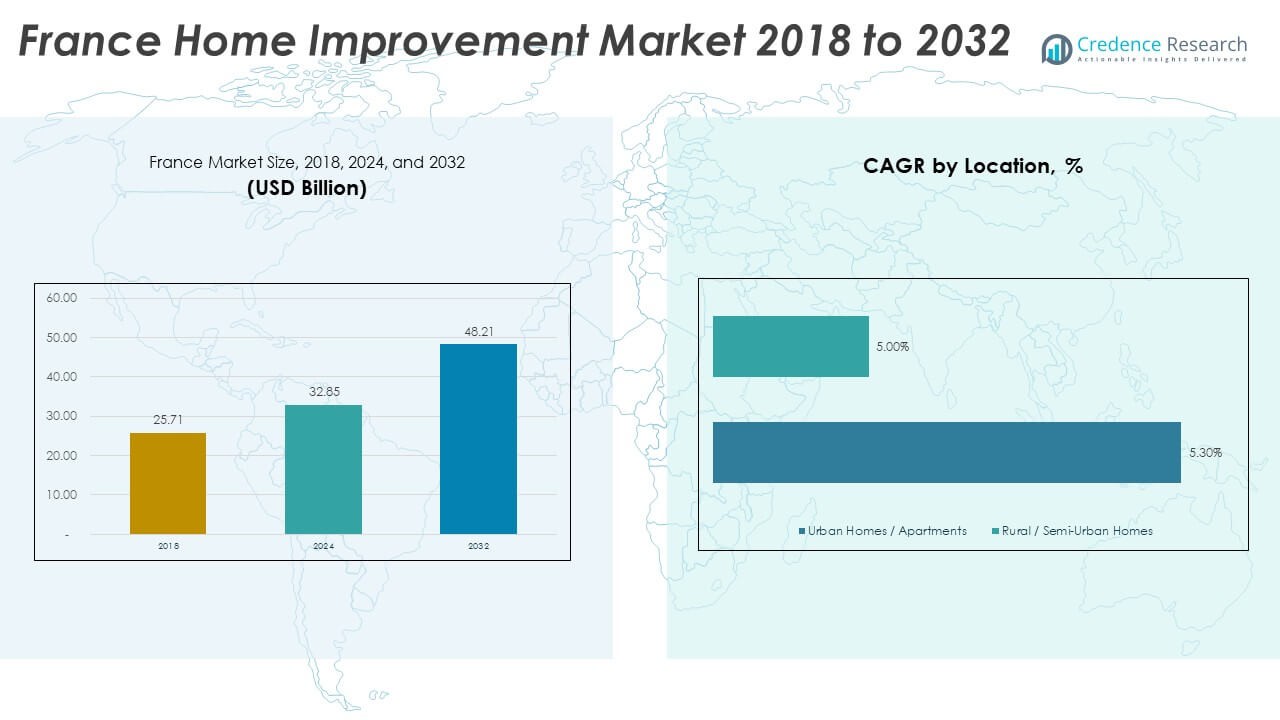
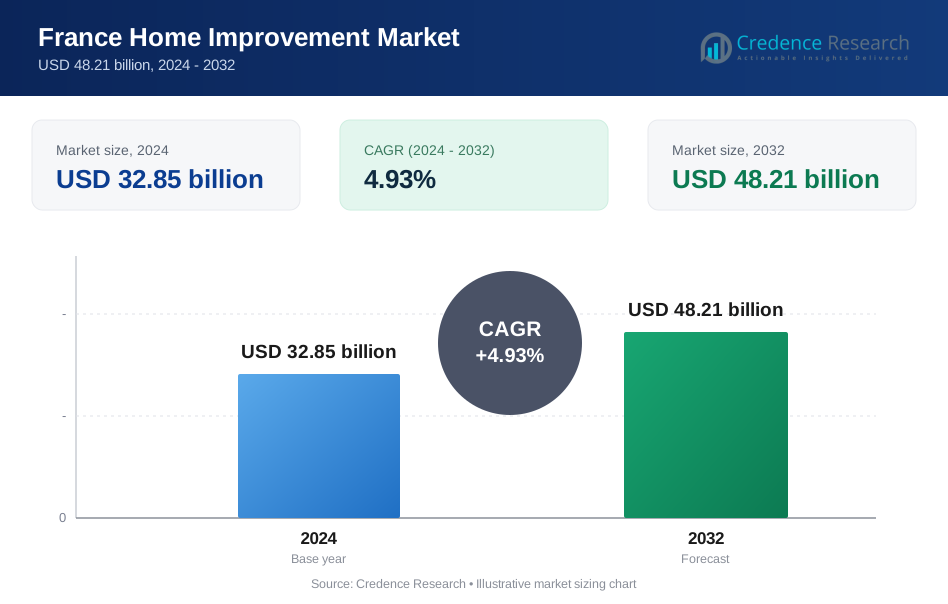
The France Home Improvement Market size was valued at USD 25.71 billion in 2018, increased to USD 32.85 billion in 2024, and is anticipated to reach USD 48.21 billion by 2032, growing at a CAGR of 4.93% during the forecast period.
| REPORT ATTRIBUTE | DETAILS |
|---|---|
| Historical Period | 2020-2023 |
| Base Year | 2024 |
| Forecast Period | 2025-2032 |
| France Home Improvement Market Size 2024 | USD 32.85 Billion |
| France Home Improvement Market, CAGR | 4.93% |
| France Home Improvement Market Size 2032 | USD 48.21 Billion |
Rising interest in home renovation is driven by growing urbanization, higher disposable incomes, and government incentives for energy-efficient housing. Consumers are investing in eco-friendly materials, smart home systems, and modern interiors that enhance comfort and sustainability. DIY culture is also expanding, supported by e-commerce platforms and the availability of affordable, easy-to-install solutions, encouraging homeowners to personalize and upgrade their living spaces independently.
Regionally, Île-de-France leads the market due to dense urban housing and higher renovation budgets, followed by regions such as Auvergne-Rhône-Alpes and Provence-Alpes-Côte d’Azur, where tourism-related property investments drive demand. Northern and western regions show growing interest in sustainable materials and energy retrofitting, while rural areas are witnessing steady adoption of modern home improvement products, aided by expanding retail networks and digital accessibility.
Market Insights:
- The France Home Improvement Market was valued at USD 25.71 billion in 2018, reached USD 32.85 billion in 2024, and is projected to reach USD 48.21 billion by 2032, growing at a CAGR of 4.93% during the forecast period.
- Île-de-France holds the largest share of the market at approximately 28%, followed by Provence-Alpes-Côte d’Azur at 18%, and Auvergne-Rhône-Alpes at 14%. These regions dominate due to urbanization, high disposable incomes, and strong consumer demand for home renovations.
- The fastest-growing region is expected to be the northern and western parts of France, which combined have a market share of around 40%. The growth is driven by rural-to-urban migration, government incentives for energy-efficient homes, and expanding retail networks.
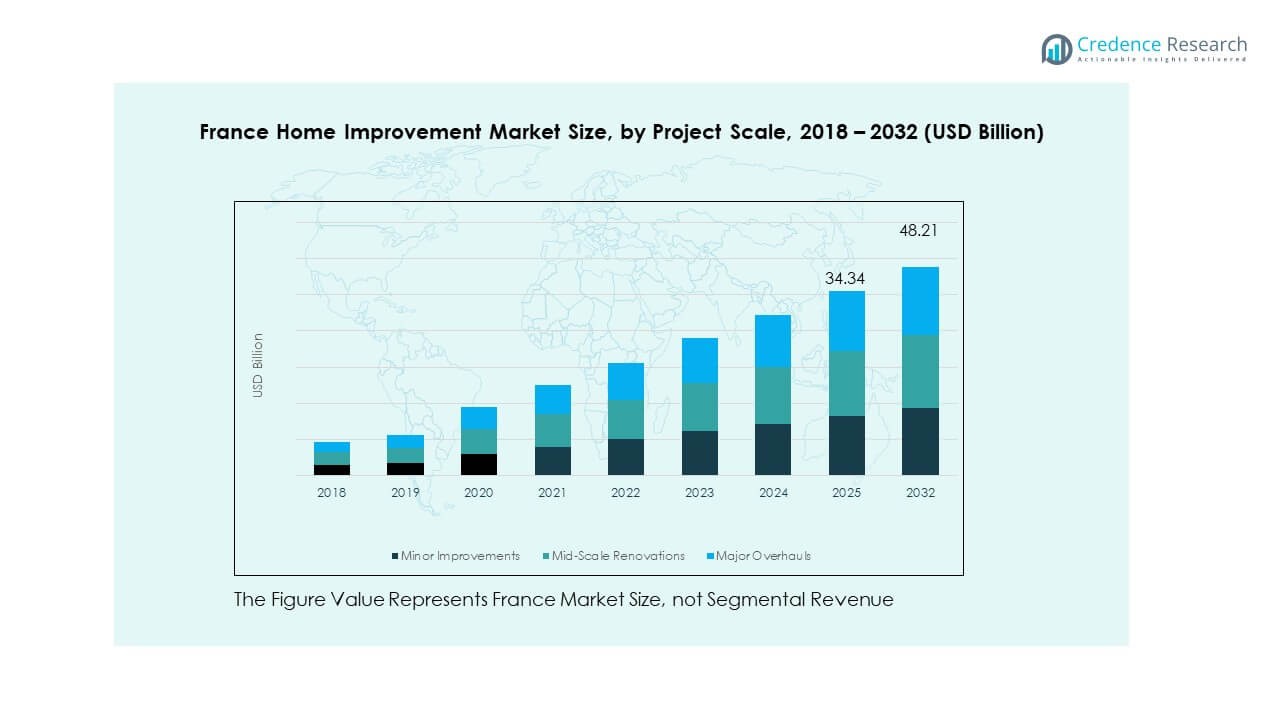
- In 2024, minor improvements account for the largest segment share, with approximately 45% of market revenue, followed by mid-scale renovations at 30%, and major overhauls at 25%.
- The distribution of project scales in the France Home Improvement Market shows a shift toward mid-scale renovations, with a steady increase in demand for major overhauls, reflecting greater investments in home upgrades and energy-efficient solutions.
Market Drivers:
Rising Consumer Spending on Home Renovation
The France Home Improvement Market is experiencing a surge in consumer spending on home renovation due to rising disposable incomes. Homeowners are investing in projects that enhance the aesthetics, functionality, and sustainability of their properties. Government incentives for energy-efficient upgrades are further driving this demand. The increase in middle-class households with higher purchasing power supports continued spending on remodelling. Furthermore, the popularity of smart home solutions is contributing to this market growth. As more individuals focus on improving their living spaces, the demand for advanced home improvement products is expanding. The DIY trend has also gained momentum, allowing homeowners to take on various renovation projects independently.
- For instance, Leroy Merlin recorded a 40 % growth in its online sales between 2020 and 2023, underlining homeowners’ appetite for renovation products. Homeowners are investing in projects that enhance the aesthetics, functionality, and sustainability of their properties. Government incentives for energy‑efficient upgrades further encourage this demand. A survey found that 45 % of French homeowners have carried out an energy retrofit since 2019 and 32 % intend to do so.
Government Support for Energy-Efficient Homes
Energy efficiency is a significant driver for the France Home Improvement Market, supported by various governmental initiatives. Programs offering financial support for sustainable construction materials and energy-saving appliances encourage homeowners to make environmentally-conscious renovations. The French government has set ambitious energy reduction goals, creating a favorable environment for energy-efficient home upgrades. This has led to an increased adoption of technologies like solar panels, efficient insulation, and smart heating systems. The market is witnessing significant interest in retrofitting older homes to meet modern environmental standards. As a result, demand for eco-friendly home improvement solutions continues to rise.
- For instance, the Ma Prime Rénov’ scheme extended in 2023 enables large subsidies for homeowners to upgrade insulation and install heat‑pumps. Programs offering financial support for sustainable materials and energy‑saving appliances encourage homeowners to make environmentally‑conscious renovations. The French government announced over €6.7 billion in public funding for building energy retrofits under its recovery plan, targeting older homes.
Growing Interest in Smart Home Technology
The growing interest in smart home technology is a key driver for the France Home Improvement Market. Homeowners are increasingly investing in automation systems that enhance security, convenience, and energy management. Products such as smart lighting, climate control systems, and security cameras are becoming integral to home renovation projects. Smart technology also plays a vital role in making homes more energy-efficient. The ability to control devices remotely or program them for optimized performance drives the adoption of these systems. This trend has significantly influenced home improvement purchases, as more consumers prioritize technology in their renovation plans.
Urbanization and Shifting Lifestyle Preferences
Urbanization continues to fuel the France Home Improvement Market as more individuals move into cities with limited space. The need for efficient use of smaller living spaces encourages the demand for multi-functional furniture, storage solutions, and compact home appliances. Shifting lifestyle preferences, including a greater focus on convenience and sustainability, further contribute to the market's growth. Consumers are increasingly seeking products that combine design, functionality, and energy efficiency. These evolving preferences drive innovation in the home improvement sector, influencing both product offerings and renovation trends.
Market Trends:
Increasing Popularity of Sustainable Materials
In the France Home Improvement Market, there is a growing demand for sustainable materials. Homeowners are opting for eco-friendly alternatives such as recycled wood, bamboo flooring, and low-VOC paints. These materials offer a combination of aesthetic appeal and environmental responsibility. The focus on sustainability extends to home appliances, with consumers increasingly choosing energy-efficient models. This trend reflects a broader societal push toward reducing carbon footprints. Builders and manufacturers are responding by offering green alternatives that meet both consumer demand and regulatory standards. As sustainability becomes a core value, it influences purchasing decisions in home improvement.
- For instance, Leroy Merlin’s home‑automation platform “Enki” supports over 500 connected devices across 25 brands, facilitating energy‑saving controls and integration with low‑emission heating systems.
Rise in DIY and E-commerce Channels
The DIY trend is gaining ground in the France Home Improvement Market, with consumers preferring to handle renovations themselves. This shift is partly driven by the ease of access to online tutorials and resources. The rise of e-commerce platforms has also made it easier for consumers to purchase home improvement products at competitive prices. Online stores offer a wide range of products, from tools to materials, along with convenient delivery options. Many retailers have expanded their digital presence, providing an enhanced shopping experience for DIY enthusiasts. This trend is expected to continue as technology evolves and home improvement products become more accessible.
- For instance, the Mr Bricolage Group operates over 1,000 stores as of June 2024, supporting a strong network for DIY projects. The shift comes from easier access to online tutorials and resources. The rise of e‑commerce platforms has made it easier for consumers to purchase home improvement products at competitive prices.
Integration of Smart Home Devices
Another prominent trend in the France Home Improvement Market is the integration of smart home devices. Consumers are increasingly investing in home automation systems that provide greater control and energy efficiency. Smart thermostats, lighting systems, and security cameras are becoming standard in home renovations. These devices allow homeowners to monitor and control their homes remotely, enhancing convenience and security. The demand for seamless integration of these technologies with existing home infrastructure is increasing. Home improvement businesses are responding by offering comprehensive smart home solutions that cater to this growing demand.
Interest in Wellness-Oriented Home Improvements
There is a rising trend of wellness-oriented home improvements in France. Consumers are increasingly focusing on creating healthier living environments that promote physical and mental well-being. This includes the installation of air purification systems, water filtration systems, and the use of non-toxic materials in home renovations. The pandemic has further accelerated this trend, as people spend more time at home and prioritize comfort. Homeowners are also investing in outdoor spaces to create calming environments. As wellness becomes a key focus, the demand for products that contribute to a healthier home is expected to grow.
Market Challenges Analysis:
High Cost of Home Improvement Projects
One of the major challenges in the France Home Improvement Market is the high cost of renovation projects. While the demand for home improvements is growing, the expenses associated with construction, materials, and labor can be prohibitive for many consumers. This is particularly challenging in urban areas where property prices are already high. Despite the availability of financing options, many homeowners hesitate to invest in substantial renovations due to the financial burden. Additionally, the fluctuating prices of raw materials and supply chain disruptions add to the cost challenges. As a result, the market's growth may be hindered for price-sensitive consumers who cannot afford large-scale home improvements.
Labor Shortage and Skill Gaps
The France Home Improvement Market is also facing a labor shortage and skill gaps, particularly in the construction and renovation sectors. The demand for skilled workers in home improvement projects, such as electricians, plumbers, and carpenters, is high. However, the industry is struggling to meet this demand due to a lack of skilled professionals. The aging workforce in the construction industry and insufficient training opportunities for younger generations exacerbate this problem. The shortage of skilled labor can delay project timelines and increase costs, ultimately impacting the growth of the market. It also limits the ability of homeowners to find affordable and qualified professionals for their renovation needs.
Market Opportunities:
Demand for Energy-Efficient Upgrades
The France Home Improvement Market presents significant opportunities in the area of energy-efficient home upgrades. As more consumers become aware of environmental issues and the financial benefits of energy-saving solutions, there is a growing demand for energy-efficient windows, insulation, and heating systems. Government incentives and rising energy costs further support this demand. Companies offering energy-efficient products that reduce energy consumption are poised for success in the market. This trend presents a strong growth opportunity for businesses focusing on green technology and energy-efficient home improvements.
Potential in Smart Home Integration
There is considerable market opportunity in the integration of smart home technologies into home improvement projects. As consumers seek greater control over their homes, the demand for smart devices continues to grow. From automated lighting systems to intelligent security features, the market for smart home products is expanding. Home improvement businesses that can integrate these devices into their offerings are positioned to capture a growing segment of tech-savvy consumers. The continued advancement of smart home technology presents an ongoing opportunity for innovation and market growth in France.
Market Segmentation Analysis:
By Project Type
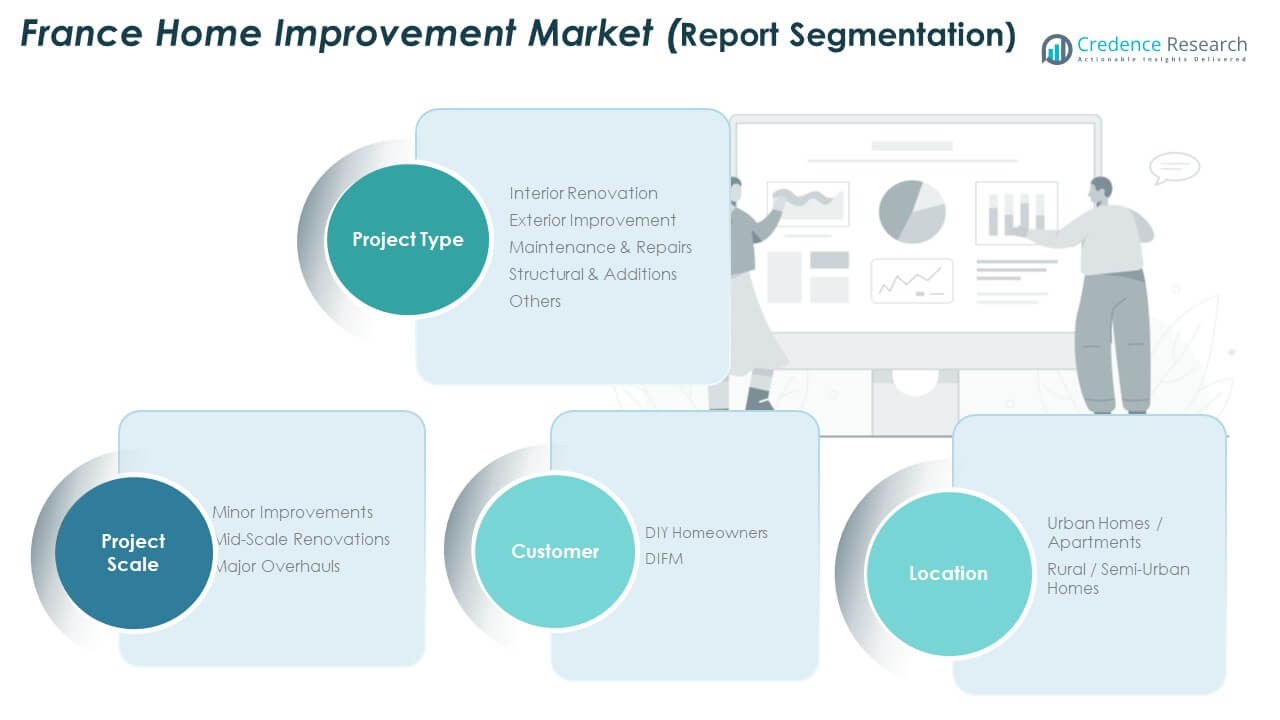
The France Home Improvement Market is segmented by project type, including interior renovation, exterior improvement, maintenance & repairs, structural & additions, and others. Interior renovations, such as remodeling kitchens and bathrooms, continue to be a significant contributor, driven by consumer demand for modern, energy-efficient designs. Exterior improvements, including landscaping and façade upgrades, have also gained traction as homeowners focus on curb appeal and sustainability. Maintenance & repairs, essential for property upkeep, form another key segment. Structural & additions, involving major renovations, are often driven by the need for more living space, while other segments cater to specialized needs like home automation.
By Project Scale
The market is further segmented by project scale into minor improvements, mid-scale renovations, and major overhauls. Minor improvements, including small updates or repairs, make up the largest portion of the market. Mid-scale renovations, such as partial room redesigns, show steady growth as homeowners seek more significant enhancements. Major overhauls, involving extensive structural changes, are less common but often bring high-value investments in the market.
- For instance, Castorama in France operates 94 stores and introduced an online platform that achieved over one million drive‑through orders in 2020, offering packages suited for mid‑scale renovation projects.
By Customer Type
The customer base is divided into DIY homeowners and DIFM (Do-It-For-Me). DIY homeowners, empowered by the internet and availability of materials, are driving the demand for affordable, small-scale renovations. DIFM customers prefer professional services for more complex projects, fueling demand for renovation companies and contractors.
By Location
Geographically, the market is divided into urban homes/apartments and rural/semi-urban homes. Urban areas, with higher disposable income, drive demand for premium home improvement products and services. Rural and semi-urban areas experience steady growth due to increased access to home improvement resources and the desire to enhance property value.
Segmentation:
By Project Type- Interior Renovation
- Exterior Improvement
- Maintenance & Repairs
- Structural & Additions
- Others
- Minor Improvements
- Mid-Scale Renovations
- Major Overhauls
- DIY Homeowners
- DIFM (Do-It-For-Me)
- Urban Homes / Apartments
- Rural / Semi-Urban Homes
Regional Analysis:
Île‑de‑France Region Dominance
The Île‑de‑France region captures a commanding share of the France Home Improvement Market, accounting for approximately 28 % of national revenue. Its high population density, elevated incomes and concentration of urban housing units drive substantial renovation and improvement activity. Consumers in this region invest heavily in premium upgrades, smart‑home systems and exterior façade enhancements. Housing units in the region often require modernization, which keeps demand strong. Contractors and retailers focus their efforts here to capitalise on the budget levels and market activity. Urban regeneration projects around Paris also boost spending on structural additions and major overhauls.
Southern & Eastern France Growth Hubs
Regions such as Provence‑Alpes‑Côte d’Azur and Auvergne‑Rhône‑Alpes hold roughly 18 % and 14 % of the market respectively. These areas benefit from tourism‑driven real estate upgrades and second‑home renovations. Homeowners in these regions focus on exterior improvements, pool installations and holiday‑home make‑overs. Local climate and lifestyle preferences fuel demand for energy‑efficient windows, outdoor living spaces and improved insulation. These regions present robust mid‑scale renovation opportunities due to older housing stock and seasonal residence usage.
Rural, Semi‑Urban and Western France Segment
The combined share for rural and semi‑urban homes in western and northern France stands near 40 % of market value. In these areas, homeowners invest in maintenance & repairs and structural additions to increase living space without relocating. Smaller towns and semi‑urban zones show rising interest in DIY projects and budget‑friendly renovations. Infrastructure improvements and retail expansion make home‑improvement products more accessible. Homes in these regions often undergo incremental upgrades, presenting steady demand but with lower average spend than major urban zones.
Key Player Analysis:
- GM Renovations
- French Connections HCB
- GLF SpA
- Crane Renovation Group
- HappyBart
- BMFrance Home ImprovementE France
- FRANCE RENOVATION
- HHI
- Moore Renovation
- Other Key Players
Competitive Analysis:
The France Home Improvement Market is highly competitive, with key players focusing on innovation and regional expansion. Leading players such as Leroy Merlin, Castorama, and Mr. Bricolage dominate the market by offering a wide range of products including construction materials, smart home devices, and renovation tools. These companies leverage strong retail networks, e-commerce platforms, and localized offerings to maintain their market positions. Smaller players also target niche segments, providing personalized services and specialized products. Intense competition drives continuous innovation in product offerings, pricing strategies, and customer service. Companies are also forming strategic partnerships to expand their product portfolios and reach new consumer segments. As consumer preferences shift toward energy-efficient and smart home solutions, market players are increasingly investing in these technologies to stay ahead.
Recent Developments:
- General Motors entered a strategic partnership with Hyundai Motor Company for co-development of electric vehicles, confirmed by reputable sources including Reuters, PR Newswire, and TechCrunch between August and October 2025.
- GM announced investment and joint ventures with Lithium Americas and Redwood Materials regarding EV battery supply and recycling, verified by Reuters and Recycling Today in 2024–2025.
Report Coverage:
The research report offers an in-depth analysis based on project type, customer type, and location. It details leading market players, providing an overview of their business, product offerings, investments, revenue streams, and key applications. Additionally, the report includes insights into the competitive environment, SWOT analysis, current market trends, as well as the primary drivers and constraints. Furthermore, it discusses various factors that have driven market expansion in recent years. The report also explores market dynamics, regulatory scenarios, and technological advancements that are shaping the industry. It assesses the impact of external factors and global economic changes on market growth. Lastly, it provides strategic recommendations for new entrants and established companies to navigate the complexities of the market.
Future Outlook:
- The France Home Improvement Market will continue to benefit from increased consumer spending on home renovations.
- Demand for energy-efficient and sustainable products will drive future growth in the market.
- Smart home technologies will become more integrated into home improvement products, offering greater convenience and security.
- Urbanization will remain a key factor, particularly in high-density areas like Paris, boosting renovation demand.
- The DIY segment will grow, driven by increased access to online resources and affordable products.
- Home improvement companies will continue expanding their e-commerce presence to capture more online sales.
- Renovation projects in rural and semi-urban areas will increase due to greater access to home improvement products.
- Maintenance and repair projects will remain a significant segment, driven by the aging housing stock.
- The rise of green building initiatives will increase demand for eco-friendly materials and retrofitting solutions.
- Regulatory frameworks focused on sustainability will foster innovation in energy-efficient products and solutions.
Request a Free Sample
Fill in your details and we'll send you a free sample report.
- Sample data tables & charts
- Research methodology
Need a Custom Version of This Report?
Tailor the scope, geography, or segments to your exact requirements.
- Custom geography or segment scope
- Direct access to our analyst team
Frequently Asked Questions
What is the current market size for France Home Improvement Market, and what is its projected size in 2032?
At what Compound Annual Growth Rate is the France Home Improvement Market projected to grow between 2024 and 2032?
Which France Home Improvement Market segment held the largest share in 2024?
What are the primary factors fueling the growth of the France Home Improvement Market?
Who are the leading companies in the France Home Improvement Market?
Which region commanded the largest share of the France Home Improvement Market in 2024?
Table of Content
Chapter 1. Report Introduction
- 1.1 Report Description & Purpose
- 1.1.1 Report Title & Market Definition
- 1.1.2 Unique Selling Propositions (USP) & Key Differentiators
- 1.1.3 Value Proposition for Stakeholders
- 1.2 Research Objectives
- 1.2.1 Market Sizing Objectives (Volume & Revenue)
- 1.2.2 Segmentation Objectives
- 1.2.3 Competitive Intelligence Objectives
- 1.2.4 Forecast & Scenario Objectives
- 1.3 Report Scope
- 1.3.1 France Home Improvement Scope – Types & Subtypes Covered
- 1.3.2 Geographic Scope – Regions & Countries Covered
- 1.3.3 Historical Period, Base Year & Forecast Period (2024; forecast to 2032)
- 1.3.4 Inclusions & Exclusions
- 1.4 HS Code & Classification Framework
- 1.5 Currency, Units & Pricing Basis
- 1.6 Target Stakeholders
- 1.7 Limitations & Assumptions
Chapter 2. Executive Summary
- 2.1 Global France Home Improvement Market Snapshot
- 2.1.1 Market Size – Historical (2024) & Forecast (2024-2032) (2024: USD 32.85 billion → 2032: USD 48.21 billion)
- 2.1.2 Volume & Revenue – Global Totals
- 2.1.3 Key Market Highlights – Top Five Facts
- 2.2 France Home Improvement Market Segmentation Snapshot
- 2.2.1 Market Split by Region – 2024 vs. 2032
- 2.3 Competitive Snapshot
- 2.3.1 Top 10 Players by Revenue Share – 2024
- 2.3.2 Top 10 Players by Volume Share – 2024
- 2.3.3 Recent Strategic Developments (18-Month Summary)
- 2.4 Key Investment Highlights & Strategic Conclusions
Chapter 3. France Home Improvement Market Dynamics & Industry Analysis
- 3.1 Market Overview & Context
- 3.1.1 France Home Improvement Market Position in the Broader Automotive Value Chain
- 3.1.2 OEM vs. Replacement Market Dynamics
- 3.1.3 Market Maturity & Development Stage by Region
- 3.2 France Home Improvement Market Drivers
- 3.3 France Home Improvement Market Restraints & Challenges
- 3.4 France Home Improvement Market Opportunities
- 3.5 Porter's Five Forces Analysis
- 3.5.1 Threat of New Entrants
- 3.5.2 Bargaining Power of Suppliers
- 3.5.3 Bargaining Power of Buyers
- 3.5.4 Threat of Substitutes
- 3.5.5 Competitive Rivalry – Intensity Assessment
- 3.6 France Home Improvement Value Chain Analysis
- 3.6.1 Upstream – Raw Material/Input Suppliers
- 3.6.1.1 Raw Material/Input 1
- 3.6.1.2 Raw Material/Input 2
- 3.6.1.3 Raw Material/Input 3
- 3.6.2 Midstream – Production/Manufacturing/Service Delivery
- 3.6.2.1 Production/Process Overview
- 3.6.2.2 Key Facility Locations & Capacity by Manufacturer
- 3.6.3 Downstream – Distribution & End Consumer
- 3.6.3.1 Primary Channel – B2B/OEM
- 3.6.3.2 Secondary Channels – Dealer, Retail, Online, Direct
- 3.6.4 Value Chain Profitability Analysis
- 3.6.1 Upstream – Raw Material/Input Suppliers
- 3.7 PESTEL Analysis
- 3.7.1 Political Factors
- 3.7.2 Economic Factors
- 3.7.3 Social Factors
- 3.7.4 Technological Factors
- 3.7.5 Environmental Factors
- 3.7.6 Legal Factors
- 3.8 France Home Improvement Supply Chain Analysis
- 3.8.1 Raw Material/Input Supply Risk Assessment
- 3.8.2 Manufacturing Concentration Risk (Geographic Exposure)
- 3.8.3 Trade Disruption Impact Analysis
- 3.9 Regulatory & Policy Landscape
Note: The regulatory and policy landscape section covers regulations based on their applicability to the market, France Home Improvement category, geography, and scope of the study. Only regulatory frameworks with a material impact on operations, compliance, trade, sustainability, or market access are analyzed in detail.
Chapter 4. Key Investment Pockets & Opportunity Analysis
- 4.1 France Home Improvement Market Attractiveness Analysis
- 4.1.1 By Region – Investment Attractiveness Matrix (Volume × CAGR)
- 4.2 Absolute Revenue Growth Opportunity
- 4.2.1 By Region – Absolute USD Growth Through 2032
- 4.3 Incremental Volume Opportunity
- 4.3.1 By Region – Incremental Volume Through 2032
- 4.3.2 Segment – Incremental Volume
- 4.4 Emerging Submarket Opportunity Deep Dive (Subject to Applicability)
- 4.5 Emerging Market Opportunity Scorecards
- 4.5.1 United States
- 4.5.2 Europe
- 4.5.3 Asia
- 4.5.4 Middle East & Africa
Note: Emerging Market Opportunity Scorecards will be included based on relevance and strategic importance. Regions listed are indicative and may vary depending on data availability and market dynamics.
Chapter 5. France Home Improvement Import-Export Analysis & Trade Flows
- 5.1 Global Trade Overview
- 5.1.1 Global Export Value by Country (2024)
- 5.1.2 Global Export Volume by Country (2024)
- 5.1.3 Global Import Value by Country (2024)
- 5.1.4 Global Import Volume by Country (2024)
- 5.1.5 Net Trade Balance by Country (2024)
- 5.2 Export Analysis – Segment
- 5.2.1 Type 1 (HS Code)
- 5.2.2 Type 2 (HS Code)
- 5.2.3 Type 3 (HS Code)
- 5.2.4 Type 4 (HS Code)
- 5.2.5 Type 5 (HS Code)
- 5.3 Import Analysis – Segment
- 5.3.1 Type 1 (HS Code)
- 5.3.2 Type 2 (HS Code)
- 5.3.3 Type 3 (HS Code)
- 5.3.4 Type 4 (HS Code)
- 5.3.5 Type 5 (HS Code)
- 5.4 Average Unit Trade Prices
- 5.4.1 Average Export Price – Segment & Country
- 5.4.2 Average Import Price – Segment & Source Country
- 5.4.3 Price Trends (2024)
- 5.5 Key Trade Route Analysis
- 5.5.1 Trade Route 1
- 5.5.2 Trade Route 2
- 5.5.3 Trade Route 3
- 5.5.4 Trade Route 4
- 5.5.5 Trade Route 5
- 5.6 Trade Policy Impact Assessment
- 5.6.1 US Anti-Dumping & Section 301 Tariffs
- 5.6.2 EU Customs Union Impact
- 5.6.3 Major Free Trade Agreements
- 5.6.4 USMCA Rules of Origin
Note: Trade policy analysis will be included only where relevant to the France Home Improvement market.
Chapter 6. Competitive Landscape & Company Benchmarking
- 6.1 France Home Improvement Market Concentration & Structure
- 6.1.1 Herfindahl-Hirschman Index (HHI) – vs. 2024
- 6.1.2 Tier 1, Tier 2 & Tier 3 Market Structure
- 6.1.3 Global, Regional & Local Player Dynamics
- 6.2 France Home Improvement Market Share Analysis – 2024
- 6.2.1 Global Revenue Share by Company
- 6.2.2 Global Volume Share by Company
- 6.2.3 Regional Revenue Share
- 6.2.4 Market Share Evolution ( vs. 2024)
- 6.2.5 OEM Segment Share by Company
- 6.2.6 Replacement Segment Share by Company
- 6.3 Production/Delivery Capacity & Facility Analysis
- 6.3.1 Global Installed Capacity
- 6.3.2 Capacity Utilization Rates
- 6.3.3 Production/Output Volume
- 6.3.4 Facility Locations & Capacity Map
- 6.3.5 Planned Capacity Additions
- 6.4 France Home Improvement Competitive Benchmarking Matrix
- 6.4.1 Revenue, Volume, CAGR & Profitability Comparison
- 6.4.2 Channel Revenue Mix
- 6.4.3 Geographic Revenue Exposure
- 6.4.4 R&D Intensity
- 6.4.5 Sustainability Maturity
- 6.5 Strategic Developments in France Home Improvement (Last 24 Months)
- 6.5.1 Mergers, Acquisitions & Divestments
- 6.5.2 New France Home Improvement Launches
- 6.5.3 Facility Expansions
- 6.5.4 Strategic Alliances, Joint Ventures & Partnerships
- 6.5.5 Distribution Expansion & Market Entry
- 6.5.6 Sustainability & ESG Initiatives
- 6.6 Competitive Strategy Mapping
- 6.6.1 Leader, Challenger, Follower & Niche Classification
- 6.6.2 Pricing Strategy Comparison
- 6.6.3 Channel Strategy Matrix
Note: Strategic developments are included based on their materiality and the availability of reliable information.
Chapter 7. Global France Home Improvement Market – By Distribution Channel
- 7.1 Segment Overview
- 7.1.1 Volume & Revenue Split by Channel (2024 & 2032)
- 7.1.2 Channel Mix Evolution (2024-2032)
Chapter 8. Regional Market Analysis – Global Overview
- 8.1 Global Regional Overview
- 8.1.1 Regional Volume Share
- 8.1.2 Regional Revenue Share
- 8.1.3 Regional Volume by Region
- 8.1.4 Regional Revenue by Region
- 8.1.5 Regional Forecast Through 2032
- 8.2 Cross-Regional Segment Analysis
- 8.2.1 By Distribution Channel
- 8.2.2 By Brand/Price Tier
Chapter 9. North America France Home Improvement Market
- 9.1 United States
- 9.2 Canada
- 9.3 Mexico
Chapter 10. Europe France Home Improvement Market
- 10.1 Germany
- 10.2 France
- 10.3 Italy
- 10.4 United Kingdom
- 10.5 Spain
- 10.6 Poland
- 10.7 Russia
- 10.8 Netherlands
- 10.9 Belgium
- 10.10 Sweden
- 10.11 Denmark
- 10.12 Norway
- 10.13 Rest of Europe
Chapter 11. Asia Pacific France Home Improvement Market
- 11.1 China
- 11.2 India
- 11.3 Japan
- 11.4 South Korea
- 11.5 Thailand
- 11.6 Indonesia
- 11.7 Vietnam
- 11.8 Malaysia
- 11.9 Australia
- 11.10 Rest of Asia Pacific
Chapter 12. Latin America France Home Improvement Market
- 12.1 Brazil
- 12.2 Argentina
- 12.3 Colombia
- 12.4 Chile
- 12.5 Rest of Latin America
Chapter 13. Middle East France Home Improvement Market
- 13.1 Saudi Arabia
- 13.2 United Arab Emirates
- 13.3 Turkey
- 13.4 Israel
- 13.5 Iran
- 13.6 Rest of the Middle East
Chapter 14. Africa France Home Improvement Market
- 14.1 South Africa
- 14.2 Egypt
- 14.3 Nigeria
- 14.4 Morocco
- 14.5 Rest of Africa
Chapter 15. France Home Improvement Company Profiles
- 15.1 [Company 01]
- 15.1.1 Company Overview
- 15.1.2 Key Management Personnel
- 15.1.3 Products & Services Portfolio
- 15.1.4 Financial Performance
- 15.1.5 Key Market Focus & Geographic Presence
- 15.1.6 Recent Developments & Strategic Initiatives
Note: The company profile list is preliminary and may change based on research findings, market developments, data availability, and client requirements.
Chapter 16. Appendices
- Appendix A – List of Abbreviations & Acronyms
- Appendix B – Industry Classification Code Reference – Full Series
- Appendix C – Production & Capacity Data Tables
- Appendix D – End-Use & Demand Base Tables
- Appendix E – Consumption & Replacement Rate Assumptions
- Appendix F – ASP Reference Tables
- Appendix G – Manufacturing & Facility Database
- Appendix H – Import-Export Data Tables
- Appendix I – Regulatory Summary Tables
- Appendix J – Primary Research Participant List (Anonymized)
- Appendix K – Primary Research Questionnaire Framework
- Appendix L – Data Sources & Bibliography
- Appendix M – Market Size Divergence & Source Comparison
Chapter 17. Research Methodology
- 17.1 Research Framework & Philosophy
- 17.2 Secondary Research – Sources, Hierarchy & Data Extraction
- 17.3 Data Modeling – Bottom-Up & Top-Down Market Sizing
- 17.4 Primary Research – Stakeholder Framework, LOI & Sample Sizes
- 17.5 Forecast Methodology – Regression, Scenario & Sensitivity Analysis
- 17.6 Quality Control – Four-Layer Validation Framework
- 17.7 Limitations & Standard Assumptions
- 17.8 Disclaimer
