
Gait Rehabilitation System Market Overview
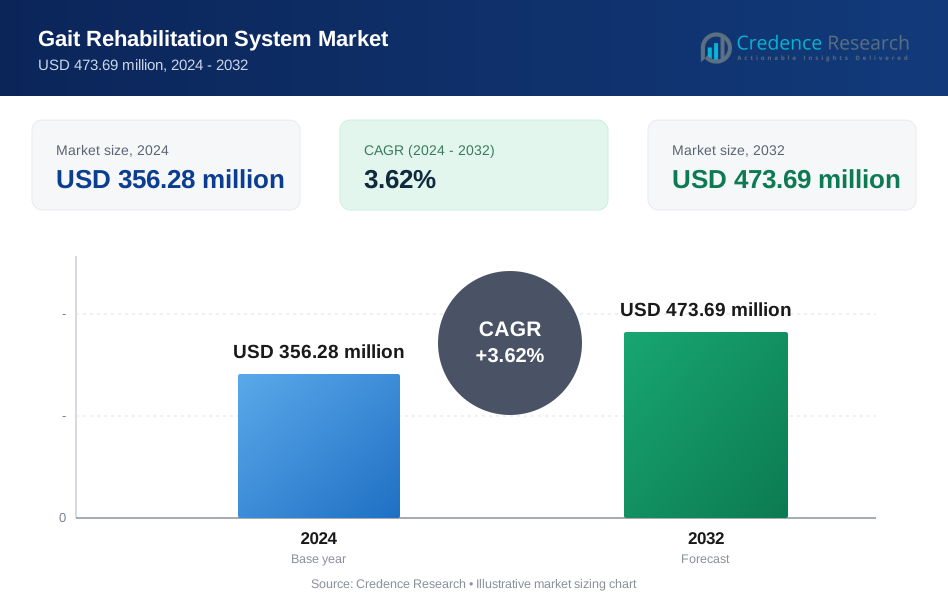
The gait rehabilitation system market is currently valued at USD 356.28 million in 2024 and is poised for robust growth. It is forecast to reach a valuation of US$ 473.69 million by 2032. This growth trajectory represents a compound annual growth rate (CAGR) of 3.62% from 2024 to 2032, indicating a steady and significant expansion in the market over this period. This market expansion is primarily attributed to the increasing prevalence of neurological disorders, a rise in the number of sports-related injuries, and an upsurge in orthopedic disease cases. The market segmentation reveals two major product types: mechanical and computer-aided gait rehabilitation systems, with the mechanical segment dominating the market in 2021. In terms of end-users, the market comprises hospitals, clinics, rehabilitation centers, and other facilities, with hospitals occupying the largest market share.
Region-wise, North America is anticipated to maintain the largest share of the gait rehabilitation system market by 2032, driven by the escalating occurrences of neurological disorders and sports injuries. Concurrently, the Asia Pacific region is projected to hold the second-largest market share, attributed to the growing prevalence of disabilities and an aging population. In Europe, market growth is primarily fueled by the increasing frequency of joint disorders. The COVID-19 pandemic has notably impacted this market, leading to a shift towards home-based exercise programs and self-rehabilitation, underscoring the potential for emerging technologies such as social assistive robotics in clinical care. The market is characterized by the presence of key players like Zebris Medical GmbH, Groupe Winncare S.A.S., and Reha Technology AG, among others, who are actively contributing to market growth through various developments and innovations.
Gait Rehabilitation System Market Drivers
The gait rehabilitation system market is propelled by a confluence of factors, converging to create a robust demand for these systems. Foremost among these is the rising incidence of neurological disorders such as Parkinson's disease, multiple sclerosis, and cerebral palsy. The prevalence of these conditions, which often impair mobility and gait, is escalating, thereby necessitating the adoption of gait rehabilitation systems for effective therapy and management.
Additionally, the realm of sports medicine is witnessing a surge in severe sports injuries. Injuries affecting ligaments and cartilage, common in athletic pursuits, are driving the need for specialized gait adjustment therapies. This trend underscores the crucial role of gait rehabilitation systems in the sports sector, where precision and recovery speed are paramount.
The increasing instances of orthopedic disorders, notably osteoarthritis, further fuel the demand for gait rehabilitation systems. As these disorders affect a significant portion of the population, especially the aging demographic, the necessity for effective gait rehabilitation solutions becomes more pronounced.
There is a growing awareness and acceptance of gait rehabilitation systems among the general public and healthcare professionals alike. This heightened awareness is contributing to an expanded market reach as more individuals recognize the benefits of these systems in improving mobility and quality of life.
Innovation plays a pivotal role in driving market growth. The development of advanced gait rehabilitation systems, incorporating computerized services and mechanical designs, is expected to revolutionize the market. These innovations enhance the effectiveness, user-friendliness, and efficiency of gait rehabilitation, making them more appealing to a broader range of users.
The market segmentation by end-user, encompassing clinics, hospitals, nursing homes, and rehabilitation centers, reveals a diverse range of applications for gait rehabilitation systems. Hospitals, in particular, are projected to constitute a significant market share by 2032, reflecting their central role in providing comprehensive rehabilitation services.
These drivers collectively underscore a dynamic and expanding market for gait rehabilitation systems, reflecting a convergence of medical needs, technological advancements, and market awareness.
Gait Rehabilitation System Market Restraints
The gait rehabilitation system market, while experiencing significant growth, encounters several restraints that impede its broader adoption. A primary challenge is the availability of alternative therapies, which offer competitive solutions to gait rehabilitation. Additionally, the high costs associated with advanced gait rehabilitation systems present a substantial barrier, particularly in regions with limited financial resources. Another notable constraint is the limited awareness and understanding of these systems in developing regions, which hampers market penetration. Regulatory hurdles also play a critical role, as the stringent and complex approval processes for medical devices can delay the introduction of new and innovative products to the market. Furthermore, the requirement for specialized training and skilled personnel for the effective deployment of these systems poses an additional challenge, limiting their widespread utilization in various healthcare settings.
Gait Rehabilitation System Market Opportunities
High Growth Potential in Emerging Economies:
Developing countries present significant growth opportunities for the gait rehabilitation system market. Increased investments in healthcare infrastructure, coupled with rising economic standards in these regions, are expected to boost the demand for advanced gait rehabilitation systems.
Technological Advancements and Innovation:
The market is likely to benefit from continuous innovations and advancements in technology. The development of more sophisticated, user-friendly, and efficient gait rehabilitation systems, including computer-aided and robotic technologies, is anticipated to attract a broader range of users and open new application avenues.
Integration with Telehealth and Remote Monitoring:
The integration of gait rehabilitation systems with telehealth and remote monitoring technologies presents a significant opportunity. This integration can facilitate remote patient monitoring and therapy, which is particularly beneficial in situations like the COVID-19 pandemic where direct patient-therapist interactions are limited.
Increasing Demand for Home-Based Rehabilitation Solutions:
There is a growing trend towards home-based rehabilitation solutions, accelerated by the COVID-19 pandemic. This shift offers an opportunity for the development and deployment of portable and easy-to-use gait rehabilitation systems suitable for home settings.
Collaborations and Partnerships:
Strategic collaborations and partnerships between key players in the market and healthcare providers can open up new opportunities. These collaborations can lead to the development of customized solutions tailored to specific patient needs and the expansion of market reach.
Rising Healthcare Expenditure and Insurance Coverage:
Increasing healthcare expenditures and the expansion of insurance coverage for rehabilitation therapies are likely to drive the demand for gait rehabilitation systems. As more patients gain access to these therapies through insurance, the market is expected to witness growth.
Interesting Facts About the Gait Rehabilitation System Market
- Sports injuries, damaging cartilage and ligaments, are a significant driver of the demand for gait rehabilitation systems. With rising sports participation, especially among children and teenagers, the incidence of injuries is increasing. For instance, Stanford Children’s Health (2020) reported that out of 30 million children and teenagers participating in sports annually in the US, approximately 3.5 million injuries occur. The most common among these are sprains and strains.
- Personal exercise activities, with or without equipment, also contribute to the injury count. The National Safety Council (NSC) estimated that in 2017, there were about 526,000 injuries from personal exercise in the US.
- According to the National Federation of State High School Associations (NFHS), there was a significant increase in sports participation among male high school students in the US during 2018–2019, particularly in sports like soccer, wrestling, and tennis. School sports participation reached a 30-year peak in 2017–2018 in the US.
- The prevalence and impact of disorders affecting gait are expected to increase with the aging population and the rise in risk factors for noncommunicable diseases (NCDs).
- OA, characterized by the breakdown of joint cartilage, is a common joint disorder, particularly in the US. The Centers for Disease Control and Prevention (CDC) report that over 32.5 million adults in the US suffer from OA. In the UK, according to the National Health Service (NHS) data from December 2018, more than 10 million people have arthritis or similar joint-affecting conditions.
- Gait rehabilitation systems are extensively used as primary therapy devices across all age groups, often without a physician's prescription, underscoring their accessibility and importance in managing mobility issues.
- The escalating number of people suffering from sports injuries and orthopedic diseases significantly contributes to the growth of the gait rehabilitation system market.
- Gait rehabilitation is focused on teaching individuals how to walk again, applicable to both children learning to walk and individuals recovering from an injury or disability.
- Primarily designed for acute and subacute neurological inpatients, gait rehabilitation is essential for patients with brain lesions, forming a critical component of their rehabilitation.
- The contemporary approach favors task-specific, repetitive training, emphasizing the need for patients to engage in walking to regain this ability effectively.
- The development of gait rehabilitation machines with programmable footplates allows for more effective training sessions, leading to substantial improvements in gait.
- Gait training exercises aim to enhance motion in lower extremity joints, improve strength and balance, and mimic the natural repetitive motion of walking.
- The gait rehabilitation system market is projected to reach US$ 473.69 million by 2032, growing at a CAGR of 3.62% from 2024 to 2032.
- The market is segmented by gait rehabilitation system type, product type, and end-users, including clinics, hospitals, nursing homes, and rehabilitation centers.
- The hospital segment is expected to acquire a significant share of the market by 2035 due to its capability to offer focused and efficient rehabilitation therapies.
Competitive Landscape
The competitive landscape of the gait rehabilitation system market is characterized by the presence of several key players, each employing various strategies to strengthen their market position. These strategies include product innovation, mergers and acquisitions, expansion into new markets, and enhancing production capabilities. Some of the notable players in the gait rehabilitation system market are:
- DIH Medical
- Meditouch
- HIWIN Corporation
- BAMA teknoloji
- Restorative Therapies, Inc.
- Zebris Medical GmbH
- Reha Technology AG
- Groupe WINNCARE
- PRODROMUS S.A.
- Meden-Inmed Sp. z o.o.
Regional Analysis
The gait rehabilitation system market demonstrates distinct regional trends and growth dynamics. In North America, the market is expected to dominate globally by 2032, largely driven by an increasing prevalence of neurological disorders and sports injuries. Common conditions such as Parkinson's disease, multiple sclerosis, and stroke, along with sports-related injuries, significantly contribute to the demand for gait rehabilitation technologies in this region. Additionally, North America benefits from substantial investments in research and development, fostering innovation and market growth in the field of gait rehabilitation systems.
In contrast, the Asia-Pacific region is projected to hold the second-largest market share by 2032, with growth mainly attributed to the rising incidence of disabilities and an aging population. This region is experiencing an increase in stroke prevalence among the elderly and is actively engaging in research and development activities, which are expected to fuel market growth. Europe also shows promising growth potential in the gait rehabilitation system market, driven by the increasing frequency of joint disorders and an expanding elderly population. The rising demand for gait rehabilitation systems in Europe is largely due to the need to address mobility issues caused by joint diseases like osteoarthritis and rheumatoid arthritis, as well as the prevalence of sports injuries and orthopedic diseases.
Segmentation
By Application
- Orthopaedic Disorders
- Neurological Disorders
- Amputation
- Others
By Product Type
- Treadmill System
- Exoskeleton
- Gait Trainer Walker
By End Users
- Clinics,
- Hospitals,
- Nursing Home,
- Rehabilitation Centers
By Age
- Paediatric
- Adult
By Connectivity
- Wired
- Wireless
Artificial intelligence
- Offering
- Technology
Request a Free Sample
Fill in your details and we'll send you a free sample report.
- Sample data tables & charts
- Research methodology
Need a Custom Version of This Report?
Tailor the scope, geography, or segments to your exact requirements.
- Custom geography or segment scope
- Direct access to our analyst team
Frequently Asked Questions
What is the projected market size of the gait rehabilitation system market by 2032?
What is driving the growth of the gait rehabilitation system market?
Which regions are leading in the gait rehabilitation system market?
What are the challenges facing the gait rehabilitation system market?
Table of Content
Chapter 1. Report Introduction
- 1.1 Report Description & Purpose
- 1.1.1 Report Title & Market Definition
- 1.1.2 Unique Selling Propositions (USP) & Key Differentiators
- 1.1.3 Value Proposition for Stakeholders
- 1.2 Research Objectives
- 1.2.1 Market Sizing Objectives (Volume & Revenue) (Volume Where Applicable)
- 1.2.2 Segmentation Objectives
- 1.2.3 Competitive Intelligence Objectives
- 1.2.4 Forecast & Scenario Objectives
- 1.3 Report Scope
- 1.3.1 Gait Rehabilitation System Scope – Segments & Subsegments Covered
- 1.3.2 Geographic Scope – Regions & Countries Covered
- 1.3.3 Historical Period, Base Year & Forecast Period (2024; forecast to 2032)
- 1.3.4 Inclusions & Exclusions
- 1.4 Industry Classification & Applicable Codes
- 1.5 Currency, Measurement Units & Valuation Basis
- 1.6 Target Stakeholders
- 1.7 Limitations & Assumptions
Chapter 2. Executive Summary
- 2.1 Global Gait Rehabilitation System Market Snapshot
- 2.1.1 Market Size – Historical (2024) & Forecast (2024-2032) (2024: USD 356.28 million → 2032: USD 473.69 million)
- 2.1.2 Volume & Revenue – Global Totals (Volume Where Applicable)
- 2.1.3 Key Market Highlights – Top Five Facts
- 2.2 Gait Rehabilitation System Market Segmentation Snapshot
- 2.2.1 Market Split by Region – 2024 vs. 2032
- 2.3 Competitive Snapshot
- 2.3.1 Top 10 Players by Revenue Share – 2024
- 2.3.2 Top 10 Players by Volume Share – 2024 (Volume Where Applicable)
- 2.3.3 Recent Strategic Developments (18-Month Summary)
- 2.4 Key Investment Highlights & Strategic Conclusions
Chapter 3. Gait Rehabilitation System Market Dynamics & Industry Analysis
- 3.1 Market Overview & Context
- 3.1.1 Gait Rehabilitation System Market Position in the Broader Industry Value Chain
- 3.1.2 Demand Structure & Purchasing Dynamics
- 3.1.3 Market Maturity & Development Stage by Region
- 3.2 Gait Rehabilitation System Market Drivers
- 3.3 Gait Rehabilitation System Market Restraints & Challenges
- 3.4 Gait Rehabilitation System Market Opportunities
- 3.5 Porter's Five Forces Analysis
- 3.5.1 Threat of New Entrants
- 3.5.2 Bargaining Power of Suppliers
- 3.5.3 Bargaining Power of Buyers
- 3.5.4 Threat of Substitutes
- 3.5.5 Competitive Rivalry – Intensity Assessment
- 3.6 Gait Rehabilitation System Value Chain Analysis
- 3.6.1 Upstream – Key Inputs, Resources & Suppliers
- 3.6.1.1 Key Input/Resource 1
- 3.6.1.2 Key Input/Resource 2
- 3.6.1.3 Key Input/Resource 3
- 3.6.2 Midstream – Core Operations & Value Creation
- 3.6.2.1 Operating Model & Process Overview
- 3.6.2.2 Key Operating Locations & Capabilities by Company
- 3.6.3 Downstream – Market Channels & End Users
- 3.6.3.1 Direct Sales & Customer Engagement Channels
- 3.6.3.2 Indirect Sales, Intermediaries & Partner Channels
- 3.6.4 Value Chain Profitability Analysis
- 3.6.1 Upstream – Key Inputs, Resources & Suppliers
- 3.7 PESTEL Analysis
- 3.7.1 Political Factors
- 3.7.2 Economic Factors
- 3.7.3 Social Factors
- 3.7.4 Technological Factors
- 3.7.5 Environmental Factors
- 3.7.6 Legal Factors
- 3.8 Gait Rehabilitation System Supply Chain Analysis
- 3.8.1 Critical Input & Resource Availability Risk Assessment
- 3.8.2 Supplier & Operational Concentration Risk (Geographic Exposure)
- 3.8.3 Supply & Service Disruption Impact Analysis
- 3.9 Regulatory & Policy Landscape
Note: The regulatory and policy landscape section covers regulations based on their applicability to the market, Gait Rehabilitation System category, geography, and scope of the study. Only regulatory frameworks with a material impact on operations, compliance, trade, sustainability, or market access are analyzed in detail.
Chapter 4. Key Investment Pockets & Opportunity Analysis
- 4.1 Gait Rehabilitation System Market Attractiveness Analysis
- 4.1.1 By Region – Investment Attractiveness Matrix (Market Size × CAGR)
- 4.2 Absolute Revenue Growth Opportunity
- 4.2.1 By Region – Absolute Revenue Growth Through 2032
- 4.3 Incremental Demand Opportunity
- 4.3.1 By Region – Incremental Demand Through 2032
- 4.3.2 Segment – Incremental Demand
- 4.4 Emerging Submarket Opportunity Deep Dive (Subject to Applicability)
- 4.5 Priority Market Opportunity Scorecards
- 4.5.1 United States
- 4.5.2 Europe
- 4.5.3 Asia
- 4.5.4 Middle East & Africa
Note: Priority market opportunity scorecards reflect the geographic scope and strategic relevance of the study. Listed markets are indicative and may be adapted to the industry.
Chapter 5. Gait Rehabilitation System Cross-Border Trade & Market Access Analysis
- 5.1 International Trade & Cross-Border Activity Overview
- 5.1.1 Global Export Value by Country (2024)
- 5.1.2 Global Export Volume by Country (2024) (Volume Where Applicable)
- 5.1.3 Global Import Value by Country (2024)
- 5.1.4 Global Import Volume by Country (2024) (Volume Where Applicable)
- 5.1.5 Net Trade Balance by Country (2024)
- 5.2 Export Analysis – Segment
- 5.2.1 Category 1 (Applicable Classification Code)
- 5.2.2 Category 2 (Applicable Classification Code)
- 5.2.3 Category 3 (Applicable Classification Code)
- 5.2.4 Category 4 (Applicable Classification Code)
- 5.2.5 Category 5 (Applicable Classification Code)
- 5.3 Import Analysis – Segment
- 5.3.1 Category 1 (Applicable Classification Code)
- 5.3.2 Category 2 (Applicable Classification Code)
- 5.3.3 Category 3 (Applicable Classification Code)
- 5.3.4 Category 4 (Applicable Classification Code)
- 5.3.5 Category 5 (Applicable Classification Code)
- 5.4 Cross-Border Pricing & Transaction Benchmarks
- 5.4.1 Export Pricing – Segment & Country
- 5.4.2 Import Pricing – Segment & Source Country
- 5.4.3 Price Trends (2024)
- 5.5 Key Cross-Border Trade & Delivery Routes
- 5.5.1 Cross-Border Trade/Delivery Route 1
- 5.5.2 Cross-Border Trade/Delivery Route 2
- 5.5.3 Cross-Border Trade/Delivery Route 3
- 5.5.4 Cross-Border Trade/Delivery Route 4
- 5.5.5 Cross-Border Trade/Delivery Route 5
- 5.6 Trade Policy & Market Access Impact Assessment
- 5.6.1 Tariff & Non-Tariff Barriers
- 5.6.2 Regional Trade & Economic Integration Frameworks
- 5.6.3 Bilateral & Multilateral Trade Agreements
- 5.6.4 Cross-Border Operating, Licensing & Localization Requirements
Note: This chapter applies where cross-border trade or delivery is relevant to Gait Rehabilitation System. Goods, services, and digital offerings are assessed using applicable classifications and transaction measures. Import-export volumes, trade balances, and route analyses are included only where meaningful to the market.
Chapter 6. Competitive Landscape & Company Benchmarking
- 6.1 Gait Rehabilitation System Market Concentration & Structure
- 6.1.1 Herfindahl-Hirschman Index (HHI) – the historical period vs. 2024
- 6.1.2 Leading, Mid-Sized & Emerging Player Structure
- 6.1.3 Global, Regional & Local Player Dynamics
- 6.2 Gait Rehabilitation System Market Share Analysis – 2024
- 6.2.1 Global Revenue Share by Company
- 6.2.2 Global Volume Share by Company (Volume Where Applicable)
- 6.2.3 Regional Revenue Share
- 6.2.4 Market Share Evolution (the historical period vs. 2024)
- 6.2.5 Company Market Share by Key Segment
- 6.2.6 Company Market Share by Customer Group
- 6.3 Operating Scale, Capacity & Infrastructure Analysis
- 6.3.1 Global Operating Scale & Supply Capacity
- 6.3.2 Resource Utilization & Operating Efficiency
- 6.3.3 Output, Service Delivery & Activity Metrics
- 6.3.4 Operating Footprint & Infrastructure Map
- 6.3.5 Planned Operational & Capacity Expansion
- 6.4 Gait Rehabilitation System Competitive Benchmarking Matrix
- 6.4.1 Revenue, Growth, Profitability & Operating Metric Comparison
- 6.4.2 Channel Revenue Mix
- 6.4.3 Geographic Revenue Exposure
- 6.4.4 R&D Intensity
- 6.4.5 Sustainability Maturity
- 6.5 Strategic Developments in Gait Rehabilitation System (Last 24 Months)
- 6.5.1 Mergers, Acquisitions & Divestments
- 6.5.2 New Products, Services & Solutions in Gait Rehabilitation System
- 6.5.3 Operational & Infrastructure Expansions
- 6.5.4 Strategic Alliances, Joint Ventures & Partnerships
- 6.5.5 Distribution Expansion & Market Entry
- 6.5.6 Sustainability & ESG Initiatives
- 6.6 Competitive Strategy Mapping
- 6.6.1 Leader, Challenger, Follower & Niche Classification
- 6.6.2 Pricing Strategy Comparison
- 6.6.3 Channel Strategy Matrix
Note: Strategic developments are included based on their materiality and the availability of reliable information.
Chapter 7. Global Gait Rehabilitation System Market – By Sales & Delivery Channel
- 7.1 Segment Overview
- 7.1.1 Volume & Revenue Split by Channel (2024 & 2032) (Volume Where Applicable)
- 7.1.2 Channel Mix Evolution (2024-2032)
Chapter 8. Regional Market Analysis – Global Overview
- 8.1 Global Regional Overview
- 8.1.1 Regional Volume Share (Volume Where Applicable)
- 8.1.2 Regional Revenue Share
- 8.1.3 Regional Volume by Region (Volume Where Applicable)
- 8.1.4 Regional Revenue by Region
- 8.1.5 Regional Forecast Through 2032
- 8.2 Cross-Regional Segment Analysis
- 8.2.1 By Sales & Delivery Channel
- 8.2.2 By Competitive Positioning & Price Tier
Chapter 9. North America Gait Rehabilitation System Market
- 9.1 United States
- 9.2 Canada
- 9.3 Mexico
Chapter 10. Europe Gait Rehabilitation System Market
- 10.1 Germany
- 10.2 France
- 10.3 Italy
- 10.4 United Kingdom
- 10.5 Spain
- 10.6 Poland
- 10.7 Russia
- 10.8 Netherlands
- 10.9 Belgium
- 10.10 Sweden
- 10.11 Denmark
- 10.12 Norway
- 10.13 Rest of Europe
Chapter 11. Asia Pacific Gait Rehabilitation System Market
- 11.1 China
- 11.2 India
- 11.3 Japan
- 11.4 South Korea
- 11.5 Thailand
- 11.6 Indonesia
- 11.7 Vietnam
- 11.8 Malaysia
- 11.9 Australia
- 11.10 Rest of Asia Pacific
Chapter 12. Latin America Gait Rehabilitation System Market
- 12.1 Brazil
- 12.2 Argentina
- 12.3 Colombia
- 12.4 Chile
- 12.5 Rest of Latin America
Chapter 13. Middle East Gait Rehabilitation System Market
- 13.1 Saudi Arabia
- 13.2 United Arab Emirates
- 13.3 Turkey
- 13.4 Israel
- 13.5 Iran
- 13.6 Rest of the Middle East
Chapter 14. Africa Gait Rehabilitation System Market
- 14.1 South Africa
- 14.2 Egypt
- 14.3 Nigeria
- 14.4 Morocco
- 14.5 Rest of Africa
Chapter 15. Gait Rehabilitation System Company Profiles
- 15.1 [Company 01]
- 15.1.1 Company Overview
- 15.1.2 Key Management Personnel
- 15.1.3 Products & Services Portfolio
- 15.1.4 Financial Performance
- 15.1.5 Key Market Focus & Geographic Presence
- 15.1.6 Recent Developments & Strategic Initiatives
Note: The company profile list is preliminary and may change based on research findings, market developments, data availability, and client requirements.
Chapter 16. Appendices
- Appendix A – List of Abbreviations & Acronyms
- Appendix B – Industry Classification Code Reference – Full Series
- Appendix C – Supply, Output & Operating Capacity Data Tables
- Appendix D – End-Use & Demand Base Tables
- Appendix E – Demand, Adoption & Usage Assumptions
- Appendix F – Pricing & Revenue Metric Reference Tables
- Appendix G – Company Operations & Infrastructure Database
- Appendix H – Cross-Border Trade & Activity Data Tables (Where Applicable)
- Appendix I – Regulatory Summary Tables
- Appendix J – Primary Research Participant List (Anonymized)
- Appendix K – Primary Research Questionnaire Framework
- Appendix L – Data Sources & Bibliography
- Appendix M – Market Size Divergence & Source Comparison
Chapter 17. Research Methodology
- 17.1 Research Framework & Philosophy
- 17.2 Secondary Research – Sources, Hierarchy & Data Extraction
- 17.3 Data Modeling – Bottom-Up & Top-Down Market Sizing
- 17.4 Primary Research – Stakeholder Framework, LOI & Sample Sizes
- 17.5 Forecast Methodology – Regression, Scenario & Sensitivity Analysis
- 17.6 Quality Control – Four-Layer Validation Framework
- 17.7 Limitations & Standard Assumptions
- 17.8 Disclaimer
