
| REPORT ATTRIBUTE | DETAILS |
|---|---|
| Historical Period | 2020-2023 |
| Base Year | 2024 |
| Forecast Period | 2025-2032 |
| Gardening Tools Market Size 2024 | USD 9,500.00 Million |
| Gardening Tools Market, CAGR | 4.20% |
| Gardening Tools Market Size 2032 | USD 13,757.30 Million |
Market Overview
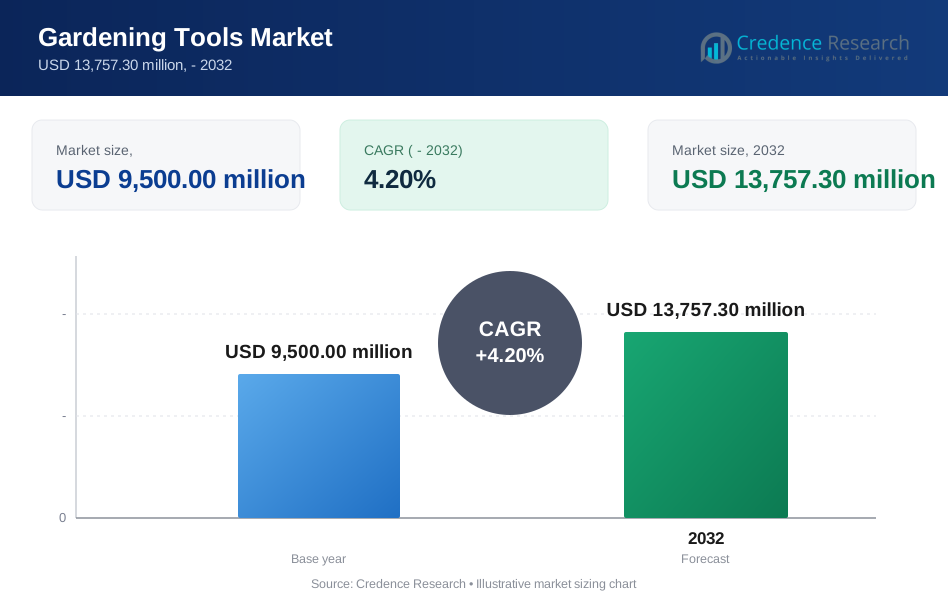
The global Gardening Tools Market is projected to grow from USD 9,500.00 million in 2024 to an estimated USD 13,757.30 million by 2032, with a compound annual growth rate (CAGR) of 4.20% from 2025 to 2032. The market's growth is driven by increasing consumer interest in gardening activities, home gardening, and landscaping.
Several factors are driving the growth of the global gardening tools market, including the rising trend of sustainable and organic gardening, increased outdoor living spaces, and growing awareness of environmental conservation. Moreover, there is a growing demand for easy-to-use, lightweight, and efficient gardening tools, catering to both amateur gardeners and professionals. The surge in DIY gardening projects, particularly in urban areas, further contributes to market growth. Additionally, the popularity of gardening as a form of stress relief and a recreational activity is creating a favorable market environment.
Geographically, North America holds a significant share in the gardening tools market, driven by high disposable incomes and widespread interest in gardening. Europe is also a prominent market, where consumers are increasingly adopting gardening as a hobby. Asia-Pacific is expected to witness rapid growth due to urbanization and rising disposable incomes. Key players in the global gardening tools market include Husqvarna Group, STIHL, Stanley Black & Decker, and Fiskars Group, among others, who are focused on product innovation and expanding their market presence.
Market Insights
- The global gardening tools market is projected to grow from USD 9,500.00 million in 2024 to USD 13,757.30 million by 2032, registering a CAGR of 4.20% from 2025 to 2032.
- Increasing consumer interest in home gardening, sustainable gardening, and landscaping is fueling demand for innovative, ergonomic, and lightweight gardening tools.
- The adoption of cordless electric tools, smart irrigation systems, and robotic lawnmowers is enhancing gardening efficiency and convenience.
- High competition, price sensitivity, and seasonal demand fluctuations pose challenges for manufacturers and retailers in the gardening tools market.
- North America holds the largest market share, supported by high disposable incomes and a strong culture of home gardening and landscaping.
- Asia-Pacific is the fastest-growing region, driven by urbanization, rising disposable incomes, and increasing interest in gardening activities.
- Companies such as Husqvarna Group, STIHL, Stanley Black & Decker, and Fiskars Group are investing in product innovation, sustainability, and digital retail expansion to strengthen their market position.
Market Drivers
Growing Interest in Sustainable and Organic Gardening
The increasing focus on sustainability and organic gardening is another significant driver of the global gardening tools market. As consumers become more environmentally conscious, there is a growing demand for eco-friendly gardening practices. Organic gardening, which avoids synthetic chemicals and fertilizers, has gained considerable traction among environmentally conscious individuals. This shift in gardening practices has led to the development and adoption of specialized tools that cater to the needs of organic gardeners. Tools designed for organic gardening, such as composters, non-toxic pesticides, and biodegradable plant protectors, are increasingly in demand.In addition, the desire for homegrown produce, such as fruits, vegetables, and herbs, has spurred a rise in home gardening activities. This trend aligns with the growing focus on health and wellness, as people are becoming more conscious of the food they consume and its impact on their well-being. Organic gardening allows individuals to control what goes into their food, ensuring that it is free from harmful chemicals and pesticides. As a result, there is an increasing need for specialized gardening tools that enable efficient organic gardening. Manufacturers are responding to this trend by producing tools that are tailored to the specific requirements of sustainable gardening, thereby driving market growth.
Urbanization and Growing Demand for Small-Scale Gardening
Rapid urbanization, particularly in emerging economies, is another crucial driver of the global gardening tools market. As more people move to urban areas, the availability of green spaces is becoming increasingly limited. This shift has led to the rise of small-scale gardening, where individuals utilize balconies, terraces, windowsills, and rooftop spaces to grow plants. Container gardening, vertical gardens, and hydroponics are becoming popular methods for maximizing limited space and enabling urban dwellers to engage in gardening.In response to this trend, gardening tool manufacturers are innovating to provide products suited for small-scale, urban gardening. Tools that are compact, easy to store, and suitable for container gardening are in high demand. Furthermore, there is an increased need for tools that support urban farming and community gardens, where space optimization and efficient gardening techniques are crucial. The growing trend of urban gardening is not only a lifestyle choice but also a response to the need for sustainable food sources in densely populated cities. As more urban residents embrace gardening, the demand for specialized tools designed for small-scale urban environments will continue to drive growth in the global gardening tools market.
Increasing Popularity of Gardening as a Hobby
The rising popularity of gardening as a hobby is a primary driver of growth in the global gardening tools market. Over the past few years, gardening has evolved from a practical activity to a lifestyle choice, offering benefits such as relaxation, stress relief, and a connection to nature. This trend is particularly prevalent among millennials and urban dwellers who seek a therapeutic activity that allows them to disconnect from their hectic digital lives. Gardening also serves as a way for individuals to grow their own food, which aligns with the growing trend of sustainability and eco-consciousness. This surge in interest has led to increased demand for gardening tools that are specifically designed to cater to both novice and experienced gardeners.For instance, gardening has become a therapeutic outlet for millennials and urban dwellers seeking stress relief and a connection to nature. This trend is evident in the rise of community gardens and rooftop green spaces, where individuals can grow their own food and contribute to environmental sustainability. As a result, there is a growing demand for gardening tools that cater to both novice and experienced gardeners, such as shovels, trowels, and watering systems.The DIY gardening movement has significantly contributed to this growth, with people transforming their homes into self-sustaining green spaces, ranging from small balconies and rooftops to expansive gardens. As a result, the demand for various gardening tools has surged. Manufacturers have responded to this trend by offering a wide range of tools that cater to different gardening needs, thus fostering further market expansion. The desire for self-reliance, coupled with the enjoyment of nurturing plants, continues to drive a growing consumer base and directly impacts the sales of gardening tools.
Technological Advancements in Gardening Tools
Technological innovations in gardening tools are another key driver of market growth. Traditional gardening tools are being replaced or enhanced with advanced features that make gardening easier, faster, and more efficient. For instance, electric and battery-powered tools like lawnmowers and hedge trimmers have gained popularity due to their convenience, low emissions, and minimal maintenance. These cordless, battery-operated tools offer greater flexibility and are more user-friendly, especially for those who may struggle with manual labor or heavier equipment.Furthermore, tools equipped with ergonomic designs are addressing the need for comfort and safety. With an aging population in many parts of the world, there is growing demand for lightweight, ergonomic tools that reduce strain on the body and make gardening accessible to people of all ages. Innovations in materials, such as rust-resistant metals and durable plastics, have also improved the longevity and performance of gardening tools. These developments are attracting both amateur gardeners and professionals alike, as they make gardening tasks more efficient and enjoyable. The shift towards technological advancements in gardening tools will continue to drive the market as more consumers prioritize convenience, sustainability, and ease of use.
Market Trends
Customization and Ergonomics
As gardening continues to be embraced by a broader demographic, particularly older adults and individuals with mobility challenges, the demand for ergonomically designed and customizable tools is on the rise. Many traditional gardening tools can be heavy, difficult to use, and may cause strain on the body, particularly when used for extended periods. As a result, there is an increasing trend toward designing gardening tools that prioritize comfort, ease of use, and customization.Ergonomically designed handles, adjustable tool lengths, and lightweight materials are becoming standard features in gardening tools. These design improvements help reduce physical strain and make gardening more accessible, especially to older consumers or individuals with disabilities. Customization options are also gaining popularity, as many gardeners prefer tools that fit their specific needs. Adjustable handles, replaceable tool heads, and multi-functional gardening tools are becoming more common in the market. These features allow users to tailor their tools to suit their personal preferences, reducing the need for multiple devices and increasing the overall efficiency of gardening tasks. The trend toward ergonomics and customization is revolutionizing the gardening tools market by making gardening more comfortable and enjoyable for a wider audience.
Growth of Urban and Small-Space Gardening
Urbanization and the growing interest in small-space gardening are significant trends that are reshaping the gardening tools market. As more people move into cities and urban areas, the availability of outdoor spaces for traditional gardening is becoming increasingly limited. In response, urban gardening, container gardening, vertical gardens, and even hydroponic systems are gaining in popularity. These trends have spurred the demand for gardening tools that cater specifically to small-scale and indoor gardening practices.Urban gardening tools, such as compact planters, balcony boxes, vertical gardening kits, and window boxes, are being developed to help city dwellers make the most of their limited space. Additionally, specialized tools designed for container gardening, such as small trowels, watering systems, and pruning shears, are gaining traction. The increasing popularity of sustainable urban farming also plays a role in this trend, with many consumers looking to grow their own fruits and vegetables in limited spaces. Gardening tool manufacturers are responding by offering products that are specifically designed for smaller spaces, easy storage, and efficient gardening in confined areas. This shift towards urban and small-space gardening is driving demand for tools that maximize limited space while promoting sustainability and convenience.
Integration of Smart Technology and Automation
One of the most prominent trends in the global gardening tools market is the increasing integration of smart technology and automation into gardening tools. As consumers seek more efficient, user-friendly, and sustainable solutions, manufacturers are increasingly incorporating digital and automated features into their products. This includes tools like smart irrigation systems, robotic lawnmowers, and garden sensors that can monitor soil moisture, temperature, and sunlight, providing real-time data to optimize gardening activities.Smart irrigation systems, for instance, are designed to reduce water waste and ensure that plants receive the correct amount of hydration. These systems often connect to mobile apps, allowing gardeners to control and monitor their irrigation schedules remotely. For example, smart irrigation systems are equipped with sensors that monitor soil moisture levels, adjusting watering schedules accordingly to prevent overwatering and ensure optimal plant hydration. These systems often integrate with mobile apps, allowing users to remotely control and monitor their irrigation schedules, making gardening more efficient and convenient.Robotic lawnmowers, similarly, have become more advanced, with many now able to navigate complex lawns and handle a variety of grass heights, all while being controlled via smartphone apps. Additionally, there is a growing trend in the development of electric-powered gardening tools that can be controlled remotely or through automated systems. These innovations make gardening less labor-intensive and more convenient, thus driving the demand for smart tools. The ongoing advancements in technology are transforming traditional gardening practices and opening new avenues for growth within the industry.
Sustainability and Eco-Friendly Products
The trend toward sustainability continues to gain traction in the gardening tools market, as more consumers seek environmentally friendly products and solutions. With growing awareness of environmental issues such as climate change, water conservation, and plastic waste, many gardeners are shifting toward eco-friendly alternatives in their gardening practices. This trend is influencing manufacturers to design tools that are not only efficient but also sustainable.Gardeners are increasingly opting for tools made from recyclable materials, biodegradable plastics, and sustainably sourced wood. For example, gardeners are increasingly opting for tools made from sustainable materials such as recycled plastics, biodegradable coconut fiber pots, and sustainably sourced wood. Products like compost bins and organic fertilizers are gaining popularity as consumers seek to reduce their environmental footprint by adopting organic gardening practices and natural pest control methods.Furthermore, the increasing popularity of sustainable gardening practices, such as xeriscaping (landscaping that reduces the need for irrigation), is leading to greater demand for tools designed to conserve water and minimize resource usage. Manufacturers are responding by developing gardening tools that prioritize sustainability and reduce the environmental impact, aligning with the growing demand for eco-conscious products. This shift toward sustainability is not only beneficial for the environment but also enhances the appeal of gardening as a hobby that contributes positively to the planet.
Market Challenges
Seasonality and Weather-Dependent Demand
Another challenge facing the gardening tools market is the seasonal nature of demand. Gardening is heavily dependent on weather conditions, with demand for gardening tools peaking during certain seasons, particularly spring and summer, and declining during colder months. This creates fluctuations in sales and can lead to inventory management issues for manufacturers and retailers. Additionally, regions with harsh winter conditions experience a drop in demand during the off-season, which affects annual revenue. Manufacturers must manage their production cycles and distribution strategies effectively to avoid excess inventory or stock shortages during peak seasons. This seasonality also forces companies to invest in marketing strategies that can sustain demand year-round or look for ways to diversify their product lines to appeal to consumers during non-gardening seasons.
High Competition and Price Sensitivity in the Gardening Tools Market
The global gardening tools market faces significant competition, with numerous manufacturers offering a wide range of products across various price points. This intense competition often leads to price wars, where brands struggle to differentiate their products solely on price. While price-conscious consumers may prioritize affordability over quality, it can be challenging for brands to maintain their margins while also offering cost-effective solutions. Additionally, there is a risk of market saturation, especially in mature markets where the demand for traditional gardening tools is stabilizing.For instance, the competitive landscape in the gardening tools market is shaped by the presence of both global giants and regional players, each striving to capture market share. Companies like Stanley Black & Decker and Husqvarna leverage their extensive product portfolios and economies of scale to dominate developed regions, while smaller firms such as CobraHead LLC focus on niche markets by offering specialized tools like ergonomic designs or eco-friendly materials. This dynamic competition forces brands to continuously innovate and differentiate their offerings beyond price alone, such as incorporating smart technologies or sustainable practices. Established companies must focus on innovation, branding, and customer loyalty to remain competitive.
Market Opportunities
Expansion in Emerging Markets
One of the most significant opportunities for growth in the global gardening tools market lies in emerging markets, particularly in Asia-Pacific, Latin America, and the Middle East. As urbanization accelerates and disposable incomes rise in these regions, there is a growing interest in gardening as both a hobby and a means of self-sufficiency. In particular, the increasing demand for organic food and sustainable living practices presents a strong market opportunity. Manufacturers can capitalize on this trend by offering affordable, high-quality gardening tools designed for small-scale urban and suburban gardens. Additionally, the shift towards sustainable gardening practices, such as organic farming and water conservation, further enhances the market potential in these regions. Establishing a strong presence in these emerging markets can drive long-term growth and enable companies to tap into a large, untapped customer base.
Development of Smart Gardening Solutions
The growing integration of technology into gardening presents a significant opportunity in the global market. Consumers are increasingly looking for innovative, smart solutions that make gardening more efficient and less labor-intensive. Smart tools, such as automated watering systems, robotic lawnmowers, and app-connected devices for monitoring plant health, are becoming more mainstream. Manufacturers that invest in research and development to create user-friendly, technologically advanced products stand to gain a competitive edge in a rapidly evolving market. The shift towards smart gardening solutions not only meets the needs of tech-savvy consumers but also appeals to those looking to optimize time and resources, further boosting the demand for high-tech gardening tools.
Market Segmentation Analysis
By Product
The gardening tools market is segmented into hand tools, lawnmowers, trimmers and edgers, and water management equipment. Hand tools dominate the market due to their affordability, ease of use, and broad application in both residential and commercial gardening. Essential tools such as shovels, trowels, pruners, and hoes are widely used for various gardening tasks, making them indispensable. Lawnmowers hold a strong market position, with increasing demand for efficient lawn care solutions. The growing adoption of electric and robotic lawnmowers further drives growth in this segment. Trimmers and edgers, essential for maintaining garden aesthetics, are increasingly favored by homeowners and landscaping professionals. The rising preference for cordless, battery-powered models is accelerating demand. Water management equipment, including irrigation systems, hoses, and sprinklers, is also witnessing significant growth as consumers prioritize water conservation and efficient irrigation solutions.
By End User
The gardening tools market is categorized into residential and commercial users. The residential segment holds the largest market share, driven by the growing popularity of home gardening, sustainable living, and DIY landscaping projects. Increasing consumer interest in organic gardening and urban farming has further fueled demand for gardening tools among homeowners. The commercial segment, comprising landscaping companies, public parks, and golf courses, is expanding steadily. This growth is supported by rising investments in urban landscaping projects, commercial real estate developments, and municipal green spaces, all of which require regular garden maintenance.
Segments
Based on product
- Hand Tools
- Lawnmowers
- Trimmers and Edgers
- Water Management Equipment
Based on End User
- Residential
- Commercial
Based on Distribution Channel
- Home Centers
- Lawn and Garden Specialty Stores
- National Retailers
- Discount Stores
- Hardware Stores
Based on Region
- North America
- U.S.
- Canada
- Mexico
- Europe
- Germany
- France
- U.K.
- Italy
- Spain
- Rest of Europe
- Asia Pacific
- China
- Japan
- India
- South Korea
- South-east Asia
- Rest of Asia Pacific
- Latin America
- Brazil
- Argentina
- Rest of Latin America
- Middle East & Africa
- GCC Countries
- South Africa
- Rest of the Middle East and Africa
Regional Analysis
North America (44.58%)
North America holds a significant portion of the global gardening tools market. In 2019, the region accounted for approximately 44.58% of the market share. This dominance is attributed to the high prevalence of landscaping activities and a strong culture of home gardening. The United States, in particular, leads the market within this region, driven by rising disposable incomes and an increasing number of residential construction projects that often include garden spaces. The trend towards Do-It-Yourself (DIY) gardening and the adoption of advanced gardening tools further bolster market growth in North America.
Europe (24.17%)
Europe represents a substantial segment of the global gardening tools market. In 2019, the region held about 24.17% of the market share. The market's strength in Europe is supported by a long-standing tradition of gardening and horticulture, coupled with increasing investments in green infrastructure and public gardens. Technological advancements, such as the development of hybrid electric gardening tools, have enhanced operational efficiency, reduced downtime, and lowered maintenance costs, contributing to market growth. Countries like Germany, the United Kingdom, and France are leading contributors, with a growing interest in sustainable and eco-friendly gardening practices.
Key players
- Honda Motor Co., Ltd.
- Ariens Company
- Briggs & Stratton
- Deere & Company
- Falcon Garden Tools
- Fiskars
- Husqvarna Group
- Robert Bosch GmbH
- Robomow Friendly House
- The Toro Company
Competitive Analysis
The global gardening tools market is highly competitive, with leading players focusing on innovation, product diversification, and strategic expansion to maintain their market presence. Husqvarna Group, Robert Bosch GmbH, and Deere & Company dominate the market with their extensive product portfolios, advanced technological integrations, and strong brand recognition. Honda Motor Co., Ltd. and Briggs & Stratton leverage their expertise in engine-powered gardening tools, particularly in lawn care equipment. Fiskars and Falcon Garden Tools focus on hand tools and ergonomic designs, catering to both residential and commercial gardeners. The Toro Company and Ariens Company specialize in high-performance lawn maintenance equipment, including mowers and trimmers. Robomow Friendly House stands out in the robotic lawnmower segment, benefiting from the growing demand for automation in gardening. Overall, competition is driven by technological advancements, sustainability initiatives, and expanding distribution networks, with key players continuously innovating to meet evolving consumer demands.
Recent Developments
- In October 2024, Honda Power Sports & Products introduced an all-new line of battery-powered walk-behind lawn mowers at Equip Exposition 2024, including HRX, HRN, and HRC models, as well as a battery-powered zero-turn-radius (ZTR) lawn mower. These models are set to redefine Honda's reputation in the lawn and garden market with superior cutting performance and environmental benefits.
- In February 2025, Ariens announced a promotion offering savings of up to £966 on selected professional zero-turn mowers from March 1 to July 31, 2025.
- In September 2023 STIHL Inc. and Briggs & Stratton announced a new manufacturing relationship to produce a line of zero-turn mowers, expanding STIHL's offerings in the U.S.
- In January 2025, John Deere introduced an autonomous zero-turn mower at CES 2025, featuring electric power, reduced emissions, and advanced autonomy features. The mower is designed for commercial use and is expected to be available by 2026.
- In February 2025, Husqvarna Group introduced 13 new boundary wire-free robotic lawnmowers, expanding its range to 24 models. This launch strengthens Husqvarna's position in autonomous mowing and includes upgrades to residential and professional models.
- In March 2025, Bosch launched a new range of hand tools designed for professionals and artisans, enhancing efficiency and user experience in industrial and professional applications.
- In January 2025, The Toro Company reported strong growth in its professional segment, driven by increased shipments of golf and grounds products and zero-turn mowers. The company also showcased innovative robotic solutions at the GCSAA trade show.
Market Concentration and Characteristics
The global gardening tools market exhibits a moderate to high market concentration, with a mix of well-established international players and regional manufacturers competing for market share. Leading companies such as Husqvarna Group, Deere & Company, Robert Bosch GmbH, and Honda Motor Co., Ltd. dominate the industry through extensive product portfolios, technological advancements, and strong distribution networks. The market is characterized by continuous innovation, with increasing adoption of smart gardening tools, ergonomic designs, and eco-friendly products to cater to evolving consumer preferences. While developed regions like North America and Europe have a mature market with strong brand loyalty, Asia-Pacific and Latin America are experiencing rapid growth, driven by urbanization and rising disposable incomes. Sustainability, automation, and lightweight, easy-to-use tools are key trends shaping market dynamics, with companies focusing on expanding their presence through strategic partnerships, acquisitions, and digital retail channels to enhance customer reach.
Report Coverage
The research report offers an in-depth analysis based on Product, End User, Distribution Channel and Region. It details leading market players, providing an overview of their business, product offerings, investments, revenue streams, and key applications. Additionally, the report includes insights into the competitive environment, SWOT analysis, current market trends, as well as the primary drivers and constraints. Furthermore, it discusses various factors that have driven market expansion in recent years. The report also explores market dynamics, regulatory scenarios, and technological advancements that are shaping the industry. It assesses the impact of external factors and global economic changes on market growth. Lastly, it provides strategic recommendations for new entrants and established companies to navigate the complexities of the market.
Future Outlook
- The demand for automated and app-connected gardening tools, such as robotic lawnmowers and smart irrigation systems, will continue to grow, driven by technological advancements and convenience.
- Consumers will prioritize environmentally friendly gardening tools made from biodegradable, recyclable, and sustainably sourced materials, promoting greener gardening practices.
- As urbanization expands, compact and space-efficient gardening tools will gain traction, catering to consumers in apartments, condos, and urban environments with limited outdoor space.
- Developing regions, particularly in Asia-Pacific and Latin America, will see strong growth in gardening tool sales, fueled by rising disposable incomes and increasing interest in home gardening.
- Manufacturers will focus on designing lightweight, user-friendly tools with ergonomic handles and adjustable features to enhance comfort and accessibility for all age groups.
- Leading market players will invest in research and development to introduce multi-functional, energy-efficient, and durable tools that enhance productivity and user experience.
- Digital transformation will drive the gardening tools market, with e-commerce platforms offering a wider variety of products, customer reviews, and doorstep delivery services.
- The global trend of do-it-yourself (DIY) gardening will continue to rise, encouraging consumers to invest in easy-to-use tools for personal gardening projects and sustainability efforts.
- Solar-powered and battery-operated gardening tools will gain market traction, reducing dependence on fossil fuels and meeting consumer demand for eco-conscious solutions.
- Companies will explore subscription-based models for tool rentals, maintenance, and replacement services, providing cost-effective and flexible options for gardening enthusiasts.
Request a Free Sample
Fill in your details and we'll send you a free sample report.
- Sample data tables & charts
- Research methodology
Need a Custom Version of This Report?
Tailor the scope, geography, or segments to your exact requirements.
- Custom geography or segment scope
- Direct access to our analyst team
Frequently Asked Questions
What was the market size of the global gardening tools market in 2023, and what is the projected size by 2032?
What are the key factors driving the growth of the gardening tools market?
Which region holds the largest market share in the gardening tools industry?
What role does technology play in the gardening tools market?
Who are the key players in the global gardening tools market?
Table of Content
Chapter 1. Report Introduction
- 1.1 Report Description & Purpose
- 1.1.1 Report Title & Market Definition
- 1.1.2 Unique Selling Propositions (USP) & Key Differentiators
- 1.1.3 Value Proposition for Stakeholders
- 1.2 Research Objectives
- 1.2.1 Market Sizing Objectives (Volume & Revenue)
- 1.2.2 Segmentation Objectives
- 1.2.3 Competitive Intelligence Objectives
- 1.2.4 Forecast & Scenario Objectives
- 1.3 Report Scope
- 1.3.1 Gardening Tools Scope – Types & Subtypes Covered
- 1.3.2 Geographic Scope – Regions & Countries Covered
- 1.3.3 Historical Period, Base Year & Forecast Period (the historical period; forecast to 2032)
- 1.3.4 Inclusions & Exclusions
- 1.4 HS Code & Classification Framework
- 1.5 Currency, Units & Pricing Basis
- 1.6 Target Stakeholders
- 1.7 Limitations & Assumptions
Chapter 2. Executive Summary
- 2.1 Global Gardening Tools Market Snapshot
- 2.1.1 Market Size – Historical (the historical period) & Forecast (2032) (base year: USD 9,500.00 million → 2032: USD 13,757.30 million)
- 2.1.2 Volume & Revenue – Global Totals
- 2.1.3 Key Market Highlights – Top Five Facts
- 2.2 Gardening Tools Market Segmentation Snapshot
- 2.2.1 Market Split by Region – vs. 2032
- 2.3 Competitive Snapshot
- 2.3.1 Top 10 Players by Revenue Share –
- 2.3.2 Top 10 Players by Volume Share –
- 2.3.3 Recent Strategic Developments (18-Month Summary)
- 2.4 Key Investment Highlights & Strategic Conclusions
Chapter 3. Gardening Tools Market Dynamics & Industry Analysis
- 3.1 Market Overview & Context
- 3.1.1 Gardening Tools Market Position in the Broader Automotive Value Chain
- 3.1.2 OEM vs. Replacement Market Dynamics
- 3.1.3 Market Maturity & Development Stage by Region
- 3.2 Gardening Tools Market Drivers
- 3.3 Gardening Tools Market Restraints & Challenges
- 3.4 Gardening Tools Market Opportunities
- 3.5 Porter's Five Forces Analysis
- 3.5.1 Threat of New Entrants
- 3.5.2 Bargaining Power of Suppliers
- 3.5.3 Bargaining Power of Buyers
- 3.5.4 Threat of Substitutes
- 3.5.5 Competitive Rivalry – Intensity Assessment
- 3.6 Gardening Tools Value Chain Analysis
- 3.6.1 Upstream – Raw Material/Input Suppliers
- 3.6.1.1 Raw Material/Input 1
- 3.6.1.2 Raw Material/Input 2
- 3.6.1.3 Raw Material/Input 3
- 3.6.2 Midstream – Production/Manufacturing/Service Delivery
- 3.6.2.1 Production/Process Overview
- 3.6.2.2 Key Facility Locations & Capacity by Manufacturer
- 3.6.3 Downstream – Distribution & End Consumer
- 3.6.3.1 Primary Channel – B2B/OEM
- 3.6.3.2 Secondary Channels – Dealer, Retail, Online, Direct
- 3.6.4 Value Chain Profitability Analysis
- 3.6.1 Upstream – Raw Material/Input Suppliers
- 3.7 PESTEL Analysis
- 3.7.1 Political Factors
- 3.7.2 Economic Factors
- 3.7.3 Social Factors
- 3.7.4 Technological Factors
- 3.7.5 Environmental Factors
- 3.7.6 Legal Factors
- 3.8 Gardening Tools Supply Chain Analysis
- 3.8.1 Raw Material/Input Supply Risk Assessment
- 3.8.2 Manufacturing Concentration Risk (Geographic Exposure)
- 3.8.3 Trade Disruption Impact Analysis
- 3.9 Regulatory & Policy Landscape
Note: The regulatory and policy landscape section covers regulations based on their applicability to the market, Gardening Tools category, geography, and scope of the study. Only regulatory frameworks with a material impact on operations, compliance, trade, sustainability, or market access are analyzed in detail.
Chapter 4. Key Investment Pockets & Opportunity Analysis
- 4.1 Gardening Tools Market Attractiveness Analysis
- 4.1.1 By Region – Investment Attractiveness Matrix (Volume × CAGR)
- 4.2 Absolute Revenue Growth Opportunity
- 4.2.1 By Region – Absolute USD Growth Through 2032
- 4.3 Incremental Volume Opportunity
- 4.3.1 By Region – Incremental Volume Through 2032
- 4.3.2 Segment – Incremental Volume
- 4.4 Emerging Submarket Opportunity Deep Dive (Subject to Applicability)
- 4.5 Emerging Market Opportunity Scorecards
- 4.5.1 United States
- 4.5.2 Europe
- 4.5.3 Asia
- 4.5.4 Middle East & Africa
Note: Emerging Market Opportunity Scorecards will be included based on relevance and strategic importance. Regions listed are indicative and may vary depending on data availability and market dynamics.
Chapter 5. Gardening Tools Import-Export Analysis & Trade Flows
- 5.1 Global Trade Overview
- 5.1.1 Global Export Value by Country (the historical period)
- 5.1.2 Global Export Volume by Country (the historical period)
- 5.1.3 Global Import Value by Country (the historical period)
- 5.1.4 Global Import Volume by Country (the historical period)
- 5.1.5 Net Trade Balance by Country (the historical period)
- 5.2 Export Analysis – Segment
- 5.2.1 Type 1 (HS Code)
- 5.2.2 Type 2 (HS Code)
- 5.2.3 Type 3 (HS Code)
- 5.2.4 Type 4 (HS Code)
- 5.2.5 Type 5 (HS Code)
- 5.3 Import Analysis – Segment
- 5.3.1 Type 1 (HS Code)
- 5.3.2 Type 2 (HS Code)
- 5.3.3 Type 3 (HS Code)
- 5.3.4 Type 4 (HS Code)
- 5.3.5 Type 5 (HS Code)
- 5.4 Average Unit Trade Prices
- 5.4.1 Average Export Price – Segment & Country
- 5.4.2 Average Import Price – Segment & Source Country
- 5.4.3 Price Trends (the historical period)
- 5.5 Key Trade Route Analysis
- 5.5.1 Trade Route 1
- 5.5.2 Trade Route 2
- 5.5.3 Trade Route 3
- 5.5.4 Trade Route 4
- 5.5.5 Trade Route 5
- 5.6 Trade Policy Impact Assessment
- 5.6.1 US Anti-Dumping & Section 301 Tariffs
- 5.6.2 EU Customs Union Impact
- 5.6.3 Major Free Trade Agreements
- 5.6.4 USMCA Rules of Origin
Note: Trade policy analysis will be included only where relevant to the Gardening Tools market.
Chapter 6. Competitive Landscape & Company Benchmarking
- 6.1 Gardening Tools Market Concentration & Structure
- 6.1.1 Herfindahl-Hirschman Index (HHI) – vs.
- 6.1.2 Tier 1, Tier 2 & Tier 3 Market Structure
- 6.1.3 Global, Regional & Local Player Dynamics
- 6.2 Gardening Tools Market Share Analysis –
- 6.2.1 Global Revenue Share by Company
- 6.2.2 Global Volume Share by Company
- 6.2.3 Regional Revenue Share
- 6.2.4 Market Share Evolution ( vs. )
- 6.2.5 OEM Segment Share by Company
- 6.2.6 Replacement Segment Share by Company
- 6.3 Production/Delivery Capacity & Facility Analysis
- 6.3.1 Global Installed Capacity
- 6.3.2 Capacity Utilization Rates
- 6.3.3 Production/Output Volume
- 6.3.4 Facility Locations & Capacity Map
- 6.3.5 Planned Capacity Additions
- 6.4 Gardening Tools Competitive Benchmarking Matrix
- 6.4.1 Revenue, Volume, CAGR & Profitability Comparison
- 6.4.2 Channel Revenue Mix
- 6.4.3 Geographic Revenue Exposure
- 6.4.4 R&D Intensity
- 6.4.5 Sustainability Maturity
- 6.5 Strategic Developments in Gardening Tools (Last 24 Months)
- 6.5.1 Mergers, Acquisitions & Divestments
- 6.5.2 New Gardening Tools Launches
- 6.5.3 Facility Expansions
- 6.5.4 Strategic Alliances, Joint Ventures & Partnerships
- 6.5.5 Distribution Expansion & Market Entry
- 6.5.6 Sustainability & ESG Initiatives
- 6.6 Competitive Strategy Mapping
- 6.6.1 Leader, Challenger, Follower & Niche Classification
- 6.6.2 Pricing Strategy Comparison
- 6.6.3 Channel Strategy Matrix
Note: Strategic developments are included based on their materiality and the availability of reliable information.
Chapter 7. Global Gardening Tools Market – By Distribution Channel
- 7.1 Segment Overview
- 7.1.1 Volume & Revenue Split by Channel ( & 2032)
- 7.1.2 Channel Mix Evolution (2032)
Chapter 8. Regional Market Analysis – Global Overview
- 8.1 Global Regional Overview
- 8.1.1 Regional Volume Share
- 8.1.2 Regional Revenue Share
- 8.1.3 Regional Volume by Region
- 8.1.4 Regional Revenue by Region
- 8.1.5 Regional Forecast Through 2032
- 8.2 Cross-Regional Segment Analysis
- 8.2.1 By Distribution Channel
- 8.2.2 By Brand/Price Tier
Chapter 9. North America Gardening Tools Market
- 9.1 United States
- 9.2 Canada
- 9.3 Mexico
Chapter 10. Europe Gardening Tools Market
- 10.1 Germany
- 10.2 France
- 10.3 Italy
- 10.4 United Kingdom
- 10.5 Spain
- 10.6 Poland
- 10.7 Russia
- 10.8 Netherlands
- 10.9 Belgium
- 10.10 Sweden
- 10.11 Denmark
- 10.12 Norway
- 10.13 Rest of Europe
Chapter 11. Asia Pacific Gardening Tools Market
- 11.1 China
- 11.2 India
- 11.3 Japan
- 11.4 South Korea
- 11.5 Thailand
- 11.6 Indonesia
- 11.7 Vietnam
- 11.8 Malaysia
- 11.9 Australia
- 11.10 Rest of Asia Pacific
Chapter 12. Latin America Gardening Tools Market
- 12.1 Brazil
- 12.2 Argentina
- 12.3 Colombia
- 12.4 Chile
- 12.5 Rest of Latin America
Chapter 13. Middle East Gardening Tools Market
- 13.1 Saudi Arabia
- 13.2 United Arab Emirates
- 13.3 Turkey
- 13.4 Israel
- 13.5 Iran
- 13.6 Rest of the Middle East
Chapter 14. Africa Gardening Tools Market
- 14.1 South Africa
- 14.2 Egypt
- 14.3 Nigeria
- 14.4 Morocco
- 14.5 Rest of Africa
Chapter 15. Gardening Tools Company Profiles
- 15.1 [Company 01]
- 15.1.1 Company Overview
- 15.1.2 Key Management Personnel
- 15.1.3 Products & Services Portfolio
- 15.1.4 Financial Performance
- 15.1.5 Key Market Focus & Geographic Presence
- 15.1.6 Recent Developments & Strategic Initiatives
Note: The company profile list is preliminary and may change based on research findings, market developments, data availability, and client requirements.
Chapter 16. Appendices
- Appendix A – List of Abbreviations & Acronyms
- Appendix B – Industry Classification Code Reference – Full Series
- Appendix C – Production & Capacity Data Tables
- Appendix D – End-Use & Demand Base Tables
- Appendix E – Consumption & Replacement Rate Assumptions
- Appendix F – ASP Reference Tables
- Appendix G – Manufacturing & Facility Database
- Appendix H – Import-Export Data Tables
- Appendix I – Regulatory Summary Tables
- Appendix J – Primary Research Participant List (Anonymized)
- Appendix K – Primary Research Questionnaire Framework
- Appendix L – Data Sources & Bibliography
- Appendix M – Market Size Divergence & Source Comparison
Chapter 17. Research Methodology
- 17.1 Research Framework & Philosophy
- 17.2 Secondary Research – Sources, Hierarchy & Data Extraction
- 17.3 Data Modeling – Bottom-Up & Top-Down Market Sizing
- 17.4 Primary Research – Stakeholder Framework, LOI & Sample Sizes
- 17.5 Forecast Methodology – Regression, Scenario & Sensitivity Analysis
- 17.6 Quality Control – Four-Layer Validation Framework
- 17.7 Limitations & Standard Assumptions
- 17.8 Disclaimer
