
Market Overview
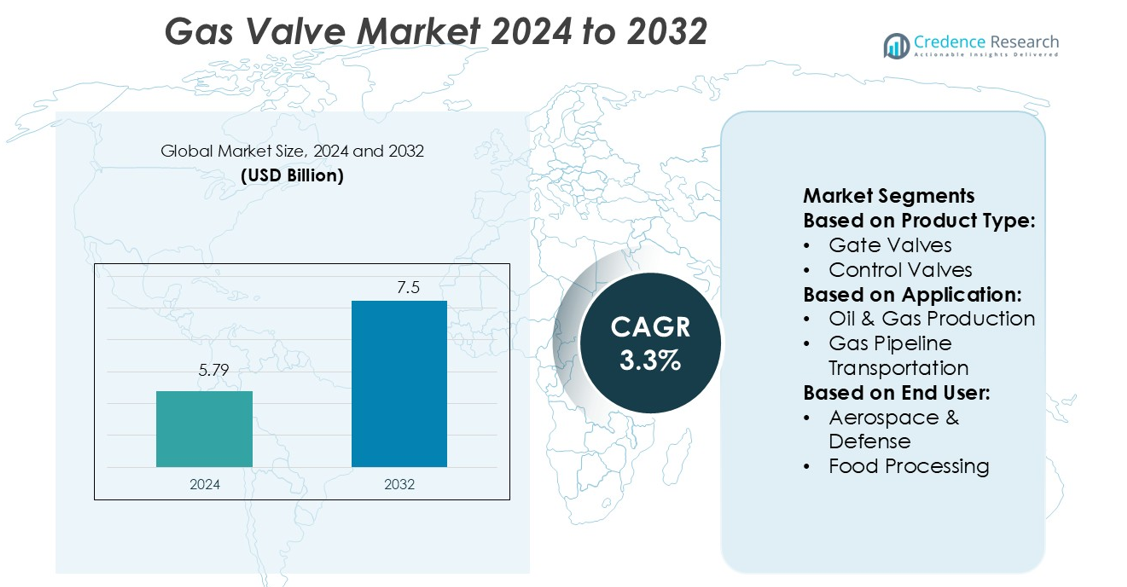
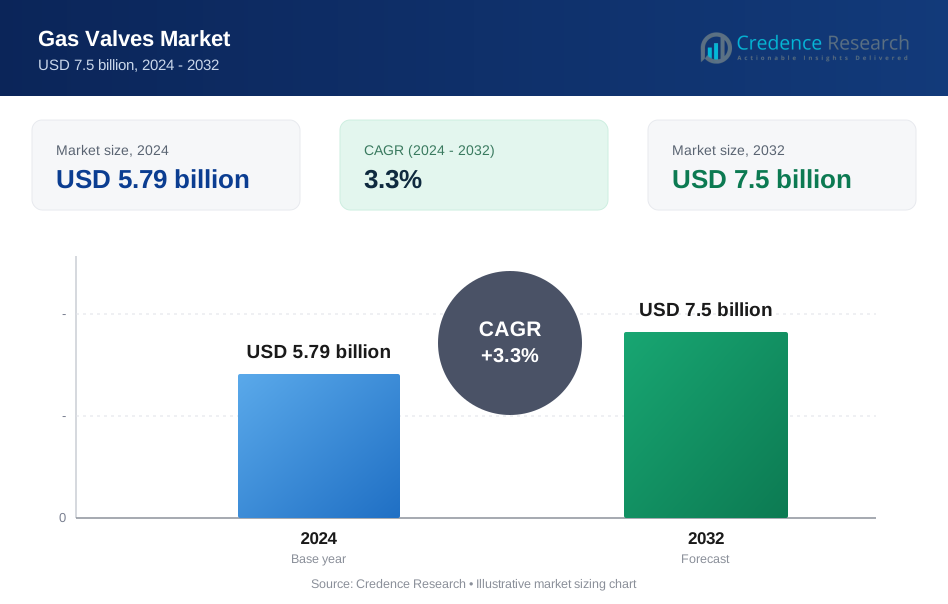
Gas Valve Market size was valued USD 5.79 billion in 2024 and is anticipated to reach USD 7.5 billion by 2032, at a CAGR of 3.3% during the forecast period.
| REPORT ATTRIBUTE | DETAILS |
|---|---|
| Historical Period | 2020-2023 |
| Base Year | 2024 |
| Forecast Period | 2025-2032 |
| Gas Valve Market Size 2024 | USD 5.79 billion |
| Gas Valve Market, CAGR | 3.3% |
| Gas Valve Market Size 2032 | USD 7.5 billion |
The gas valve market is highly competitive, with top players including Schlumberger Limited, Dalian DV Valve, Danfoss A/S, CNNC Sufa Technology Industry, Flowserve Corporation, ARIS Stellantriebe GmbH, Emerson Electric Co., Shandong Yidu Valve Group, China Yuanda Valve Group, and Dwyer Instruments LTD. These companies focus on advanced valve technologies, automation, and energy-efficient solutions to meet rising global demand. North America leads the market with a 34.5% share, supported by strong oil and gas infrastructure, extensive pipeline networks, and rapid adoption of smart valve systems. Strategic partnerships, product innovation, and regional expansion remain key factors enabling these companies to strengthen their market presence and maintain a competitive edge in both mature and emerging economies.
Market Insights
- The gas valve market was valued at USD 5.79 billion in 2024 and is projected to reach USD 7.5 billion by 2032, growing at a CAGR of 3.3% during the forecast period.
- Rising investments in oil and gas infrastructure and growing municipal gas distribution networks are driving strong product demand across multiple industries.
- Smart valve technologies, IoT integration, and automation are shaping key market trends, enhancing operational safety and efficiency.
- The market is highly competitive, with leading companies focusing on product innovation, partnerships, and expansion to maintain their global presence.
- North America holds a 34.5% market share, making it the leading region, supported by strong energy infrastructure, while gate valves dominate the product segment due to wide applications in pipeline control and safety.
Market Segmentation Analysis:
By Product Type
Ball valves hold the dominant market share in the gas valve market due to their simple structure, tight sealing, and low maintenance requirements. Their quarter-turn operation provides fast shutoff, making them ideal for gas pipeline transportation and municipal distribution networks. Gate valves and control valves also see rising use in upstream and midstream gas operations, driven by the growing demand for precise flow regulation and safety. Butterfly and plug valves support cost-effective installations in low-pressure systems. Others, such as globe and needle valves, serve specialized applications like instrumentation and control systems.
- For instance, SLB’s GROVE IST integrated-seat ball valve reduced required torque by up to 30% compared to conventional metal-seated trunnion ball valves during qualification testing.
By Application
Gas pipeline transportation accounts for the largest market share, supported by rising investments in transmission and distribution networks. Gas pipeline systems require high-performance ball and gate valves to ensure flow reliability, leak prevention, and compliance with safety regulations. Oil and gas production follows closely, driven by upstream exploration projects and enhanced processing infrastructure. Municipal gas applications grow steadily with expanding urban infrastructure and residential demand. Other segments like power generation and irrigation rely on compact and automated valve systems for operational efficiency and process safety.
- For instance, Dalian DV Valve’s forged-steel API 6D ball valves are built in classes up to 2500 and sizes 2″ to 24″ (as per their catalog) to suit high-pressure gas pipelines. These valves use butt–welded ends or flanged ends to maintain pipeline integrity.
By End User
The chemical and petroleum industry leads the market share due to the high demand for reliable flow control systems in processing, storage, and transportation of gas. This segment relies heavily on ball and control valves for managing high-pressure operations and volatile fluids. Aerospace and defense applications adopt advanced gas valve systems to meet strict performance and safety standards. Food processing and automotive industries use valves in controlled environments for heating and gas distribution. Other end users, including semiconductor, pulp and paper, mining, and construction, contribute steadily through specialized and high-durability valve applications.
Key Growth Drivers
Rising Demand from Oil & Gas Infrastructure
The gas valve market is expanding due to growing investments in oil and gas infrastructure. Governments and private players are modernizing pipelines, refineries, and storage systems to boost operational safety and efficiency. Gas valves are critical in controlling flow and pressure in these networks, ensuring safe transportation and distribution. Advanced control and automated valves help reduce leakage risks and downtime. This high reliability makes them essential for both upstream and downstream operations, driving strong adoption across North America, the Middle East, and Asia Pacific.
- For instance, Danfoss’s PML 65 solenoid valve is rated for maximum working pressures up to 28 bar g (406 psi g) and handles temperature ranges from –60 °C to +120 °C, per the installation guide.
Expansion of Municipal Gas Distribution Networks
Rapid urbanization and rising residential gas usage are increasing the need for municipal gas networks. Governments are investing in expanding city gas distribution systems to meet growing demand. Gas valves play a central role in regulating flow, pressure, and safety across these networks. Upgrading old infrastructure with modern valves enhances performance and ensures compliance with safety standards. Countries such as India and China are seeing fast growth in city gas networks, supporting market expansion. This steady infrastructure development fuels the demand for high-performance gas valves.
- For instance, Sufa supplies resilient-seated gate valves with socket ends for city gas grids, in pressure classes PN6, PN10, PN16, PN25 (corresponding to 6 to 25 bar).
Technological Advancements and Automation
Technological progress in valve automation is a major growth driver. Smart and automated valves offer improved monitoring, remote control, and predictive maintenance features. They help operators optimize system performance, reduce energy loss, and increase safety. Integration with SCADA and IoT platforms provides real-time data, enabling faster response during operational failures. Industries such as power generation, oil and gas, and chemical processing are actively replacing traditional valves with automated systems, boosting market penetration and creating long-term growth opportunities.
Key Trends & Opportunities
Shift Toward Smart and Digital Valves
The gas valve market is moving toward intelligent control solutions. Smart valves equipped with sensors and connectivity enable real-time monitoring, fault detection, and remote operations. This shift aligns with the growing adoption of Industry 4.0 and digital pipeline management. Manufacturers are focusing on energy-efficient and reliable designs to support modern industrial infrastructure. The increasing use of AI and IoT solutions offers strong opportunities for companies investing in advanced valve technologies.
- For instance, Flowserve’s PMV D30 digital positioner features a “high-air capacity” spool valve enabling use on very large actuators, and supports protocols such as HART, Profibus PA, and Foundation Fieldbus.
Rising Adoption of Renewable and Hydrogen Gas Systems
The global energy transition is creating new opportunities for gas valve manufacturers. The use of hydrogen and renewable natural gas requires valves designed for high purity and specific pressure ranges. These new energy systems demand corrosion-resistant and precise flow control valves. Companies are developing specialized products to meet these requirements, opening new revenue streams. Europe and Asia are leading this shift with large-scale hydrogen projects and renewable integration plans.
- For instance, ARIS’s Tensor series actuators use a brushless DC motor with wear-free Hall effect position detection. The drive supports multi-voltage input (85 – 265 V AC) and provides torque from 5 to 500 Nm with precise control.
Growth in Retrofitting and Upgrading Projects
Aging energy infrastructure across developed regions is driving demand for retrofitting projects. Industries are replacing old mechanical valves with modern, automated systems to meet stricter safety and efficiency regulations. This creates steady aftermarket opportunities for valve manufacturers. Upgraded systems also reduce operational costs and improve reliability, making retrofitting an attractive investment for both public and private operators.
Key Challenges
High Installation and Maintenance Costs
Gas valves require high initial investment, particularly for advanced and automated models. Installation often involves complex engineering, skilled labor, and downtime in existing systems. Maintenance costs also rise due to periodic calibration, inspection, and part replacement. These factors can limit adoption in small and mid-sized industries, particularly in cost-sensitive regions. Addressing these cost barriers remains a major challenge for manufacturers and system integrators.
Stringent Safety and Regulatory Standards
Gas valve applications are governed by strict safety regulations. Meeting these standards requires precise engineering, extensive testing, and certifications, which increase product costs and time-to-market. Non-compliance can lead to heavy penalties and legal liabilities. Global differences in regulatory frameworks further complicate manufacturing and distribution. Ensuring compliance while maintaining competitive pricing is a critical challenge for market players, especially in cross-border trade.
Regional Analysis
North America North America dominates the gas valve market with a 34.5% share in 2024. The region benefits from a strong oil and gas infrastructure and steady investments in modernization. Expanding shale gas exploration, LNG terminals, and pipeline upgrades fuel valve demand across upstream and downstream applications. The U.S. leads adoption, supported by stringent safety standards and advanced automation technologies. Municipal gas distribution and power generation also contribute to steady market growth. Leading manufacturers in the region emphasize smart valve solutions with IoT integration, enabling real-time monitoring and control to enhance system efficiency and safety compliance.
Europe
Europe holds a 27.8% market share in the gas valve market. The region focuses on energy transition, upgrading gas infrastructure, and integrating renewable energy sources like hydrogen. EU regulations promoting pipeline safety and low-emission operations are boosting demand for precision control valves. Countries such as Germany, the U.K., and France are modernizing municipal and industrial gas networks. Adoption of hydrogen-compatible valves is gaining momentum as decarbonization initiatives accelerate. Strong regulatory frameworks, technological innovation, and infrastructure retrofit projects are key factors supporting Europe’s steady market growth, making it a hub for advanced and sustainable gas valve solutions.
Asia Pacific
Asia Pacific accounts for 29.6% of the market, making it the fastest-growing region in the gas valve industry. Rapid industrialization, expanding city gas distribution networks, and large energy infrastructure projects drive demand. China and India lead growth through government-backed investments in pipeline expansion and LNG import facilities. The shift toward modernized, automated valves supports operational efficiency and safety compliance. Urbanization and rising residential gas consumption further boost municipal gas applications. Competitive manufacturing capabilities and rising technology adoption strengthen the region’s position, attracting global players to expand their presence in the Asia Pacific gas valve market.
Latin America
Latin America represents 4.2% of the gas valve market, supported by growing investments in oil and gas exploration. Brazil and Mexico lead regional demand, with ongoing pipeline expansion and refinery modernization projects. The focus on improving gas distribution infrastructure and enhancing energy security drives adoption of reliable valve solutions. Municipal gas networks are expanding in urban areas, supporting steady market growth. However, infrastructure limitations and investment constraints pose challenges. International players are entering the market through strategic collaborations and technology transfers to meet the region’s increasing need for efficient and durable gas valve systems.
Middle East & Africa
The Middle East & Africa account for 3.9% of the global market, driven by large-scale oil and gas projects. Countries such as Saudi Arabia, the UAE, and Qatar are investing in advanced pipeline networks and LNG facilities. Gas valves play a critical role in these high-capacity systems, supporting precise control and safety. Growing demand for automation and smart monitoring in upstream and downstream operations fuels market penetration. Africa is emerging gradually, with gas infrastructure expansion in Nigeria and Egypt. Despite challenges like limited technological adoption in some areas, the region remains a key growth hub for high-performance valves.
Market Segmentations:
By Product Type:
- Gate Valves
- Control Valves
By Application:
- Oil & Gas Production
- Gas Pipeline Transportation
By End User:
- Aerospace & Defense
- Food Processing
By Geography
- North America
- U.S.
- Canada
- Mexico
- Europe
- Germany
- France
- U.K.
- Italy
- Spain
- Rest of Europe
- Asia Pacific
- China
- Japan
- India
- South Korea
- South-east Asia
- Rest of Asia Pacific
- Latin America
- Brazil
- Argentina
- Rest of Latin America
- Middle East & Africa
- GCC Countries
- South Africa
- Rest of the Middle East and Africa
Competitive Landscape
The gas valve market features strong competition with key players such as Schlumberger Limited, Dalian DV Valve, Danfoss A/S, CNNC Sufa Technology Industry, Flowserve Corporation, ARIS Stellantriebe GmbH, Emerson Electric Co., Shandong Yidu Valve Group, China Yuanda Valve Group, and Dwyer Instruments LTD. The gas valve market is shaped by rapid technological advancements, strategic partnerships, and expanding global footprints. Companies are investing heavily in automation and smart valve technologies to meet rising demand for operational efficiency and safety. A growing focus on energy transition and hydrogen infrastructure is driving product innovation and new solution development. Firms are adopting strategies like mergers, acquisitions, and geographic expansion to strengthen their market position. Strong emphasis on R&D, cost optimization, and compliance with international safety standards further intensifies competition, pushing manufacturers to deliver more efficient and durable valve solutions.
Key Player Analysis
- Schlumberger Limited
- Dalian DV Valve
- Danfoss A/S
- CNNC Sufa Technology Industry
- Flowserve Corporation
- ARIS Stellantriebe GmbH
- Emerson Electric Co.
- Shandong Yidu Valve Group
- China Yuanda Valve Group
- Dwyer Instruments LTD
Recent Developments
- In September 2025, Ohio Valve Company opens Valve World Headquarters in Houston, aiming to be a global hub for innovation, operational excellence, and industry leadership in valve manufacturing.
- In January 2025, InflowControl introduced the Gas Autonomous Inflow Control Valve (Gas AICV®), the world's first autonomous flow control valve specifically designed for gas reservoirs.
- In October 2023, AVK Group acquired Bayard S.A.S, Talis Flow Control (Shanghai) Co. Ltd., Belgicast International S.L., and sales companies in Italy and Portugal. The acquisition is expected to help the company expand further.
- In October 2023, Burhani Engineers Ltd. introduced a valves testing and rehabilitation hub in Nairobi, Kenya. This hub is expected to help lower the repair and maintenance costs for existing valves in oil and gas, power, mining, and other industries
Report Coverage
The research report offers an in-depth analysis based on Product Type, Application, End-User and Geography. It details leading market players, providing an overview of their business, product offerings, investments, revenue streams, and key applications. Additionally, the report includes insights into the competitive environment, SWOT analysis, current market trends, as well as the primary drivers and constraints. Furthermore, it discusses various factors that have driven market expansion in recent years. The report also explores market dynamics, regulatory scenarios, and technological advancements that are shaping the industry. It assesses the impact of external factors and global economic changes on market growth. Lastly, it provides strategic recommendations for new entrants and established companies to navigate the complexities of the market.
Future Outlook
- The market will witness rising demand from expanding oil and gas infrastructure.
- Adoption of smart and automated valve technologies will accelerate.
- Hydrogen and renewable gas systems will create new product opportunities.
- Urbanization will drive growth in municipal gas distribution networks.
- Energy transition goals will increase the need for efficient valve solutions.
- Retrofitting of old infrastructure will boost aftermarket demand.
- Stricter safety regulations will push innovation in high-performance valves.
- Manufacturers will focus on developing corrosion-resistant and durable products.
- Partnerships and acquisitions will strengthen global market presence.
- Asia Pacific will emerge as a major growth hub for gas valves.
Request a Free Sample
Fill in your details and we'll send you a free sample report.
- Sample data tables & charts
- Research methodology
Need a Custom Version of This Report?
Tailor the scope, geography, or segments to your exact requirements.
- Custom geography or segment scope
- Direct access to our analyst team
Frequently Asked Questions
What is the current size of the Global Gas Valves Market?
At what Compound Annual Growth Rate is the Gas Valve Market projected to grow between 2025 and 2032?
What factors are driving the growth of the Global Gas Valves Market?
What are the key segments within the Global Gas Valves Market?
What are some challenges faced by the Global Gas Valves Market?
Who are the major players in the Global Gas Valves Market?
Table of Content
Chapter 1. Report Introduction
- 1.1 Report Description & Purpose
- 1.1.1 Report Title & Market Definition
- 1.1.2 Unique Selling Propositions (USP) & Key Differentiators
- 1.1.3 Value Proposition for Stakeholders
- 1.2 Research Objectives
- 1.2.1 Market Sizing Objectives (Volume & Revenue) (Volume Where Applicable)
- 1.2.2 Segmentation Objectives
- 1.2.3 Competitive Intelligence Objectives
- 1.2.4 Forecast & Scenario Objectives
- 1.3 Report Scope
- 1.3.1 Gas Valves Scope – Segments & Subsegments Covered
- 1.3.2 Geographic Scope – Regions & Countries Covered
- 1.3.3 Historical Period, Base Year & Forecast Period (2024; forecast to 2032)
- 1.3.4 Inclusions & Exclusions
- 1.4 Industry Classification & Applicable Codes
- 1.5 Currency, Measurement Units & Valuation Basis
- 1.6 Target Stakeholders
- 1.7 Limitations & Assumptions
Chapter 2. Executive Summary
- 2.1 Global Gas Valves Market Snapshot
- 2.1.1 Market Size – Historical (2024) & Forecast (2024-2032) (2024: USD 5.79 billion → 2032: USD 7.5 billion)
- 2.1.2 Volume & Revenue – Global Totals (Volume Where Applicable)
- 2.1.3 Key Market Highlights – Top Five Facts
- 2.2 Gas Valves Market Segmentation Snapshot
- 2.2.1 Market Split by Region – 2024 vs. 2032
- 2.3 Competitive Snapshot
- 2.3.1 Top 10 Players by Revenue Share – 2024
- 2.3.2 Top 10 Players by Volume Share – 2024 (Volume Where Applicable)
- 2.3.3 Recent Strategic Developments (18-Month Summary)
- 2.4 Key Investment Highlights & Strategic Conclusions
Chapter 3. Gas Valves Market Dynamics & Industry Analysis
- 3.1 Market Overview & Context
- 3.1.1 Gas Valves Market Position in the Broader Industry Value Chain
- 3.1.2 Demand Structure & Purchasing Dynamics
- 3.1.3 Market Maturity & Development Stage by Region
- 3.2 Gas Valves Market Drivers
- 3.3 Gas Valves Market Restraints & Challenges
- 3.4 Gas Valves Market Opportunities
- 3.5 Porter's Five Forces Analysis
- 3.5.1 Threat of New Entrants
- 3.5.2 Bargaining Power of Suppliers
- 3.5.3 Bargaining Power of Buyers
- 3.5.4 Threat of Substitutes
- 3.5.5 Competitive Rivalry – Intensity Assessment
- 3.6 Gas Valves Value Chain Analysis
- 3.6.1 Upstream – Key Inputs, Resources & Suppliers
- 3.6.1.1 Key Input/Resource 1
- 3.6.1.2 Key Input/Resource 2
- 3.6.1.3 Key Input/Resource 3
- 3.6.2 Midstream – Core Operations & Value Creation
- 3.6.2.1 Operating Model & Process Overview
- 3.6.2.2 Key Operating Locations & Capabilities by Company
- 3.6.3 Downstream – Market Channels & End Users
- 3.6.3.1 Direct Sales & Customer Engagement Channels
- 3.6.3.2 Indirect Sales, Intermediaries & Partner Channels
- 3.6.4 Value Chain Profitability Analysis
- 3.6.1 Upstream – Key Inputs, Resources & Suppliers
- 3.7 PESTEL Analysis
- 3.7.1 Political Factors
- 3.7.2 Economic Factors
- 3.7.3 Social Factors
- 3.7.4 Technological Factors
- 3.7.5 Environmental Factors
- 3.7.6 Legal Factors
- 3.8 Gas Valves Supply Chain Analysis
- 3.8.1 Critical Input & Resource Availability Risk Assessment
- 3.8.2 Supplier & Operational Concentration Risk (Geographic Exposure)
- 3.8.3 Supply & Service Disruption Impact Analysis
- 3.9 Regulatory & Policy Landscape
Note: The regulatory and policy landscape section covers regulations based on their applicability to the market, Gas Valves category, geography, and scope of the study. Only regulatory frameworks with a material impact on operations, compliance, trade, sustainability, or market access are analyzed in detail.
Chapter 4. Key Investment Pockets & Opportunity Analysis
- 4.1 Gas Valves Market Attractiveness Analysis
- 4.1.1 By Region – Investment Attractiveness Matrix (Market Size × CAGR)
- 4.2 Absolute Revenue Growth Opportunity
- 4.2.1 By Region – Absolute Revenue Growth Through 2032
- 4.3 Incremental Demand Opportunity
- 4.3.1 By Region – Incremental Demand Through 2032
- 4.3.2 Segment – Incremental Demand
- 4.4 Emerging Submarket Opportunity Deep Dive (Subject to Applicability)
- 4.5 Priority Market Opportunity Scorecards
- 4.5.1 United States
- 4.5.2 Europe
- 4.5.3 Asia
- 4.5.4 Middle East & Africa
Note: Priority market opportunity scorecards reflect the geographic scope and strategic relevance of the study. Listed markets are indicative and may be adapted to the industry.
Chapter 5. Gas Valves Cross-Border Trade & Market Access Analysis
- 5.1 International Trade & Cross-Border Activity Overview
- 5.1.1 Global Export Value by Country (2024)
- 5.1.2 Global Export Volume by Country (2024) (Volume Where Applicable)
- 5.1.3 Global Import Value by Country (2024)
- 5.1.4 Global Import Volume by Country (2024) (Volume Where Applicable)
- 5.1.5 Net Trade Balance by Country (2024)
- 5.2 Export Analysis – Segment
- 5.2.1 Category 1 (Applicable Classification Code)
- 5.2.2 Category 2 (Applicable Classification Code)
- 5.2.3 Category 3 (Applicable Classification Code)
- 5.2.4 Category 4 (Applicable Classification Code)
- 5.2.5 Category 5 (Applicable Classification Code)
- 5.3 Import Analysis – Segment
- 5.3.1 Category 1 (Applicable Classification Code)
- 5.3.2 Category 2 (Applicable Classification Code)
- 5.3.3 Category 3 (Applicable Classification Code)
- 5.3.4 Category 4 (Applicable Classification Code)
- 5.3.5 Category 5 (Applicable Classification Code)
- 5.4 Cross-Border Pricing & Transaction Benchmarks
- 5.4.1 Export Pricing – Segment & Country
- 5.4.2 Import Pricing – Segment & Source Country
- 5.4.3 Price Trends (2024)
- 5.5 Key Cross-Border Trade & Delivery Routes
- 5.5.1 Cross-Border Trade/Delivery Route 1
- 5.5.2 Cross-Border Trade/Delivery Route 2
- 5.5.3 Cross-Border Trade/Delivery Route 3
- 5.5.4 Cross-Border Trade/Delivery Route 4
- 5.5.5 Cross-Border Trade/Delivery Route 5
- 5.6 Trade Policy & Market Access Impact Assessment
- 5.6.1 Tariff & Non-Tariff Barriers
- 5.6.2 Regional Trade & Economic Integration Frameworks
- 5.6.3 Bilateral & Multilateral Trade Agreements
- 5.6.4 Cross-Border Operating, Licensing & Localization Requirements
Note: This chapter applies where cross-border trade or delivery is relevant to Gas Valves. Goods, services, and digital offerings are assessed using applicable classifications and transaction measures. Import-export volumes, trade balances, and route analyses are included only where meaningful to the market.
Chapter 6. Competitive Landscape & Company Benchmarking
- 6.1 Gas Valves Market Concentration & Structure
- 6.1.1 Herfindahl-Hirschman Index (HHI) – vs. 2024
- 6.1.2 Leading, Mid-Sized & Emerging Player Structure
- 6.1.3 Global, Regional & Local Player Dynamics
- 6.2 Gas Valves Market Share Analysis – 2024
- 6.2.1 Global Revenue Share by Company
- 6.2.2 Global Volume Share by Company (Volume Where Applicable)
- 6.2.3 Regional Revenue Share
- 6.2.4 Market Share Evolution ( vs. 2024)
- 6.2.5 Company Market Share by Key Segment
- 6.2.6 Company Market Share by Customer Group
- 6.3 Operating Scale, Capacity & Infrastructure Analysis
- 6.3.1 Global Operating Scale & Supply Capacity
- 6.3.2 Resource Utilization & Operating Efficiency
- 6.3.3 Output, Service Delivery & Activity Metrics
- 6.3.4 Operating Footprint & Infrastructure Map
- 6.3.5 Planned Operational & Capacity Expansion
- 6.4 Gas Valves Competitive Benchmarking Matrix
- 6.4.1 Revenue, Growth, Profitability & Operating Metric Comparison
- 6.4.2 Channel Revenue Mix
- 6.4.3 Geographic Revenue Exposure
- 6.4.4 R&D Intensity
- 6.4.5 Sustainability Maturity
- 6.5 Strategic Developments in Gas Valves (Last 24 Months)
- 6.5.1 Mergers, Acquisitions & Divestments
- 6.5.2 New Products, Services & Solutions in Gas Valves
- 6.5.3 Operational & Infrastructure Expansions
- 6.5.4 Strategic Alliances, Joint Ventures & Partnerships
- 6.5.5 Distribution Expansion & Market Entry
- 6.5.6 Sustainability & ESG Initiatives
- 6.6 Competitive Strategy Mapping
- 6.6.1 Leader, Challenger, Follower & Niche Classification
- 6.6.2 Pricing Strategy Comparison
- 6.6.3 Channel Strategy Matrix
Note: Strategic developments are included based on their materiality and the availability of reliable information.
Chapter 7. Global Gas Valves Market – By Sales & Delivery Channel
- 7.1 Segment Overview
- 7.1.1 Volume & Revenue Split by Channel (2024 & 2032) (Volume Where Applicable)
- 7.1.2 Channel Mix Evolution (2024-2032)
Chapter 8. Regional Market Analysis – Global Overview
- 8.1 Global Regional Overview
- 8.1.1 Regional Volume Share (Volume Where Applicable)
- 8.1.2 Regional Revenue Share
- 8.1.3 Regional Volume by Region (Volume Where Applicable)
- 8.1.4 Regional Revenue by Region
- 8.1.5 Regional Forecast Through 2032
- 8.2 Cross-Regional Segment Analysis
- 8.2.1 By Sales & Delivery Channel
- 8.2.2 By Competitive Positioning & Price Tier
Chapter 9. North America Gas Valves Market
- 9.1 United States
- 9.2 Canada
- 9.3 Mexico
Chapter 10. Europe Gas Valves Market
- 10.1 Germany
- 10.2 France
- 10.3 Italy
- 10.4 United Kingdom
- 10.5 Spain
- 10.6 Poland
- 10.7 Russia
- 10.8 Netherlands
- 10.9 Belgium
- 10.10 Sweden
- 10.11 Denmark
- 10.12 Norway
- 10.13 Rest of Europe
Chapter 11. Asia Pacific Gas Valves Market
- 11.1 China
- 11.2 India
- 11.3 Japan
- 11.4 South Korea
- 11.5 Thailand
- 11.6 Indonesia
- 11.7 Vietnam
- 11.8 Malaysia
- 11.9 Australia
- 11.10 Rest of Asia Pacific
Chapter 12. Latin America Gas Valves Market
- 12.1 Brazil
- 12.2 Argentina
- 12.3 Colombia
- 12.4 Chile
- 12.5 Rest of Latin America
Chapter 13. Middle East Gas Valves Market
- 13.1 Saudi Arabia
- 13.2 United Arab Emirates
- 13.3 Turkey
- 13.4 Israel
- 13.5 Iran
- 13.6 Rest of the Middle East
Chapter 14. Africa Gas Valves Market
- 14.1 South Africa
- 14.2 Egypt
- 14.3 Nigeria
- 14.4 Morocco
- 14.5 Rest of Africa
Chapter 15. Gas Valves Company Profiles
- 15.1 [Company 01]
- 15.1.1 Company Overview
- 15.1.2 Key Management Personnel
- 15.1.3 Products & Services Portfolio
- 15.1.4 Financial Performance
- 15.1.5 Key Market Focus & Geographic Presence
- 15.1.6 Recent Developments & Strategic Initiatives
Note: The company profile list is preliminary and may change based on research findings, market developments, data availability, and client requirements.
Chapter 16. Appendices
- Appendix A – List of Abbreviations & Acronyms
- Appendix B – Industry Classification Code Reference – Full Series
- Appendix C – Supply, Output & Operating Capacity Data Tables
- Appendix D – End-Use & Demand Base Tables
- Appendix E – Demand, Adoption & Usage Assumptions
- Appendix F – Pricing & Revenue Metric Reference Tables
- Appendix G – Company Operations & Infrastructure Database
- Appendix H – Cross-Border Trade & Activity Data Tables (Where Applicable)
- Appendix I – Regulatory Summary Tables
- Appendix J – Primary Research Participant List (Anonymized)
- Appendix K – Primary Research Questionnaire Framework
- Appendix L – Data Sources & Bibliography
- Appendix M – Market Size Divergence & Source Comparison
Chapter 17. Research Methodology
- 17.1 Research Framework & Philosophy
- 17.2 Secondary Research – Sources, Hierarchy & Data Extraction
- 17.3 Data Modeling – Bottom-Up & Top-Down Market Sizing
- 17.4 Primary Research – Stakeholder Framework, LOI & Sample Sizes
- 17.5 Forecast Methodology – Regression, Scenario & Sensitivity Analysis
- 17.6 Quality Control – Four-Layer Validation Framework
- 17.7 Limitations & Standard Assumptions
- 17.8 Disclaimer
