Market Overview:
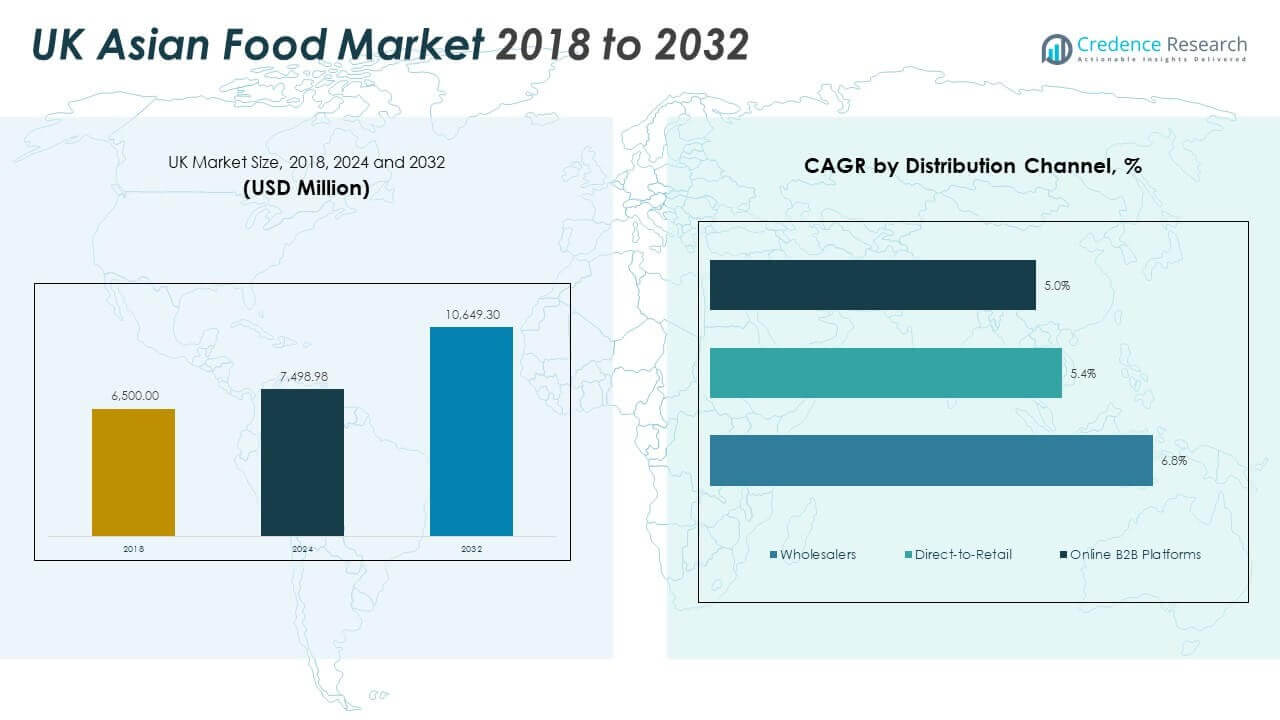
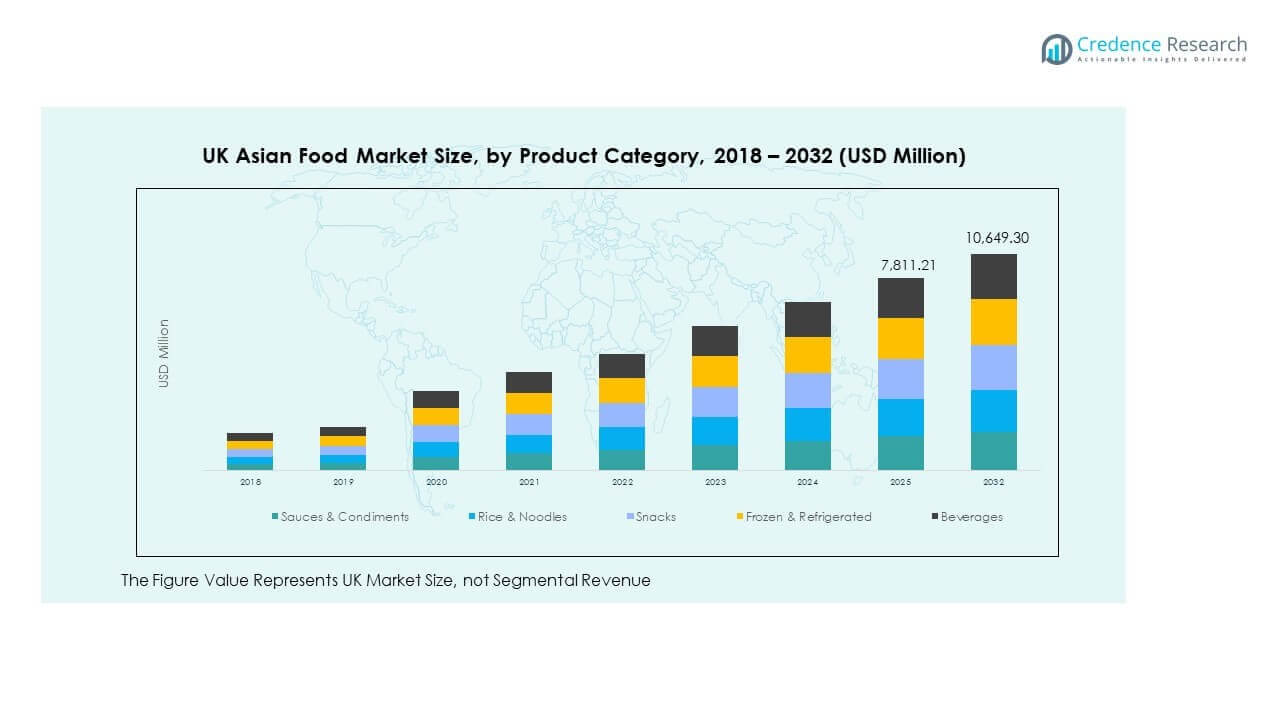
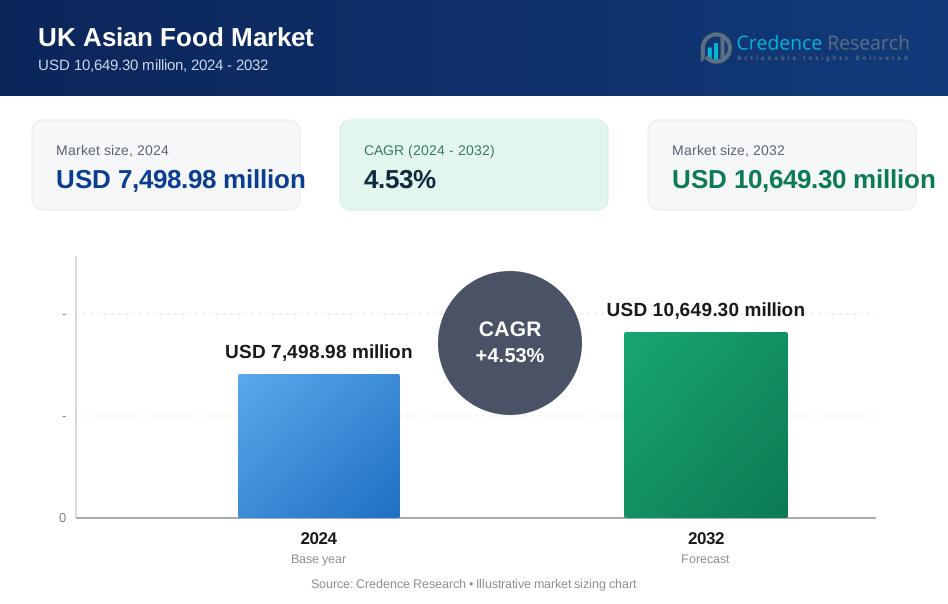
The UK Asian Food Market size was valued at USD 6,500.00 million in 2018 to USD 7,498.98 million in 2024 and is anticipated to reach USD 10,649.30 million by 2032, at a CAGR of 4.53% during the forecast period.
| REPORT ATTRIBUTE | DETAILS |
|---|---|
| Historical Period | 2020-2023 |
| Base Year | 2024 |
| Forecast Period | 2025-2032 |
| UK Asian Food Market Size 2024 | USD 7,498.98 million |
| UK Asian Food Market, CAGR | 4.53% |
| UK Asian Food Market Size 2032 | USD 10,649.30 million |
The market is driven by a blend of cultural consumption and rising interest in Asian flavors across the UK. Core demand comes from South Asian communities, but younger consumers and health-conscious buyers are also adopting Asian food formats. Demand for sauces, ready meals, noodles, and frozen snacks continues to rise due to convenience and flavor appeal. Retail chains widen shelf space for branded and private-label SKUs. Marketing through influencers, cooking platforms, and festivals also fuels category awareness.
Geographically, England holds the dominant share due to its large urban populations and ethnic diversity, especially in cities like London, Birmingham, and Leicester. Scotland and Wales are emerging regions, supported by expanding retail access and rising Asian QSR outlets. Northern Ireland remains smaller but shows potential through e-commerce penetration and changing demographics. Urban centers drive volume due to density and cultural familiarity, while suburban and secondary cities support growth through retail and digital reach.
Market Insights
- The UK Asian Food Market was valued at USD 6,500.00 million in 2018, rose to USD 7,498.98 million in 2024, and is projected to reach USD 10,649.30 million by 2032, growing at a CAGR of 4.53%.
- England led the market with approximately 78% share due to dense urban populations, multicultural communities, and strong retail infrastructure. Scotland and Wales followed with 11% and 6% shares respectively, supported by expanding ethnic retail and growing demand in urban centers.
- Northern Ireland, holding a 5% share, emerged as the fastest-growing region, driven by rising online grocery access, shifting demographics, and growing foodservice interest in Asian cuisine.
- Product category distribution in 2024 showed sauces & condiments and rice & noodles as dominant segments, together accounting for more than 45% of market share.
- Beverages and frozen & refrigerated foods saw notable gains, collectively representing around 30% of the 2024 market size, driven by convenience, innovation, and growing interest in authentic Asian drink and meal experiences.
Market Drivers
Strong Ethnic Population Base and Cultural Food Traditions Sustain Demand
The large and growing South Asian population in the UK drives consistent demand for traditional food items. Generational households continue to cook with regional spices, grains, and ingredients daily. This supports repeat purchase behavior and wide product variety. British Asians represent a significant consumer base, particularly in England. The UK Asian Food Market benefits from this stable demographic core. Weddings, festivals, and religious observances boost sales of specific ingredients. Food remains central to cultural identity, making it less vulnerable to shifting trends. The market sees strong demand for both staple pantry items and celebration-specific products.
- For instance, TRS Foods, a leading UK ethnic food brand, offers its Madras curry powder in 400g packs widely available across UK retailers, supporting daily cooking in South Asian households.
Mainstream Retail Expansion Boosts Accessibility Across Consumer Segments
Major supermarkets such as Tesco, Sainsbury’s, and Morrisons have added extensive Asian food sections across locations. Products previously found only in ethnic stores are now widely available. This shift brings accessibility to non-Asian shoppers as well. Retail chains partner with importers to improve supply chains and inventory depth. The UK Asian Food Market gains visibility through private label and co-branded products. Shelf placement improves product trial among new demographics. Recipe cards and promotional tie-ins encourage category exploration. Broader access translates into volume sales and better economies of scale for suppliers. Retail integration plays a vital role in sustained market expansion.
- For instance, Tesco stocks over 200 Asian food products in dedicated aisles across its 3,800 UK stores, partnering with importers like TRS for consistent supply.
Busy Lifestyle Shifts Drive Growth In Ready-To-Cook And Frozen Categories
Modern consumers prefer convenience, leading to a rise in ready meals, frozen snacks, and meal kits. The UK Asian Food Market adapts through innovation in shelf-stable and heat-and-eat formats. Working families and young professionals favor quick preparation without compromising flavor. Brands invest in microwave-friendly packaging and modern labeling. Growth in dual-income households supports demand for packaged meals. Time savings remains a key purchase factor for urban consumers. Foodservice chains also add frozen Asian SKUs for menu efficiency. This convenience-led segment opens cross-ethnic appeal and regular consumption. Suppliers now focus on quality, taste, and short prep time for new launches.
Digital Channels And Online Grocery Delivery Expand Reach Beyond Metro Hubs
E-commerce growth boosts access to Asian groceries beyond traditional city centers. Online platforms offer extensive product variety and home delivery. The UK Asian Food Market benefits from tech adoption among younger and second-gen consumers. Subscription boxes and specialty e-tailers cater to niche demands. Online reviews and food blogs promote new product trials. Bulk ordering through online wholesale options supports small food businesses. Delivery innovations extend reach to rural and suburban areas. Brands gain direct access to shoppers without retail dependence. Digital convenience builds frequency of purchase and broader market penetration.
Market Trends
Fusion Products and Cross-Cultural Flavors Broaden Consumer Appeal
The UK Asian Food Market sees rising demand for fusion foods that blend regional spices with Western formats. Products like tikka masala wraps, biryani burgers, or curry pies reflect this shift. Younger consumers experiment with mixed flavors at home and while dining out. Social media exposure influences fusion recipe trends. Foodservice players launch menus that blend street food formats with global styles. Packaged snack companies infuse Indian or Thai flavors into chips and dips. Hybrid recipes grow across categories such as sauces, spreads, and frozen meals. This trend appeals to multicultural households and broadens market reach. Fusion formats also drive shelf space gains in mainstream retail.
- For instance, in June 2024, Marks & Spencer launched its limited-edition Collection Chicken Tikka Masala Pizza across 1,000+ UK stores. The product featured a slow-fermented base, smoky masala sauce, and a mango chutney drizzle, aimed at younger, fusion-driven consumers.
Clean Label, Organic and Natural Ingredient Focus Shapes New Product Development
Consumers seek cleaner labels, pushing brands toward natural, preservative-free ingredient profiles. The UK Asian Food Market responds with organic spice blends, non-GMO lentils, and cold-pressed oils. Transparency in sourcing and allergen labeling gains relevance. Health-conscious families prefer low-salt and no-added-sugar variants. Gluten-free chapatis, dairy-free desserts, and vegan curries grow in demand. Ethical sourcing of ingredients such as turmeric and cardamom gains attention. Certifications like Soil Association or Fairtrade improve shelf trust. Wellness-focused branding now influences purchase decisions more than ethnic identity. This trend supports premium pricing and niche brand emergence.
Street Food and Regional Cuisine Variants Gain Shelf Traction
Growing interest in street food flavors drives product development across frozen and ready-to-eat formats. The UK Asian Food Market capitalizes on dishes like pani puri, momos, and satay skewers. Shoppers seek regional authenticity beyond generic curry blends. Brands now highlight geographic labels such as Punjabi, Tamil, or Bengali to differentiate. Food festivals and pop-up restaurants popularize lesser-known dishes. Supermarkets allocate dedicated shelf space for street-style frozen appetizers. Packaging highlights origin stories to build emotional resonance. These formats appeal to both Asian and non-Asian consumers. Growth in experiential dining culture supports continued expansion in this segment.
- For instance, TRS Foods supplies a wide range of ethnic spices and pulses, with popular SKUs such as Garam Masala and Madras Curry Powder typically available in 100g or 400g packs. While its core distribution is stronger in Tesco and Asda, TRS products have limited presence in Sainsbury’s, which primarily features brands like Patak’s and Sharwood’s in its Asian food aisles across 600+ stores.
Plant-Based and Meat-Free Formats Gain Traction Across Protein Alternatives
Vegetarianism and veganism rise across age groups in the UK, impacting Asian food categories. The UK Asian Food Market sees innovation in jackfruit biryani, tofu tikka, and lentil-based protein snacks. Plant-based meat alternatives align well with traditional vegetarian Indian recipes. Soy, chickpea, and pea protein formats find ready consumer acceptance. Halal-certified vegan products fill a niche gap in mainstream retail. Home cooks experiment with plant-forward ingredients guided by health and sustainability goals. Foodservice menus adapt to offer more vegan curries and rice bowls. Frozen sections now include dairy-free and eggless Asian desserts. The shift opens new growth lanes for progressive brands.
Market Challenges Analysis
Regulatory Compliance, Labeling Requirements, And Import Complexity Affect Smaller Suppliers
Smaller brands often struggle with evolving food safety regulations and import restrictions. The UK Asian Food Market faces hurdles from Brexit-related trade changes. Shifting customs rules increase import costs and delays. Labeling laws require precise allergen, origin, and nutritional disclosures. Brands must adapt packaging to meet legal standards. Changes in shelf-life claims and organic certifications raise operational challenges. Many small and mid-sized importers face high compliance costs. Fragmented documentation systems slow time-to-shelf for new items. These factors limit agility and market access for traditional and regional producers.
Supply Chain Constraints, Price Volatility, And Ingredient Dependence On Foreign Sources
The UK Asian Food Market heavily relies on imported spices, pulses, and oils from South Asia. Any disruption in India, Bangladesh, or Sri Lanka affects inventory and cost structures. Monsoon variability, crop failures, or export bans cause sudden price spikes. Energy costs and freight charges add volatility across categories. COVID-era disruptions exposed fragility in ingredient flow and packaging logistics. High dependency on foreign suppliers creates limited local fallback. Container shortages or geopolitical friction further slow shipments. Retailers and distributors must hold buffer stock or risk empty shelves. Sourcing diversification remains a challenge for bulk and specialty buyers.
Market Opportunities
Growing Acceptance Among Non-Asian Households Expands Consumer Base
Non-Asian consumers increasingly explore ethnic cuisines at home, opening new demand segments. The UK Asian Food Market gains traction through accessible product formats. Recipe kits and cooking tutorials promote usage of lentils, spices, and ready sauces. Fusion foods make entry easier for first-time buyers. Supermarkets use promotions and influencer tie-ins to drive interest. This broader consumption widens the category beyond cultural dependence. Mainstream adoption encourages innovation and product localization. Brands benefit from positioning Asian foods as part of the everyday UK diet.
Institutional Foodservice, QSR Expansion, And Travel Retail Open New Sales Channels
Institutional buyers such as universities and hospitals diversify menus with Asian dishes. The UK Asian Food Market finds growth in QSR chains offering biryani bowls, curry pots, and Asian snacks. Airports, train stations, and service areas now carry ready-to-eat regional options. Food delivery apps promote ghost kitchens focused on Asian cuisine. Travel retail and catering services create demand for shelf-stable single-serve packs. This channel mix improves visibility across consumer occasions. New formats help meet on-the-go and impulse purchase needs. The market benefits from rising interest in global food experiences.
Market Segmentation Analysis
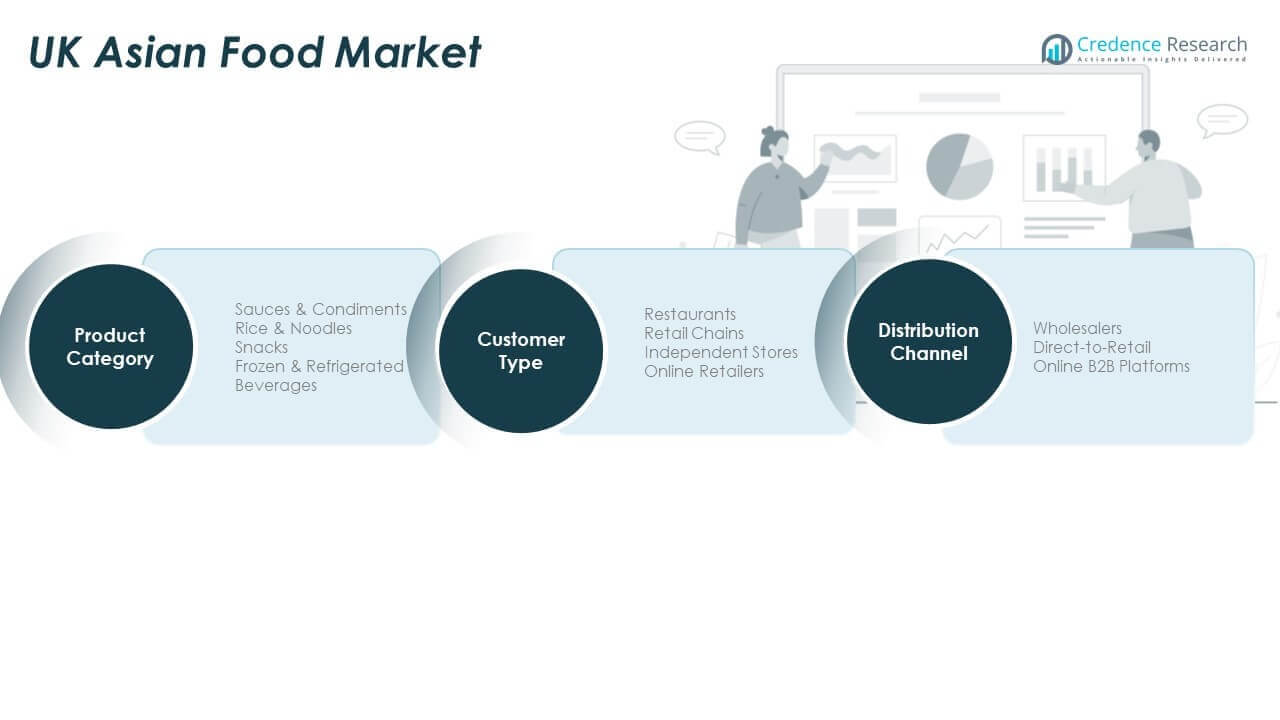
By Product Category
The UK Asian Food Market sees strong segmentation by product category, with sauces & condiments leading due to their daily use and high shelf rotation. Products like curry pastes, soy sauces, and chutneys are in high demand among both Asian and non-Asian consumers. Rice & noodles form the core staple category, driven by basmati, jasmine, and instant noodle variants. Snacks such as samosas, rice crackers, and masala crisps show rising impulse-driven growth across retail formats. Frozen & refrigerated foods witness steady expansion due to the convenience-driven lifestyle shift, while traditional beverages like masala chai, lassi, and Asian fruit juices gain popularity across ethnic and mainstream buyers.
- For instance, Tesco sources bulk basmati rice from suppliers like Tilda, distributing 20kg sacks to its 3,800 UK outlets to ensure chain‑wide availability of this staple product.
By Customer Type
Customer segmentation shows restaurants as significant buyers, demanding bulk volumes of spices, sauces, and frozen foods for consistent menu offerings. Retail chains hold a major share due to their scale and ability to drive branded and private-label sales across urban and suburban locations. Independent stores serve ethnic communities with specialized SKUs and imported goods, maintaining loyalty through cultural familiarity. Online retailers are emerging rapidly, serving tech-savvy consumers with wide assortment access and delivery convenience. Each customer type plays a distinct role in market depth and breadth.
- For instance, Sainsbury’s partners with Tilda for 5kg basmati rice bags, supplying 1,400 stores nationwide.
By Distribution Channel
Wholesalers dominate the supply chain by enabling large-volume movement across restaurants and independent stores. They support market efficiency through bulk pricing and regional distribution. Direct-to-retail channels give brands control over shelf visibility, pricing strategy, and in-store promotions, making them critical for high-margin products. Online B2B platforms simplify procurement for small businesses, offering scalable order volumes and fast fulfillment. This segment is growing with the digitalization of trade and stronger tech infrastructure among buyers and sellers. Distribution diversity ensures balanced access across urban and rural geographies.
Segmentation
By Product Category
- Sauces & Condiments
- Rice & Noodles
- Snacks
- Frozen & Refrigerated Foods
- Beverages
By Customer Type
- Restaurants
- Retail Chains
- Independent Stores
- Online Retailers
By Distribution Channel
- Wholesalers
- Direct-to-Retail
- Online B2B Platforms
Regional Analysis
England: Leading Market with High Urban Concentration and Strong Retail Penetration
England accounts for the largest share of the UK Asian Food Market, holding nearly 78% of the total market revenue. The region benefits from high ethnic diversity, particularly in London, Birmingham, Leicester, and Manchester. Dense urban populations support a wide retail footprint, with Asian food aisles common in major supermarkets. Local wholesalers and specialty ethnic stores dominate distribution in regional clusters. High product visibility and proximity to import hubs like London and Felixstowe support consistent stock levels. Consumer familiarity with Asian cuisine drives mainstream adoption across households and restaurants. England remains the epicenter for product innovation and market testing.
Scotland and Wales: Emerging Growth Centers with Increasing Retail Access
Scotland contributes around 11% of the UK Asian Food Market, with key demand centers in Glasgow, Edinburgh, and Aberdeen. Growth stems from rising multicultural populations and expanding Asian QSR outlets. Supermarkets are adding SKUs for sauces, rice, and ready meals across metro locations. Wales holds nearly 6% market share and is catching up in terms of retail availability and product diversity. Ethnic stores in Cardiff and Swansea report steady sales of core items such as lentils, spices, and snacks. These regions show promising growth driven by improved logistics and expanding consumer awareness.
Northern Ireland: Smallest Contributor but Rising on E-Commerce Expansion
Northern Ireland holds an estimated 5% share of the UK Asian Food Market, with most demand concentrated in Belfast. Brick-and-mortar retail options remain limited, but growth is evident through online platforms. Cross-border supply with Ireland introduces logistical flexibility. Demand focuses on frozen items, noodles, and halal-certified products. Direct imports and distributor partnerships help bridge availability gaps. Rising Asian student and worker populations are influencing product demand. It holds potential for growth as digital access and cultural exposure continue to expand.
Key Player Analysis
- Clearspring
- Blue Dragon
- TRS Foods
- Patak’s
- East End Foods
Competitive Analysis
The UK Asian Food Market features a blend of legacy brands, regional importers, and emerging private labels. Large players such as TRS Foods, Patak’s, and East End Foods hold a strong presence across sauces, spices, and dry goods. These companies benefit from scale, diversified distribution, and established consumer trust. Clearspring and Blue Dragon focus on Japanese and pan-Asian formats, targeting health-conscious and mainstream consumers with clean-label offerings. Retail chains introduce private-label SKUs to capture price-sensitive buyers and expand product assortment. Distribution strategy plays a central role in competitiveness. Brands with direct retail relationships and strong wholesaler ties maintain shelf consistency. Innovation in ready meals, frozen formats, and fusion sauces helps players expand across mainstream and ethnic channels. E-commerce platforms and online B2B wholesalers open new access for smaller brands and niche imports. The UK Asian Food Market remains competitive, driven by authenticity, pricing control, packaging innovation, and regional adaptability. Brand equity and supply reliability shape long-term positioning.
Recent Developments
- In November 2025, Patak’s and Blue Dragon announced a partnership with Tesco to launch 31 new world foods products, expanding their Asian food offerings in the UK market.
- In July 2025, Unilever launched a new Korean-inspired instant noodle brand called Namdong in the UK market, targeting the rising demand for Asian cuisine flavors. This product launch focuses on appealing to younger demographics like Gen Z with spicy and mild options marketed via TikTok.
- In March 2025, Clearspring initiated its first-ever consumer marketing campaign, "Clearly Authentic, Clearly Delicious," featuring outdoor ads in London to promote products like silken tofu, matcha, and seaveg crispies.
Report Coverage
The research report offers an in-depth analysis based on Product Category, Customer Type and Distribution Channel. It details leading market players, providing an overview of their business, product offerings, investments, revenue streams, and key applications. Additionally, the report includes insights into the competitive environment, SWOT analysis, current market trends, as well as the primary drivers and constraints. Furthermore, it discusses various factors that have driven market expansion in recent years. The report also explores market dynamics, regulatory scenarios, and technological advancements that are shaping the industry. It assesses the impact of external factors and global economic changes on market growth. Lastly, it provides strategic recommendations for new entrants and established companies to navigate the complexities of the market.
Future Outlook
- Growing non-Asian consumer interest will expand the market beyond its traditional ethnic base.
- Supermarket private labels will continue to drive affordability and mainstream penetration.
- Frozen and ready-to-eat meals will see strong growth due to rising demand for convenience.
- Regional dishes and street food formats will gain shelf presence across retail and QSRs.
- Health-focused variants such as low-sodium, vegan, and organic options will see higher uptake.
- Online B2B platforms will streamline procurement for small businesses and specialty retailers.
- Direct-to-consumer digital models will grow with e-commerce penetration and mobile adoption.
- Product traceability and clean labeling will influence brand loyalty and retailer preferences.
- Regional expansion in Scotland, Wales, and Northern Ireland will improve geographic balance.
- Strategic partnerships and M&A among importers, brands, and retailers will shape competition.
Request a Free Sample
Fill in your details and we'll send you a free sample report.
- Sample data tables & charts
- Research methodology
Need a Custom Version of This Report?
Tailor the scope, geography, or segments to your exact requirements.
- Custom geography or segment scope
- Direct access to our analyst team
Frequently Asked Questions
What is the current market size for UK Asian Food Market, and what is its projected size in 2032?
At what Compound Annual Growth Rate is the UK Asian Food Market projected to grow between 2024 and 2032?
Which UK Asian Food Market segment held the largest share in 2024?
What are the primary factors fueling the growth of the UK Asian Food Market?
Who are the leading companies in the UK Asian Food Market?
Which region commanded the largest share of the UK Asian Food Market in 2024?
Table of Content
Chapter 1 Market Segmentation
- 1.1 Segmentation Framework
- 1.1.1 Product and Service Classification
- 1.1.2 Application and End-Use Classification
- 1.1.3 Technology and Solution Classification
- 1.1.4 Customer and Distribution Channel Classification
- 1.1.5 Geographic Segmentation
- 1.1.6 Market Segment Definitions and Boundaries
Chapter 2 Introduction
- 2.1 Report Objectives and Scope
- 2.2 Product Definition and Industry Terminology
- 2.3 Market Inclusions and Exclusions
- 2.4 Research Process
- 2.4.1 Primary Research and Expert Interviews
- 2.4.2 Secondary Research and Source Review
- 2.4.3 Top-Down and Bottom-Up Estimation
- 2.4.4 Data Triangulation and Verification
- 2.5 Market Size Measurement Basis
- 2.5.1 2024: USD 7,498.98 million → 2032: USD 10,649.30 million
- 2.6 Historical and Forecast Reference Periods
- 2.6.1 Base Year: 2024
- 2.6.2 Forecast Period: 2024-2032
- 2.7 Research Assumptions and Limitations
Chapter 3 Executive Summary
- 3.1 Market Snapshot and Key Findings
- 3.2 Base-Year Market Size, 2024
- 3.3 Forecast Market Size, 2032
- 3.4 Revenue and Volume Growth Outlook
- 3.5 Key Demand and Supply Indicators
- 3.6 Leading Market Segments
- 3.7 Fastest-Growing Market Opportunities
- 3.8 Regional Performance Highlights
- 3.9 Technology and Industry Transformation
- 3.10 Competitive Landscape Summary
- 3.11 Analyst View and Strategic Implications
Chapter 4 UK Asian Food Market Trends and Developments
- 4.1 Historical Industry Development
- 4.2 Recent Market Trends and Developments
- 4.3 Demand and Customer Behavior Trends
- 4.4 Technology and Product Innovation
- 4.5 Artificial Intelligence, Automation and Digitalization
- 4.6 Local Manufacturing and Supply Chain Realignment
- 4.7 Industry Partnerships, Mergers and Acquisitions
- 4.8 Sustainability and Circular Economy Developments
- 4.9 Government and Private Sector Investment Trends
- 4.10 Emerging Business Models and Commercialization
- 4.11 Industry Developments and Announcements
Chapter 5 UK Asian Food Market Production, Supply and Demand Analysis
- 5.1 Demand Trend and Consumption Analysis
- 5.2 Demand Forecast, 2024-2032
- 5.3 Production and Output Trend
- 5.4 Production and Output Forecast, 2024-2032
- 5.5 Installed Capacity and Capacity Utilization
- 5.6 Company-Wise Production Plants and Statistics
- 5.6.1 Installed Production Capacity
- 5.6.2 Actual Production
- 5.6.3 Planned Capacity and Expansion Targets
- 5.7 Supply Chain Structure and Procurement Trends
- 5.8 Supply-Demand Gap and Bottlenecks
- 5.9 Import Dependence and Sourcing Structure
- 5.10 Contract Manufacturing and Outsourcing
- 5.11 Regional Supply and Demand Concentration
Chapter 6 UK Asian Food Market Pricing Analysis
- 6.1 Pricing Structure and Measurement
- 6.2 Historical Pricing Trends
- 6.3 Pricing Outlook, 2024-2032
- 6.4 Average Selling Price and Unit Economics
- 6.5 Pricing by Product and Market Segment
- 6.6 Geographic Pricing Differences
- 6.7 Key Input, Energy, Labor and Logistics Costs
- 6.8 Contract Pricing and Purchasing Models
- 6.9 Pricing Sensitivity and Competitive Positioning
- 6.10 Price, Margin and Profitability Implications
Chapter 7 UK Asian Food Market Dynamics
- 7.1 Market Growth Drivers
- 7.1.1 Demand-Side Drivers
- 7.1.2 Technology and Innovation Drivers
- 7.1.3 Infrastructure and Investment Drivers
- 7.1.4 Regulatory and Policy Drivers
- 7.2 Market Restraints
- 7.2.1 Cost and Affordability Constraints
- 7.2.2 Technology and Adoption Barriers
- 7.2.3 Supply Chain and Operational Constraints
- 7.3 Market Challenges
- 7.3.1 Competitive Pressure and Margin Erosion
- 7.3.2 Skills, Infrastructure and Implementation Gaps
- 7.4 Emerging Market Opportunities
- 7.5 Market Dynamics Impact and Time-Horizon Assessment
Chapter 8 UK Asian Food Value Chain Analysis
- 8.1 Industry Value Chain Overview
- 8.2 Upstream Suppliers and Critical Inputs
- 8.3 Technology and Component Providers
- 8.4 Manufacturing or Service Delivery
- 8.5 Distribution, Channel Partners and Integrators
- 8.6 Downstream Applications and End Users
- 8.7 Value Addition and Profit Pools
- 8.8 Vertical Integration and Outsourcing
- 8.9 Supplier Concentration and Risk
- 8.10 Supply Chain Localization and Resilience
Chapter 9 UK Asian Food Market Regulations and Policies
- 9.1 Relevant Laws, Standards and Compliance Frameworks
- 9.2 Product, Service, Safety and Quality Requirements
- 9.3 Government Policies, Incentives and Subsidies
- 9.4 Imports, Exports and Trade Barriers
- 9.5 Public Procurement and Local Content Requirements
- 9.6 Environmental and Sustainability Compliance
- 9.7 Upcoming Policy Changes and Market Implications
Chapter 10 UK Asian Food Market Hotspots and Opportunities
- 10.1 Market Opportunity Mapping and Growth Hotspots
- 10.2 High-Growth Applications and Customer Groups
- 10.3 Underserved Markets and White-Space Opportunities
- 10.4 Emerging Technology and Product Opportunities
- 10.5 New Capacity and Investment Hotspots
- 10.6 Market Entry and Expansion Opportunities
- 10.7 Distribution and Partnership Opportunities
- 10.8 Near-Term and Long-Term Commercial Potential
- 10.9 Opportunity Attractiveness and Execution Risks
Chapter 11 UK Asian Food Market Outlook, 2024-2032
- 11.1 Market Size and Analysis
- 11.1.1 Revenue (Market Measurement: 2024: USD 7,498.98 million → 2032: USD 10,649.30 million)
- 11.1.2 Market Volume and Quantity Sold
- 11.1.3 Historical Market Size
- 11.1.4 Base-Year Market Size, 2024
- 11.2 Market Forecast, 2024-2032
- 11.2.1 Revenue Forecast to 2032
- 11.2.2 Volume Forecast to 2032
- 11.2.3 CAGR and Year-on-Year Growth
- 11.2.4 Incremental Revenue Opportunity
- 11.3 Forecast Assumptions and Scenario Analysis
- 11.3.1 Base-Case Forecast
- 11.3.2 Optimistic and Conservative Scenarios
- 11.3.3 Technology, Pricing and Policy Sensitivities
- 11.4 Market Attractiveness and Growth Outlook
Chapter 12 UK Asian Food Market Segmentation and Outlook
- 12.1 Segmentation Summary and Market Shares, 2024
- 12.2 Largest and Fastest-Growing Segments
- 12.3 Segment Growth Comparison
- 12.4 Segment Attractiveness and Priority Matrix
Chapter 13 UK Asian Food Geographic Market Outlook, 2024-2032
- 13.1 Domestic Market Distribution and Demand Clusters
- 13.2 State- or Province-Wise Market Size and Forecast, 2024-2032
- 13.3 City and Metropolitan Market Outlook
- 13.4 Industrial, Manufacturing and Commercial Clusters
- 13.5 Geographic Concentration of Key End Users
- 13.6 Local Pricing and Purchasing Differences
- 13.7 Domestic Production Facilities and Capacity Map
- 13.8 Local Infrastructure and Project Pipeline
- 13.9 State-Level Policy and Incentive Differences
- 13.10 Subnational Investment Hotspots and Opportunities
- 13.11 Distribution and Logistics Networks
- 13.12 Domestic Competitive Footprint
Chapter 14 UK Asian Food Technology, Innovation and Sustainability Outlook
- 14.1 Technology Landscape and Maturity
- 14.2 Product, Process and Service Innovation
- 14.3 AI, Automation and Digital Tools in the Industry
- 14.4 Technology Adoption and Performance Benchmarking
- 14.5 Innovation Pipeline and R&D Investment
- 14.6 Patent and Intellectual Property Trends
- 14.7 Energy Efficiency and Resource Management
- 14.8 Sustainability, Recycling and Circularity
- 14.9 Technology Roadmap, 2024-2032
- 14.10 Risks of Obsolescence and Technology Substitution
Chapter 15 UK Asian Food Market Key Strategic Imperatives
- 15.1 Growth and Market Entry Priorities
- 15.2 High-Return Products and Segments
- 15.3 Pricing, Profitability and Cost Optimization
- 15.4 Technology Investment and Product Differentiation
- 15.5 Supply Chain Localization and Resilience
- 15.6 Distribution and Customer Acquisition
- 15.7 Partnership, Acquisition and Capacity Strategy
- 15.8 Regional Expansion Priorities
- 15.9 Short-, Medium- and Long-Term Actions
Chapter 16 Competition Outlook
- 16.1 Industry Competition Characteristics
- 16.2 Market Structure and Concentration
- 16.3 Market Share and Competitive Positioning, 2024
- 16.4 Company-Wise Revenue and Product Benchmarking
- 16.5 Production and Service Capacity Benchmarking
- 16.6 Technology, Pricing and Differentiation
- 16.7 Regional Footprint and Distribution Strength
- 16.8 Mergers, Acquisitions and Strategic Alliances
- 16.9 New Entrants and Competitive Threats
- 16.10 Porter's Five Forces and Industry Attractiveness
- 16.11 Competitive Outlook, 2024-2032
Chapter 17 Company Profiles
- 17.1 Company Coverage and Selection Criteria
- 17.2 Leading Market Participants – Standard Profile Structure
- 17.2.1 Business Description
- 17.2.2 Company Ownership and Geographic Presence
- 17.2.3 Product and Service Portfolio
- 17.2.4 Manufacturing and Operating Footprint
- 17.2.5 Production Capacity and Expansion Plans
- 17.2.6 Financial Performance and Investment
- 17.2.7 Market Share and Competitive Position
- 17.2.8 Technology and Innovation Capabilities
- 17.2.9 Strategic Alliances or Partnerships
- 17.2.10 Recent Developments
- 17.2.11 Growth Strategy and Outlook
- 17.3 Other Relevant Market Participants
Note: Every listed company is profiled on the structure shown under the first company. The company list is preliminary and may change based on research findings, market developments, data availability and client requirements.
Chapter 18 Disclaimer
- 18.1 Research and Forecast Disclaimer
- 18.2 Data Source and Estimation Limitations
Note: The depth of individual sections depends on data availability for this market. Volume, capacity, trade and other unit-based metrics are included where applicable.