Market Overview:
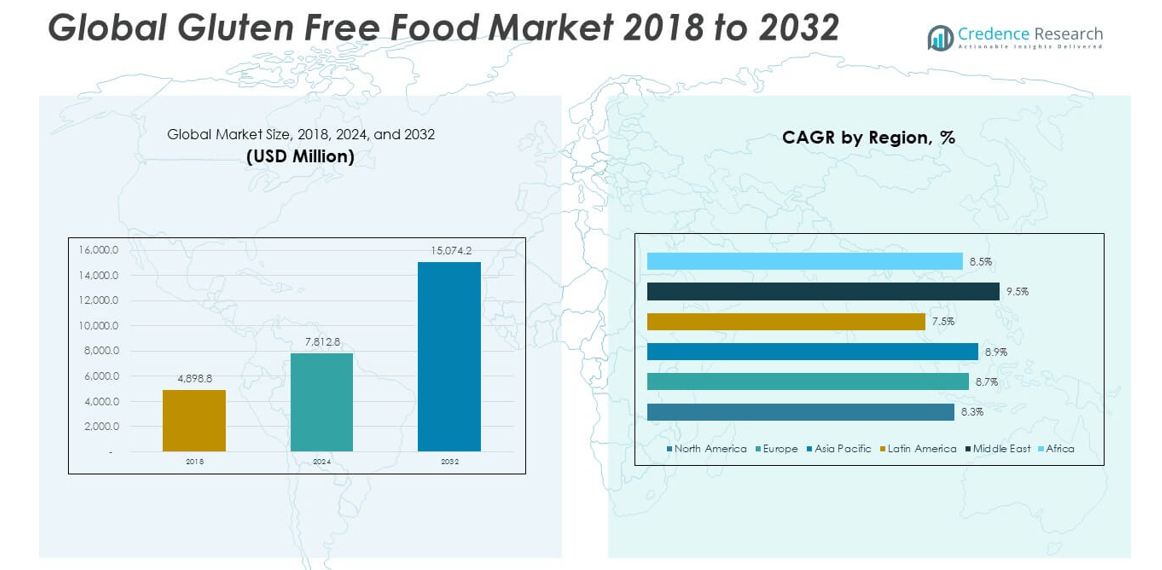
The Global Gluten Free Food Market size was valued at USD 4,898.8 million in 2018, growing to USD 7,812.8 million in 2024, and is anticipated to reach USD 15,074.2 million by 2032, at a CAGR of 8.62% during the forecast period.
| REPORT ATTRIBUTE | DETAILS |
|---|---|
| Historical Period | 2020-2023 |
| Base Year | 2024 |
| Forecast Period | 2025-2032 |
| Gluten Free Food Market Size 2024 | USD 7,812.8 million |
| Gluten Free Food Market, CAGR | 8.62% |
| Gluten Free Food Market Size 2032 | USD 15,074.2 million |
Rising health awareness and increasing prevalence of celiac disease are driving market growth. Consumers are shifting toward healthier food choices and adopting gluten-free diets for better digestion and energy. The surge in demand for clean-label and allergen-free products is also pushing food manufacturers to innovate. Expanding retail availability and attractive product labeling are further supporting the adoption of gluten-free foods across global markets.
North America leads the market due to strong consumer awareness, developed retail infrastructure, and high disposable income. Europe follows, driven by a large health-conscious population and favorable food safety regulations. The Asia-Pacific region is emerging rapidly due to urbanization, westernized diets, and a growing middle class adopting premium health foods. Rising awareness and online retail penetration are boosting demand in emerging economies such as India, China, and Japan.
Market Insights:
- The Global Gluten Free Food Market was valued at USD 4,898.8 million in 2018, grew to USD 7,812.8 million in 2024, and is projected to reach USD 15,074.22 million by 2032, expanding at a CAGR of 8.62%.
- Asia Pacific held the largest regional share at 34.5%, supported by urbanization, rising disposable income, and growing awareness of gluten intolerance. Europe followed with 27%, driven by strong labeling laws and product diversification. North America contributed 21%, supported by health-conscious consumers and advanced retail networks.
- The Asia Pacific region is the fastest-growing market, supported by expanding e-commerce channels, café culture, and the introduction of affordable gluten-free options in China, India, and Japan.
- Among product types, bakery products account for the largest segment share due to strong consumer preference for gluten-free bread, cookies, and cakes.
- Snacks and ready-to-eat products represent the second-largest category, driven by convenience, flavor innovation, and high demand among working consumers worldwide.
Market Drivers:
Rising Consumer Awareness Toward Healthy Eating and Celiac Disease Management
Growing awareness about celiac disease and gluten intolerance is a key driver for the Global Gluten Free Food Market. Consumers are increasingly choosing gluten-free diets to manage allergies and promote gut health. Awareness campaigns and medical recommendations are reinforcing the need for gluten-free alternatives. The trend is further encouraged by the easy access to information on social media. Health-conscious consumers are opting for natural, safe, and nutritious food. It is creating consistent demand in both developed and emerging economies. The market benefits from this growing preference for healthy and allergen-free eating.
- For instance, General Mills has leveraged digital campaigns and educational resources, as well as partnership programs with healthcare professionals, to market gluten-free Cheerios. Awareness campaigns and medical recommendations have reinforced the need for gluten-free alternatives. Health-conscious consumers are opting for natural, safe, and nutritious food, creating consistent demand in both developed and emerging economies.
Expansion of Retail Channels and Product Accessibility in Supermarkets and Online Platforms
The growing availability of gluten-free products in hypermarkets, supermarkets, and online stores has widened consumer reach. Large retail chains are increasing shelf space for gluten-free products, promoting visibility and convenience. E-commerce platforms support product discovery and direct brand interaction. It allows consumers to compare ingredients and select trusted options. Subscription models and online offers are fueling regular purchases. Partnerships between food manufacturers and retailers help improve distribution networks. This retail transformation is enhancing accessibility and supporting overall market expansion.
Product Innovation and Ingredient Advancements Enhancing Taste and Nutritional Value
Continuous product innovation remains central to the market’s expansion. Manufacturers are improving formulations to enhance taste, texture, and nutritional quality. It enables gluten-free foods to match traditional products in flavor and satisfaction. The use of new flours, grains, and protein sources enhances functionality. Companies are focusing on developing fortified, low-calorie, and high-fiber options. This technological improvement is attracting mainstream consumers beyond those with medical needs. Clean-label and organic certifications are also increasing product credibility. These innovations strengthen consumer trust and sustain long-term demand.
Rising Disposable Income and Lifestyle Shifts Toward Premium Health-Focused Food Choices
Increasing disposable incomes and urban lifestyle shifts are driving premium food consumption. Consumers in developed and emerging nations are investing more in dietary health. Gluten-free food aligns well with this premium health-focused lifestyle. It appeals to fitness-conscious individuals and those seeking balanced diets. Growing cafe culture and awareness of specialty diets are supporting this trend. The expansion of international brands in new markets further drives adoption. It is positioning gluten-free food as both a health necessity and a lifestyle choice. This shift continues to fuel steady market growth globally.
Market Trends:
Growing Influence of Clean Label and Natural Ingredient Preferences Among Consumers
Consumers are now prioritizing clean-label gluten-free products that use simple and natural ingredients. This preference is shifting product development toward transparency and authenticity. Manufacturers are removing artificial preservatives and focusing on recognizable ingredients. It enhances trust and supports long-term brand loyalty. The Global Gluten Free Food Market is adapting to these expectations by reformulating recipes. Certifications for non-GMO, organic, and allergen-free labels are becoming standard. Brands focusing on minimal ingredient processing are gaining a competitive edge. This trend reflects a broader movement toward mindful consumption.
- For instance, Hain Celestial Group reformulated its North American gluten-free snacks by September 2025 to eliminate artificial colors and preservatives, and secured Non-GMO Project Verified status on over 80 products. Manufacturers are responding by focusing on transparency, authentic formulation, and gaining key certifications, supporting long-term loyalty and trust.
Rising Adoption of Plant-Based and Functional Gluten-Free Products in Mainstream Diets
The increasing overlap between plant-based and gluten-free diets is shaping product trends. Consumers are choosing foods that deliver both functional and ethical benefits. It is leading to innovation in protein-rich and fiber-enhanced snacks, meals, and beverages. Companies are merging plant-based proteins with gluten-free flours to appeal to a larger audience. Functional ingredients such as probiotics, seeds, and pulses are gaining popularity. This combination enhances nutritional value and digestion benefits. The demand for multifunctional foods continues to grow across global markets. It is reshaping how consumers perceive gluten-free nutrition.
- For instance, Gruma's Mission Foods division launched gluten-free chickpea tortillas in July 2025 that provide 4g of protein and 7g of fiber per serving. While the company's "better-for-you" segment continues to perform well, Gruma's Q3 2025 earnings report indicated a 5% decrease in US net sales. This launch aligns with the ongoing market trend where consumers seek foods with enhanced nutritional profiles, driving the traction of functional ingredients such as seeds and pulses.
Technological Integration in Food Production and Packaging for Quality Enhancement
Advanced food processing and smart packaging technologies are transforming the gluten-free segment. These technologies help maintain taste consistency, freshness, and longer shelf life. The Global Gluten Free Food Market benefits from improved baking and extrusion systems. Automation enables better control of texture and nutritional profiles. Smart packaging with QR codes and freshness indicators attracts modern consumers. It promotes transparency and interactive engagement. Such innovations improve both product performance and customer experience. These developments will define the next phase of market maturity.
Influence of Social Media and Celebrity Endorsements Promoting Gluten-Free Lifestyle
Social media campaigns and celebrity endorsements have become powerful marketing tools. Influencers promote gluten-free diets as part of a modern, healthy lifestyle. It encourages awareness and rapid adoption among young consumers. Food bloggers and wellness brands frequently highlight gluten-free product benefits. Viral recipes and online reviews create strong consumer trust. Companies collaborate with influencers to expand visibility in digital spaces. This cultural and social shift supports strong market penetration. It has made gluten-free living aspirational rather than restrictive.
Market Challenges Analysis:
High Production Costs and Ingredient Limitations Affecting Product Profitability
The cost of manufacturing gluten-free products remains a major challenge for producers. Specialized raw materials such as alternative grains and stabilizers are expensive. The need for separate production lines to avoid cross-contamination adds to the cost. It makes gluten-free products more costly for consumers, limiting mass adoption. Maintaining taste, texture, and nutritional balance requires advanced R&D investment. Smaller producers face difficulty in matching large brand capabilities. Ingredient sourcing challenges further slow production efficiency. These financial and technical limitations continue to affect market competitiveness.
Limited Consumer Awareness in Developing Regions and Supply Chain Constraints
While developed regions show high awareness, developing areas lag behind in understanding gluten-free diets. Many consumers perceive gluten-free food as unnecessary or elite. It slows adoption outside urban centers. Distribution challenges and lack of cold chain infrastructure further hinder expansion. The Global Gluten Free Food Market faces difficulty reaching remote retail markets. Retail education and promotional campaigns are often limited. Weak labeling enforcement also affects consumer confidence. This combination of factors restricts widespread market penetration.
Market Opportunities:
Rising Demand in Emerging Economies Through Health Awareness and Retail Expansion
Emerging markets such as India, China, and Brazil offer strong potential for growth. Rising urban populations are adopting western dietary habits and premium food products. Increased awareness of gluten intolerance is supporting product introduction. The Global Gluten Free Food Market can benefit from expanding supermarket chains and online retail. It is creating easy access to new product varieties. Local partnerships can help brands tailor offerings to regional preferences. This expansion provides long-term profitability opportunities for global producers.
Innovation in Product Diversification and Collaboration with Foodservice Industry
The growing collaboration between manufacturers and foodservice operators offers vast scope. Restaurants and cafes are introducing dedicated gluten-free menus to meet dietary needs. Product diversification across bakery, snacks, beverages, and ready meals expands consumer options. It strengthens brand visibility and consumer loyalty. Foodservice partnerships also enable real-time market testing for new recipes. Companies can leverage this collaboration to enhance consumer trust and repeat demand. These factors collectively open new avenues for global market expansion.
Market Segmentation Analysis:
By Type
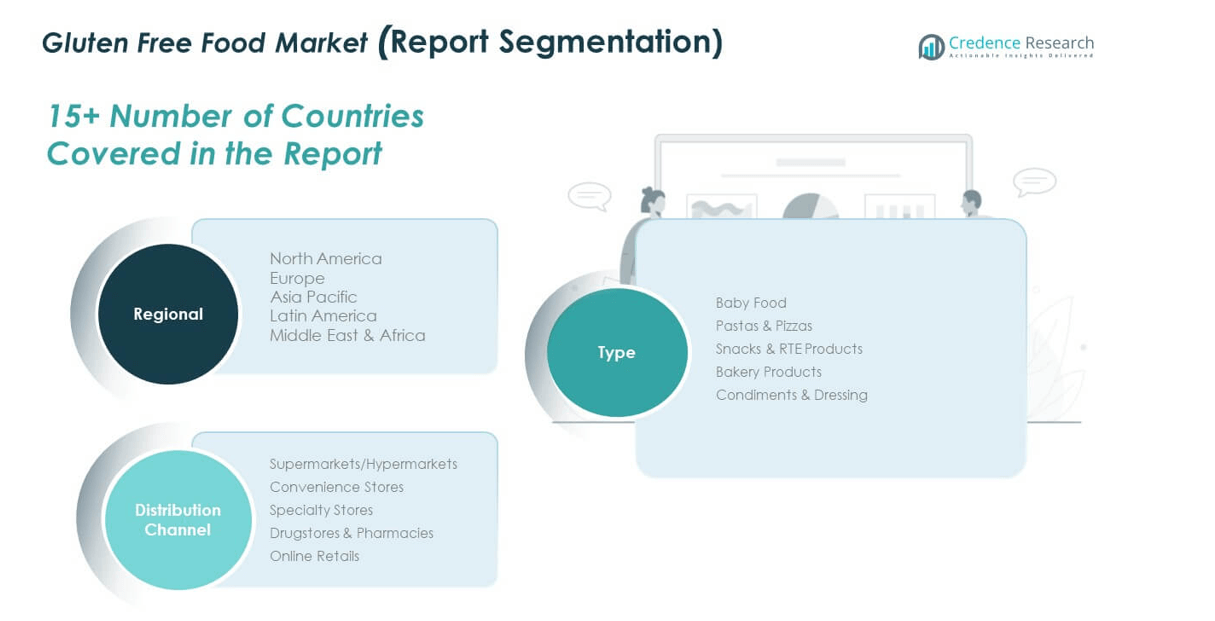
The Global Gluten Free Food Market is segmented into baby food, pastas and pizzas, snacks and ready-to-eat (RTE) products, bakery products, and condiments and dressings. Bakery products hold a major share, driven by high consumer preference for gluten-free bread, cakes, and cookies. Snacks and RTE products are gaining strong traction due to convenience and innovation in flavor variety. Baby food products are expanding steadily as parents seek allergen-free nutrition options. Pastas and pizzas reflect increasing restaurant and retail availability. Condiments and dressings are emerging segments, supported by clean-label demand and gluten-free formulations across sauces and spreads. It continues to diversify with expanding product ranges targeting daily consumption needs.
- For instance, Amy’s Kitchen introduced four gluten-free frozen pizzas and Italian entrees in Target stores in October 2025, which contributed to a 14% monthly increase in frozen pizza sales-demonstrating strong demand in bakery and RTE segments. Snacks and RTE products are securing growth via innovation and convenience, while condiments and dressings benefit from the clean-label trend.
By Application
Based on application, the market covers supermarkets and hypermarkets, convenience stores, specialty stores, drugstores and pharmacies, and online retail. Supermarkets and hypermarkets dominate due to extensive product variety and easy accessibility. Convenience stores support impulse purchases and growing consumer reach. Specialty stores attract health-conscious buyers seeking premium or organic gluten-free options. Drugstores and pharmacies contribute through diet-specific health food sections. Online retail is the fastest-growing segment, supported by e-commerce platforms offering home delivery and product transparency. It benefits from strong digital adoption and targeted marketing. This multi-channel distribution framework is expanding the market footprint globally.
- For instance, the gluten-free food market is experiencing significant growth, with a growing demand driven by increasing health-consciousness among consumers. As a major market player, Kellanova has expanded its retail reach for gluten-free products through multi-channel strategies, focusing on both in-store availability and online sales platforms. Additionally, the company is using AI-optimized creative to enhance its marketing and better identify consumer buying patterns.
Segmentation:
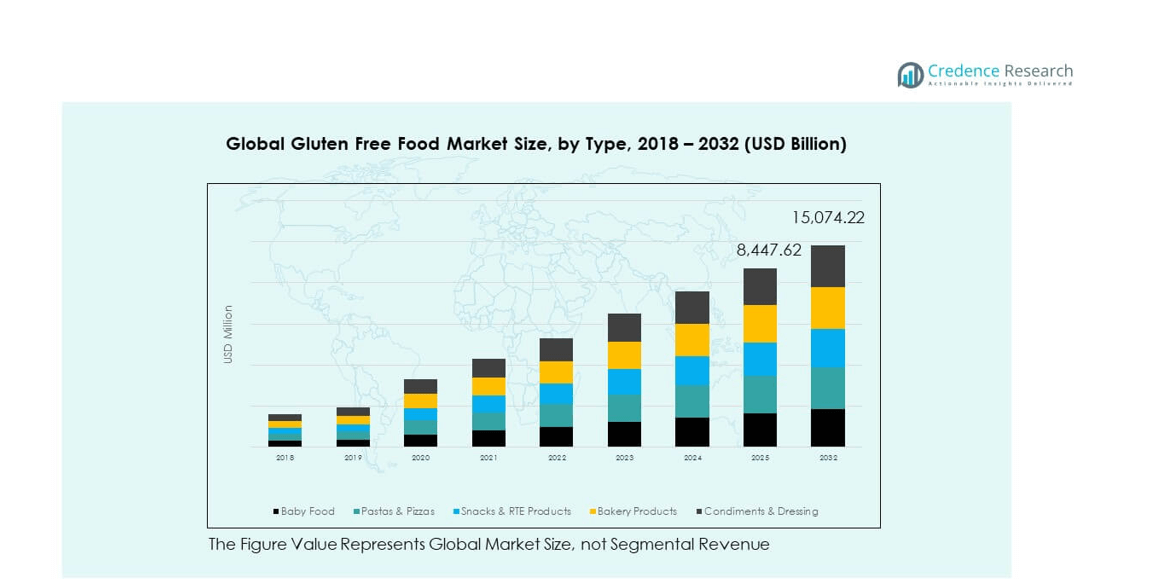
- By Type
- Baby Food
- Pastas & Pizzas
- Snacks & Ready-to-Eat (RTE) Products
- Bakery Products
- Condiments & Dressings
- By Application
- Supermarkets/Hypermarkets
- Convenience Stores
- Specialty Stores
- Drugstores & Pharmacies
- Online Retail
- By Region
- North America
- U.S.
- Canada
- Europe
- Germany
- France
- Italy
- U.K.
- Russia
- Rest of Europe
- Asia-Pacific
- India
- China
- Japan
- Rest of Asia-Pacific
- Latin America
- Brazil
- Mexico
- Rest of Latin America
- Middle East and Africa
- GCC Countries
- South Africa
- Rest of Middle East and Africa
- North America
Regional Analysis:
North America
The North America Gluten Free Food Market size was valued at USD 1,072.35 million in 2018, growing to USD 1,680.43 million in 2024, and is anticipated to reach USD 3,165.59 million by 2032, at a CAGR of 8.3% during the forecast period. North America holds around 21.0% of the total Global Gluten Free Food Market share. High consumer awareness of celiac disease and gluten intolerance supports strong product adoption. It benefits from established food processing industries, advanced labeling laws, and widespread retail distribution. Major brands are introducing innovative products across bakery and snacks categories. Strong e-commerce growth also boosts accessibility to gluten-free products. The U.S. remains the key revenue contributor, while Canada shows steady growth through health-conscious consumers. Strategic collaborations between manufacturers and retailers continue to expand product visibility.
Europe
The Europe Gluten Free Food Market size was valued at USD 1,309.45 million in 2018, increasing to USD 2,097.41 million in 2024, and is anticipated to reach USD 4,070.04 million by 2032, at a CAGR of 8.7% during the forecast period. Europe accounts for nearly 27.0% of the total Global Gluten Free Food Market share. Strong regulatory support for gluten-free labeling and rising diagnosis of gluten intolerance drive market expansion. The region’s diverse food culture encourages product diversification across bakery, pasta, and snacks. It witnesses high adoption in countries such as Germany, the U.K., France, and Italy. Manufacturers are focusing on organic, clean-label, and fortified formulations. Expanding retail channels and rising preference for plant-based gluten-free options strengthen growth. Continuous product innovation sustains Europe’s leading position in the global market.
Asia Pacific
The Asia Pacific Gluten Free Food Market size was valued at USD 1,676.86 million in 2018, reaching USD 2,722.55 million in 2024, and is projected to hit USD 5,376.97 million by 2032, at a CAGR of 8.9% during the forecast period. Asia Pacific represents about 34.5% of the Global Gluten Free Food Market share. Rapid urbanization and increasing health awareness are fueling regional demand. It benefits from growing disposable income and western dietary influence. Japan, China, and India are major growth centers supported by expanding retail infrastructure. Rising cases of gluten sensitivity and digestive health awareness are boosting adoption. Local manufacturers are investing in cost-effective product development and distribution. Expanding e-commerce and café culture further encourage gluten-free consumption. The region is expected to remain the fastest-growing market during the forecast period.
Latin America
The Latin America Gluten Free Food Market size was valued at USD 506.54 million in 2018, expanding to USD 762.98 million in 2024, and is anticipated to reach USD 1,356.68 million by 2032, at a CAGR of 7.5% during the forecast period. Latin America holds about 8.7% of the Global Gluten Free Food Market share. Growing health awareness and the introduction of affordable gluten-free options are driving adoption. Brazil and Argentina are the key contributors, supported by strong retail penetration. It benefits from an increasing number of regional players launching local product variants. Expanding supermarkets and online platforms make gluten-free foods more accessible. Rising influence of global health trends is shifting consumer preferences toward cleaner diets. Foodservice providers are also offering gluten-free menu options to attract younger consumers.
Middle East
The Middle East Gluten Free Food Market size was valued at USD 212.61 million in 2018, reaching USD 357.49 million in 2024, and is projected to grow to USD 737.13 million by 2032, at a CAGR of 9.5% during the forecast period. The region represents about 4.7% of the Global Gluten Free Food Market share. Increasing awareness of digestive health and higher disposable income are stimulating product demand. The UAE and Saudi Arabia lead consumption, supported by expanding retail networks. It is seeing more availability of imported gluten-free brands and specialty stores. The hospitality sector is incorporating gluten-free menu options to attract tourists. Rising participation of local producers in the premium health food category enhances supply diversity. The market is strengthening through strategic brand partnerships and marketing initiatives.
Africa
The Africa Gluten Free Food Market size was valued at USD 121.00 million in 2018, reaching USD 191.97 million in 2024, and is expected to reach USD 367.81 million by 2032, at a CAGR of 8.5% during the forecast period. Africa contributes around 4.1% of the total Global Gluten Free Food Market share. Growing urban populations and improving income levels are gradually supporting gluten-free adoption. South Africa leads regional consumption, followed by Egypt and Nigeria. It benefits from increasing import of gluten-free packaged foods and nutritional awareness. Limited domestic production remains a challenge, but investments in local manufacturing are rising. Expanding retail outlets and international brand entry are strengthening distribution. Awareness programs are improving consumer perception and product acceptance. The market shows steady long-term potential across metropolitan areas.
Key Player Analysis:
- Conagra Brands, Inc.
- Freedom Foods Group Ltd
- Pinnacle Foods Inc
- General Mills Inc.
- Gruma, S.A.B. de C.V.
- The Hain Celestial Group, Inc.
- Amy’s Kitchen, Inc.
- Enjoy Life Foods
- The Kraft Heinz Company
- Kellanova (formerly Kellogg Company)
- Other Key Players: Barilla G. e R. Fratelli S.p.A., Boulder Brands, Dr. Schär AG/SPA, Mondelez International, Nestlé S.A., PepsiCo, Inc., and Genius Foods Ltd.
Competitive Analysis:
The Global Gluten Free Food Market is moderately competitive, driven by a mix of global brands and regional producers. Key players are expanding through product innovation, partnerships, and acquisitions to strengthen distribution and product diversity. It emphasizes quality, labeling transparency, and taste improvement to attract a wider consumer base. Companies are focusing on clean-label, plant-based, and organic formulations to meet health-conscious demand. Investments in R&D and manufacturing efficiency enhance brand positioning. Intense competition encourages firms to differentiate through innovation, affordability, and sustainability. Strategic expansion in emerging markets continues to define the competitive landscape.
Recent Developments:
- In October 2025, Amy’s Kitchen rolled out four new Italian-inspired products at Target stores nationwide, including Spaghetti Italiano and gluten-free personal-sized pizzas. This launch demonstrates Amy’s commitment to expanding organic, gluten-free, and restaurant-quality meals accessible for busy families needing allergen-friendly solutions.
- Gruma’s Mission Foods division launched new gluten-free chickpea tortillas in July 2025, providing consumers with a high-fiber, plant-based, and gluten-free alternative for wraps and tacos. For instance, these tortillas are now available at major retailers, supporting dietary needs and preferences for both gluten-free and plant-based diets.
- In June 2025, Conagra Brands unveiled over 50 new frozen food products, including a major expansion of its gluten-free offerings such as Udi’s gluten-free chicken meals and family-size enchiladas. These launches address rising demand for convenient, specialty frozen meals among consumers seeking gluten-free options. For instance, its gluten-free Udi’s enchiladas target the growing base of consumers seeking premium, allergen-friendly choices in the frozen aisle.
- In January 2025, General Mills introduced several new breakfast products, including expanded gluten-free varieties under flagship brands such as Cheerios Protein and Cheerios Oat Crunch Chocolate. Additionally, General Mills Foodservice debuted Honey Cheerios™, a gluten-free cereal exclusive to K-12 school feeding programs, increasing accessibility for children with gluten sensitivities.
Report Coverage:
The research report offers an in-depth analysis based on product type and application. It details leading market players, providing an overview of their business, product offerings, investments, revenue streams, and key applications. Additionally, the report includes insights into the competitive environment, SWOT analysis, current market trends, as well as the primary drivers and constraints. Furthermore, it discusses various factors that have driven market expansion in recent years. The report also explores market dynamics, regulatory scenarios, and technological advancements that are shaping the industry. It assesses the impact of external factors and global economic changes on market growth. Lastly, it provides strategic recommendations for new entrants and established companies to navigate the complexities of the market.
Future Outlook:
- Demand for gluten-free snacks and bakery products will continue to accelerate globally.
- E-commerce platforms will play a major role in expanding retail reach.
- Product innovation will focus on nutritional enhancement and ingredient transparency.
- Asia Pacific will remain the fastest-growing regional market.
- Strategic partnerships between food manufacturers and retailers will intensify.
- Clean-label and organic certification will become stronger purchase drivers.
- Technological advances will improve product texture and shelf life.
- Increased marketing of gluten-free products as lifestyle foods will broaden the audience.
- Expansion into foodservice and hospitality sectors will enhance brand presence.
- Investment in local production and regional branding will strengthen market penetration.

Request a Free Sample
Fill in your details and we'll send you a free sample report.
- Sample data tables & charts
- Research methodology
Market Dynamics
Rising Consumer Awareness Toward Healthy Eating and Celiac Disease Management
Increasing diagnosis of celiac disease and gluten intolerance, along with broader health consciousness, is driving consumers to seek gluten-free alternatives for better digestion and overall wellness. Awareness campaigns and medical recommendations are reinforcing the need for gluten-free diets, expanding the market in both developed and emerging economies.
Expansion of Retail Channels and Product Accessibility
The proliferation of gluten-free products in supermarkets, hypermarkets, and online platforms has made these foods more accessible to a wider audience. Enhanced shelf space, e-commerce growth, and subscription models are making it easier for consumers to discover and regularly purchase gluten-free options.
Product Innovation and Ingredient Advancements
Continuous innovation in product formulations is improving the taste, texture, and nutritional value of gluten-free foods, making them more appealing to mainstream consumers. The use of new grains, protein sources, and clean-label ingredients is attracting health-conscious buyers and expanding the market beyond those with medical needs.
Rising Disposable Income and Lifestyle Shifts
Growing disposable incomes and urbanization are leading consumers, especially in emerging markets, to invest in premium, health-focused foods such as gluten-free products. The alignment of gluten-free foods with fitness and wellness trends is positioning them as both a health necessity and a lifestyle choice.
Influence of Clean Label and Natural Ingredient Preferences
Consumers are increasingly demanding gluten-free products with simple, natural, and recognizable ingredients, driving manufacturers to reformulate products for transparency and authenticity. Certifications such as non-GMO and organic are becoming standard, further boosting consumer trust and market growth.
Need a Custom Version of This Report?
Tailor the scope, geography, or segments to your exact requirements.
- Custom geography or segment scope
- Direct access to our analyst team
Frequently Asked Questions
What is the current market size for the Global Gluten Free Food Market, and what is its projected size in 2032?
At what Compound Annual Growth Rate is the Global Gluten Free Food Market projected to grow between 2025 and 2032?
Which Global Gluten Free Food Market segment held the largest share in 2024?
What are the primary factors fueling the growth of the Global Gluten Free Food Market?
Who are the leading companies in the Global Gluten Free Food Market?
Who are the major players in this market?
Table of Content
Chapter 1 Market Segmentation
- 1.1 Segmentation Framework
- 1.1.1 Product and Service Classification
- 1.1.2 Application and End-Use Classification
- 1.1.3 Technology and Solution Classification
- 1.1.4 Customer and Distribution Channel Classification
- 1.1.5 Geographic Segmentation
- 1.1.6 Market Segment Definitions and Boundaries
- 1.2 By Type
- 1.2.1 Bakery Products
- 1.2.2 Snacks & Ready-to-Eat (RTE) Products
- 1.2.3 Pastas & Pizzas
- 1.2.4 Baby Food
- 1.2.5 Condiments & Dressings
- 1.3 By Application
- 1.3.1 Supermarkets/Hypermarkets
- 1.3.2 Convenience Stores
- 1.3.3 Specialty Stores
- 1.3.4 Drugstores & Pharmacies
- 1.3.5 Online Retail
Chapter 2 Introduction
- 2.1 Report Objectives and Scope
- 2.2 Product Definition and Industry Terminology
- 2.3 Market Inclusions and Exclusions
- 2.4 Research Process
- 2.4.1 Primary Research and Expert Interviews
- 2.4.2 Secondary Research and Source Review
- 2.4.3 Top-Down and Bottom-Up Estimation
- 2.4.4 Data Triangulation and Verification
- 2.5 Market Size Measurement Basis
- 2.5.1 2018: USD 4,898.8 million → 2032: USD 15,074.2 million
- 2.6 Historical and Forecast Reference Periods
- 2.6.1 Base Year: 2018
- 2.6.2 Forecast Period: 2018-2032
- 2.7 Research Assumptions and Limitations
Chapter 3 Executive Summary
- 3.1 Market Snapshot and Key Findings
- 3.2 Base-Year Market Size, 2018
- 3.3 Forecast Market Size, 2032
- 3.4 Revenue and Volume Growth Outlook
- 3.5 Key Demand and Supply Indicators
- 3.6 Leading Market Segments
- 3.7 Fastest-Growing Market Opportunities
- 3.8 Regional Performance Highlights
- 3.9 Technology and Industry Transformation
- 3.10 Competitive Landscape Summary
- 3.11 Analyst View and Strategic Implications
Chapter 4 Global Gluten Free Food Market Trends and Developments
- 4.1 Historical Industry Development
- 4.2 Recent Market Trends and Developments
- 4.3 Demand and Customer Behavior Trends
- 4.4 Technology and Product Innovation
- 4.5 Artificial Intelligence, Automation and Digitalization
- 4.6 Local Manufacturing and Supply Chain Realignment
- 4.7 Industry Partnerships, Mergers and Acquisitions
- 4.8 Sustainability and Circular Economy Developments
- 4.9 Government and Private Sector Investment Trends
- 4.10 Emerging Business Models and Commercialization
- 4.11 Industry Developments and Announcements
Chapter 5 Global Gluten Free Food Market Production, Supply and Demand Analysis
- 5.1 Demand Trend and Consumption Analysis
- 5.2 Demand Forecast, 2018-2032
- 5.3 Production and Output Trend
- 5.4 Production and Output Forecast, 2018-2032
- 5.5 Installed Capacity and Capacity Utilization
- 5.6 Company-Wise Production Plants and Statistics
- 5.6.1 Installed Production Capacity
- 5.6.2 Actual Production
- 5.6.3 Planned Capacity and Expansion Targets
- 5.7 Supply Chain Structure and Procurement Trends
- 5.8 Supply-Demand Gap and Bottlenecks
- 5.9 Import Dependence and Sourcing Structure
- 5.10 Contract Manufacturing and Outsourcing
- 5.11 Regional Supply and Demand Concentration
Chapter 6 Global Gluten Free Food Market Pricing Analysis
- 6.1 Pricing Structure and Measurement
- 6.2 Historical Pricing Trends
- 6.3 Pricing Outlook, 2018-2032
- 6.4 Average Selling Price and Unit Economics
- 6.5 Pricing by Product and Market Segment
- 6.6 Geographic Pricing Differences
- 6.7 Key Input, Energy, Labor and Logistics Costs
- 6.8 Contract Pricing and Purchasing Models
- 6.9 Pricing Sensitivity and Competitive Positioning
- 6.10 Price, Margin and Profitability Implications
Chapter 7 Global Gluten Free Food Market Dynamics
- 7.1 Market Growth Drivers
- 7.1.1 Demand-Side Drivers
- 7.1.2 Technology and Innovation Drivers
- 7.1.3 Infrastructure and Investment Drivers
- 7.1.4 Regulatory and Policy Drivers
- 7.2 Market Restraints
- 7.2.1 Cost and Affordability Constraints
- 7.2.2 Technology and Adoption Barriers
- 7.2.3 Supply Chain and Operational Constraints
- 7.3 Market Challenges
- 7.3.1 Competitive Pressure and Margin Erosion
- 7.3.2 Skills, Infrastructure and Implementation Gaps
- 7.4 Emerging Market Opportunities
- 7.5 Market Dynamics Impact and Time-Horizon Assessment
Chapter 8 Global Gluten Free Food Value Chain Analysis
- 8.1 Industry Value Chain Overview
- 8.2 Upstream Suppliers and Critical Inputs
- 8.3 Technology and Component Providers
- 8.4 Manufacturing or Service Delivery
- 8.5 Distribution, Channel Partners and Integrators
- 8.6 Downstream Applications and End Users
- 8.7 Value Addition and Profit Pools
- 8.8 Vertical Integration and Outsourcing
- 8.9 Supplier Concentration and Risk
- 8.10 Supply Chain Localization and Resilience
Chapter 9 Global Gluten Free Food Market Regulations and Policies
- 9.1 Relevant Laws, Standards and Compliance Frameworks
- 9.2 Product, Service, Safety and Quality Requirements
- 9.3 Government Policies, Incentives and Subsidies
- 9.4 Imports, Exports and Trade Barriers
- 9.5 Public Procurement and Local Content Requirements
- 9.6 Environmental and Sustainability Compliance
- 9.7 Upcoming Policy Changes and Market Implications
Chapter 10 Global Gluten Free Food Market Hotspots and Opportunities
- 10.1 Market Opportunity Mapping and Growth Hotspots
- 10.2 High-Growth Applications and Customer Groups
- 10.3 Underserved Markets and White-Space Opportunities
- 10.4 Emerging Technology and Product Opportunities
- 10.5 New Capacity and Investment Hotspots
- 10.6 Market Entry and Expansion Opportunities
- 10.7 Distribution and Partnership Opportunities
- 10.8 Near-Term and Long-Term Commercial Potential
- 10.9 Opportunity Attractiveness and Execution Risks
Chapter 11 Global Gluten Free Food Market Outlook, 2018-2032
- 11.1 Market Size and Analysis
- 11.1.1 Revenue (Market Measurement: 2018: USD 4,898.8 million → 2032: USD 15,074.2 million)
- 11.1.2 Market Volume and Quantity Sold
- 11.1.3 Historical Market Size
- 11.1.4 Base-Year Market Size, 2018
- 11.2 Market Forecast, 2018-2032
- 11.2.1 Revenue Forecast to 2032
- 11.2.2 Volume Forecast to 2032
- 11.2.3 CAGR and Year-on-Year Growth
- 11.2.4 Incremental Revenue Opportunity
- 11.3 Forecast Assumptions and Scenario Analysis
- 11.3.1 Base-Case Forecast
- 11.3.2 Optimistic and Conservative Scenarios
- 11.3.3 Technology, Pricing and Policy Sensitivities
- 11.4 Market Attractiveness and Growth Outlook
Chapter 12 Global Gluten Free Food Market Segmentation and Outlook
- 12.1 Segmentation Summary and Market Shares, 2018
- 12.2 Largest and Fastest-Growing Segments
- 12.3 By Type - Market Size and Forecast, 2018-2032
- 12.3.1 Segment Definition and Scope
- 12.3.2 Historical Market Size
- 12.3.3 Revenue Forecast, 2018-2032
- 12.3.4 Volume Forecast, 2018-2032
- 12.3.5 Base-Year Market Share, 2018
- 12.3.6 Segment CAGR and Growth Drivers
- 12.3.7 Subsegment Market Size and Forecast
- 12.3.7.1 Bakery Products
- 12.3.7.2 Snacks & Ready-to-Eat (RTE) Products
- 12.3.7.3 Pastas & Pizzas
- 12.3.7.4 Baby Food
- 12.3.7.5 Condiments & Dressings
- 12.3.8 Subsegment Pricing and Adoption Trends
- 12.3.9 Leading Suppliers and Competition
- 12.3.10 Regional Demand and Opportunities
- 12.4 By Application - Market Size and Forecast, 2018-2032
- 12.4.1 Segment Definition and Scope
- 12.4.2 Historical Market Size
- 12.4.3 Revenue Forecast, 2018-2032
- 12.4.4 Volume Forecast, 2018-2032
- 12.4.5 Base-Year Market Share, 2018
- 12.4.6 Segment CAGR and Growth Drivers
- 12.4.7 Subsegment Market Size and Forecast
- 12.4.7.1 Supermarkets/Hypermarkets
- 12.4.7.2 Convenience Stores
- 12.4.7.3 Specialty Stores
- 12.4.7.4 Drugstores & Pharmacies
- 12.4.7.5 Online Retail
- 12.4.8 Subsegment Pricing and Adoption Trends
- 12.4.9 Leading Suppliers and Competition
- 12.4.10 Regional Demand and Opportunities
- 12.5 Segment Growth Comparison
- 12.6 Segment Attractiveness and Priority Matrix
Chapter 13 Global Gluten Free Food End-Use and Application Market Outlook
- 13.1 End-Use Industry and Customer Demand Structure
- 13.2 Leading Applications and Customer Groups
- 13.3 End-Use Market Size, Share and Forecast
- 13.4 Major End-Use Industry Deep Dives
- 13.4.1 Customer Requirements and Use Cases
- 13.4.2 Demand and Replacement Cycles
- 13.4.3 Technical and Regulatory Considerations
- 13.4.4 Purchasing and Procurement Models
- 13.4.5 Leading Vendors and Distribution Channels
- 13.4.6 Forecast and Commercial Opportunities
- 13.5 Emerging Applications and Cross-Segment Demand
- 13.6 End-Use Industry Investment Priorities
Chapter 14 Global Gluten Free Food Geographic Market Outlook, 2018-2032
- 14.1 Regional Market Size and Share, 2018
- 14.2 Regional Market Forecast, 2018-2032
- 14.3 Regional Pricing, Production and Demand Differences
- 14.4 North America
- 14.4.1 United States
- 14.4.2 Canada
- 14.4.3 Mexico
- 14.5 Europe
- 14.5.1 Germany
- 14.5.2 France
- 14.5.3 Italy
- 14.5.4 United Kingdom
- 14.5.5 Spain
- 14.5.6 Poland
- 14.5.7 Russia
- 14.5.8 Netherlands
- 14.5.9 Belgium
- 14.5.10 Sweden
- 14.5.11 Denmark
- 14.5.12 Norway
- 14.5.13 Rest of Europe
- 14.6 Asia Pacific
- 14.6.1 China
- 14.6.2 India
- 14.6.3 Japan
- 14.6.4 South Korea
- 14.6.5 Thailand
- 14.6.6 Indonesia
- 14.6.7 Vietnam
- 14.6.8 Malaysia
- 14.6.9 Australia
- 14.6.10 Rest of Asia Pacific
- 14.7 Latin America
- 14.7.1 Brazil
- 14.7.2 Argentina
- 14.7.3 Colombia
- 14.7.4 Chile
- 14.7.5 Rest of Latin America
- 14.8 Middle East
- 14.8.1 Saudi Arabia
- 14.8.2 United Arab Emirates
- 14.8.3 Turkey
- 14.8.4 Israel
- 14.8.5 Iran
- 14.8.6 Rest of the Middle East
- 14.9 Africa
- 14.9.1 South Africa
- 14.9.2 Egypt
- 14.9.3 Nigeria
- 14.9.4 Morocco
- 14.9.5 Rest of Africa
- 14.10 Regional Investment, Policy and Supply Chain Differences
- 14.11 Regional Competitive Landscape
- 14.12 Geographic Growth Hotspots
Chapter 15 Global Gluten Free Food Technology, Innovation and Sustainability Outlook
- 15.1 Technology Landscape and Maturity
- 15.2 Product, Process and Service Innovation
- 15.3 AI, Automation and Digital Tools in the Industry
- 15.4 Technology Adoption and Performance Benchmarking
- 15.5 Innovation Pipeline and R&D Investment
- 15.6 Patent and Intellectual Property Trends
- 15.7 Energy Efficiency and Resource Management
- 15.8 Sustainability, Recycling and Circularity
- 15.9 Technology Roadmap, 2018-2032
- 15.10 Risks of Obsolescence and Technology Substitution
Chapter 16 Global Gluten Free Food Market Key Strategic Imperatives
- 16.1 Growth and Market Entry Priorities
- 16.2 High-Return Products and Segments
- 16.3 Pricing, Profitability and Cost Optimization
- 16.4 Technology Investment and Product Differentiation
- 16.5 Supply Chain Localization and Resilience
- 16.6 Distribution and Customer Acquisition
- 16.7 Partnership, Acquisition and Capacity Strategy
- 16.8 Regional Expansion Priorities
- 16.9 Short-, Medium- and Long-Term Actions
Chapter 17 Competition Outlook
- 17.1 Industry Competition Characteristics
- 17.2 Market Structure and Concentration
- 17.3 Market Share and Competitive Positioning, 2018
- 17.4 Company-Wise Revenue and Product Benchmarking
- 17.5 Production and Service Capacity Benchmarking
- 17.6 Technology, Pricing and Differentiation
- 17.7 Regional Footprint and Distribution Strength
- 17.8 Mergers, Acquisitions and Strategic Alliances
- 17.9 New Entrants and Competitive Threats
- 17.10 Porter's Five Forces and Industry Attractiveness
- 17.11 Competitive Outlook, 2018-2032
Chapter 18 Company Profiles
- 18.1 Company Coverage and Selection Criteria
- 18.2 Conagra Brands, Inc.
- 18.2.1 Business Description
- 18.2.2 Company Ownership and Geographic Presence
- 18.2.3 Product and Service Portfolio
- 18.2.4 Manufacturing and Operating Footprint
- 18.2.5 Production Capacity and Expansion Plans
- 18.2.6 Financial Performance and Investment
- 18.2.7 Market Share and Competitive Position
- 18.2.8 Technology and Innovation Capabilities
- 18.2.9 Strategic Alliances or Partnerships
- 18.2.10 Recent Developments
- 18.2.11 Growth Strategy and Outlook
- 18.3 General Mills Inc.
- 18.4 Gruma, S.A.B. de C.V.
- 18.5 The Hain Celestial Group, Inc.
- 18.6 Amy’s Kitchen, Inc.
- 18.7 Kellanova (formerly Kellogg Company)
- 18.8 Barilla G. e R. Fratelli S.p.A.
- 18.9 Dr. Schär AG/SPA
- 18.10 Nestlé S.A.
- 18.11 Pinnacle Foods Inc
- 18.12 Other Relevant Market Participants
Note: Every listed company is profiled on the structure shown under the first company. The company list is preliminary and may change based on research findings, market developments, data availability and client requirements.
Chapter 19 Disclaimer
- 19.1 Research and Forecast Disclaimer
- 19.2 Data Source and Estimation Limitations
Note: The depth of individual sections depends on data availability for this market. Volume, capacity, trade and other unit-based metrics are included where applicable.