Market Overview
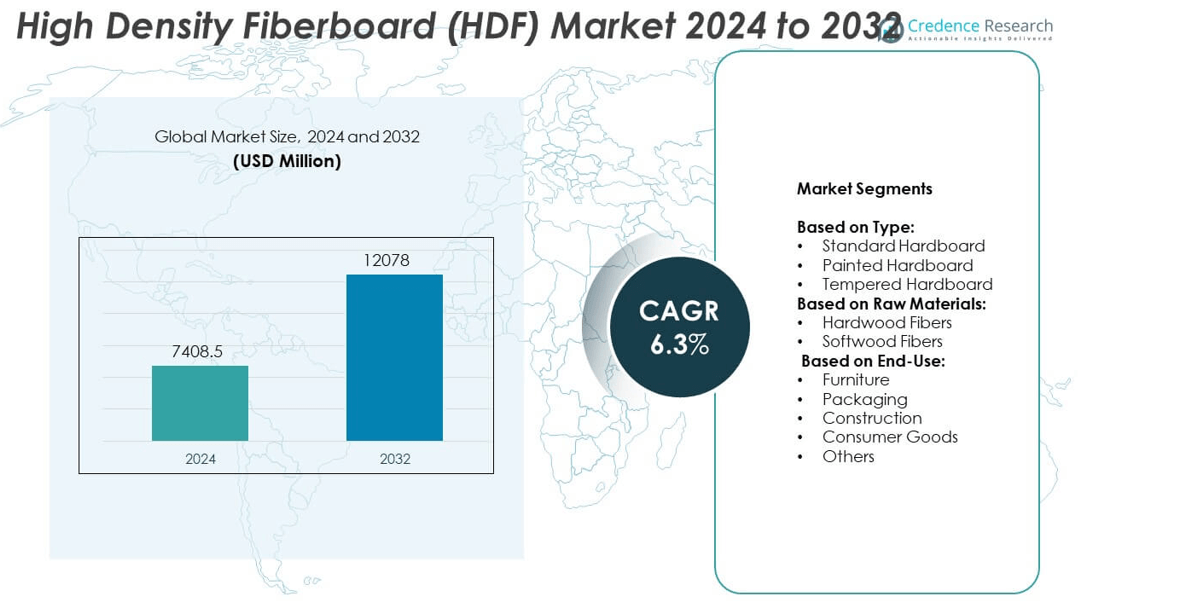
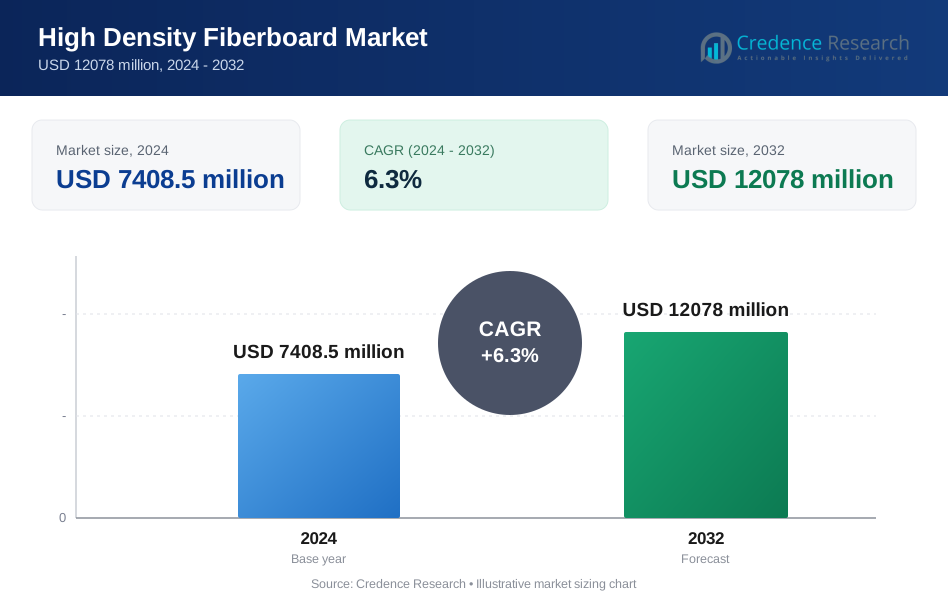
The High Density Fiberboard (HDF) Market size was valued at USD 7408.5 million in 2024 and is projected to reach USD 12078 million by 2032, growing at a CAGR of 6.3% during the forecast period.
| REPORT ATTRIBUTE | DETAILS |
|---|---|
| Historical Period | 2020-2023 |
| Base Year | 2024 |
| Forecast Period | 2025-2032 |
| High Density Fiberboard (HDF) Market Size 2024 | SD 7408.5 million |
| High Density Fiberboard (HDF) Market, CAGR | 6.3% |
| High Density Fiberboard (HDF) Market Size 2032 | USD 12078 million |
The High Density Fiberboard (HDF) market grows with rising demand from the furniture and construction industries, supported by its durability, smooth finish, and cost efficiency. Increasing adoption of eco-friendly and low-emission boards strengthens its position under stricter environmental regulations. Decorative finishes and customization trends drive usage in modern interiors, while advancements in manufacturing technologies improve product quality and performance. Expanding urbanization in emerging economies further boosts consumption, creating consistent opportunities for manufacturers to innovate and expand their global presence.
The High Density Fiberboard (HDF) market shows strong growth across Asia-Pacific, North America, and Europe, with emerging economies driving significant demand through construction and furniture expansion. Asia-Pacific leads in production and consumption due to rapid urbanization and large manufacturing bases. North America and Europe maintain steady demand supported by sustainable product adoption and renovation activities. Key players such as Kronospan, Greenpanel Industries, Swiss Krono Group, and Arauco focus on expanding capacity, introducing eco-friendly solutions, and strengthening regional distribution networks.
Market Insights
- The High Density Fiberboard (HDF) market was valued at USD 7408.5 million in 2024 and is expected to reach USD 12078 million by 2032, growing at a CAGR of 6.3%.
- Demand is driven by the furniture industry due to HDF’s durability, smooth surface, and cost-effectiveness, making it suitable for modular and modern designs.
- Trends highlight increasing adoption of eco-friendly, low-emission boards and decorative finishes, with consumers preferring sustainable solutions and customized interiors.
- Leading players including Masonite International, Kronospan, Greenpanel Industries, Swiss Krono Group, and Arauco compete by expanding capacity, investing in technology, and enhancing product performance.
- Challenges include raw material price fluctuations, moisture sensitivity, and competition from alternatives such as plywood and particleboard, which limit adoption in some applications.
- Asia-Pacific leads demand due to rapid urbanization, housing projects, and strong furniture production, while North America and Europe show steady growth through renovation and eco-friendly product demand.
- Latin America and the Middle East & Africa expand gradually, supported by construction projects and rising furniture consumption, offering future opportunities for market participants.
Market Drivers
Rising Demand in the Furniture and Interior Industry
The High Density Fiberboard (HDF) market benefits from rising adoption in furniture and interior design. Manufacturers prefer HDF due to its smooth finish, durability, and ability to support intricate designs. It helps furniture makers meet consumer demand for cost-effective yet visually appealing products. The trend of modular furniture in urban housing boosts its utilization. Growing construction projects also increase the requirement for HDF-based panels and fittings. This demand cycle creates a consistent push for manufacturers to expand production. It strengthens the market presence across both residential and commercial applications.
- For instance, Hatil produces 48 000 furniture units per month, using engineered wood and HDF-derived particle boards in its automated factories
Sustainability and Use of Recycled Raw Materials
The High Density Fiberboard (HDF) market gains momentum from rising emphasis on sustainability. Producers are focusing on eco-friendly materials and recycled wood fibers to reduce environmental impact. It supports compliance with stricter regulations on sustainable manufacturing practices. Eco-conscious consumers drive preference for panels with reduced emissions and sustainable certification. Global retailers encourage suppliers to adopt environmentally responsible materials, reinforcing adoption. Use of advanced production processes enhances the market’s green profile. This focus on sustainability positions HDF as a long-term alternative to solid wood.
- For instance, Unilin Panels employs a world-first industrial method to recycle discarded MDF and HDF. This innovation enables the company to store 380 000 tonnes of CO₂ annually by reusing wood fibers
Advancements in Manufacturing Technologies
The High Density Fiberboard (HDF) market advances with continuous improvements in manufacturing technology. Modern machinery enables precise density control, smoother surfaces, and enhanced durability. It supports consistent product quality across large-scale production. Automation reduces costs, shortens production cycles, and improves supply capabilities. Producers invest in advanced resin formulations that improve moisture resistance and strength. The adoption of digital cutting and pressing technologies further refines customization. These technological upgrades expand the scope of HDF applications in varied industries.
Expansion in Construction and Real Estate Development
The High Density Fiberboard (HDF) market grows with the steady expansion of construction and real estate projects. Residential and commercial developments demand cost-effective and durable materials for interior applications. It provides a reliable solution for flooring, wall paneling, and doors in large projects. Developers choose HDF due to its uniform texture and resistance to warping. Rising urbanization drives steady consumption in fast-growing economies. Government infrastructure projects also expand opportunities for HDF suppliers. This wide adoption cements its role as a key material in modern construction.
Market Trends
Growing Adoption of Eco-Friendly and Low-Emission Boards
The High Density Fiberboard (HDF) market is witnessing a growing trend toward eco-friendly materials. Producers are developing boards with low formaldehyde emissions to meet stricter regulations. It supports rising consumer demand for safer indoor air quality in residential and commercial spaces. Certification standards such as CARB and E1 drive greater compliance and adoption. Global brands push suppliers to align with sustainability goals, strengthening demand for green-certified products. The trend elevates HDF’s reputation as an environmentally responsible alternative to plywood and particleboard.
- For instance, Solenis developed its Soyad adhesive line, which contains zero formaldehyde and very low volatile organic compounds. Its products meet CARB Phase 2 and LEED criteria and earned the U.S. EPA’s Presidential Green Chemistry Challenge Award
Integration of Decorative Finishes and Customization Options
The High Density Fiberboard (HDF) market benefits from increasing demand for decorative finishes. Consumers prefer panels with pre-laminated, painted, or veneered surfaces for direct application. It allows end-users to save time and reduce post-processing costs. Designers embrace HDF due to its ability to mimic natural wood grains with precision. Rising demand for personalized interiors boosts the need for customized panels. Manufacturers introduce innovative textures and shades to attract a wider customer base. This trend reinforces HDF’s role in modern furniture and interior applications.
- For instance, Evertree introduced Green Ultimate™ plant-based MDF (applicable to HDF-like uses) emitting 0.01 ppm formaldehyde, matching solid-wood emission levels
Technological Innovations for Improved Performance
The High Density Fiberboard (HDF) market evolves with advancements in technology. Producers enhance board performance through improved resin systems and advanced pressing methods. It results in higher moisture resistance, thermal stability, and better load-bearing capacity. Investments in digital and automated machinery support efficient large-scale production. Companies integrate precision cutting tools that expand design flexibility for industrial users. Technological progress increases the competitiveness of HDF against alternative engineered wood products. The trend enhances its application scope across diverse industries.
Expansion in Emerging Economies with Urbanization Growth
The High Density Fiberboard (HDF) market expands rapidly in emerging economies due to urbanization. Rapid population growth creates strong demand for affordable housing and durable interior materials. It enables HDF to gain traction in flooring, cabinetry, and wall paneling. Governments in Asia-Pacific and Latin America promote large-scale housing projects, boosting demand further. Expanding middle-class populations fuel higher spending on modern furniture and interiors. Global players invest in local manufacturing units to reduce supply gaps. This trend secures HDF’s position as a preferred choice in fast-growing regions.
Market Challenges Analysis
Volatility in Raw Material Supply and Price Fluctuations
The High Density Fiberboard (HDF) market faces challenges from unstable raw material supply and cost variations. Wood fiber availability depends on forestry regulations, environmental policies, and regional deforestation limits. It raises procurement risks for manufacturers that rely heavily on consistent supply chains. Rising global demand for wood-based products adds further pressure on raw material costs. Energy and resin prices also contribute to unpredictable production expenses. Fluctuating costs create difficulties in pricing strategies and profit margin stability. These challenges force producers to adopt tighter sourcing strategies and diversify supply networks.
Moisture Sensitivity and Competition from Alternative Materials
The High Density Fiberboard (HDF) market struggles with issues related to moisture sensitivity. Prolonged exposure to water can cause swelling, reducing product durability in humid environments. It restricts wider adoption in outdoor and high-moisture applications. Competing materials such as medium-density fiberboard, plywood, and particleboard offer comparable solutions at lower costs. Shifts in consumer preferences toward lightweight and multi-functional materials create additional competition. Manufacturers must invest in advanced treatment technologies to address performance gaps. The challenge remains significant for producers aiming to expand into new end-use sectors.
Market Opportunities
Rising Demand from Sustainable Construction and Green Building Projects
The High Density Fiberboard (HDF) market holds significant opportunity from sustainable construction initiatives. Green building certifications encourage the use of eco-friendly, recyclable, and low-emission materials. It positions HDF as a preferred alternative to traditional wood products in large projects. Growing urban development in emerging economies boosts demand for cost-effective yet durable materials. Construction companies seek HDF for flooring, paneling, and cabinetry that align with sustainability targets. Increased awareness of environmental impact drives stronger acceptance in residential and commercial sectors. These factors create steady growth avenues for manufacturers adapting to green standards.
Expansion in Innovative Furniture and Interior Applications
\The High Density Fiberboard (HDF) market benefits from growing opportunities in innovative furniture design. Rising demand for modular, space-saving, and customizable solutions pushes manufacturers to enhance HDF product lines. It provides an ideal base for decorative laminates, veneers, and high-gloss finishes. Consumers prefer versatile boards that combine durability with aesthetic appeal. Advancements in surface treatments expand usage across premium interior applications. E-commerce growth also widens the reach of furniture brands using HDF in diverse product ranges. This trend creates strong potential for manufacturers to capture new customer segments globally.
Market Segmentation Analysis:
By Type:
The High Density Fiberboard (HDF) market divides into standard hardboard, painted hardboard, and tempered hardboard. Standard hardboard dominates due to its wide use in furniture and interior applications. It offers durability, smooth surfaces, and ease of machining for large-scale production. Painted hardboard attracts demand from decorative applications, where cost-effective and pre-finished surfaces reduce processing time. Tempered hardboard secures steady growth with its higher resistance to wear, moisture, and impact. It finds preference in construction, flooring, and packaging sectors requiring superior performance. The diversity in types supports adoption across multiple industries.
- For instance, Arauco is a major global manufacturer of forest products, operating a wide range of panel production facilities across the Americas and in Europe (through its joint venture, Sonae Arauco). The company's total annual panel production capacity is significantly larger than 5.9 million cubic meters and includes a comprehensive selection of products such as MDF, HDF, hardboard, particleboard, and plywood.
By Raw Material:
The High Density Fiberboard (HDF) market is segmented into hardwood fibers and softwood fibers. Hardwood fibers maintain dominance due to their density, strength, and ability to provide a smooth finish. It ensures higher dimensional stability, making the boards suitable for furniture and flooring. Softwood fibers are gaining attention for their cost efficiency and availability in large volumes. Producers in regions with abundant softwood reserves increasingly integrate them into production. Demand for mixed fiber solutions continues to expand as manufacturers balance quality and cost. The raw material segment strongly influences product durability and end-user adoption.
- For instance, Roseburg Forest Products manages over 600 000 acres of timberland, ensuring stable fiber supply to its manufacturing-serving furniture, construction, and industrial panel needs
By End-Use:
The High Density Fiberboard (HDF) market covers furniture, packaging, construction, consumer goods, and others. Furniture represents the largest segment due to demand for modular, durable, and affordable products. It supports applications in cabinetry, shelving, and interior fittings across residential and commercial spaces. Construction emerges as another key end-use, where HDF is used in paneling, flooring, and doors. Packaging grows steadily with industries preferring lightweight and strong boards for product safety. Consumer goods contribute to niche applications, including electronics, decorative items, and appliances. Other uses include industrial components, offering new opportunities for manufacturers to expand market reach.
Segments:
Based on Type:
- Standard Hardboard
- Painted Hardboard
- Tempered Hardboard
Based on Raw Materials:
- Hardwood Fibers
- Softwood Fibers
Based on End-Use:
- Furniture
- Packaging
- Construction
- Consumer Goods
- Others
Based on the Geography:
- North America
- U.S.
- Canada
- Mexico
- Europe
- UK
- France
- Germany
- Italy
- Spain
- Russia
- Belgium
- Netherlands
- Austria
- Sweden
- Poland
- Denmark
- Switzerland
- Rest of Europe
- Asia Pacific
- China
- Japan
- South Korea
- India
- Australia
- Thailand
- Indonesia
- Vietnam
- Malaysia
- Philippines
- Taiwan
- Rest of Asia Pacific
- Latin America
- Brazil
- Argentina
- Peru
- Chile
- Colombia
- Rest of Latin America
- Middle East
- UAE
- KSA
- Israel
- Turkey
- Iran
- Rest of Middle East
- Africa
- Egypt
- Nigeria
- Algeria
- Morocco
- Rest of Africa
Regional Analysis
North America
The High Density Fiberboard (HDF) market in North America holds a market share of 24% in 2024, supported by strong demand across furniture, construction, and consumer goods sectors. The region benefits from established manufacturing bases, advanced technology adoption, and robust consumer purchasing power. It plays a vital role in the premium furniture market, where HDF is chosen for its smooth surface, durability, and ease of customization. Growing renovation activities and demand for modular interiors strengthen its adoption in residential spaces. Construction firms also prefer HDF panels for flooring, doors, and wall applications due to cost efficiency and consistency in performance. The presence of leading manufacturers and investments in sustainable, low-emission boards further drive growth. With rising emphasis on eco-friendly products, North America continues to expand its use of HDF in both commercial and residential applications, making it a stable and mature market.
Europe
Europe accounts for 21% of the High Density Fiberboard (HDF) market, with high penetration in the furniture and interior design industries. The region’s strict environmental regulations drive adoption of low-emission boards and recycled fiber-based products. Countries such as Germany, Italy, and France lead in production and consumption, particularly in modular and luxury furniture. It gains strong traction from eco-conscious consumers who demand certified sustainable products. The growing renovation activities in urban housing projects create steady demand for HDF panels. Rising use of advanced decorative finishes in HDF boards also meets Europe’s preference for aesthetics and functionality. The region is expected to maintain steady growth as local manufacturers integrate innovative technologies and expand into Eastern European markets.
Asia-Pacific
The High Density Fiberboard (HDF) market in Asia-Pacific dominates globally with a market share of 38%, making it the leading regional market. Rapid urbanization and population growth drive strong demand for cost-effective and durable materials. Furniture manufacturing hubs in China, India, and Southeast Asia rely heavily on HDF for cabinetry, flooring, and decorative interiors. It gains further momentum from government initiatives supporting housing development and infrastructure projects. Rising middle-class incomes increase consumer spending on modern furniture and interiors. The region also benefits from abundant raw material availability, lower production costs, and expanding export opportunities. Continuous investments in advanced production facilities make Asia-Pacific a key driver of global HDF market expansion.
Latin America
Latin America holds a market share of 9% in the High Density Fiberboard (HDF) market, supported by construction growth and expanding furniture demand. Brazil and Mexico serve as primary contributors, leveraging their industrial bases and rising consumer spending. It gains traction in affordable housing projects, where HDF offers cost-effective solutions for doors, flooring, and paneling. Packaging industries also increasingly adopt HDF boards due to their strength and durability. Local manufacturers benefit from rising government support for sustainable wood-based industries. While the market is smaller compared to developed regions, steady economic development ensures long-term growth. Regional adoption expands further as supply chains improve and global players increase their presence.
Middle East and Africa
The High Density Fiberboard (HDF) market in the Middle East and Africa represents 8% of the global share, driven by rapid construction growth and rising urbanization. Gulf countries, led by the UAE and Saudi Arabia, demand high volumes of HDF panels for real estate projects and commercial construction. It finds increasing use in doors, wall cladding, and interiors due to its cost-effectiveness and consistent quality. In Africa, rising urban populations and expanding infrastructure projects support gradual adoption. Consumer demand for affordable furniture solutions also creates steady growth prospects. The region faces challenges in raw material availability but offsets them with imports and foreign investment in production facilities. Future growth potential remains significant as governments prioritize modern infrastructure and housing development.
Key Player Analysis
- Swiss Krono Group
- Greenpanel Industries
- Masisa
- Jiangsu Hysen International Trading Co
- Dare Wood-Based Panels Group
- Arauco
- Masonite International
- Kronospan
- Finsa
Competitive Analysis
The competitive landscape of the High Density Fiberboard (HDF) market features leading players such as Masonite International, Jiangsu Hysen International Trading Co, Greenpanel Industries, Arauco, Kronospan, Masisa, Swiss Krono Group, Finsa, and Dare Wood-Based Panels Group. These companies focus on expanding production capacity, improving product quality, and enhancing global distribution networks to strengthen their market presence. Many invest in advanced manufacturing technologies to deliver boards with higher durability, better surface finishes, and improved moisture resistance. Sustainability initiatives also play a key role, with firms developing low-emission products to comply with environmental regulations and meet consumer demand for eco-friendly solutions. Strategic mergers, acquisitions, and partnerships are common, helping companies diversify portfolios and enter new regional markets. Strong emphasis on decorative finishes and customized solutions allows them to serve diverse applications in furniture, construction, and consumer goods. Pricing strategies remain competitive, especially in emerging economies where cost-sensitive demand is rising. These players continue to balance efficiency, innovation, and sustainability to maintain leadership and expand their footprint in a growing global market.
Recent Developments
- In 2024, Masisa entered the Dow Jones Sustainability MILA Pacific Alliance Index and achieved 4th place in its sector, based on its score of 72 out of 100 in the S&P Global Corporate Sustainability Assessment (CSA).
- In 2024, Swiss Krono Group installed a new CEO, Peter Wijnbergen, effective signaling leadership transition driving strategic direction
- In 2024, Kronospan showcased its Kronodesign® Trend Collection offering innovative design solutions at the SICAM fair in Italy
Report Coverage
The research report offers an in-depth analysis based on Type, Raw Material, End-Use and Geography. It details leading market players, providing an overview of their business, product offerings, investments, revenue streams, and key applications. Additionally, the report includes insights into the competitive environment, SWOT analysis, current market trends, as well as the primary drivers and constraints. Furthermore, it discusses various factors that have driven market expansion in recent years. The report also explores market dynamics, regulatory scenarios, and technological advancements that are shaping the industry. It assesses the impact of external factors and global economic changes on market growth. Lastly, it provides strategic recommendations for new entrants and established companies to navigate the complexities of the market.
Future Outlook
- The High Density Fiberboard (HDF) market will grow with increasing demand for modular furniture.
- Rising focus on sustainable and low-emission materials will shape production practices.
- Expansion in residential and commercial construction will continue to drive adoption.
- Manufacturers will invest in advanced surface treatments to enhance durability and design appeal.
- Emerging economies will provide strong growth opportunities through rapid urbanization.
- Digital and automated technologies will improve production efficiency and product quality.
- Global players will expand local manufacturing units to reduce supply chain challenges.
- Demand for decorative finishes and customized panels will strengthen across interiors.
- Competition with alternative wood-based products will push innovation in performance features.
- Sustainability certifications will remain crucial for gaining consumer and regulatory acceptance.
Request a Free Sample
Fill in your details and we'll send you a free sample report.
- Sample data tables & charts
- Research methodology
Market Dynamics
Rising Demand in Furniture and Interior Industry
High Density Fiberboard (HDF) is increasingly used in modular and modern furniture due to its durability, smooth finish, and cost-effectiveness, meeting consumer preferences for affordable and visually appealing products.
Sustainability and Use of Recycled Raw Materials
Manufacturers are adopting eco-friendly production methods and recycled wood fibers to comply with stricter environmental regulations and meet the growing demand for sustainable, low-emission boards.
Advancements in Manufacturing Technologies
Continuous improvements in manufacturing, such as precise density control and advanced resin formulations, enhance HDF’s quality, moisture resistance, and customization options, expanding its application scope.
Expansion in Construction and Real Estate Development
The growth of residential and commercial construction projects, especially in emerging economies, is driving demand for HDF panels in flooring, wall paneling, and doors due to their uniform texture and resistance to warping.
Growing Adoption of Decorative Finishes and Customization
Trends toward decorative, pre-laminated, and customizable HDF panels are boosting market growth as consumers and designers seek versatile solutions for modern interiors and personalized applications.
Need a Custom Version of This Report?
Tailor the scope, geography, or segments to your exact requirements.
- Custom geography or segment scope
- Direct access to our analyst team
Frequently Asked Questions
What is the current market size for High Density Fiberboard (HDF) market, and what is its projected size in 2032?
At what Compound Annual Growth Rate is the High Density Fiberboard (HDF) Market projected to grow between 2025 and 2032?
Which High Density Fiberboard (HDF) market segment held the largest share in 2024?
Who are the leading companies in the High Density Fiberboard (HDF) Market?
Table of Content
Chapter 1 Market Segmentation
- 1.1 Segmentation Framework
- 1.1.1 Product and Service Classification
- 1.1.2 Application and End-Use Classification
- 1.1.3 Technology and Solution Classification
- 1.1.4 Customer and Distribution Channel Classification
- 1.1.5 Geographic Segmentation
- 1.1.6 Market Segment Definitions and Boundaries
- 1.2 By Type
- 1.2.1 Standard Hardboard
- 1.2.2 Painted Hardboard
- 1.2.3 Tempered Hardboard
- 1.3 By End-Use
- 1.3.1 Furniture
- 1.3.2 Packaging
- 1.3.3 Construction
- 1.3.4 Consumer Goods
- 1.3.5 Others
- 1.4 By Raw Material
- 1.4.1 Hardwood Fibers
- 1.4.2 Softwood Fibers
Chapter 2 Introduction
- 2.1 Report Objectives and Scope
- 2.2 Product Definition and Industry Terminology
- 2.3 Market Inclusions and Exclusions
- 2.4 Research Process
- 2.4.1 Primary Research and Expert Interviews
- 2.4.2 Secondary Research and Source Review
- 2.4.3 Top-Down and Bottom-Up Estimation
- 2.4.4 Data Triangulation and Verification
- 2.5 Market Size Measurement Basis
- 2.5.1 2024: USD 7408.5 million → 2032: USD 12078 million
- 2.6 Historical and Forecast Reference Periods
- 2.6.1 Base Year: 2024
- 2.6.2 Forecast Period: 2024-2032
- 2.7 Research Assumptions and Limitations
Chapter 3 Executive Summary
- 3.1 Market Snapshot and Key Findings
- 3.2 Base-Year Market Size, 2024
- 3.3 Forecast Market Size, 2032
- 3.4 Revenue and Volume Growth Outlook
- 3.5 Key Demand and Supply Indicators
- 3.6 Leading Market Segments
- 3.7 Fastest-Growing Market Opportunities
- 3.8 Regional Performance Highlights
- 3.9 Technology and Industry Transformation
- 3.10 Competitive Landscape Summary
- 3.11 Analyst View and Strategic Implications
Chapter 4 Global High Density Fiberboard Market Trends and Developments
- 4.1 Historical Industry Development
- 4.2 Recent Market Trends and Developments
- 4.3 Demand and Customer Behavior Trends
- 4.4 Technology and Product Innovation
- 4.5 Artificial Intelligence, Automation and Digitalization
- 4.6 Local Manufacturing and Supply Chain Realignment
- 4.7 Industry Partnerships, Mergers and Acquisitions
- 4.8 Sustainability and Circular Economy Developments
- 4.9 Government and Private Sector Investment Trends
- 4.10 Emerging Business Models and Commercialization
- 4.11 Industry Developments and Announcements
Chapter 5 Global High Density Fiberboard Market Production, Supply and Demand Analysis
- 5.1 Demand Trend and Consumption Analysis
- 5.2 Demand Forecast, 2024-2032
- 5.3 Production and Output Trend
- 5.4 Production and Output Forecast, 2024-2032
- 5.5 Installed Capacity and Capacity Utilization
- 5.6 Company-Wise Production Plants and Statistics
- 5.6.1 Installed Production Capacity
- 5.6.2 Actual Production
- 5.6.3 Planned Capacity and Expansion Targets
- 5.7 Supply Chain Structure and Procurement Trends
- 5.8 Supply-Demand Gap and Bottlenecks
- 5.9 Import Dependence and Sourcing Structure
- 5.10 Contract Manufacturing and Outsourcing
- 5.11 Regional Supply and Demand Concentration
Chapter 6 Global High Density Fiberboard Market Pricing Analysis
- 6.1 Pricing Structure and Measurement
- 6.2 Historical Pricing Trends
- 6.3 Pricing Outlook, 2024-2032
- 6.4 Average Selling Price and Unit Economics
- 6.5 Pricing by Product and Market Segment
- 6.6 Geographic Pricing Differences
- 6.7 Key Input, Energy, Labor and Logistics Costs
- 6.8 Contract Pricing and Purchasing Models
- 6.9 Pricing Sensitivity and Competitive Positioning
- 6.10 Price, Margin and Profitability Implications
Chapter 7 Global High Density Fiberboard Market Dynamics
- 7.1 Market Growth Drivers
- 7.1.1 Demand-Side Drivers
- 7.1.2 Technology and Innovation Drivers
- 7.1.3 Infrastructure and Investment Drivers
- 7.1.4 Regulatory and Policy Drivers
- 7.2 Market Restraints
- 7.2.1 Cost and Affordability Constraints
- 7.2.2 Technology and Adoption Barriers
- 7.2.3 Supply Chain and Operational Constraints
- 7.3 Market Challenges
- 7.3.1 Competitive Pressure and Margin Erosion
- 7.3.2 Skills, Infrastructure and Implementation Gaps
- 7.4 Emerging Market Opportunities
- 7.5 Market Dynamics Impact and Time-Horizon Assessment
Chapter 8 Global High Density Fiberboard Value Chain Analysis
- 8.1 Industry Value Chain Overview
- 8.2 Upstream Suppliers and Critical Inputs
- 8.3 Technology and Component Providers
- 8.4 Manufacturing or Service Delivery
- 8.5 Distribution, Channel Partners and Integrators
- 8.6 Downstream Applications and End Users
- 8.7 Value Addition and Profit Pools
- 8.8 Vertical Integration and Outsourcing
- 8.9 Supplier Concentration and Risk
- 8.10 Supply Chain Localization and Resilience
Chapter 9 Global High Density Fiberboard Market Regulations and Policies
- 9.1 Relevant Laws, Standards and Compliance Frameworks
- 9.2 Product, Service, Safety and Quality Requirements
- 9.3 Government Policies, Incentives and Subsidies
- 9.4 Imports, Exports and Trade Barriers
- 9.5 Public Procurement and Local Content Requirements
- 9.6 Environmental and Sustainability Compliance
- 9.7 Upcoming Policy Changes and Market Implications
Chapter 10 Global High Density Fiberboard Market Hotspots and Opportunities
- 10.1 Market Opportunity Mapping and Growth Hotspots
- 10.2 High-Growth Applications and Customer Groups
- 10.3 Underserved Markets and White-Space Opportunities
- 10.4 Emerging Technology and Product Opportunities
- 10.5 New Capacity and Investment Hotspots
- 10.6 Market Entry and Expansion Opportunities
- 10.7 Distribution and Partnership Opportunities
- 10.8 Near-Term and Long-Term Commercial Potential
- 10.9 Opportunity Attractiveness and Execution Risks
Chapter 11 Global High Density Fiberboard Market Outlook, 2024-2032
- 11.1 Market Size and Analysis
- 11.1.1 Revenue (Market Measurement: 2024: USD 7408.5 million → 2032: USD 12078 million)
- 11.1.2 Market Volume and Quantity Sold
- 11.1.3 Historical Market Size
- 11.1.4 Base-Year Market Size, 2024
- 11.2 Market Forecast, 2024-2032
- 11.2.1 Revenue Forecast to 2032
- 11.2.2 Volume Forecast to 2032
- 11.2.3 CAGR and Year-on-Year Growth
- 11.2.4 Incremental Revenue Opportunity
- 11.3 Forecast Assumptions and Scenario Analysis
- 11.3.1 Base-Case Forecast
- 11.3.2 Optimistic and Conservative Scenarios
- 11.3.3 Technology, Pricing and Policy Sensitivities
- 11.4 Market Attractiveness and Growth Outlook
Chapter 12 Global High Density Fiberboard Market Segmentation and Outlook
- 12.1 Segmentation Summary and Market Shares, 2024
- 12.2 Largest and Fastest-Growing Segments
- 12.3 By Type - Market Size and Forecast, 2024-2032
- 12.3.1 Segment Definition and Scope
- 12.3.2 Historical Market Size
- 12.3.3 Revenue Forecast, 2024-2032
- 12.3.4 Volume Forecast, 2024-2032
- 12.3.5 Base-Year Market Share, 2024
- 12.3.6 Segment CAGR and Growth Drivers
- 12.3.7 Subsegment Market Size and Forecast
- 12.3.7.1 Standard Hardboard
- 12.3.7.2 Painted Hardboard
- 12.3.7.3 Tempered Hardboard
- 12.3.8 Subsegment Pricing and Adoption Trends
- 12.3.9 Leading Suppliers and Competition
- 12.3.10 Regional Demand and Opportunities
- 12.4 By End-Use - Market Size and Forecast, 2024-2032
- 12.4.1 Segment Definition and Scope
- 12.4.2 Historical Market Size
- 12.4.3 Revenue Forecast, 2024-2032
- 12.4.4 Volume Forecast, 2024-2032
- 12.4.5 Base-Year Market Share, 2024
- 12.4.6 Segment CAGR and Growth Drivers
- 12.4.7 Subsegment Market Size and Forecast
- 12.4.7.1 Furniture
- 12.4.7.2 Packaging
- 12.4.7.3 Construction
- 12.4.7.4 Consumer Goods
- 12.4.7.5 Others
- 12.4.8 Subsegment Pricing and Adoption Trends
- 12.4.9 Leading Suppliers and Competition
- 12.4.10 Regional Demand and Opportunities
- 12.5 By Raw Material - Market Size and Forecast, 2024-2032
- 12.5.1 Segment Definition and Scope
- 12.5.2 Historical Market Size
- 12.5.3 Revenue Forecast, 2024-2032
- 12.5.4 Volume Forecast, 2024-2032
- 12.5.5 Base-Year Market Share, 2024
- 12.5.6 Segment CAGR and Growth Drivers
- 12.5.7 Subsegment Market Size and Forecast
- 12.5.7.1 Hardwood Fibers
- 12.5.7.2 Softwood Fibers
- 12.5.8 Subsegment Pricing and Adoption Trends
- 12.5.9 Leading Suppliers and Competition
- 12.5.10 Regional Demand and Opportunities
- 12.6 Segment Growth Comparison
- 12.7 Segment Attractiveness and Priority Matrix
Chapter 13 Global High Density Fiberboard End-Use and Application Market Outlook
- 13.1 End-Use Industry and Customer Demand Structure
- 13.2 Leading Applications and Customer Groups
- 13.3 End-Use Market Size, Share and Forecast
- 13.4 Major End-Use Industry Deep Dives
- 13.4.1 Customer Requirements and Use Cases
- 13.4.2 Demand and Replacement Cycles
- 13.4.3 Technical and Regulatory Considerations
- 13.4.4 Purchasing and Procurement Models
- 13.4.5 Leading Vendors and Distribution Channels
- 13.4.6 Forecast and Commercial Opportunities
- 13.5 Emerging Applications and Cross-Segment Demand
- 13.6 End-Use Industry Investment Priorities
Chapter 14 Global High Density Fiberboard Geographic Market Outlook, 2024-2032
- 14.1 Regional Market Size and Share, 2024
- 14.2 Regional Market Forecast, 2024-2032
- 14.3 Regional Pricing, Production and Demand Differences
- 14.4 North America
- 14.4.1 United States
- 14.4.2 Canada
- 14.4.3 Mexico
- 14.5 Europe
- 14.5.1 Germany
- 14.5.2 France
- 14.5.3 Italy
- 14.5.4 United Kingdom
- 14.5.5 Spain
- 14.5.6 Poland
- 14.5.7 Russia
- 14.5.8 Netherlands
- 14.5.9 Belgium
- 14.5.10 Sweden
- 14.5.11 Denmark
- 14.5.12 Norway
- 14.5.13 Rest of Europe
- 14.6 Asia Pacific
- 14.6.1 China
- 14.6.2 India
- 14.6.3 Japan
- 14.6.4 South Korea
- 14.6.5 Thailand
- 14.6.6 Indonesia
- 14.6.7 Vietnam
- 14.6.8 Malaysia
- 14.6.9 Australia
- 14.6.10 Rest of Asia Pacific
- 14.7 Latin America
- 14.7.1 Brazil
- 14.7.2 Argentina
- 14.7.3 Colombia
- 14.7.4 Chile
- 14.7.5 Rest of Latin America
- 14.8 Middle East
- 14.8.1 Saudi Arabia
- 14.8.2 United Arab Emirates
- 14.8.3 Turkey
- 14.8.4 Israel
- 14.8.5 Iran
- 14.8.6 Rest of the Middle East
- 14.9 Africa
- 14.9.1 South Africa
- 14.9.2 Egypt
- 14.9.3 Nigeria
- 14.9.4 Morocco
- 14.9.5 Rest of Africa
- 14.10 Regional Investment, Policy and Supply Chain Differences
- 14.11 Regional Competitive Landscape
- 14.12 Geographic Growth Hotspots
Chapter 15 Global High Density Fiberboard Technology, Innovation and Sustainability Outlook
- 15.1 Technology Landscape and Maturity
- 15.2 Product, Process and Service Innovation
- 15.3 AI, Automation and Digital Tools in the Industry
- 15.4 Technology Adoption and Performance Benchmarking
- 15.5 Innovation Pipeline and R&D Investment
- 15.6 Patent and Intellectual Property Trends
- 15.7 Energy Efficiency and Resource Management
- 15.8 Sustainability, Recycling and Circularity
- 15.9 Technology Roadmap, 2024-2032
- 15.10 Risks of Obsolescence and Technology Substitution
Chapter 16 Global High Density Fiberboard Market Key Strategic Imperatives
- 16.1 Growth and Market Entry Priorities
- 16.2 High-Return Products and Segments
- 16.3 Pricing, Profitability and Cost Optimization
- 16.4 Technology Investment and Product Differentiation
- 16.5 Supply Chain Localization and Resilience
- 16.6 Distribution and Customer Acquisition
- 16.7 Partnership, Acquisition and Capacity Strategy
- 16.8 Regional Expansion Priorities
- 16.9 Short-, Medium- and Long-Term Actions
Chapter 17 Competition Outlook
- 17.1 Industry Competition Characteristics
- 17.2 Market Structure and Concentration
- 17.3 Market Share and Competitive Positioning, 2024
- 17.4 Company-Wise Revenue and Product Benchmarking
- 17.5 Production and Service Capacity Benchmarking
- 17.6 Technology, Pricing and Differentiation
- 17.7 Regional Footprint and Distribution Strength
- 17.8 Mergers, Acquisitions and Strategic Alliances
- 17.9 New Entrants and Competitive Threats
- 17.10 Porter's Five Forces and Industry Attractiveness
- 17.11 Competitive Outlook, 2024-2032
Chapter 18 Company Profiles
- 18.1 Company Coverage and Selection Criteria
- 18.2 Swiss Krono Group
- 18.2.1 Business Description
- 18.2.2 Company Ownership and Geographic Presence
- 18.2.3 Product and Service Portfolio
- 18.2.4 Manufacturing and Operating Footprint
- 18.2.5 Production Capacity and Expansion Plans
- 18.2.6 Financial Performance and Investment
- 18.2.7 Market Share and Competitive Position
- 18.2.8 Technology and Innovation Capabilities
- 18.2.9 Strategic Alliances or Partnerships
- 18.2.10 Recent Developments
- 18.2.11 Growth Strategy and Outlook
- 18.3 Greenpanel Industries
- 18.4 Masisa
- 18.5 Jiangsu Hysen International Trading Co
- 18.6 Dare Wood-Based Panels Group
- 18.7 Arauco
- 18.8 Masonite International
- 18.9 Kronospan
- 18.10 Finsa
- 18.11 Other Relevant Market Participants
Note: Every listed company is profiled on the structure shown under the first company. The company list is preliminary and may change based on research findings, market developments, data availability and client requirements.
Chapter 19 Disclaimer
- 19.1 Research and Forecast Disclaimer
- 19.2 Data Source and Estimation Limitations
Note: The depth of individual sections depends on data availability for this market. Volume, capacity, trade and other unit-based metrics are included where applicable.