Market overview
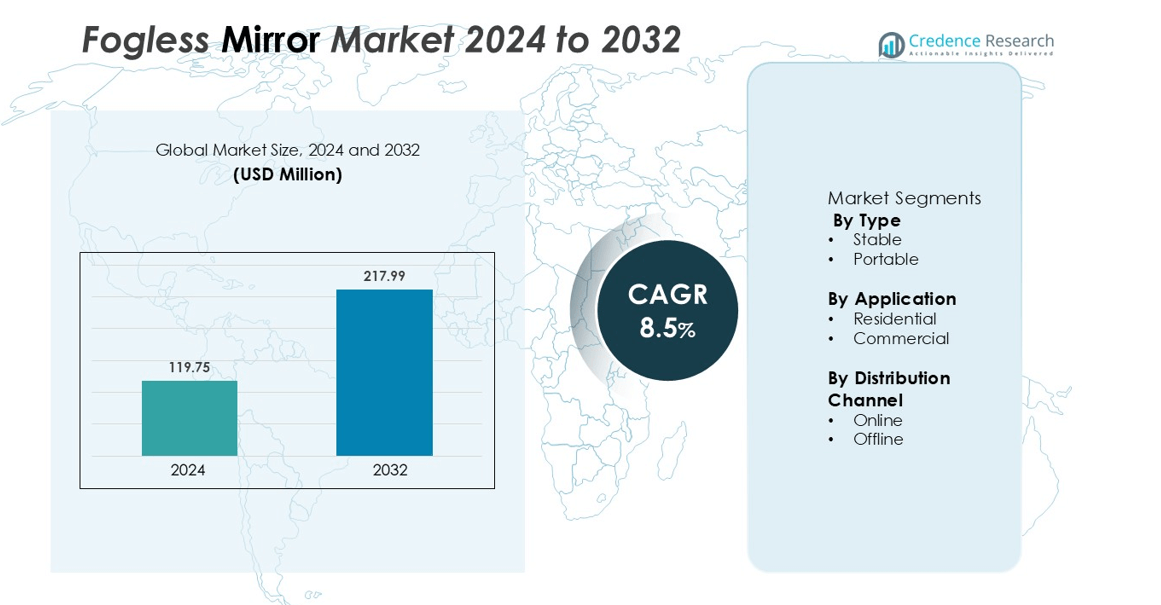
Fogless mirror market size was valued USD 119.75 million in 2024 and is anticipated to reach USD 217.99 million by 2032, at a CAGR of 8.5% during the forecast period.
| REPORT ATTRIBUTE | DETAILS |
|---|---|
| Historical Period | 2020-2023 |
| Base Year | 2024 |
| Forecast Period | 2025-2032 |
| Fogless Mirror Market Size 2024 | USD 119.75 million |
| Fogless Mirror Market, CAGR | 8.5% |
| Fogless Mirror Market Size 2032 | USD 217.99 million |
The fogless mirror market is characterized by the presence of several key players focusing on innovation, quality, and market reach. Leading companies include Electric Mirror, Inc., JiBen Technology, Inc., Mirrorvana, LLC, ClearMirror, Roper Rhodes Ltd., Sharper Image, LLC, Zadro, Inc., ToiletTree Products, WeProFab, and New Home Bath & Mirror Inc. These players differentiate themselves through advanced anti-fog technologies, LED lighting, smart features, and durable designs, targeting both residential and commercial segments. North America remains the leading region, accounting for 35% of the market, driven by high consumer awareness, strong disposable income, and significant adoption of modern bathroom solutions. U.S.-based companies dominate the regional landscape, leveraging technological innovation, robust distribution networks, and e-commerce platforms to sustain growth and strengthen brand presence across residential and commercial applications.
Market Insights
- The global fogless mirror market is projected to reach a significant USD value by 2032, growing at a CAGR of around 8.5% during the forecast period, driven by increasing residential and commercial adoption.
- Rising demand for personal grooming, home renovation, and smart bathroom solutions is fueling market growth, with LED-integrated and energy-efficient mirrors gaining traction across North America and Europe.
- Key trends include the integration of smart features, eco-friendly designs, and rising e-commerce penetration, enabling consumers to access a wider variety of technologically advanced mirrors.
- Competitive analysis shows leading players such as Electric Mirror, Inc., JiBen Technology, Inc., Mirrorvana, LLC, and Roper Rhodes Ltd. focusing on innovation, product differentiation, and strategic partnerships to strengthen market presence, while price sensitivity and maintenance requirements act as market restraints.
- North America leads with 35% market share, followed by Europe at 28%, Asia-Pacific at 22%, Latin America at 8%, and the Middle East & Africa at 7%, with residential segments dominating approximately 68% of the overall market.
Market Segmentation Analysis:
By Type
The Fogless Mirror market by type is categorized into Stable and Portable variants. The Stable segment dominates with approximately 70% market share, driven by its reliable anti-fog performance and suitability for permanent installation in bathrooms and commercial settings. Consumers and businesses prefer stable models for long-term use and minimal maintenance. Portable mirrors, while appealing for travel and personal grooming, hold a smaller share due to limited size and functionality. Market growth is supported by increasing demand for convenience in personal care and smart home integration features.
- For instance, Electric Mirror's Aqua™ Fog Free Mirror features corrosion-resistant OmegaMirror™ glass and an integrated defogger, ensuring clear reflections in humid environments
By Application
By application, Fogless Mirrors are segmented into Residential and Commercial uses. Residential applications lead the market with nearly 68% share, driven by rising consumer interest in home grooming solutions and wellness routines. Adoption is fueled by awareness of hygiene, convenience, and aesthetic appeal in modern bathroom designs. Commercial applications, including hotels, gyms, and healthcare facilities, are expanding steadily as businesses seek to enhance customer experience and reduce maintenance costs. Growth in this segment is supported by demand for high-quality, durable mirrors that withstand frequent use.
- For instance, Electric Mirror's Acclaim™ LED Fog Free Mirror combines LED lighting and a built-in defogger, offering a premium fog-free mirror solution for hospitality bathrooms.
By Distribution Channel
The Fogless Mirror market distribution channels include Online and Offline retail. Online sales dominate with roughly 62% market share, driven by e-commerce growth, wider product variety, and ease of home delivery. Consumers increasingly rely on online platforms for product comparisons, reviews, and convenience. Offline channels, such as specialty stores, home improvement centers, and department stores, remain relevant for customers seeking immediate access and in-person inspection. Market expansion in both channels is propelled by rising awareness, promotional campaigns, and the introduction of technologically advanced mirror models tailored to consumer needs
Key Growth Drivers
Rising Demand for Home Grooming and Personal Care
The increasing focus on personal hygiene and grooming at home is a primary driver of the fogless mirror market. Consumers are investing in bathroom upgrades and wellness routines, creating demand for mirrors that offer convenience and clear visibility during shaving, skincare, and makeup application. This trend is further amplified by urbanization and the growing adoption of modern bathroom designs, where fogless mirrors are integrated as functional and aesthetic elements. Additionally, the popularity of self-care routines among millennials and Gen Z is fueling adoption, particularly in residential settings. Manufacturers are responding by offering energy-efficient, smart, and customizable mirrors, which enhances consumer appeal and drives market growth across both home and commercial segments.
- For instance, Electric Mirror's Acclaim™ LED Fog Free Mirror features a calculated L70 LED lifespan of 124,000 hours, ensuring long-term reliability for home users.
Technological Advancements and Smart Features
Technological innovation in fogless mirrors, such as LED lighting, anti-fog coatings, and integration with smart home systems, is driving market expansion. Smart mirrors with temperature sensors, Bluetooth connectivity, and touch controls are gaining traction, especially among tech-savvy consumers and commercial establishments seeking enhanced functionality. These innovations improve user experience, reduce maintenance, and create differentiation in a competitive market. The ability to combine aesthetic appeal with technological utility attracts both residential and commercial buyers, encouraging repeat purchases and premium product adoption. Continuous research and development are expected to sustain growth, as manufacturers develop more energy-efficient and feature-rich mirrors tailored to evolving consumer preferences.
- For Instance, Electric Mirror's Radiance™ Lighted Mirror boasts a calculated L70 LED lifespan of 140,000 hours, highlighting its durability and long-term performance.
Expansion of E-commerce and Online Retail Channels
The rapid growth of e-commerce platforms is a key driver in the fogless mirror market. Online channels provide consumers with easy access to a wide range of products, detailed specifications, and customer reviews, facilitating informed purchase decisions. Convenience, home delivery, and competitive pricing further stimulate demand. Brands are leveraging online marketing, digital promotions, and social media campaigns to enhance visibility and reach new demographics. E-commerce also enables smaller manufacturers and niche brands to access wider markets without heavy investment in physical retail. This shift toward online retail not only boosts sales volumes but also supports global market penetration, making digital channels a critical growth catalyst for the industry.
Key Trends & Opportunities
Integration of Eco-friendly and Energy-efficient Designs
Sustainability is emerging as a significant trend in the fogless mirror market, with increasing consumer preference for energy-efficient and eco-friendly products. Manufacturers are developing mirrors with low-power LED lighting, sustainable materials, and recyclable components to meet growing environmental awareness. This trend presents opportunities for brands to differentiate themselves while catering to regulatory requirements in various regions. Residential and commercial buyers are increasingly seeking products that reduce electricity consumption and environmental impact. Companies investing in sustainable design innovation can capitalize on this demand, expand their product portfolio, and enhance brand loyalty while tapping into the premium segment of eco-conscious consumers.
- For instance, Electric Mirror's Brilliance™ Lighted Mirror features natural-looking LED light color with a Color Rendering Index (CRI) of 90+, a Correlated Color Temperature (CCT) of 3,000 Kelvin, and achieves 351 initial lumens per foot for front lighting and 713 lumens per foot for wall-glow lighting.
Rising Adoption in Commercial and Hospitality Sectors
The fogless mirror market is witnessing growth opportunities in commercial applications, including hotels, gyms, spas, and healthcare facilities. Businesses are investing in mirrors that improve user experience, reduce maintenance, and enhance hygiene standards. This adoption trend is driven by the need for durability, aesthetic appeal, and smart functionalities, which create value in high-traffic areas. The growing hospitality and wellness industries, particularly in urban and tourist-centric regions, are creating a significant market for premium and technologically advanced fogless mirrors. Strategic partnerships and bulk supply contracts offer manufacturers opportunities to expand their footprint and strengthen their presence in the commercial segment.
- For instance, Electric Mirror's Acclaim™ LED Fog Free Mirror is designed for wet locations, including showers, and features forward-facing task lighting with a CRI of 90+, a CCT of 3,000 Kelvin, and delivers 604 lumens per foot with a maximum efficacy of 100 lumens per watt. The mirror's LED lifespan is calculated to be 124,000 hours (L70)
Key Challenges
High Product Costs and Premium Pricing
The relatively high cost of fogless mirrors, especially models with advanced features, remains a significant challenge for market expansion. Many consumers are reluctant to invest in premium products, limiting adoption in price-sensitive segments. Commercial buyers may also face budget constraints when integrating smart mirrors across multiple facilities. Manufacturers must balance technological enhancements with cost-efficiency to broaden market accessibility. This pricing challenge is particularly pronounced in emerging markets, where awareness and purchasing power may be limited. Companies are addressing this by offering entry-level models, promotional discounts, and financing options to stimulate demand and encourage wider adoption.
Maintenance and Technical Limitations
Despite their benefits, fogless mirrors require proper maintenance to sustain anti-fog performance, which can pose challenges for users. Poor installation, inconsistent heating, or inferior coating quality may reduce effectiveness, leading to dissatisfaction and returns. Additionally, technical limitations such as limited lifespan of LEDs or electrical components can hinder consumer confidence. These factors require manufacturers to invest in quality assurance, user education, and after-sales support to ensure reliability. Addressing maintenance concerns and improving product durability is essential for market growth, as consistent performance and customer satisfaction directly influence brand reputation and repeat purchases.
Regional Analysis
North America
North America dominates the fogless mirror market with an estimated 35% share, driven by high consumer awareness of personal grooming, advanced smart home adoption, and strong disposable income. The U.S. and Canada are leading markets, with growing residential and commercial demand for technologically advanced mirrors featuring LED lighting, anti-fog coatings, and smart integrations. Rising investments in home renovation and bathroom remodeling further fuel growth. E-commerce penetration and strong retail networks enhance accessibility, while urbanization and lifestyle trends encourage adoption. The market benefits from continuous innovation by domestic manufacturers and increasing interest in energy-efficient, premium-quality mirrors.
Europe
Europe holds around 28% of the fogless mirror market, driven by widespread adoption of premium bathroom fixtures and high consumer focus on aesthetics and hygiene. Germany, the U.K., and France are major contributors, with both residential and commercial segments witnessing steady growth. Regulatory support for energy-efficient and eco-friendly products has accelerated demand for advanced fogless mirrors with LED and smart features. The hospitality and wellness sectors provide additional growth opportunities. Market expansion is supported by online retail, home improvement stores, and increasing renovation activities, while consumer preferences for durable, high-quality mirrors continue to drive innovation in the region.
Asia-Pacific
The Asia-Pacific region accounts for approximately 22% of the fogless mirror market, led by rapid urbanization, rising disposable income, and growing interest in personal grooming and wellness. China, India, Japan, and South Korea are key markets, with residential demand complemented by expanding hospitality and fitness industries. Increasing e-commerce penetration, modern bathroom infrastructure, and smart home adoption contribute to market growth. Local manufacturers are investing in cost-effective, technologically advanced mirrors to cater to price-sensitive consumers. Government initiatives promoting urban development and hygiene standards further drive market expansion, creating opportunities for both international and domestic players in the region.
Latin America
Latin America represents about 8% of the fogless mirror market, with growth driven by rising disposable incomes, urbanization, and increasing awareness of personal grooming and hygiene. Brazil and Mexico are primary markets, with residential demand dominating and commercial adoption gradually increasing in hotels and fitness centers. E-commerce expansion and the availability of mid- to high-end mirror models support market penetration. However, economic variability and price sensitivity constrain rapid growth. Manufacturers are focusing on durable, cost-effective mirrors with anti-fog and LED features to attract consumers, while promotional activities and partnerships with local retailers enhance brand visibility and market reach.
Middle East & Africa
The Middle East & Africa (MEA) accounts for roughly 7% of the fogless mirror market, driven by growth in the residential sector and luxury commercial projects, particularly in hotels, gyms, and spas. The U.A.E., Saudi Arabia, and South Africa are the largest contributors. Rising disposable income, urbanization, and adoption of modern bathroom designs encourage demand. The hospitality sector plays a critical role, as premium fogless mirrors improve customer experience and reduce maintenance requirements. E-commerce is gradually influencing market growth, complemented by offline retail expansion. Demand for technologically advanced, durable, and energy-efficient mirrors is expected to continue shaping the market in this region.
Market Segmentations:
By Type:
- Stable
- Portable
By Application:
- Residential
- Commercial
By Distribution Channel:
- Online
- Offline
By Geography
- North America
- U.S.
- Canada
- Mexico
- Europe
- Germany
- France
- U.K.
- Italy
- Spain
- Rest of Europe
- Asia Pacific
- China
- Japan
- India
- South Korea
- South-east Asia
- Rest of Asia Pacific
- Latin America
- Brazil
- Argentina
- Rest of Latin America
- Middle East & Africa
- GCC Countries
- South Africa
- Rest of the Middle East and Africa
Competitive Landscape
The fogless mirror market is moderately fragmented, with a mix of global and regional players competing on product innovation, quality, and distribution reach. Key market participants focus on developing technologically advanced mirrors with features such as anti-fog coatings, LED lighting, Bluetooth connectivity, and smart home integration to differentiate themselves and capture premium segments. Strategic initiatives, including partnerships with e-commerce platforms, collaborations with hospitality chains, and targeted marketing campaigns, are common to expand market presence. Companies are also investing in research and development to enhance durability, energy efficiency, and aesthetic appeal. While established brands dominate developed regions like North America and Europe, emerging markets in Asia-Pacific and Latin America are witnessing entry by local manufacturers offering cost-effective solutions. Competitive pricing, brand recognition, and after-sales service are critical factors influencing market share and sustaining long-term growth.
Key Player Analysis
- WeProFab – China
- Mirrorvana, LLC – U.S.
- Electric Mirror, Inc. – U.S.
- Sharper Image, LLC – U.S.
- Roper Rhodes Ltd. – U.K.
- Zadro, Inc. – U.S.
- JiBen Technology, Inc. – U.S.
- New Home Bath & Mirror Inc – U.S.
- ToiletTree Products – U.S.
- ClearMirror – U.S.
Recent Developments
- In March 2025, InventHelp has declared advancement of a fogless bathroom mirror, DCD-447. The purpose of this product is to enhance convenience during grooming by making sure that the mirror is clear during steamy conditions. Advanced technology is embedded in the mirror to ensure prevention of fog accumulation to make the consumers’ bathroom experience better.
- In March 2023, American company Fogless Innovations launched a new line of fogless mirrors for the home and commercial markets. The mirrors use a patented technology that prevents condensation from forming on the surface, even in humid conditions.
- In February 2022, German company AGC announced that it would be investing €10 million in a new production line for fogless mirrors. The new line is expected to be operational by the end of 2023 and will help AGC meet the growing demand for fogless mirrors in the automotive and construction markets.
Report Coverage
The research report offers an in-depth analysis based on Type, Application, Distribution channel and Geography. It details leading market players, providing an overview of their business, product offerings, investments, revenue streams, and key applications. Additionally, the report includes insights into the competitive environment, SWOT analysis, current market trends, as well as the primary drivers and constraints. Furthermore, it discusses various factors that have driven market expansion in recent years. The report also explores market dynamics, regulatory scenarios, and technological advancements that are shaping the industry. It assesses the impact of external factors and global economic changes on market growth. Lastly, it provides strategic recommendations for new entrants and established companies to navigate the complexities of the market.
Future Outlook
- The fogless mirror market is expected to grow steadily due to rising consumer demand for home grooming and personal care solutions.
- Technological innovations, including smart features and energy-efficient designs, will drive product adoption across residential and commercial segments.
- Increasing urbanization and modern bathroom renovations will expand the demand for premium and aesthetically appealing mirrors.
- E-commerce growth will continue to enhance accessibility and convenience, boosting online sales channels.
- Rising awareness of hygiene and wellness will encourage both individual consumers and commercial establishments to invest in fogless mirrors.
- The hospitality and fitness sectors will increasingly adopt fogless mirrors to enhance customer experience and operational efficiency.
- Manufacturers will focus on durable, low-maintenance, and eco-friendly designs to meet consumer expectations and regulatory standards.
- Competitive pricing and product differentiation will remain key strategies for gaining market share.
- Emerging markets will present new growth opportunities as disposable income and lifestyle awareness increase.
- Continuous research and development will support the introduction of advanced, feature-rich mirrors to sustain long-term market growth.

Request a Free Sample
Fill in your details and we'll send you a free sample report.
- Sample data tables & charts
- Research methodology
Need a Custom Version of This Report?
Tailor the scope, geography, or segments to your exact requirements.
- Custom geography or segment scope
- Direct access to our analyst team
Frequently Asked Questions
What is the current market size for Fogless Mirror market, and what is its projected size in 2032?
At what Compound Annual Growth Rate is the Fogless Mirror market projected to grow between 2025 and 2032?
Which Fogless Mirror market segment held the largest share in 2024?
What are the primary factors fueling the growth of the Fogless Mirror market?
Who are the leading companies in the Fogless Mirror market?
Which region commanded the largest share of the Fogless Mirror market in 2024?
Table of Content
Chapter 1 Market Segmentation
- 1.1 Segmentation Framework
- 1.1.1 Product and Service Classification
- 1.1.2 Application and End-Use Classification
- 1.1.3 Technology and Solution Classification
- 1.1.4 Customer and Distribution Channel Classification
- 1.1.5 Geographic Segmentation
- 1.1.6 Market Segment Definitions and Boundaries
Chapter 2 Introduction
- 2.1 Report Objectives and Scope
- 2.2 Product Definition and Industry Terminology
- 2.3 Market Inclusions and Exclusions
- 2.4 Research Process
- 2.4.1 Primary Research and Expert Interviews
- 2.4.2 Secondary Research and Source Review
- 2.4.3 Top-Down and Bottom-Up Estimation
- 2.4.4 Data Triangulation and Verification
- 2.5 Market Size Measurement Basis
- 2.5.1 2024: USD 119.75 million → 2032: USD 217.99 million
- 2.6 Historical and Forecast Reference Periods
- 2.6.1 Base Year: 2024
- 2.6.2 Forecast Period: 2024-2032
- 2.7 Research Assumptions and Limitations
Chapter 3 Executive Summary
- 3.1 Market Snapshot and Key Findings
- 3.2 Base-Year Market Size, 2024
- 3.3 Forecast Market Size, 2032
- 3.4 Revenue and Volume Growth Outlook
- 3.5 Key Demand and Supply Indicators
- 3.6 Leading Market Segments
- 3.7 Fastest-Growing Market Opportunities
- 3.8 Regional Performance Highlights
- 3.9 Technology and Industry Transformation
- 3.10 Competitive Landscape Summary
- 3.11 Analyst View and Strategic Implications
Chapter 4 Global Fogless Mirror Market Trends and Developments
- 4.1 Historical Industry Development
- 4.2 Recent Market Trends and Developments
- 4.3 Demand and Customer Behavior Trends
- 4.4 Technology and Product Innovation
- 4.5 Artificial Intelligence, Automation and Digitalization
- 4.6 Local Manufacturing and Supply Chain Realignment
- 4.7 Industry Partnerships, Mergers and Acquisitions
- 4.8 Sustainability and Circular Economy Developments
- 4.9 Government and Private Sector Investment Trends
- 4.10 Emerging Business Models and Commercialization
- 4.11 Industry Developments and Announcements
Chapter 5 Global Fogless Mirror Market Production, Supply and Demand Analysis
- 5.1 Demand Trend and Consumption Analysis
- 5.2 Demand Forecast, 2024-2032
- 5.3 Production and Output Trend
- 5.4 Production and Output Forecast, 2024-2032
- 5.5 Installed Capacity and Capacity Utilization
- 5.6 Company-Wise Production Plants and Statistics
- 5.6.1 Installed Production Capacity
- 5.6.2 Actual Production
- 5.6.3 Planned Capacity and Expansion Targets
- 5.7 Supply Chain Structure and Procurement Trends
- 5.8 Supply-Demand Gap and Bottlenecks
- 5.9 Import Dependence and Sourcing Structure
- 5.10 Contract Manufacturing and Outsourcing
- 5.11 Regional Supply and Demand Concentration
Chapter 6 Global Fogless Mirror Market Pricing Analysis
- 6.1 Pricing Structure and Measurement
- 6.2 Historical Pricing Trends
- 6.3 Pricing Outlook, 2024-2032
- 6.4 Average Selling Price and Unit Economics
- 6.5 Pricing by Product and Market Segment
- 6.6 Geographic Pricing Differences
- 6.7 Key Input, Energy, Labor and Logistics Costs
- 6.8 Contract Pricing and Purchasing Models
- 6.9 Pricing Sensitivity and Competitive Positioning
- 6.10 Price, Margin and Profitability Implications
Chapter 7 Global Fogless Mirror Market Dynamics
- 7.1 Market Growth Drivers
- 7.1.1 Demand-Side Drivers
- 7.1.2 Technology and Innovation Drivers
- 7.1.3 Infrastructure and Investment Drivers
- 7.1.4 Regulatory and Policy Drivers
- 7.2 Market Restraints
- 7.2.1 Cost and Affordability Constraints
- 7.2.2 Technology and Adoption Barriers
- 7.2.3 Supply Chain and Operational Constraints
- 7.3 Market Challenges
- 7.3.1 Competitive Pressure and Margin Erosion
- 7.3.2 Skills, Infrastructure and Implementation Gaps
- 7.4 Emerging Market Opportunities
- 7.5 Market Dynamics Impact and Time-Horizon Assessment
Chapter 8 Global Fogless Mirror Value Chain Analysis
- 8.1 Industry Value Chain Overview
- 8.2 Upstream Suppliers and Critical Inputs
- 8.3 Technology and Component Providers
- 8.4 Manufacturing or Service Delivery
- 8.5 Distribution, Channel Partners and Integrators
- 8.6 Downstream Applications and End Users
- 8.7 Value Addition and Profit Pools
- 8.8 Vertical Integration and Outsourcing
- 8.9 Supplier Concentration and Risk
- 8.10 Supply Chain Localization and Resilience
Chapter 9 Global Fogless Mirror Market Regulations and Policies
- 9.1 Relevant Laws, Standards and Compliance Frameworks
- 9.2 Product, Service, Safety and Quality Requirements
- 9.3 Government Policies, Incentives and Subsidies
- 9.4 Imports, Exports and Trade Barriers
- 9.5 Public Procurement and Local Content Requirements
- 9.6 Environmental and Sustainability Compliance
- 9.7 Upcoming Policy Changes and Market Implications
Chapter 10 Global Fogless Mirror Market Hotspots and Opportunities
- 10.1 Market Opportunity Mapping and Growth Hotspots
- 10.2 High-Growth Applications and Customer Groups
- 10.3 Underserved Markets and White-Space Opportunities
- 10.4 Emerging Technology and Product Opportunities
- 10.5 New Capacity and Investment Hotspots
- 10.6 Market Entry and Expansion Opportunities
- 10.7 Distribution and Partnership Opportunities
- 10.8 Near-Term and Long-Term Commercial Potential
- 10.9 Opportunity Attractiveness and Execution Risks
Chapter 11 Global Fogless Mirror Market Outlook, 2024-2032
- 11.1 Market Size and Analysis
- 11.1.1 Revenue (Market Measurement: 2024: USD 119.75 million → 2032: USD 217.99 million)
- 11.1.2 Market Volume and Quantity Sold
- 11.1.3 Historical Market Size
- 11.1.4 Base-Year Market Size, 2024
- 11.2 Market Forecast, 2024-2032
- 11.2.1 Revenue Forecast to 2032
- 11.2.2 Volume Forecast to 2032
- 11.2.3 CAGR and Year-on-Year Growth
- 11.2.4 Incremental Revenue Opportunity
- 11.3 Forecast Assumptions and Scenario Analysis
- 11.3.1 Base-Case Forecast
- 11.3.2 Optimistic and Conservative Scenarios
- 11.3.3 Technology, Pricing and Policy Sensitivities
- 11.4 Market Attractiveness and Growth Outlook
Chapter 12 Global Fogless Mirror Market Segmentation and Outlook
- 12.1 Segmentation Summary and Market Shares, 2024
- 12.2 Largest and Fastest-Growing Segments
- 12.3 Segment Growth Comparison
- 12.4 Segment Attractiveness and Priority Matrix
Chapter 13 Global Fogless Mirror Geographic Market Outlook, 2024-2032
- 13.1 Regional Market Size and Share, 2024
- 13.2 Regional Market Forecast, 2024-2032
- 13.3 Regional Pricing, Production and Demand Differences
- 13.4 North America
- 13.4.1 United States
- 13.4.2 Canada
- 13.4.3 Mexico
- 13.5 Europe
- 13.5.1 Germany
- 13.5.2 France
- 13.5.3 Italy
- 13.5.4 United Kingdom
- 13.5.5 Spain
- 13.5.6 Poland
- 13.5.7 Russia
- 13.5.8 Netherlands
- 13.5.9 Belgium
- 13.5.10 Sweden
- 13.5.11 Denmark
- 13.5.12 Norway
- 13.5.13 Rest of Europe
- 13.6 Asia Pacific
- 13.6.1 China
- 13.6.2 India
- 13.6.3 Japan
- 13.6.4 South Korea
- 13.6.5 Thailand
- 13.6.6 Indonesia
- 13.6.7 Vietnam
- 13.6.8 Malaysia
- 13.6.9 Australia
- 13.6.10 Rest of Asia Pacific
- 13.7 Latin America
- 13.7.1 Brazil
- 13.7.2 Argentina
- 13.7.3 Colombia
- 13.7.4 Chile
- 13.7.5 Rest of Latin America
- 13.8 Middle East
- 13.8.1 Saudi Arabia
- 13.8.2 United Arab Emirates
- 13.8.3 Turkey
- 13.8.4 Israel
- 13.8.5 Iran
- 13.8.6 Rest of the Middle East
- 13.9 Africa
- 13.9.1 South Africa
- 13.9.2 Egypt
- 13.9.3 Nigeria
- 13.9.4 Morocco
- 13.9.5 Rest of Africa
- 13.10 Regional Investment, Policy and Supply Chain Differences
- 13.11 Regional Competitive Landscape
- 13.12 Geographic Growth Hotspots
Chapter 14 Global Fogless Mirror Technology, Innovation and Sustainability Outlook
- 14.1 Technology Landscape and Maturity
- 14.2 Product, Process and Service Innovation
- 14.3 AI, Automation and Digital Tools in the Industry
- 14.4 Technology Adoption and Performance Benchmarking
- 14.5 Innovation Pipeline and R&D Investment
- 14.6 Patent and Intellectual Property Trends
- 14.7 Energy Efficiency and Resource Management
- 14.8 Sustainability, Recycling and Circularity
- 14.9 Technology Roadmap, 2024-2032
- 14.10 Risks of Obsolescence and Technology Substitution
Chapter 15 Global Fogless Mirror Market Key Strategic Imperatives
- 15.1 Growth and Market Entry Priorities
- 15.2 High-Return Products and Segments
- 15.3 Pricing, Profitability and Cost Optimization
- 15.4 Technology Investment and Product Differentiation
- 15.5 Supply Chain Localization and Resilience
- 15.6 Distribution and Customer Acquisition
- 15.7 Partnership, Acquisition and Capacity Strategy
- 15.8 Regional Expansion Priorities
- 15.9 Short-, Medium- and Long-Term Actions
Chapter 16 Competition Outlook
- 16.1 Industry Competition Characteristics
- 16.2 Market Structure and Concentration
- 16.3 Market Share and Competitive Positioning, 2024
- 16.4 Company-Wise Revenue and Product Benchmarking
- 16.5 Production and Service Capacity Benchmarking
- 16.6 Technology, Pricing and Differentiation
- 16.7 Regional Footprint and Distribution Strength
- 16.8 Mergers, Acquisitions and Strategic Alliances
- 16.9 New Entrants and Competitive Threats
- 16.10 Porter's Five Forces and Industry Attractiveness
- 16.11 Competitive Outlook, 2024-2032
Chapter 17 Company Profiles
- 17.1 Company Coverage and Selection Criteria
- 17.2 Leading Market Participants – Standard Profile Structure
- 17.2.1 Business Description
- 17.2.2 Company Ownership and Geographic Presence
- 17.2.3 Product and Service Portfolio
- 17.2.4 Manufacturing and Operating Footprint
- 17.2.5 Production Capacity and Expansion Plans
- 17.2.6 Financial Performance and Investment
- 17.2.7 Market Share and Competitive Position
- 17.2.8 Technology and Innovation Capabilities
- 17.2.9 Strategic Alliances or Partnerships
- 17.2.10 Recent Developments
- 17.2.11 Growth Strategy and Outlook
- 17.3 Other Relevant Market Participants
Note: Every listed company is profiled on the structure shown under the first company. The company list is preliminary and may change based on research findings, market developments, data availability and client requirements.
Chapter 18 Disclaimer
- 18.1 Research and Forecast Disclaimer
- 18.2 Data Source and Estimation Limitations
Note: The depth of individual sections depends on data availability for this market. Volume, capacity, trade and other unit-based metrics are included where applicable.