Market Insights
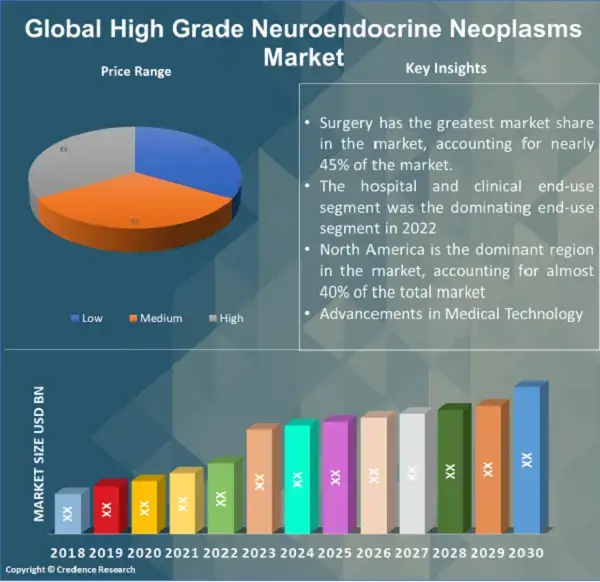
- The global demand for High Grade Neuroendocrine Neoplasms was valued at USD XX Million in 2022 and is expected to reach USD XX Million in 2030, growing at a CAGR of 8.50% between 2023 and 2030.
- The Gastroenteropancreatic Neuroendocrine Neoplasms (GEP-NENs) sector contributes significantly to the High Grade Neuroendocrine Neoplasms market, and the Pulmonary Neuroendocrine Neoplasms (Lung) segment is critical.
- Small Cell Neuroendocrine Carcinomas (Poorly Differentiated) dominate the market, while Grade 3 Neuroendocrine Neoplasms (Well-Differentiated) are also significant.
- Surgery has the biggest market share in the High Grade Neuroendocrine Neoplasms market, accounting for over 45% of the market, while Targeted Therapy is the fastest growing sector in the High Grade Neuroendocrine Neoplasms market.
- In terms of revenue share, hospital and clinical was the dominating end-use group in 2022. Pharmaceutical firms are another key segment among the listed alternatives.
- North America is the dominant region in the High Grade Neuroendocrine Neoplasms Market, accounting for almost 40% of the total market and Asia Pacific is expected to be the fastest-growing regio.
- increasing prevalence of high-grade neuroendocrine neoplasms, advancements in diagnostic technology, and rising desire for tailored and targeted medicines are the drivers of the market.
- High Cost and lack of awareness are two restraints of the market
Executive Summary
Market Definition
The refers to the market for medical products and services related to the diagnosis, treatment, and management of high-grade neuroendocrine neoplasms. High-grade neuroendocrine neoplasms are aggressive cancers that originate in the neuroendocrine cells. This market encompasses various aspects, including diagnostic tests, imaging techniques, surgical procedures, radiation therapy, chemotherapy, targeted therapies, and supportive care for patients. The market aims to provide effective and personalized treatment options for individuals with high-grade neuroendocrine neoplasms, improving their outcomes and quality of life.
Market Overview
The global High Grade Neuroendocrine Neoplasms Market has been steadily growing in recent years and is predicted to grow at a 8.50% CAGR between 2023 and 2030. The market is anticipated to be worth USD XX million by 2030, up from USD XX million in 2022.
The High Grade Neuroendocrine Neoplasms Market is an ever-changing market that includes a wide range of medical products and services for the diagnosis, treatment, and management of high-grade neuroendocrine neoplasms. Several reasons are driving this market, including advances in medical technology, an increase in the occurrence of high-grade neuroendocrine neoplasms, and more awareness among healthcare professionals and patients.
The desire for effective diagnostic tests and imaging techniques that can effectively detect and stage high-grade neuroendocrine neoplasms is driving the market. Furthermore, the introduction of novel surgical methods, radiation therapy, chemotherapy, and targeted medicines has dramatically improved patient treatment outcomes.
However, there are several limitations in the market. Early detection and treatment of high-grade neuroendocrine neoplasms can be hampered by a lack of awareness and understanding among healthcare providers and patients. Furthermore, patients may face difficulties due to the high expense of modern treatment choices and restricted access to specialized healthcare facilities.
Nonetheless, the High Grade Neuroendocrine Neoplasms Market offers growth and innovation prospects. The growing emphasis on personalized medicine and precision oncology creates opportunities for the development of targeted treatments and patient-specific treatment regimens. Collaborations between pharmaceutical corporations, research institutions, and healthcare professionals can also help to progress the field and enhance patient results.
Segmentation by Primary site of origin
- The Gastroenteropancreatic Neuroendocrine Neoplasms (GEP-NENs) sector contributes significantly to the High Grade Neuroendocrine Neoplasms market.
- The Pulmonary Neuroendocrine Neoplasms (Lung) segment is crucial.
Segmentation by Tumor Grade and Stage
- The market is dominated by Small Cell Neuroendocrine Carcinomas (Poorly Differentiated).
- A significant market sector is Grade 3 Neuroendocrine Neoplasms (Well-Differentiated).
Segmentation by Treatment Approach
- Surgery has the greatest market share in the High Grade Neuroendocrine Neoplasms market, accounting for nearly 45% of the market.
- Targeted Therapy is the fastest growing segment in the High Grade Neuroendocrine Neoplasms market..
Segmentation by End-User
- In terms of revenue share, the hospital and clinical end-use segment was the dominating end-use segment in 2022, since these facilities performed a considerable number of diagnostic operations. The presence of developed technologies, as well as the availability of different options for NET diagnosis, are projected to boost market growth even more.
- Pharmaceutical firms are another key segment among the listed alternatives. They are critical in the development and manufacture of drugs for the treatment of neuroendocrine neoplasms.
Segmentation by Region
- North America is the dominant region in the High Grade Neuroendocrine Neoplasms Market, accounting for almost 40% of the total market
- Over the projection period, Asia Pacific is expected to be the fastest-growing region.
- The rest of the world, including Latin America, the Middle East, and Africa, supplies the remaining demand for High Grade Neuroendocrine Neoplasms.
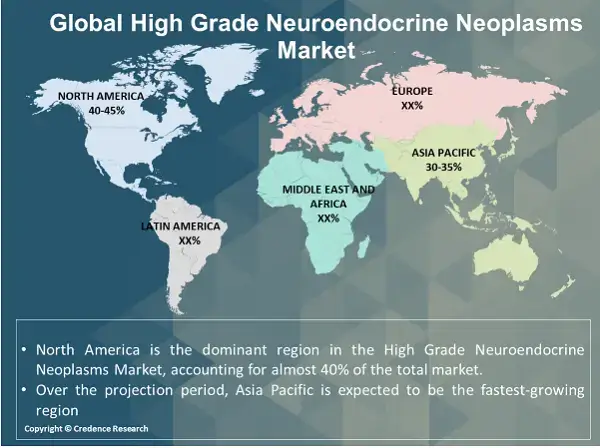
North America is the dominant region in the High Grade Neuroendocrine Neoplasms Market, accounting for almost 40% of the total market. This dominance is due to variables such as modern healthcare infrastructure, large healthcare spending, and a well-established R&D ecosystem. Several significant industry participants, including pharmaceutical corporations, medical device makers, and research organizations, are headquartered in the region. These characteristics contribute to North America's strong position as a driving force in the diagnosis, treatment, and management of high-grade neuroendocrine neoplasms.
The Asia Pacific area is the fastest expanding region in the High Grade Neuroendocrine Neoplasms Market. In comparison to other regions, it has experienced a strong compound annual growth rate (CAGR). This expansion can be linked to a variety of variables, including increased healthcare infrastructure development, increased knowledge of high-grade neuroendocrine neoplasms, and improved access to healthcare services. Furthermore, developments in medical technology and increased investments in research & development have led to the growth of the Asia Pacific market.
Key Highlights of the Report
The global High Grade Neuroendocrine Neoplasms Market is segmented by Primary site of origin, Tumor Grade and Stage, Treatment Approach, End-User, and region. Surgery has the biggest market share in the market. Small Cell Neuroendocrine Carcinomas (Poorly Differentiated) dominate the market. In addition, the Pulmonary Neuroendocrine Neoplasms (Lung) section is critical., with North America leading the market growth.
The primary drivers of the market include the increasing prevalence of high-grade neuroendocrine neoplasms, advancements in diagnostic technology, and rising desire for tailored and targeted medicines. Furthermore, the market faces constraints such as little awareness and comprehension among healthcare providers and patients, high treatment costs, and limited access to specialized healthcare facilities.
Nonetheless, North America dominates the High Grade Neuroendocrine Neoplasms Market, accounting for almost 40% of total market revenue, with Asia Pacific predicted to be the fastest-growing region. Furthermore, the Asia Pacific region is the fastest growing in the High Grade Neuroendocrine Neoplasms Market. It has witnessed a high compound annual growth rate (CAGR) in compared to other regions.
What Factors Are Fueling The Growth Of The Global High Grade Neuroendocrine Neoplasms Market?
The primary drivers of the market include the increasing prevalence of high-grade neuroendocrine neoplasms, advancements in diagnostic technology, and rising desire for tailored and targeted medicines.
What Are The Key Challenges Encountered By The Global High Grade Neuroendocrine Neoplasms Market?
The industry has constraints such as low awareness and comprehension among healthcare providers and patients, high treatment costs, and limited access to specialized healthcare facilities.
What Opportunities For Growth Exist In The Global High Grade Neuroendocrine Neoplasms Market?
Opportunities in the market include increased R&D activities, advancements in precision diagnostics and targeted medicines, and a growing emphasis on early detection and individualized treatment techniques.
Market Drivers
The global High Grade Neuroendocrine Neoplasms Market is driven by several factors. The following are the key drivers of the global High Grade Neuroendocrine Neoplasms Market:
Advancements in Medical Technology
Medical technology advancements have played a crucial influence in propelling the High Grade Neuroendocrine Neoplasms Market. These advances have resulted in better diagnostic procedures, including as molecular imaging and genetic testing, allowing for more accurate and early diagnosis of neuroendocrine neoplasms. Furthermore, technological advancements have aided in the development of minimally invasive surgical methods and targeted medicines, resulting in better treatment outcomes and patient care. Furthermore, medical gadget innovations such as 3D printed surgical models and robotic surgical systems have improved surgical precision and patient safety.
Increased Awareness Among Healthcare Providers And Patients
The rise in high-grade neuroendocrine neoplasms instances, as well as increased awareness among healthcare professionals and patients, have been important driving forces in the High Grade Neuroendocrine Neoplasms Market. As more cases are recognized and reported, healthcare practitioners gain a better understanding of the disease, leading to better detection and treatment tactics. Furthermore, improved patient awareness means that they seek medical attention early, leading in better outcomes. The increased acknowledgment of high-grade neuroendocrine neoplasms is driving the market's expansion by creating a desire for enhanced diagnostic and therapeutic alternatives. It is critical to raise awareness and be proactive about our health.
Market Restraints
The global High Grade Neuroendocrine Neoplasms Market faces some challenges that may hinder its growth. These include the following:
High Cost
Due to the high expense of modern treatment choices and restricted access to specialist healthcare facilities, patients may confront difficulties. The modern technology and therapies utilized in the treatment of high-grade neuroendocrine neoplasms can be highly costly, rendering them out of reach for certain patients. Furthermore, not all healthcare facilities have the resources and competence to provide specialist care for these disorders, resulting in limited access for patients in some places. It is critical for healthcare systems to remove these barriers and provide patients with affordable and equitable access to the care they require.
Lack of Awareness
There may be delays in diagnosis and treatment initiation if healthcare providers and patients are not well-informed about the signs, symptoms, and diagnostic techniques for these neoplasms. That is why it is critical to raise awareness and educate both healthcare professionals and the general public about high-grade neuroendocrine neoplasms. We can improve patient outcomes by raising awareness and ensuring that malignant neoplasms are recognized and treated at the earliest feasible stage.
Opportunities
The global High Grade Neuroendocrine Neoplasms Market offers significant growth opportunities. These include the following:
A Rising Focus on Individualized Medicine
With technological and research breakthroughs, there is a better awareness of individual differences in disease presentation and response to treatment. Personalized medicine is concerned with adapting medical interventions to an individual's specific traits, such as genetic makeup or lifestyle circumstances. This method enables for more targeted and effective therapies, which may improve patient outcomes while lowering healthcare expenditures. The shift to personalized medicine creates new opportunities for precision diagnostics, targeted medicines, and personalized treatment plans, ultimately leading to a more personalized and patient-centered approach to healthcare.
Competitive Landscape
Key Players
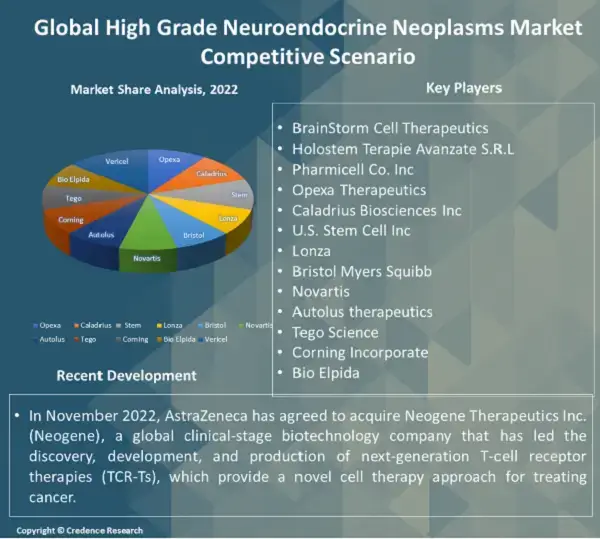
The global High Grade Neuroendocrine Neoplasms Market is highly competitive, with several key players. Some of the major players in the market and their market share are as follows:
- Brain Storm Cell Therapeutics
- Holostem Terapie Avanzate S.R.L
- Pharmicell Co. Inc
- Opexa Therapeutics
- Caladrius Biosciences Inc
- U.S. Stem Cell Inc
- Lonza
- Bristol Myers Squibb
- Novartis
- Autolus therapeutics
- Tego Science
- Corning Incorporate
- Bio Elpida
- Vericel Corporation
- Catalent, Inc
- Sartorius AG
These organizations prioritize Primary site of origin innovation, Disease Area expansion, and mergers and acquisitions to stay competitive.
The global High Grade Neuroendocrine Neoplasms Market's key players continually seek to stay ahead by offering new Primary site of origins and developments.
In April 2022, Aspen Neuroscience, Inc., in collaboration with numerous clinical screening sites in the United States, launched the first patient screening study of its sort. The Trial-Ready Cohort Study is a preliminary step in filing an Investigational New Drug (IND) application with the US Food and Drug Administration for ANPD001 and further research into iPSC-derived cell replacement therapy for Parkinson's disease.
In April 2022, Tree Frog Therapeutics has announced The Stem Cell Space Shot Grant, which will fund research in the fields of stem cell biology and regenerative medicine with USD 100,000.
Summary of Key Findings
- The primary market driver is increasing prevalence of high-grade neuroendocrine neoplasms.
- Market segmented by Primary site of origin, Tumor Grade and Stage, Treatment Approch, End-User, and region.
- Targeted Therapy is the fastest growing segment in the High Grade Neuroendocrine Neoplasms market.
- The market is dominated by Small Cell Neuroendocrine Carcinomas (Poorly Differentiated
- North America is leading market growth; the market is highly competitive with key players including BrainStorm Cell Therapeutics; Holostem Terapie Avanzate S.R.L; Pharmicell Co. Inc; Opexa Therapeutics; Caladrius Biosciences Inc; U.S. Stem Cell Inc; Lonza; Bristol Myers Squibb; Novartis; Autolus therapeutics; Tego Science; Corning Incorporated; Bio Elpida; Vericel Corporation; Catalent, Inc; Sartorius AG
Future Outlook
- Rising rates of prevalence and incidence
- Technological advancements in diagnostics and biomarker identification Increased use of targeted treatments and immunotherapies
- A greater emphasis is being placed on early detection and screening programs.
- Healthcare infrastructure expansion in emerging markets
- Pharmaceutical companies and research universities working together
Segmentation
- By Primary Site of Origin:
- Pulmonary Neuroendocrine Neoplasms (Lung)
- Gastroenteropancreatic Neuroendocrine Neoplasms (GEP-NENs)
- Other Primary Sites (e.g., Neuroendocrine Neoplasms of the Thymus)
- By Tumor Grade and Stage:
- Grade 3 Neuroendocrine Neoplasms (Well-Differentiated)
- Small Cell Neuroendocrine Carcinomas (Poorly Differentiated)
- By Treatment Approach:
- Surgery
- Chemotherapy
- Targeted Therapy
- Radiation Therapy
- Peptide Receptor Radionuclide Therapy (PRRT)
- Other Therapies
- By End-User:
- Hospitals and Clinics
- Oncology Centers
- Research Institutes
- Pharmaceutical Companies
- By Region
- North America
- U.S
- Canada
- Mexico
- Europe
- Germany
- France
- U.K.
- Italy
- Spain
- Rest of Europe
- Asia Pacific
- China
- Japan
- India
- South Korea
- South-east Asia
- Rest of Asia Pacific
- Latin America
- Brazil
- Argentina
- Rest of Latin America
- Middle East & Africa
- GCC Countries
- South Africa
- Rest of Middle East and Africa
- North America
Adjacent Markets
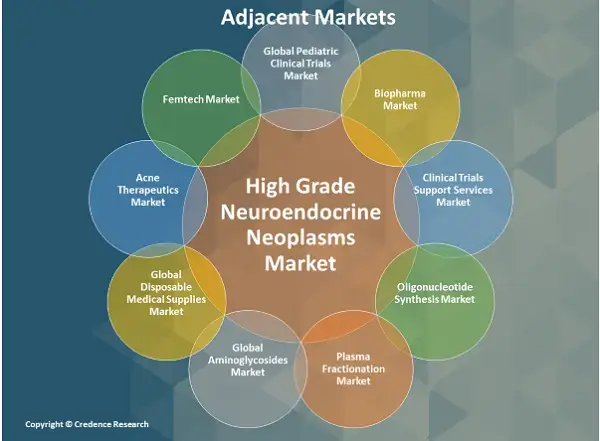
In the High Grade Neuroendocrine Neoplasms Market, there are several adjacent markets which has high revenue growth opportunities. The key adjacent markets for High Grade Neuroendocrine Neoplasms Market-

Request a Free Sample
Fill in your details and we'll send you a free sample report.
- Sample data tables & charts
- Research methodology
Market Dynamics
Increasing Prevalence of High-Grade Neuroendocrine Neoplasms
A rising incidence of high-grade neuroendocrine neoplasms globally is expanding the patient pool, driving demand for advanced diagnostics and treatment options.
Advancements in Diagnostic Technology
Innovations such as molecular imaging, genetic testing, and improved biomarker identification are enabling earlier and more accurate diagnosis, which increases the likelihood of effective intervention and market growth.
Rising Demand for Tailored and Targeted Therapies
The shift toward personalized medicine and targeted therapies is fueling market expansion, as these approaches offer improved efficacy and reduced side effects for patients with high-grade neuroendocrine neoplasms.
Expansion of Healthcare Infrastructure in Emerging Markets
Growth in healthcare infrastructure and increased access to specialized care in regions like Asia Pacific are enabling more patients to receive timely diagnosis and advanced treatments, contributing to overall market growth.
Collaborations and R&D Investments
Strategic partnerships between pharmaceutical companies, research institutions, and healthcare providers are accelerating the development of novel therapies and expanding the treatment landscape for high-grade neuroendocrine neoplasms.
Need a Custom Version of This Report?
Tailor the scope, geography, or segments to your exact requirements.
- Custom geography or segment scope
- Direct access to our analyst team
Frequently Asked Questions
What is the current size of the worldwide High Grade Neuroendocrine Neoplasms Market?
What is the predicted growth rate of the High Grade Neuroendocrine Neoplasms Market between 2023 and 2030?
Which segment has the most market share in terms of Treatment Approch?
Which Primary site origin segment governs the market demand for High Grade Neuroendocrine Neoplasms?
Which Treatment approach segment is predicted to grow at the fastest rate over the forecast period?
Which region is driving the High Grade Neuroendocrine Neoplasms industry forward?
Who are the major players in the global High Grade Neuroendocrine Neoplasms Market?
What are the major market drivers of the High Grade Neuroendocrine Neoplasms industry?
What are the major market restraints of the High Grade Neuroendocrine Neoplasms industry?
What are the major market opportunities of the High Grade Neuroendocrine Neoplasms industry?
Table of Content
Chapter 1 Market Segmentation
- 1.1 Segmentation Framework
- 1.1.1 Product and Service Classification
- 1.1.2 Application and End-Use Classification
- 1.1.3 Technology and Solution Classification
- 1.1.4 Customer and Distribution Channel Classification
- 1.1.5 Geographic Segmentation
- 1.1.6 Market Segment Definitions and Boundaries
- 1.2 By End-User
- 1.2.1 Hospitals and Clinics
- 1.2.2 Oncology Centers
- 1.2.3 Research Institutes
- 1.2.4 Pharmaceutical Companies
- 1.3 By Treatment Approach
- 1.3.1 Surgery
- 1.3.2 Chemotherapy
- 1.3.3 Targeted Therapy
- 1.3.4 Radiation Therapy
- 1.3.5 Peptide Receptor Radionuclide Therapy (PRRT)
- 1.3.6 Other Therapies
- 1.4 By Tumor Grade and Stage
- 1.4.1 Small Cell Neuroendocrine Carcinomas (Poorly Differentiated)
- 1.4.2 Grade 3 Neuroendocrine Neoplasms (Well-Differentiated)
- 1.5 By Primary Site of Origin
- 1.5.1 Pulmonary Neuroendocrine Neoplasms (Lung)
- 1.5.2 Gastroenteropancreatic Neuroendocrine Neoplasms (GEP-NENs)
- 1.5.3 Other Primary Sites (e.g., Thymus)
Chapter 2 Introduction
- 2.1 Report Objectives and Scope
- 2.2 Product Definition and Industry Terminology
- 2.3 Market Inclusions and Exclusions
- 2.4 Research Process
- 2.4.1 Primary Research and Expert Interviews
- 2.4.2 Secondary Research and Source Review
- 2.4.3 Top-Down and Bottom-Up Estimation
- 2.4.4 Data Triangulation and Verification
- 2.5 Research Assumptions and Limitations
Chapter 3 Executive Summary
- 3.1 Market Snapshot and Key Findings
- 3.2 Base-Year Market Size
- 3.3 Forecast Market Size
- 3.4 Revenue and Volume Growth Outlook
- 3.5 Key Demand and Supply Indicators
- 3.6 Leading Market Segments
- 3.7 Fastest-Growing Market Opportunities
- 3.8 Regional Performance Highlights
- 3.9 Technology and Industry Transformation
- 3.10 Competitive Landscape Summary
- 3.11 Analyst View and Strategic Implications
Chapter 4 Global High Grade Neuroendocrine Neoplasms Market Trends and Developments
- 4.1 Historical Industry Development
- 4.2 Recent Market Trends and Developments
- 4.3 Demand and Customer Behavior Trends
- 4.4 Technology and Product Innovation
- 4.5 Artificial Intelligence, Automation and Digitalization
- 4.6 Local Manufacturing and Supply Chain Realignment
- 4.7 Industry Partnerships, Mergers and Acquisitions
- 4.8 Sustainability and Circular Economy Developments
- 4.9 Government and Private Sector Investment Trends
- 4.10 Emerging Business Models and Commercialization
- 4.11 Industry Developments and Announcements
Chapter 5 Global High Grade Neuroendocrine Neoplasms Market Production, Supply and Demand Analysis
- 5.1 Demand Trend and Consumption Analysis
- 5.2 Demand Forecast
- 5.3 Production and Output Trend
- 5.4 Production and Output Forecast
- 5.5 Installed Capacity and Capacity Utilization
- 5.6 Company-Wise Production Plants and Statistics
- 5.6.1 Installed Production Capacity
- 5.6.2 Actual Production
- 5.6.3 Planned Capacity and Expansion Targets
- 5.7 Supply Chain Structure and Procurement Trends
- 5.8 Supply-Demand Gap and Bottlenecks
- 5.9 Import Dependence and Sourcing Structure
- 5.10 Contract Manufacturing and Outsourcing
- 5.11 Regional Supply and Demand Concentration
Chapter 6 Global High Grade Neuroendocrine Neoplasms Market Pricing Analysis
- 6.1 Pricing Structure and Measurement
- 6.2 Historical Pricing Trends
- 6.3 Pricing Outlook
- 6.4 Average Selling Price and Unit Economics
- 6.5 Pricing by Product and Market Segment
- 6.6 Geographic Pricing Differences
- 6.7 Key Input, Energy, Labor and Logistics Costs
- 6.8 Contract Pricing and Purchasing Models
- 6.9 Pricing Sensitivity and Competitive Positioning
- 6.10 Price, Margin and Profitability Implications
Chapter 7 Global High Grade Neuroendocrine Neoplasms Market Dynamics
- 7.1 Market Growth Drivers
- 7.1.1 Demand-Side Drivers
- 7.1.2 Technology and Innovation Drivers
- 7.1.3 Infrastructure and Investment Drivers
- 7.1.4 Regulatory and Policy Drivers
- 7.2 Market Restraints
- 7.2.1 Cost and Affordability Constraints
- 7.2.2 Technology and Adoption Barriers
- 7.2.3 Supply Chain and Operational Constraints
- 7.3 Market Challenges
- 7.3.1 Competitive Pressure and Margin Erosion
- 7.3.2 Skills, Infrastructure and Implementation Gaps
- 7.4 Emerging Market Opportunities
- 7.5 Market Dynamics Impact and Time-Horizon Assessment
Chapter 8 Global High Grade Neuroendocrine Neoplasms Value Chain Analysis
- 8.1 Industry Value Chain Overview
- 8.2 Upstream Suppliers and Critical Inputs
- 8.3 Technology and Component Providers
- 8.4 Manufacturing or Service Delivery
- 8.5 Distribution, Channel Partners and Integrators
- 8.6 Downstream Applications and End Users
- 8.7 Value Addition and Profit Pools
- 8.8 Vertical Integration and Outsourcing
- 8.9 Supplier Concentration and Risk
- 8.10 Supply Chain Localization and Resilience
Chapter 9 Global High Grade Neuroendocrine Neoplasms Market Regulations and Policies
- 9.1 Relevant Laws, Standards and Compliance Frameworks
- 9.2 Product, Service, Safety and Quality Requirements
- 9.3 Government Policies, Incentives and Subsidies
- 9.4 Imports, Exports and Trade Barriers
- 9.5 Public Procurement and Local Content Requirements
- 9.6 Environmental and Sustainability Compliance
- 9.7 Upcoming Policy Changes and Market Implications
Chapter 10 Global High Grade Neuroendocrine Neoplasms Market Hotspots and Opportunities
- 10.1 Market Opportunity Mapping and Growth Hotspots
- 10.2 High-Growth Applications and Customer Groups
- 10.3 Underserved Markets and White-Space Opportunities
- 10.4 Emerging Technology and Product Opportunities
- 10.5 New Capacity and Investment Hotspots
- 10.6 Market Entry and Expansion Opportunities
- 10.7 Distribution and Partnership Opportunities
- 10.8 Near-Term and Long-Term Commercial Potential
- 10.9 Opportunity Attractiveness and Execution Risks
Chapter 11 Global High Grade Neuroendocrine Neoplasms Market Outlook
- 11.1 Market Size and Analysis
- 11.1.1 Revenue
- 11.1.2 Market Volume and Quantity Sold
- 11.1.3 Historical Market Size
- 11.1.4 Base-Year Market Size
- 11.2 Market Forecast
- 11.2.1 Revenue Forecast
- 11.2.2 Volume Forecast
- 11.2.3 CAGR and Year-on-Year Growth
- 11.2.4 Incremental Revenue Opportunity
- 11.3 Forecast Assumptions and Scenario Analysis
- 11.3.1 Base-Case Forecast
- 11.3.2 Optimistic and Conservative Scenarios
- 11.3.3 Technology, Pricing and Policy Sensitivities
- 11.4 Market Attractiveness and Growth Outlook
Chapter 12 Global High Grade Neuroendocrine Neoplasms Market Segmentation and Outlook
- 12.1 Segmentation Summary and Market Shares
- 12.2 Largest and Fastest-Growing Segments
- 12.3 By End-User - Market Size and Forecast
- 12.3.1 Segment Definition and Scope
- 12.3.2 Historical Market Size
- 12.3.3 Revenue Forecast
- 12.3.4 Volume Forecast
- 12.3.5 Base-Year Market Share
- 12.3.6 Segment CAGR and Growth Drivers
- 12.3.7 Subsegment Market Size and Forecast
- 12.3.7.1 Hospitals and Clinics
- 12.3.7.2 Oncology Centers
- 12.3.7.3 Research Institutes
- 12.3.7.4 Pharmaceutical Companies
- 12.3.8 Subsegment Pricing and Adoption Trends
- 12.3.9 Leading Suppliers and Competition
- 12.3.10 Regional Demand and Opportunities
- 12.4 By Treatment Approach - Market Size and Forecast
- 12.4.1 Segment Definition and Scope
- 12.4.2 Historical Market Size
- 12.4.3 Revenue Forecast
- 12.4.4 Volume Forecast
- 12.4.5 Base-Year Market Share
- 12.4.6 Segment CAGR and Growth Drivers
- 12.4.7 Subsegment Market Size and Forecast
- 12.4.7.1 Surgery
- 12.4.7.2 Chemotherapy
- 12.4.7.3 Targeted Therapy
- 12.4.7.4 Radiation Therapy
- 12.4.7.5 Peptide Receptor Radionuclide Therapy (PRRT)
- 12.4.7.6 Other Therapies
- 12.4.8 Subsegment Pricing and Adoption Trends
- 12.4.9 Leading Suppliers and Competition
- 12.4.10 Regional Demand and Opportunities
- 12.5 By Tumor Grade and Stage - Market Size and Forecast
- 12.5.1 Segment Definition and Scope
- 12.5.2 Historical Market Size
- 12.5.3 Revenue Forecast
- 12.5.4 Volume Forecast
- 12.5.5 Base-Year Market Share
- 12.5.6 Segment CAGR and Growth Drivers
- 12.5.7 Subsegment Market Size and Forecast
- 12.5.7.1 Small Cell Neuroendocrine Carcinomas (Poorly Differentiated)
- 12.5.7.2 Grade 3 Neuroendocrine Neoplasms (Well-Differentiated)
- 12.5.8 Subsegment Pricing and Adoption Trends
- 12.5.9 Leading Suppliers and Competition
- 12.5.10 Regional Demand and Opportunities
- 12.6 By Primary Site of Origin - Market Size and Forecast
- 12.6.1 Segment Definition and Scope
- 12.6.2 Historical Market Size
- 12.6.3 Revenue Forecast
- 12.6.4 Volume Forecast
- 12.6.5 Base-Year Market Share
- 12.6.6 Segment CAGR and Growth Drivers
- 12.6.7 Subsegment Market Size and Forecast
- 12.6.7.1 Pulmonary Neuroendocrine Neoplasms (Lung)
- 12.6.7.2 Gastroenteropancreatic Neuroendocrine Neoplasms (GEP-NENs)
- 12.6.7.3 Other Primary Sites (e.g., Thymus)
- 12.6.8 Subsegment Pricing and Adoption Trends
- 12.6.9 Leading Suppliers and Competition
- 12.6.10 Regional Demand and Opportunities
- 12.7 Segment Growth Comparison
- 12.8 Segment Attractiveness and Priority Matrix
Chapter 13 Global High Grade Neuroendocrine Neoplasms End-Use and Application Market Outlook
- 13.1 End-Use Industry and Customer Demand Structure
- 13.2 Leading Applications and Customer Groups
- 13.3 End-Use Market Size, Share and Forecast
- 13.4 Major End-Use Industry Deep Dives
- 13.4.1 Customer Requirements and Use Cases
- 13.4.2 Demand and Replacement Cycles
- 13.4.3 Technical and Regulatory Considerations
- 13.4.4 Purchasing and Procurement Models
- 13.4.5 Leading Vendors and Distribution Channels
- 13.4.6 Forecast and Commercial Opportunities
- 13.5 Emerging Applications and Cross-Segment Demand
- 13.6 End-Use Industry Investment Priorities
Chapter 14 Global High Grade Neuroendocrine Neoplasms Geographic Market Outlook
- 14.1 Regional Market Size and Share
- 14.2 Regional Market Forecast
- 14.3 Regional Pricing, Production and Demand Differences
- 14.4 North America
- 14.4.1 United States
- 14.4.2 Canada
- 14.4.3 Mexico
- 14.5 Europe
- 14.5.1 Germany
- 14.5.2 France
- 14.5.3 Italy
- 14.5.4 United Kingdom
- 14.5.5 Spain
- 14.5.6 Poland
- 14.5.7 Russia
- 14.5.8 Netherlands
- 14.5.9 Belgium
- 14.5.10 Sweden
- 14.5.11 Denmark
- 14.5.12 Norway
- 14.5.13 Rest of Europe
- 14.6 Asia Pacific
- 14.6.1 China
- 14.6.2 India
- 14.6.3 Japan
- 14.6.4 South Korea
- 14.6.5 Thailand
- 14.6.6 Indonesia
- 14.6.7 Vietnam
- 14.6.8 Malaysia
- 14.6.9 Australia
- 14.6.10 Rest of Asia Pacific
- 14.7 Latin America
- 14.7.1 Brazil
- 14.7.2 Argentina
- 14.7.3 Colombia
- 14.7.4 Chile
- 14.7.5 Rest of Latin America
- 14.8 Middle East
- 14.8.1 Saudi Arabia
- 14.8.2 United Arab Emirates
- 14.8.3 Turkey
- 14.8.4 Israel
- 14.8.5 Iran
- 14.8.6 Rest of the Middle East
- 14.9 Africa
- 14.9.1 South Africa
- 14.9.2 Egypt
- 14.9.3 Nigeria
- 14.9.4 Morocco
- 14.9.5 Rest of Africa
- 14.10 Regional Investment, Policy and Supply Chain Differences
- 14.11 Regional Competitive Landscape
- 14.12 Geographic Growth Hotspots
Chapter 15 Global High Grade Neuroendocrine Neoplasms Technology, Innovation and Sustainability Outlook
- 15.1 Technology Landscape and Maturity
- 15.2 Product, Process and Service Innovation
- 15.3 AI, Automation and Digital Tools in the Industry
- 15.4 Technology Adoption and Performance Benchmarking
- 15.5 Innovation Pipeline and R&D Investment
- 15.6 Patent and Intellectual Property Trends
- 15.7 Energy Efficiency and Resource Management
- 15.8 Sustainability, Recycling and Circularity
- 15.9 Technology Roadmap
- 15.10 Risks of Obsolescence and Technology Substitution
Chapter 16 Global High Grade Neuroendocrine Neoplasms Market Key Strategic Imperatives
- 16.1 Growth and Market Entry Priorities
- 16.2 High-Return Products and Segments
- 16.3 Pricing, Profitability and Cost Optimization
- 16.4 Technology Investment and Product Differentiation
- 16.5 Supply Chain Localization and Resilience
- 16.6 Distribution and Customer Acquisition
- 16.7 Partnership, Acquisition and Capacity Strategy
- 16.8 Regional Expansion Priorities
- 16.9 Short-, Medium- and Long-Term Actions
Chapter 17 Competition Outlook
- 17.1 Industry Competition Characteristics
- 17.2 Market Structure and Concentration
- 17.3 Market Share and Competitive Positioning
- 17.4 Company-Wise Revenue and Product Benchmarking
- 17.5 Production and Service Capacity Benchmarking
- 17.6 Technology, Pricing and Differentiation
- 17.7 Regional Footprint and Distribution Strength
- 17.8 Mergers, Acquisitions and Strategic Alliances
- 17.9 New Entrants and Competitive Threats
- 17.10 Porter's Five Forces and Industry Attractiveness
- 17.11 Competitive Outlook
Chapter 18 Company Profiles
- 18.1 Company Coverage and Selection Criteria
- 18.2 Novartis
- 18.2.1 Business Description
- 18.2.2 Company Ownership and Geographic Presence
- 18.2.3 Product and Service Portfolio
- 18.2.4 Manufacturing and Operating Footprint
- 18.2.5 Production Capacity and Expansion Plans
- 18.2.6 Financial Performance and Investment
- 18.2.7 Market Share and Competitive Position
- 18.2.8 Technology and Innovation Capabilities
- 18.2.9 Strategic Alliances or Partnerships
- 18.2.10 Recent Developments
- 18.2.11 Growth Strategy and Outlook
- 18.3 Bristol Myers Squibb
- 18.4 Lonza
- 18.5 Catalent, Inc
- 18.6 Vericel Corporation
- 18.7 Sartorius AG
- 18.8 Corning Incorporated
- 18.9 Caladrius Biosciences Inc
- 18.10 Pharmicell Co. Inc
- 18.11 Autolus Therapeutics
- 18.12 Other Relevant Market Participants
Note: Every listed company is profiled on the structure shown under the first company. The company list is preliminary and may change based on research findings, market developments, data availability and client requirements.
Chapter 19 Disclaimer
- 19.1 Research and Forecast Disclaimer
- 19.2 Data Source and Estimation Limitations
Note: The depth of individual sections depends on data availability for this market. Volume, capacity, trade and other unit-based metrics are included where applicable.