
Market Overview
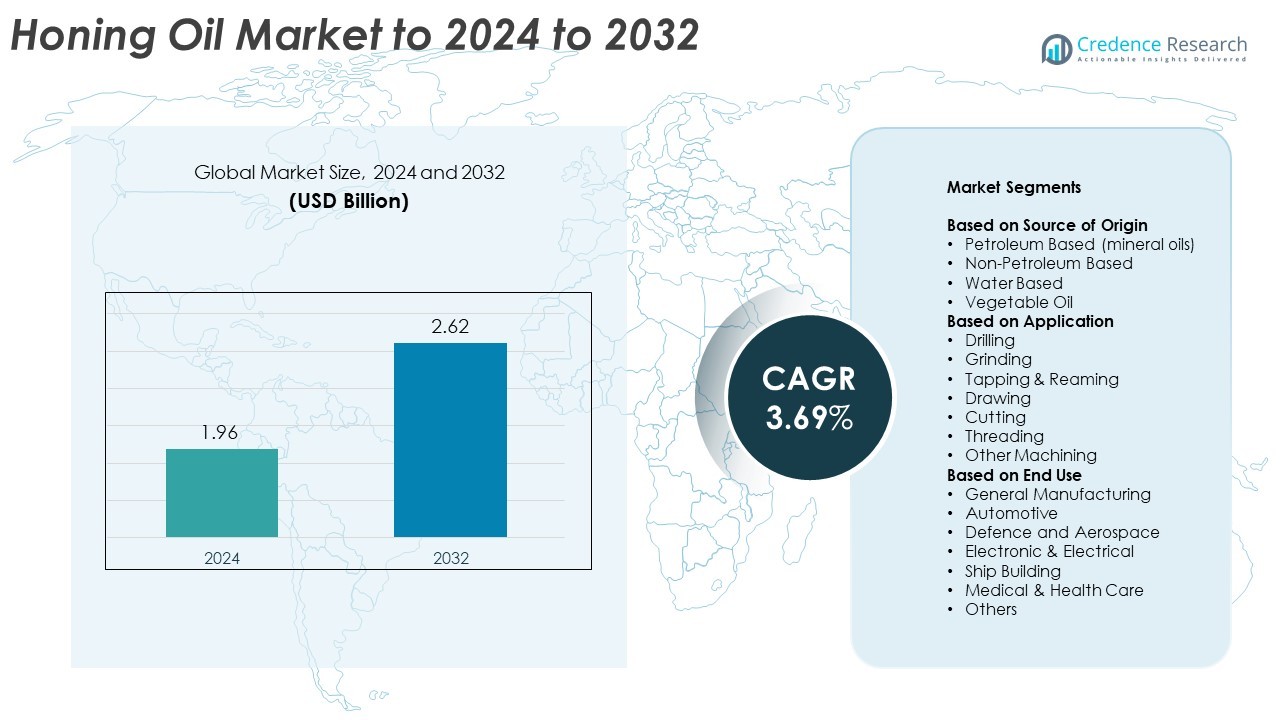
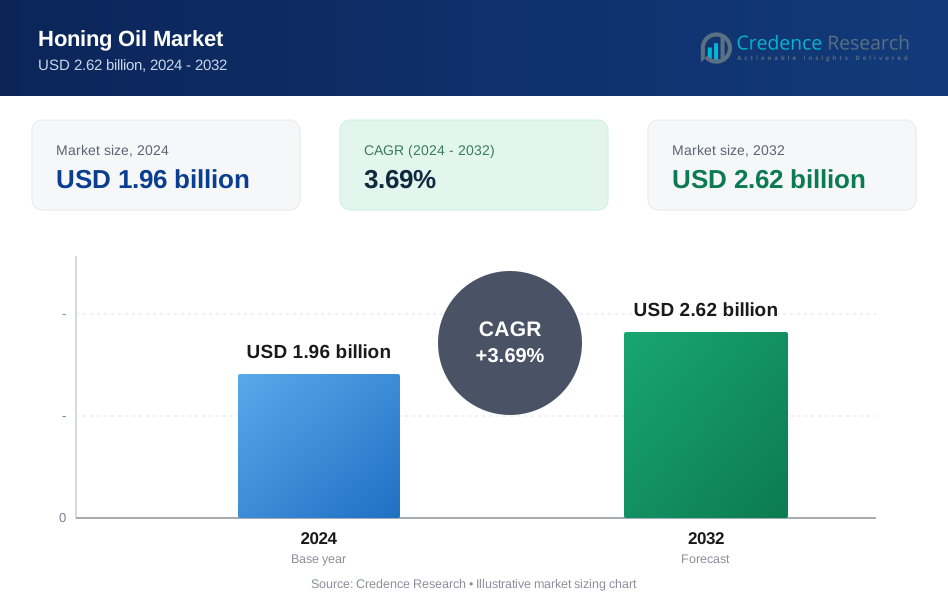
Honing Oil Market size was valued USD 1.96 billion in 2024 and is anticipated to reach USD 2.62 billion by 2032, at a CAGR of 3.69% during the forecast period.
| REPORT ATTRIBUTE | DETAILS |
|---|---|
| Historical Period | 2020-2023 |
| Base Year | 2024 |
| Forecast Period | 2025-2032 |
| Honing Oil Market Market Size 2024 | USD 1.96 Billion |
| Honing Oil Market Market, CAGR | 3.69% |
| Honing Oil Market Market Size 2032 | USD 2.62 Billion |
The Honing Oil Market is characterized by strong competition among major players such as Shell Plc., Castrol (BP Plc.), Houghton International Inc., and Delapena Honing Equipment. These companies dominate through advanced product portfolios, sustainable formulations, and global supply networks. They focus on developing high-performance, low-emission, and bio-based honing oils to meet evolving industrial and environmental requirements. North America led the market in 2024 with a 34.7% share, supported by robust automotive and aerospace manufacturing sectors. Asia-Pacific followed closely, driven by rapid industrialization, expanding machining operations, and rising adoption of automation across production facilities.
Market Insights
- The Honing Oil Market was valued at USD 1.96 billion in 2024 and is projected to reach USD 2.62 billion by 2032, growing at a CAGR of 3.69%.
- Rising demand from the automotive and manufacturing industries drives market growth, supported by the need for precision finishing and tool longevity.
- Technological advancements and the shift toward bio-based and water-soluble honing oils are shaping new sustainability trends.
- The market remains competitive with major players focusing on innovation, product diversification, and expansion in high-growth regions.
- North America led the market with a 34.7% share in 2024, followed by Asia-Pacific at 31.8%, while the petroleum-based segment held the largest share at 46.3%.
Market Segmentation Analysis:
By Source of Origin
The petroleum-based segment dominated the honing oil market in 2024 with a 46.3% share. Its dominance is driven by superior lubrication, high thermal stability, and effective metal chip removal. Petroleum-based honing oils are widely used in precision machining operations due to their ability to reduce friction and extend tool life. Non-petroleum, water-based, and vegetable oil variants are gaining traction for their eco-friendly nature and low volatility. Growing environmental awareness and strict disposal regulations are gradually encouraging manufacturers to develop biodegradable alternatives, particularly for applications in medical and aerospace industries.
- For instance, Castrol Honilo 981 shows 4.8–4.9 mm²/s kinematic viscosity at 40 °C and a flash point >125 °C, enabling stable lubrication under heat.
By Application
The grinding segment led the market in 2024 with a 33.8% share. Grinding operations require consistent lubrication and cooling to maintain dimensional accuracy and surface finish, which honing oils efficiently provide. Increasing demand for precision-engineered components in automotive and aerospace manufacturing drives the use of honing oils in grinding applications. Other machining processes such as drilling, tapping, and threading are also expanding, supported by the rise of advanced CNC machines. The growing need for high-speed production and reduced tool wear continues to strengthen demand in the grinding application segment.
- For instance, FUCHS ECOCUT HSG 211 LE lists 11 mm²/s viscosity at 40 °C and a 172 °C flash point, supporting high-load grinding duty.
By End Use
The automotive segment held the largest share of 38.5% in 2024. The segment’s growth is fueled by extensive use of honing oils in engine cylinder bores, gear finishing, and fuel injector component manufacturing. Automotive OEMs prefer high-performance honing oils for achieving tighter tolerances and smooth surface textures. The general manufacturing and defense sectors are also expanding due to ongoing industrial modernization and increased defense procurement. Rising adoption of precision machining in electronic, medical, and shipbuilding industries further enhances the demand for advanced honing oil formulations across diverse end-use applications.
Key Growth Drivers
Rising Demand from Automotive and Manufacturing Industries
Expanding automotive and general manufacturing sectors are major drivers for the honing oil market. Honing oils are essential for achieving smooth surface finishes, precision, and extended tool life during component production. The growing use of honing in engine blocks, gears, and fuel injectors enhances productivity and reduces maintenance costs. Increasing adoption of automated machining systems and CNC technology across automotive and industrial production facilities further accelerates demand for high-quality honing oils.
- For instance, Castrol reports Honilo 981 use reduced filter paper consumption by 50% in a production setting, evidencing lower upkeep needs.
Advancements in Metalworking Fluids Technology
Continuous innovation in metalworking fluid formulations is propelling honing oil adoption. Modern honing oils feature improved oxidation stability, reduced mist formation, and enhanced cooling performance. These innovations ensure higher machining accuracy and minimize tool wear under extreme conditions. Manufacturers are focusing on developing additive-enhanced and synthetic-based oils to meet advanced industrial performance needs. This technological progress supports the demand for efficient and environment-friendly honing solutions in high-precision machining processes.
- For instance, Sunnen SHO-500 eliminates sulfur, chlorine, and fluorine additives and is BioPreferred-listed for regulated environments.
Growing Shift Toward Sustainable and Bio-Based Oils
Environmental regulations are encouraging a shift toward biodegradable and non-toxic honing oils. Vegetable-based and water-soluble alternatives are gaining popularity due to their lower environmental impact and safe disposal. Industries such as medical, aerospace, and defense increasingly prefer sustainable lubricants to meet eco-compliance standards. This transition is driving innovation in green oil formulations, positioning bio-based honing oils as a long-term growth driver within the global market.
Key Trends and Opportunities
Integration of Smart Machining and Automation
The adoption of smart machining technologies and IoT-enabled systems is transforming honing operations. Automated lubrication systems that optimize oil flow and temperature improve process efficiency and reduce waste. Manufacturers are using data-driven monitoring tools to track oil degradation and extend service life. This trend is opening opportunities for honing oil suppliers to develop intelligent fluids compatible with connected manufacturing environments.
- For instance, Blaser prescribes electronic concentration management with typical coolant concentration between 3% and 15%, and at least weekly recorded checks to keep processes stable.
Expansion in Aerospace and Medical Manufacturing
Rising investments in aerospace and medical component manufacturing are creating new opportunities for honing oil suppliers. These industries demand ultra-precise surface finishes and high-quality materials for critical parts such as hydraulic components, implants, and surgical tools. Honing oils designed for stainless steel, titanium, and composite materials are in high demand. This trend supports the adoption of specialty oils that enhance performance and ensure compliance with safety and hygiene standards.
- For instance, TotalEnergies’ Folia biopolymer fluid is water-based, oil- and emulsifier-free, delivering up to 25 % longer tool life, 55 % lower coolant consumption, and 12 % higher machining speed, with a four-ball test load value of 2,000 N (or typically 2.0 mm wear scar diameter in the four-ball test, depending on the test method).
Key Challenges
Environmental Regulations and Waste Disposal Issues
Stringent global regulations on waste oil disposal pose significant challenges to honing oil manufacturers. Traditional petroleum-based honing oils contain additives that can harm aquatic life and soil quality if improperly discarded. Companies must invest in advanced recycling and recovery systems to comply with environmental standards. The need for sustainable waste management solutions increases production costs, particularly for small and mid-scale manufacturers.
Fluctuating Raw Material Prices
Volatility in crude oil and additive prices impacts honing oil production costs and market stability. Petroleum-based formulations remain dominant, making manufacturers vulnerable to supply disruptions and cost fluctuations. Price instability affects profit margins and challenges long-term contract pricing with industrial clients. To counter this, producers are diversifying sourcing strategies and increasing the use of synthetic and bio-based raw materials to stabilize product pricing.
Regional Analysis
North America
North America dominated the honing oil market in 2024 with a 34.7% share. The region’s growth is driven by the strong presence of the automotive, aerospace, and heavy machinery industries in the United States and Canada. Advanced manufacturing technologies and high adoption of precision machining processes support consistent demand for honing oils. Growing investments in electric vehicle component production further boost the market. Key manufacturers focus on developing synthetic and bio-based oils to meet stringent environmental standards, enhancing North America’s position as a leading market for high-performance honing oils.
Europe
Europe accounted for 27.9% of the honing oil market in 2024. The region benefits from a well-established industrial base and strict environmental regulations promoting sustainable lubricants. Germany, Italy, and France are major contributors due to their strong automotive and engineering sectors. Rising demand for precision machining in aerospace and medical manufacturing strengthens market growth. European manufacturers are increasingly shifting toward low-VOC and biodegradable honing oils to meet EU emission norms, reinforcing the region’s commitment to green production practices and sustainable industrial development.
Asia-Pacific
Asia-Pacific held the largest and fastest-growing share of 31.8% in 2024. Rapid industrialization in China, India, and Japan drives demand for honing oils in automotive and general manufacturing sectors. Expanding infrastructure and increased adoption of automated machining systems enhance market growth. The region also benefits from cost-efficient production and a growing focus on locally produced bio-based lubricants. Rising investments in precision engineering, coupled with large-scale machinery exports, position Asia-Pacific as a key growth hub for honing oil manufacturers seeking volume expansion and cost advantages.
Latin America
Latin America accounted for 3.6% of the global honing oil market in 2024. The market is supported by the growing automotive assembly and industrial machinery sectors in Brazil and Mexico. Increasing investments in manufacturing infrastructure and rising foreign partnerships encourage the use of advanced metalworking fluids. However, limited awareness about sustainable oil alternatives restrains faster adoption. The region’s gradual industrial modernization and growing preference for imported high-performance oils are expected to support moderate market growth during the forecast period.
Middle East & Africa
The Middle East & Africa region held a 2% share of the honing oil market in 2024. Industrial growth in the United Arab Emirates, Saudi Arabia, and South Africa supports demand in manufacturing and energy-related applications. Expanding defense and aerospace projects also boost market penetration. However, limited local production and dependency on imported raw materials pose challenges. Increasing government initiatives to promote industrial diversification and automation are expected to gradually drive demand for honing oils across regional manufacturing facilities.
Market Segmentations:
By Source of Origin
- Petroleum Based (mineral oils)
- Non-Petroleum Based
- Water Based
- Vegetable Oil
By Application
- Drilling
- Grinding
- Tapping & Reaming
- Drawing
- Cutting
- Threading
- Other Machining
By End Use
- General Manufacturing
- Automotive
- Defence and Aerospace
- Electronic & Electrical
- Ship Building
- Medical & Health Care
- Others
By Geography
- North America
- U.S.
- Canada
- Mexico
- Europe
- Germany
- France
- U.K.
- Italy
- Spain
- Rest of Europe
- Asia Pacific
- China
- Japan
- India
- South Korea
- South-east Asia
- Rest of Asia Pacific
- Latin America
- Brazil
- Argentina
- Rest of Latin America
- Middle East & Africa
- GCC Countries
- South Africa
- Rest of the Middle East and Africa
Competitive Landscape
The Honing Oil Market is highly competitive and features leading players such as Shell Plc., Castrol (BP Plc.), Houghton International Inc., Delapena Honing Equipment, Chem Arrow Corporation, QualiChem Inc., Metalworking Lubricants Company, Falcon Industrial Inc., Eastern Oil Company, CC Jensen, Sunbelt Lubricants, and Cimcool Industrial Products. These companies focus on continuous innovation in lubrication technology, developing high-performance and eco-friendly honing oils for advanced machining operations. They emphasize improving oxidation stability, cooling efficiency, and biodegradability to meet industrial and environmental standards. Strategic collaborations, product diversification, and strong distribution networks help maintain market presence across automotive, aerospace, and manufacturing sectors. Additionally, investments in R&D to develop bio-based and synthetic formulations strengthen competitiveness in regions with stringent regulations. Expansion into emerging industrial economies and the introduction of customized lubrication solutions remain key strategies driving long-term growth and market consolidation among global and regional participants.
Key Player Analysis
- Shell Plc.
- Castrol (BP Plc.)
- Houghton International Inc.
- Delapena Honing Equipment
- Chem Arrow Corporation
- QualiChem Inc.
- Metalworking Lubricants Company
- Falcon Industrial Inc.
- Eastern Oil Company
- CC Jensen
- Sunbelt Lubricants
- Cimcool Industrial Products
Recent Developments
- In 2024, Castrol (BP Plc.) continued to offer its established range of Honilo neat honing oils and Syntilo synthetic coolants, which included products formulated with advanced extreme-pressure (EP) additives for optimizing performance in various honing operations, including heavy-duty diesel engine blocks.
- In 2024, Houghton continued to offer its existing range of honing fluids, which included options designed to be more environmentally responsible and safer for operators, such as bio-based and mineral-oil-free alternatives.
- In 2023, Shell Plc. continued to offer its established Macron range of neat cutting and honing oils, which provided improved tool life and surface finish in precision engineering applications.
Report Coverage
The research report offers an in-depth analysis based on Source of Origin, Application, End-Use and Geography. It details leading market players, providing an overview of their business, product offerings, investments, revenue streams, and key applications. Additionally, the report includes insights into the competitive environment, SWOT analysis, current market trends, as well as the primary drivers and constraints. Furthermore, it discusses various factors that have driven market expansion in recent years. The report also explores market dynamics, regulatory scenarios, and technological advancements that are shaping the industry. It assesses the impact of external factors and global economic changes on market growth. Lastly, it provides strategic recommendations for new entrants and established companies to navigate the complexities of the market.
Future Outlook
- Demand for bio-based and water-soluble honing oils will continue to grow due to sustainability goals.
- Advancements in synthetic formulations will enhance tool life and machining efficiency.
- Automotive and aerospace sectors will remain major consumers of high-performance honing oils.
- Automation and precision machining trends will increase oil consumption in manufacturing units.
- Manufacturers will focus on developing low-emission and recyclable oil products.
- Asia-Pacific will lead market expansion with rapid industrialization and production capacity growth.
- Rising adoption of CNC and automated honing machines will boost lubricant demand.
- Partnerships between oil producers and machine tool makers will strengthen product integration.
- Strict environmental regulations will encourage innovation in biodegradable oil compositions.
- Digital monitoring of honing oil performance will gain traction in smart manufacturing facilities.
Request a Free Sample
Fill in your details and we'll send you a free sample report.
- Sample data tables & charts
- Research methodology
Need a Custom Version of This Report?
Tailor the scope, geography, or segments to your exact requirements.
- Custom geography or segment scope
- Direct access to our analyst team
Frequently Asked Questions
What is the current market size for Honing Oil Market, and what is its projected size in 2032?
At what Compound Annual Growth Rate is the Honing Oil Market projected to grow between 2025 and 2032?
Which Honing Oil Market segment held the largest share in 2024?
What are the primary factors fueling the growth of the Honing Oil Market?
Who are the leading companies in the Honing Oil Market?
Which region commanded the largest share of the Honing Oil Market in 2024?
Table of Content
Chapter 1. Report Introduction
- 1.1 Report Description & Purpose
- 1.1.1 Report Title & Market Definition
- 1.1.2 Unique Selling Propositions (USP) & Key Differentiators
- 1.1.3 Value Proposition for Stakeholders
- 1.2 Research Objectives
- 1.2.1 Market Sizing Objectives (Volume & Revenue) (Volume Where Applicable)
- 1.2.2 Segmentation Objectives
- 1.2.3 Competitive Intelligence Objectives
- 1.2.4 Forecast & Scenario Objectives
- 1.3 Report Scope
- 1.3.1 Honing Oil Scope – Segments & Subsegments Covered
- 1.3.2 Geographic Scope – Regions & Countries Covered
- 1.3.3 Historical Period, Base Year & Forecast Period (2024; forecast to 2032)
- 1.3.4 Inclusions & Exclusions
- 1.4 Industry Classification & Applicable Codes
- 1.5 Currency, Measurement Units & Valuation Basis
- 1.6 Target Stakeholders
- 1.7 Limitations & Assumptions
Chapter 2. Executive Summary
- 2.1 Global Honing Oil Market Snapshot
- 2.1.1 Market Size – Historical (2024) & Forecast (2024-2032) (2024: USD 1.96 billion → 2032: USD 2.62 billion)
- 2.1.2 Volume & Revenue – Global Totals (Volume Where Applicable)
- 2.1.3 Key Market Highlights – Top Five Facts
- 2.2 Honing Oil Market Segmentation Snapshot
- 2.2.1 Market Split by Region – 2024 vs. 2032
- 2.3 Competitive Snapshot
- 2.3.1 Top 10 Players by Revenue Share – 2024
- 2.3.2 Top 10 Players by Volume Share – 2024 (Volume Where Applicable)
- 2.3.3 Recent Strategic Developments (18-Month Summary)
- 2.4 Key Investment Highlights & Strategic Conclusions
Chapter 3. Honing Oil Market Dynamics & Industry Analysis
- 3.1 Market Overview & Context
- 3.1.1 Honing Oil Market Position in the Broader Industry Value Chain
- 3.1.2 Demand Structure & Purchasing Dynamics
- 3.1.3 Market Maturity & Development Stage by Region
- 3.2 Honing Oil Market Drivers
- 3.3 Honing Oil Market Restraints & Challenges
- 3.4 Honing Oil Market Opportunities
- 3.5 Porter's Five Forces Analysis
- 3.5.1 Threat of New Entrants
- 3.5.2 Bargaining Power of Suppliers
- 3.5.3 Bargaining Power of Buyers
- 3.5.4 Threat of Substitutes
- 3.5.5 Competitive Rivalry – Intensity Assessment
- 3.6 Honing Oil Value Chain Analysis
- 3.6.1 Upstream – Key Inputs, Resources & Suppliers
- 3.6.1.1 Key Input/Resource 1
- 3.6.1.2 Key Input/Resource 2
- 3.6.1.3 Key Input/Resource 3
- 3.6.2 Midstream – Core Operations & Value Creation
- 3.6.2.1 Operating Model & Process Overview
- 3.6.2.2 Key Operating Locations & Capabilities by Company
- 3.6.3 Downstream – Market Channels & End Users
- 3.6.3.1 Direct Sales & Customer Engagement Channels
- 3.6.3.2 Indirect Sales, Intermediaries & Partner Channels
- 3.6.4 Value Chain Profitability Analysis
- 3.6.1 Upstream – Key Inputs, Resources & Suppliers
- 3.7 PESTEL Analysis
- 3.7.1 Political Factors
- 3.7.2 Economic Factors
- 3.7.3 Social Factors
- 3.7.4 Technological Factors
- 3.7.5 Environmental Factors
- 3.7.6 Legal Factors
- 3.8 Honing Oil Supply Chain Analysis
- 3.8.1 Critical Input & Resource Availability Risk Assessment
- 3.8.2 Supplier & Operational Concentration Risk (Geographic Exposure)
- 3.8.3 Supply & Service Disruption Impact Analysis
- 3.9 Regulatory & Policy Landscape
Note: The regulatory and policy landscape section covers regulations based on their applicability to the market, Honing Oil category, geography, and scope of the study. Only regulatory frameworks with a material impact on operations, compliance, trade, sustainability, or market access are analyzed in detail.
Chapter 4. Key Investment Pockets & Opportunity Analysis
- 4.1 Honing Oil Market Attractiveness Analysis
- 4.1.1 By Region – Investment Attractiveness Matrix (Market Size × CAGR)
- 4.2 Absolute Revenue Growth Opportunity
- 4.2.1 By Region – Absolute Revenue Growth Through 2032
- 4.3 Incremental Demand Opportunity
- 4.3.1 By Region – Incremental Demand Through 2032
- 4.3.2 Segment – Incremental Demand
- 4.4 Emerging Submarket Opportunity Deep Dive (Subject to Applicability)
- 4.5 Priority Market Opportunity Scorecards
- 4.5.1 United States
- 4.5.2 Europe
- 4.5.3 Asia
- 4.5.4 Middle East & Africa
Note: Priority market opportunity scorecards reflect the geographic scope and strategic relevance of the study. Listed markets are indicative and may be adapted to the industry.
Chapter 5. Honing Oil Cross-Border Trade & Market Access Analysis
- 5.1 International Trade & Cross-Border Activity Overview
- 5.1.1 Global Export Value by Country (2024)
- 5.1.2 Global Export Volume by Country (2024) (Volume Where Applicable)
- 5.1.3 Global Import Value by Country (2024)
- 5.1.4 Global Import Volume by Country (2024) (Volume Where Applicable)
- 5.1.5 Net Trade Balance by Country (2024)
- 5.2 Export Analysis – Segment
- 5.2.1 Category 1 (Applicable Classification Code)
- 5.2.2 Category 2 (Applicable Classification Code)
- 5.2.3 Category 3 (Applicable Classification Code)
- 5.2.4 Category 4 (Applicable Classification Code)
- 5.2.5 Category 5 (Applicable Classification Code)
- 5.3 Import Analysis – Segment
- 5.3.1 Category 1 (Applicable Classification Code)
- 5.3.2 Category 2 (Applicable Classification Code)
- 5.3.3 Category 3 (Applicable Classification Code)
- 5.3.4 Category 4 (Applicable Classification Code)
- 5.3.5 Category 5 (Applicable Classification Code)
- 5.4 Cross-Border Pricing & Transaction Benchmarks
- 5.4.1 Export Pricing – Segment & Country
- 5.4.2 Import Pricing – Segment & Source Country
- 5.4.3 Price Trends (2024)
- 5.5 Key Cross-Border Trade & Delivery Routes
- 5.5.1 Cross-Border Trade/Delivery Route 1
- 5.5.2 Cross-Border Trade/Delivery Route 2
- 5.5.3 Cross-Border Trade/Delivery Route 3
- 5.5.4 Cross-Border Trade/Delivery Route 4
- 5.5.5 Cross-Border Trade/Delivery Route 5
- 5.6 Trade Policy & Market Access Impact Assessment
- 5.6.1 Tariff & Non-Tariff Barriers
- 5.6.2 Regional Trade & Economic Integration Frameworks
- 5.6.3 Bilateral & Multilateral Trade Agreements
- 5.6.4 Cross-Border Operating, Licensing & Localization Requirements
Note: This chapter applies where cross-border trade or delivery is relevant to Honing Oil. Goods, services, and digital offerings are assessed using applicable classifications and transaction measures. Import-export volumes, trade balances, and route analyses are included only where meaningful to the market.
Chapter 6. Competitive Landscape & Company Benchmarking
- 6.1 Honing Oil Market Concentration & Structure
- 6.1.1 Herfindahl-Hirschman Index (HHI) – vs. 2024
- 6.1.2 Leading, Mid-Sized & Emerging Player Structure
- 6.1.3 Global, Regional & Local Player Dynamics
- 6.2 Honing Oil Market Share Analysis – 2024
- 6.2.1 Global Revenue Share by Company
- 6.2.2 Global Volume Share by Company (Volume Where Applicable)
- 6.2.3 Regional Revenue Share
- 6.2.4 Market Share Evolution ( vs. 2024)
- 6.2.5 Company Market Share by Key Segment
- 6.2.6 Company Market Share by Customer Group
- 6.3 Operating Scale, Capacity & Infrastructure Analysis
- 6.3.1 Global Operating Scale & Supply Capacity
- 6.3.2 Resource Utilization & Operating Efficiency
- 6.3.3 Output, Service Delivery & Activity Metrics
- 6.3.4 Operating Footprint & Infrastructure Map
- 6.3.5 Planned Operational & Capacity Expansion
- 6.4 Honing Oil Competitive Benchmarking Matrix
- 6.4.1 Revenue, Growth, Profitability & Operating Metric Comparison
- 6.4.2 Channel Revenue Mix
- 6.4.3 Geographic Revenue Exposure
- 6.4.4 R&D Intensity
- 6.4.5 Sustainability Maturity
- 6.5 Strategic Developments in Honing Oil (Last 24 Months)
- 6.5.1 Mergers, Acquisitions & Divestments
- 6.5.2 New Products, Services & Solutions in Honing Oil
- 6.5.3 Operational & Infrastructure Expansions
- 6.5.4 Strategic Alliances, Joint Ventures & Partnerships
- 6.5.5 Distribution Expansion & Market Entry
- 6.5.6 Sustainability & ESG Initiatives
- 6.6 Competitive Strategy Mapping
- 6.6.1 Leader, Challenger, Follower & Niche Classification
- 6.6.2 Pricing Strategy Comparison
- 6.6.3 Channel Strategy Matrix
Note: Strategic developments are included based on their materiality and the availability of reliable information.
Chapter 7. Global Honing Oil Market – By Sales & Delivery Channel
- 7.1 Segment Overview
- 7.1.1 Volume & Revenue Split by Channel (2024 & 2032) (Volume Where Applicable)
- 7.1.2 Channel Mix Evolution (2024-2032)
Chapter 8. Regional Market Analysis – Global Overview
- 8.1 Global Regional Overview
- 8.1.1 Regional Volume Share (Volume Where Applicable)
- 8.1.2 Regional Revenue Share
- 8.1.3 Regional Volume by Region (Volume Where Applicable)
- 8.1.4 Regional Revenue by Region
- 8.1.5 Regional Forecast Through 2032
- 8.2 Cross-Regional Segment Analysis
- 8.2.1 By Sales & Delivery Channel
- 8.2.2 By Competitive Positioning & Price Tier
Chapter 9. North America Honing Oil Market
- 9.1 United States
- 9.2 Canada
- 9.3 Mexico
Chapter 10. Europe Honing Oil Market
- 10.1 Germany
- 10.2 France
- 10.3 Italy
- 10.4 United Kingdom
- 10.5 Spain
- 10.6 Poland
- 10.7 Russia
- 10.8 Netherlands
- 10.9 Belgium
- 10.10 Sweden
- 10.11 Denmark
- 10.12 Norway
- 10.13 Rest of Europe
Chapter 11. Asia Pacific Honing Oil Market
- 11.1 China
- 11.2 India
- 11.3 Japan
- 11.4 South Korea
- 11.5 Thailand
- 11.6 Indonesia
- 11.7 Vietnam
- 11.8 Malaysia
- 11.9 Australia
- 11.10 Rest of Asia Pacific
Chapter 12. Latin America Honing Oil Market
- 12.1 Brazil
- 12.2 Argentina
- 12.3 Colombia
- 12.4 Chile
- 12.5 Rest of Latin America
Chapter 13. Middle East Honing Oil Market
- 13.1 Saudi Arabia
- 13.2 United Arab Emirates
- 13.3 Turkey
- 13.4 Israel
- 13.5 Iran
- 13.6 Rest of the Middle East
Chapter 14. Africa Honing Oil Market
- 14.1 South Africa
- 14.2 Egypt
- 14.3 Nigeria
- 14.4 Morocco
- 14.5 Rest of Africa
Chapter 15. Honing Oil Company Profiles
- 15.1 [Company 01]
- 15.1.1 Company Overview
- 15.1.2 Key Management Personnel
- 15.1.3 Products & Services Portfolio
- 15.1.4 Financial Performance
- 15.1.5 Key Market Focus & Geographic Presence
- 15.1.6 Recent Developments & Strategic Initiatives
Note: The company profile list is preliminary and may change based on research findings, market developments, data availability, and client requirements.
Chapter 16. Appendices
- Appendix A – List of Abbreviations & Acronyms
- Appendix B – Industry Classification Code Reference – Full Series
- Appendix C – Supply, Output & Operating Capacity Data Tables
- Appendix D – End-Use & Demand Base Tables
- Appendix E – Demand, Adoption & Usage Assumptions
- Appendix F – Pricing & Revenue Metric Reference Tables
- Appendix G – Company Operations & Infrastructure Database
- Appendix H – Cross-Border Trade & Activity Data Tables (Where Applicable)
- Appendix I – Regulatory Summary Tables
- Appendix J – Primary Research Participant List (Anonymized)
- Appendix K – Primary Research Questionnaire Framework
- Appendix L – Data Sources & Bibliography
- Appendix M – Market Size Divergence & Source Comparison
Chapter 17. Research Methodology
- 17.1 Research Framework & Philosophy
- 17.2 Secondary Research – Sources, Hierarchy & Data Extraction
- 17.3 Data Modeling – Bottom-Up & Top-Down Market Sizing
- 17.4 Primary Research – Stakeholder Framework, LOI & Sample Sizes
- 17.5 Forecast Methodology – Regression, Scenario & Sensitivity Analysis
- 17.6 Quality Control – Four-Layer Validation Framework
- 17.7 Limitations & Standard Assumptions
- 17.8 Disclaimer
