
Market Overview
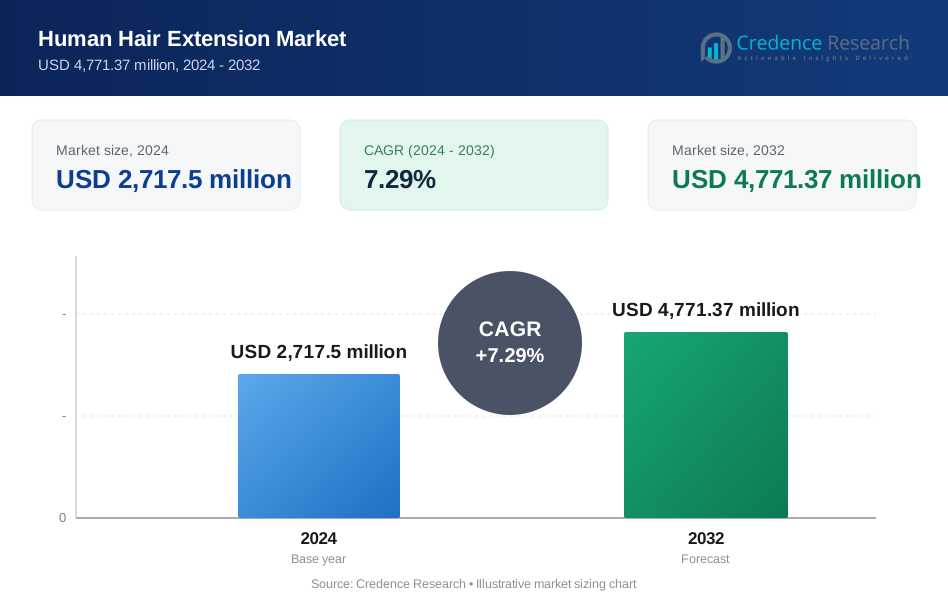
The Human Hair Extension Market reached USD 2,717.5 million in 2024 and is expected to rise to USD 4,771.37 million by 2032, reflecting a CAGR of 7.29% over the forecast period.
| REPORT ATTRIBUTE | DETAILS |
|---|---|
| Historical Period | 2020-2023 |
| Base Year | 2024 |
| Forecast Period | 2025-2032 |
| Human Hair Extension Market Size 2024 | USD 2,717.5 Million |
| Human Hair Extension Market, CAGR | 7.29% |
| Human Hair Extension Market Size 2032 | USD 4,771.37 Million |
The Human Hair Extension market features strong competition among leading players such as Great Lengths, BELLAMI Hair, Indique Hair, Hairdreams, Mayvenn, Donna Bella Hair, BEVM, Evergreen Products Group, Klix Hair Extensions, and Cinderella Hair Extensions. These brands expand their reach through premium Remy and virgin hair offerings, salon partnerships, and strong online distribution. Asia Pacific stands as the leading region with a 32% market share, supported by large sourcing networks and strong manufacturing capacity. North America and Europe follow with 28% and 24% shares, driven by high beauty spending and strong adoption of premium, ethically sourced extensions.
Market Insights
- The Human Hair Extension market reached USD 2,717.5 million in 2024 and will reach USD 4,771.37 million by 2032, recording a 7.29% CAGR during the forecast period.
- Rising beauty awareness and demand for natural-looking styles drive adoption across salons and personal users, with clip-in extensions holding a 42% share and Remy hair leading with a 51% share.
- Key trends include premiumization, ethical sourcing, and growth of texture-matched products supported by strong online retail expansion and influencer-driven styling culture.
- The market remains competitive with brands such as Great Lengths, BELLAMI Hair, Indique Hair, and Hairdreams focusing on premium quality, traceable sourcing, and strong salon partnerships; however, high prices and quality inconsistency restrain wider penetration.
- Asia Pacific leads regional performance with a 32% share, followed by North America at 28% and Europe at 24%, while Latin America holds 9% and the Middle East & Africa account for 7% of global demand.
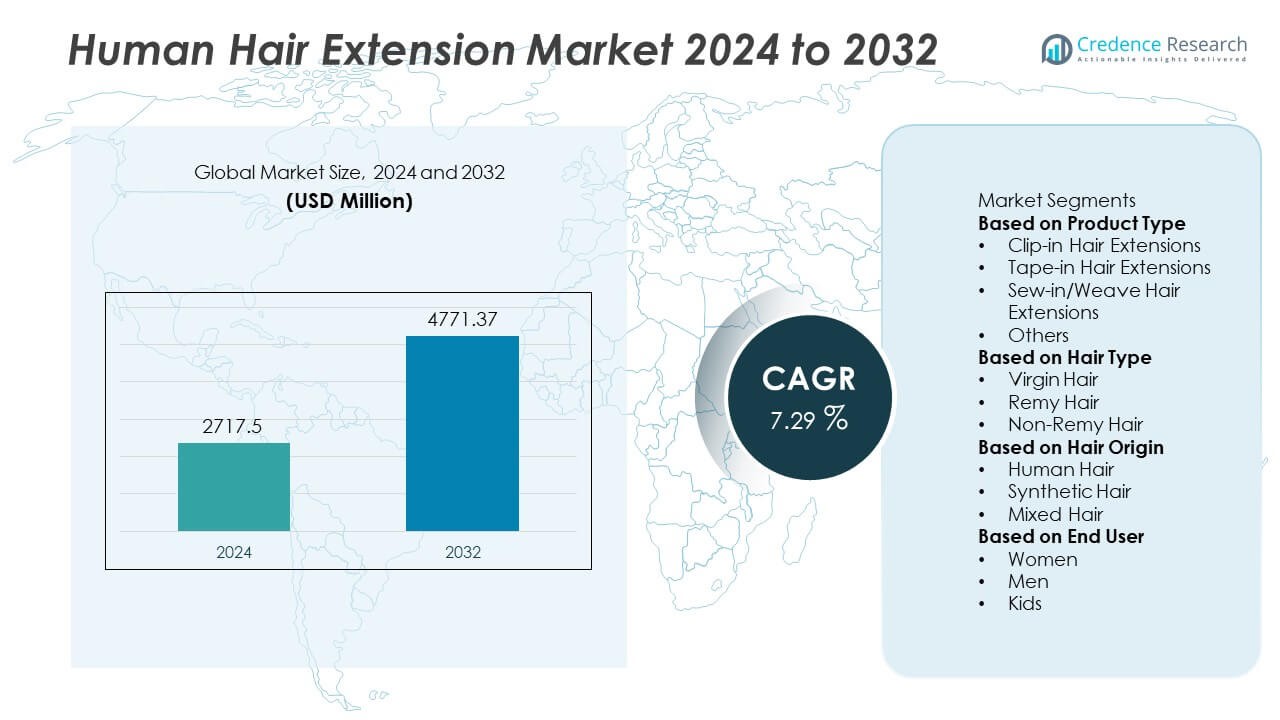
Market Segmentation Analysis:
By Product Type
Clip-in extensions lead the segment with a 42% share due to simple use and quick styling. Tape-in formats grow as salons prefer light adhesive systems that blend well. Sew-in and weave extensions stay important in regions that favor long-wear looks. Other systems such as micro-link and fusion attract users seeking strong hold and smooth finish. Online creators increase product visibility and support higher adoption. Rising interest in instant volume, daily styling ease, and flexible looks drives overall growth.
- For instance, Great Lengths offers both clip-in and bonded lines built with 100% human strands. Their pre-bonded system uses organic hydrolyzed keratin bonds which are applied using either a thermal method (the 3200 system) or an ultrasonic cold-fusion method (the Ultrasonic 5000 system).
By Hair Type
Remy hair dominates the segment with a 51% share because users value cuticle alignment, smooth texture, and long service life. Virgin hair grows among premium buyers seeking untreated strands with strong durability and natural flow. Non-Remy hair supports price-sensitive users who switch styles often. Salons promote high-grade bundles for improved performance and better styling results. Wider online availability of verified products boosts adoption. Consumers lean toward higher-quality options to reduce tangling and maintain consistent appearance.
- For instance, Hairdreams processes Remy strands through a multi-step quality system that includes a 12-stage fiber inspection line using optical scanners capable of detecting strand defects smaller than 0.03 millimeters. The company’s laserbeamer technology attaches bonds within 4 seconds per strand. This approach helps stylists deliver uniform texture and long-lasting appearance.
By Hair Origin
Human hair holds the leading position with a 64% share, supported by demand for natural appearance and heat-styling flexibility. Synthetic hair grows as fiber quality improves and offers low-cost styling choices. Mixed hair appeals to mid-range users seeking balance between longevity and affordability. Social media trends push interest in premium human-hair extensions across key cities. Expanding e-commerce options help users compare quality and choose trusted brands. Rising beauty awareness and frequent style changes lift overall demand.
Key Growth Driver
Rising Beauty Consciousness and Styling Flexibility
Growing focus on personal appearance boosts demand for high-quality human hair extensions. Users adopt extensions to add volume, length, or color without chemical treatments. Social media trends increase awareness, as influencers showcase daily styling looks that rely on premium hair bundles. Salons promote extensions as quick solutions for events, professional use, and regular grooming. Rising disposable income in urban regions expands spending on premium Remy and virgin hair. Broader online access helps consumers compare quality and purchase authenticated products. These factors push steady market expansion across both personal and professional styling channels.
- For instance, BELLAMI Hair has spent over a decade testing, innovating, and perfecting solutions for every hair type and goal, employing rigorous manufacturing standards and meticulous inspection to ensure consistent texture, tone, and longevity across premium hair lines.
Expansion of Salon Services and Premiumization
Professional salons adopt advanced extension systems due to higher customer demand for natural-looking results. Tape-in, sew-in, and clip-in formats gain strong acceptance as stylists offer customizable solutions. Premium Remy and virgin hair see higher uptake because clients prefer durability and smooth texture. Salons also promote recurring maintenance visits, which drives steady revenue. Training programs improve application skills and increase consumer trust in salon-grade extensions. Premiumization strengthens as buyers shift from synthetic units to higher-grade human hair products. These developments expand the overall value and scale of the market.
- For instance, Great Lengths operates an ultrasonic bonding platform that forms attachment points using advanced technology. The company emphasizes high quality and a rigorous selection process to ensure fiber uniformity and performance, allowing salons to deliver natural texture and long-lasting results.
Growth of E-commerce and Global Sourcing Networks
Online platforms widen product access and help users purchase verified human hair bundles with transparent quality checks. Global sourcing networks support consistent supply of Remy and virgin hair, reducing shortages across high-demand markets. E-commerce brands use detailed product videos, customer reviews, and quality certifications to build trust. Faster delivery services increase adoption among younger consumers who follow rapid fashion cycles. Digital marketing campaigns raise awareness of new textures, shades, and installation methods. These advancements strengthen online sales and support global market penetration.
Key Trend & Opportunity
Rising Demand for Premium and Ethically Sourced Hair
Consumers show stronger interest in ethically sourced human hair, especially virgin and Remy types. Transparent supply chains, donor tracking, and certified sourcing create trust and support premium pricing. Brands invest in ethical procurement programs to improve traceability and reduce counterfeit risks. Growing awareness of sustainability encourages users to choose long-lasting extensions instead of disposable synthetic units. This shift opens opportunities for premium suppliers offering quality consistency and verified origin. Ethical sourcing also enhances brand reputation and supports expansion in regulated markets.
- For instance, Great Lengths operates an ethical sourcing program audited under ISO 14001, where each hair batch is logged in a digital ledger using a 24-point traceability checklist. The company’s processing facility in Rome handles up to 3,600 kilograms of raw hair per year and uses water-purification units that filter contaminants down to 0.2 microns.
Advancements in Natural Texture Matching and Customization
Manufacturers introduce more texture-matching options to serve diverse hair types across global markets. Improved processing techniques maintain cuticle integrity and offer natural flow, even after coloring or styling. Customizable bundles, pre-colored options, and tailored lengths meet rising personalization demand. Salons also expand services for blended textures that match regional styling needs. These innovations support higher adoption in multicultural markets and open new segments in professional styling. Texture-focused development strengthens product differentiation and encourages users to shift from synthetic choices to premium natural hair alternatives.
- For instance, Indique Hair uses a special machine that draws hair strands to align the cuticles and prevent reversal issues. Its color-treatment process involves dyeing the hair to a uniform natural tone after machine alignment, especially for the Remix collection which uses hair from multiple sources.
Key Challenge
High Cost and Price Sensitivity in Emerging Markets
Premium Remy and virgin hair remain costly due to limited supply and complex processing. Many price-sensitive buyers in emerging regions choose synthetic or mixed-hair alternatives, slowing adoption of high-quality products. Fluctuation in raw hair availability further affects pricing stability. Counterfeit bundles also disrupt market trust, making consumers cautious about investing in premium segments. Manufacturers must balance affordability and quality to maintain competitiveness. Creating mid-range offerings helps address broader market needs but does not fully offset cost barriers for premium categories.
Quality Inconsistency and Supply Chain Fragmentation
Sourcing human hair requires complex multi-step processes involving collection, sorting, cleaning, and alignment. Unorganized supply chains create variability in quality, leading to mismatched textures, tangling issues, and reduced durability. Fragmented procurement networks also increase the risk of unethical sourcing practices, which damage brand credibility. Manufacturers face difficulties in standardizing quality across large batches. Regulatory oversight remains limited in many regions, making consistency even harder to maintain. These factors challenge long-term trust and create hurdles for global expansion.
Regional Analysis
North America
North America holds a 28% market share, supported by strong demand for premium Remy and virgin hair extensions across the United States and Canada. Consumers prefer natural-looking styles, driving higher adoption in salons and professional studios. Social media trends influence frequent styling changes, boosting recurring purchases. E-commerce platforms provide wide access to verified human hair bundles, strengthening online sales. Growing multicultural populations increase demand for texture-matched extensions across urban regions. Rising disposable income and strong beauty service networks further support market expansion across key cities.
Europe
Europe accounts for a 24% market share, driven by rising beauty awareness and interest in high-quality human hair extensions. Demand grows as salons promote tape-in and sew-in systems that deliver natural blends and long wear. Consumers prioritize ethically sourced European-grade hair, supporting the premium segment. The United Kingdom, Germany, France, and Italy remain major centers for professional installations. Expanding online retail channels increase access to verified products. Cultural preference for subtle, natural styles supports steady demand across both personal and professional users.
Asia Pacific
Asia Pacific leads the market with a 32% share, supported by large-scale hair sourcing networks and strong manufacturing bases in China, India, and Southeast Asia. Rising beauty consciousness and growing youth populations drive consumption of affordable and premium extensions. Japan, South Korea, and Australia show strong demand for natural-texture products, lifting the premium segment. Expanding urbanization and digital retail platforms increase access to diverse hair types. Regional suppliers benefit from cost advantages and broad texture availability, strengthening export activity and domestic consumption.
Latin America
Latin America holds a 9% market share, driven by increasing interest in fashion styling and beauty enhancement trends. Brazil and Mexico lead the region as consumers adopt extensions for volume, curl enhancement, and event styling. Growing salon networks promote tape-in and clip-in formats that suit regional hair textures. Rising social media influence supports the shift toward premium human hair products. Expanding e-commerce activity improves availability and comparison of quality standards. Urbanization and rising income levels encourage broader adoption across major cities.
Middle East & Africa
The Middle East & Africa region captures a 7% market share, supported by strong cultural preference for long-length and high-volume hair styling. The UAE and Saudi Arabia drive premium sales due to high spending on beauty services. Africa shows strong demand for sew-in and weave extensions, especially in Nigeria and South Africa, where styling frequency remains high. Growth in beauty salons and import channels increases access to human hair bundles. Social trends and rising income levels support premiumization. Expanding urban markets strengthen overall regional demand.
Market Segmentations:
By Product Type
- Clip-in Hair Extensions
- Tape-in Hair Extensions
- Sew-in/Weave Hair Extensions
- Others
By Hair Type
- Virgin Hair
- Remy Hair
- Non-Remy Hair
By Hair Origin
- Human Hair
- Synthetic Hair
- Mixed Hair
By End User
- Women
- Men
- Kids
By Geography
- North America
- U.S.
- Canada
- Mexico
- Europe
- Germany
- France
- U.K.
- Italy
- Spain
- Rest of Europe
- Asia Pacific
- China
- Japan
- India
- South Korea
- South-east Asia
- Rest of Asia Pacific
- Latin America
- Brazil
- Argentina
- Rest of Latin America
- Middle East & Africa
- GCC Countries
- South Africa
- Rest of the Middle East and Africa
Competitive Landscape
The competitive landscape features major players such as Great Lengths, BELLAMI Hair, Indique Hair, Hairdreams, Mayvenn, Donna Bella Hair, BEVM, Evergreen Products Group, Klix Hair Extensions, and Cinderella Hair Extensions. These companies compete through product quality, ethical sourcing, advanced processing methods, and strong brand positioning. Leading brands focus on premium Remy and virgin hair, offering diverse textures, shades, and installation formats to meet global styling needs. Many players strengthen market presence through salon partnerships, training programs, and influencer collaborations. E-commerce platforms support wider reach by offering verified products with transparent quality grading. Companies invest in traceable supply chains to improve authenticity and reduce counterfeit risks. Continuous innovation in texture matching, lightweight bonding, and color-stable treatments enhances user experience. Rising demand for personalized and natural-looking styles encourages players to expand product portfolios and adopt customer-centric strategies.
Key Player Analysis
- Great Lengths
- BELLAMI Hair
- Indique Hair
- Hairdreams
- Mayvenn
- Donna Bella Hair
- Beauty Elements Ventures Manufacturing (BEVM)
- Evergreen Products Group
- Klix Hair Extensions
- Cinderella Hair Extensions
Recent Developments
- In April 2025, BELLAMI Hair launched its Textured Hair Collection built for curly and coily hair types.
- In December 2024, Great Lengths received investment from Deutsche Beteiligungs AG (DBAG) to expand its global presence and sustainable luxury offerings.
- In 2024, Donna Bella Hair unveiled a refreshed brand identity and redesigned its website to elevate its premium shopping experience.
Report Coverage
The research report offers an in-depth analysis based on Product Type, Hair Type, Hair Origin, End User and Geography. It details leading market players, providing an overview of their business, product offerings, investments, revenue streams, and key applications. Additionally, the report includes insights into the competitive environment, SWOT analysis, current market trends, as well as the primary drivers and constraints. Furthermore, it discusses various factors that have driven market expansion in recent years. The report also explores market dynamics, regulatory scenarios, and technological advancements that are shaping the industry. It assesses the impact of external factors and global economic changes on market growth. Lastly, it provides strategic recommendations for new entrants and established companies to navigate the complexities of the market.
Future Outlook
- Demand for premium Remy and virgin hair will rise as users prefer natural looks.
- Online platforms will gain stronger traction through verified grading and global delivery.
- Salons will expand advanced installation services, improving long-term customer retention.
- Ethical and traceable sourcing will become a key factor in brand differentiation.
- Texture-matched products will grow as companies target diverse global hair types.
- Heat-resistant and color-stable treatments will improve durability and styling results.
- Emerging markets will adopt higher-quality extensions as incomes rise.
- Influencer-driven styling trends will accelerate product visibility and faster fashion cycles.
- Innovations in bonding and lightweight materials will enhance comfort and wearability.
- Regional suppliers will strengthen export capacity to meet rising international demand.
Request a Free Sample
Fill in your details and we'll send you a free sample report.
- Sample data tables & charts
- Research methodology
Need a Custom Version of This Report?
Tailor the scope, geography, or segments to your exact requirements.
- Custom geography or segment scope
- Direct access to our analyst team
Frequently Asked Questions
What is the current market size for the Human Hair Extension market, and what is its projected size in 2032?
At what Compound Annual Growth Rate is the Human Hair Extension market projected to grow between 2025 and 2032?
Which Human Hair Extension market segment held the largest share in 2024?
What are the primary factors fueling the growth of the Human Hair Extension market?
Who are the leading companies in the Human Hair Extension market?
Which region commanded the largest share of the Human Hair Extension market in 2024?
Table of Content
Chapter 1. Report Introduction
- 1.1 Report Description & Purpose
- 1.1.1 Report Title & Market Definition
- 1.1.2 Unique Selling Propositions (USP) & Key Differentiators
- 1.1.3 Value Proposition for Stakeholders
- 1.2 Research Objectives
- 1.2.1 Market Sizing Objectives (Volume & Revenue) (Volume Where Applicable)
- 1.2.2 Segmentation Objectives
- 1.2.3 Competitive Intelligence Objectives
- 1.2.4 Forecast & Scenario Objectives
- 1.3 Report Scope
- 1.3.1 Human Hair Extension Scope – Segments & Subsegments Covered
- 1.3.2 Geographic Scope – Regions & Countries Covered
- 1.3.3 Historical Period, Base Year & Forecast Period (2024; forecast to 2032)
- 1.3.4 Inclusions & Exclusions
- 1.4 Industry Classification & Applicable Codes
- 1.5 Currency, Measurement Units & Valuation Basis
- 1.6 Target Stakeholders
- 1.7 Limitations & Assumptions
Chapter 2. Executive Summary
- 2.1 Global Human Hair Extension Market Snapshot
- 2.1.1 Market Size – Historical (2024) & Forecast (2024-2032) (2024: USD 2,717.5 million → 2032: USD 4,771.37 million)
- 2.1.2 Volume & Revenue – Global Totals (Volume Where Applicable)
- 2.1.3 Key Market Highlights – Top Five Facts
- 2.2 Human Hair Extension Market Segmentation Snapshot
- 2.2.1 Market Split by Region – 2024 vs. 2032
- 2.3 Competitive Snapshot
- 2.3.1 Top 10 Players by Revenue Share – 2024
- 2.3.2 Top 10 Players by Volume Share – 2024 (Volume Where Applicable)
- 2.3.3 Recent Strategic Developments (18-Month Summary)
- 2.4 Key Investment Highlights & Strategic Conclusions
Chapter 3. Human Hair Extension Market Dynamics & Industry Analysis
- 3.1 Market Overview & Context
- 3.1.1 Human Hair Extension Market Position in the Broader Industry Value Chain
- 3.1.2 Demand Structure & Purchasing Dynamics
- 3.1.3 Market Maturity & Development Stage by Region
- 3.2 Human Hair Extension Market Drivers
- 3.3 Human Hair Extension Market Restraints & Challenges
- 3.4 Human Hair Extension Market Opportunities
- 3.5 Porter's Five Forces Analysis
- 3.5.1 Threat of New Entrants
- 3.5.2 Bargaining Power of Suppliers
- 3.5.3 Bargaining Power of Buyers
- 3.5.4 Threat of Substitutes
- 3.5.5 Competitive Rivalry – Intensity Assessment
- 3.6 Human Hair Extension Value Chain Analysis
- 3.6.1 Upstream – Key Inputs, Resources & Suppliers
- 3.6.1.1 Key Input/Resource 1
- 3.6.1.2 Key Input/Resource 2
- 3.6.1.3 Key Input/Resource 3
- 3.6.2 Midstream – Core Operations & Value Creation
- 3.6.2.1 Operating Model & Process Overview
- 3.6.2.2 Key Operating Locations & Capabilities by Company
- 3.6.3 Downstream – Market Channels & End Users
- 3.6.3.1 Direct Sales & Customer Engagement Channels
- 3.6.3.2 Indirect Sales, Intermediaries & Partner Channels
- 3.6.4 Value Chain Profitability Analysis
- 3.6.1 Upstream – Key Inputs, Resources & Suppliers
- 3.7 PESTEL Analysis
- 3.7.1 Political Factors
- 3.7.2 Economic Factors
- 3.7.3 Social Factors
- 3.7.4 Technological Factors
- 3.7.5 Environmental Factors
- 3.7.6 Legal Factors
- 3.8 Human Hair Extension Supply Chain Analysis
- 3.8.1 Critical Input & Resource Availability Risk Assessment
- 3.8.2 Supplier & Operational Concentration Risk (Geographic Exposure)
- 3.8.3 Supply & Service Disruption Impact Analysis
- 3.9 Regulatory & Policy Landscape
Note: The regulatory and policy landscape section covers regulations based on their applicability to the market, Human Hair Extension category, geography, and scope of the study. Only regulatory frameworks with a material impact on operations, compliance, trade, sustainability, or market access are analyzed in detail.
Chapter 4. Key Investment Pockets & Opportunity Analysis
- 4.1 Human Hair Extension Market Attractiveness Analysis
- 4.1.1 By Region – Investment Attractiveness Matrix (Market Size × CAGR)
- 4.2 Absolute Revenue Growth Opportunity
- 4.2.1 By Region – Absolute Revenue Growth Through 2032
- 4.3 Incremental Demand Opportunity
- 4.3.1 By Region – Incremental Demand Through 2032
- 4.3.2 Segment – Incremental Demand
- 4.4 Emerging Submarket Opportunity Deep Dive (Subject to Applicability)
- 4.5 Priority Market Opportunity Scorecards
- 4.5.1 United States
- 4.5.2 Europe
- 4.5.3 Asia
- 4.5.4 Middle East & Africa
Note: Priority market opportunity scorecards reflect the geographic scope and strategic relevance of the study. Listed markets are indicative and may be adapted to the industry.
Chapter 5. Human Hair Extension Cross-Border Trade & Market Access Analysis
- 5.1 International Trade & Cross-Border Activity Overview
- 5.1.1 Global Export Value by Country (2024)
- 5.1.2 Global Export Volume by Country (2024) (Volume Where Applicable)
- 5.1.3 Global Import Value by Country (2024)
- 5.1.4 Global Import Volume by Country (2024) (Volume Where Applicable)
- 5.1.5 Net Trade Balance by Country (2024)
- 5.2 Export Analysis – Segment
- 5.2.1 Category 1 (Applicable Classification Code)
- 5.2.2 Category 2 (Applicable Classification Code)
- 5.2.3 Category 3 (Applicable Classification Code)
- 5.2.4 Category 4 (Applicable Classification Code)
- 5.2.5 Category 5 (Applicable Classification Code)
- 5.3 Import Analysis – Segment
- 5.3.1 Category 1 (Applicable Classification Code)
- 5.3.2 Category 2 (Applicable Classification Code)
- 5.3.3 Category 3 (Applicable Classification Code)
- 5.3.4 Category 4 (Applicable Classification Code)
- 5.3.5 Category 5 (Applicable Classification Code)
- 5.4 Cross-Border Pricing & Transaction Benchmarks
- 5.4.1 Export Pricing – Segment & Country
- 5.4.2 Import Pricing – Segment & Source Country
- 5.4.3 Price Trends (2024)
- 5.5 Key Cross-Border Trade & Delivery Routes
- 5.5.1 Cross-Border Trade/Delivery Route 1
- 5.5.2 Cross-Border Trade/Delivery Route 2
- 5.5.3 Cross-Border Trade/Delivery Route 3
- 5.5.4 Cross-Border Trade/Delivery Route 4
- 5.5.5 Cross-Border Trade/Delivery Route 5
- 5.6 Trade Policy & Market Access Impact Assessment
- 5.6.1 Tariff & Non-Tariff Barriers
- 5.6.2 Regional Trade & Economic Integration Frameworks
- 5.6.3 Bilateral & Multilateral Trade Agreements
- 5.6.4 Cross-Border Operating, Licensing & Localization Requirements
Note: This chapter applies where cross-border trade or delivery is relevant to Human Hair Extension. Goods, services, and digital offerings are assessed using applicable classifications and transaction measures. Import-export volumes, trade balances, and route analyses are included only where meaningful to the market.
Chapter 6. Competitive Landscape & Company Benchmarking
- 6.1 Human Hair Extension Market Concentration & Structure
- 6.1.1 Herfindahl-Hirschman Index (HHI) – vs. 2024
- 6.1.2 Leading, Mid-Sized & Emerging Player Structure
- 6.1.3 Global, Regional & Local Player Dynamics
- 6.2 Human Hair Extension Market Share Analysis – 2024
- 6.2.1 Global Revenue Share by Company
- 6.2.2 Global Volume Share by Company (Volume Where Applicable)
- 6.2.3 Regional Revenue Share
- 6.2.4 Market Share Evolution ( vs. 2024)
- 6.2.5 Company Market Share by Key Segment
- 6.2.6 Company Market Share by Customer Group
- 6.3 Operating Scale, Capacity & Infrastructure Analysis
- 6.3.1 Global Operating Scale & Supply Capacity
- 6.3.2 Resource Utilization & Operating Efficiency
- 6.3.3 Output, Service Delivery & Activity Metrics
- 6.3.4 Operating Footprint & Infrastructure Map
- 6.3.5 Planned Operational & Capacity Expansion
- 6.4 Human Hair Extension Competitive Benchmarking Matrix
- 6.4.1 Revenue, Growth, Profitability & Operating Metric Comparison
- 6.4.2 Channel Revenue Mix
- 6.4.3 Geographic Revenue Exposure
- 6.4.4 R&D Intensity
- 6.4.5 Sustainability Maturity
- 6.5 Strategic Developments in Human Hair Extension (Last 24 Months)
- 6.5.1 Mergers, Acquisitions & Divestments
- 6.5.2 New Products, Services & Solutions in Human Hair Extension
- 6.5.3 Operational & Infrastructure Expansions
- 6.5.4 Strategic Alliances, Joint Ventures & Partnerships
- 6.5.5 Distribution Expansion & Market Entry
- 6.5.6 Sustainability & ESG Initiatives
- 6.6 Competitive Strategy Mapping
- 6.6.1 Leader, Challenger, Follower & Niche Classification
- 6.6.2 Pricing Strategy Comparison
- 6.6.3 Channel Strategy Matrix
Note: Strategic developments are included based on their materiality and the availability of reliable information.
Chapter 7. Global Human Hair Extension Market – By Sales & Delivery Channel
- 7.1 Segment Overview
- 7.1.1 Volume & Revenue Split by Channel (2024 & 2032) (Volume Where Applicable)
- 7.1.2 Channel Mix Evolution (2024-2032)
Chapter 8. Regional Market Analysis – Global Overview
- 8.1 Global Regional Overview
- 8.1.1 Regional Volume Share (Volume Where Applicable)
- 8.1.2 Regional Revenue Share
- 8.1.3 Regional Volume by Region (Volume Where Applicable)
- 8.1.4 Regional Revenue by Region
- 8.1.5 Regional Forecast Through 2032
- 8.2 Cross-Regional Segment Analysis
- 8.2.1 By Sales & Delivery Channel
- 8.2.2 By Competitive Positioning & Price Tier
Chapter 9. North America Human Hair Extension Market
- 9.1 United States
- 9.2 Canada
- 9.3 Mexico
Chapter 10. Europe Human Hair Extension Market
- 10.1 Germany
- 10.2 France
- 10.3 Italy
- 10.4 United Kingdom
- 10.5 Spain
- 10.6 Poland
- 10.7 Russia
- 10.8 Netherlands
- 10.9 Belgium
- 10.10 Sweden
- 10.11 Denmark
- 10.12 Norway
- 10.13 Rest of Europe
Chapter 11. Asia Pacific Human Hair Extension Market
- 11.1 China
- 11.2 India
- 11.3 Japan
- 11.4 South Korea
- 11.5 Thailand
- 11.6 Indonesia
- 11.7 Vietnam
- 11.8 Malaysia
- 11.9 Australia
- 11.10 Rest of Asia Pacific
Chapter 12. Latin America Human Hair Extension Market
- 12.1 Brazil
- 12.2 Argentina
- 12.3 Colombia
- 12.4 Chile
- 12.5 Rest of Latin America
Chapter 13. Middle East Human Hair Extension Market
- 13.1 Saudi Arabia
- 13.2 United Arab Emirates
- 13.3 Turkey
- 13.4 Israel
- 13.5 Iran
- 13.6 Rest of the Middle East
Chapter 14. Africa Human Hair Extension Market
- 14.1 South Africa
- 14.2 Egypt
- 14.3 Nigeria
- 14.4 Morocco
- 14.5 Rest of Africa
Chapter 15. Human Hair Extension Company Profiles
- 15.1 [Company 01]
- 15.1.1 Company Overview
- 15.1.2 Key Management Personnel
- 15.1.3 Products & Services Portfolio
- 15.1.4 Financial Performance
- 15.1.5 Key Market Focus & Geographic Presence
- 15.1.6 Recent Developments & Strategic Initiatives
Note: The company profile list is preliminary and may change based on research findings, market developments, data availability, and client requirements.
Chapter 16. Appendices
- Appendix A – List of Abbreviations & Acronyms
- Appendix B – Industry Classification Code Reference – Full Series
- Appendix C – Supply, Output & Operating Capacity Data Tables
- Appendix D – End-Use & Demand Base Tables
- Appendix E – Demand, Adoption & Usage Assumptions
- Appendix F – Pricing & Revenue Metric Reference Tables
- Appendix G – Company Operations & Infrastructure Database
- Appendix H – Cross-Border Trade & Activity Data Tables (Where Applicable)
- Appendix I – Regulatory Summary Tables
- Appendix J – Primary Research Participant List (Anonymized)
- Appendix K – Primary Research Questionnaire Framework
- Appendix L – Data Sources & Bibliography
- Appendix M – Market Size Divergence & Source Comparison
Chapter 17. Research Methodology
- 17.1 Research Framework & Philosophy
- 17.2 Secondary Research – Sources, Hierarchy & Data Extraction
- 17.3 Data Modeling – Bottom-Up & Top-Down Market Sizing
- 17.4 Primary Research – Stakeholder Framework, LOI & Sample Sizes
- 17.5 Forecast Methodology – Regression, Scenario & Sensitivity Analysis
- 17.6 Quality Control – Four-Layer Validation Framework
- 17.7 Limitations & Standard Assumptions
- 17.8 Disclaimer
