
Market Overview:
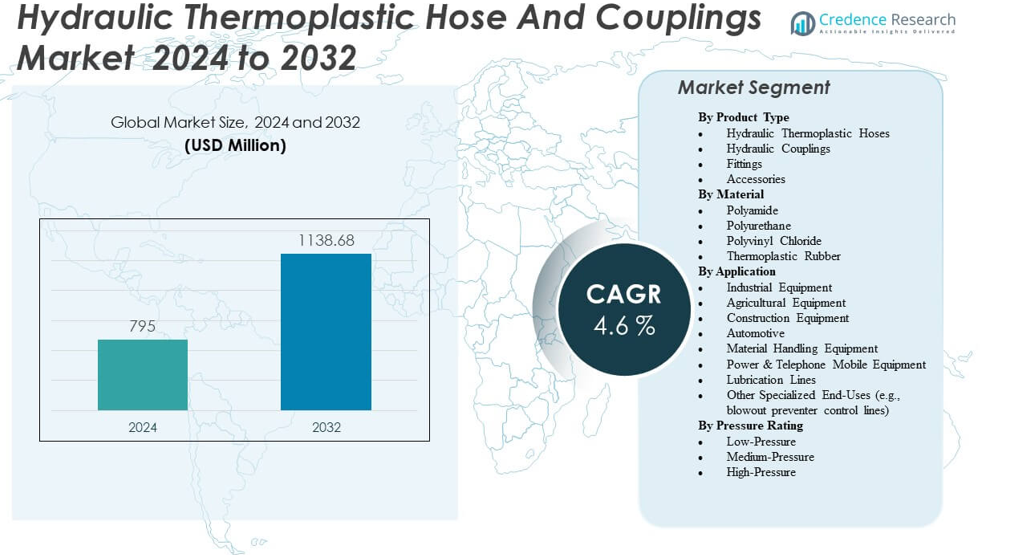
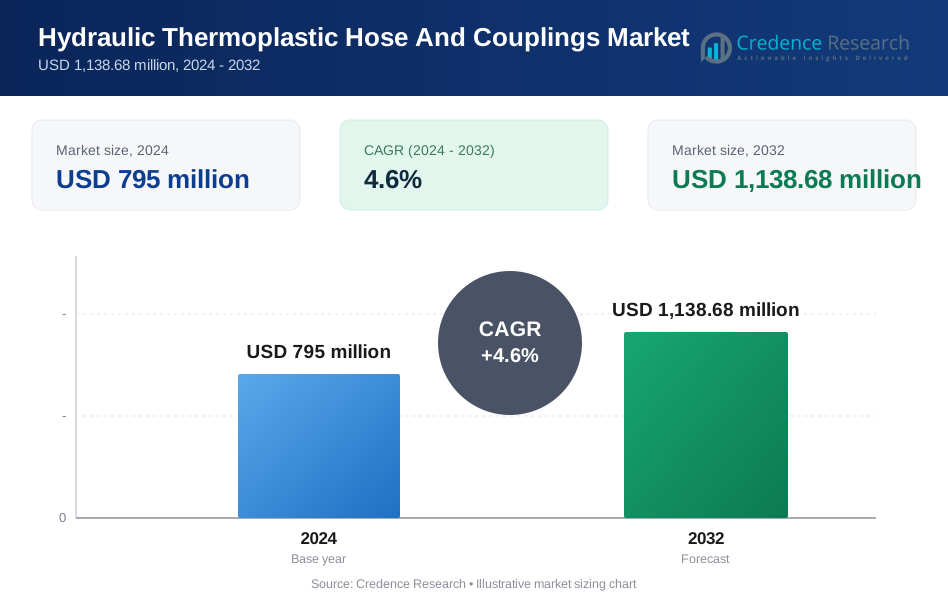
The Hydraulic Thermoplastic Hose and Couplings Market is projected to grow from USD 795 million in 2024 to an estimated USD 1,138.68 million by 2032, with a compound annual growth rate (CAGR) of 4.6% from 2024 to 2032.
| REPORT ATTRIBUTE | DETAILS |
|---|---|
| Historical Period | 2020-2023 |
| Base Year | 2024 |
| Forecast Period | 2025-2032 |
| Hydraulic Thermoplastic Hose and Couplings Market Size 2024 | USD 795 million |
| Hydraulic Thermoplastic Hose and Couplings Market, CAGR | 4.6% |
| Hydraulic Thermoplastic Hose and Couplings Market Size 2032 | USD 1,138.68 million |
The growth of the Hydraulic Thermoplastic Hose and Couplings Market is driven by increasing demand for durable, high-performance hydraulic components across industries such as construction, agriculture, and automotive. The need for lightweight, flexible, and environmentally friendly hydraulic hoses is also fueling this demand. As industries continue to modernize their equipment and embrace automation, the market for advanced hose solutions is expected to expand, with thermoplastic hoses offering superior resistance to wear, temperature, and chemical exposure.
Regionally, North America and Europe dominate the Hydraulic Thermoplastic Hose and Couplings Market due to their mature industrial sectors and high demand for hydraulic systems in manufacturing and construction. North America, led by the United States, benefits from technological advancements and strong regulatory frameworks that promote high-quality hydraulic components. Asia-Pacific is emerging as a high-growth region, driven by rapid industrialization in countries like China and India, where infrastructure development and agricultural mechanization are expanding rapidly.
Market Insights:
- The Hydraulic Thermoplastic Hose and Couplings Market is projected to grow from USD 795 million in 2024 to USD 1,138.68 million by 2032, with a CAGR of 4.6%.
- Increasing demand for durable and flexible hoses across industries like construction, agriculture, and automotive is driving market growth.
- Technological advancements in material science are enhancing the performance of thermoplastic hoses, making them more durable and resistant to wear.
- Rising adoption of hydraulic systems in industrial automation and heavy machinery applications is further boosting the market.
- However, competition from alternative materials like rubber and metal hoses could challenge market expansion.
- North America and Europe lead the market, benefiting from strong industrial sectors and regulatory standards.
- Asia-Pacific is emerging as a high-growth region, driven by rapid industrialization and infrastructure development in countries like China and India.
Market Drivers:
Growing Adoption Across Various Industries
The Hydraulic Thermoplastic Hose And Couplings Market benefits from increasing demand in industries requiring high-performance hydraulic systems. Industries such as construction, agriculture, and oil & gas rely heavily on advanced hydraulic hoses for fluid transfer applications. These hoses offer superior durability and chemical resistance compared to traditional rubber hoses. End-users are shifting to thermoplastic hoses for their lightweight nature and long-term cost-effectiveness. The demand for more efficient, environmentally friendly, and safer fluid transfer systems propels market growth. As these industries modernize and adopt advanced technologies, hydraulic thermoplastic solutions are expected to play an essential role in improving machinery performance.
Technological Advancements in Hydraulic Systems
Technological developments in hydraulic systems drive the growth of the Hydraulic Thermoplastic Hose And Couplings Market. Manufacturers are integrating digital technologies such as sensors and predictive maintenance into hydraulic systems. These advancements require hoses and couplings with higher pressure tolerance and enhanced performance. Thermoplastic hoses meet these demands, offering better flexibility, high resistance to abrasions, and extended service life. Their ability to function effectively in extreme conditions makes them a top choice for new machinery and retrofitting existing systems. The continued progress in automation and machinery technology further boosts the market's growth potential.
- For instance, Eaton’s LifeSense hose technology integrates advanced sensors to monitor hose health in real time, reducing hose-related downtime by up to 50% in manufacturing plants. These innovations drive the demand for hoses with higher pressure tolerance and enhanced performance, supporting greater operational efficiency across industries.
Rising Infrastructure and Construction Investments
The Hydraulic Thermoplastic Hose And Couplings Market is poised for growth due to significant infrastructure development and construction investments worldwide. Governments and private enterprises are prioritizing large-scale projects, including transportation, energy, and urban development. As heavy machinery and construction vehicles become increasingly integral to these projects, there is a higher demand for durable hydraulic systems. These systems rely on thermoplastic hoses that can handle high pressures and environmental stress. The need for efficient, long-lasting components in critical machinery directly impacts the increasing demand for hydraulic hoses and couplings.
Regulatory Pressure and Safety Standards
Regulatory changes are driving the growth of the Hydraulic Thermoplastic Hose And Couplings Market. Governments worldwide are enforcing stricter regulations on fluid systems, especially in industries such as mining, construction, and manufacturing. These industries face heightened scrutiny regarding safety standards and environmental impact. Thermoplastic hoses, with their enhanced safety features and environmental benefits, are being adopted to meet these regulations. The demand for compliance with global standards has prompted industries to upgrade their hydraulic systems, creating a significant market opportunity for thermoplastic hose manufacturers.
- For instance, Polyhose’s PH149 SAE 100R8 thermoplastic hose is specified for high-pressure lines at 100–420 bar with aramid-fiber reinforcement and a −40 °C to +100 °C range, fitting safety-critical applications in regulated environments.
Market Trends:
Shift Toward Lightweight Hydraulic Solutions
The demand for lightweight hydraulic components is a key trend in the Hydraulic Thermoplastic Hose And Couplings Market. Lightweight hoses improve fuel efficiency and reduce the overall weight of machinery, contributing to higher operational efficiency. These products are being increasingly adopted in industries such as automotive, construction, and agriculture, where reducing weight plays a crucial role in enhancing machine performance. Thermoplastic hoses are gaining popularity due to their ability to deliver high performance while maintaining a low weight. This trend is pushing manufacturers to design lighter yet stronger hoses that offer better flexibility and durability.
Integration of Smart and IoT Capabilities
The integration of smart features and Internet of Things (IoT) technology is influencing the Hydraulic Thermoplastic Hose And Couplings Market. Hydraulic systems are now incorporating sensors and smart components that allow for real-time monitoring of system performance. These innovations help predict maintenance needs, reduce downtime, and enhance efficiency. Thermoplastic hoses equipped with these capabilities offer enhanced functionality, including monitoring pressure, temperature, and wear levels. The growing adoption of connected technologies is expected to continue driving demand for high-performance hoses that integrate seamlessly into smart hydraulic systems.
Increased Focus on Sustainability and Eco-Friendly Materials
Sustainability has become a prominent trend in the Hydraulic Thermoplastic Hose And Couplings Market, with manufacturers focusing on producing eco-friendly hoses and couplings. As industries strive to meet sustainability targets, thermoplastic hoses, which offer recyclability and reduced environmental impact, are gaining traction. These materials are being favored over traditional rubber-based solutions, which are less environmentally friendly. With growing concerns about environmental regulations and corporate social responsibility, the demand for greener hydraulic components is expected to rise, presenting opportunities for companies investing in sustainable solutions.
- Manuli Hydraulics, for instance, launched a new range of thermoplastic hoses made from recyclable materials, aligning with global sustainability goals while maintaining superior performance in high-pressure applications, particularly in mining and construction.
Customization and Tailored Solutions for Specific Applications
Another notable trend in the Hydraulic Thermoplastic Hose And Couplings Market is the increasing demand for customized hoses that meet the unique needs of specific industries. As industries diversify and develop more complex machinery, there is a greater need for hoses and couplings tailored to particular environmental and operational conditions. Manufacturers are responding by offering specialized hoses designed for high-pressure, high-temperature, or corrosive environments. This trend is particularly evident in sectors like aerospace, automotive, and offshore oil & gas, where standard hoses may not meet performance requirements. Customization is becoming a key differentiator for suppliers in the competitive landscape.
- For instance, Polyhose is a renowned manufacturer of thermoplastic and ultra-high-pressure hoses used in demanding industries like oil and gas. The company provides high-performance hydraulic solutions that meet the stringent requirements of various sectors, including offshore and drilling operations.
Market Challenges Analysis:
Pressure to Maintain Performance Standards
One of the significant challenges in the Hydraulic Thermoplastic Hose And Couplings Market is the need to maintain consistent performance standards. As applications in sectors like oil & gas, construction, and automotive become more demanding, the required quality of hydraulic hoses becomes increasingly stringent. Thermoplastic hoses must perform effectively under extreme pressure, temperature fluctuations, and environmental stresses. Ensuring that these products maintain reliability over extended periods, while still meeting safety and performance standards, is a challenge for manufacturers. Failure to meet these expectations can result in costly downtime and increased maintenance costs, which pose risks to market growth.
Competition from Alternative Solutions
The Hydraulic Thermoplastic Hose And Couplings Market faces competition from alternative materials and technologies that offer similar benefits. Rubber, metal, and other composite hoses continue to serve as viable alternatives in certain applications. Despite the growing preference for thermoplastic solutions, some industries remain hesitant to adopt new materials due to concerns about compatibility, initial costs, and lack of familiarity with the technology. Manufacturers must continuously innovate to differentiate their thermoplastic hoses, providing better performance, cost-efficiency, and long-term benefits to outpace the competition and gain wider acceptance.
Market Opportunities:
Expansion in Emerging Economies
Emerging economies present significant growth opportunities for the Hydraulic Thermoplastic Hose And Couplings Market. Rapid industrialization in regions such as Asia-Pacific, Latin America, and the Middle East is fueling the demand for advanced hydraulic systems in various industries, including manufacturing, agriculture, and construction. As these economies continue to expand, the need for efficient, cost-effective, and durable hydraulic components will grow. Thermoplastic hoses, with their ability to provide high performance and reliability at lower costs, position themselves as an ideal solution for these developing markets. This presents a promising opportunity for manufacturers to expand their market share in these high-growth regions.
Technological Innovation Driving New Applications
Advancements in material science and manufacturing processes are opening new applications for hydraulic thermoplastic hoses. Ongoing research is leading to the development of more advanced, high-performance materials that can withstand even more extreme environments. The ability to create hoses that can operate in higher-pressure, higher-temperature conditions opens up opportunities in sectors like aerospace, defense, and offshore drilling. Furthermore, the integration of IoT and smart technologies into hydraulic systems is driving demand for hoses that support real-time monitoring and predictive maintenance. This trend offers opportunities for companies to develop next-generation hydraulic hoses and couplings that meet the evolving needs of high-tech industries.
Market Segmentation Analysis:
By Product Type
The Hydraulic Thermoplastic Hose And Couplings Market is segmented into hydraulic thermoplastic hoses, hydraulic couplings, fittings, and accessories. Hydraulic thermoplastic hoses dominate the market due to their durability, flexibility, and resistance to abrasion, making them essential for fluid transfer systems in various industries. Hydraulic couplings and fittings play a critical role in connecting hoses and ensuring leak-free, secure operations. Accessories complement these products by offering additional features such as protection against mechanical damage. The increasing demand for high-performance hydraulic systems across industries further drives growth in this segment.
- For instance, Parker Hannifin’s TOUGHJACKET hose line includes a hose designed to withstand over 650,000 abrasion cycles in the ASTM D 6037 test, representing a significant improvement over standard hose wear-cycle performance for extreme environments.
By Material
The materials used in hydraulic thermoplastic hoses are crucial to their performance. The market is segmented into polyamide, polyurethane, polyvinyl chloride (PVC), and thermoplastic rubber. Polyamide hoses are highly resistant to wear, offering long service life in harsh conditions. Polyurethane hoses are valued for their high flexibility and resistance to abrasion. PVC, though more affordable, provides good chemical resistance for various applications. Thermoplastic rubber combines the benefits of both rubber and plastic, offering excellent performance in dynamic applications. Each material type caters to specific industry needs, influencing the market’s expansion.
- For instance, Eaton announced in 2023 that its Synflex thermoplastic hydraulic hoses made from specially engineered polyamide blends can operate continuously at temperatures up to 100°C and achieve a bend radius as tight as 51 mm for the 3/8-inch size, enabling efficient use in compact industrial installations.
By Application
The application segment of the Hydraulic Thermoplastic Hose And Couplings Market covers a wide range of industries, including industrial equipment, agricultural equipment, construction equipment, automotive, material handling, power & telephone mobile equipment, lubrication lines, and other specialized end-uses. Industrial and construction equipment require high-pressure hoses for efficient operations, driving significant demand. Agricultural and automotive sectors rely on flexible, durable hoses for machinery that must withstand challenging environments. The specialization of end-uses, such as blowout preventer control lines in the oil and gas industry, also presents unique opportunities for market growth.
By Pressure Rating
The pressure rating segment of the Hydraulic Thermoplastic Hose And Couplings Market is categorized into low-pressure, medium-pressure, and high-pressure hoses. Low-pressure hoses are used in applications where fluid transfer occurs at lower pressures, offering cost-effective solutions for light-duty systems. Medium-pressure hoses are commonly used in agricultural and industrial machinery. High-pressure hoses are essential in demanding environments like construction, automotive, and power equipment. As industries continue to adopt more sophisticated machinery and systems, the demand for high-pressure hydraulic solutions grows, further expanding this segment.
Segmentation:
By Product Type
- Hydraulic Thermoplastic Hoses
- Hydraulic Couplings
- Fittings
- Accessories
By Material
- Polyamide
- Polyurethane
- Polyvinyl Chloride
- Thermoplastic Rubber
By Application
- Industrial Equipment
- Agricultural Equipment
- Construction Equipment
- Automotive
- Material Handling Equipment
- Power & Telephone Mobile Equipment
- Lubrication Lines
- Other Specialized End-Uses (e.g., blowout preventer control lines)
By Pressure Rating
- Low-Pressure
- Medium-Pressure
- High-Pressure
By Region
- North America
- U.S.
- Canada
- Mexico
- Europe
- Germany
- France
- U.K.
- Italy
- Spain
- Rest of Europe
- Asia Pacific
- China
- Japan
- India
- South Korea
- South-east Asia
- Rest of Asia Pacific
- Latin America
- Brazil
- Argentina
- Rest of Latin America
- Middle East & Africa
- GCC Countries
- South Africa
- Rest of the Middle East and Africa
Regional Analysis:
The Hydraulic Thermoplastic Hose and Couplings Market in North America holds approximately 38% of the global market share, driven by well‑established manufacturing infrastructure, high demand in construction and agriculture equipment sectors, and strong industrial service networks. It benefits from advanced technology adoption and frequent replacement cycles of hydraulic systems in heavy machinery. The United States serves as a major contributor, supported by stable capital goods spending and regulatory incentives. The presence of leading hose and coupling manufacturers further strengthens the regional market.
In Europe, the market commands around 27% share, thanks to strict safety and environmental regulations, high automation levels in manufacturing, and strong demand from automotive and construction equipment sectors. Suppliers meet rigorous standards for fluid transfer systems, which drives demand for advanced thermoplastic hose solutions. The region’s emphasis on sustainability and light‑weight components also supports its steady growth trend. Leading European countries include Germany, France and Italy where heavy industry remains active.
The Asia‑Pacific region accounts for about 35% share and exhibits the fastest growth profile due to rapid industrialisation, infrastructure development and expansion of agriculture mechanisation in countries such as China and India. It benefits from large volumes of construction machinery and mobile equipment procurement. While Middle East & Africa and Latin America hold smaller shares under 10%, they offer emerging opportunities tied to mining, oil & gas and resource‑based infrastructure projects.
Key Player Analysis:
- Parker Hannifin Corporation
- Gates Corporation
- Eaton Corporation
- Continental AG
- Manuli Hydraulics
- Trelleborg AB
- Alfagomma S.p.A.
- Kurt Hydraulics
- Polyhose India Pvt. Ltd.
- Ryco Hydraulics
- Saint-Gobain
- Piranha Hose Products, Inc.
- Semperit AG
- Dunlop Hiflex
- NRP Jones
Competitive Analysis:
The Hydraulic Thermoplastic Hose and Couplings Market features multiple global players competing across material innovation, distribution reach and service support. Key companies such as Parker Hannifin Corporation, Gates Corporation, and Eaton Corporation lead through strong R&D investments and broad product portfolios. These firms emphasise quality, customized solutions and global service networks. Mid‑tier and regional players also compete aggressively on cost and local responsiveness. Competitive intensity remains high, with firms differentiating through material advances, high‑performance ratings and aftermarket support. As manufacturers focus on expanding their market share, partnerships, acquisitions, and geographic expansion are common strategies to strengthen their presence. Ongoing product development and technological enhancements also play a crucial role in maintaining competitive advantage in this growing market.
Recent Developments:
- In November 2025, Danfoss Power Solutions entered into an agreement to acquire Hydro Holding Spa, a premier manufacturer of hose fittings headquartered in Castello d’Argile, Italy. Hydro Holding will integrate into Danfoss Power Solutions’ Fluid Conveyance division, expanding the company’s hose fittings portfolio and bolstering its position in the European market.
Report Coverage:
The research report offers an in-depth analysis based on Product Type, Material, Application and Pressure Rating. It details leading market players, providing an overview of their business, product offerings, investments, revenue streams, and key applications. Additionally, the report includes insights into the competitive environment, SWOT analysis, current market trends, as well as the primary drivers and constraints. Furthermore, it discusses various factors that have driven market expansion in recent years. The report also explores market dynamics, regulatory scenarios, and technological advancements that are shaping the industry. It assesses the impact of external factors and global economic changes on market growth. Lastly, it provides strategic recommendations for new entrants and established companies to navigate the complexities of the market.
Future Outlook:
- Continued demand for lightweight, durable hoses in various industries will drive market growth.
- The push for increased industrial automation will expand the need for high-performance hydraulic systems.
- Technological advancements in material science will enhance the capabilities of thermoplastic hoses.
- Growth in construction and agricultural machinery sectors will fuel demand for hydraulic hoses.
- Environmental regulations will encourage the adoption of eco-friendly, recyclable hydraulic solutions.
- The integration of IoT and smart technology in hydraulic systems will create new opportunities for hose manufacturers.
- The expansion of manufacturing operations in emerging economies will increase market penetration.
- Strategic mergers and acquisitions among key players will lead to a more consolidated market.
- There will be a rise in demand for customized solutions catering to specific industrial needs.
- Continued investments in R&D will result in more efficient, cost-effective hydraulic hose products.
Request a Free Sample
Fill in your details and we'll send you a free sample report.
- Sample data tables & charts
- Research methodology
Need a Custom Version of This Report?
Tailor the scope, geography, or segments to your exact requirements.
- Custom geography or segment scope
- Direct access to our analyst team
Frequently Asked Questions
What is the current market size for the Hydraulic Thermoplastic Hose And Couplings Market, and what is its projected size in 2032?
At what Compound Annual Growth Rate is the Hydraulic Thermoplastic Hose And Couplings Market projected to grow between 2024 and 2032?
Which Hydraulic Thermoplastic Hose And Couplings Market segment held the largest share in 2024?
What are the primary factors fueling the growth of the Hydraulic Thermoplastic Hose And Couplings Market?
Who are the major players in this market?
Table of Content
Chapter 1. Report Introduction
- 1.1 Report Description & Purpose
- 1.1.1 Report Title & Market Definition
- 1.1.2 Unique Selling Propositions (USP) & Key Differentiators
- 1.1.3 Value Proposition for Stakeholders
- 1.2 Research Objectives
- 1.2.1 Market Sizing Objectives (Volume & Revenue)
- 1.2.2 Segmentation Objectives
- 1.2.3 Competitive Intelligence Objectives
- 1.2.4 Forecast & Scenario Objectives
- 1.3 Report Scope
- 1.3.1 Hydraulic Thermoplastic Hose And Couplings Scope – Types & Subtypes Covered
- 1.3.2 Geographic Scope – Regions & Countries Covered
- 1.3.3 Historical Period, Base Year & Forecast Period (2024; forecast to 2032)
- 1.3.4 Inclusions & Exclusions
- 1.4 HS Code & Classification Framework
- 1.5 Currency, Units & Pricing Basis
- 1.6 Target Stakeholders
- 1.7 Limitations & Assumptions
Chapter 2. Executive Summary
- 2.1 Global Hydraulic Thermoplastic Hose And Couplings Market Snapshot
- 2.1.1 Market Size – Historical (2024) & Forecast (2024-2032) (2024: USD 795 million → 2032: USD 1,138.68 million)
- 2.1.2 Volume & Revenue – Global Totals
- 2.1.3 Key Market Highlights – Top Five Facts
- 2.2 Hydraulic Thermoplastic Hose And Couplings Market Segmentation Snapshot
- 2.2.1 Market Split by Region – 2024 vs. 2032
- 2.3 Competitive Snapshot
- 2.3.1 Top 10 Players by Revenue Share – 2024
- 2.3.2 Top 10 Players by Volume Share – 2024
- 2.3.3 Recent Strategic Developments (18-Month Summary)
- 2.4 Key Investment Highlights & Strategic Conclusions
Chapter 3. Hydraulic Thermoplastic Hose And Couplings Market Dynamics & Industry Analysis
- 3.1 Market Overview & Context
- 3.1.1 Hydraulic Thermoplastic Hose And Couplings Market Position in the Broader Automotive Value Chain
- 3.1.2 OEM vs. Replacement Market Dynamics
- 3.1.3 Market Maturity & Development Stage by Region
- 3.2 Hydraulic Thermoplastic Hose And Couplings Market Drivers
- 3.3 Hydraulic Thermoplastic Hose And Couplings Market Restraints & Challenges
- 3.4 Hydraulic Thermoplastic Hose And Couplings Market Opportunities
- 3.5 Porter's Five Forces Analysis
- 3.5.1 Threat of New Entrants
- 3.5.2 Bargaining Power of Suppliers
- 3.5.3 Bargaining Power of Buyers
- 3.5.4 Threat of Substitutes
- 3.5.5 Competitive Rivalry – Intensity Assessment
- 3.6 Hydraulic Thermoplastic Hose And Couplings Value Chain Analysis
- 3.6.1 Upstream – Raw Material/Input Suppliers
- 3.6.1.1 Raw Material/Input 1
- 3.6.1.2 Raw Material/Input 2
- 3.6.1.3 Raw Material/Input 3
- 3.6.2 Midstream – Production/Manufacturing/Service Delivery
- 3.6.2.1 Production/Process Overview
- 3.6.2.2 Key Facility Locations & Capacity by Manufacturer
- 3.6.3 Downstream – Distribution & End Consumer
- 3.6.3.1 Primary Channel – B2B/OEM
- 3.6.3.2 Secondary Channels – Dealer, Retail, Online, Direct
- 3.6.4 Value Chain Profitability Analysis
- 3.6.1 Upstream – Raw Material/Input Suppliers
- 3.7 PESTEL Analysis
- 3.7.1 Political Factors
- 3.7.2 Economic Factors
- 3.7.3 Social Factors
- 3.7.4 Technological Factors
- 3.7.5 Environmental Factors
- 3.7.6 Legal Factors
- 3.8 Hydraulic Thermoplastic Hose And Couplings Supply Chain Analysis
- 3.8.1 Raw Material/Input Supply Risk Assessment
- 3.8.2 Manufacturing Concentration Risk (Geographic Exposure)
- 3.8.3 Trade Disruption Impact Analysis
- 3.9 Regulatory & Policy Landscape
Note: The regulatory and policy landscape section covers regulations based on their applicability to the market, Hydraulic Thermoplastic Hose And Couplings category, geography, and scope of the study. Only regulatory frameworks with a material impact on operations, compliance, trade, sustainability, or market access are analyzed in detail.
Chapter 4. Key Investment Pockets & Opportunity Analysis
- 4.1 Hydraulic Thermoplastic Hose And Couplings Market Attractiveness Analysis
- 4.1.1 By Region – Investment Attractiveness Matrix (Volume × CAGR)
- 4.2 Absolute Revenue Growth Opportunity
- 4.2.1 By Region – Absolute USD Growth Through 2032
- 4.3 Incremental Volume Opportunity
- 4.3.1 By Region – Incremental Volume Through 2032
- 4.3.2 Segment – Incremental Volume
- 4.4 Emerging Submarket Opportunity Deep Dive (Subject to Applicability)
- 4.5 Emerging Market Opportunity Scorecards
- 4.5.1 United States
- 4.5.2 Europe
- 4.5.3 Asia
- 4.5.4 Middle East & Africa
Note: Emerging Market Opportunity Scorecards will be included based on relevance and strategic importance. Regions listed are indicative and may vary depending on data availability and market dynamics.
Chapter 5. Hydraulic Thermoplastic Hose And Couplings Import-Export Analysis & Trade Flows
- 5.1 Global Trade Overview
- 5.1.1 Global Export Value by Country (2024)
- 5.1.2 Global Export Volume by Country (2024)
- 5.1.3 Global Import Value by Country (2024)
- 5.1.4 Global Import Volume by Country (2024)
- 5.1.5 Net Trade Balance by Country (2024)
- 5.2 Export Analysis – Segment
- 5.2.1 Type 1 (HS Code)
- 5.2.2 Type 2 (HS Code)
- 5.2.3 Type 3 (HS Code)
- 5.2.4 Type 4 (HS Code)
- 5.2.5 Type 5 (HS Code)
- 5.3 Import Analysis – Segment
- 5.3.1 Type 1 (HS Code)
- 5.3.2 Type 2 (HS Code)
- 5.3.3 Type 3 (HS Code)
- 5.3.4 Type 4 (HS Code)
- 5.3.5 Type 5 (HS Code)
- 5.4 Average Unit Trade Prices
- 5.4.1 Average Export Price – Segment & Country
- 5.4.2 Average Import Price – Segment & Source Country
- 5.4.3 Price Trends (2024)
- 5.5 Key Trade Route Analysis
- 5.5.1 Trade Route 1
- 5.5.2 Trade Route 2
- 5.5.3 Trade Route 3
- 5.5.4 Trade Route 4
- 5.5.5 Trade Route 5
- 5.6 Trade Policy Impact Assessment
- 5.6.1 US Anti-Dumping & Section 301 Tariffs
- 5.6.2 EU Customs Union Impact
- 5.6.3 Major Free Trade Agreements
- 5.6.4 USMCA Rules of Origin
Note: Trade policy analysis will be included only where relevant to the Hydraulic Thermoplastic Hose And Couplings market.
Chapter 6. Competitive Landscape & Company Benchmarking
- 6.1 Hydraulic Thermoplastic Hose And Couplings Market Concentration & Structure
- 6.1.1 Herfindahl-Hirschman Index (HHI) – vs. 2024
- 6.1.2 Tier 1, Tier 2 & Tier 3 Market Structure
- 6.1.3 Global, Regional & Local Player Dynamics
- 6.2 Hydraulic Thermoplastic Hose And Couplings Market Share Analysis – 2024
- 6.2.1 Global Revenue Share by Company
- 6.2.2 Global Volume Share by Company
- 6.2.3 Regional Revenue Share
- 6.2.4 Market Share Evolution ( vs. 2024)
- 6.2.5 OEM Segment Share by Company
- 6.2.6 Replacement Segment Share by Company
- 6.3 Production/Delivery Capacity & Facility Analysis
- 6.3.1 Global Installed Capacity
- 6.3.2 Capacity Utilization Rates
- 6.3.3 Production/Output Volume
- 6.3.4 Facility Locations & Capacity Map
- 6.3.5 Planned Capacity Additions
- 6.4 Hydraulic Thermoplastic Hose And Couplings Competitive Benchmarking Matrix
- 6.4.1 Revenue, Volume, CAGR & Profitability Comparison
- 6.4.2 Channel Revenue Mix
- 6.4.3 Geographic Revenue Exposure
- 6.4.4 R&D Intensity
- 6.4.5 Sustainability Maturity
- 6.5 Strategic Developments in Hydraulic Thermoplastic Hose And Couplings (Last 24 Months)
- 6.5.1 Mergers, Acquisitions & Divestments
- 6.5.2 New Hydraulic Thermoplastic Hose And Couplings Launches
- 6.5.3 Facility Expansions
- 6.5.4 Strategic Alliances, Joint Ventures & Partnerships
- 6.5.5 Distribution Expansion & Market Entry
- 6.5.6 Sustainability & ESG Initiatives
- 6.6 Competitive Strategy Mapping
- 6.6.1 Leader, Challenger, Follower & Niche Classification
- 6.6.2 Pricing Strategy Comparison
- 6.6.3 Channel Strategy Matrix
Note: Strategic developments are included based on their materiality and the availability of reliable information.
Chapter 7. Global Hydraulic Thermoplastic Hose And Couplings Market – By Distribution Channel
- 7.1 Segment Overview
- 7.1.1 Volume & Revenue Split by Channel (2024 & 2032)
- 7.1.2 Channel Mix Evolution (2024-2032)
Chapter 8. Regional Market Analysis – Global Overview
- 8.1 Global Regional Overview
- 8.1.1 Regional Volume Share
- 8.1.2 Regional Revenue Share
- 8.1.3 Regional Volume by Region
- 8.1.4 Regional Revenue by Region
- 8.1.5 Regional Forecast Through 2032
- 8.2 Cross-Regional Segment Analysis
- 8.2.1 By Distribution Channel
- 8.2.2 By Brand/Price Tier
Chapter 9. North America Hydraulic Thermoplastic Hose And Couplings Market
- 9.1 United States
- 9.2 Canada
- 9.3 Mexico
Chapter 10. Europe Hydraulic Thermoplastic Hose And Couplings Market
- 10.1 Germany
- 10.2 France
- 10.3 Italy
- 10.4 United Kingdom
- 10.5 Spain
- 10.6 Poland
- 10.7 Russia
- 10.8 Netherlands
- 10.9 Belgium
- 10.10 Sweden
- 10.11 Denmark
- 10.12 Norway
- 10.13 Rest of Europe
Chapter 11. Asia Pacific Hydraulic Thermoplastic Hose And Couplings Market
- 11.1 China
- 11.2 India
- 11.3 Japan
- 11.4 South Korea
- 11.5 Thailand
- 11.6 Indonesia
- 11.7 Vietnam
- 11.8 Malaysia
- 11.9 Australia
- 11.10 Rest of Asia Pacific
Chapter 12. Latin America Hydraulic Thermoplastic Hose And Couplings Market
- 12.1 Brazil
- 12.2 Argentina
- 12.3 Colombia
- 12.4 Chile
- 12.5 Rest of Latin America
Chapter 13. Middle East Hydraulic Thermoplastic Hose And Couplings Market
- 13.1 Saudi Arabia
- 13.2 United Arab Emirates
- 13.3 Turkey
- 13.4 Israel
- 13.5 Iran
- 13.6 Rest of the Middle East
Chapter 14. Africa Hydraulic Thermoplastic Hose And Couplings Market
- 14.1 South Africa
- 14.2 Egypt
- 14.3 Nigeria
- 14.4 Morocco
- 14.5 Rest of Africa
Chapter 15. Hydraulic Thermoplastic Hose And Couplings Company Profiles
- 15.1 [Company 01]
- 15.1.1 Company Overview
- 15.1.2 Key Management Personnel
- 15.1.3 Products & Services Portfolio
- 15.1.4 Financial Performance
- 15.1.5 Key Market Focus & Geographic Presence
- 15.1.6 Recent Developments & Strategic Initiatives
Note: The company profile list is preliminary and may change based on research findings, market developments, data availability, and client requirements.
Chapter 16. Appendices
- Appendix A – List of Abbreviations & Acronyms
- Appendix B – Industry Classification Code Reference – Full Series
- Appendix C – Production & Capacity Data Tables
- Appendix D – End-Use & Demand Base Tables
- Appendix E – Consumption & Replacement Rate Assumptions
- Appendix F – ASP Reference Tables
- Appendix G – Manufacturing & Facility Database
- Appendix H – Import-Export Data Tables
- Appendix I – Regulatory Summary Tables
- Appendix J – Primary Research Participant List (Anonymized)
- Appendix K – Primary Research Questionnaire Framework
- Appendix L – Data Sources & Bibliography
- Appendix M – Market Size Divergence & Source Comparison
Chapter 17. Research Methodology
- 17.1 Research Framework & Philosophy
- 17.2 Secondary Research – Sources, Hierarchy & Data Extraction
- 17.3 Data Modeling – Bottom-Up & Top-Down Market Sizing
- 17.4 Primary Research – Stakeholder Framework, LOI & Sample Sizes
- 17.5 Forecast Methodology – Regression, Scenario & Sensitivity Analysis
- 17.6 Quality Control – Four-Layer Validation Framework
- 17.7 Limitations & Standard Assumptions
- 17.8 Disclaimer
