
Market Overview:
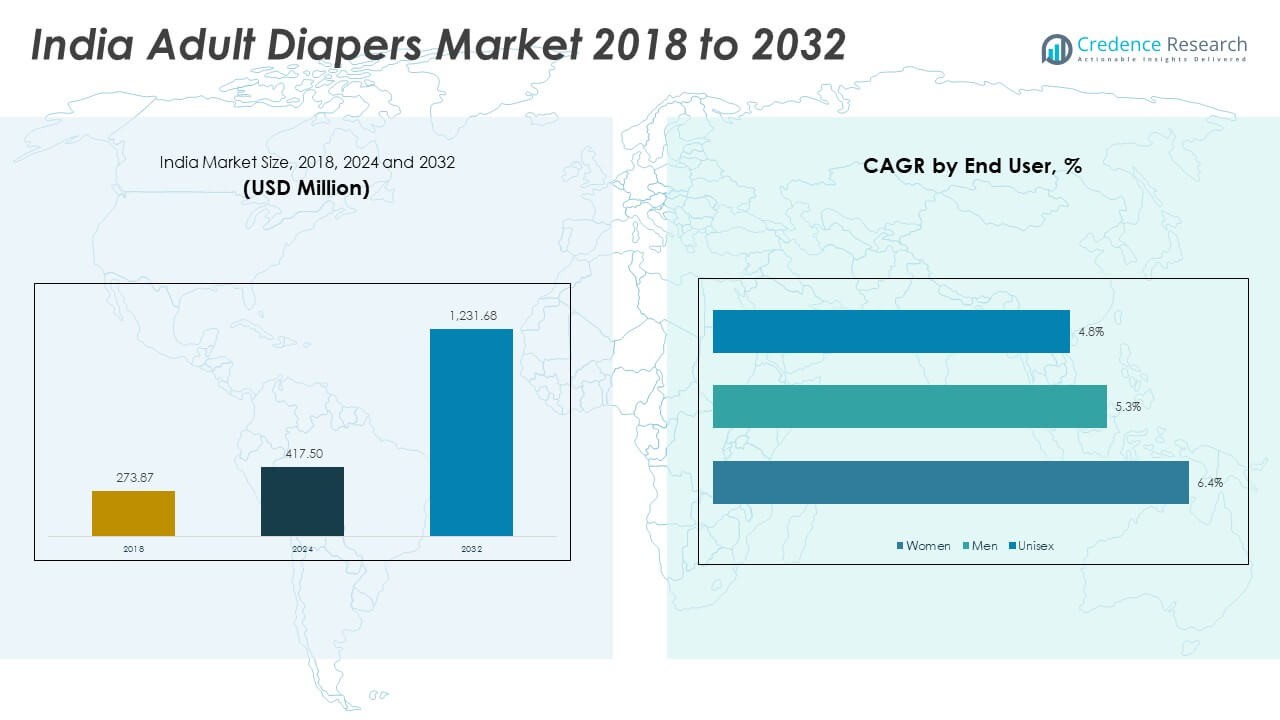
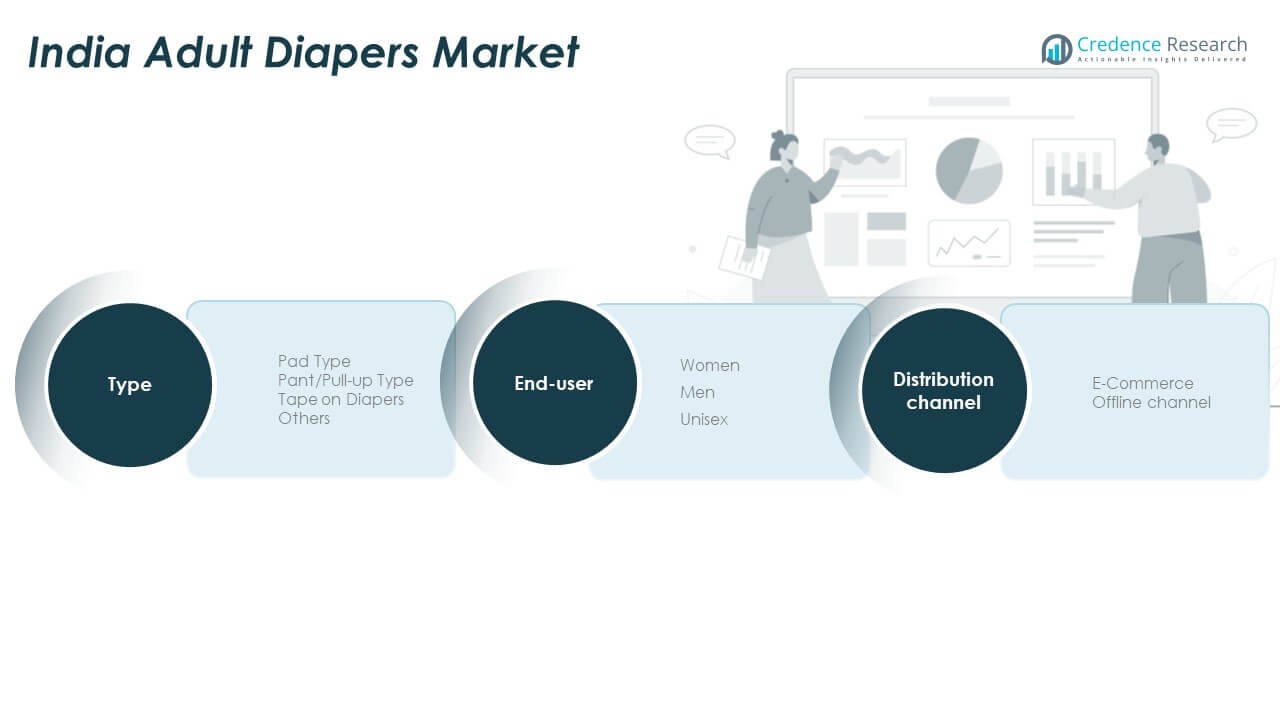
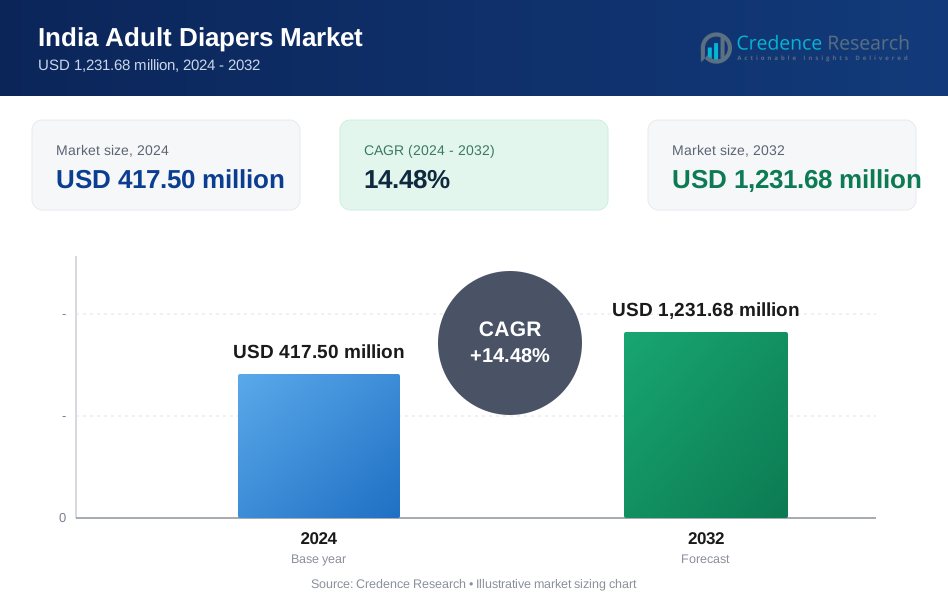
The India Adult Diapers Market size was valued at USD 273.87 million in 2018 to USD 417.50 million in 2024 and is anticipated to reach USD 1,231.68 million by 2032, at a CAGR of 14.48% during the forecast period.
| REPORT ATTRIBUTE | DETAILS |
|---|---|
| Historical Period | 2020-2023 |
| Base Year | 2024 |
| Forecast Period | 2025-2032 |
| India Adult Diapers Market Size 2024 | USD 417.50 Million |
| India Adult Diapers Market, CAGR | 14.48% |
| India Adult Diapers Market Size 2032 | USD 1,231.68 Million |
The market is experiencing strong growth due to rising awareness of elderly care, increasing cases of incontinence, and higher life expectancy. Growing urbanization, lifestyle changes, and improved access to healthcare products have also boosted demand. Manufacturers are focusing on product innovations such as skin-friendly materials, improved absorption capacity, and eco-friendly designs. The stigma around adult diaper use is reducing, leading to higher acceptance across both healthcare institutions and households. Expanding retail and e-commerce distribution further accelerates adoption.
Regionally, metropolitan areas and developed states dominate demand, supported by higher disposable incomes, better healthcare access, and greater awareness. Urban regions lead adoption due to lifestyle shifts and broader availability through organized retail and online platforms. Rural areas, though smaller in share, represent emerging growth opportunities driven by awareness campaigns and improving distribution networks. Increased government focus on elderly healthcare and the rapid rise in aging populations across key states ensure sustained market expansion across both established and developing regions.
Market Insights:
- The India Adult Diapers Market size was USD 273.87 million in 2018, reached USD 417.50 million in 2024, and is projected to hit USD 1,231.68 million by 2032, growing at a CAGR of 14.48%.
- North India led with 30% share in 2024, driven by urban demand and healthcare access; West India followed with 25%, supported by high incomes; South India held 28%, backed by strong hospital and institutional adoption.
- East and Central India, with 17% share in 2024, represent the fastest-growing region due to awareness campaigns, improving distribution, and untapped rural potential.
- Pant/Pull-up type accounted for the largest share in 2024, supported by ease of use, comfort, and discreet design, positioning it as the leading product type.
- Tape-on diapers held a notable share, driven by institutional demand from hospitals and elderly care facilities, while pad type products catered to cost-conscious users seeking lightweight options.
Market Drivers:
Rising Geriatric Population and Increasing Life Expectancy
The India Adult Diapers Market is significantly influenced by the country’s growing elderly population. A steady rise in life expectancy has led to a larger proportion of senior citizens requiring reliable incontinence solutions. With age-related health issues becoming more prevalent, demand for adult diapers has increased sharply. Families and caregivers view adult diapers as essential for enhancing comfort and hygiene in daily living. The healthcare sector actively promotes these products as part of geriatric care routines. Public health campaigns highlight awareness about incontinence, reducing hesitation among users. This demographic transformation forms one of the strongest drivers for the market’s growth.
- For instance, the Indian company Rotech Healthcare Private Limited manufactures the Lyfcare brand of adult diapers, which are designed with features like superior absorption technology and breathable fabric for comfort and fit. This serves the growing demand for adult incontinence products among India's aging population.
Growing Awareness and Acceptance of Hygiene Products
The India Adult Diapers Market benefits from rising awareness regarding personal hygiene and comfort. Educational efforts by healthcare professionals and NGOs have reduced the stigma associated with adult diaper use. Increased exposure to global healthcare practices has encouraged urban populations to adopt these products. Hospital recommendations during post-surgical recovery or chronic illness further drive usage. Caregivers now consider adult diapers as necessary household items for managing elderly care. Acceptance across different socio-economic classes shows a gradual shift in attitudes. Expanding discussions around hygiene and dignity in aging strengthen product adoption across wider demographics.
- For instance, in mid-2023, ADbhoot’s Liberty Adult Diaper marketing campaign effectively reshaped societal perceptions, reaching over 300,000 consumers through healthcare collaborations emphasizing hygiene and independence.
Expansion of Retail and E-Commerce Distribution Networks
The India Adult Diapers Market is expanding through stronger retail channels and online platforms. Organized retail outlets stock a wide range of product options, creating greater visibility. Supermarkets, pharmacies, and specialty stores improve accessibility for caregivers and individuals. E-commerce platforms offer discreet purchase options with doorstep delivery, easing consumer hesitation. Promotional campaigns and subscription models enhance convenience for frequent buyers. Online reviews and product comparisons empower buyers to make informed decisions. This multi-channel distribution network strengthens demand by meeting consumer expectations of availability and privacy.
Product Innovations and Focus on Comfort and Sustainability
The India Adult Diapers Market is witnessing rapid innovation in product design and performance. Manufacturers are introducing skin-friendly materials and advanced absorption technologies. Products are being tailored to reduce odor, provide longer wear time, and improve fit. Eco-friendly alternatives are gaining attention, aligning with consumer demand for sustainable products. Brands highlight features such as breathable fabrics and adjustable sizes to increase comfort. These innovations improve consumer trust and expand the adoption base. Companies that invest in R&D continue to shape the competitive landscape by meeting evolving needs.
Market Trends:
Shifting Consumer Preferences Toward Premium and Customized Products
The India Adult Diapers Market is observing a steady shift toward premium product segments. Consumers increasingly prefer diapers offering higher absorption, better comfort, and discreet design. Customization based on fit, gender, and activity level has grown in demand. Younger caregivers are willing to pay more for products ensuring dignity and convenience. Market leaders introduce premium lines to capture this rising preference. Innovations such as ultra-thin designs and odor-locking layers attract urban buyers. This trend indicates a movement toward value-added offerings rather than basic products.
Integration of Technology in Product Development
The India Adult Diapers Market is incorporating smart features through technological integration. Some advanced products are designed with wetness indicators to alert caregivers. Sensors and connected applications are being explored for hospital and home care. These features improve monitoring and reduce the risk of infections among patients. Hospitals and nursing homes increasingly adopt such solutions for efficiency. Research on using biodegradable super-absorbent polymers supports both performance and sustainability. Technology-driven differentiation helps manufacturers maintain competitiveness in crowded markets. This trend highlights the merging of healthcare innovation with consumer hygiene products.
Marketing Strategies Targeting Urban and Semi-Urban Populations
The India Adult Diapers Market is experiencing aggressive marketing efforts in urban and semi-urban areas. Campaigns emphasize themes of dignity, independence, and convenience in daily living. Television and digital advertising play a key role in shaping consumer attitudes. Celebrities and healthcare experts often endorse products to reduce hesitation. Promotional activities in hospitals and wellness centers increase exposure.
Market Challenges Analysis:
High Cost of Premium Products and Limited Affordability
The India Adult Diapers Market faces challenges due to the high cost of premium products. Many consumers, especially in rural areas, find these products unaffordable. Price-sensitive buyers often rely on cheaper substitutes or restrict their usage. Manufacturers struggle to balance affordability with quality, impacting mass adoption. Hospitals and healthcare providers also face budget constraints, limiting large-scale procurement. While urban customers accept higher prices for comfort and discretion, rural markets demand cost-effective solutions. This price gap creates barriers to equitable adoption across regions.
Social Stigma and Lack of Awareness in Rural Areas
The India Adult Diapers Market encounters resistance in rural areas due to stigma and limited awareness. Many elderly individuals hesitate to adopt diapers, perceiving them as unnecessary or embarrassing. Cultural attitudes reinforce this resistance, especially among lower-income groups. Lack of targeted educational campaigns restricts product acceptance beyond urban hubs. Healthcare providers often underemphasize the role of adult diapers in long-term care. Distribution networks in remote areas also remain weak, reducing accessibility. Without overcoming social taboos, the market cannot fully expand its reach.
Market Opportunities:
Rising Healthcare Infrastructure and Institutional Adoption
The India Adult Diapers Market presents opportunities through expanding healthcare infrastructure and institutional usage. Hospitals, nursing homes, and elderly care facilities increasingly integrate adult diapers into patient management. Government focus on geriatric healthcare creates demand for bulk supply contracts. Organized care centers adopt these products to enhance patient comfort and reduce caregiver workload. The rising number of healthcare facilities in semi-urban areas broadens product penetration. Institutional adoption ensures stable demand and supports long-term market expansion strategies.
Untapped Potential in Rural and Semi-Urban Regions
The India Adult Diapers Market holds strong potential in rural and semi-urban regions. Awareness campaigns led by healthcare providers and NGOs can reduce stigma. Improved distribution networks and affordable product ranges can unlock these markets. Localized marketing tailored to cultural preferences may accelerate acceptance. E-commerce penetration into smaller towns creates access to discreet purchases. Brands that target these regions with affordable and culturally sensitive solutions can secure significant growth. This opportunity highlights the need for inclusive strategies across diverse Indian markets.
Market Segmentation Analysis:
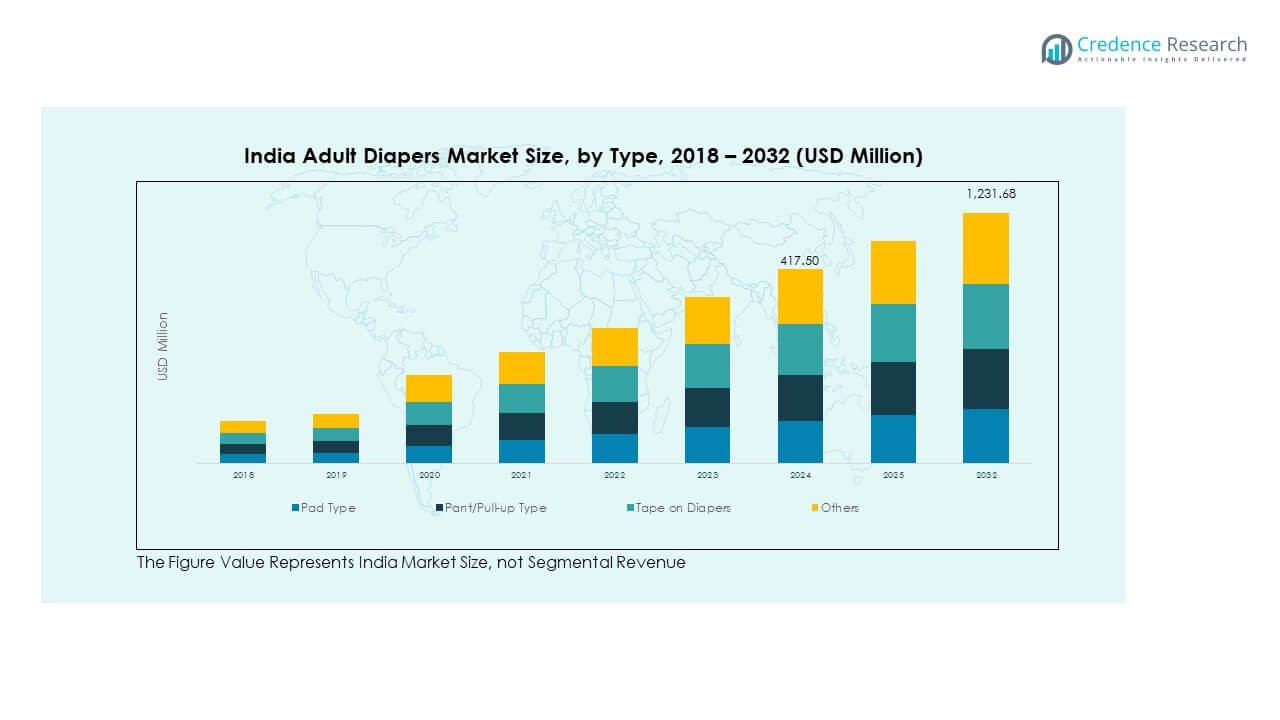
By Type
The India Adult Diapers Market is segmented into pad type, pant/pull-up type, tape-on diapers, and others. Pant/pull-up type dominates demand due to ease of use, comfort, and discreet design. Hospitals and elderly care centers continue to rely on tape-on diapers for patients requiring assistance. Pad type finds traction among cost-conscious buyers and those preferring lightweight options. The “others” category includes hybrid formats gaining niche adoption. Manufacturers emphasize comfort, absorption, and fit to strengthen their type-based offerings.
- For instance, Paramount Surgimed Ltd was awarded BIS certification for disposable adult tape-on diapers in 2022, enhancing hospital adoption through assurance of quality standards.
By End-User
Women, men, and unisex categories define end-user segmentation. Women represent a major share due to higher life expectancy and greater incidence of incontinence. Men contribute steadily with growing awareness and adoption across urban centers. Unisex products address convenience for caregivers and healthcare providers, offering flexible solutions. Companies design gender-specific features to improve comfort and usage experience.
- For instance, BonBon India offers a variety of unisex adult diapers that are sold through online marketplaces and their website. These products are marketed with a focus on high absorption using features like super absorbent polymer and on skin comfort with hypoallergenic materials.
By Distribution Channel
E-commerce and offline channels drive distribution in this market. E-commerce is expanding rapidly with discreet delivery, product variety, and subscription models. Online platforms encourage adoption through targeted marketing and user reviews. Offline channels, including pharmacies, supermarkets, and specialty stores, remain crucial for accessibility and trust. It ensures product availability in both urban and semi-urban regions. The balance of online convenience and offline reach continues to shape consumer choices.
Segmentation:
- By Type
- Pad Type
- Pant/Pull-up Type
- Tape on Diapers
- Others
- By End-User
- Women
- Men
- Unisex
- By Distribution Channel
- E-Commerce
- Offline Channel
Regional Analysis:
North and West India: Established Demand Centers
The India Adult Diapers Market shows strong presence in North and West India, together holding nearly 55% share. North India leads with a high concentration of urban populations, advanced healthcare facilities, and rising geriatric demographics. States such as Delhi, Haryana, and Uttar Pradesh contribute significantly through organized retail and hospital demand. West India, including Maharashtra and Gujarat, benefits from higher disposable incomes and lifestyle awareness. Strong distribution networks and expanding e-commerce adoption support regional dominance. It continues to attract investments from leading brands due to consistent demand growth.
South India: Healthcare and Institutional Growth
South India contributes close to 28% share, supported by advanced healthcare infrastructure and institutional usage. Hospitals and nursing homes across states like Tamil Nadu, Karnataka, and Kerala integrate adult diapers into patient care. Awareness programs in healthcare settings reduce stigma and increase acceptance. High literacy levels support informed purchasing decisions, leading to faster adoption across segments. The region’s organized retail sector further promotes premium offerings. It represents a stable growth hub with strong acceptance across both genders and unisex products.
East and Central India: Emerging Growth Corridors
East and Central India together account for nearly 17% share, with demand steadily increasing. Rising awareness campaigns by healthcare providers and NGOs encourage adoption among elderly populations. Semi-urban and rural markets show potential due to improving distribution networks. Price sensitivity remains a challenge, pushing demand for affordable product variants. States such as West Bengal, Bihar, and Madhya Pradesh are witnessing gradual growth in acceptance. It is expected that continued awareness and affordable solutions will expand the adoption base in these regions.
Key Player Analysis:
- Kimberly-Clark Corporation
- Procter & Gamble Co.
- Unicharm Corporation (Sofy, Lifree)
- Nobel Hygiene Pvt. Ltd. (Friends Adult Diapers)
- Emami Ltd.
- Godrej Consumer Products Ltd.
- Essity Aktiebolag (TENA)
- Daio Paper Corporation
- Hengan International Group Company Limited
- DSG International Public Company Limited
Competitive Analysis:
The India Adult Diapers Market is highly competitive, shaped by both global multinationals and strong domestic players. Leading companies such as Kimberly-Clark, Procter & Gamble, and Unicharm dominate through brand strength and wide distribution. Domestic brands like Nobel Hygiene and Godrej Consumer Products add momentum with affordable and locally tailored products. It reflects a balance of premium and value-driven strategies across urban and semi-urban markets. Companies focus on innovation, skin-friendly materials, and targeted marketing to increase adoption. Expanding e-commerce platforms enhance visibility and customer reach. Competitive intensity continues to rise with sustained investments in product development and distribution.
Recent Developments:
- In February 2025, Unicharm Corporation announced the opening of a third manufacturing facility in India, located in Gujarat, with a $131 million investment. This facility will boost production capacity by 30% for disposable diapers, including adult diapers, expanding Unicharm's footprint in the Indian market and creating approximately 1000 jobs.
Report Coverage:
The research report offers an in-depth analysis based on type, end-user, and distribution channel. It details leading market players, providing an overview of their business, product offerings, investments, revenue streams, and key applications. Additionally, the report includes insights into the competitive environment, SWOT analysis, current market trends, as well as the primary drivers and constraints. Furthermore, it discusses various factors that have driven market expansion in recent years. The report also explores market dynamics, regulatory scenarios, and technological advancements that are shaping the industry. It assesses the impact of external factors and global economic changes on market growth. Lastly, it provides strategic recommendations for new entrants and established companies to navigate the complexities of the market.
Future Outlook:
- Rising geriatric population will remain a primary growth catalyst.
- Awareness campaigns will reduce stigma and accelerate adoption.
- E-commerce will expand with discreet delivery and subscription models.
- Premium and gender-specific diapers will gain stronger acceptance.
- Hospitals and nursing homes will drive institutional demand.
- Product innovation will focus on skin health and eco-friendly materials.
- Urban regions will dominate, while semi-urban areas will show fast growth.
- Competitive intensity will rise with global and domestic brand rivalry.
- Partnerships with pharmacies and healthcare providers will expand distribution.
- Long-term growth will align with lifestyle changes and improved healthcare access.
Request a Free Sample
Fill in your details and we'll send you a free sample report.
- Sample data tables & charts
- Research methodology
Need a Custom Version of This Report?
Tailor the scope, geography, or segments to your exact requirements.
- Custom geography or segment scope
- Direct access to our analyst team
Frequently Asked Questions
What is the current market size for India Adult Diapers Market, and what is its projected size in 2032?
At what Compound Annual Growth Rate is the India Adult Diapers Market projected to grow between 2024 and 2032?
Which India Adult Diapers Market segment held the largest share in 2024?
What are the primary factors fueling the growth of the India Adult Diapers Market?
Who are the leading companies in the India Adult Diapers Market?
Which region commanded the largest share of the India Adult Diapers Market in 2024?
Table of Content
Chapter 1. Report Introduction
- 1.1 Report Description & Purpose
- 1.1.1 Report Title & Market Definition
- 1.1.2 Unique Selling Propositions (USP) & Key Differentiators
- 1.1.3 Value Proposition for Stakeholders
- 1.2 Research Objectives
- 1.2.1 Market Sizing Objectives (Volume & Revenue)
- 1.2.2 Segmentation Objectives
- 1.2.3 Competitive Intelligence Objectives
- 1.2.4 Forecast & Scenario Objectives
- 1.3 Report Scope
- 1.3.1 India Adult Diapers Scope – Types & Subtypes Covered
- 1.3.2 Geographic Scope – Regions & Countries Covered
- 1.3.3 Historical Period, Base Year & Forecast Period (2024; forecast to 2032)
- 1.3.4 Inclusions & Exclusions
- 1.4 HS Code & Classification Framework
- 1.5 Currency, Units & Pricing Basis
- 1.6 Target Stakeholders
- 1.7 Limitations & Assumptions
Chapter 2. Executive Summary
- 2.1 Global India Adult Diapers Market Snapshot
- 2.1.1 Market Size – Historical (2024) & Forecast (2024-2032) (2024: USD 417.50 million → 2032: USD 1,231.68 million)
- 2.1.2 Volume & Revenue – Global Totals
- 2.1.3 Key Market Highlights – Top Five Facts
- 2.2 India Adult Diapers Market Segmentation Snapshot
- 2.2.1 Market Split by Region – 2024 vs. 2032
- 2.3 Competitive Snapshot
- 2.3.1 Top 10 Players by Revenue Share – 2024
- 2.3.2 Top 10 Players by Volume Share – 2024
- 2.3.3 Recent Strategic Developments (18-Month Summary)
- 2.4 Key Investment Highlights & Strategic Conclusions
Chapter 3. India Adult Diapers Market Dynamics & Industry Analysis
- 3.1 Market Overview & Context
- 3.1.1 India Adult Diapers Market Position in the Broader Automotive Value Chain
- 3.1.2 OEM vs. Replacement Market Dynamics
- 3.1.3 Market Maturity & Development Stage by Region
- 3.2 India Adult Diapers Market Drivers
- 3.3 India Adult Diapers Market Restraints & Challenges
- 3.4 India Adult Diapers Market Opportunities
- 3.5 Porter's Five Forces Analysis
- 3.5.1 Threat of New Entrants
- 3.5.2 Bargaining Power of Suppliers
- 3.5.3 Bargaining Power of Buyers
- 3.5.4 Threat of Substitutes
- 3.5.5 Competitive Rivalry – Intensity Assessment
- 3.6 India Adult Diapers Value Chain Analysis
- 3.6.1 Upstream – Raw Material/Input Suppliers
- 3.6.1.1 Raw Material/Input 1
- 3.6.1.2 Raw Material/Input 2
- 3.6.1.3 Raw Material/Input 3
- 3.6.2 Midstream – Production/Manufacturing/Service Delivery
- 3.6.2.1 Production/Process Overview
- 3.6.2.2 Key Facility Locations & Capacity by Manufacturer
- 3.6.3 Downstream – Distribution & End Consumer
- 3.6.3.1 Primary Channel – B2B/OEM
- 3.6.3.2 Secondary Channels – Dealer, Retail, Online, Direct
- 3.6.4 Value Chain Profitability Analysis
- 3.6.1 Upstream – Raw Material/Input Suppliers
- 3.7 PESTEL Analysis
- 3.7.1 Political Factors
- 3.7.2 Economic Factors
- 3.7.3 Social Factors
- 3.7.4 Technological Factors
- 3.7.5 Environmental Factors
- 3.7.6 Legal Factors
- 3.8 India Adult Diapers Supply Chain Analysis
- 3.8.1 Raw Material/Input Supply Risk Assessment
- 3.8.2 Manufacturing Concentration Risk (Geographic Exposure)
- 3.8.3 Trade Disruption Impact Analysis
- 3.9 Regulatory & Policy Landscape
Note: The regulatory and policy landscape section covers regulations based on their applicability to the market, India Adult Diapers category, geography, and scope of the study. Only regulatory frameworks with a material impact on operations, compliance, trade, sustainability, or market access are analyzed in detail.
Chapter 4. Key Investment Pockets & Opportunity Analysis
- 4.1 India Adult Diapers Market Attractiveness Analysis
- 4.1.1 By Region – Investment Attractiveness Matrix (Volume × CAGR)
- 4.2 Absolute Revenue Growth Opportunity
- 4.2.1 By Region – Absolute USD Growth Through 2032
- 4.3 Incremental Volume Opportunity
- 4.3.1 By Region – Incremental Volume Through 2032
- 4.3.2 Segment – Incremental Volume
- 4.4 Emerging Submarket Opportunity Deep Dive (Subject to Applicability)
- 4.5 Emerging Market Opportunity Scorecards
- 4.5.1 United States
- 4.5.2 Europe
- 4.5.3 Asia
- 4.5.4 Middle East & Africa
Note: Emerging Market Opportunity Scorecards will be included based on relevance and strategic importance. Regions listed are indicative and may vary depending on data availability and market dynamics.
Chapter 5. India Adult Diapers Import-Export Analysis & Trade Flows
- 5.1 Global Trade Overview
- 5.1.1 Global Export Value by Country (2024)
- 5.1.2 Global Export Volume by Country (2024)
- 5.1.3 Global Import Value by Country (2024)
- 5.1.4 Global Import Volume by Country (2024)
- 5.1.5 Net Trade Balance by Country (2024)
- 5.2 Export Analysis – Segment
- 5.2.1 Type 1 (HS Code)
- 5.2.2 Type 2 (HS Code)
- 5.2.3 Type 3 (HS Code)
- 5.2.4 Type 4 (HS Code)
- 5.2.5 Type 5 (HS Code)
- 5.3 Import Analysis – Segment
- 5.3.1 Type 1 (HS Code)
- 5.3.2 Type 2 (HS Code)
- 5.3.3 Type 3 (HS Code)
- 5.3.4 Type 4 (HS Code)
- 5.3.5 Type 5 (HS Code)
- 5.4 Average Unit Trade Prices
- 5.4.1 Average Export Price – Segment & Country
- 5.4.2 Average Import Price – Segment & Source Country
- 5.4.3 Price Trends (2024)
- 5.5 Key Trade Route Analysis
- 5.5.1 Trade Route 1
- 5.5.2 Trade Route 2
- 5.5.3 Trade Route 3
- 5.5.4 Trade Route 4
- 5.5.5 Trade Route 5
- 5.6 Trade Policy Impact Assessment
- 5.6.1 US Anti-Dumping & Section 301 Tariffs
- 5.6.2 EU Customs Union Impact
- 5.6.3 Major Free Trade Agreements
- 5.6.4 USMCA Rules of Origin
Note: Trade policy analysis will be included only where relevant to the India Adult Diapers market.
Chapter 6. Competitive Landscape & Company Benchmarking
- 6.1 India Adult Diapers Market Concentration & Structure
- 6.1.1 Herfindahl-Hirschman Index (HHI) – vs. 2024
- 6.1.2 Tier 1, Tier 2 & Tier 3 Market Structure
- 6.1.3 Global, Regional & Local Player Dynamics
- 6.2 India Adult Diapers Market Share Analysis – 2024
- 6.2.1 Global Revenue Share by Company
- 6.2.2 Global Volume Share by Company
- 6.2.3 Regional Revenue Share
- 6.2.4 Market Share Evolution ( vs. 2024)
- 6.2.5 OEM Segment Share by Company
- 6.2.6 Replacement Segment Share by Company
- 6.3 Production/Delivery Capacity & Facility Analysis
- 6.3.1 Global Installed Capacity
- 6.3.2 Capacity Utilization Rates
- 6.3.3 Production/Output Volume
- 6.3.4 Facility Locations & Capacity Map
- 6.3.5 Planned Capacity Additions
- 6.4 India Adult Diapers Competitive Benchmarking Matrix
- 6.4.1 Revenue, Volume, CAGR & Profitability Comparison
- 6.4.2 Channel Revenue Mix
- 6.4.3 Geographic Revenue Exposure
- 6.4.4 R&D Intensity
- 6.4.5 Sustainability Maturity
- 6.5 Strategic Developments in India Adult Diapers (Last 24 Months)
- 6.5.1 Mergers, Acquisitions & Divestments
- 6.5.2 New India Adult Diapers Launches
- 6.5.3 Facility Expansions
- 6.5.4 Strategic Alliances, Joint Ventures & Partnerships
- 6.5.5 Distribution Expansion & Market Entry
- 6.5.6 Sustainability & ESG Initiatives
- 6.6 Competitive Strategy Mapping
- 6.6.1 Leader, Challenger, Follower & Niche Classification
- 6.6.2 Pricing Strategy Comparison
- 6.6.3 Channel Strategy Matrix
Note: Strategic developments are included based on their materiality and the availability of reliable information.
Chapter 7. Global India Adult Diapers Market – By Distribution Channel
- 7.1 Segment Overview
- 7.1.1 Volume & Revenue Split by Channel (2024 & 2032)
- 7.1.2 Channel Mix Evolution (2024-2032)
Chapter 8. Regional Market Analysis – Global Overview
- 8.1 Global Regional Overview
- 8.1.1 Regional Volume Share
- 8.1.2 Regional Revenue Share
- 8.1.3 Regional Volume by Region
- 8.1.4 Regional Revenue by Region
- 8.1.5 Regional Forecast Through 2032
- 8.2 Cross-Regional Segment Analysis
- 8.2.1 By Distribution Channel
- 8.2.2 By Brand/Price Tier
Chapter 9. North America India Adult Diapers Market
- 9.1 United States
- 9.2 Canada
- 9.3 Mexico
Chapter 10. Europe India Adult Diapers Market
- 10.1 Germany
- 10.2 France
- 10.3 Italy
- 10.4 United Kingdom
- 10.5 Spain
- 10.6 Poland
- 10.7 Russia
- 10.8 Netherlands
- 10.9 Belgium
- 10.10 Sweden
- 10.11 Denmark
- 10.12 Norway
- 10.13 Rest of Europe
Chapter 11. Asia Pacific India Adult Diapers Market
- 11.1 China
- 11.2 India
- 11.3 Japan
- 11.4 South Korea
- 11.5 Thailand
- 11.6 Indonesia
- 11.7 Vietnam
- 11.8 Malaysia
- 11.9 Australia
- 11.10 Rest of Asia Pacific
Chapter 12. Latin America India Adult Diapers Market
- 12.1 Brazil
- 12.2 Argentina
- 12.3 Colombia
- 12.4 Chile
- 12.5 Rest of Latin America
Chapter 13. Middle East India Adult Diapers Market
- 13.1 Saudi Arabia
- 13.2 United Arab Emirates
- 13.3 Turkey
- 13.4 Israel
- 13.5 Iran
- 13.6 Rest of the Middle East
Chapter 14. Africa India Adult Diapers Market
- 14.1 South Africa
- 14.2 Egypt
- 14.3 Nigeria
- 14.4 Morocco
- 14.5 Rest of Africa
Chapter 15. India Adult Diapers Company Profiles
- 15.1 [Company 01]
- 15.1.1 Company Overview
- 15.1.2 Key Management Personnel
- 15.1.3 Products & Services Portfolio
- 15.1.4 Financial Performance
- 15.1.5 Key Market Focus & Geographic Presence
- 15.1.6 Recent Developments & Strategic Initiatives
Note: The company profile list is preliminary and may change based on research findings, market developments, data availability, and client requirements.
Chapter 16. Appendices
- Appendix A – List of Abbreviations & Acronyms
- Appendix B – Industry Classification Code Reference – Full Series
- Appendix C – Production & Capacity Data Tables
- Appendix D – End-Use & Demand Base Tables
- Appendix E – Consumption & Replacement Rate Assumptions
- Appendix F – ASP Reference Tables
- Appendix G – Manufacturing & Facility Database
- Appendix H – Import-Export Data Tables
- Appendix I – Regulatory Summary Tables
- Appendix J – Primary Research Participant List (Anonymized)
- Appendix K – Primary Research Questionnaire Framework
- Appendix L – Data Sources & Bibliography
- Appendix M – Market Size Divergence & Source Comparison
Chapter 17. Research Methodology
- 17.1 Research Framework & Philosophy
- 17.2 Secondary Research – Sources, Hierarchy & Data Extraction
- 17.3 Data Modeling – Bottom-Up & Top-Down Market Sizing
- 17.4 Primary Research – Stakeholder Framework, LOI & Sample Sizes
- 17.5 Forecast Methodology – Regression, Scenario & Sensitivity Analysis
- 17.6 Quality Control – Four-Layer Validation Framework
- 17.7 Limitations & Standard Assumptions
- 17.8 Disclaimer
