
Market Overview:
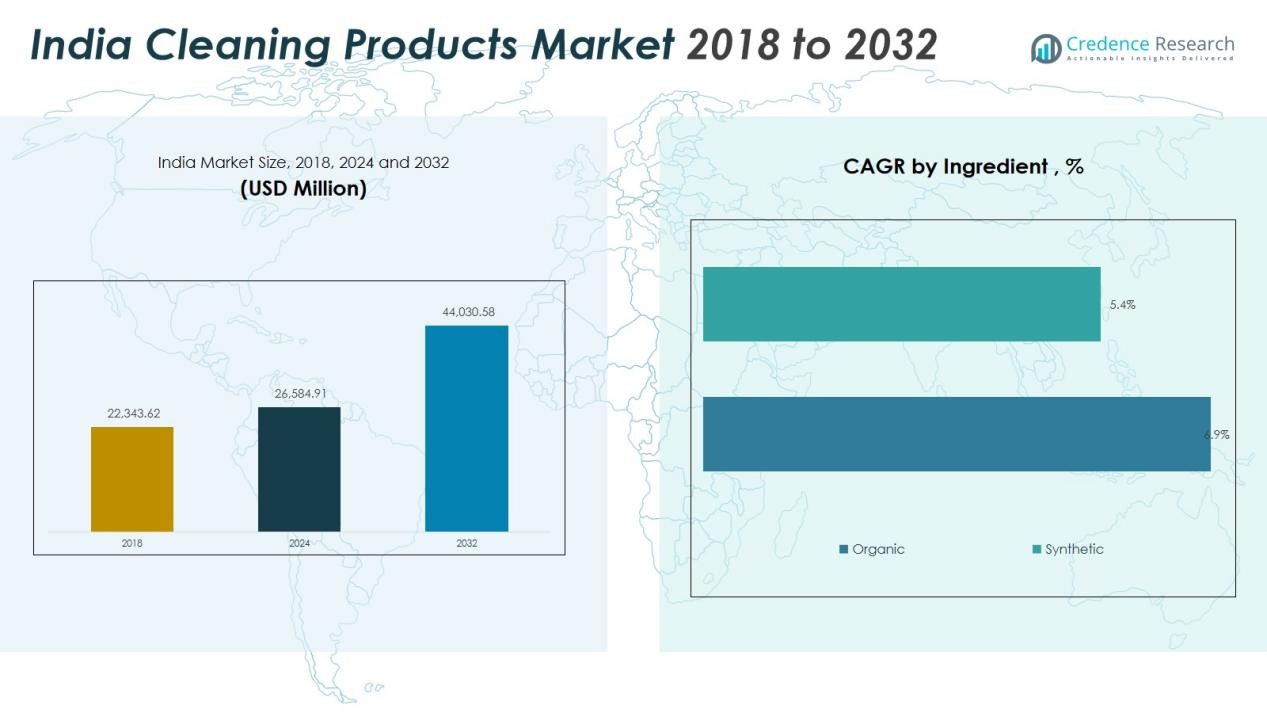
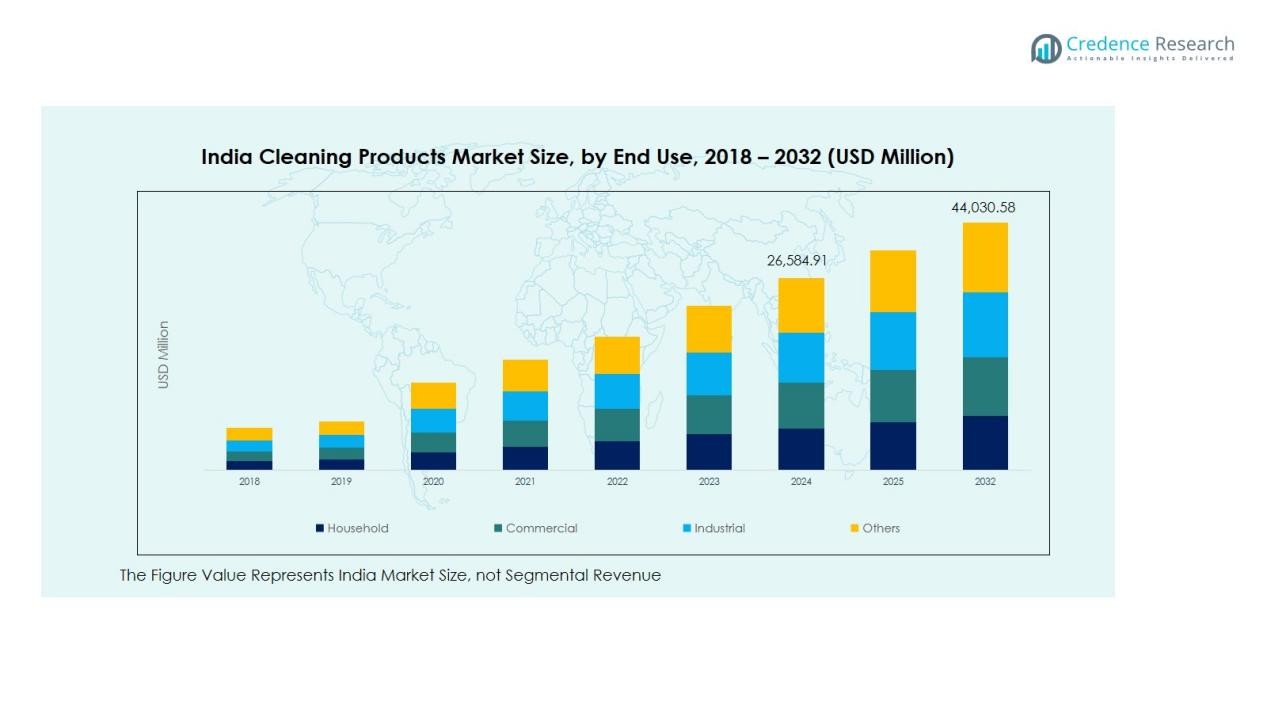
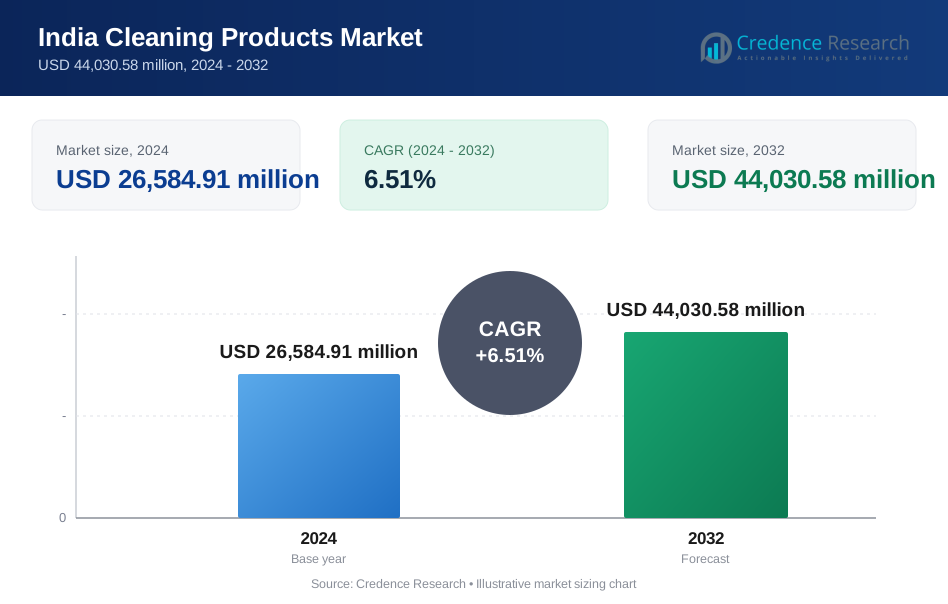
The India Cleaning Products Market size was valued at USD 22,343.62 million in 2018 to USD 26,584.91 million in 2024 and is anticipated to reach USD 44,030.58 million by 2032, at a CAGR of 6.51% during the forecast period.
| REPORT ATTRIBUTE | DETAILS |
|---|---|
| Historical Period | 2020-2023 |
| Base Year | 2024 |
| Forecast Period | 2025-2032 |
| India Cleaning Products Market Size 2024 | USD 26,584.91 Million |
| India Cleaning Products Market, CAGR | 6.51% |
| India Cleaning Products Market Size 2032 | USD 44,030.58 Million |
Growing health consciousness, reinforced by pandemic-driven habits, remains a major catalyst for market acceleration. Consumers increasingly prefer products with antibacterial and eco-friendly properties, while manufacturers invest in safer formulations, biodegradable ingredients, and premium segments. Rapid urbanization, improving living standards, and the penetration of modern retail formats further broaden product availability. E-commerce platforms also contribute to category growth by facilitating convenient access and promoting niche and premium cleaning brands.
Regionally, metropolitan areas such as Delhi-NCR, Mumbai, Bengaluru, and Chennai dominate market demand due to higher disposable incomes, dense populations, and faster adoption of innovative home-care products. Tier-2 and tier-3 cities are witnessing rising consumption as awareness campaigns expand and distribution networks strengthen. Rural markets demonstrate steady growth supported by increasing affordability, improved retail reach, and government initiatives focused on hygiene and sanitation.
Market Insights:
- The India Cleaning Products Market reached USD 26,584.91 million in 2024 and is projected to hit USD 44,030.58 million by 2032, reflecting a strong CAGR of 6.51%, supported by rising hygiene awareness, urban lifestyle expansion, and premium product adoption.
- Metro regions collectively command the highest share, led by Delhi-NCR (18–20%), Mumbai Metropolitan Region (15–17%), and Bengaluru (10–12%), driven by higher incomes, faster acceptance of branded cleaning solutions, and strong penetration of organized retail and quick-commerce networks.
- The fastest-growing region is the tier-2 and tier-3 cluster (23–25% share), expanding rapidly due to improving distribution networks, rising affordability, growing preference for branded cleaners, and stronger e-commerce accessibility that boosts product choice and availability.
- The home-care cleaning segment leads the market with surface and floor cleaners holding 34–36% share, supported by widespread household adoption, growing demand for disinfectant-based formulations, and continuous product innovation across fragrances, multipurpose formats, and safe-chemical blends.
- Laundry-care products capture 28–30% share, benefiting from rising usage of liquid detergents, fabric conditioners, and premium washing solutions as consumers shift away from traditional powders and seek improved convenience, stain-removal performance, and machine-wash compatibility.
Market Drivers:
Rising Health and Hygiene Priorities
The India Cleaning Products Market gains strong momentum from heightened consumer focus on hygiene and sanitation. Households and institutions adopt advanced cleaning solutions to reduce infection risks and maintain safe environments. It benefits from sustained awareness campaigns that highlight the importance of routine cleaning. Demand continues to shift toward disinfectants, multipurpose cleaners, and antimicrobial solutions that ensure superior protection.
- For example, PERISAFE introduced Multipurpose Disinfectant Wipes in India in 2024, which provide a 2-in-1 germ-killing and tough mess cleaning solution, reflecting the market's shift to multipurpose and antimicrobial products.
Expansion of Urban Lifestyles and Modern Living Standards
Urbanization fuels the adoption of efficient home-care products that support faster and cleaner household management. Consumers in metros and large cities prefer convenient, time-saving cleaning formats that deliver consistent results. It experiences rising demand for specialized surface cleaners, appliance-safe solutions, and high-performance products aligned with busy lifestyles. Growth accelerates further as organized retail channels present broader product choices and promote premium offerings.
- For example, Reckitt Benckiser's Dettol Surface Cleanser has expanded its portfolio to include appliance-safe variants that maintain disinfecting strength while being gentle on surfaces, with product tests showing 99.9% bacteria elimination within seconds on kitchen appliances widely used in urban homes.
Innovation in Eco-Friendly and Low-Chemical Formulations
Sustainability influences purchasing decisions as consumers seek safer alternatives with reduced chemical content. It witnesses strong traction for biodegradable, plant-based, and fragrance-free formulations that minimize environmental impact. Brands invest in research to enhance product safety, improve efficacy, and strengthen regulatory compliance. Market players introduce innovations such as refill packs and concentrated solutions to reduce packaging waste and appeal to responsible consumers.
E-Commerce Growth and Strengthening Distribution Networks
Online platforms reshape demand patterns by improving product visibility and access across regions. The India Cleaning Products Market benefits from digital promotions, subscription-based supply models, and rapid doorstep delivery. It expands deeper into tier-2 and tier-3 cities through improved logistics and wider retail penetration. Stronger distribution networks enable brands to reach new customer segments and support continuous market growth.
Market Trends:
Transition Toward Premium, Specialized, and Eco-Safe Products
The India Cleaning Products Market moves toward premium and specialized solutions that support advanced hygiene needs. Consumers prefer products with stronger antimicrobial performance, faster action, and compatibility with modern home surfaces. It reflects a steady rise in demand for fragrance-free, low-toxicity, and biodegradable formulations that align with growing environmental expectations. Brands introduce concentrated liquids, refill packs, and advanced dispensing formats to improve convenience and reduce waste. Product portfolios expand to include appliance-specific cleaners, high-touch surface solutions, and sensitive-skin variants. Digital education campaigns strengthen awareness about ingredient safety and performance benefits, which encourages product trials.
- For instance, Koparo Clean’s Multi-Surface Cleaner excludes over 25 harmful chemicals and offers 85% plastic usage reduction through its refill program compared to new bottles, showcasing technological innovation and eco-conscious convenience.
Strengthening Omnichannel Presence and Technology-Enabled Engagement
Retail strategies evolve quickly as brands deepen omnichannel integration to reach broader consumer groups. The India Cleaning Products Market benefits from the strong push toward e-commerce, subscription models, and quick-commerce platforms. It gains visibility through targeted digital marketing, influencer-led promotions, and AI-driven product recommendations. Traditional retail also adapts through improved shelf placement, wider brand assortments, and regional customization of product lines. Demand rises for smart packaging features that support transparency, such as QR-based information access and sustainability indicators. Product accessibility improves across tier-2 and tier-3 cities through stronger logistics networks, which supports consistent market expansion.
- For instance, Big Basket scaled up its quick-commerce infrastructure in 2024-2025, expanding its 'BB Now' rapid delivery service to around 50 to 75 cities to compete with rivals like Blinkit and Zepto, with plans to increase its network of dark stores to 900 by the end of 2025.
Market Challenges Analysis:
High Price Sensitivity and Intense Competitive Pressure
The India Cleaning Products Market faces persistent challenges linked to strong price sensitivity across large consumer segments. Low-cost local brands compete aggressively with established players, which restricts premium pricing opportunities. It must address fluctuating raw material costs that influence production expenses and narrow margins. Rural markets remain highly value-driven, which limits rapid adoption of advanced or specialized formulations. Brand loyalty stays relatively weak in mass categories, and frequent promotions shape purchasing behavior. Companies must balance affordability with differentiated performance to retain market share.
Regulatory Compliance, Supply Constraints, and Environmental Concerns
Evolving regulations on chemical composition, labeling, and environmental safety create ongoing operational constraints. The India Cleaning Products Market must adjust to stricter norms that require reformulation and rigorous quality controls. It also manages supply-chain disruptions tied to packaging materials, imported raw inputs, and logistics delays. Growing scrutiny of plastic waste and chemical discharge raises pressure on brands to adopt greener alternatives. Product development cycles extend as companies work to meet sustainability expectations without compromising efficacy. Regional disparities in retail infrastructure add further complexity to consistent nationwide distribution.
Market Opportunities:
Expansion of Premium, Sustainable, and Specialized Product Lines
The India Cleaning Products Market holds strong opportunities in premium and eco-focused categories that align with rising safety and sustainability priorities. Consumers show greater interest in low-chemical, plant-based, and dermatologically safe formulations that support healthier living environments. It can gain traction by introducing appliance-specific cleaners, high-touch surface solutions, and fragrance-neutral variants designed for sensitive users. Brands that invest in ethical sourcing, refill systems, and biodegradable packaging can strengthen long-term differentiation. Demand for concentrated liquids and value-packed refills continues to expand, supported by cost efficiency and reduced waste. Innovation in product formats and ingredients remains a strategic path for capturing premium share.
Acceleration of Digital Commerce and Wider Regional Penetration
E-commerce growth creates strong opportunities for brands to reach new customers with targeted pricing, assortments, and subscription-based solutions. The India Cleaning Products Market benefits from rising adoption of quick-commerce platforms that deliver essentials rapidly to urban households. It can scale effectively through digital-first strategies, influencer partnerships, and data-driven product recommendations. Stronger logistics networks enable deeper penetration into tier-2, tier-3, and rural markets where demand for structured hygiene solutions is rising. Retail expansion in semi-urban regions supports increased visibility and trial of branded cleaning products. Companies that tailor pack sizes, fragrances, and price points for diverse geographies can unlock sustained growth potential.
Market Segmentation Analysis:
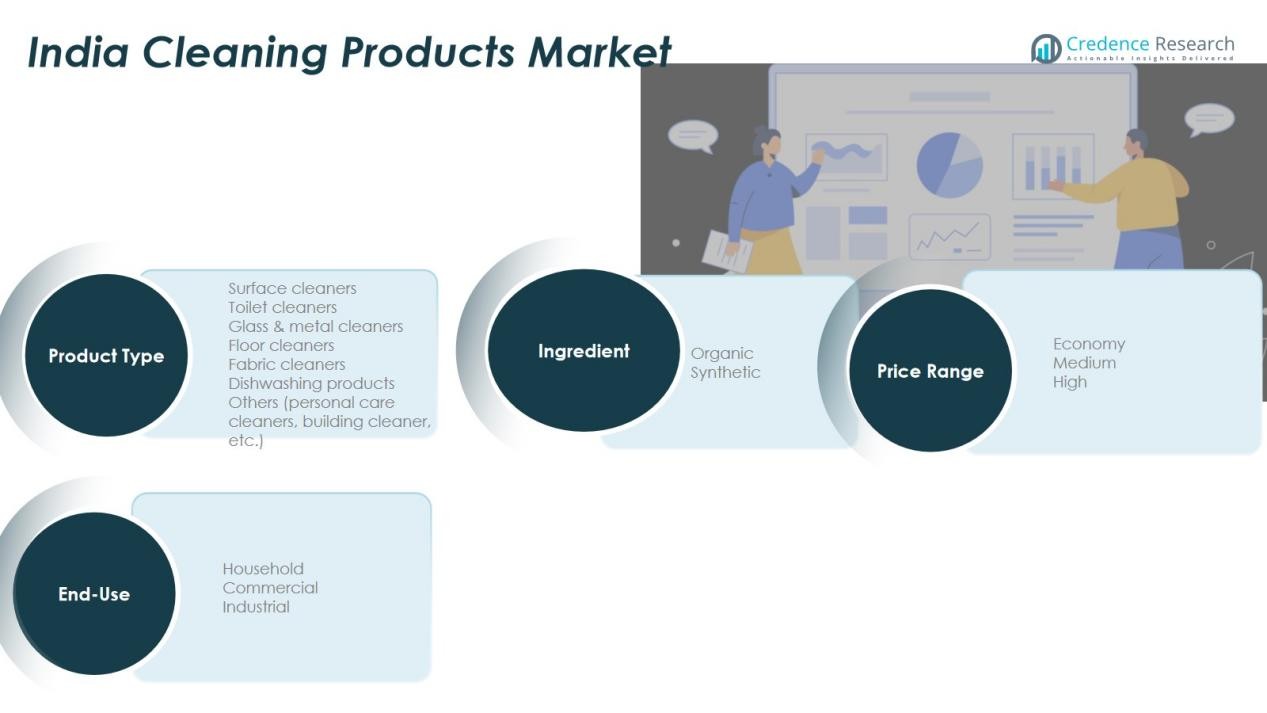
By Product Type
The India Cleaning Products Market shows strong diversity across surface cleaners, toilet cleaners, floor cleaners, glass and metal cleaners, fabric cleaners, dishwashing products, and specialized variants. Surface and toilet cleaners maintain dominant demand due to rising hygiene priorities in households and commercial spaces. It benefits from the rapid adoption of multipurpose solutions that offer convenience and broader application. Dishwashing and floor cleaning categories gain momentum through product innovations and fragrance-enhanced formulations. Premium appliance-specific cleaners also expand their presence as modern homes use more sensitive surfaces and materials.
- For instance, some Odonil Gel Pockets and Zippers are advertised to last for up to 30 days, while the Odonil Blocks can last up to 45 days.
By Ingredient
Consumer preferences shape clear segmentation between organic and synthetic formulations. The India Cleaning Products Market experiences growing interest in organic cleaners supported by awareness of skin safety and environmental responsibility. It sees steady demand for synthetic products that deliver stronger efficacy and lower price points. Brands enhance their portfolios with plant-based and low-chemical solutions that meet eco-conscious expectations. Regulatory focus on safe ingredients encourages consistent upgrades across both categories.
- For instance, Happi Planet, a homecare startup, raised INR 8.47 Crore in funding (February 2024) to expand its microbial and naturally derived surfactant-based cleaners that reduce chemical load on users and environment.
By End-use
Household, commercial, industrial, and other institutional segments create distinct demand patterns across the market. The India Cleaning Products Market secures its largest share from households that prioritize daily hygiene routines and convenient cleaning formats. It gains significant traction in commercial spaces such as offices, hospitality establishments, and retail facilities that require stringent cleanliness standards. Industrial uses expand through the need for heavy-duty cleaners suited for machinery, production floors, and regulated environments. Tailored formulations and pack-size customization support broader adoption across all end-use categories.
Segmentations:
By Product Type
- Surface cleaners
- Toilet cleaners
- Glass & metal cleaners
- Floor cleaners
- Fabric cleaners
- Dishwashing products
- Others (personal care cleaners, building cleaners, etc.)
By Ingredient
- Organic
- Synthetic
By End-use
- Household
- Commercial
- Industrial
- Others
By Price Range
- Economy
- Medium
- High
Regional Analysis:
Strong Demand Concentration in Metropolitan Hubs
Major metropolitan regions such as Delhi-NCR, Mumbai, Bengaluru, and Chennai lead demand with high adoption of branded and premium cleaning solutions. The India Cleaning Products Market benefits from higher disposable incomes, faster lifestyle shifts, and wider access to organized retail in these cities. It gains momentum through strong penetration of quick-commerce platforms, supermarket chains, and specialty home-care stores. Consumers in these regions prioritize convenience, efficiency, and specialized cleaners that support modern home environments. Demand for eco-friendly and low-chemical formulations also shows strong traction in metro markets.
Expanding Consumption Across Tier-2 and Tier-3 Cities
Tier-2 and tier-3 cities show rapid market development supported by rising awareness of hygiene and improved retail infrastructure. The India Cleaning Products Market strengthens its footprint in cities such as Jaipur, Lucknow, Coimbatore, and Indore through targeted distribution and localized marketing. It benefits from growing acceptance of branded cleaners over traditional substitutes, driven by improved affordability and product availability. E-commerce access widens choices for consumers in these regions and accelerates the shift toward specialized and value-added products. Retail expansion across these emerging cities supports continued market uptake.
Steady Growth in Rural Markets Supported by Distribution Expansion
Rural regions contribute steadily to overall growth as hygiene awareness increases and government-led sanitation programs influence consumer behavior. The India Cleaning Products Market expands through small pack sizes, value-focused offerings, and wider reach of FMCG distributors. It gains traction from heightened interest in surface and floor cleaners that replace basic cleaning agents. Local manufacturing hubs and regional brands support competitive pricing that meets rural affordability levels. Strengthened logistics networks and deeper retail penetration continue to improve access, which supports long-term demand in rural markets.
Key Player Analysis:
- Hindustan Unilever Limited (HUL)
- Procter & Gamble (India) Private Limited (P&G India)
- Godrej Consumer Products Limited (GCPL)
- Reckitt Benckiser India Limited
- Jyothy Laboratories Limited
- Nirma Limited
- ITC Limited
- Dabur India Limited
- C. Johnson Products (India) Private Limited
Competitive Analysis:
The India Cleaning Products Market features a highly competitive landscape dominated by global and domestic FMCG leaders. Key players such as Hindustan Unilever Limited (HUL), Procter & Gamble (India) Private Limited (P&G India), Godrej Consumer Products Limited (GCPL), Reckitt Benckiser India Limited, and Jyothy Laboratories Limited hold strong market positions through extensive portfolios and wide distribution networks. It reflects intense rivalry driven by pricing strategies, frequent product launches, and heavy investment in marketing campaigns. Companies focus on innovation in eco-friendly formulations, surface-specific cleaners, and fragrance-enhanced products to strengthen brand differentiation. Digital channels play a central role in expanding consumer reach, while regional penetration remains a critical factor for scalability. Competitive pressure intensifies further as regional brands and private labels gain visibility through low-cost offerings and targeted local presence.
Recent Developments:
- In January 2025, Hindustan Unilever Limited (HUL) announced the acquisition of a 90.5% stake in Uprising Science Pvt Ltd, the parent company of premium beauty brand Minimalist, in a transaction valued at ₹2,670 crore.
- In October 2025, Godrej Consumer Products Limited signed definitive agreements for acquisitions in the fast-growing men’s grooming segment.
Report Coverage:
The research report offers an in-depth analysis based on Product Type, Ingredient, End-use and Price Range. It details leading market players, providing an overview of their business, product offerings, investments, revenue streams, and key applications. Additionally, the report includes insights into the competitive environment, SWOT analysis, current market trends, as well as the primary drivers and constraints. Furthermore, it discusses various factors that have driven market expansion in recent years. The report also explores market dynamics, regulatory scenarios, and technological advancements that are shaping the industry. It assesses the impact of external factors and global economic changes on market growth. Lastly, it provides strategic recommendations for new entrants and established companies to navigate the complexities of the market.
Future Outlook:
- The India Cleaning Products Market will expand steadily as consumers prioritize sustained hygiene practices across households and institutions.
- Demand for eco-friendly, low-chemical, and plant-based formulations will rise as safety and environmental expectations strengthen.
- Digital commerce, quick-commerce services, and subscription models will shape purchasing behavior and improve product accessibility.
- Regional penetration will deepen in tier-2, tier-3, and rural markets through focused distribution strategies and localized product offerings.
- Brands will invest more in appliance-specific, surface-tailored, and premium cleaning solutions that support modern home environments.
- Product innovation will accelerate in concentrated liquids, refill packs, and advanced dispensing formats to reduce waste and enhance convenience.
- Marketing strategies will rely heavily on digital engagement, influencer partnerships, and data-driven consumer segmentation.
- Retail expansion through supermarkets, hypermarkets, and neighborhood stores will strengthen visibility and support wider product adoption.
- Private labels and regional players will gain stronger presence through competitive pricing and rapid adaptability.
- Sustainability, packaging reduction, and transparent ingredient communication will emerge as key differentiators guiding long-term brand loyalty.
Request a Free Sample
Fill in your details and we'll send you a free sample report.
- Sample data tables & charts
- Research methodology
Need a Custom Version of This Report?
Tailor the scope, geography, or segments to your exact requirements.
- Custom geography or segment scope
- Direct access to our analyst team
Frequently Asked Questions
What is the current market size for the India Cleaning Products Market, and what is its projected size in 2032?
At what Compound Annual Growth Rate is the India Cleaning Products Market projected to grow between 2024 and 2032?
Which India Cleaning Products Market segment held the largest share in 2024?
What are the primary factors fueling the growth of the India Cleaning Products Market?
Who are the leading companies in the India Cleaning Products Market?
Which region commanded the largest share of the India Cleaning Products Market in 2024?
Table of Content
Chapter 1. Report Introduction
- 1.1 Report Description & Purpose
- 1.1.1 Report Title & Market Definition
- 1.1.2 Unique Selling Propositions (USP) & Key Differentiators
- 1.1.3 Value Proposition for Stakeholders
- 1.2 Research Objectives
- 1.2.1 Market Sizing Objectives (Volume & Revenue)
- 1.2.2 Segmentation Objectives
- 1.2.3 Competitive Intelligence Objectives
- 1.2.4 Forecast & Scenario Objectives
- 1.3 Report Scope
- 1.3.1 India Cleaning Products Scope – Types & Subtypes Covered
- 1.3.2 Geographic Scope – Regions & Countries Covered
- 1.3.3 Historical Period, Base Year & Forecast Period (2024; forecast to 2032)
- 1.3.4 Inclusions & Exclusions
- 1.4 HS Code & Classification Framework
- 1.5 Currency, Units & Pricing Basis
- 1.6 Target Stakeholders
- 1.7 Limitations & Assumptions
Chapter 2. Executive Summary
- 2.1 Global India Cleaning Products Market Snapshot
- 2.1.1 Market Size – Historical (2024) & Forecast (2024-2032) (2024: USD 26,584.91 million → 2032: USD 44,030.58 million)
- 2.1.2 Volume & Revenue – Global Totals
- 2.1.3 Key Market Highlights – Top Five Facts
- 2.2 India Cleaning Products Market Segmentation Snapshot
- 2.2.1 Market Split by Region – 2024 vs. 2032
- 2.3 Competitive Snapshot
- 2.3.1 Top 10 Players by Revenue Share – 2024
- 2.3.2 Top 10 Players by Volume Share – 2024
- 2.3.3 Recent Strategic Developments (18-Month Summary)
- 2.4 Key Investment Highlights & Strategic Conclusions
Chapter 3. India Cleaning Products Market Dynamics & Industry Analysis
- 3.1 Market Overview & Context
- 3.1.1 India Cleaning Products Market Position in the Broader Automotive Value Chain
- 3.1.2 OEM vs. Replacement Market Dynamics
- 3.1.3 Market Maturity & Development Stage by Region
- 3.2 India Cleaning Products Market Drivers
- 3.3 India Cleaning Products Market Restraints & Challenges
- 3.4 India Cleaning Products Market Opportunities
- 3.5 Porter's Five Forces Analysis
- 3.5.1 Threat of New Entrants
- 3.5.2 Bargaining Power of Suppliers
- 3.5.3 Bargaining Power of Buyers
- 3.5.4 Threat of Substitutes
- 3.5.5 Competitive Rivalry – Intensity Assessment
- 3.6 India Cleaning Products Value Chain Analysis
- 3.6.1 Upstream – Raw Material/Input Suppliers
- 3.6.1.1 Raw Material/Input 1
- 3.6.1.2 Raw Material/Input 2
- 3.6.1.3 Raw Material/Input 3
- 3.6.2 Midstream – Production/Manufacturing/Service Delivery
- 3.6.2.1 Production/Process Overview
- 3.6.2.2 Key Facility Locations & Capacity by Manufacturer
- 3.6.3 Downstream – Distribution & End Consumer
- 3.6.3.1 Primary Channel – B2B/OEM
- 3.6.3.2 Secondary Channels – Dealer, Retail, Online, Direct
- 3.6.4 Value Chain Profitability Analysis
- 3.6.1 Upstream – Raw Material/Input Suppliers
- 3.7 PESTEL Analysis
- 3.7.1 Political Factors
- 3.7.2 Economic Factors
- 3.7.3 Social Factors
- 3.7.4 Technological Factors
- 3.7.5 Environmental Factors
- 3.7.6 Legal Factors
- 3.8 India Cleaning Products Supply Chain Analysis
- 3.8.1 Raw Material/Input Supply Risk Assessment
- 3.8.2 Manufacturing Concentration Risk (Geographic Exposure)
- 3.8.3 Trade Disruption Impact Analysis
- 3.9 Regulatory & Policy Landscape
Note: The regulatory and policy landscape section covers regulations based on their applicability to the market, India Cleaning Products category, geography, and scope of the study. Only regulatory frameworks with a material impact on operations, compliance, trade, sustainability, or market access are analyzed in detail.
Chapter 4. Key Investment Pockets & Opportunity Analysis
- 4.1 India Cleaning Products Market Attractiveness Analysis
- 4.1.1 By Region – Investment Attractiveness Matrix (Volume × CAGR)
- 4.2 Absolute Revenue Growth Opportunity
- 4.2.1 By Region – Absolute USD Growth Through 2032
- 4.3 Incremental Volume Opportunity
- 4.3.1 By Region – Incremental Volume Through 2032
- 4.3.2 Segment – Incremental Volume
- 4.4 Emerging Submarket Opportunity Deep Dive (Subject to Applicability)
- 4.5 Emerging Market Opportunity Scorecards
- 4.5.1 United States
- 4.5.2 Europe
- 4.5.3 Asia
- 4.5.4 Middle East & Africa
Note: Emerging Market Opportunity Scorecards will be included based on relevance and strategic importance. Regions listed are indicative and may vary depending on data availability and market dynamics.
Chapter 5. India Cleaning Products Import-Export Analysis & Trade Flows
- 5.1 Global Trade Overview
- 5.1.1 Global Export Value by Country (2024)
- 5.1.2 Global Export Volume by Country (2024)
- 5.1.3 Global Import Value by Country (2024)
- 5.1.4 Global Import Volume by Country (2024)
- 5.1.5 Net Trade Balance by Country (2024)
- 5.2 Export Analysis – Segment
- 5.2.1 Type 1 (HS Code)
- 5.2.2 Type 2 (HS Code)
- 5.2.3 Type 3 (HS Code)
- 5.2.4 Type 4 (HS Code)
- 5.2.5 Type 5 (HS Code)
- 5.3 Import Analysis – Segment
- 5.3.1 Type 1 (HS Code)
- 5.3.2 Type 2 (HS Code)
- 5.3.3 Type 3 (HS Code)
- 5.3.4 Type 4 (HS Code)
- 5.3.5 Type 5 (HS Code)
- 5.4 Average Unit Trade Prices
- 5.4.1 Average Export Price – Segment & Country
- 5.4.2 Average Import Price – Segment & Source Country
- 5.4.3 Price Trends (2024)
- 5.5 Key Trade Route Analysis
- 5.5.1 Trade Route 1
- 5.5.2 Trade Route 2
- 5.5.3 Trade Route 3
- 5.5.4 Trade Route 4
- 5.5.5 Trade Route 5
- 5.6 Trade Policy Impact Assessment
- 5.6.1 US Anti-Dumping & Section 301 Tariffs
- 5.6.2 EU Customs Union Impact
- 5.6.3 Major Free Trade Agreements
- 5.6.4 USMCA Rules of Origin
Note: Trade policy analysis will be included only where relevant to the India Cleaning Products market.
Chapter 6. Competitive Landscape & Company Benchmarking
- 6.1 India Cleaning Products Market Concentration & Structure
- 6.1.1 Herfindahl-Hirschman Index (HHI) – vs. 2024
- 6.1.2 Tier 1, Tier 2 & Tier 3 Market Structure
- 6.1.3 Global, Regional & Local Player Dynamics
- 6.2 India Cleaning Products Market Share Analysis – 2024
- 6.2.1 Global Revenue Share by Company
- 6.2.2 Global Volume Share by Company
- 6.2.3 Regional Revenue Share
- 6.2.4 Market Share Evolution ( vs. 2024)
- 6.2.5 OEM Segment Share by Company
- 6.2.6 Replacement Segment Share by Company
- 6.3 Production/Delivery Capacity & Facility Analysis
- 6.3.1 Global Installed Capacity
- 6.3.2 Capacity Utilization Rates
- 6.3.3 Production/Output Volume
- 6.3.4 Facility Locations & Capacity Map
- 6.3.5 Planned Capacity Additions
- 6.4 India Cleaning Products Competitive Benchmarking Matrix
- 6.4.1 Revenue, Volume, CAGR & Profitability Comparison
- 6.4.2 Channel Revenue Mix
- 6.4.3 Geographic Revenue Exposure
- 6.4.4 R&D Intensity
- 6.4.5 Sustainability Maturity
- 6.5 Strategic Developments in India Cleaning Products (Last 24 Months)
- 6.5.1 Mergers, Acquisitions & Divestments
- 6.5.2 New India Cleaning Products Launches
- 6.5.3 Facility Expansions
- 6.5.4 Strategic Alliances, Joint Ventures & Partnerships
- 6.5.5 Distribution Expansion & Market Entry
- 6.5.6 Sustainability & ESG Initiatives
- 6.6 Competitive Strategy Mapping
- 6.6.1 Leader, Challenger, Follower & Niche Classification
- 6.6.2 Pricing Strategy Comparison
- 6.6.3 Channel Strategy Matrix
Note: Strategic developments are included based on their materiality and the availability of reliable information.
Chapter 7. Global India Cleaning Products Market – By Distribution Channel
- 7.1 Segment Overview
- 7.1.1 Volume & Revenue Split by Channel (2024 & 2032)
- 7.1.2 Channel Mix Evolution (2024-2032)
Chapter 8. Regional Market Analysis – Global Overview
- 8.1 Global Regional Overview
- 8.1.1 Regional Volume Share
- 8.1.2 Regional Revenue Share
- 8.1.3 Regional Volume by Region
- 8.1.4 Regional Revenue by Region
- 8.1.5 Regional Forecast Through 2032
- 8.2 Cross-Regional Segment Analysis
- 8.2.1 By Distribution Channel
- 8.2.2 By Brand/Price Tier
Chapter 9. North America India Cleaning Products Market
- 9.1 United States
- 9.2 Canada
- 9.3 Mexico
Chapter 10. Europe India Cleaning Products Market
- 10.1 Germany
- 10.2 France
- 10.3 Italy
- 10.4 United Kingdom
- 10.5 Spain
- 10.6 Poland
- 10.7 Russia
- 10.8 Netherlands
- 10.9 Belgium
- 10.10 Sweden
- 10.11 Denmark
- 10.12 Norway
- 10.13 Rest of Europe
Chapter 11. Asia Pacific India Cleaning Products Market
- 11.1 China
- 11.2 India
- 11.3 Japan
- 11.4 South Korea
- 11.5 Thailand
- 11.6 Indonesia
- 11.7 Vietnam
- 11.8 Malaysia
- 11.9 Australia
- 11.10 Rest of Asia Pacific
Chapter 12. Latin America India Cleaning Products Market
- 12.1 Brazil
- 12.2 Argentina
- 12.3 Colombia
- 12.4 Chile
- 12.5 Rest of Latin America
Chapter 13. Middle East India Cleaning Products Market
- 13.1 Saudi Arabia
- 13.2 United Arab Emirates
- 13.3 Turkey
- 13.4 Israel
- 13.5 Iran
- 13.6 Rest of the Middle East
Chapter 14. Africa India Cleaning Products Market
- 14.1 South Africa
- 14.2 Egypt
- 14.3 Nigeria
- 14.4 Morocco
- 14.5 Rest of Africa
Chapter 15. India Cleaning Products Company Profiles
- 15.1 [Company 01]
- 15.1.1 Company Overview
- 15.1.2 Key Management Personnel
- 15.1.3 Products & Services Portfolio
- 15.1.4 Financial Performance
- 15.1.5 Key Market Focus & Geographic Presence
- 15.1.6 Recent Developments & Strategic Initiatives
Note: The company profile list is preliminary and may change based on research findings, market developments, data availability, and client requirements.
Chapter 16. Appendices
- Appendix A – List of Abbreviations & Acronyms
- Appendix B – Industry Classification Code Reference – Full Series
- Appendix C – Production & Capacity Data Tables
- Appendix D – End-Use & Demand Base Tables
- Appendix E – Consumption & Replacement Rate Assumptions
- Appendix F – ASP Reference Tables
- Appendix G – Manufacturing & Facility Database
- Appendix H – Import-Export Data Tables
- Appendix I – Regulatory Summary Tables
- Appendix J – Primary Research Participant List (Anonymized)
- Appendix K – Primary Research Questionnaire Framework
- Appendix L – Data Sources & Bibliography
- Appendix M – Market Size Divergence & Source Comparison
Chapter 17. Research Methodology
- 17.1 Research Framework & Philosophy
- 17.2 Secondary Research – Sources, Hierarchy & Data Extraction
- 17.3 Data Modeling – Bottom-Up & Top-Down Market Sizing
- 17.4 Primary Research – Stakeholder Framework, LOI & Sample Sizes
- 17.5 Forecast Methodology – Regression, Scenario & Sensitivity Analysis
- 17.6 Quality Control – Four-Layer Validation Framework
- 17.7 Limitations & Standard Assumptions
- 17.8 Disclaimer
