
| REPORT ATTRIBUTE | DETAILS |
|---|---|
| Historical Period | 2019-2022 |
| Base Year | 2023 |
| Forecast Period | 2024-2032 |
| India Data Center Renovation Market Size 2024 | USD 452.29 million |
| India Data Center Renovation Market, CAGR | 15.90% |
| India Data Center Renovation Market Size 2032 | USD 1,472.64 million |
Market Overview
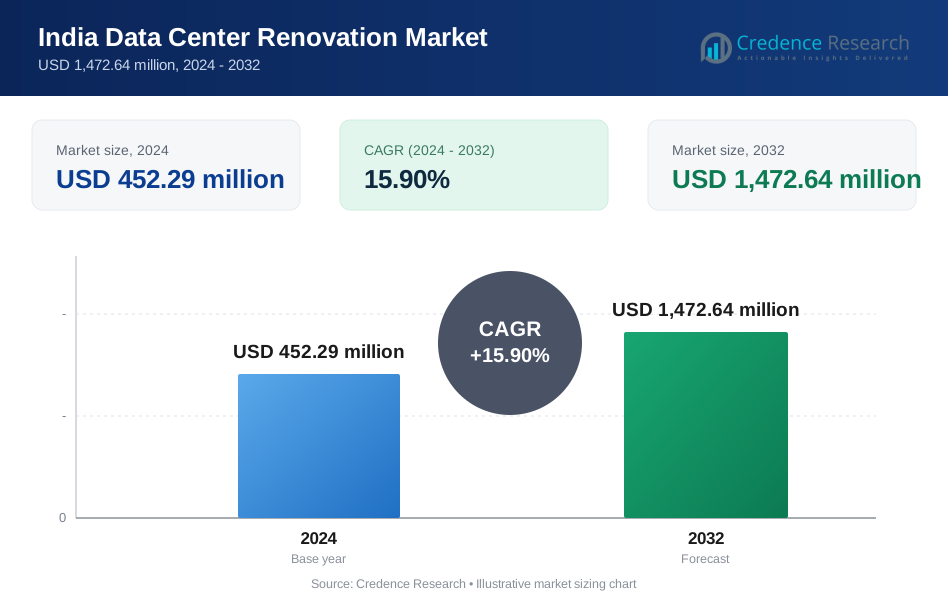
India Data Center Renovation market size was valued at USD 452.29 million in 2024 and is anticipated to reach USD 1,472.64 million by 2032, at a CAGR of 15.90% during the forecast period (2024-2032).
The India data center renovation market is experiencing significant growth due to the increasing demand for energy-efficient and sustainable infrastructure. Rising data consumption, cloud adoption, and the expansion of hyperscale data centers are driving renovations to enhance operational efficiency and reduce carbon footprints. Government initiatives such as the Digital India program and favorable policies supporting data localization further propel market growth. Additionally, advancements in cooling technologies, AI-driven automation, and modular data center designs are key trends shaping the industry. The rapid shift towards hybrid cloud solutions and edge computing is encouraging enterprises to modernize legacy infrastructure, ensuring scalability and security. Increasing investments from global technology firms and data center operators are accelerating renovation activities to meet evolving regulatory and compliance standards.
The India data center renovation market is witnessing significant growth across key regions, including Northern, Western, Southern, and Eastern India, driven by rising digitalization, cloud adoption, and increasing regulatory compliance. Northern and Western India are leading hubs due to the presence of major IT and financial centers, while Southern India is emerging as a critical market with growing investments in Bengaluru, Hyderabad, and Chennai. The Eastern region is gradually expanding, supported by government initiatives and increasing data storage needs. Key players in the market include Cisco Systems, Siemens, Emerson Electric, Eaton, ABB, Vertiv, Johnson Controls, Legrand, Dell Technologies, Hewlett Packard Enterprise, Lenovo, Schneider Electric, Microsoft, Honeywell, IBM, and Google. These companies focus on upgrading infrastructure, enhancing energy efficiency, and integrating smart technologies to meet evolving industry demands. With increasing demand for modernization, these players are investing in innovative solutions to strengthen India's data center ecosystem.
Market Insights
- The India data center renovation market was valued at USD 452.29 million in 2024 and is expected to reach USD 1,472.64 million by 2032, growing at a CAGR of 15.90% during the forecast period.
- Increasing digital transformation, cloud adoption, and AI-driven workloads are driving demand for modernized data center infrastructure.
- Energy efficiency and sustainability concerns are pushing companies to invest in advanced cooling, power management, and automation solutions.
- Key players such as Cisco, Siemens, Emerson Electric, ABB, Vertiv, and Microsoft are actively expanding their market presence through strategic investments and partnerships.
- High costs of renovation and integration challenges with legacy systems pose significant restraints to market growth.
- Northern and Western regions dominate the market due to major IT and financial hubs, while Southern and Eastern regions are experiencing growing investments.
- Rising government initiatives and data localization regulations are further accelerating the need for upgraded and secure data center facilities.
Market Drivers
Increasing Adoption of AI, Edge Computing, and Automation
The growing adoption of artificial intelligence (AI), edge computing, and automation is significantly influencing the need for data center renovations. For instance, Goldman Sachs Research projects that AI will increase data center power consumption by 200 TWh annually between 2023 and 2030, with AI accounting for about 19% of data center power demand by 2028. AI-driven automation is improving data center management, enabling predictive maintenance, workload optimization, and real-time monitoring. Additionally, edge computing, which processes data closer to the source rather than relying solely on centralized cloud facilities, is necessitating infrastructure upgrades for better latency and efficiency. Enterprises are integrating AI-powered cooling systems, smart power distribution, and automated security protocols to enhance operational performance. As technology advancements continue to reshape the data center landscape, organizations are prioritizing renovations to support AI workloads, enable real-time analytics, and enhance cybersecurity. The continuous evolution of digital technologies is making data center modernization a strategic imperative for businesses aiming to stay competitive in the rapidly evolving digital economy.
Rising Demand for Energy-Efficient and Sustainable Infrastructure
The increasing need for energy-efficient and sustainable infrastructure is a major driver of the India data center renovation market. With data centers accounting for significant energy consumption, enterprises are investing in renovations to improve energy efficiency and reduce operational costs. The adoption of advanced cooling technologies, efficient power management systems, and renewable energy integration is gaining momentum. Green data centers, which prioritize lower carbon footprints and sustainable practices, are becoming a key focus for organizations. Additionally, regulatory frameworks promoting energy efficiency, such as the Energy Conservation Act and sustainability initiatives by the government, are pushing data center operators to modernize their existing infrastructure. The shift toward energy-efficient operations not only helps companies achieve sustainability goals but also enhances long-term cost savings, making data center renovation an essential investment.
Growth in Cloud Computing and Hyperscale Data Centers
The rapid expansion of cloud computing and hyperscale data centers is accelerating the demand for data center renovations in India. Businesses are increasingly adopting cloud-based solutions to enhance flexibility, scalability, and cost-efficiency, leading to a surge in data center workloads. Hyperscale data centers, which house vast amounts of data for cloud service providers, require continuous upgrades to meet evolving performance and security demands. Renovations include infrastructure upgrades such as improved networking capabilities, enhanced storage solutions, and optimized server efficiency to support high-performance computing. The growing presence of global cloud providers like AWS, Microsoft Azure, and Google Cloud in India is further driving investments in data center modernization. As enterprises transition to hybrid and multi-cloud environments, the need to renovate existing data centers to align with cloud infrastructure requirements continues to grow.
Government Initiatives and Data Localization Policies
Government initiatives and data localization policies are playing a crucial role in driving data center renovations across India. The Digital India initiative, aimed at strengthening the country’s digital infrastructure, is encouraging enterprises to upgrade their data centers to meet increasing digital demands. Additionally, data protection regulations, including the Personal Data Protection (PDP) Bill, emphasize data localization, requiring companies to store and process data within India. As a result, businesses are investing in renovating and expanding their data centers to comply with these regulations while ensuring data security and reliability. The government’s push for indigenous data center capabilities has also led to incentives and tax benefits for modernization projects, further driving market growth. Public and private sector collaboration in building robust data infrastructure is fostering a strong demand for renovation and upgradation activities.
Market Trends
Growing Investments in Security and Compliance Upgrades
The increasing risk of cyber threats and evolving regulatory requirements are prompting data center operators to prioritize security and compliance renovations. Businesses are upgrading security infrastructure by implementing advanced encryption technologies, biometric access controls, and AI-driven threat detection systems. In India, data centers faced 51 million cyber-attacks in a nine-month period, highlighting the need for robust security measures. Data localization regulations, such as the Digital Personal Data Protection Act, are compelling enterprises to enhance data storage and compliance frameworks. Renovation strategies include deploying software-defined security solutions, multi-factor authentication, and AI-enabled risk assessment tools to strengthen data protection measures. As cyber threats continue to evolve, data center renovations in India are focusing on improving security resilience and regulatory compliance, ensuring robust data governance and risk management frameworks.
Increased Focus on Green Data Centers and Sustainability
The growing emphasis on sustainability is driving the adoption of green data center renovations in India. Organizations are actively investing in eco-friendly infrastructure upgrades to reduce energy consumption and minimize carbon footprints. The integration of renewable energy sources, such as solar and wind power, along with energy-efficient cooling systems, is becoming a key trend. Liquid cooling and AI-driven energy management solutions are gaining traction, enabling data centers to optimize power usage and maintain operational efficiency. Additionally, government regulations promoting sustainability and corporate ESG commitments are encouraging businesses to modernize existing data centers with environmentally responsible technologies. As enterprises strive to achieve net-zero emissions, green data center renovations are expected to play a pivotal role in shaping the future of the industry.
Surge in Edge Computing and Decentralized Data Processing
The rapid expansion of edge computing is significantly influencing data center renovation strategies in India. With the increasing need for real-time data processing, enterprises are upgrading existing infrastructure to support decentralized computing models. Edge data centers, which enable faster processing and lower latency, are being integrated into traditional data center networks. Renovations involve enhancing network capabilities, deploying high-performance servers, and implementing advanced connectivity solutions to facilitate seamless edge computing operations. Sectors such as telecommunications, healthcare, and smart cities are driving the demand for edge data centers, necessitating extensive infrastructure upgrades. As businesses move toward distributed computing environments, data center renovations are focusing on optimizing latency, bandwidth efficiency, and security to support next-generation digital applications.
Integration of AI and Automation for Enhanced Operations
The integration of artificial intelligence (AI) and automation is transforming data center renovation trends in India. AI-powered solutions are improving data center efficiency by enabling predictive maintenance, intelligent workload management, and real-time monitoring. Automated cooling systems, energy optimization tools, and AI-driven security enhancements are being incorporated to enhance operational resilience. Businesses are leveraging AI to analyze power usage patterns, detect anomalies, and reduce downtime, leading to cost-effective renovations. Additionally, robotic process automation (RPA) is streamlining routine data center tasks, reducing manual intervention, and improving response times. As organizations prioritize efficiency and reliability, AI and automation-driven renovations are becoming a strategic investment in modernizing India’s data center infrastructure.
Market Challenges Analysis
Evolving Regulatory Landscape and Security Concerns
The rapidly evolving regulatory landscape and stringent data security requirements present significant challenges for data center renovation in India. Compliance with data localization laws, such as the Digital Personal Data Protection Act, necessitates extensive infrastructure modifications to ensure data storage and processing within the country. Organizations must continuously update their security frameworks to address emerging cybersecurity threats, which increases renovation complexities. Integrating advanced security measures, such as AI-driven threat detection and multi-factor authentication, requires technical expertise and seamless implementation. For instance, the DPDA establishes data centers as data processors, increasing accountability to report security breaches. Additionally, the rising frequency of cyberattacks underscores the importance of robust security renovations, making it imperative for businesses to align their modernization strategies with regulatory compliance. As data privacy regulations become more stringent, data center operators must navigate legal complexities while ensuring scalable and secure infrastructure upgrades.
High Capital Investment and Operational Disruptions
The substantial capital investment required for data center renovations poses a significant challenge for businesses in India. Upgrading infrastructure, implementing energy-efficient solutions, and integrating advanced technologies demand considerable financial resources. Small and medium-sized enterprises (SMEs) often struggle to allocate funds for large-scale renovations, leading to delays in modernization efforts. Additionally, operational disruptions during renovation projects impact business continuity, causing downtime and potential revenue losses. Migrating workloads, upgrading servers, and optimizing cooling systems require meticulous planning to minimize service interruptions. Organizations must adopt phased renovation strategies and leverage modular upgrades to balance cost-effectiveness and operational efficiency. Despite the long-term benefits of modernization, the high upfront investment remains a major barrier to widespread adoption.
Market Opportunities
The India data center renovation market presents significant opportunities driven by the increasing adoption of cloud computing, artificial intelligence (AI), and digital transformation initiatives. As businesses shift towards hybrid and multi-cloud environments, the need to modernize existing data centers to enhance scalability and efficiency is growing. Enterprises are investing in infrastructure upgrades to support high-performance computing, real-time data processing, and edge computing applications. Additionally, the rise of AI-driven automation in data centers offers opportunities for deploying intelligent cooling systems, predictive maintenance, and energy optimization solutions. The demand for modular and software-defined data center architectures is also rising, allowing businesses to achieve greater flexibility and cost-effectiveness. As organizations seek to improve operational resilience and reduce downtime, investments in advanced power management, security enhancements, and disaster recovery solutions are expected to surge.
Moreover, the Indian government’s focus on data localization and digital infrastructure development is creating new avenues for data center renovation. Regulations mandating local data storage are compelling enterprises to upgrade their existing infrastructure to ensure compliance while enhancing data security. Incentives and policy support for green data centers and energy-efficient operations are further encouraging renovations aimed at reducing carbon footprints and improving sustainability. The increasing participation of global technology firms in India's data center industry is driving significant capital inflows, fostering large-scale modernization projects. Additionally, the growing demand for colocation services and enterprise data solutions is fueling the need for infrastructure improvements to support expanding workloads. As cybersecurity threats become more sophisticated, opportunities exist for integrating AI-powered security solutions, real-time threat monitoring, and compliance-driven enhancements. With India emerging as a key hub for digital transformation, the data center renovation market is poised for sustained growth, offering long-term opportunities for infrastructure providers, technology firms, and service vendors.
Market Segmentation Analysis:
By Renovation Type:
The India data center renovation market is segmented into mechanical renovation, electrical renovation, and infrastructure renovation, each addressing specific operational improvements. Mechanical renovation focuses on upgrading cooling systems, ventilation, and HVAC technologies to enhance thermal efficiency and reduce energy consumption. The growing adoption of liquid cooling and AI-driven climate control solutions is driving demand in this segment. Electrical renovation involves upgrading power distribution systems, backup generators, and uninterruptible power supplies (UPS) to ensure consistent energy delivery and reduce downtime risks. The increasing reliance on renewable energy sources and smart grid integration is further accelerating investments in this segment. Infrastructure renovation includes structural modifications, security enhancements, and physical expansion to accommodate increasing data loads and improve facility resilience. The shift towards modular and software-defined data centers is influencing infrastructure upgrades to support scalability and disaster recovery. As businesses seek to enhance operational efficiency and future-proof their data centers, demand for all three renovation types is expected to grow significantly.
By Renovation Goal:
Based on renovation goals, the market is categorized into improved energy efficiency, increased capacity and density, and modernization and upgrading. Improved energy efficiency remains a primary focus, with businesses investing in energy-saving technologies such as AI-powered cooling, renewable energy integration, and efficient power management systems. Rising electricity costs and sustainability regulations are driving data center operators to adopt green renovation strategies. Increased capacity and density renovations are essential for supporting high-performance computing, edge processing, and cloud services. Companies are optimizing floor space utilization, upgrading server racks, and enhancing cooling efficiency to accommodate higher-density workloads. Modernization and upgrading initiatives focus on deploying next-generation security frameworks, automation solutions, and compliance-driven infrastructure enhancements. Organizations are replacing outdated systems with software-defined architectures, AI-driven monitoring, and real-time analytics to improve performance and cybersecurity. As India’s data economy expands, data center renovations aligned with these strategic goals will play a crucial role in shaping the industry’s long-term growth.
Segments:
Based on Renovation Type:
- Mechanical Renovation
- Electrical Renovation
- Infrastructure Renovation
Based on Renovation Goal:
- Improved Energy Efficiency
- Increased Capacity and Density
- Modernization and Upgrading
Based on Component:
- Cooling Systems
- Power Systems
- Racks and Enclosures
- Security Systems
Based on Age:
- 0-5 Years
- 6-10 Years
- 11-15 Years
- 16-20 Years
- Over 20 Years
Based on the Geography:
- Northern
- Western
- Southern
- Eastern
Regional Analysis
Northern Region
The Northern region holds the largest share of the India data center renovation market, accounting for approximately 35% of the total market. This dominance is driven by the presence of major IT hubs, government institutions, and hyperscale data centers in cities like Delhi-NCR and Noida. The region is witnessing substantial investments in data center modernization, fueled by the increasing adoption of cloud computing, artificial intelligence (AI), and 5G infrastructure. Additionally, government initiatives such as the Digital India program and Smart City projects are accelerating the need for scalable and energy-efficient data center renovations. Enterprises in the region are focusing on upgrading mechanical and electrical systems to improve energy efficiency and ensure compliance with stringent data security regulations. With rising demand for colocation services and hyperscale cloud solutions, the Northern region continues to attract investment from both domestic and international technology firms, further fueling the growth of the data center renovation market.
Western Region
The Western region holds a market share of approximately 30%, making it one of the fastest-growing segments in the India data center renovation industry. The region’s growth is fueled by the presence of key financial and IT hubs such as Mumbai and Pune, which house some of India’s largest data center facilities. Mumbai, in particular, serves as the country’s primary financial center, driving demand for high-security, scalable, and efficient data center solutions. Businesses in this region are investing heavily in infrastructure renovations to support higher-density workloads and meet sustainability targets. Additionally, Mumbai's status as a key subsea cable landing station is attracting investments in network and connectivity enhancements, further propelling data center upgrades. With increasing regulatory requirements for data localization and compliance, enterprises in the Western region are prioritizing modernization efforts to enhance security, energy efficiency, and operational resilience.
Southern Region
The Southern region holds a market share of approximately 20%, supported by major technology clusters in Bengaluru, Hyderabad, and Chennai. With the increasing presence of IT companies, cloud service providers, and AI-driven enterprises, the demand for upgraded data center infrastructure is rising. Businesses in this region are focusing on mechanical and electrical renovations to optimize cooling efficiency and power distribution. The region also benefits from robust submarine cable connectivity in Chennai, facilitating high-speed data transfer and boosting demand for advanced infrastructure upgrades. Additionally, as global cloud providers establish new data center facilities in the region, renovation activities are accelerating to support higher workloads, security enhancements, and sustainability initiatives. The rising adoption of edge computing and IoT applications further underscores the need for continuous modernization efforts in the Southern region.
Eastern Region
The Eastern region holds a smaller but growing share of approximately 15% in the India data center renovation market, driven by increasing investments in cities like Kolkata and Bhubaneswar. Traditionally, the region has lagged in data center infrastructure development; however, recent government initiatives and private sector investments are changing the landscape. With the rise of digital banking, e-commerce, and cloud adoption, businesses in the Eastern region are upgrading data center facilities to enhance operational efficiency and cybersecurity resilience. Mechanical and infrastructure renovations, including improved cooling solutions and security systems, are becoming a priority. Additionally, the region’s strategic location for disaster recovery services is attracting enterprises seeking backup solutions for business continuity. As digital transformation efforts expand, the Eastern region is poised for steady growth in data center renovation, supporting the overall market expansion in India.
Key Player Analysis
- Cisco Systems
- Siemens
- Emerson Electric
- Eaton
- ABB
- Vertiv
- Johnson Controls
- Legrand
- Dell Technologies
- Hewlett Packard Enterprise
- Lenovo
- Schneider Electric
- Microsoft
- Honeywell
- IBM
Competitive Analysis
The India data center renovation market is highly competitive, with leading players focusing on innovation, strategic partnerships, and infrastructure upgrades to gain a competitive edge. Cisco Systems, Siemens, Emerson Electric, Eaton, ABB, Vertiv, Johnson Controls, Legrand, Dell Technologies, Hewlett Packard Enterprise, Lenovo, Schneider Electric, Microsoft, Honeywell, IBM, and Google are among the key players shaping the market landscape. These companies offer a diverse range of solutions, including energy-efficient cooling systems, advanced power distribution units, smart automation, and cloud integration services. Many of these players are investing in R&D to enhance the efficiency and scalability of data center infrastructure, addressing the growing demand for high-performance computing and AI-driven workloads. For instance, organizations are implementing advanced cooling systems that utilize ambient air and liquid cooling techniques to reduce energy consumption and optimize functionality. Additionally, partnerships with hyperscale cloud providers and local enterprises are strengthening their market position. While international players dominate, domestic companies are also emerging with localized solutions. The competitive landscape is expected to intensify as sustainability, security, and operational efficiency become key priorities in data center renovations.
Recent Developments
- In December 2024, Microsoft announced the completion of construction on three Azure availability zones in Saudi Arabia, with availability expected in 2026. These zones are part of Microsoft's ongoing investments in the Kingdom, focusing on providing highly secure and globally trusted cloud services to governments and key industries.
- In October 2024, Johnson Controls announced its participation in Data Centre World Asia 2024, where it will showcase its integrated solutions for smarter, safer, and more resilient data center operations. The company aims to highlight its commitment to sustainable infrastructure and advanced technology.
- In October 2024, Dell's founder and CEO, Michael Dell, predicted that data center capacity will need to increase by 100 times over the next 10 years due to the rising demand for AI services.
- In June 2024, Schneider Electric opened a new 105,000-square-foot integration facility in Red Oak, Texas, designed to build pre-engineered and prefabricated IT infrastructure to meet the growing demand for data centers in the U.S. This facility will accelerate the production of integrated modular data center solutions, reducing production costs and expediting delivery.
- In May 2024, Dell Technologies unveiled enhancements to its Dell AI Factory, combining its XE 9680 with direct liquid cooling to support AI workloads. The company also introduced new storage capabilities with PowerStore 4.0, offering greater efficiency and better speeds.
Market Concentration & Characteristics
The India data center renovation market exhibits a moderate to high market concentration, with a few leading global and domestic players dominating the industry. Established companies such as Cisco Systems, Siemens, Emerson Electric, Eaton, ABB, Vertiv, and Schneider Electric hold significant market share due to their extensive portfolios, strong financial backing, and technological expertise. The market is characterized by increasing investments in energy-efficient and scalable infrastructure, driven by rising cloud adoption, AI workloads, and government regulations on data localization. The competitive environment encourages continuous innovation, with players focusing on advanced cooling systems, smart automation, and modular solutions. Additionally, the growing demand for colocation data centers and hyperscale facilities is shaping market dynamics, leading to strategic partnerships and acquisitions. Despite high initial costs and integration challenges, the market presents opportunities for new entrants offering specialized renovation services that cater to evolving industry requirements. The market is expected to expand further with continued digital transformation efforts.
Report Coverage
The research report offers an in-depth analysis based on Renovation Type, Renovation Goal, Component, Age and Geography. It details leading market players, providing an overview of their business, product offerings, investments, revenue streams, and key applications. Additionally, the report includes insights into the competitive environment, SWOT analysis, current market trends, as well as the primary drivers and constraints. Furthermore, it discusses various factors that have driven market expansion in recent years. The report also explores market dynamics, regulatory scenarios, and technological advancements that are shaping the industry. It assesses the impact of external factors and global economic changes on market growth. Lastly, it provides strategic recommendations for new entrants and established companies to navigate the complexities of the market.
Future Outlook
- The India data center renovation market will continue to grow, driven by increasing digital transformation and cloud adoption.
- Energy efficiency and sustainability will remain key priorities, leading to higher investments in advanced cooling and power management solutions.
- The demand for high-performance computing and AI-driven workloads will accelerate modernization efforts in data centers.
- Government regulations on data localization and cybersecurity will push enterprises to upgrade their infrastructure for compliance.
- Hybrid and multi-cloud environments will drive the need for flexible and scalable data center renovation solutions.
- Key players will focus on automation and AI-driven monitoring systems to enhance operational efficiency and security.
- Rising investments in hyperscale and colocation data centers will fuel demand for large-scale infrastructure upgrades.
- Strategic partnerships between global technology providers and local enterprises will shape the competitive landscape.
- The Northern and Western regions will maintain dominance, while the Southern and Eastern regions will witness growing investments.
- The market will present opportunities for specialized service providers offering customized renovation solutions.
Request a Free Sample
Fill in your details and we'll send you a free sample report.
- Sample data tables & charts
- Research methodology
Market Dynamics
Adoption of AI, Edge Computing, and Automation
The increasing integration of AI, edge computing, and automation is driving the need for data center renovations to support higher computational loads, real-time analytics, and predictive maintenance, making infrastructure upgrades essential for operational efficiency and competitiveness.
Demand for Energy-Efficient and Sustainable Infrastructure
With rising energy costs and sustainability regulations, enterprises are investing in advanced cooling, power management, and renewable energy integration to reduce operational expenses and carbon footprints, fueling the renovation market.
Growth in Cloud Computing and Hyperscale Data Centers
The rapid expansion of cloud services and hyperscale data centers in India is necessitating continuous infrastructure upgrades to support scalability, security, and high-performance computing, leading to increased renovation activities.
Government Initiatives and Data Localization Policies
Government programs like Digital India and data localization mandates are compelling organizations to modernize and expand their data centers to comply with regulatory requirements and enhance data security, accelerating renovation investments.
Increasing Security and Compliance Requirements
The evolving threat landscape and stricter compliance standards are pushing data center operators to upgrade security systems, implement advanced monitoring, and ensure regulatory adherence, driving demand for renovation projects focused on resilience and data protection.
Need a Custom Version of This Report?
Tailor the scope, geography, or segments to your exact requirements.
- Custom geography or segment scope
- Direct access to our analyst team
Frequently Asked Questions
What is the current size of the India Data Center Renovation market?
What factors are driving the growth of the India Data Center Renovation market?
What are the key segments within the India Data Center Renovation market?
Who are the major players in the India Data Center Renovation market?
Table of Content
Chapter 1 Market Segmentation
- 1.1 Segmentation Framework
- 1.1.1 Product and Service Classification
- 1.1.2 Application and End-Use Classification
- 1.1.3 Technology and Solution Classification
- 1.1.4 Customer and Distribution Channel Classification
- 1.1.5 Geographic Segmentation
- 1.1.6 Market Segment Definitions and Boundaries
- 1.2 By Component
- 1.2.1 Cooling Systems
- 1.2.2 Power Systems
- 1.2.3 Racks and Enclosures
- 1.2.4 Security Systems
- 1.3 By Renovation Goal
- 1.3.1 Improved Energy Efficiency
- 1.3.2 Increased Capacity and Density
- 1.3.3 Modernization and Upgrading
- 1.4 By Renovation Type
- 1.4.1 Mechanical Renovation
- 1.4.2 Electrical Renovation
- 1.4.3 Infrastructure Renovation
Chapter 2 Introduction
- 2.1 Report Objectives and Scope
- 2.2 Product Definition and Industry Terminology
- 2.3 Market Inclusions and Exclusions
- 2.4 Research Process
- 2.4.1 Primary Research and Expert Interviews
- 2.4.2 Secondary Research and Source Review
- 2.4.3 Top-Down and Bottom-Up Estimation
- 2.4.4 Data Triangulation and Verification
- 2.5 Market Size Measurement Basis
- 2.5.1 2024: USD 452.29 million → 2032: USD 1,472.64 million
- 2.6 Historical and Forecast Reference Periods
- 2.6.1 Base Year: 2024
- 2.6.2 Forecast Period: 2024-2032
- 2.7 Research Assumptions and Limitations
Chapter 3 Executive Summary
- 3.1 Market Snapshot and Key Findings
- 3.2 Base-Year Market Size, 2024
- 3.3 Forecast Market Size, 2032
- 3.4 Revenue and Volume Growth Outlook
- 3.5 Key Demand and Supply Indicators
- 3.6 Leading Market Segments
- 3.7 Fastest-Growing Market Opportunities
- 3.8 Regional Performance Highlights
- 3.9 Technology and Industry Transformation
- 3.10 Competitive Landscape Summary
- 3.11 Analyst View and Strategic Implications
Chapter 4 India Data Center Renovation Market Trends and Developments
- 4.1 Historical Industry Development
- 4.2 Recent Market Trends and Developments
- 4.3 Demand and Customer Behavior Trends
- 4.4 Technology and Product Innovation
- 4.5 Artificial Intelligence, Automation and Digitalization
- 4.6 Local Manufacturing and Supply Chain Realignment
- 4.7 Industry Partnerships, Mergers and Acquisitions
- 4.8 Sustainability and Circular Economy Developments
- 4.9 Government and Private Sector Investment Trends
- 4.10 Emerging Business Models and Commercialization
- 4.11 Industry Developments and Announcements
Chapter 5 India Data Center Renovation Market Production, Supply and Demand Analysis
- 5.1 Demand Trend and Consumption Analysis
- 5.2 Demand Forecast, 2024-2032
- 5.3 Production and Output Trend
- 5.4 Production and Output Forecast, 2024-2032
- 5.5 Installed Capacity and Capacity Utilization
- 5.6 Company-Wise Production Plants and Statistics
- 5.6.1 Installed Production Capacity
- 5.6.2 Actual Production
- 5.6.3 Planned Capacity and Expansion Targets
- 5.7 Supply Chain Structure and Procurement Trends
- 5.8 Supply-Demand Gap and Bottlenecks
- 5.9 Import Dependence and Sourcing Structure
- 5.10 Contract Manufacturing and Outsourcing
- 5.11 Regional Supply and Demand Concentration
Chapter 6 India Data Center Renovation Market Pricing Analysis
- 6.1 Pricing Structure and Measurement
- 6.2 Historical Pricing Trends
- 6.3 Pricing Outlook, 2024-2032
- 6.4 Average Selling Price and Unit Economics
- 6.5 Pricing by Product and Market Segment
- 6.6 Geographic Pricing Differences
- 6.7 Key Input, Energy, Labor and Logistics Costs
- 6.8 Contract Pricing and Purchasing Models
- 6.9 Pricing Sensitivity and Competitive Positioning
- 6.10 Price, Margin and Profitability Implications
Chapter 7 India Data Center Renovation Market Dynamics
- 7.1 Market Growth Drivers
- 7.1.1 Demand-Side Drivers
- 7.1.2 Technology and Innovation Drivers
- 7.1.3 Infrastructure and Investment Drivers
- 7.1.4 Regulatory and Policy Drivers
- 7.2 Market Restraints
- 7.2.1 Cost and Affordability Constraints
- 7.2.2 Technology and Adoption Barriers
- 7.2.3 Supply Chain and Operational Constraints
- 7.3 Market Challenges
- 7.3.1 Competitive Pressure and Margin Erosion
- 7.3.2 Skills, Infrastructure and Implementation Gaps
- 7.4 Emerging Market Opportunities
- 7.5 Market Dynamics Impact and Time-Horizon Assessment
Chapter 8 India Data Center Renovation Value Chain Analysis
- 8.1 Industry Value Chain Overview
- 8.2 Upstream Suppliers and Critical Inputs
- 8.3 Technology and Component Providers
- 8.4 Manufacturing or Service Delivery
- 8.5 Distribution, Channel Partners and Integrators
- 8.6 Downstream Applications and End Users
- 8.7 Value Addition and Profit Pools
- 8.8 Vertical Integration and Outsourcing
- 8.9 Supplier Concentration and Risk
- 8.10 Supply Chain Localization and Resilience
Chapter 9 India Data Center Renovation Market Regulations and Policies
- 9.1 Relevant Laws, Standards and Compliance Frameworks
- 9.2 Product, Service, Safety and Quality Requirements
- 9.3 Government Policies, Incentives and Subsidies
- 9.4 Imports, Exports and Trade Barriers
- 9.5 Public Procurement and Local Content Requirements
- 9.6 Environmental and Sustainability Compliance
- 9.7 Data Protection, AI and Cybersecurity Compliance
- 9.8 Upcoming Policy Changes and Market Implications
Chapter 10 India Data Center Renovation Market Hotspots and Opportunities
- 10.1 Market Opportunity Mapping and Growth Hotspots
- 10.2 High-Growth Applications and Customer Groups
- 10.3 Underserved Markets and White-Space Opportunities
- 10.4 Emerging Technology and Product Opportunities
- 10.5 New Capacity and Investment Hotspots
- 10.6 Market Entry and Expansion Opportunities
- 10.7 Distribution and Partnership Opportunities
- 10.8 Near-Term and Long-Term Commercial Potential
- 10.9 Opportunity Attractiveness and Execution Risks
Chapter 11 India Data Center Renovation Market Outlook, 2024-2032
- 11.1 Market Size and Analysis
- 11.1.1 Revenue (Market Measurement: 2024: USD 452.29 million → 2032: USD 1,472.64 million)
- 11.1.2 Market Volume and Quantity Sold
- 11.1.3 Historical Market Size
- 11.1.4 Base-Year Market Size, 2024
- 11.2 Market Forecast, 2024-2032
- 11.2.1 Revenue Forecast to 2032
- 11.2.2 Volume Forecast to 2032
- 11.2.3 CAGR and Year-on-Year Growth
- 11.2.4 Incremental Revenue Opportunity
- 11.3 Forecast Assumptions and Scenario Analysis
- 11.3.1 Base-Case Forecast
- 11.3.2 Optimistic and Conservative Scenarios
- 11.3.3 Technology, Pricing and Policy Sensitivities
- 11.4 Market Attractiveness and Growth Outlook
Chapter 12 India Data Center Renovation Market Segmentation and Outlook
- 12.1 Segmentation Summary and Market Shares, 2024
- 12.2 Largest and Fastest-Growing Segments
- 12.3 By Component - Market Size and Forecast, 2024-2032
- 12.3.1 Segment Definition and Scope
- 12.3.2 Historical Market Size
- 12.3.3 Revenue Forecast, 2024-2032
- 12.3.4 Volume Forecast, 2024-2032
- 12.3.5 Base-Year Market Share, 2024
- 12.3.6 Segment CAGR and Growth Drivers
- 12.3.7 Subsegment Market Size and Forecast
- 12.3.7.1 Cooling Systems
- 12.3.7.2 Power Systems
- 12.3.7.3 Racks and Enclosures
- 12.3.7.4 Security Systems
- 12.3.8 Subsegment Pricing and Adoption Trends
- 12.3.9 Leading Suppliers and Competition
- 12.3.10 Regional Demand and Opportunities
- 12.4 By Renovation Goal - Market Size and Forecast, 2024-2032
- 12.4.1 Segment Definition and Scope
- 12.4.2 Historical Market Size
- 12.4.3 Revenue Forecast, 2024-2032
- 12.4.4 Volume Forecast, 2024-2032
- 12.4.5 Base-Year Market Share, 2024
- 12.4.6 Segment CAGR and Growth Drivers
- 12.4.7 Subsegment Market Size and Forecast
- 12.4.7.1 Improved Energy Efficiency
- 12.4.7.2 Increased Capacity and Density
- 12.4.7.3 Modernization and Upgrading
- 12.4.8 Subsegment Pricing and Adoption Trends
- 12.4.9 Leading Suppliers and Competition
- 12.4.10 Regional Demand and Opportunities
- 12.5 By Renovation Type - Market Size and Forecast, 2024-2032
- 12.5.1 Segment Definition and Scope
- 12.5.2 Historical Market Size
- 12.5.3 Revenue Forecast, 2024-2032
- 12.5.4 Volume Forecast, 2024-2032
- 12.5.5 Base-Year Market Share, 2024
- 12.5.6 Segment CAGR and Growth Drivers
- 12.5.7 Subsegment Market Size and Forecast
- 12.5.7.1 Mechanical Renovation
- 12.5.7.2 Electrical Renovation
- 12.5.7.3 Infrastructure Renovation
- 12.5.8 Subsegment Pricing and Adoption Trends
- 12.5.9 Leading Suppliers and Competition
- 12.5.10 Regional Demand and Opportunities
- 12.6 Segment Growth Comparison
- 12.7 Segment Attractiveness and Priority Matrix
Chapter 13 India Data Center Renovation Geographic Market Outlook, 2024-2032
- 13.1 Domestic Market Distribution and Demand Clusters
- 13.2 State- or Province-Wise Market Size and Forecast, 2024-2032
- 13.3 City and Metropolitan Market Outlook
- 13.4 Industrial, Manufacturing and Commercial Clusters
- 13.5 Geographic Concentration of Key End Users
- 13.6 Local Pricing and Purchasing Differences
- 13.7 Domestic Production Facilities and Capacity Map
- 13.8 Local Infrastructure and Project Pipeline
- 13.9 State-Level Policy and Incentive Differences
- 13.10 Subnational Investment Hotspots and Opportunities
- 13.11 Distribution and Logistics Networks
- 13.12 Domestic Competitive Footprint
Chapter 14 India Data Center Renovation Technology, Innovation and Sustainability Outlook
- 14.1 Technology Landscape and Maturity
- 14.2 Product, Process and Service Innovation
- 14.3 AI, Automation and Digital Tools in the Industry
- 14.4 Technology Adoption and Performance Benchmarking
- 14.5 Innovation Pipeline and R&D Investment
- 14.6 Patent and Intellectual Property Trends
- 14.7 Energy Efficiency and Resource Management
- 14.8 Sustainability, Recycling and Circularity
- 14.9 Technology Roadmap, 2024-2032
- 14.10 Risks of Obsolescence and Technology Substitution
Chapter 15 India Data Center Renovation Market Key Strategic Imperatives
- 15.1 Growth and Market Entry Priorities
- 15.2 High-Return Products and Segments
- 15.3 Pricing, Profitability and Cost Optimization
- 15.4 Technology Investment and Product Differentiation
- 15.5 Supply Chain Localization and Resilience
- 15.6 Distribution and Customer Acquisition
- 15.7 Partnership, Acquisition and Capacity Strategy
- 15.8 Regional Expansion Priorities
- 15.9 Short-, Medium- and Long-Term Actions
Chapter 16 Competition Outlook
- 16.1 Industry Competition Characteristics
- 16.2 Market Structure and Concentration
- 16.3 Market Share and Competitive Positioning, 2024
- 16.4 Company-Wise Revenue and Product Benchmarking
- 16.5 Production and Service Capacity Benchmarking
- 16.6 Technology, Pricing and Differentiation
- 16.7 Regional Footprint and Distribution Strength
- 16.8 Mergers, Acquisitions and Strategic Alliances
- 16.9 New Entrants and Competitive Threats
- 16.10 Porter's Five Forces and Industry Attractiveness
- 16.11 Competitive Outlook, 2024-2032
Chapter 17 Company Profiles
- 17.1 Company Coverage and Selection Criteria
- 17.2 Cisco Systems
- 17.2.1 Business Description
- 17.2.2 Company Ownership and Geographic Presence
- 17.2.3 Product and Service Portfolio
- 17.2.4 Manufacturing and Operating Footprint
- 17.2.5 Production Capacity and Expansion Plans
- 17.2.6 Financial Performance and Investment
- 17.2.7 Market Share and Competitive Position
- 17.2.8 Technology and Innovation Capabilities
- 17.2.9 Strategic Alliances or Partnerships
- 17.2.10 Recent Developments
- 17.2.11 Growth Strategy and Outlook
- 17.3 Siemens
- 17.4 Emerson Electric
- 17.5 Eaton
- 17.6 ABB
- 17.7 Vertiv
- 17.8 Johnson Controls
- 17.9 Schneider Electric
- 17.10 Dell Technologies
- 17.11 Microsoft
- 17.12 Other Relevant Market Participants
Note: Every listed company is profiled on the structure shown under the first company. The company list is preliminary and may change based on research findings, market developments, data availability and client requirements.
Chapter 18 Disclaimer
- 18.1 Research and Forecast Disclaimer
- 18.2 Data Source and Estimation Limitations
Note: The depth of individual sections depends on data availability for this market. Volume, capacity, trade and other unit-based metrics are included where applicable.

