
Market Overview:
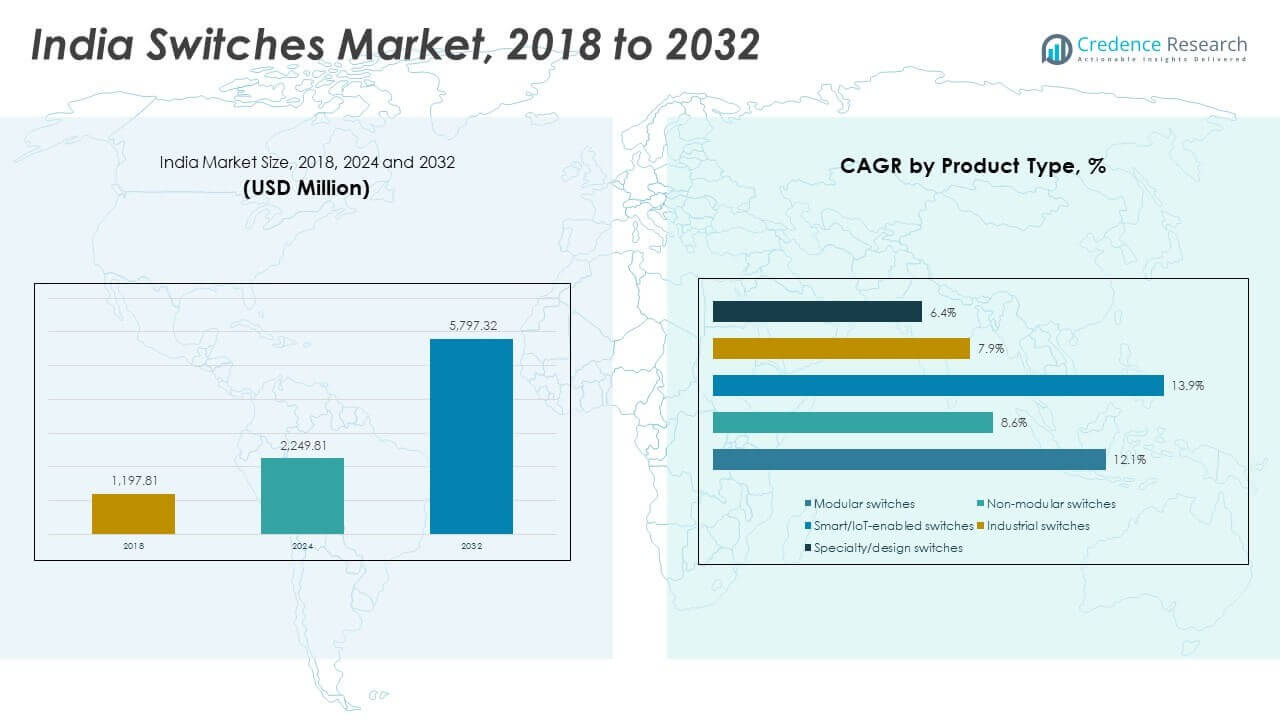
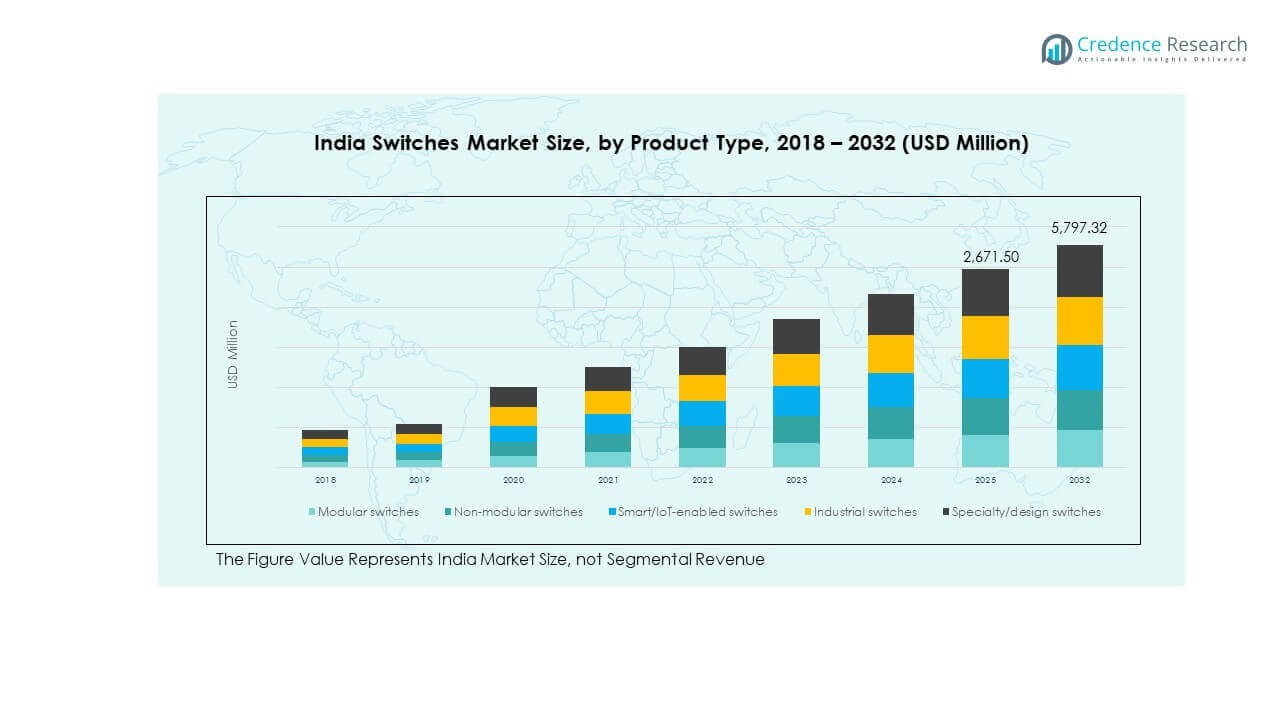
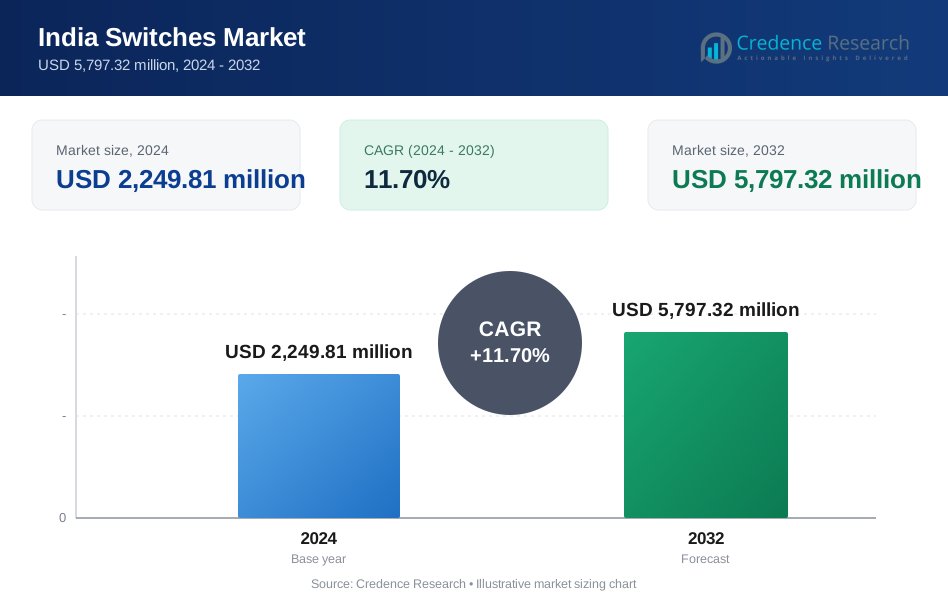
The India Switches Market size was valued at USD 1,197.81 million in 2018 to USD 2,249.81 million in 2024 and is anticipated to reach USD 5,797.32 million by 2032, at a CAGR of 11.70% during the forecast period.
| REPORT ATTRIBUTE | DETAILS |
|---|---|
| Historical Period | 2020-2023 |
| Base Year | 2024 |
| Forecast Period | 2025-2032 |
| India Switches Market Size 2024 | USD 2,249.81 million |
| India Switches Market, CAGR | 11.70% |
| India Switches Market Size 2032 | USD 5,797.32 million |
Market growth is driven by rapid urban housing projects and rising electrification needs. Infrastructure expansion across offices, retail, and public facilities lifts demand for durable switches. Consumers prefer modular and smart switches for safety and design appeal. Local manufacturing growth improves supply stability and pricing. Energy efficiency standards encourage adoption of advanced electrical components. Industrial automation and factory upgrades further raise usage levels. Strong distribution networks improve product access across tier-two and tier-three cities.
Western and southern India lead the market due to strong real estate activity. Maharashtra, Gujarat, Tamil Nadu, and Karnataka show high adoption across housing and industries. Northern India follows, supported by metro expansion and commercial construction. States such as Uttar Pradesh and Haryana show rising demand from urban projects. Eastern India is emerging with infrastructure upgrades and rural electrification. Improved power access supports gradual market penetration across underserved regions.
Market Insights:
- India Switches Market was valued at USD 1,197.81 million in 2018, reached USD 2,249.81 million in 2024, and is projected to hit USD 5,797.32 million by 2032, growing at a CAGR of 11.70%, driven by housing, infrastructure, and replacement demand.
- West India leads with about 34% share due to strong urbanization, real estate redevelopment, and industrial clusters, while South India follows with nearly 29% share supported by housing growth and IT-led commercial expansion.
- North India holds around 23% share, backed by metro cities and infrastructure projects, whereas East India is the fastest-growing region with about 14% share, driven by urbanization, electrification, and rising organized retail presence.
- By product type, modular switches dominate with roughly 40% share due to design appeal and standardization, followed by non-modular switches at about 30%, supported by cost-sensitive demand.
- Smart and specialty switches together account for nearly 30% share, reflecting growing adoption of premium, connected, and design-focused products across urban residential and commercial segments.
Market Drivers:
Urban Housing Expansion and Electrical Infrastructure Scale-Up
India Switches Market benefits from strong housing demand across urban centers. Large residential projects require safe and reliable electrical fittings. Builders prefer standardized switch designs for faster installation. Government housing schemes raise overall unit volumes. Renovation activity also supports replacement demand. Rising apartment density increases per-building switch consumption. Organized real estate improves compliance with quality standards. These factors create stable and repeat demand cycles.
- For instance, Havells India operates 15 manufacturing plants across India and produces nearly 90% of its electrical products in-house. The company is the largest MCB manufacturer in South Asia, with annual capacity exceeding 60 million poles. This scale supports reliable supply of modular wiring devices for large housing and township projects.
Commercial Construction and Institutional Facility Growth Momentum
India Switches Market gains support from offices, malls, and public buildings. Commercial projects need durable switches for high-usage areas. Hospitals and schools demand safety-focused electrical components. Smart city programs raise electrical specification standards. Metro stations and airports expand switch installation scope. Developers focus on long-life products to reduce maintenance costs. This shift supports premium product adoption. Institutional demand adds volume stability across cycles.
- For instance, Schneider Electric India supplies commercial-grade switch solutions for airport and metro infrastructure projects, with products designed and tested for high mechanical endurance exceeding 100,000 switching cycles to meet institutional reliability standards.
Industrial Expansion and Manufacturing Facility Electrification Needs
India Switches Market grows with factory and warehouse expansion. Industrial users require robust switches for control panels. Production facilities upgrade electrical layouts for efficiency. Export-oriented units follow global safety norms. Automation adoption increases structured wiring needs. New industrial corridors raise greenfield demand. Power distribution upgrades support higher load handling. Industrial demand improves average selling prices.
Rising Consumer Awareness And Safety-Focused Purchase Behavior
India Switches Market benefits from better consumer awareness. Buyers focus on fire safety and durability. Brand trust influences switch selection decisions. Certified products gain preference over unorganized options. Retail visibility improves informed buying choices. Electricians recommend reliable brands for liability control. Aesthetic design also influences home buyers. This shift supports organized market growth.
Market Trends:
Shift Toward Modular and Aesthetic Electrical Switch Designs
India Switches Market shows strong movement toward modular formats. Consumers prefer sleek and uniform switch plates. Interior design trends influence electrical product choices. Modular systems simplify replacement and upgrades. Color and finish options gain popularity. Premium housing projects drive this trend. Retail displays highlight design-led differentiation. Style becomes a purchase driver. Brands expand modular ranges to match modern interiors. Electricians favor modular systems for faster installation.
- For instance, Legrand India offers premium modular switch ranges such as Arteor and Myrius with over 20 color and finish combinations across plates and mechanisms. These options support customized electrical designs for high-end residential and hospitality projects, including hotels and luxury apartments.
Rising Adoption of Smart and Connected Switch Solutions
India Switches Market sees gradual interest in smart switches. Urban users adopt app-based control features. Smart homes increase demand for connected devices. Voice assistant compatibility attracts tech-focused buyers. Builders offer smart-ready wiring layouts. Energy monitoring features add perceived value. Prices slowly become accessible to mid-income users. Smart adoption grows steadily. Developers promote automation as a lifestyle upgrade. Connectivity becomes part of new housing specifications.
- For instance, Panasonic Life Solutions India markets connected switches through its Anchor brand and MirAIe IoT platform, which are compatible with major voice assistants like Amazon Alexa and Google Assistant.
Expansion of Organized Retail and E-Commerce Channels
India Switches Market benefits from wider retail reach. Organized electrical stores expand in tier-two cities. E-commerce platforms improve product comparison access. Online reviews influence buyer confidence. Digital catalogs support electrician recommendations. Brands invest in omnichannel presence. Faster delivery improves project timelines. Channel expansion boosts visibility. Retail training improves product knowledge. Online promotions increase brand recall.
Growing Focus On Standardization and Product Certifications
India Switches Market reflects stronger focus on certified products. Regulatory compliance gains importance for builders. Standard ratings improve buyer trust. Government projects mandate certified components. Testing labels influence institutional procurement. Brands highlight compliance in marketing. This trend favors organized manufacturers. Quality assurance becomes a key differentiator. Certification reduces long-term safety risks. Compliance supports institutional acceptance.
Market Challenges Analysis:
Price Sensitivity and Intense Competition from Unorganized Players
India Switches Market faces strong price pressure across segments. Unorganized players offer low-cost alternatives. Contractors often prioritize upfront cost savings. Margin pressure affects branded manufacturers. Price wars reduce profitability sustainability. Distribution control remains uneven in rural areas. Brand education requires steady investment. Cost competition limits premium penetration. Counterfeit products further distort pricing benchmarks. Enforcement gaps affect fair competition.
Raw Material Volatility and Supply Chain Constraints
India Switches Market experiences input cost fluctuations. Plastic resins and metals show price swings. Manufacturers face planning uncertainty. Smaller firms struggle with inventory management. Import dependency affects cost stability. Logistics delays disrupt project timelines. Passing costs to buyers remains difficult. These factors challenge operational efficiency. Supplier concentration increases procurement risk. Long lead times impact production scheduling.
Market Opportunities:
Rising Electrification And Infrastructure Development Across Emerging Regions
India Switches Market gains opportunity from expanding electrification. Rural housing upgrades raise basic switch demand. Infrastructure projects extend power access. Government-led development supports steady installations. Emerging towns adopt organized electrical products. Distribution expansion improves last-mile reach. Volume growth potential remains strong. Long-term demand visibility improves.
Product Innovation And Premiumization Through Design And Technology
India Switches Market can unlock value through innovation. Brands introduce design-focused premium ranges. Smart features attract urban buyers. Durable materials support longer product life. Custom solutions serve luxury housing projects. Branding improves perceived product value. Export potential grows with quality upgrades. Innovation supports margin expansion.
Market Segmentation Analysis:
By Product Type
India Switches Market shows strong demand for modular switches due to design appeal and ease of installation. Conventional switches retain volume demand in cost-sensitive projects. Smart switches gain traction in urban homes with automation needs.
- For instance, GM Modular focuses heavily on modular switches across its portfolio, offering a wide range of plate sizes and configurations. These products cater to both mass housing and premium residential projects, reflecting strong market preference for modular formats.
By Technology
Mechanical switches dominate due to reliability and wide usage. Electronic switches support better load control in commercial spaces. Smart and connected switches expand with app-based control preferences.
- For instance, Polycab manufactures mechanical switches rated for 6A and 16A applications, while its electronic and smart variants support timed control and remote operation for residential and light commercial use.
By Price & Design Tier
Economy products lead volumes across mass housing projects. Mid-range switches balance design and durability for apartments. Premium switches grow in luxury homes and high-end offices.
By Application
Residential usage drives steady replacement and new installation demand. Commercial buildings prefer durable and standardized switch systems. Industrial sites require robust switches for control panels.
By End User
Households form the largest user base due to housing growth. Offices and IT parks demand long-life products for heavy usage. Industrial facilities and institutional buildings focus on safety compliance.
By Distribution Channel
Electrical retail stores remain the primary sales route. Wholesalers support bulk project supply. Direct sales serve large developers. Online platforms expand reach among urban consumers.
Segmentation:
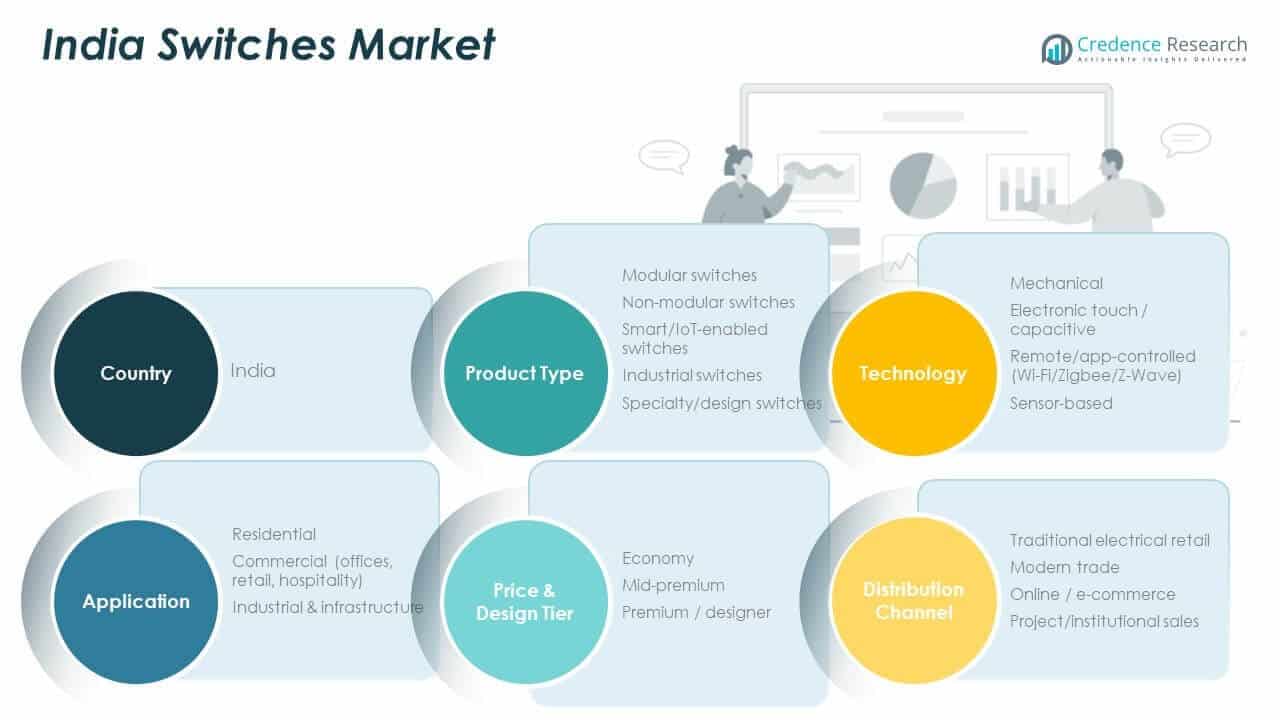
By Product Type
- Modular switches
- Conventional switches
- Smart switches
By Technology
- Mechanical switches
- Electronic switches
- Smart and connected switches
By Price & Design Tier
- Economy
- Mid-range
- Premium
By Application
- Residential
- Commercial
- Industrial
By End User
- Households
- Offices and IT parks
- Industrial facilities
- Institutional buildings
By Distribution Channel
- Electrical retail stores
- Wholesalers and distributors
- Direct sales
- Online platforms
By Region
- North India
- South India
- West India
- East India
Regional Analysis:
West India Leads With Strong Urban And Industrial Demand Share
India Switches Market shows West India holding nearly 34% market share due to rapid urban growth. Maharashtra and Gujarat drive demand from housing and industrial projects. Large commercial hubs raise consumption across offices and retail spaces. Real estate redevelopment supports replacement demand. Strong manufacturing clusters increase industrial usage volumes. Organized retail presence improves brand penetration. High income levels support premium switch adoption.
South India Maintains Solid Position Backed By Housing And IT Growth
India Switches Market records South India with around 29% market share. Karnataka and Tamil Nadu lead demand from urban housing projects. IT parks and tech campuses support commercial installations. High electrification rates ensure steady replacement cycles. Consumer preference leans toward modular and smart designs. Builders follow higher electrical safety standards. Strong distributor networks support regional reach.
North And East India Show Rising Share With Infrastructure Expansion
India Switches Market sees North India accounting for about 23% market share. Delhi NCR and Haryana drive commercial and residential demand. Metro rail and airport projects raise institutional installations. East India holds nearly 14% share with steady growth momentum. States such as West Bengal and Odisha expand infrastructure coverage. Urbanization improves organized product adoption. Rural electrification supports gradual volume growth.
Key Player Analysis:
- Panasonic Life Solutions India
- Havells India Ltd
- Legrand India
- Schneider Electric India
- GM Modular
- Polycab
- Other regional and unorganized manufacturers
Competitive Analysis:
India Switches Market shows a moderately consolidated structure with strong brand competition. Leading players focus on design, quality, and wide distribution reach. Organized manufacturers gain advantage through certified products and brand trust. Product portfolios span economy to premium categories. Companies invest in dealer networks and electrician engagement. Innovation centers on modular formats and smart features. Pricing discipline remains critical due to unorganized competition. Strategic partnerships strengthen market positioning. Scale and supply reliability define competitive strength.
Recent Developments:
- In December 2025, Panasonic Life Solutions India announced the winners of its third edition of the Panasonic Ignition accelerator programme, partnering with startups Red Health and Respirer Living Sciences to co-create tech-driven residential solutions.
- In November 2025, Havells India acquired a strategic stake in Kundan Solar to bolster its clean energy portfolio, including potential synergies with electrical products like switches through expanded renewable offerings. In October 2025, Havells International, a subsidiary, acquired the remaining 20% stake in its US-based JV Havells HVAC LLC, making it wholly-owned, though focused on HVAC rather than switches.
- In July 2025, Schneider Electric finalized the acquisition of the remaining 35% stake in its Indian subsidiary SEIPL from Temasek for about $6.3 billion, gaining full control to accelerate growth in electrical infrastructure including switches and related products.
Report Coverage:
The research report offers an in-depth analysis based on product type, technology, price tier, application, end user and distribution channel. It details leading market players, providing an overview of their business, product offerings, investments, revenue streams, and key applications. Additionally, the report includes insights into the competitive environment, SWOT analysis, current market trends, as well as the primary drivers and constraints. Furthermore, it discusses various factors that have driven market expansion in recent years. The report also explores market dynamics, regulatory scenarios, and technological advancements that are shaping the industry. It assesses the impact of external factors and global economic changes on market growth. Lastly, it provides strategic recommendations for new entrants and established companies to navigate the complexities of the market.
Future Outlook:
- Urban housing projects will sustain steady switch replacement demand across apartments, gated communities, and redevelopment projects, driven by aging electrical infrastructure and higher safety awareness among homeowners.
- Modular formats will gain wider acceptance across income groups due to ease of installation, cleaner aesthetics, and flexibility in upgrades for evolving interior layouts.
- Smart switches will expand within premium residential developments, supported by smart-home adoption, app-based control preferences, and growing familiarity with connected living solutions.
- Commercial construction will support stable volume growth from offices, retail spaces, healthcare facilities, and educational buildings that require durable and standardized electrical fittings.
- Industrial users will prioritize durability and safety compliance, focusing on switches that support heavy usage, regulatory standards, and long operational life in production environments.
- Organized retail penetration will rise in smaller cities as branded electrical stores expand networks, improve product visibility, and strengthen electrician engagement programs.
- E-commerce will improve brand discovery and price transparency by enabling easy comparison, broader product access, and faster delivery for individual buyers and contractors.
- Product standardization will favor certified manufacturers as builders and institutions increasingly mandate compliance with safety and quality benchmarks.
- Design-led differentiation will support premiumization strategies through expanded color, finish, and form-factor options aligned with modern interior preferences.
- Brand-led players will strengthen market share through distribution scale, reliable supply chains, and sustained investments in channel partnerships and service support.
Request a Free Sample
Fill in your details and we'll send you a free sample report.
- Sample data tables & charts
- Research methodology
Need a Custom Version of This Report?
Tailor the scope, geography, or segments to your exact requirements.
- Custom geography or segment scope
- Direct access to our analyst team
Frequently Asked Questions
What is the current market size and projected size by 2032?
What is the projected CAGR between 2024 and 2032?
Which segment held the largest share in 2024?
What factors are fueling market growth?
Who are the leading companies in the market?
Which region held the largest share in 2024?
Table of Content
Chapter 1. Report Introduction
- 1.1 Report Description & Purpose
- 1.1.1 Report Title & Market Definition
- 1.1.2 Unique Selling Propositions (USP) & Key Differentiators
- 1.1.3 Value Proposition for Stakeholders
- 1.2 Research Objectives
- 1.2.1 Market Sizing Objectives (Volume & Revenue)
- 1.2.2 Segmentation Objectives
- 1.2.3 Competitive Intelligence Objectives
- 1.2.4 Forecast & Scenario Objectives
- 1.3 Report Scope
- 1.3.1 India Switches Scope – Types & Subtypes Covered
- 1.3.2 Geographic Scope – Regions & Countries Covered
- 1.3.3 Historical Period, Base Year & Forecast Period (2024; forecast to 2032)
- 1.3.4 Inclusions & Exclusions
- 1.4 HS Code & Classification Framework
- 1.5 Currency, Units & Pricing Basis
- 1.6 Target Stakeholders
- 1.7 Limitations & Assumptions
Chapter 2. Executive Summary
- 2.1 Global India Switches Market Snapshot
- 2.1.1 Market Size – Historical (2024) & Forecast (2024-2032) (2024: USD 2,249.81 million → 2032: USD 5,797.32 million)
- 2.1.2 Volume & Revenue – Global Totals
- 2.1.3 Key Market Highlights – Top Five Facts
- 2.2 India Switches Market Segmentation Snapshot
- 2.2.1 Market Split by Region – 2024 vs. 2032
- 2.3 Competitive Snapshot
- 2.3.1 Top 10 Players by Revenue Share – 2024
- 2.3.2 Top 10 Players by Volume Share – 2024
- 2.3.3 Recent Strategic Developments (18-Month Summary)
- 2.4 Key Investment Highlights & Strategic Conclusions
Chapter 3. India Switches Market Dynamics & Industry Analysis
- 3.1 Market Overview & Context
- 3.1.1 India Switches Market Position in the Broader Automotive Value Chain
- 3.1.2 OEM vs. Replacement Market Dynamics
- 3.1.3 Market Maturity & Development Stage by Region
- 3.2 India Switches Market Drivers
- 3.3 India Switches Market Restraints & Challenges
- 3.4 India Switches Market Opportunities
- 3.5 Porter's Five Forces Analysis
- 3.5.1 Threat of New Entrants
- 3.5.2 Bargaining Power of Suppliers
- 3.5.3 Bargaining Power of Buyers
- 3.5.4 Threat of Substitutes
- 3.5.5 Competitive Rivalry – Intensity Assessment
- 3.6 India Switches Value Chain Analysis
- 3.6.1 Upstream – Raw Material/Input Suppliers
- 3.6.1.1 Raw Material/Input 1
- 3.6.1.2 Raw Material/Input 2
- 3.6.1.3 Raw Material/Input 3
- 3.6.2 Midstream – Production/Manufacturing/Service Delivery
- 3.6.2.1 Production/Process Overview
- 3.6.2.2 Key Facility Locations & Capacity by Manufacturer
- 3.6.3 Downstream – Distribution & End Consumer
- 3.6.3.1 Primary Channel – B2B/OEM
- 3.6.3.2 Secondary Channels – Dealer, Retail, Online, Direct
- 3.6.4 Value Chain Profitability Analysis
- 3.6.1 Upstream – Raw Material/Input Suppliers
- 3.7 PESTEL Analysis
- 3.7.1 Political Factors
- 3.7.2 Economic Factors
- 3.7.3 Social Factors
- 3.7.4 Technological Factors
- 3.7.5 Environmental Factors
- 3.7.6 Legal Factors
- 3.8 India Switches Supply Chain Analysis
- 3.8.1 Raw Material/Input Supply Risk Assessment
- 3.8.2 Manufacturing Concentration Risk (Geographic Exposure)
- 3.8.3 Trade Disruption Impact Analysis
- 3.9 Regulatory & Policy Landscape
Note: The regulatory and policy landscape section covers regulations based on their applicability to the market, India Switches category, geography, and scope of the study. Only regulatory frameworks with a material impact on operations, compliance, trade, sustainability, or market access are analyzed in detail.
Chapter 4. Key Investment Pockets & Opportunity Analysis
- 4.1 India Switches Market Attractiveness Analysis
- 4.1.1 By Region – Investment Attractiveness Matrix (Volume × CAGR)
- 4.2 Absolute Revenue Growth Opportunity
- 4.2.1 By Region – Absolute USD Growth Through 2032
- 4.3 Incremental Volume Opportunity
- 4.3.1 By Region – Incremental Volume Through 2032
- 4.3.2 Segment – Incremental Volume
- 4.4 Emerging Submarket Opportunity Deep Dive (Subject to Applicability)
- 4.5 Emerging Market Opportunity Scorecards
- 4.5.1 United States
- 4.5.2 Europe
- 4.5.3 Asia
- 4.5.4 Middle East & Africa
Note: Emerging Market Opportunity Scorecards will be included based on relevance and strategic importance. Regions listed are indicative and may vary depending on data availability and market dynamics.
Chapter 5. India Switches Import-Export Analysis & Trade Flows
- 5.1 Global Trade Overview
- 5.1.1 Global Export Value by Country (2024)
- 5.1.2 Global Export Volume by Country (2024)
- 5.1.3 Global Import Value by Country (2024)
- 5.1.4 Global Import Volume by Country (2024)
- 5.1.5 Net Trade Balance by Country (2024)
- 5.2 Export Analysis – Segment
- 5.2.1 Type 1 (HS Code)
- 5.2.2 Type 2 (HS Code)
- 5.2.3 Type 3 (HS Code)
- 5.2.4 Type 4 (HS Code)
- 5.2.5 Type 5 (HS Code)
- 5.3 Import Analysis – Segment
- 5.3.1 Type 1 (HS Code)
- 5.3.2 Type 2 (HS Code)
- 5.3.3 Type 3 (HS Code)
- 5.3.4 Type 4 (HS Code)
- 5.3.5 Type 5 (HS Code)
- 5.4 Average Unit Trade Prices
- 5.4.1 Average Export Price – Segment & Country
- 5.4.2 Average Import Price – Segment & Source Country
- 5.4.3 Price Trends (2024)
- 5.5 Key Trade Route Analysis
- 5.5.1 Trade Route 1
- 5.5.2 Trade Route 2
- 5.5.3 Trade Route 3
- 5.5.4 Trade Route 4
- 5.5.5 Trade Route 5
- 5.6 Trade Policy Impact Assessment
- 5.6.1 US Anti-Dumping & Section 301 Tariffs
- 5.6.2 EU Customs Union Impact
- 5.6.3 Major Free Trade Agreements
- 5.6.4 USMCA Rules of Origin
Note: Trade policy analysis will be included only where relevant to the India Switches market.
Chapter 6. Competitive Landscape & Company Benchmarking
- 6.1 India Switches Market Concentration & Structure
- 6.1.1 Herfindahl-Hirschman Index (HHI) – vs. 2024
- 6.1.2 Tier 1, Tier 2 & Tier 3 Market Structure
- 6.1.3 Global, Regional & Local Player Dynamics
- 6.2 India Switches Market Share Analysis – 2024
- 6.2.1 Global Revenue Share by Company
- 6.2.2 Global Volume Share by Company
- 6.2.3 Regional Revenue Share
- 6.2.4 Market Share Evolution ( vs. 2024)
- 6.2.5 OEM Segment Share by Company
- 6.2.6 Replacement Segment Share by Company
- 6.3 Production/Delivery Capacity & Facility Analysis
- 6.3.1 Global Installed Capacity
- 6.3.2 Capacity Utilization Rates
- 6.3.3 Production/Output Volume
- 6.3.4 Facility Locations & Capacity Map
- 6.3.5 Planned Capacity Additions
- 6.4 India Switches Competitive Benchmarking Matrix
- 6.4.1 Revenue, Volume, CAGR & Profitability Comparison
- 6.4.2 Channel Revenue Mix
- 6.4.3 Geographic Revenue Exposure
- 6.4.4 R&D Intensity
- 6.4.5 Sustainability Maturity
- 6.5 Strategic Developments in India Switches (Last 24 Months)
- 6.5.1 Mergers, Acquisitions & Divestments
- 6.5.2 New India Switches Launches
- 6.5.3 Facility Expansions
- 6.5.4 Strategic Alliances, Joint Ventures & Partnerships
- 6.5.5 Distribution Expansion & Market Entry
- 6.5.6 Sustainability & ESG Initiatives
- 6.6 Competitive Strategy Mapping
- 6.6.1 Leader, Challenger, Follower & Niche Classification
- 6.6.2 Pricing Strategy Comparison
- 6.6.3 Channel Strategy Matrix
Note: Strategic developments are included based on their materiality and the availability of reliable information.
Chapter 7. Global India Switches Market – By Distribution Channel
- 7.1 Segment Overview
- 7.1.1 Volume & Revenue Split by Channel (2024 & 2032)
- 7.1.2 Channel Mix Evolution (2024-2032)
Chapter 8. Regional Market Analysis – Global Overview
- 8.1 Global Regional Overview
- 8.1.1 Regional Volume Share
- 8.1.2 Regional Revenue Share
- 8.1.3 Regional Volume by Region
- 8.1.4 Regional Revenue by Region
- 8.1.5 Regional Forecast Through 2032
- 8.2 Cross-Regional Segment Analysis
- 8.2.1 By Distribution Channel
- 8.2.2 By Brand/Price Tier
Chapter 9. North America India Switches Market
- 9.1 United States
- 9.2 Canada
- 9.3 Mexico
Chapter 10. Europe India Switches Market
- 10.1 Germany
- 10.2 France
- 10.3 Italy
- 10.4 United Kingdom
- 10.5 Spain
- 10.6 Poland
- 10.7 Russia
- 10.8 Netherlands
- 10.9 Belgium
- 10.10 Sweden
- 10.11 Denmark
- 10.12 Norway
- 10.13 Rest of Europe
Chapter 11. Asia Pacific India Switches Market
- 11.1 China
- 11.2 India
- 11.3 Japan
- 11.4 South Korea
- 11.5 Thailand
- 11.6 Indonesia
- 11.7 Vietnam
- 11.8 Malaysia
- 11.9 Australia
- 11.10 Rest of Asia Pacific
Chapter 12. Latin America India Switches Market
- 12.1 Brazil
- 12.2 Argentina
- 12.3 Colombia
- 12.4 Chile
- 12.5 Rest of Latin America
Chapter 13. Middle East India Switches Market
- 13.1 Saudi Arabia
- 13.2 United Arab Emirates
- 13.3 Turkey
- 13.4 Israel
- 13.5 Iran
- 13.6 Rest of the Middle East
Chapter 14. Africa India Switches Market
- 14.1 South Africa
- 14.2 Egypt
- 14.3 Nigeria
- 14.4 Morocco
- 14.5 Rest of Africa
Chapter 15. India Switches Company Profiles
- 15.1 [Company 01]
- 15.1.1 Company Overview
- 15.1.2 Key Management Personnel
- 15.1.3 Products & Services Portfolio
- 15.1.4 Financial Performance
- 15.1.5 Key Market Focus & Geographic Presence
- 15.1.6 Recent Developments & Strategic Initiatives
Note: The company profile list is preliminary and may change based on research findings, market developments, data availability, and client requirements.
Chapter 16. Appendices
- Appendix A – List of Abbreviations & Acronyms
- Appendix B – Industry Classification Code Reference – Full Series
- Appendix C – Production & Capacity Data Tables
- Appendix D – End-Use & Demand Base Tables
- Appendix E – Consumption & Replacement Rate Assumptions
- Appendix F – ASP Reference Tables
- Appendix G – Manufacturing & Facility Database
- Appendix H – Import-Export Data Tables
- Appendix I – Regulatory Summary Tables
- Appendix J – Primary Research Participant List (Anonymized)
- Appendix K – Primary Research Questionnaire Framework
- Appendix L – Data Sources & Bibliography
- Appendix M – Market Size Divergence & Source Comparison
Chapter 17. Research Methodology
- 17.1 Research Framework & Philosophy
- 17.2 Secondary Research – Sources, Hierarchy & Data Extraction
- 17.3 Data Modeling – Bottom-Up & Top-Down Market Sizing
- 17.4 Primary Research – Stakeholder Framework, LOI & Sample Sizes
- 17.5 Forecast Methodology – Regression, Scenario & Sensitivity Analysis
- 17.6 Quality Control – Four-Layer Validation Framework
- 17.7 Limitations & Standard Assumptions
- 17.8 Disclaimer
